

★★★★☆ 4.4/5 — The definitive guide to understanding love as an attachment bond and healing relationships through seven structured conversations.
Best for: Couples stuck in repetitive conflict patterns, therapists, and anyone who wants to understand what makes love last.
Reading time: ~6 hrs (guide: 19 min)
Difficulty to apply: Moderate — requires vulnerability and a willing partner.
Hold Me Tight in one minute
The fights you keep having with your partner are not really about the dishes, the budget, or the in-laws — they are about one primal question: “Are you there for me?” Dr. Sue Johnson, the creator of Emotionally Focused Therapy (EFT), reveals that adult romantic love is fundamentally an attachment bond — the same kind of bond that infants form with caregivers. When that bond feels threatened, we respond with predictable patterns of protest (pursuing) or withdrawal (distancing) that escalate conflict instead of resolving it. The book guides couples through seven conversations designed to identify these patterns, reach the raw emotions beneath them, and create new moments of genuine emotional connection that repair and strengthen the bond.
Key takeaways
- Love is an attachment bond: Adult romantic love follows the same neurological and behavioral patterns as infant-caregiver attachment. This is biology, not weakness.
- Most fights are really about attachment security: The surface issue (money, chores, parenting) is almost never the real issue. The real question is: “Can I count on you? Are you there for me?”
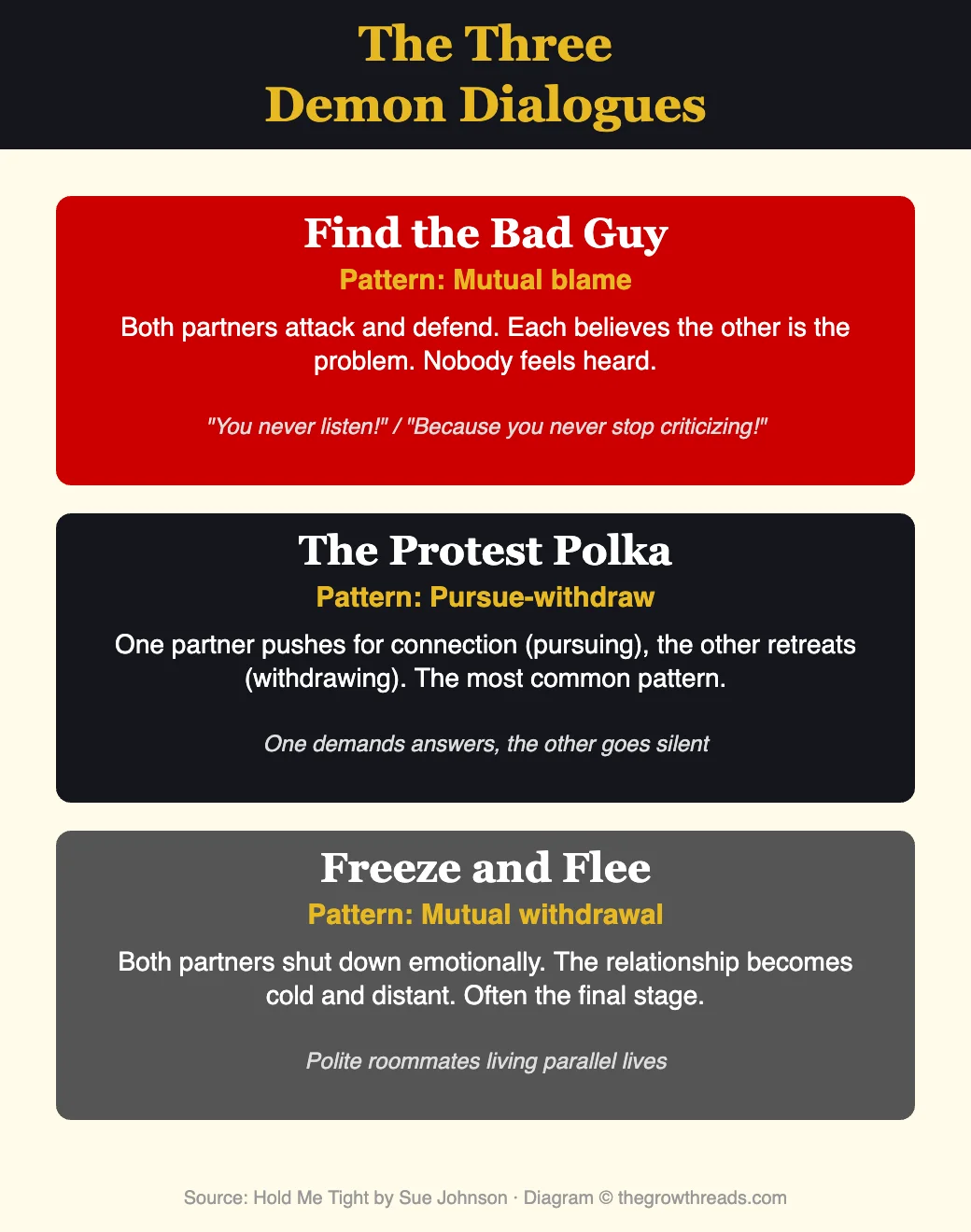
- Demon Dialogues trap couples: Three destructive patterns — Find the Bad Guy, the Protest Polka, and Freeze and Flee — create self-reinforcing cycles that feel impossible to escape.
- The Protest Polka is the most common trap: One partner pursues (criticizes, demands, escalates) while the other withdraws (shuts down, avoids, goes silent). Both are protesting the disconnection.
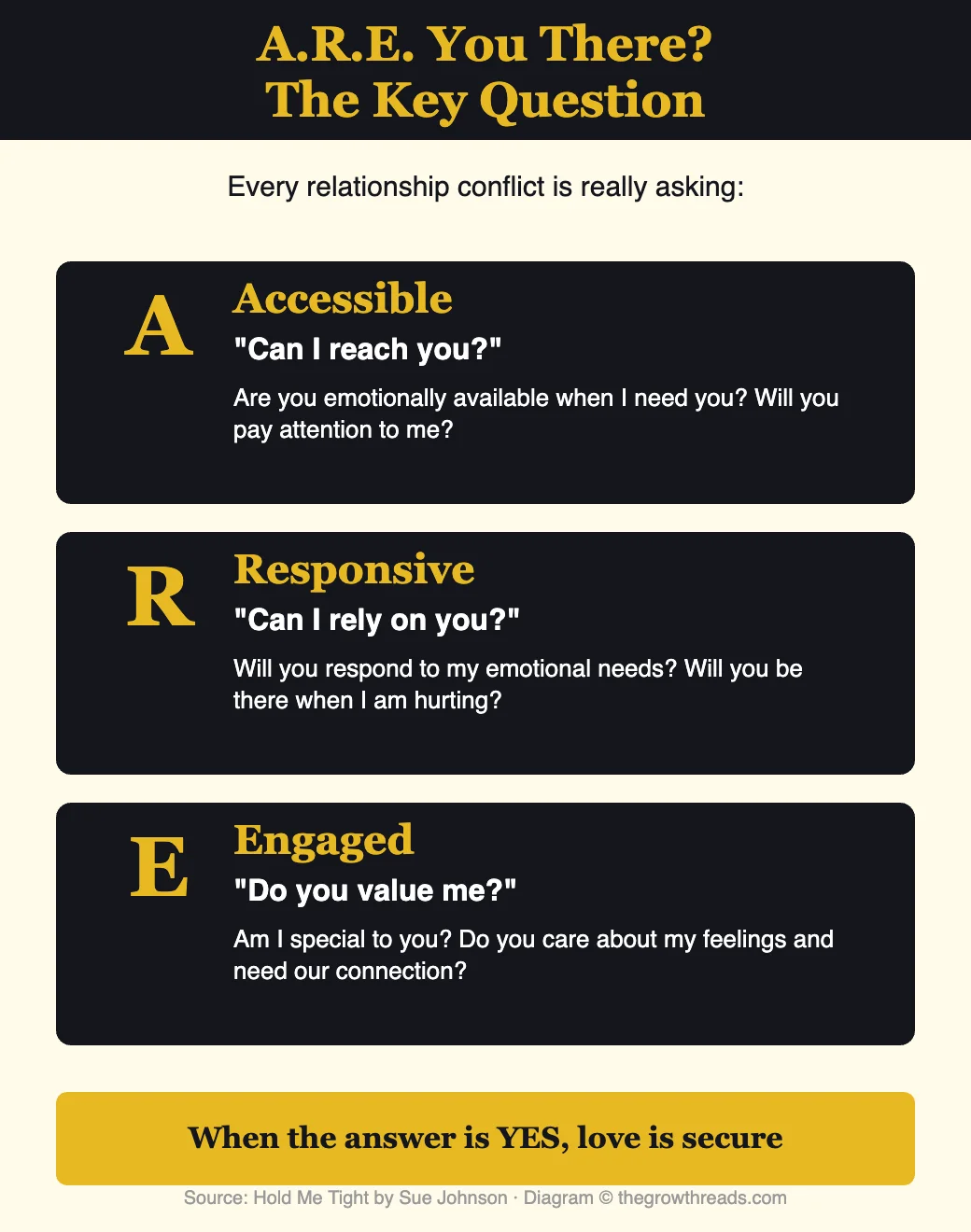
- A.R.E. is the key question: Are you Accessible, Responsive, and Engaged? When the answer is yes, the relationship feels secure. When it is no, attachment panic follows.
- Vulnerability is the antidote: The only way to break demon dialogues is for one partner to risk sharing the softer emotions (fear, loneliness, need) beneath their defensive reactions.
- Attachment injuries can be healed: Past betrayals and emotional wounds do not have to be permanent — but healing requires the injuring partner to fully acknowledge the pain and demonstrate changed behavior.
- EFT is the most researched couples therapy: Emotionally Focused Therapy has the strongest evidence base of any couples intervention, with 70-75% of couples moving from distress to recovery.
What is Hold Me Tight about?
Hold Me Tight is a relationship guide based on Emotionally Focused Therapy that frames adult love as an attachment bond and presents seven structured conversations designed to help couples identify destructive interaction patterns, access deeper emotions, and create lasting security in their relationship.
About the author
Dr. Sue Johnson is a clinical psychologist, distinguished research professor at Alliant International University, and the primary developer of Emotionally Focused Therapy (EFT), the most empirically validated approach to couples therapy in the world. Born in England and trained in Canada, Johnson spent decades studying what makes relationships work — and what makes them fall apart. Her research has been published in over 100 peer-reviewed journal articles, and EFT is now practiced by thousands of therapists in over 40 countries. Johnson is known for her warmth, directness, and ability to translate complex attachment science into language that ordinary couples can understand and apply. Explore all Sue Johnson book summaries →
Key concepts at a glance
| Concept | What it means | Use it when |
|---|---|---|
| Attachment Bond | Adult love follows infant-caregiver attachment patterns | You want to understand why love feels so intense |
| Demon Dialogues | Three destructive interaction patterns that trap couples | You keep having the same fight over and over |
| The Protest Polka | Pursue-withdraw cycle: one pushes, the other retreats | One partner demands and the other shuts down |
| A.R.E. | Accessible, Responsive, Engaged — the key question of love | You want to assess or improve emotional safety |
| Raw Spots | Hypersensitive areas created by past attachment wounds | Small moments trigger disproportionate reactions |
| Hold Me Tight Conversation | The pivotal moment of emotional vulnerability and response | You want to create a breakthrough moment of connection |
| Attachment Injury | A specific betrayal or abandonment that damaged trust | A past event still poisons the present relationship |
Part 1: Recognizing the demon dialogues
Johnson begins by naming the three patterns that destroy relationships from the inside. “Find the Bad Guy” is mutual blame — both partners attack and defend, each convinced the other is the villain. The Protest Polka (the most common and most dangerous) features one partner pursuing connection through criticism, questioning, or emotional intensity, while the other withdraws into silence, avoidance, or emotional flatness. “Freeze and Flee” is the final stage, where both partners have withdrawn and the relationship becomes a cold, polite arrangement between roommates.
The crucial insight is that both partners in the Protest Polka are doing the same thing — protesting the disconnection — but in opposite ways. The pursuer escalates because they are terrified of losing the bond and believe that making enough noise will force the other person to engage. The withdrawer retreats because they are terrified of failing their partner and believe that anything they say will make things worse. Both are driven by the same attachment fear; they simply express it differently.
Part 2: The A.R.E. framework and raw spots
Johnson distills the essence of attachment security into three letters: A.R.E. — Accessible (“Can I reach you?”), Responsive (“Can I rely on you to respond to my emotional needs?”), and Engaged (“Do I matter to you? Am I valued?”). When partners can answer yes to all three, the relationship feels safe, and conflict becomes manageable. When any of the three breaks down, attachment panic sets in and the demon dialogues begin.
Raw spots are the specific sensitivities that trigger disproportionate reactions. They form in childhood, previous relationships, or even within the current relationship — any moment when an attachment figure was not accessible, responsive, or engaged during a time of need. A partner who was abandoned in childhood may have a raw spot around being left alone; a partner who was criticized by a parent may have a raw spot around feeling inadequate. When a current interaction touches a raw spot, the emotional response is far larger than the situation warrants, because the brain is responding to both the present moment and the accumulated weight of every similar moment from the past.
Part 3: The Hold Me Tight conversation — creating new bonds
The pivotal fourth conversation — “Hold Me Tight” — is where the transformation happens. Johnson guides couples through a structured process of emotional risk-taking: one partner shares their deepest attachment fear (“I am afraid that if I stop fighting for your attention, you will forget I exist”) and the other responds with genuine emotional engagement (“I had no idea you felt that way. I do not want you to feel invisible. You matter to me more than anyone”).
This moment of vulnerability and response is not a technique — it is a neurobiological event. When a partner reaches out with their softer emotions and receives a compassionate response, the brain literally rewires its expectations about the relationship. The amygdala calms, oxytocin floods the system, and the attachment bond strengthens. Johnson reports that these moments are often the turning point in therapy — the instant when years of defensive patterns begin to dissolve.
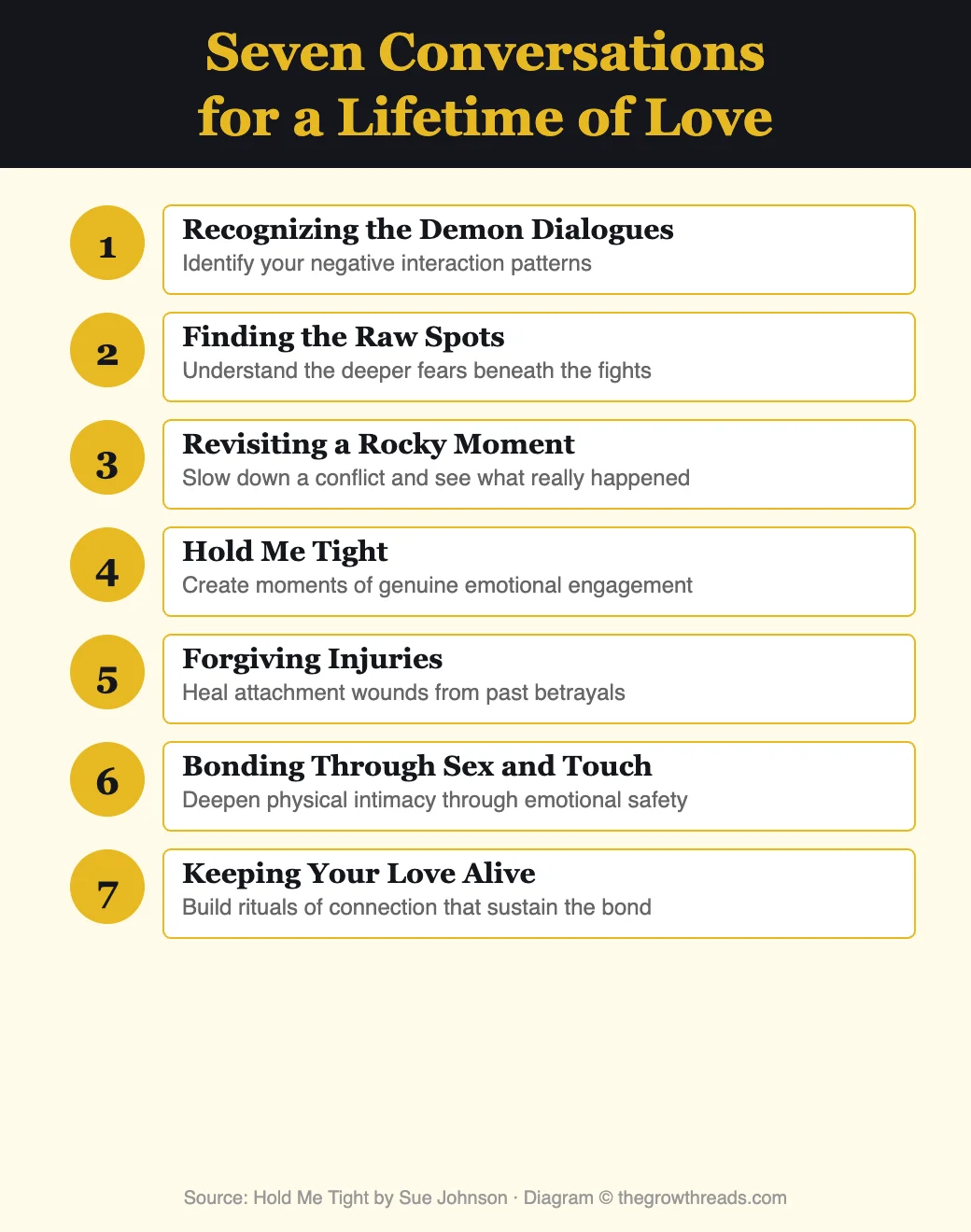
The remaining conversations address forgiving attachment injuries (specific betrayals or abandonments that left lasting wounds), deepening physical intimacy through emotional safety, and building daily rituals of connection that maintain the bond over time. Johnson emphasizes that emotional safety is the prerequisite for physical intimacy — not the other way around — and that couples who feel securely attached naturally develop richer, more satisfying physical relationships.
Who is Hold Me Tight best for — and who should read something else first?
Hold Me Tight is ideal for couples who are stuck in repetitive conflict patterns and cannot seem to break free despite trying to communicate better. It is also valuable for individuals who want to understand their own attachment patterns before entering or deepening a relationship. Therapists and counselors will find it an accessible introduction to EFT principles.
If your relationship challenge is more about communication technique than emotional depth, Crucial Conversations offers more tactical tools. If you are focused on understanding your own attachment style before working on a relationship, Attached is a more targeted starting point.
Questions to reflect on
- Which demon dialogue — Find the Bad Guy, Protest Polka, or Freeze and Flee — most accurately describes the pattern in your closest relationship?
- In your relationship conflicts, are you typically the pursuer or the withdrawer — and what fear drives that behavior?
- What is your deepest attachment fear — the one you almost never say out loud? What would happen if you shared it with your partner?
- When was the last time you felt genuinely Accessible, Responsive, and Engaged with your partner — and what made that moment possible?
- Is there an attachment injury in your relationship that has never been fully acknowledged or healed?
🔥 Ready to transform your relationship?
Learn the seven conversations that turn conflict into connection and keep love alive.
How to apply Hold Me Tight (7-day plan)
- Day 1: Identify your demon dialogue. Think of your most recent recurring conflict and name the pattern: are you doing the Protest Polka (one pursues, one withdraws), Finding the Bad Guy (mutual blame), or Freeze and Flee (mutual shutdown)?
- Day 2: Map your roles. In the pattern you identified, what is your typical move? Write down: “When I feel [emotion], I tend to [behavior].” Ask your partner to do the same.
- Day 3: Find a raw spot. Think of a moment this week when you had a disproportionately strong reaction. Trace it back: does it connect to an older experience of not feeling seen, safe, or valued?
- Day 4: Practice the A.R.E. check-in. Ask your partner: “On a scale of 1-10, how Accessible, Responsive, and Engaged do I feel to you right now?” Listen without defending.
- Day 5: Share one softer emotion. Instead of your usual reaction (anger, criticism, withdrawal), tell your partner what you feel underneath: “When you come home and go straight to your phone, I feel like I do not matter to you.”
- Day 6: Respond to a bid for connection. When your partner reaches out today — even in small ways (a question, a touch, a look) — respond with full attention and warmth instead of distraction.
- Day 7: Create one connection ritual. Agree on a daily practice: a 6-second kiss when you reunite, 20 minutes of phone-free conversation after dinner, or a weekly date where you share what you appreciate about each other.
Frequently asked questions
What is Emotionally Focused Therapy?
Emotionally Focused Therapy (EFT) is a structured approach to couples therapy developed by Sue Johnson in the 1980s based on attachment theory and emotion science. It helps couples identify and change the negative interaction patterns (demon dialogues) that keep them stuck, access the deeper attachment emotions beneath their defensive behaviors, and create new patterns of emotional responsiveness that strengthen the bond. EFT has the strongest evidence base of any couples therapy, with research showing 70-75% of couples moving from distress to recovery and 90% showing significant improvement.
Can we do this without a therapist?
Hold Me Tight was specifically written for couples to use on their own, without a therapist. Johnson designed the seven conversations as a self-guided program that mirrors the EFT process she uses in clinical practice. Many couples report significant breakthroughs from the book alone. However, if you are dealing with serious issues (infidelity, addiction, abuse, severe depression), Johnson recommends working with a certified EFT therapist who can provide the safety and guidance that complex situations require. The International Centre for Excellence in EFT maintains a directory of certified therapists.
What if my partner will not read the book?
Johnson acknowledges that often only one partner is initially willing to engage. Her advice is to start by changing your own behavior within the demon dialogue — if you are the pursuer, practice softening your approach; if you are the withdrawer, practice staying present instead of retreating. These unilateral changes often shift the dynamic enough that the other partner becomes curious and willing to participate. You can also attend a Hold Me Tight workshop alone or share specific concepts (the demon dialogues, the A.R.E. framework) verbally rather than asking your partner to read the entire book.
Is attachment theory just for romantic relationships?
No. While Hold Me Tight focuses on romantic partnerships, attachment theory applies to all close relationships — parent-child, close friendships, and even therapeutic relationships. Johnson has written subsequent books applying EFT principles to parent-child bonds (Hold Me Tight, Let Me Go) and to individual therapy. The core insight — that humans are wired for connection and respond with predictable patterns when that connection feels threatened — is universal across relationship types.
What is the Protest Polka?
The Protest Polka is the most common and most destructive relationship pattern. One partner (the pursuer) responds to disconnection by escalating — criticizing, questioning, demanding, expressing frustration or anger. The other partner (the withdrawer) responds by retreating — going silent, avoiding eye contact, leaving the room, or becoming emotionally flat. Each partner’s behavior triggers the other’s: the pursuer escalates because withdrawal feels like abandonment; the withdrawer retreats because pursuit feels like attack. Both are protesting the disconnection; they just do it in opposite ways.
Can damaged relationships really be repaired?
Yes, in the vast majority of cases. Johnson’s research shows that EFT produces recovery in 70-75% of distressed couples, and that these results are maintained at two-year follow-up. Even couples dealing with infidelity, chronic conflict, or decades of distance can rebuild their bond if both partners are willing to engage in the process. The key is not the severity of the damage but the willingness of both partners to risk vulnerability. Johnson has seen couples on the verge of divorce transform their relationships through the Hold Me Tight process in a matter of weeks.
How is this different from other relationship books?
Most relationship books focus on communication techniques (active listening, I-statements, conflict resolution scripts). Hold Me Tight goes deeper by addressing the attachment emotions that drive communication breakdowns in the first place. Johnson argues that teaching couples to communicate better without addressing the underlying attachment fears is like teaching someone to swim in a tsunami — the technique is irrelevant when the emotional waves are overwhelming. EFT is also the only couples approach with this level of empirical validation, making it more than just good advice — it is clinically proven treatment.
Related summaries
- Attached Summary & Review — Amir Levine on understanding your attachment style.
- The 5 Love Languages Summary & Review — Gary Chapman on speaking your partner’s emotional language.
- Crucial Conversations Summary & Review — Tools for talking when stakes are high.
- Best Relationship Books — Our complete guide to the top books on love, communication, and connection.
How we analyze books: Every summary on The Growth Reads is built from a close reading of the full text, cross-referenced with the author’s published interviews, peer-reviewed research where applicable, and reader feedback from multiple platforms. We focus on extracting actionable frameworks rather than abstract theory. Read our full methodology.