

★★★★★ 4.6/5 — A clear, compassionate roadmap for recognizing narcissistic relationship patterns and reclaiming your sense of self, without an ounce of self-blame.
Best for: Anyone untangling themselves from a manipulative partner, parent, boss, or friend who needs language for what actually happened.
Reading time: ~6 hrs to read the book (368 pages) · ~14 min to read this guide
Difficulty to apply: Moderate — the ideas are simple, but the emotional work is real
It’s Not You in one minute
You are not the reason someone else chooses to manipulate, gaslight, or invalidate you. In It’s Not You, clinical psychologist Dr. Ramani Durvasula argues that narcissistic relationships follow a recognizable pattern, and that pattern, not your character, explains why you feel confused, anxious, and constantly at fault. Drawing on more than two decades of clinical work, she maps the “narcissistic playbook”: idealization, devaluation, discard, and hoovering, then shows exactly how gaslighting and invalidation keep you locked in self-doubt. The second half of the book is a healing manual: how to set boundaries that actually hold, how to use the “gray rock” method when contact is unavoidable, how to grieve a relationship (or a parent) who was never going to change, and how to rebuild the sense of self that got worn down along the way. The message repeats throughout: you cannot fix a narcissistic person, but you can stop blaming yourself for their behavior, and that shift is where healing actually begins.
Key takeaways
- Narcissism sits on a spectrum: from everyday self-centeredness to a diagnosable personality disorder, and the label matters less than the pattern of harm you’re experiencing.
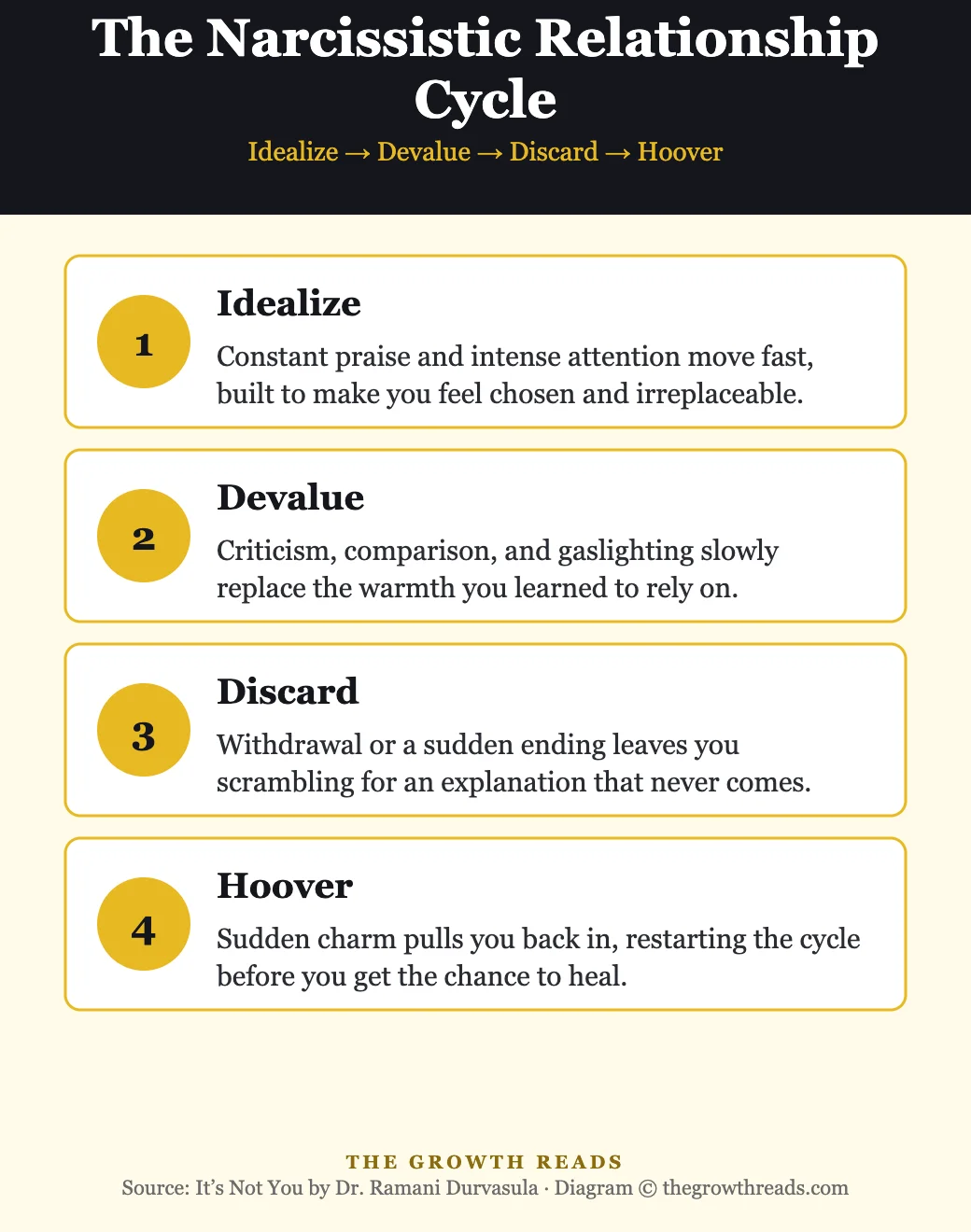
- The relationship follows a cycle: idealize (love-bombing), devalue (criticism and gaslighting), discard (withdrawal), and hoover (sudden warmth that pulls you back in).
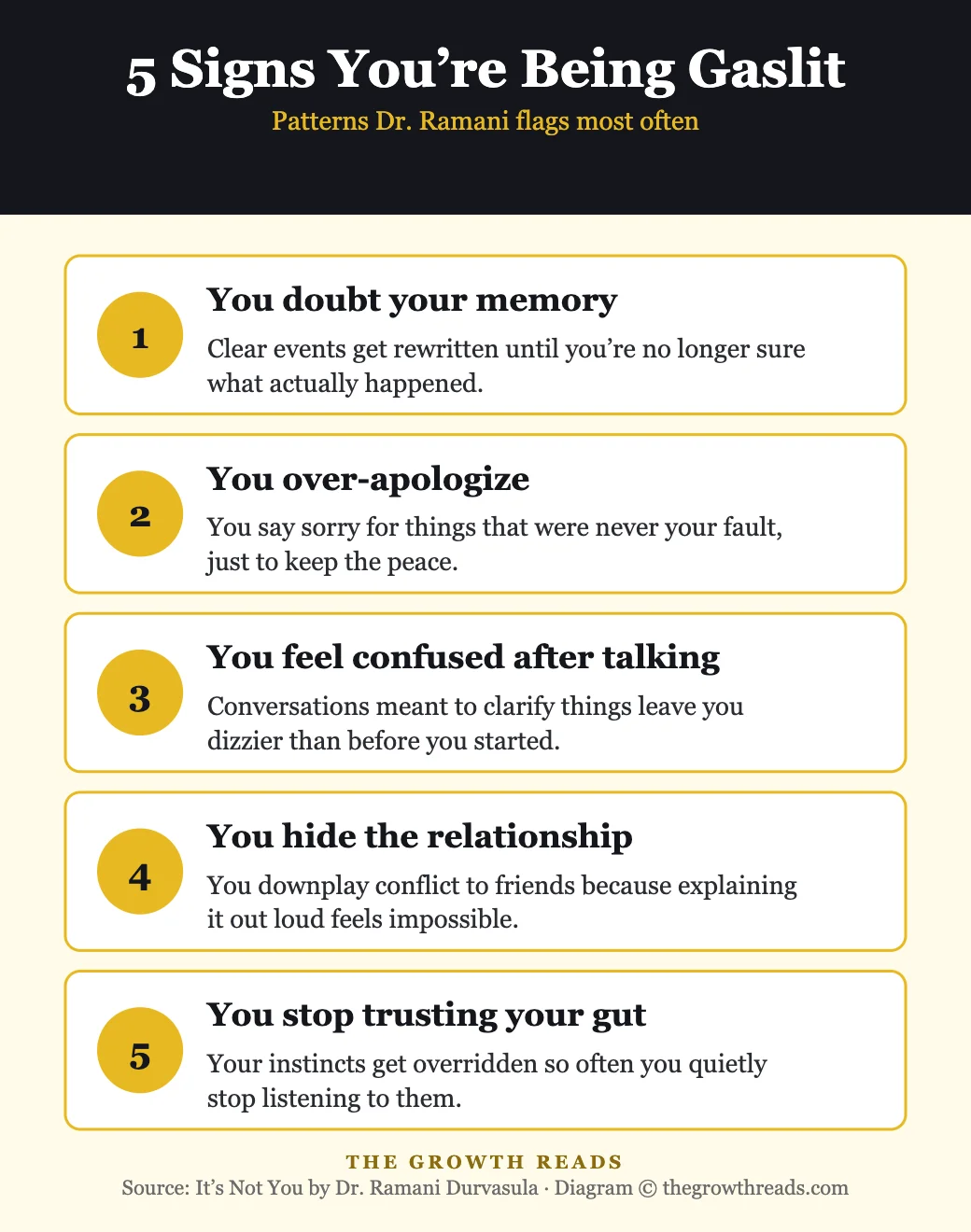
- Gaslighting works by rewriting reality: repeated small denials of what you saw, heard, or felt eventually erode your ability to trust your own memory.
- DARVO is the go-to defense: Deny, Attack, Reverse Victim and Offender describes how a narcissistic person flips blame the moment they’re confronted.
- Trauma bonds form through intermittent reinforcement: unpredictable warmth after cruelty creates an attachment that feels like love but functions like a habit you can’t shake.
- You can’t reason, love, or therapy someone into changing: healing starts when you redirect that energy toward protecting yourself instead.
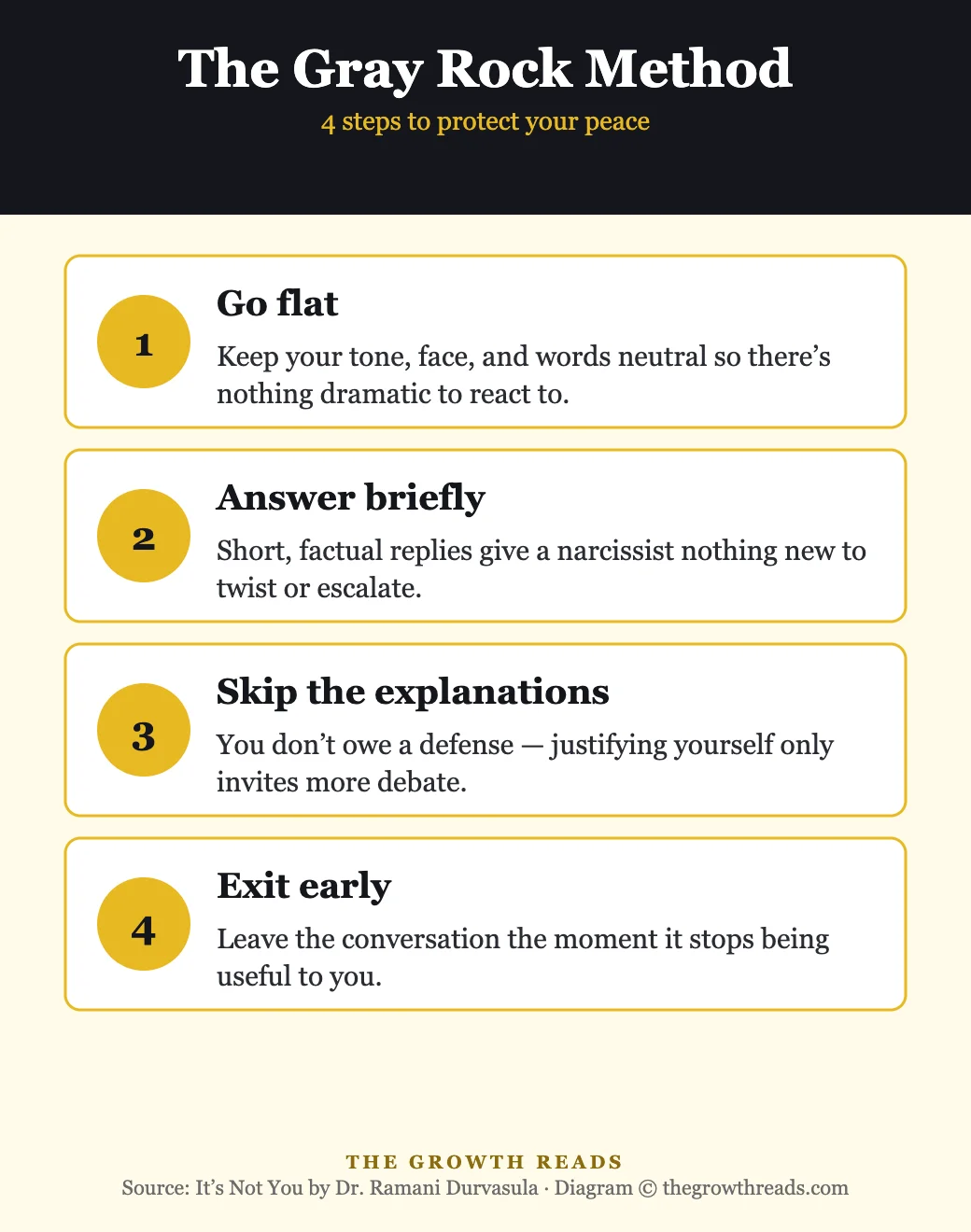
- The gray rock method limits harm: staying flat, brief, and unreactive is a practical option when full no-contact isn’t possible, like with a coparent or a boss.
- Boundaries are commitments to yourself: not ultimatums for the other person to become better, but decisions about what you will and won’t tolerate.
- Grief is a legitimate part of healing: even in a toxic relationship, you’re allowed to mourn who you hoped they’d be.
- Rebuilding self-trust is a skill, not a switch: it comes from small, repeated moments of honoring your own perception instead of overriding it.
What is It’s Not You about?
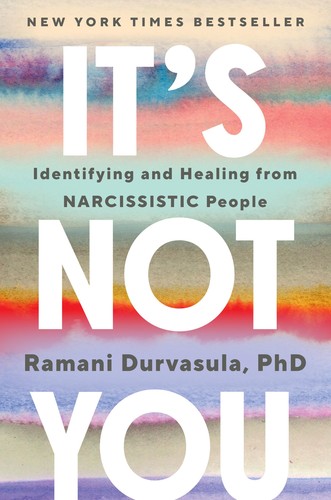
It’s Not You: Identifying and Healing from Narcissistic People is a 2024 book by clinical psychologist Dr. Ramani Durvasula that explains the recognizable patterns of narcissistic relationships, including idealization, gaslighting, and devaluation, and offers a practical, self-compassionate path to healing through boundaries, the gray rock method, and rebuilding self-trust.
About the author
Dr. Ramani Durvasula is a licensed clinical psychologist and Professor Emerita of Psychology at California State University, Los Angeles. She has spent more than two decades studying narcissism and its effects on relationships, families, and workplaces, and is one of the most widely followed voices on the subject through her YouTube channel and her podcast, Navigating Narcissism with Dr. Ramani. It’s Not You is her fourth book and became an instant New York Times bestseller, praised by figures like Mel Robbins and Maria Shriver for translating clinical research on narcissistic abuse into language survivors could actually use. Her work draws on both academic research and thousands of hours of clinical practice with people recovering from these relationships.
Key concepts at a glance
| Concept | What it means | Use it when |
|---|---|---|
| Narcissistic playbook | The repeating idealize–devalue–discard–hoover cycle | You keep asking “why does this feel so familiar?” |
| Gaslighting | Repeated denial of your reality until you doubt yourself | You constantly feel confused after conversations |
| DARVO | Deny, Attack, Reverse Victim and Offender | You’re accused of overreacting the moment you raise a concern |
| Trauma bond | An attachment formed through unpredictable cruelty and warmth | You know the relationship hurts you but can’t seem to leave |
| Gray rock method | Staying flat, brief, and emotionally unreactive on purpose | Full no-contact isn’t possible, like coparenting or work |
| Radical acceptance | Accepting who someone actually is, not who you hope they’ll become | You’re still waiting for an apology or change that won’t come |
| Narcissistic supply | The attention, admiration, or reactions a narcissistic person depends on | You notice they escalate the moment you stop reacting |
Part 1: Spotting the Pattern
Durvasula opens by placing narcissism on a spectrum rather than treating it as an on/off diagnosis. Everyday self-centeredness sits at one end; narcissistic personality disorder, which is rare and hard to formally diagnose, sits at the other. Most people who cause this kind of harm never see a clinician, so waiting for a diagnosis before you trust your own experience is, in her view, a trap. What matters is the pattern: grandiosity, a persistent need for admiration, a thin skin around criticism paired with a total lack of empathy for yours, and a habit of treating other people as extensions of their own needs rather than as separate individuals with their own.
That pattern shows up as a cycle, and it looks remarkably similar whether the narcissistic person is a partner, a parent, a boss, or a friend. It starts with idealization: intense attention, fast-moving affection, a sense of being “finally understood.” Then devaluation creeps in gradually, small criticisms, subtle comparisons to other people, a cooling that you explain away as a rough patch. Eventually there’s a discard: withdrawal, a sudden argument, or an abrupt ending that leaves you scrambling for a reason. And then, often just as you start to move on, there’s hoovering: an apology, a gift, a message out of nowhere that pulls you back into the cycle before you’ve had the chance to heal.
TGR Note: If this pull feels magnetic in a way you can’t quite explain, TGR’s Attached breaks down how anxious-avoidant attachment pairings make cycles like this one feel so hard to walk away from, even when you know better.
Part 2: The Toolkit of Confusion
The second part of the book is a close look at the specific tactics that keep people stuck, and Durvasula is precise about naming them. Gaslighting is the flat denial of things you clearly remember: “that never happened,” “you’re too sensitive,” “I never said that.” It works gradually, one small denial at a time, until you start pre-emptively doubting your own memory before anyone else even challenges it. Triangulation brings a third person into the dynamic, an ex, a coworker, a family member, to manufacture jealousy or make you feel replaceable. And when you finally do confront the behavior directly, Durvasula describes the near-universal response as DARVO: Deny it happened, Attack your character for bringing it up, and Reverse the roles so that you end up defending yourself instead of the concern you raised.
Underneath all of it is invalidation, the steady message that your feelings are wrong, exaggerated, or simply inconvenient. Durvasula’s central insight here is that none of this requires elaborate scheming. It’s often automatic, a narcissistic person’s default way of protecting a fragile sense of self. But automatic or not, the effect on you is the same: a slow erosion of confidence in your own perception, until you’re the one asking “am I overreacting?” before anyone else has to.
TGR Note: Once you can name the tactic, the next skill is holding a line despite it. TGR’s Boundaries by Cloud and Townsend is a useful companion for turning that recognition into a concrete, repeatable practice.
Part 3: What It Costs You
Durvasula doesn’t rush past the toll this takes. Chronic self-blame, hypervigilance, and a kind of low-grade anxiety that never fully switches off are common, along with the exhausting habit of “walking on eggshells,” scanning every interaction for warning signs before they even appear. Many readers describe symptoms that overlap with complex trauma: intrusive replays of arguments, a startle response to certain tones of voice, and a shrinking social circle because it becomes easier to withdraw than to keep defending or explaining the relationship to friends who don’t understand it.
A key piece of the puzzle is trauma bonding, and Durvasula explains it in terms that reframe the whole experience: unpredictable reinforcement, cruelty followed by unexpected warmth, is one of the most powerful conditioning patterns there is, the same variable-reward structure that makes slot machines so compelling. Staying, even when the relationship clearly hurts you, isn’t a character flaw or evidence of poor judgment. It’s a predictable response to a predictable pattern, which is exactly why naming the pattern matters so much.
TGR Note: If this cost sounds like it started with a parent rather than a partner, TGR’s Adult Children of Emotionally Immature Parents goes deeper on that specific dynamic. And if you recognize the reflex to keep smoothing things over even when it costs you, Codependent No More is a natural next read.
Part 4: The Path Back to Yourself
The final section is where the book shifts from diagnosis to practice, and its first move is radical acceptance: accepting who someone actually is, not who you keep hoping they’ll become. Durvasula is direct that most narcissistic people don’t change, not because change is impossible in theory, but because it requires a level of sustained insight and motivation that the pattern itself works against. That’s not meant as pessimism; it’s meant as permission to stop waiting and start protecting yourself now.
From there, the book gets tactical. Boundaries are reframed as decisions about your own behavior, not demands you make of someone else: “I will leave the room when voices are raised” rather than “you need to stop yelling.” When full no-contact isn’t realistic, because you share children, a workplace, or a family, the gray rock method offers a middle path: staying flat, brief, and factual so there’s nothing dramatic left for the other person to react to. Grief gets real space here too. Durvasula treats mourning a relationship, or a parent, as a legitimate and necessary stage, not a sign you haven’t moved on. And rebuilding self-trust, she argues, happens the same way it was worn down: gradually, through small, repeated moments of honoring your own perception instead of second-guessing it.
TGR Note: For a structured way to put new boundaries into daily practice, TGR’s Set Boundaries, Find Peace pairs well with this book’s healing chapters.
Who is It’s Not You best for — and who should read something else first?
This book is best for anyone who already senses something is wrong in a relationship, whether romantic, familial, or professional, and needs language, structure, and permission to trust that instinct. It’s especially useful if you’ve been told (by the other person, or even by yourself) that you’re “too sensitive” or “too much,” and you want a clear-eyed way to separate what’s actually happening from that framing.
If what you need is a broader toolkit for handling difficult conversations in general, not specifically narcissistic ones, start with Crucial Conversations or Nonviolent Communication instead. And if you’re in a situation involving physical danger, a domestic violence hotline or a licensed therapist should come before any book, this one included.
Questions to reflect on
- Which stage of the idealize–devalue–discard–hoover cycle feels most familiar in a relationship you’re thinking about right now?
- What’s one thing you’ve stopped trusting about your own perception, and what would it take to trust it again?
- Where in your life are you currently over-explaining or over-apologizing just to avoid conflict?
- If full no-contact isn’t an option for you right now, what would a realistic gray rock approach actually look like day to day?
- Who is one person you could tell the whole story to, without editing it to sound less serious than it was?
🔥 Ready to stop blaming yourself?
Get the full book for the complete healing framework, guided exercises, and Dr. Ramani’s clinical case studies.
How to apply It’s Not You (7-day plan)
- Day 1 — Name the pattern. Write down one relationship you want to examine and map it against idealize–devalue–discard–hoover. Just notice, don’t judge yourself for missing it before now.
- Day 2 — Track one gaslighting moment. Recall a specific conversation that left you confused, and write down what you actually remember happening, in your own words.
- Day 3 — Practice gray rock once. Pick one low-stakes exchange today and respond flat, brief, and factual. Notice how it feels compared to your usual reaction.
- Day 4 — Draft one boundary. Write a single sentence describing what you will do differently next time, not what you need the other person to do.
- Day 5 — Tell someone the unedited version. Share the full story with one trusted person, without softening it to sound more reasonable than it felt.
- Day 6 — Grieve on paper. Write a short letter you won’t send, to the person you wished they’d been.
- Day 7 — Choose one support. Book a therapy session, look into a support group, or schedule regular time with a friend who believes you.
Frequently asked questions
Do I need a diagnosis to know if someone is narcissistic?
No. Dr. Ramani is explicit that a formal diagnosis of narcissistic personality disorder is rare and hard to obtain, since narcissistic people rarely seek treatment for it. The book focuses on recognizing patterns of behavior, idealization, gaslighting, invalidation, rather than chasing a clinical label, because the pattern is what determines the harm to you regardless of what’s written on any chart.
Can a narcissistic person change?
Durvasula is candid that meaningful, lasting change is rare, since it requires a level of sustained insight and motivation that the pattern itself tends to work against. She frames this not as pessimism but as permission: you can stop waiting for change and start protecting yourself now, which is often the more realistic and more empowering path forward for you.
What’s the difference between gray rock and going no-contact?
No-contact means cutting off communication entirely, which isn’t always possible with a coparent, a boss, or certain family members. Gray rock is the practical alternative: staying flat, brief, and emotionally unreactive during required contact, so there’s nothing dramatic left for the other person to latch onto or escalate.
Is this book only about romantic relationships?
No. Durvasula applies the same framework to parents, siblings, friends, coworkers, and bosses. Some of the book’s most affecting chapters cover narcissistic parents specifically, including how their children often carry chronic self-doubt and people-pleasing patterns well into adulthood.
Does the book blame people for staying in these relationships?
No, this is actually one of its central arguments against doing so. Durvasula explains trauma bonding as a predictable response to intermittent reinforcement, unpredictable cruelty followed by warmth, rather than a character flaw. Staying for a while is framed as a normal human response to that pattern, not evidence of poor judgment on your part.
Is this book a substitute for therapy?
Not necessarily. It works well as an accessible starting point that pairs with therapy rather than replacing it, especially if you’re processing significant trauma, considering leaving a difficult situation, or supporting children through one. If you’re ever in immediate danger, a domestic violence hotline should take priority over any book, including this one.
How is this different from other books on narcissism?
Its main distinction is balance: roughly equal weight given to identification, spotting the pattern clearly with concrete examples, and to healing, specific tools like gray rock, boundary scripts, and grief work, rather than dwelling mainly on describing narcissistic traits. Readers consistently point to that healing half as the most practically useful part of the book.
Related summaries
- Boundaries — the classic playbook for defining and holding limits.
- Codependent No More — for anyone who recognizes the urge to fix or over-function for others.
- Adult Children of Emotionally Immature Parents — when the pattern started with a parent.
- Attached — the attachment styles that make these cycles feel so hard to walk away from.
See the full best relationship books list for more.
How we analyze books: Every TGR summary is built from a full read of the book, author interviews and public talks, and cross-referencing with related research, then structured around what you can actually do differently this week. Read our full methodology.