

⭐⭐⭐⭐ 4.3 / 5 — A research-backed operating system for sustained peak performance.
Best for: Ambitious professionals, entrepreneurs, athletes, and anyone who wants to move from good to extraordinary through deliberate daily practices.
Reading time: ~7 hours (368 pages)
Difficulty to apply: Moderate — the six habits are straightforward to understand but require consistent daily intention and reflection to internalize.
High Performance Habits in one minute
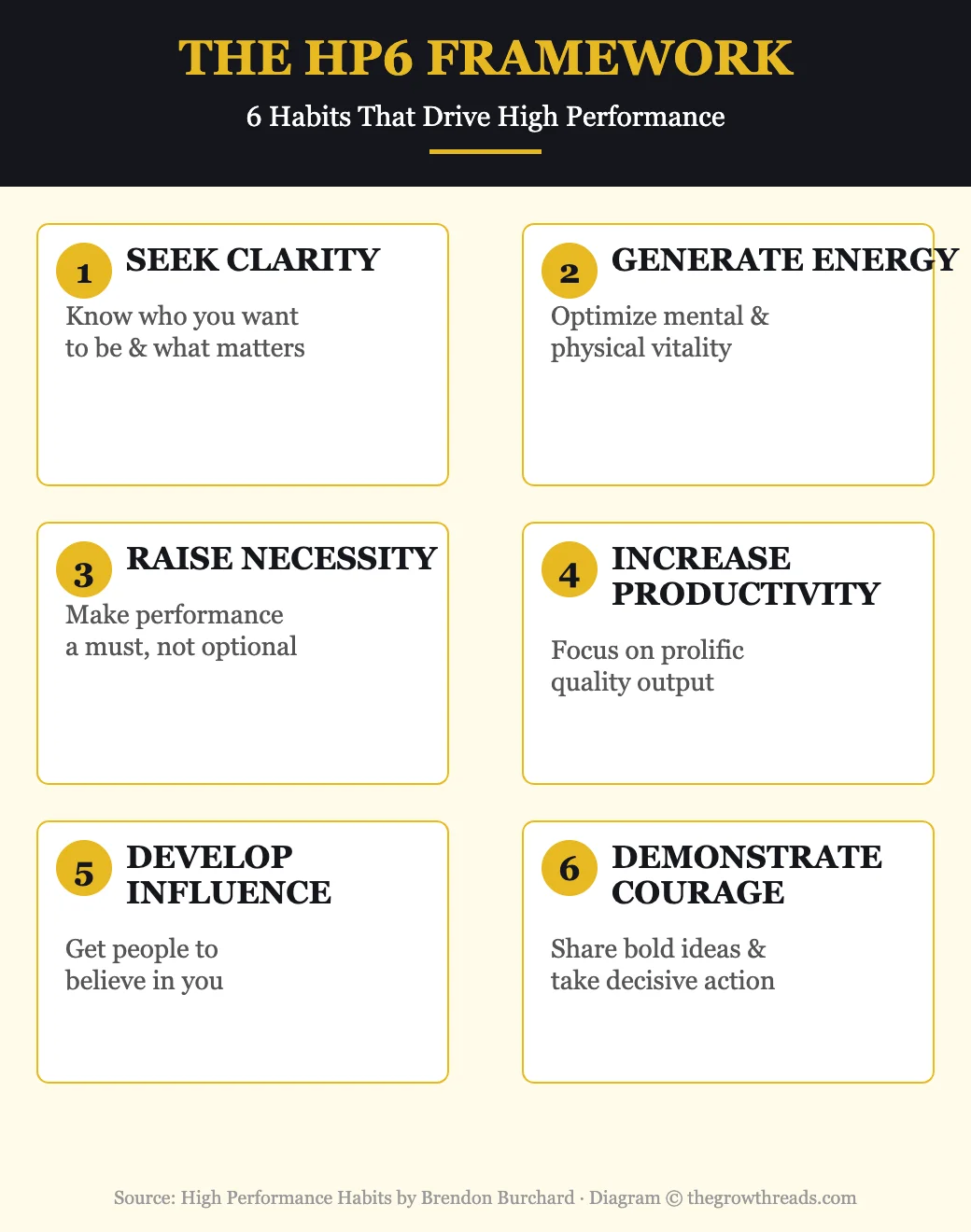
High performance is not about talent, luck, or working longer hours — it is about adopting six deliberate habits consistently. Brendon Burchard spent over two decades studying what separates extraordinary achievers from everyone else. Drawing from one of the largest studies of high performers ever conducted — surveying and coaching over 3,000 people across industries — he distilled six habits that reliably predict long-term success. These habits fall into two categories: personal (seek clarity, generate energy, raise necessity) and social (increase productivity, develop influence, demonstrate courage). The breakthrough insight is that these are learnable, practicable behaviors, not fixed personality traits. Anyone willing to put in the deliberate work can adopt them.
Key takeaways
- High performance is habit-driven, not talent-driven: The six HP habits are learnable skills, not genetic gifts. Sustained success comes from deliberate daily practice rather than raw ability.
- Clarity is the starting point: High performers obsessively define who they want to be, how they want to interact with others, and what meaningful work matters most.
- Energy must be actively generated: Peak performers don’t wait to feel energized — they create physical and mental vitality through structured transitions, exercise, and intentional renewal throughout the day.
- Necessity makes performance non-negotiable: When internal standards meet external obligations (deadlines, teams, public commitments), people rise to a level they wouldn’t reach with motivation alone.
- Prolific quality output beats busywork: High performers focus on producing what matters most — their “five moves” — rather than checking off endless to-do lists.
- Influence is about teaching and challenging: The most effective leaders shape others not by authority but by modeling the way, asking people to rise, and genuinely caring about their growth.
- Courage is the most correlated habit: Of all six habits, demonstrating courage — sharing bold ideas, standing up for others, taking action despite fear — correlates most strongly with high performance.
- The three traps to avoid: Superiority (looking down on others), dissatisfaction (never enjoying wins), and neglect (ignoring health and relationships) derail high performers more than external obstacles.
- Transitions are performance triggers: Using the space between meetings, tasks, and conversations to reset intention and energy is one of the most practical strategies in the book.
- You don’t need to be “fixed” — you need to be intentional: High performance is not therapy for brokenness; it is the deliberate engineering of your best self through repeated daily choices.
What is High Performance Habits about?
High Performance Habits presents six evidence-based habits — seek clarity, generate energy, raise necessity, increase productivity, develop influence, and demonstrate courage — that Brendon Burchard identified through one of the largest high-performance studies ever conducted, providing a repeatable system anyone can use to achieve sustained extraordinary results in their career and life.
About the author
Brendon Burchard is one of the most-watched personal development trainers in the world, with over 300 million views on his videos and courses completed by over two million students. He built his career after a near-death car accident at age 19 forced him to confront three questions — “Did I live? Did I love? Did I matter?” — that became the foundation for his work. Burchard is the founder of the High Performance Institute and has consulted with executives at Fortune 500 companies, professional athletes, and heads of state. His books, including The Motivation Manifesto and Life’s Golden Ticket, have collectively spent over 100 weeks on bestseller lists. He brings both academic research and hands-on coaching experience to his methodology. Explore all Brendon Burchard book summaries →
Key concepts at a glance
| Concept | What it means | Use it when |
|---|---|---|
| HP6 Framework | The six habits that predict high performance across domains | You want a complete system, not random tips |
| Clarity Triad | Define self, social, and service intentions daily | You feel scattered or unclear about priorities |
| Release Tension, Set Intention | Use transitions between activities to reset energy | You carry stress from one meeting into the next |
| Raise Necessity | Connect performance to identity and social obligation | Motivation alone isn’t sustaining your effort |
| Prolific Quality Output (PQO) | Focus on your most impactful deliverables, not busywork | You’re busy but not producing meaningful work |
| The Five Moves | Identify the five major steps to your next big goal | A big goal feels overwhelming or unclear |
| Influence Model | Teach, challenge, and role-model to lead effectively | You need to inspire a team without formal authority |
| The Three Traps | Superiority, dissatisfaction, and neglect derail success | You’re achieving but feeling empty or isolated |
Part 1: Personal habits — Seek clarity
Burchard opens with perhaps the most foundational finding from his research: high performers have an unusual degree of clarity about who they are and what they want. This is not the vague “find your passion” advice. It is a structured, daily practice of defining four things — self, social, skills, and service.
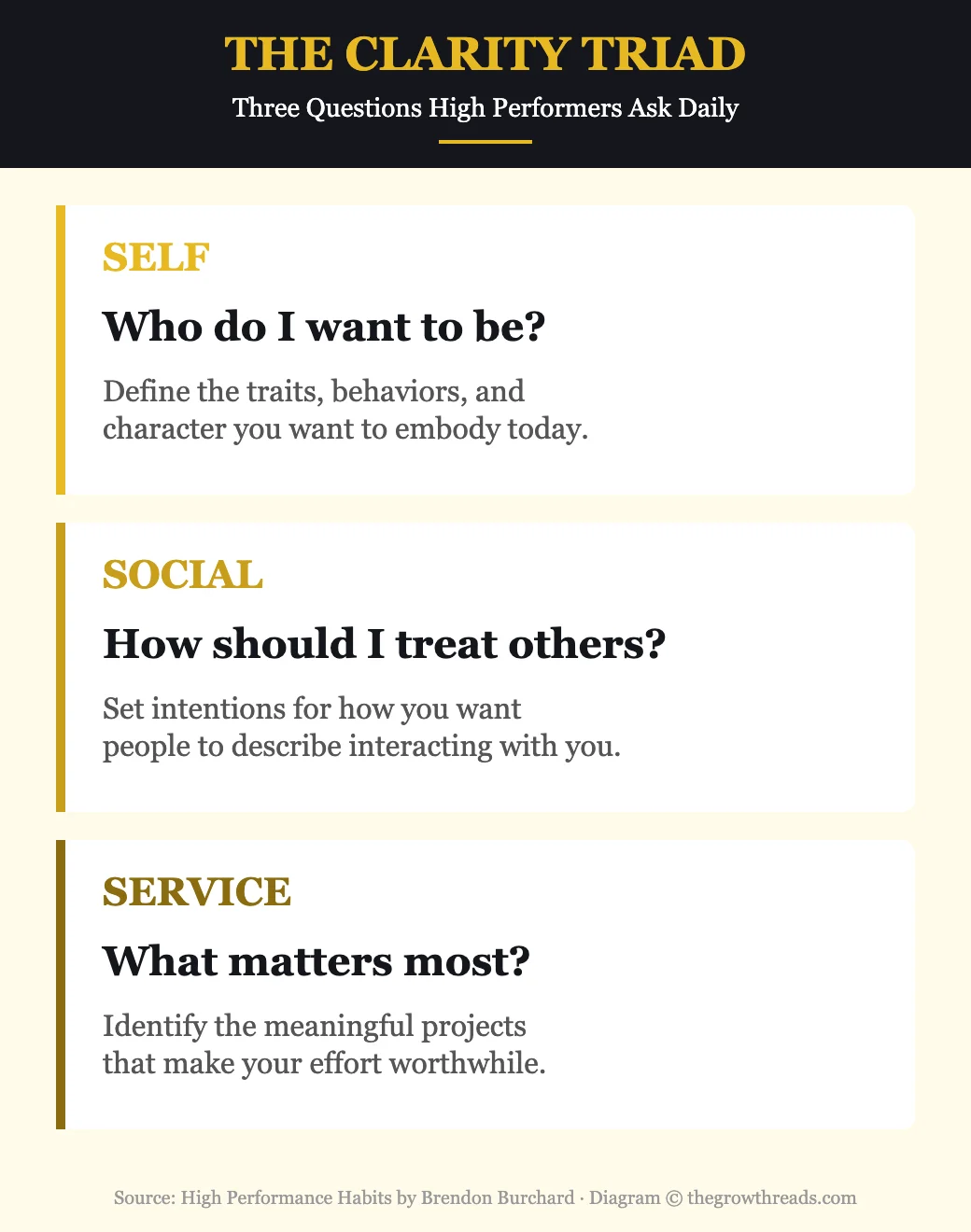
The Clarity Triad asks three questions before every significant situation: Who do I need to be right now? How should I treat the people around me? What is the meaningful outcome I’m working toward? High performers don’t stumble into their days hoping for focus — they set explicit intentions about how they will show up.
Burchard’s research revealed that high performers describe their ideal future selves with far more specificity than average performers. Where most people say “I want to be successful,” high performers say things like “I want to be the kind of leader who makes every person on my team feel they can grow here.” This granularity of vision acts as a behavioral compass, making decisions easier because the filter is already set.
The practical mechanism is deceptively simple: at the start of each week and before each significant interaction, high performers write or mentally rehearse who they intend to be. This practice is close to what psychologists call “implementation intentions” — a technique with strong evidence for bridging the gap between goals and action.
Part 2: Personal habits — Generate energy and raise necessity
The second personal habit challenges one of the biggest myths about high achievers: that they have more energy naturally. Burchard’s data shows they don’t — they simply manage energy more deliberately. The core technique is what he calls “Release Tension, Set Intention” (RTSI) transitions.
Between every meeting, task, or activity, high performers take 30 to 60 seconds to close their eyes, release physical tension (drop shoulders, unclench jaw, breathe deeply), and set an intention for the next activity. This creates a clean psychological break that prevents emotional carryover. Burchard found that high performers who used RTSI transitions reported 40% less end-of-day exhaustion than those who barreled from task to task.
Physical energy is non-negotiable. Burchard prescribes what he calls the “1-by-1 method”: one workout per day (even if it’s just a brisk 20-minute walk) and one sleep habit you protect above all others (such as a fixed bedtime or no screens after 9 PM). The research showed that high performers who exercised regularly scored 23% higher on the High Performance Indicator than those who didn’t.
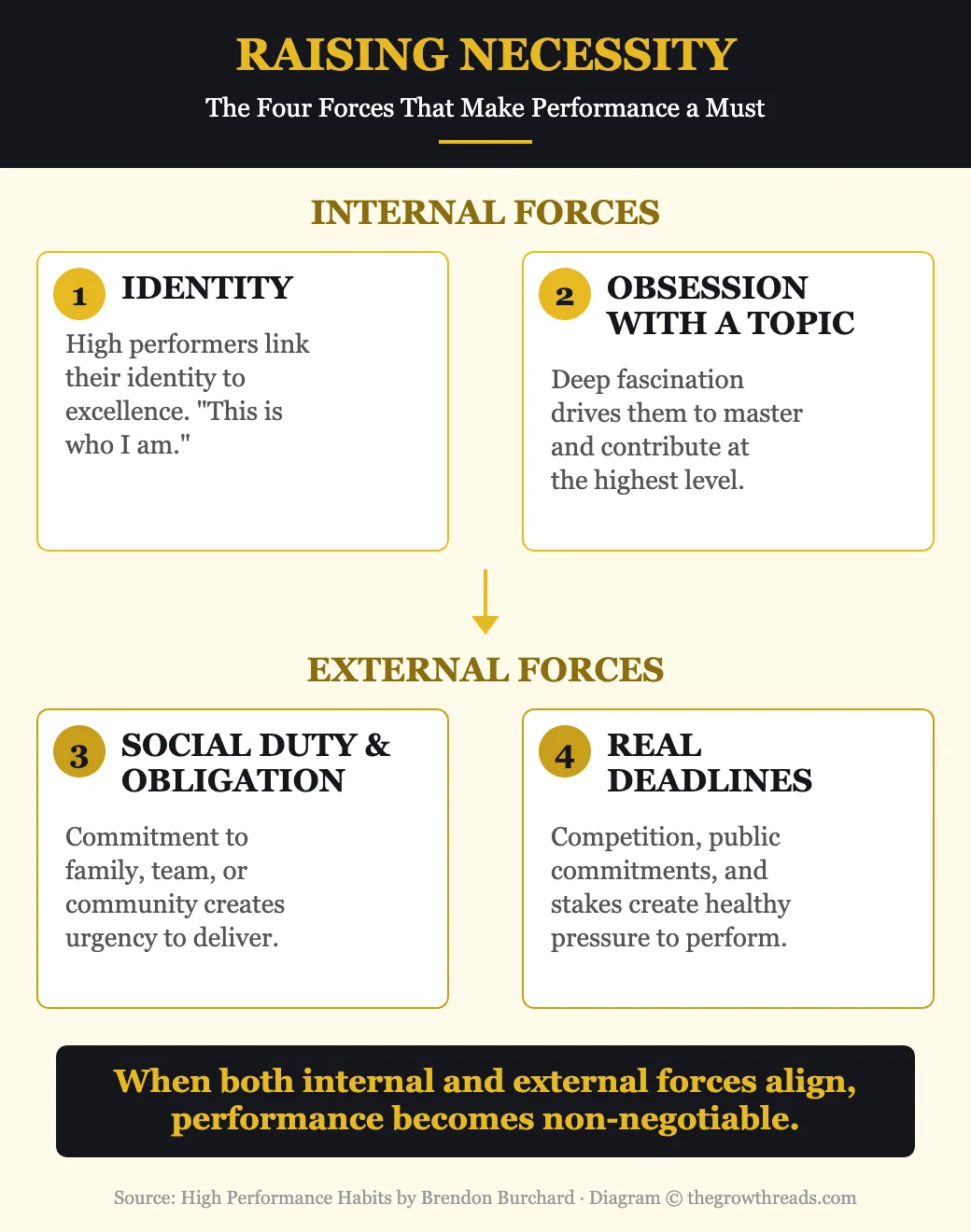
The third personal habit, raising necessity, addresses why some people sustain intensity while others burn out or plateau. Burchard identifies four forces of necessity — two internal (identity and obsession with a topic) and two external (social duty and real deadlines). When all four align, performance becomes almost automatic.
The internal drivers are about linking your performance to your self-concept. A high performer doesn’t just set a goal to write a book; they think, “I am a writer. Writers write every day. If I don’t write today, I’m not living as who I truly am.” The external drivers come from making public commitments, accepting accountability, and putting real stakes on outcomes.
Part 3: Social habits — Increase productivity and develop influence
Burchard redefines productivity in a way that surprises most readers. For high performers, productivity is not about doing more things — it is about increasing their Prolific Quality Output (PQO). PQO is the one type of deliverable that matters most in your field. For a writer, it’s published pieces. For a salesperson, it’s closed deals. For a researcher, it’s published studies.
The “Five Moves” strategy asks: “If I could only do five major things over the next few years to achieve my goal, what would they be?” Then all daily work is filtered through whether it advances one of those five moves. This is how high performers stay productive without succumbing to the trap of busyness. Burchard found that the ability to identify and focus on PQO was the single strongest differentiator between high performers and their peers in organizational settings.
High performers also block time ruthlessly. Burchard recommends dedicating 60% or more of your workday to PQO and batching administrative tasks into compressed time blocks. This echoes what many time-management experts teach, but Burchard grounds it in the specific data from his High Performance Indicator assessments — people who spent the majority of their day on PQO scored 32% higher overall.
The fifth habit, developing influence, focuses on how high performers get people to believe in and work with them. Burchard’s model distills influence into three practices: teach people how to think about key situations, challenge them to grow beyond their comfort zone, and role-model the behavior you expect. High performers don’t influence through manipulation or authority — they invest in people’s growth.
A particularly powerful finding: high performers ask others to raise their standards more often than average performers do. They don’t shy away from saying, “I think you can do better than this — here’s what I think you’re capable of.” This combination of high challenge and high support creates what Burchard calls a “pull” effect — people want to perform for leaders who clearly believe in them.
Part 4: The courage habit and the three traps
Burchard saves his most surprising finding for last: of all six habits, demonstrating courage has the strongest correlation with overall high performance. This isn’t physical courage — it’s the daily willingness to share your ideas when they might be rejected, to stand up for someone who needs support, and to take bold action before you feel fully ready.
High performers practice courage as a habit, not a personality trait. Three specific courage practices emerged from the research: honor the struggle (reframe difficulty as necessary growth, not punishment), share your truth (express your real opinions and ambitions rather than playing it safe), and find someone to fight for (connecting your effort to serving someone else transforms fear into fuel).
The “find someone to fight for” principle was one of Burchard’s strongest findings. When high performers felt afraid or overwhelmed, they didn’t try to pump themselves up — they thought about the people counting on them. Parents thought of their children. Coaches thought of their athletes. Entrepreneurs thought of their customers. This external orientation turned self-doubt into purposeful action.
The book closes with a sobering chapter on the three traps that destroy high performance from within. Superiority — the belief that you’re better than others, which kills learning and alienates allies. Dissatisfaction — the inability to appreciate wins, which drains motivation despite achievement. Neglect — sacrificing health, relationships, or personal well-being for results, which eventually collapses the foundation that performance depends on.
Burchard’s antidote for each trap is built into the six habits themselves. Clarity prevents superiority (you’re focused on your own standards, not comparing). Influence prevents dissatisfaction (serving others creates meaning beyond metrics). Energy prevents neglect (you literally cannot skip self-care within the system). The framework is self-correcting by design.
Who is High Performance Habits best for — and who should read something else first?
This book is ideal for people who are already competent in their field and want to move from good to exceptional. If you’re an ambitious professional, a team leader, an entrepreneur, or an athlete looking for a systematic approach to sustained peak performance, Burchard gives you a research-backed operating system.
If you’re struggling with basic habit formation — just trying to exercise regularly or wake up on time — you may want to start with Atomic Habits or Tiny Habits first. Those books are better at the mechanics of building small routines. Burchard assumes you already have baseline discipline and are ready to optimize for extraordinary results.
If you’re interested primarily in deep focus and cognitive performance at work, Deep Work by Cal Newport may be more tightly focused on what you need. Burchard covers a broader scope — energy, relationships, courage, influence — which is the book’s strength if you want a holistic system, but less targeted if you have a narrow goal.
Questions to reflect on
- If you described your ideal self in your current role with complete specificity, what three traits would define that person — and how many of those traits did you actively practice today?
- What is your PQO — the one type of output that matters most in your work — and what percentage of your day do you actually spend on it?
- Think about your last five transitions between meetings or tasks. Did you carry tension forward, or did you deliberately reset your energy and intention?
- When was the last time you challenged someone you care about to raise their standards — and when did someone last do that for you?
- Which of the three traps (superiority, dissatisfaction, neglect) do you feel most at risk for right now, and what is one specific action you could take this week to counteract it?
🔥 Ready to build your high performance operating system?
Get Burchard’s six-habit framework and start engineering extraordinary results today.
How to apply High Performance Habits (7-day plan)
- Day 1 — Define your Clarity Triad: Write down your answers to the three clarity questions (self, social, service) for your current primary role. Post them where you’ll see them every morning.
- Day 2 — Identify your PQO: Write the single type of output that matters most in your work. Calculate roughly what percentage of yesterday you spent on it. Set a target to increase that by 10%.
- Day 3 — Practice RTSI transitions: Between every meeting or major task today, close your eyes for 30 seconds, release physical tension, and set one intention for the next activity. Track how many transitions you complete.
- Day 4 — Map your Five Moves: Identify the five major milestones that would bring your biggest current goal to completion. Write them on a card you keep at your desk.
- Day 5 — Raise necessity: Make one public commitment about a goal to a friend, colleague, or mentor. Write down who is counting on you to achieve this result and why their outcome depends on yours.
- Day 6 — Practice the influence triad: Teach one person something useful today. Challenge one person to raise their standard on a specific task. Intentionally model a behavior you want to see in others.
- Day 7 — Demonstrate courage: Share one bold idea you’ve been holding back in a meeting, conversation, or email. Identify one person who needs support and offer it. Notice how acting despite discomfort feels different from waiting until you feel ready.
Frequently asked questions
What are the 6 high performance habits?
The six habits are: seek clarity (define who you want to be and what matters), generate energy (actively manage physical and mental vitality), raise necessity (make performance feel essential through identity and obligation), increase productivity (focus on prolific quality output rather than busywork), develop influence (teach, challenge, and role-model for others), and demonstrate courage (share bold ideas and take action despite fear). They divide into three personal habits and three social habits.
Is High Performance Habits worth reading?
Yes, particularly if you are already functioning well and want to reach the next level. The book stands out because it is grounded in a large-scale research study rather than anecdotes alone. It provides a complete system with six interlocking habits rather than isolated tips. Readers who want practical daily routines they can start immediately will find strong value, especially in the clarity, energy, and productivity chapters.
How is this different from Atomic Habits?
Atomic Habits by James Clear focuses on the mechanics of building any habit through cues, cravings, responses, and rewards. It is a general-purpose habit-formation framework. High Performance Habits is more specific and ambitious: it identifies the six particular habits that separate extraordinary achievers from everyone else. Think of Atomic Habits as the engine (how to build habits) and High Performance Habits as the GPS (which habits to build for peak performance).
What is Prolific Quality Output (PQO)?
PQO is the single type of deliverable that matters most in your role or field. For a content creator, it might be published articles. For a salesperson, closed deals. For a researcher, published papers. Burchard found that high performers spend the majority of their working time on their PQO rather than on administrative tasks, meetings, or reactive busywork. The Five Moves strategy helps you identify the major steps that advance your PQO.
What is the Release Tension, Set Intention technique?
RTSI is a 30- to 60-second practice performed between activities throughout the day. You close your eyes, consciously release physical tension (drop shoulders, relax jaw, take three deep breaths), then set a single clear intention for the next task or meeting. Burchard’s research found that this simple transition ritual reduced end-of-day exhaustion by 40% and improved focus across multiple activities. It prevents the emotional bleed-over that drains energy.
Can these habits help with burnout?
Yes, and this is one of Burchard’s central arguments. He contends that burnout comes not from working hard but from working without clarity, energy management, or purpose. The six habits are designed to be sustainable: generating energy prevents physical depletion, seeking clarity prevents the aimless overwork that causes existential fatigue, and raising necessity ensures effort feels meaningful. The three traps chapter specifically addresses neglect-driven burnout.
How long does it take to see results from the HP6?
Burchard suggests that most people notice meaningful changes within 30 to 60 days of consistent practice. The clarity and energy habits tend to produce the fastest results because they create immediate shifts in focus and vitality. The influence and courage habits take longer because they involve interpersonal dynamics and building trust. Full integration of all six habits into a natural daily rhythm typically takes three to six months of deliberate effort.
Related summaries
- Atomic Habits by James Clear — The definitive guide to habit mechanics, perfect for building the daily routines Burchard’s system requires.
- Deep Work by Cal Newport — If PQO resonated, Newport’s framework for focused, distraction-free work is the ideal complement.
- The ONE Thing by Gary Keller — A sharper lens on the focusing question that underlies Burchard’s Five Moves strategy.
- Essentialism by Greg McKeown — The philosophy of doing less but better, which aligns perfectly with the PQO concept.
Explore more productivity books: This summary is part of our Best Productivity Books collection. Browse the full list for more evidence-based guides to working smarter and achieving more.