

★★★★½ 4.5/5 — a genuinely foundational book on personal effectiveness that trades quick hacks for durable, principle-based character. Dense but deeply rewarding.
Best for: anyone who wants a complete operating system for life and work, not just productivity tips · Reading time: ~8 hours (this guide: 16 min) · Difficulty to apply: Moderate — the habits are simple to name, but they reshape how you live
The 7 Habits of Highly Effective People in one minute
Real, lasting effectiveness grows from character and principles, not from clever techniques. Stephen Covey’s 1989 classic argues that the quick-fix “personality ethic” of the modern era — image, tactics, positive thinking — is built on sand, and that genuine success rests on a “character ethic” of timeless principles like integrity, fairness, and patience. He organizes personal growth into seven habits that move you along a “maturity continuum”: three habits build private victory and independence, three build public victory and healthy interdependence, and the seventh renews you so the others endure. Along the way Covey delivers some of the most useful mental models ever written for a general audience — proactivity, beginning with the end in mind, the time management matrix, win-win thinking, and empathic listening. It is less a productivity book than a philosophy of living well.
Key takeaways
- Character beats personality: lasting effectiveness comes from who you are, not from surface techniques for managing impressions.
- Be proactive (Habit 1): between stimulus and response lies your freedom to choose; focus your energy on your circle of influence, not your circle of concern.
- Begin with the end in mind (Habit 2): define your values and destination first — write a personal mission statement — so your daily actions serve a purpose.
- Put first things first (Habit 3): schedule your priorities rather than prioritizing your schedule; live in the important-but-not-urgent quadrant.
- Think win-win (Habit 4): seek mutual benefit; an abundance mindset assumes there is enough success for everyone.
- Seek first to understand, then to be understood (Habit 5): listen with the intent to understand, not to reply — the single most powerful communication habit.
- Synergize (Habit 6): value differences so the whole becomes greater than the sum of its parts.
- Sharpen the saw (Habit 7): renew yourself across four dimensions — physical, mental, social/emotional, and spiritual — so the other habits last.
- The Emotional Bank Account: trust in every relationship is built through consistent deposits of kindness, honesty, and kept promises.
- Private victory precedes public victory: you must master yourself before you can build effective relationships with others.
What is The 7 Habits of Highly Effective People about?
The 7 Habits of Highly Effective People is a personal-development book by Stephen Covey that presents a principle-centered framework for effectiveness. It teaches seven habits — spanning self-mastery, cooperation with others, and self-renewal — that Covey argues build the character and skills needed for lasting success in both private and professional life.
About the author
Stephen R. Covey (1932–2012) was an American educator, businessman, and keynote speaker who spent years studying two centuries of American success literature for his doctoral work — an analysis that became the backbone of this book. He noticed that writing from the first 150 years emphasized character and principles, while the more recent literature had shifted to personality and technique, and he set out to reclaim the older, deeper tradition. Published in 1989, The 7 Habits of Highly Effective People sold more than 40 million copies and made Covey one of the most influential management thinkers of his generation. He co-founded FranklinCovey, advised leaders worldwide, and wrote follow-ups including First Things First and The 8th Habit. His enduring insight is that effectiveness is not a trick to be learned but a character to be grown. Explore all Stephen R. Covey book summaries →
Key concepts at a glance
| Concept | What it means | Use it when |
|---|---|---|
| Character ethic | Success built on principles, not image | You’re tempted by quick fixes |
| Circle of influence | Focus on what you can affect | You feel powerless or reactive |
| End in mind | Define the destination first | Starting a project or a life stage |
| Time management matrix | Prioritize important over urgent | You’re always firefighting |
| Win-win | Seek mutual benefit | Negotiating or collaborating |
| Empathic listening | Understand before being understood | Any conflict or hard conversation |
| Sharpen the saw | Renew body, mind, heart, spirit | You’re burning out |
Part 1: Character over personality — paradigms and the inside-out approach
Covey begins with a distinction that reframes everything that follows: the difference between the personality ethic and the character ethic. The personality ethic treats success as a function of image, techniques, and attitude — the sort of surface skills that promise quick results. The character ethic, which dominated older success writing, holds that there are principles as real as gravity — integrity, fairness, service, patience — and that lasting effectiveness comes only from aligning yourself with them. You cannot fake your way to a good harvest, Covey notes; the “law of the farm” requires that you plant, tend, and wait. This is the “inside-out” approach: change starts with your own character and paradigms, not with trying to change other people or circumstances.
Central to this is the idea of paradigms — the mental maps through which we see the world. Covey argues that we do not see the world as it is, but as we are, and that the most significant breakthroughs come from paradigm shifts, moments when we suddenly see a situation in a completely new way. His famous illustration is a subway ride where unruly children annoy him until the father quietly explains they have just come from the hospital where their mother died; in an instant Covey’s irritation dissolves into compassion. Nothing about the scene changed except his paradigm — and that changed everything. The seven habits, he explains, are principle-centered paradigms that move you up a maturity continuum from dependence to independence to interdependence.
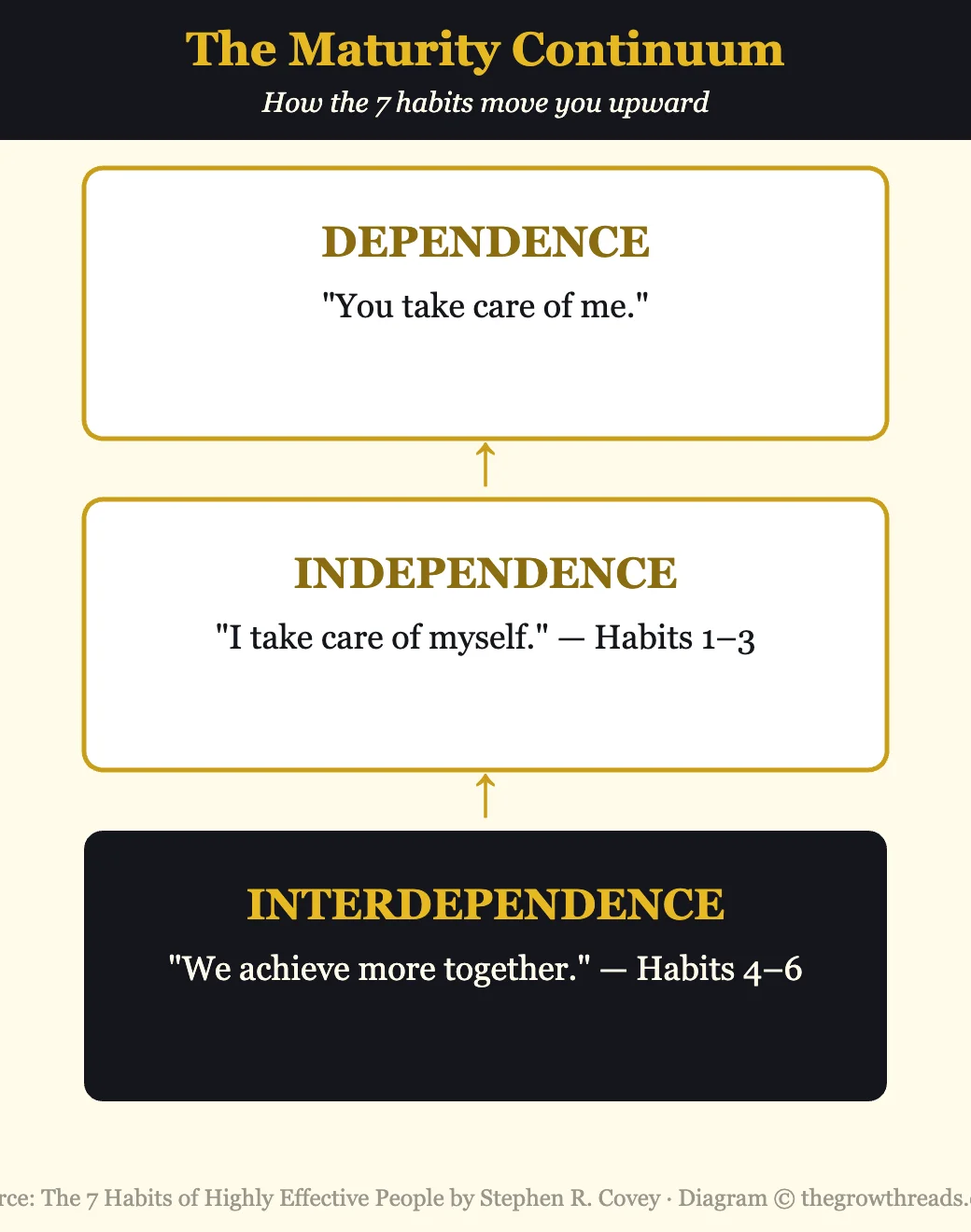
This continuum structures the whole book. We all begin dependent, relying on others. The first three habits carry us to independence — the private victory of self-mastery. The next three carry us to interdependence — the public victory of working powerfully with others. And the seventh renews the whole system. Crucially, Covey insists the order matters: you cannot skip to effective relationships without first mastering yourself, because you cannot give what you do not have.
Part 2: The Private Victory — habits 1, 2, and 3
Habit 1, Be Proactive, is the foundation. Covey draws on the idea that between what happens to us and how we respond lies a space, and in that space lies our freedom to choose. Proactive people take responsibility for their responses rather than blaming circumstances; reactive people are driven by moods and conditions. He offers a practical test: focus your energy on your Circle of Influence — the things you can actually affect — rather than your Circle of Concern, the vast set of things you worry about but cannot control. Doing so, paradoxically, expands your influence, while obsessing over what you cannot control shrinks it.
Habit 2, Begin with the End in Mind, asks you to define your destination before you set out. Covey’s vivid exercise is to imagine your own funeral and ask what you would want people to say about you — a way of surfacing your deepest values. From this he recommends writing a personal mission statement, a written constitution for your life against which you can measure decisions. Habit 3, Put First Things First, is where vision meets the calendar. It is the practice of organizing and executing around your priorities, and its central tool is the time management matrix.
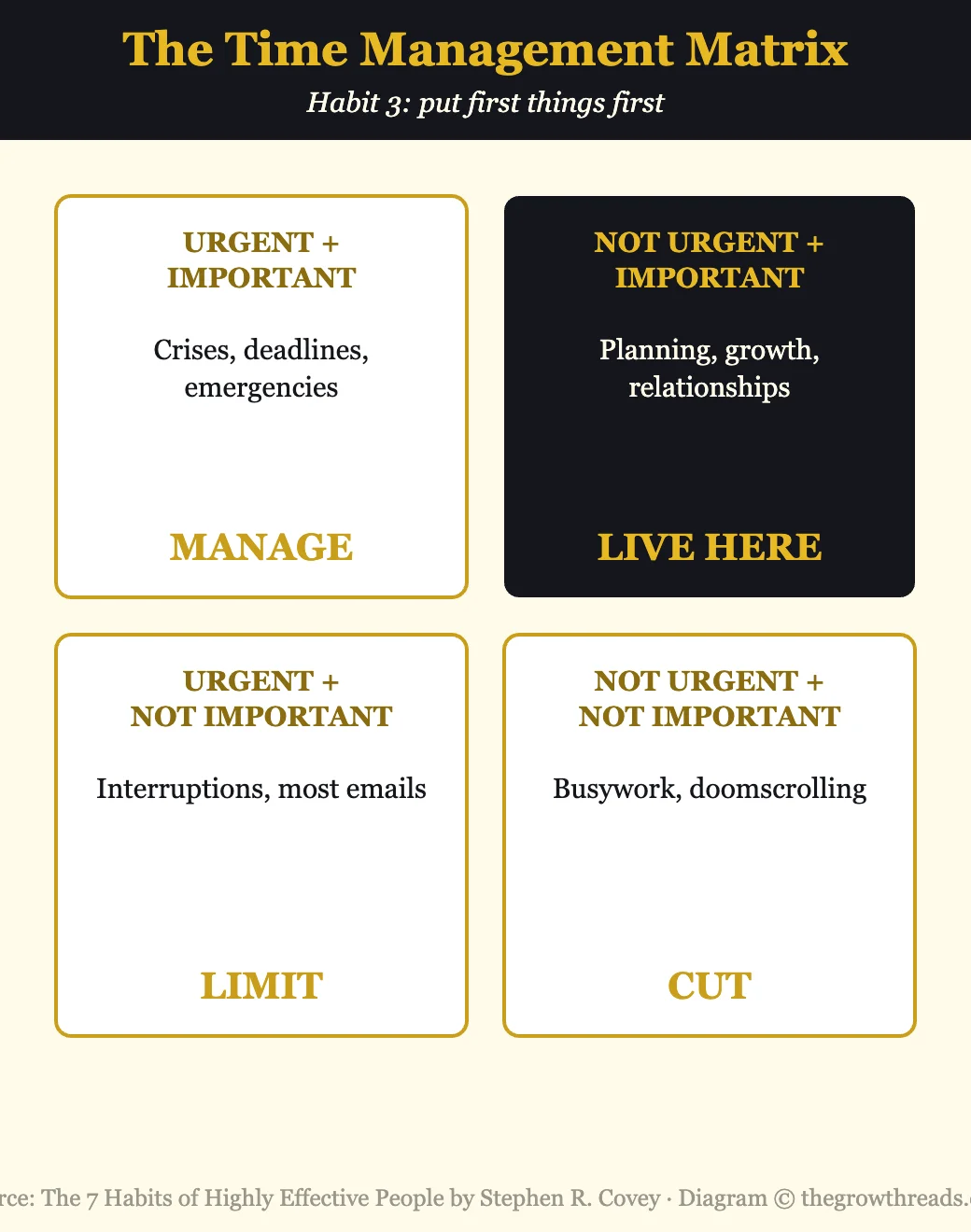
The matrix sorts activities by two questions: is it urgent, and is it important? Most people live reactively in Quadrant 1 (urgent and important — crises) and waste time in Quadrants 3 and 4 (urgent but unimportant interruptions, and outright time-wasting). The secret of effective people, Covey argues, is to live in Quadrant 2 — the important but not urgent work of planning, relationship-building, prevention, and growth. This quadrant never screams for attention, so it requires the discipline to schedule your priorities rather than merely reacting to whatever is loudest.
TGR Note: Covey’s Quadrant 2 is the philosophical parent of two modern productivity classics. Deep Work by Cal Newport is essentially a book about protecting Quadrant 2 from Quadrant 3 distraction, and The One Thing narrows it further to a single priority. If Habit 3 is the principle, those books are the modern operating manuals.
Part 3: The Public Victory — habits 4, 5, and 6
Once you have achieved a private victory over yourself, Covey turns to the public victory of working with others — and he grounds it in a concept called the Emotional Bank Account. Every interaction with another person is either a deposit (kindness, honesty, keeping commitments, apologizing) or a withdrawal (disrespect, broken promises, betrayal). Trust is the balance in that account, and it determines whether communication is easy or fraught. You cannot have effective relationships without a positive balance, and the public-victory habits are how you build one.
Habit 4, Think Win-Win, is a mindset of mutual benefit rooted in an “abundance mentality” — the belief that there is enough success to go around, as opposed to the scarcity mentality that treats every gain by another as a loss for you. Habit 5, Seek First to Understand, Then to Be Understood, Covey calls the single most important principle of interpersonal relations. Most people listen with the intent to reply, filtering everything through their own experience; empathic listening means listening with the intent to genuinely understand the other person’s frame of reference first. Only then have you earned the right to be understood. Habit 6, Synergize, is the creative payoff: when people who trust each other value their differences rather than merely tolerating them, they produce solutions neither could have reached alone — the whole becomes greater than the sum of its parts.
TGR Note: Habit 5 — seek first to understand — is the same skill Chris Voss builds an entire negotiation method around in Never Split the Difference through “tactical empathy,” and it is the warm core of How to Win Friends and Influence People. Covey supplies the principle; those books supply the technique for using it under pressure.
Part 4: Renewal — habit 7, sharpen the saw
The final habit surrounds and sustains the other six. Covey tells the parable of a man frantically sawing a tree who is too busy to stop and sharpen his dull saw — and so takes far longer than he needs to. Habit 7, Sharpen the Saw, is the practice of regular self-renewal so that you preserve and enhance your greatest asset: yourself. Covey identifies four dimensions to renew — the physical (exercise, nutrition, rest), the mental (reading, learning, planning), the social and emotional (service, empathy, meaningful connection), and the spiritual (values, reflection, meaning). Neglect any one and the others suffer; tend all four and you create an upward spiral of growth.
What makes the seven habits cohere is this upward spiral. Renewal strengthens your proactivity, which sharpens your mission, which clarifies your priorities, which improves your relationships — each pass around the loop taking you higher. Covey’s closing argument is that this is not a checklist to complete but a lifelong practice: effectiveness is a direction, not a destination, and the habits are how you keep moving in it. Decades later, the framework still holds up because it is built on principles rather than trends.
TGR Note: Covey names the habits but says less about how to install them mechanically. That is exactly the gap Atomic Habits fills — cue, craving, response, reward — turning Covey’s “be proactive” or “sharpen the saw” from a resolution into a repeatable system. Read Covey for the what and why, and Clear for the how.
Who is The 7 Habits best for — and who should read something else first?
This book is ideal for anyone who wants a comprehensive, principle-based framework for their whole life — students, professionals, leaders, and parents alike. Its scope is its strength: it addresses character, productivity, relationships, and renewal in one coherent system. It is not a light read; Covey’s style is earnest and dense, and the ideas reward patience rather than skimming. If you want something more immediately tactical, start with Atomic Habits for habit mechanics or Getting Things Done for a productivity system, then return to Covey for the deeper framework that gives those tactics a purpose.
Questions to reflect on
- Are you spending more energy on your Circle of Concern or your Circle of Influence?
- If you wrote a personal mission statement today, what would it have to say?
- How much of your week actually goes to Quadrant 2 — important but not urgent — work?
- Whose Emotional Bank Account with you is overdrawn, and what deposit could you make this week?
- In your last disagreement, were you listening to understand or listening to reply?
🔥 Ready to build effectiveness that lasts?
This guide is the map — Covey’s stories and exercises are what turn the habits into a way of living.
How to apply The 7 Habits (7-day plan)
- Day 1 — Practice the pause. Notice one moment between stimulus and response and choose your reaction deliberately (Habit 1).
- Day 2 — Draft a mission statement. Write a few sentences on the values and legacy you want to live by (Habit 2).
- Day 3 — Schedule Quadrant 2. Block one hour this week for important, non-urgent work and defend it (Habit 3).
- Day 4 — Make a deposit. Do one small, genuine act that builds trust with someone whose account is low.
- Day 5 — Listen to understand. In one conversation, reflect back what the other person means before you respond (Habit 5).
- Day 6 — Seek a win-win. Reframe one negotiation or decision so both sides can genuinely gain (Habit 4).
- Day 7 — Sharpen the saw. Do one thing for each dimension — body, mind, heart, and spirit (Habit 7).
Frequently asked questions
Is The 7 Habits of Highly Effective People worth reading?
Yes. Decades after publication it remains one of the most respected books on personal effectiveness because it is built on timeless principles rather than trends. Its frameworks — proactivity, beginning with the end in mind, the time management matrix, win-win, and empathic listening — have become part of the language of self-improvement. It is denser and more earnest than many modern books, so it rewards patient reading, but the payoff is a complete, coherent system for living and working well rather than a handful of disconnected tips.
What are the 7 habits in order?
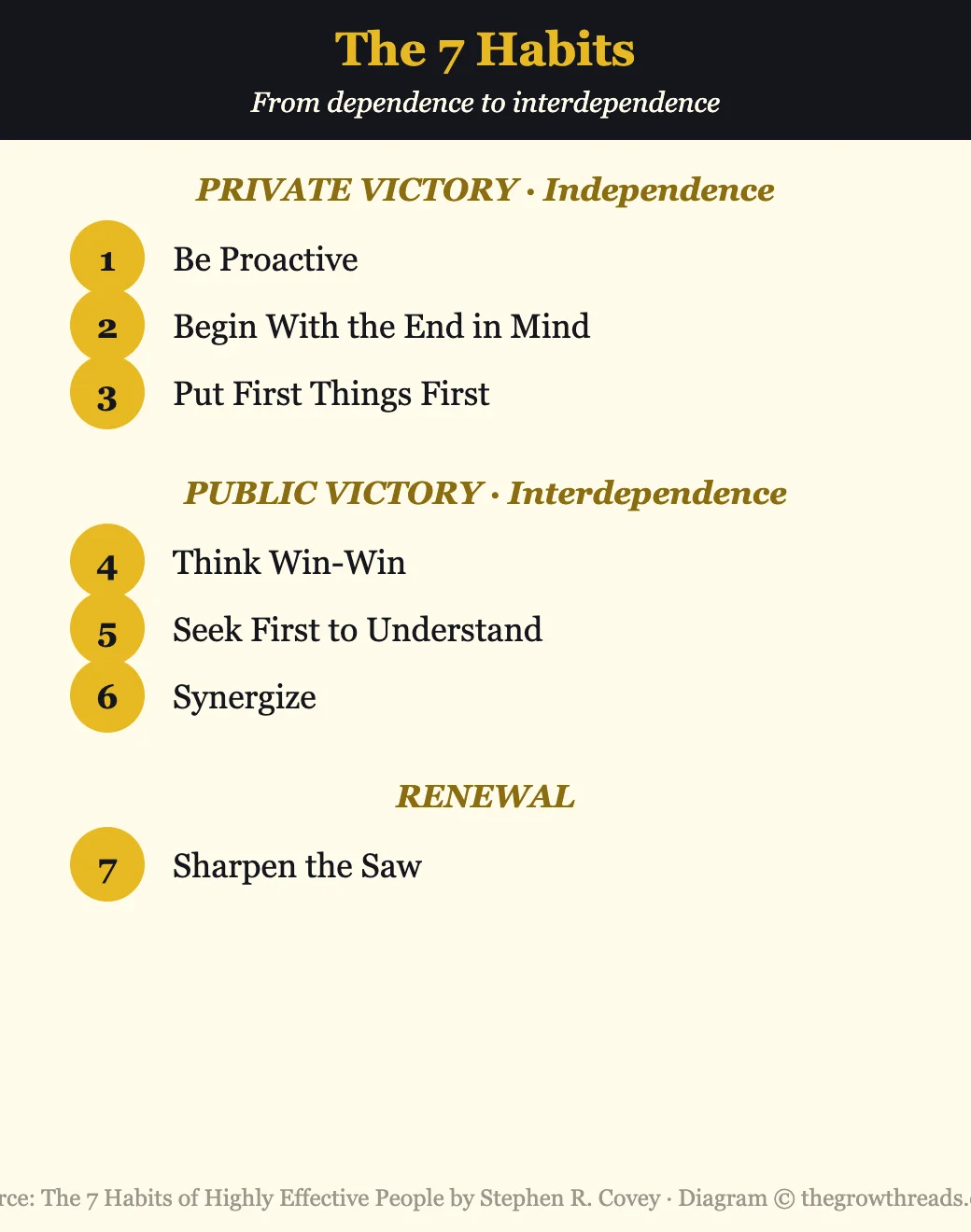
They are: 1) Be Proactive, 2) Begin With the End in Mind, 3) Put First Things First, 4) Think Win-Win, 5) Seek First to Understand, Then to Be Understood, 6) Synergize, and 7) Sharpen the Saw. Covey groups them deliberately: habits 1 to 3 build the “private victory” of self-mastery and independence, habits 4 to 6 build the “public victory” of effective relationships and interdependence, and habit 7 renews you so the other six endure. The order matters — self-mastery comes before working well with others.
What is the main message of The 7 Habits?
That effectiveness is a matter of character, not technique. Covey argues that real, lasting success comes from aligning yourself with timeless principles — integrity, responsibility, fairness, service — rather than from image management or quick hacks. The seven habits are the practical expression of that idea, moving you from dependence to independence to interdependence and renewing you along the way. In short: work from the inside out, changing yourself before trying to change your circumstances.
How long does it take to read The 7 Habits?
The book is around 350 to 380 pages and most readers take about eight hours to finish it, though its density means many people read it slowly and revisit sections. It is designed to be studied rather than skimmed, with exercises throughout. Our summary above captures the core framework in roughly 16 minutes, which is a good way to decide whether to invest in the full, richer read.
What is the time management matrix in The 7 Habits?
It is Covey’s tool for Habit 3, sorting activities by two questions: urgent or not, important or not. This creates four quadrants. Quadrant 1 is urgent and important (crises), Quadrant 2 is important but not urgent (planning, growth, relationships), Quadrant 3 is urgent but not important (interruptions), and Quadrant 4 is neither (time-wasting). Covey argues effective people deliberately spend more time in Quadrant 2, because that prevention-and-growth work reduces crises and produces the highest long-term results.
Is The 7 Habits good for beginners?
Yes, though it asks more of the reader than a typical introductory book. It requires no prior knowledge, but its earnest, concept-heavy style means beginners should be ready to think and take notes rather than breeze through. Many readers find it most valuable when they apply one habit at a time. Those who want a lighter on-ramp can start with a more tactical modern book and come to Covey once they want a deeper, unifying framework.
Is The 7 Habits still relevant today?
Very much so. Because the book is founded on principles rather than technology or trends, its core ideas have aged remarkably well. Proactivity, prioritizing important-over-urgent work, seeking mutual benefit, and empathic listening are, if anything, more relevant in a distracted, polarized age. The examples occasionally feel dated, but the frameworks remain a benchmark that countless newer books build upon, which is a strong sign of their staying power.
Related summaries
- Atomic Habits Summary — the mechanics for actually installing the habits Covey names.
- Deep Work Summary — protecting Quadrant 2 from distraction.
- Getting Things Done Summary — a complete system for putting first things first.
- The One Thing Summary — narrowing to your single highest priority.
- Browse all our best productivity books.
How we analyze books: We work from the full book — reconstructing its core arguments in our own words, adding commentary that connects it to related research and other books in our library, and pressure-testing the advice against how it plays out in real life. We never reproduce the text; we synthesize it. Read our full methodology.
Disclosure: The Growth Reads is reader-supported. When you buy through links on our site we may earn an affiliate commission at no extra cost to you. We only recommend books we believe are worth your time, and our summaries and opinions are written independently.