

⭐⭐⭐⭐✬ 4.5/5
| Actionability: | ⭐⭐⭐⭐⭐ 5/5 |
| Writing Quality: | ⭐⭐⭐⭐ 4/5 |
| Research Depth: | ⭐⭐⭐⭐⭐ 5/5 |
| Accessibility: | ⭐⭐⭐⭐✬ 4.5/5 |
| Lasting Impact: | ⭐⭐⭐⭐⭐ 5/5 |
The foundational text on principled negotiation — developed at Harvard, used by diplomats, CEOs, and anyone who wants to reach better agreements without damaging relationships.
Best for: Professionals, managers, parents, couples, and anyone who negotiates (which is everyone) and wants to stop arguing over positions and start solving problems together.
Reading time: ~5 hours (240 pages) | Difficulty to apply: Low to moderate — the principles are intuitive, but overriding the instinct to argue positions takes conscious practice.
Getting to Yes in one minute
Stop bargaining over positions and start negotiating on interests. Roger Fisher and William Ury, founders of the Harvard Negotiation Project, developed a method called “principled negotiation” that replaces the adversarial dance of demands and concessions with a collaborative problem-solving process. The method rests on four pillars: separate the people from the problem, focus on interests rather than positions, generate options for mutual gain, and insist on objective criteria. When the other side plays hardball, your power comes not from threats but from your BATNA — your Best Alternative To a Negotiated Agreement. The stronger your walkaway option, the stronger your position. This book has been translated into 36 languages, sold over 15 million copies, and reshaped how everyone from hostage negotiators to divorce mediators to business executives approach the table.
Key takeaways
- Separate the people from the problem: every negotiation has a relationship dimension and a substance dimension. Deal with them independently — be soft on people, hard on the problem.
- Focus on interests, not positions: a position is what someone demands. An interest is why they demand it. Behind opposing positions often lie shared or compatible interests that unlock creative agreements.
- Invent options for mutual gain: before deciding, brainstorm. Most negotiations leave value on the table because both sides jump to dividing a fixed pie instead of expanding it first.
- Insist on objective criteria: base agreements on fair standards — market value, expert opinion, legal precedent, industry norms — so outcomes depend on principle, not pressure.
- Know your BATNA: your Best Alternative To a Negotiated Agreement is your source of power. Never accept a deal worse than your best alternative, and invest time in improving your alternatives before negotiating.
- Don’t react — go to the balcony: when emotions run high, mentally step back and observe the negotiation from above. This pause prevents you from saying something destructive and keeps you focused on interests.
- Use “negotiation jujitsu”: when the other side attacks your position, don’t defend. Redirect by asking questions: “Why do you want that? What problem are you trying to solve?” Turn attacks into explorations.
- Make it easy for them to say yes: the best agreement is one both sides feel good about. Frame proposals in terms of the other side’s interests, not just your own.
- Acknowledge emotions openly: unspoken frustration, fear, and anger undermine negotiations. Name the emotions — yours and theirs — so they stop controlling the conversation.
- One text procedure for complex negotiations: have a neutral party draft a single text, then refine it together. This prevents positional entrenchment and keeps everyone working from the same starting point.
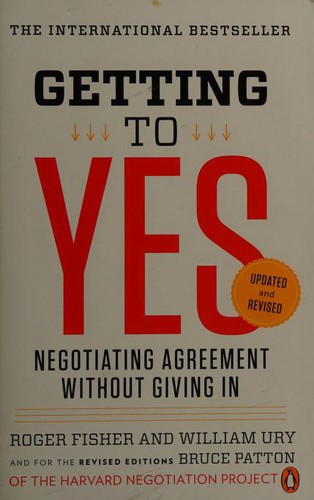
What is Getting to Yes about?
Getting to Yes is a negotiation guide by Roger Fisher, William Ury, and Bruce Patton that introduces “principled negotiation,” a method developed at the Harvard Negotiation Project. It teaches readers to negotiate agreements that satisfy both parties’ underlying interests by separating people from problems, focusing on interests over positions, generating creative options, and using objective criteria.
About the authors
Roger Fisher was a professor at Harvard Law School and the director of the Harvard Negotiation Project. He served as a consultant to governments and organizations worldwide, helping negotiate everything from the Camp David Accords to corporate mergers. William Ury, co-founder of the Harvard Negotiation Project, is an anthropologist and negotiation advisor who has mediated conflicts ranging from boardroom disputes to ethnic wars in the Middle East. Bruce Patton, who contributed significantly to the third edition, is also a Harvard Negotiation Project co-founder and co-author of Difficult Conversations.
Key concepts at a glance
| Concept | What it means | Use it when |
|---|---|---|
| Principled Negotiation | Decide issues on merit, not through a contest of wills | Any negotiation where you want a fair, durable outcome |
| Positions vs Interests | Positions are demands; interests are the underlying needs behind them | You hit an impasse over competing demands |
| BATNA | Best Alternative To a Negotiated Agreement — your walkaway option | Determining your negotiation power and bottom line |
| Inventing Options | Brainstorming multiple possible agreements before committing | The negotiation feels zero-sum or stuck |
| Objective Criteria | Fair standards independent of either side’s will | Disagreement about what is fair or reasonable |
| Negotiation Jujitsu | Redirecting attacks into problem-solving questions | The other side is aggressive or positional |
| One-Text Procedure | A single draft refined collaboratively via a mediator | Multi-party negotiations or complex deals |
Part 1: The problem with positional bargaining
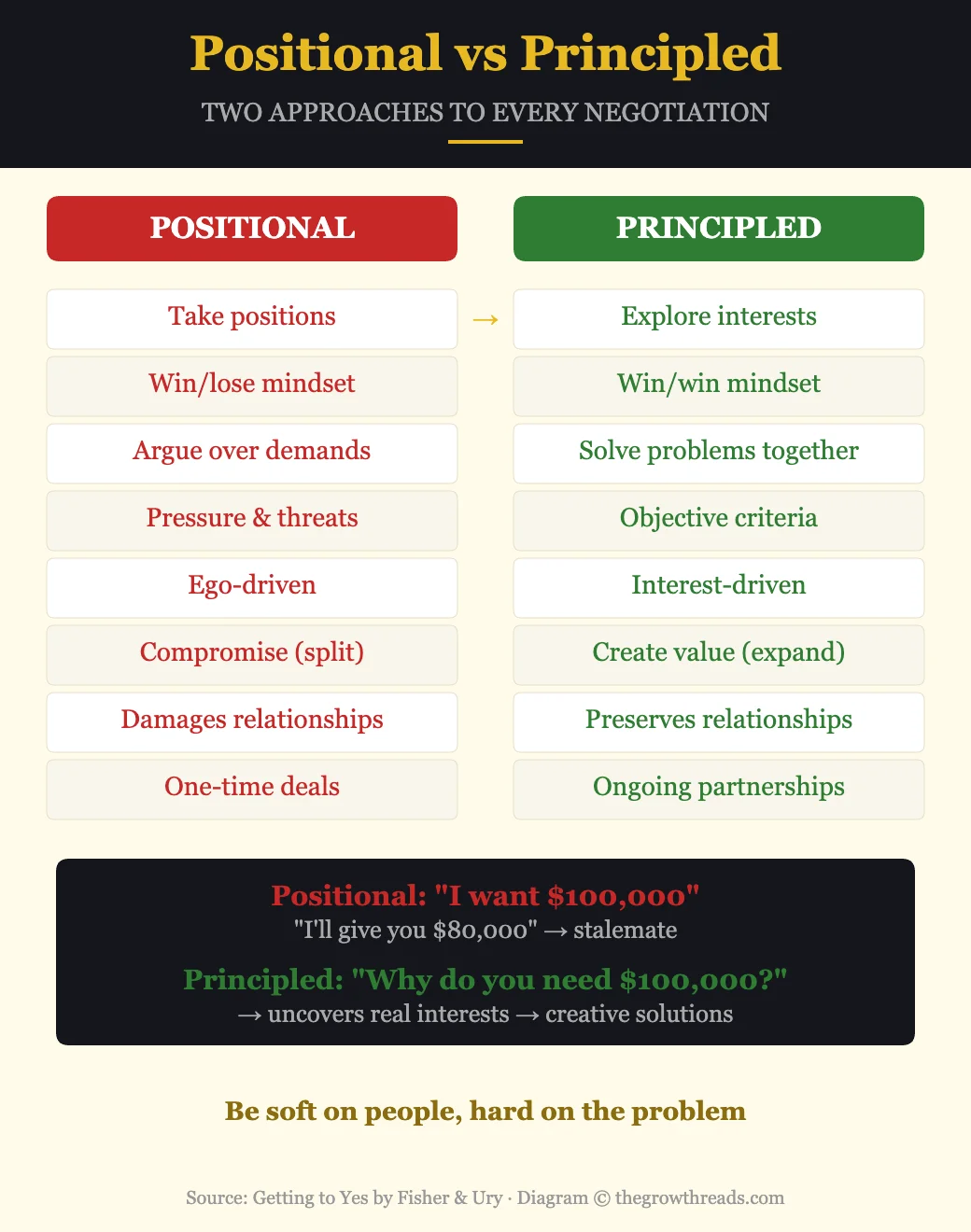
Fisher and Ury open by diagnosing what is wrong with the way most people negotiate: they bargain over positions. One side states a demand, the other states a counter-demand, and both sides dig in. Each concession feels like a loss. The process becomes a contest of wills where the relationship and the outcome both suffer. The harder you try to win, the more you damage the relationship. The more you try to preserve the relationship, the more you give away on substance.
Positional bargaining fails on three dimensions. First, it produces unwise agreements — outcomes that don’t meet the legitimate interests of either side and leave value on the table. Second, it is inefficient — the tactical dance of offers and counteroffers wastes enormous time and energy. Third, it endangers relationships — the adversarial dynamic creates resentment that lingers long after the deal is signed. The more people and issues involved, the worse these problems become.
The alternative is principled negotiation, also called “negotiation on the merits.” Instead of arguing over what each side is willing to accept, you focus on what is fair, what is possible, and what serves both sides’ real interests. The goal is not to split the difference but to find a solution that is better for both sides than the obvious compromise.
Part 2: The four principles in practice
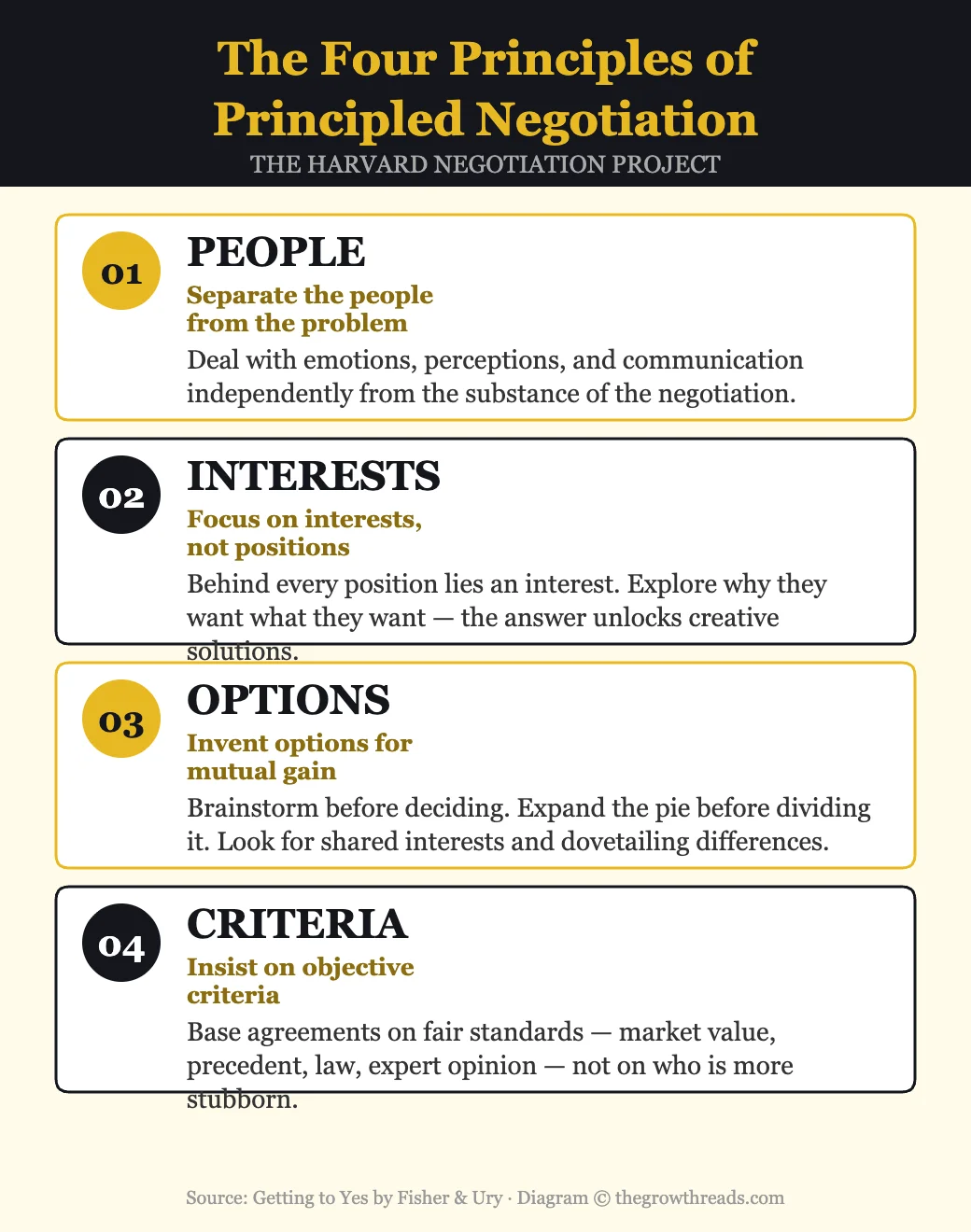
The first principle — separate the people from the problem — addresses the reality that every negotiation has two levels: the substance (what you are negotiating about) and the relationship (how you feel about each other). Fisher and Ury argue that these must be handled independently. When you mix them, you end up either sacrificing substance to preserve the relationship or damaging the relationship to win on substance. Neither outcome is acceptable.
In practice, this means actively managing three people-level challenges: perception (each side sees the situation differently), emotion (frustration, fear, and anger cloud judgment), and communication (assumptions and misunderstandings derail even well-intentioned negotiations). Fisher and Ury recommend putting yourself in their shoes before reacting, acknowledging emotions explicitly rather than ignoring them, and listening more than you speak.
The second principle — focus on interests, not positions — is the core intellectual contribution of the book. A position is what someone says they want (“I want the office with the window”). An interest is why they want it (“I need natural light to work effectively”). Two people can have incompatible positions but compatible interests. Perhaps one needs light and the other needs quiet — the window office and the interior office serve different interests perfectly. The key move is to ask “Why?” and “Why not?” until the real interests surface.
The third principle — invent options for mutual gain — addresses the poverty of imagination that plagues most negotiations. Under pressure, people see only two options: my way or your way. Fisher and Ury recommend a structured brainstorming session where judgment is suspended, creativity is encouraged, and the goal is to expand the pie before dividing it. Look for shared interests (both sides want a durable agreement), dovetailing interests (one side values X, the other values Y), and low-cost, high-benefit trades.
The fourth principle — insist on objective criteria — protects the process from degenerating back into a contest of wills. When disagreement persists, appeal to standards that are independent of either side’s desires: market rates, precedent, expert opinion, legal norms, scientific evidence. This reframes the question from “What will you accept?” to “What is fair?” — a question both sides can engage with productively.
Part 3: BATNA and the power to walk away
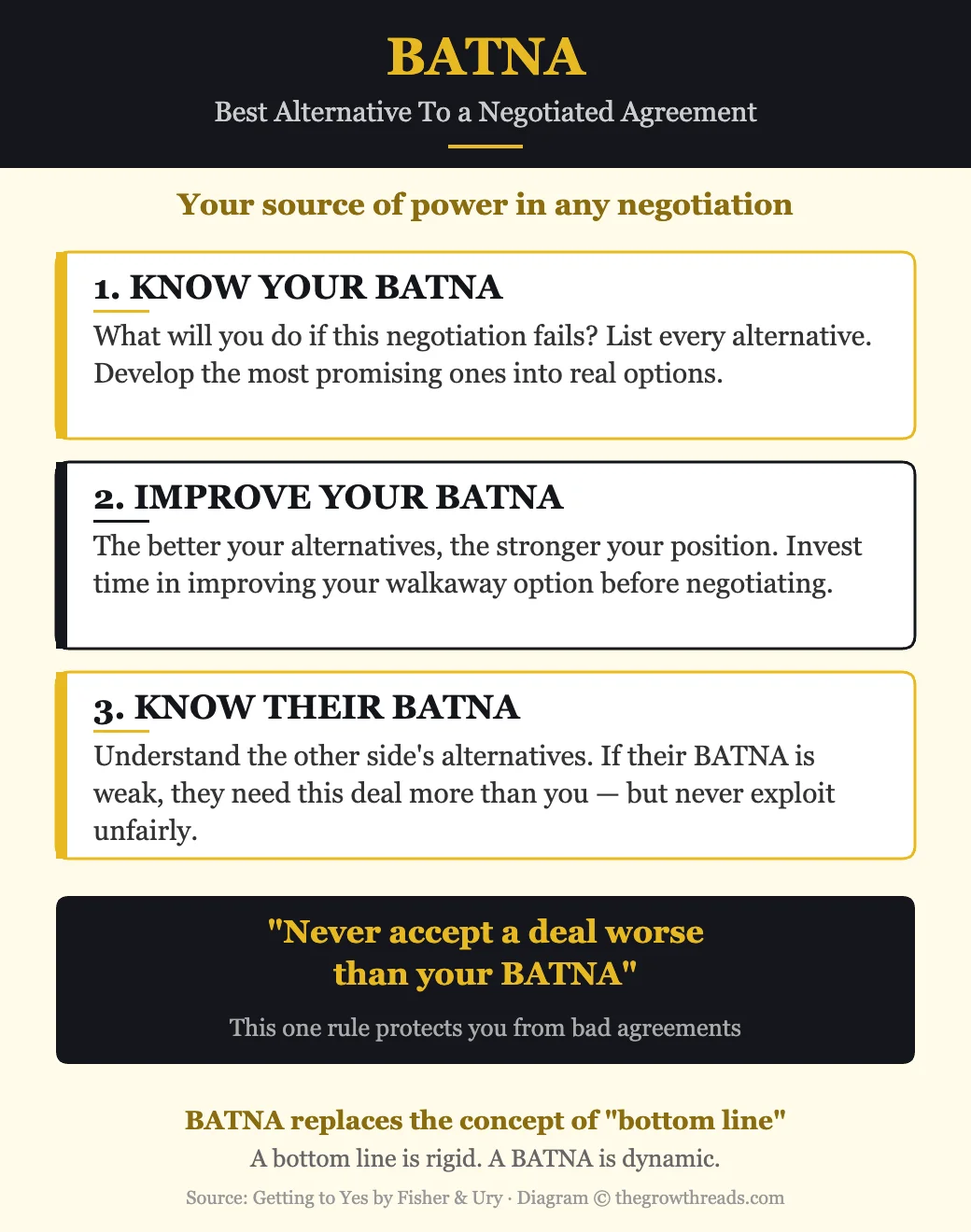
The most practical concept in Getting to Yes is the BATNA — Best Alternative To a Negotiated Agreement. Your BATNA is what you will do if the negotiation fails. It is not your bottom line (a fixed number below which you won’t go) but your walkaway option — a living, developing alternative that gives you genuine power.
Fisher and Ury argue that negotiation power does not come from wealth, authority, or threats. It comes from the quality of your alternatives. A job candidate with three competing offers has more power than a CEO with no other candidates. A supplier with ten potential customers has more power than a monopoly buyer with no alternatives. The rule is absolute: never accept a deal worse than your BATNA.
The three steps to using BATNA effectively are: first, identify all your alternatives (not just the most obvious one). Second, develop the most promising alternatives into concrete options — actually pursue the competing job offer, actually get quotes from other suppliers. Third, assess the other side’s BATNA. If their alternatives are weak, they need this deal more than you do — but Fisher and Ury emphasize using this knowledge to craft fair agreements, not to exploit.
BATNA replaces the traditional concept of a “bottom line,” which Fisher and Ury argue is dangerously rigid. A bottom line is a fixed number decided in advance that prevents you from accepting a bad deal but also prevents you from accepting creative alternatives you hadn’t imagined. BATNA is dynamic — it grows or shrinks as your alternatives develop, and it allows you to evaluate each proposal on its merits relative to your actual options.
Part 4: What if they play dirty?
The final sections of Getting to Yes address the objection that principled negotiation only works when both sides play fair. Fisher and Ury acknowledge that many negotiators use dirty tricks — deception, psychological warfare, positional pressure tactics — and offer a systematic response they call “negotiation jujitsu.”
The core move is to refuse to react. When the other side attacks your position, don’t defend it. When they pressure you, don’t counterpressure. Instead, redirect the energy. Ask questions: “Why do you think that’s fair?” “Can you help me understand your reasoning?” “What standard would you propose for deciding this?” Every attack becomes an opportunity to bring the conversation back to interests, options, and criteria.
For truly difficult negotiators, Fisher and Ury recommend the “one-text procedure”: bring in a neutral third party who creates a single draft agreement, then circulates it to both sides for criticism and revision. Each round improves the draft without either side having to make concessions from their positions. The Camp David Accords between Israel and Egypt — one of the most famous negotiations of the twentieth century — were achieved using essentially this method, with the United States mediating between the two sides using a single text refined over thirteen days.
Fisher and Ury also address dirty tricks directly: lies, threats, take-it-or-leave-it ultimatums, and calculated delays. Their advice is consistent: name the tactic without attacking the person. “It seems like you’re presenting this as a final offer. I understand the pressure to close, but I think we can both do better if we explore the interests behind our positions.” This response acknowledges the tactic, refuses to submit to it, and redirects toward principled negotiation — all without escalating the conflict.
Who is Getting to Yes best for — and who should read something else first?
This book is essential for anyone who negotiates — which means everyone. Whether you are negotiating a salary, a contract, a household chore schedule, or an international treaty, the principled negotiation framework applies. It is particularly valuable for people who tend toward one of two extremes: those who are too aggressive (and damage relationships) and those who are too accommodating (and give away too much). The book provides a third way that is neither hard nor soft.
If you want the tactical, street-level negotiation skills that complement this strategic framework, read Never Split the Difference by Chris Voss. If your negotiation challenges are primarily within close relationships — with partners, children, or family — start with Nonviolent Communication by Marshall Rosenberg, which translates many of the same principles into a relationship-focused language.
Questions to reflect on
- In your last disagreement, were you arguing about positions (what you each wanted) or exploring interests (why you each wanted it)?
- What is your BATNA in a negotiation you are currently facing — and have you invested enough time in developing it?
- When someone pushes back on your proposal, is your instinct to defend harder or to ask “Why?” — and which approach gets better results?
- Can you recall a negotiation where you left value on the table because both sides jumped to dividing the pie instead of expanding it first?
- How would your most difficult professional relationship change if you consistently separated the person from the problem?
🔥 Ready to negotiate smarter — without sacrificing relationships?
Getting to Yes gives you the Harvard-developed framework used by diplomats, CEOs, and mediators worldwide.
How to apply Getting to Yes (7-day plan)
- Day 1 — Map your next negotiation: Identify a negotiation you are currently facing (work, home, business). Write down your position. Then write down your interests — the reasons behind that position.
- Day 2 — Calculate your BATNA: List every alternative you have if this negotiation fails. Pick the best one. Ask yourself: is this alternative developed enough, or should you invest time improving it?
- Day 3 — Map their interests: Put yourself in the other side’s shoes. What do they really need? What are they worried about? Write down at least three interests behind their position.
- Day 4 — Brainstorm options: Spend 20 minutes generating at least ten possible agreements — without judging any of them. Include creative combinations, trade-offs, and ideas that address both sides’ interests.
- Day 5 — Find objective criteria: Research fair standards that could apply: market rates, expert opinions, precedent, industry norms. Prepare to frame your proposal in terms of what is fair, not what you want.
- Day 6 — Practice “going to the balcony”: In your next tense conversation (at work or at home), mentally step back for five seconds before responding. Name the emotion you are feeling. Then respond to the interest, not the attack.
- Day 7 — Use one question: In any negotiation or disagreement today, replace your instinctive counter-argument with one question: “Help me understand why that is important to you.” Notice how the conversation shifts.
Frequently asked questions
What is principled negotiation?
Principled negotiation is a method developed at the Harvard Negotiation Project that focuses on deciding issues based on merit rather than through a contest of wills. It rests on four pillars: separate the people from the problem, focus on interests rather than positions, generate options for mutual gain, and insist on objective criteria. The goal is to reach agreements that satisfy both parties’ underlying needs while preserving the relationship. It is designed to work whether the other side cooperates or not.
What is BATNA and why does it matter?
BATNA stands for Best Alternative To a Negotiated Agreement. It is what you will do if the current negotiation fails — your walkaway option. BATNA matters because it is the true source of negotiation power. A strong BATNA means you can walk away from a bad deal; a weak BATNA means you are vulnerable to accepting unfavorable terms. Fisher and Ury recommend three steps: identify all your alternatives, develop the most promising ones into concrete options, and assess the other side’s BATNA to understand the balance of power.
What is the difference between positions and interests?
A position is what someone says they want — a specific demand or solution (“I want a 20% raise”). An interest is why they want it — the underlying need, concern, or motivation (“I need to feel valued, cover my increased expenses, and see a path forward in my career”). Positions are often incompatible, but interests are frequently shared or complementary. By asking “Why?” and “Why not?” you move from arguing about fixed positions to exploring the interests beneath them, which opens the door to creative solutions neither side initially imagined.
How do you negotiate with someone who plays dirty?
Fisher and Ury recommend “negotiation jujitsu” — refusing to react to attacks and instead redirecting the energy. When someone makes threats, attacks your position, or uses deceptive tactics, do not counter-attack. Instead, ask questions: “Can you explain how that is fair?” “What problem are you trying to solve?” Name the tactic without attacking the person: “It seems like this is being presented as a final offer. I would like to understand the reasoning behind it.” This approach refuses to reward dirty tactics while keeping the door open for principled discussion.
Does Getting to Yes work in personal relationships?
Yes, and Fisher and Ury explicitly designed the framework to apply beyond business. The principles — separating people from problems, exploring interests, and generating creative options — are especially powerful in personal relationships where preserving the relationship matters as much as resolving the issue. The book’s emphasis on acknowledging emotions and understanding the other side’s perspective makes it highly applicable to conflicts with partners, family members, roommates, and friends.
How is Getting to Yes different from Never Split the Difference?
Getting to Yes provides the strategic framework for principled negotiation — the philosophical foundation and structural approach. Never Split the Difference by Chris Voss adds tactical tools from FBI hostage negotiation: labeling emotions, calibrated questions (“How am I supposed to do that?”), the accusation audit, and tactical empathy. Fisher and Ury emphasize rationality and fairness; Voss emphasizes emotional intelligence and influence. They are complementary: Getting to Yes tells you what to aim for, Never Split the Difference tells you how to get there in the heat of the moment.
Is Getting to Yes still relevant today?
Extremely. First published in 1981 and updated in 2011, Getting to Yes remains the most widely taught negotiation text in the world. It is required reading at Harvard, Stanford, and Wharton business schools, and is used by the United Nations, the World Bank, and major corporations. The principles are timeless because human psychology has not changed: people still confuse positions with interests, react emotionally under pressure, and leave value on the table by failing to brainstorm. The third edition includes responses to common criticisms and updated examples.
Related summaries
- Never Split the Difference — Chris Voss’s FBI negotiation playbook, the tactical complement to Getting to Yes’s strategic framework.
- Crucial Conversations — Tools for navigating high-stakes conversations where emotions are strong and opinions differ.
- Difficult Conversations — Written by Fisher and Ury’s Harvard colleagues, extending principled negotiation into everyday personal and professional conflicts.
- Best Relationship Books — Our complete curated list of the most impactful relationship and communication books.