

★★★★☆ 4.4/5 — A research-backed guide to the leadership behaviors that double your team’s output without adding headcount.
Best for: Managers who suspect they are unintentionally suppressing their team’s intelligence, executives building high-performance cultures, and anyone promoted because of expertise who now needs to lead through others.
Reading time: ~6 hours (this summary: 18 min)
Difficulty to apply: Medium — the concepts are immediately recognizable; the hardest part is resisting the urge to be the smartest person in the room.
Multipliers in One Minute
Some leaders make everyone around them smarter and more capable — while others drain intelligence and capability from their teams, often with the best of intentions. Liz Wiseman studied 150 leaders across 35 companies in four continents and found that the best leaders (“Multipliers”) get two times more capability from their people than the worst (“Diminishers”) — with the same team, the same budget, and the same constraints. The difference is not charisma or experience but five specific, learnable disciplines that shift a leader’s role from being the genius to being the genius maker.
Key Takeaways
- Multipliers get 2x more from their people: Wiseman’s research showed Multipliers extract an average of 95% of people’s capability, while Diminishers extract only 48% — less than half.
- The core assumption defines everything: Multipliers assume people are smart and will figure it out. Diminishers assume people need them to figure it out for them.
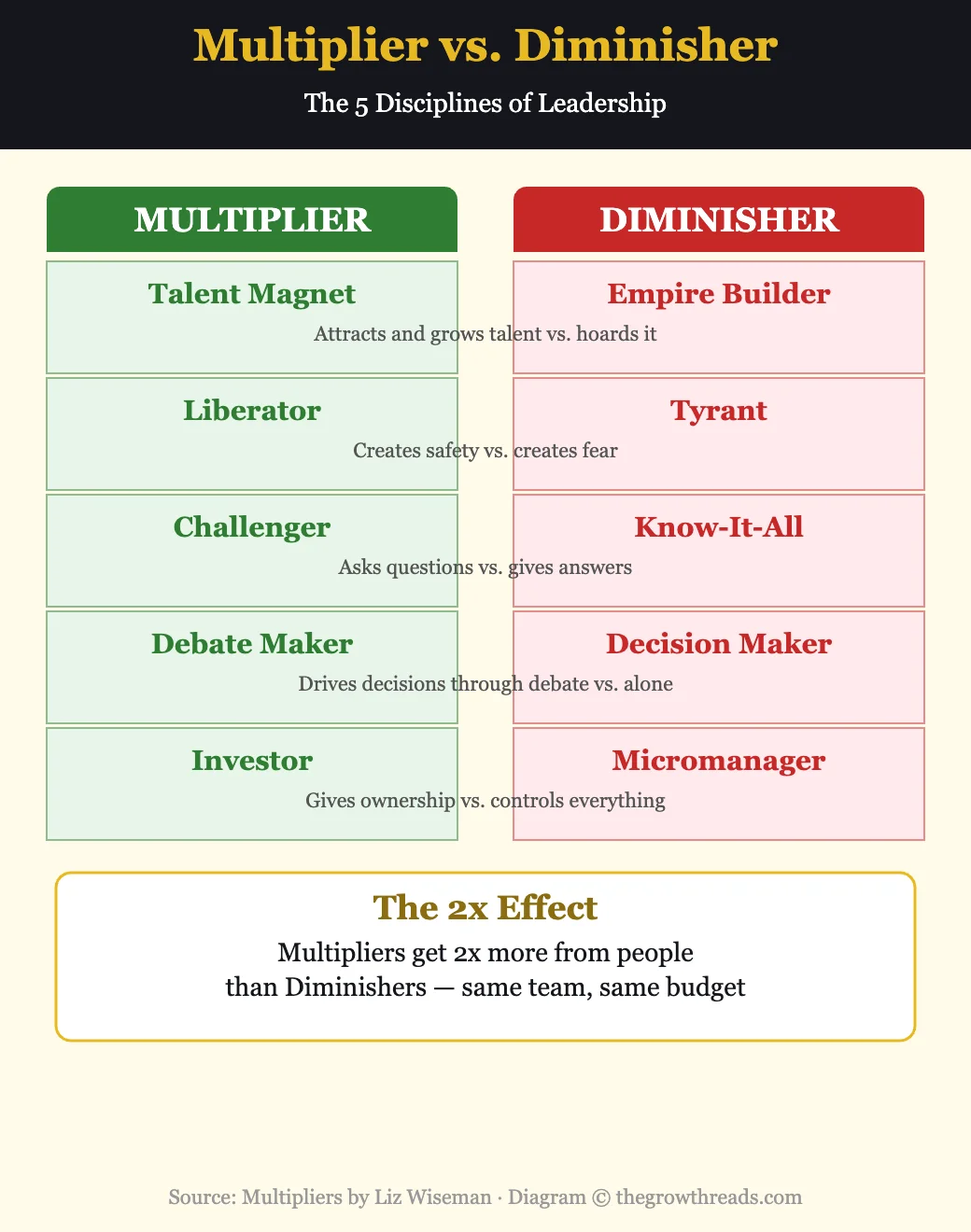
- Five disciplines separate the two: Talent Magnet vs. Empire Builder, Liberator vs. Tyrant, Challenger vs. Know-It-All, Debate Maker vs. Decision Maker, and Investor vs. Micromanager.
- Most Diminishers are accidental: The most dangerous Diminishers are well-intentioned leaders whose strengths (quick thinking, deep expertise, protective instincts) have an unintended suppressive effect on their teams.
- The Idea Fountain is the most common accidental Diminisher: Leaders who constantly share brilliant ideas inadvertently signal that the team’s ideas are not needed.
- Multipliers create space by playing fewer chips: When leaders contribute less frequently, their contributions carry more weight and the team fills the space with their own thinking.
- Debate is a Multiplier tool, not a time-waster: Multipliers use rigorous debate to drive sound decisions and build the team’s collective understanding, not to show off.
- Ownership transfers through the 51% vote: Multipliers give team members majority ownership of decisions, keeping enough stake to guide but not enough to override.
- Hard work grows people; easy work shrinks them: Multipliers stretch people beyond their comfort zones because challenge, not comfort, develops capability.
- You can start with one practice: Wiseman recommends picking one Multiplier behavior and practicing it for 30 days before adding another.
What Is Multipliers About?
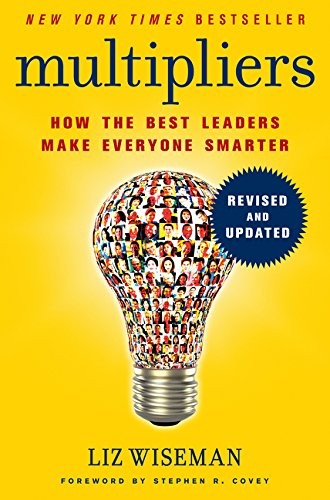
Multipliers presents research from 150 leaders across 35 companies showing that certain leadership behaviors consistently amplify team intelligence and output, while others suppress it. Liz Wiseman identifies five disciplines that distinguish “Multipliers” (leaders who get 2x from their people) from “Diminishers,” and provides a practical framework for any leader to make the shift — starting with recognizing their own accidental diminishing behaviors.
About the Author
Liz Wiseman is a researcher, executive advisor, and former Vice President of Oracle University, where she was responsible for developing leaders across 140 countries. Her frustration with brilliant executives who seemed to make everyone around them less capable drove her to study the phenomenon systematically. The resulting research, involving interviews with professionals on four continents, became one of the most influential leadership books of the past decade. She is also the author of Rookie Smarts and Impact Players, and her work has been adopted by companies including Apple, Google, Microsoft, Nike, and Salesforce. Explore all Liz Wiseman book summaries →
Key Concepts at a Glance
| Concept | What It Means | Use It When |
|---|---|---|
| Multiplier | A leader who amplifies the intelligence and capability of everyone around them | You want to get dramatically more from your team without adding resources |
| Diminisher | A leader who drains capability by making themselves the center of intelligence | You notice your team is underperforming despite having talented people |
| Accidental Diminisher | A well-intentioned leader whose strengths have suppressive side effects | You are working harder than ever but your team seems passive or disengaged |
| Talent Magnet | A leader who attracts, develops, and exports talent | You want to build a reputation that makes top performers seek out your team |
| Liberator | A leader who creates intense but safe environments that demand best thinking | Your team is afraid to take risks or share unconventional ideas |
| Challenger | A leader who defines opportunities that stretch people beyond their comfort zone | Your team is comfortable but no longer growing |
| Debate Maker | A leader who uses rigorous debate to drive sound decisions | Decisions are being made too fast without adequate input |
| Investor | A leader who gives ownership and accountability rather than jumping in to rescue | You keep solving problems that your team should be solving themselves |
Part 1: The Multiplier Effect — Why Some Leaders Double Output
Wiseman opens with a question every professional has experienced: why do some leaders make you feel smart, capable, and energized, while others — sometimes equally brilliant — leave you feeling drained and small? Her research program at Oracle, later expanded globally, quantified the difference. When she asked people to rate how much of their capability they brought to work under different leaders, the average for Multipliers was 95% and for Diminishers was 48%.
The implication is staggering: organizations do not have a talent shortage — they have a leadership shortage. The same team, given a Multiplier leader, performs at twice the level. Wiseman is careful to note that this is not about being a “nice” leader versus a “tough” one. Many Multipliers are intensely demanding. The difference lies in one foundational assumption: Multipliers believe people are smart and will figure things out if given the right challenge and ownership. Diminishers believe people will not figure it out without them.
This assumption operates as a self-fulfilling prophecy. Under a Diminisher, smart people learn to wait for direction, withhold their best ideas (why bother?), and operate at a fraction of their capacity. Under a Multiplier, the same people volunteer ideas, take initiative, and stretch beyond what they thought possible. Wiseman describes this as the “2x effect” — not a metaphor but a measurable, consistent finding across industries and cultures.
Part 2: The Five Disciplines — Talent Magnet, Liberator, and Challenger
Wiseman organizes the Multiplier-Diminisher difference into five disciplines, each representing a paired contrast. The first three disciplines focus on creating the conditions for intelligence to flow.
Talent Magnet vs. Empire Builder: Multipliers attract top talent because they are known for developing people. They look for “native genius” — the thing each person does naturally and effortlessly — and then position people so that genius is fully utilized. Critically, Multipliers are also comfortable exporting talent: letting their best people move on to bigger roles elsewhere, which paradoxically makes even more people want to work for them. Empire Builders, by contrast, hoard talent, acquire people for their own prestige, and underutilize them — talented people join their teams and then stagnate.
Liberator vs. Tyrant: Multipliers create an environment of both safety and pressure. People feel safe to think, experiment, and make mistakes — but they also feel an intense expectation to bring their very best. Wiseman calls this “an intensely demanding work environment where people feel free.” Tyrants create environments of fear where people censor themselves. The Liberator achieves this balance through two specific moves: they create space by restraining their own contributions (speaking less, listening more) and they demand best work by making it clear that effort without quality is not acceptable.
Challenger vs. Know-It-All: Multipliers lead by asking questions and framing challenges rather than by providing answers. When a Multiplier sees an opportunity, they define it, set a bar that requires a stretch, and then hand the problem to the team. The Know-It-All, by contrast, has already figured out the answer and directs the team to execute their vision. The difference in engagement is dramatic: people working for a Challenger own the solution because they created it; people working for a Know-It-All execute but do not invest, because the solution was never theirs.
Part 3: Debate Maker, Investor, and the Accidental Diminisher
Debate Maker vs. Decision Maker: Multipliers drive decisions through rigorous, structured debate. They frame the question, assemble the right people, demand preparation, and then facilitate a process where data and logic — not politics or hierarchy — determine the outcome. The decision itself may still be made by the leader, but the team’s intelligence shapes it. Decision Makers (in the Diminisher sense) make decisions efficiently but alone, depriving the team of understanding and buy-in. The result: the Diminisher’s team executes reluctantly because they never understood the reasoning behind the decision.
Investor vs. Micromanager: The final discipline addresses what happens after work is assigned. Multipliers invest in their people: they provide resources, teach when asked, and hold people accountable — but they do not take over. When a team member struggles, the Investor’s instinct is to coach, not rescue. The Micromanager’s instinct is to jump in and “help,” which communicates a devastating message: “I do not trust you to handle this.” Wiseman introduces the concept of giving “51% of the vote” — making the team member the majority owner of the decision while the leader retains enough stake to guide without overriding.
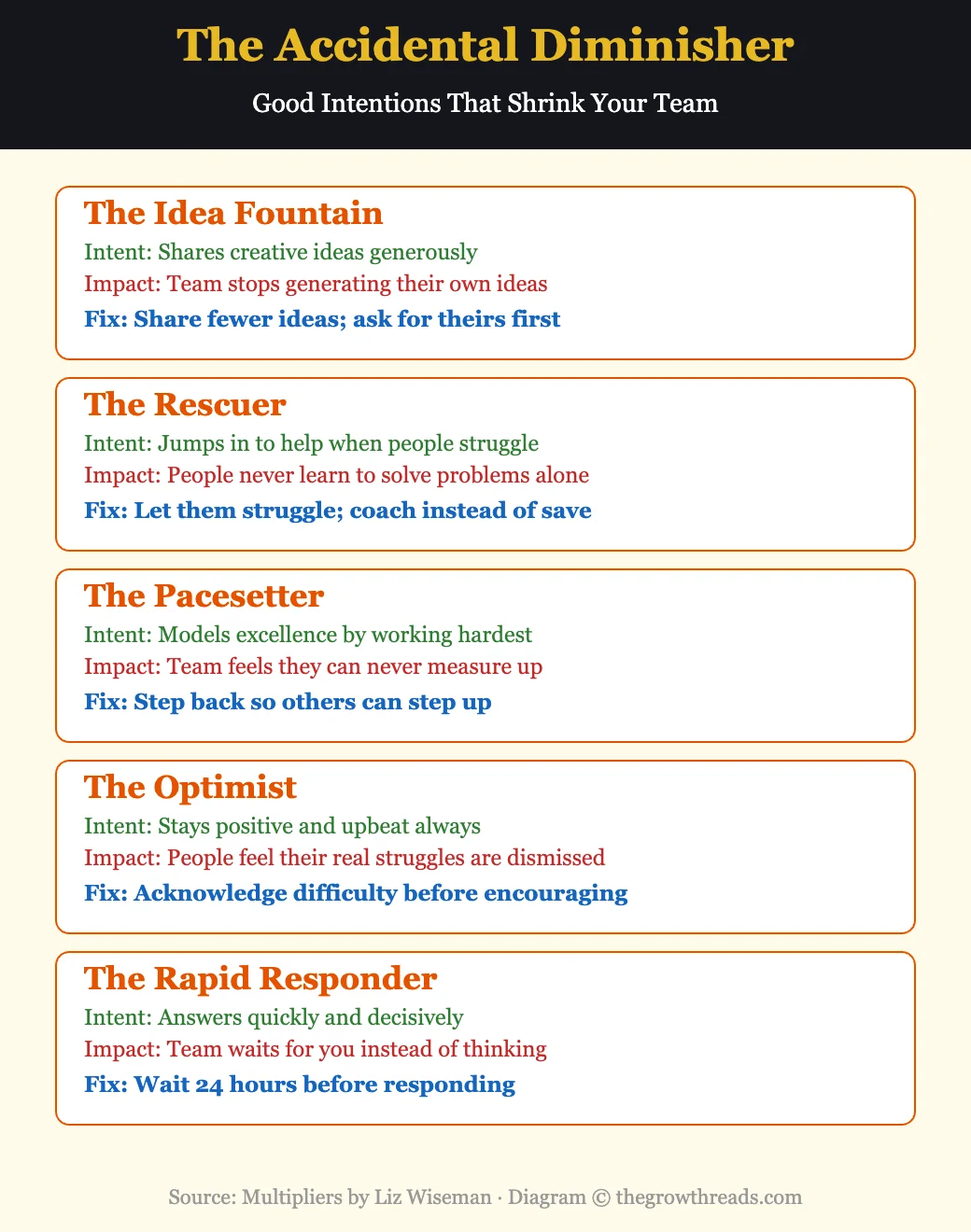
Perhaps the most powerful chapter in the book is the one on “Accidental Diminishers” — leaders whose genuine strengths have unintended suppressive effects. The Idea Fountain has so many creative ideas that the team stops generating their own. The Rescuer jumps in whenever someone struggles, preventing them from learning through difficulty. The Pacesetter works harder than everyone, inadvertently signaling that no one else can measure up. The Optimist stays relentlessly positive, which makes people feel their real struggles are dismissed. Wiseman reports that after studying 150 leaders, she found that the majority of Diminishers were accidental — well-intentioned leaders blind to the impact of their best qualities.
Part 4: Becoming a Multiplier — The Practical Shift
Wiseman is pragmatic about change. She does not suggest you overhaul your leadership style overnight. Instead, she recommends the “30-day Multiplier challenge”: pick one discipline where you score lowest, choose one specific practice within that discipline, and work on it exclusively for 30 days. Only after the first behavior becomes habitual do you add a second.
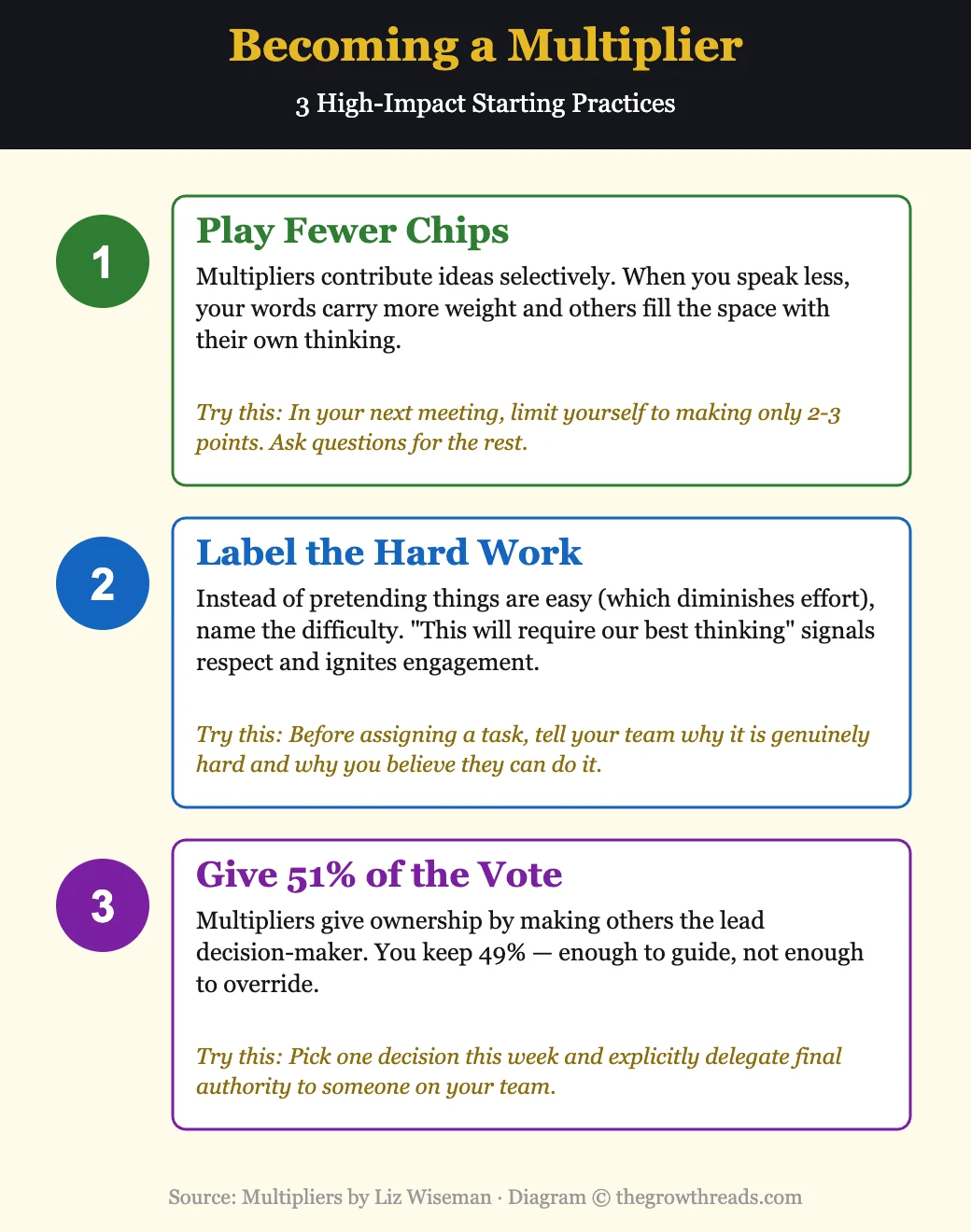
Three starting practices she recommends most frequently are: “Play fewer chips” (speak less, ask more, contribute ideas selectively so each one carries more weight), “Label the hard work” (instead of making things sound easy, name the difficulty explicitly — “This is genuinely hard, and I believe this team can crack it”), and “Give 51% of the vote” (explicitly hand decision-making authority to a team member, keeping your role as advisor rather than decider).
Wiseman also addresses how to work for a Diminisher — a situation most professionals will face at some point. Her advice is counterintuitive: instead of waiting for permission, multiply yourself. Volunteer information, make your thinking visible, invite the leader into a debate (even if they did not ask for one), and find small pockets of autonomy to demonstrate capability. This does not always transform the Diminisher, but it protects your own capacity and occasionally shifts the dynamic.
Who Is Multipliers Best For — and Who Should Read Something Else First?
Multipliers is ideal for mid-level managers and senior leaders who want to dramatically increase team performance without adding headcount. It is especially powerful for technical experts who were promoted into leadership because of their expertise and now need to lead through others rather than through their own brilliance. HR professionals and executive coaches will also find the diagnostic framework invaluable.
If your leadership challenge is more about building trust and psychological safety than amplifying intelligence, start with Dare to Lead — Brene Brown covers the vulnerability foundation that makes Multiplier behaviors possible. If you are looking for organizational transformation rather than individual leadership change, Good to Great provides the systems-level complement. And if your challenge is self-leadership — disciplining your own ego before leading others — Ego Is the Enemy is an excellent prerequisite.
Questions to Reflect On
- Think about the best leader you have ever worked for. Which of the five Multiplier disciplines did they practice most? How did it feel to work under that discipline?
- Which Accidental Diminisher type — Idea Fountain, Rescuer, Pacesetter, Optimist, or Rapid Responder — do you most identify with? What evidence supports that assessment?
- In your last three team meetings, how much of the airtime did you take versus your team? What would change if you cut your contribution by 50%?
- Is there a decision this week that you could hand to a team member with 51% of the vote? What would it take for you to trust them with it?
- If you asked your team anonymously whether you are more of a Multiplier or a Diminisher, what do you think they would say? Are you willing to actually ask?
🔥 Ready to double your team’s output?
Multipliers shows you the five disciplines that make everyone around you smarter, more capable, and more engaged.
How to Apply Multipliers (7-Day Plan)
- Day 1 — Take the Diminisher audit: Review the five Accidental Diminisher types (Idea Fountain, Rescuer, Pacesetter, Optimist, Rapid Responder). For each, write down a specific recent example where you may have exhibited that behavior. Ask a trusted colleague to validate your self-assessment.
- Day 2 — Choose your discipline: Of the five Multiplier disciplines (Talent Magnet, Liberator, Challenger, Debate Maker, Investor), identify the one where you are weakest. This is your 30-day focus area. Write down why this discipline matters for your team right now.
- Day 3 — Play fewer chips: In every meeting today, limit yourself to two substantive comments. For the rest of the time, ask questions: “What do you think?” “What are we missing?” “Who has a different perspective?” Notice what happens to the team’s energy.
- Day 4 — Identify native genius: For each person on your team, write down the one thing they do so naturally that they do not even recognize it as exceptional. In your next one-on-one, name that genius explicitly and ask how their current role utilizes it.
- Day 5 — Give 51% of the vote: Choose one decision you would normally make yourself. Brief a team member on the context, hand them majority ownership, and tell them: “This is your call. I trust your judgment. I am here if you want to think it through.”
- Day 6 — Run a debate: Take an important upcoming decision and structure a 30-minute debate. Frame the question clearly, assign someone to argue each side, demand data over opinion, and let the group drive toward a recommendation before you weigh in.
- Day 7 — Reflect and commit: Journal on what you noticed this week. Where did you see your team step up when you stepped back? Where was it hardest to resist jumping in? Commit to continuing your chosen discipline for the remaining 23 days of the Multiplier challenge.
Frequently Asked Questions
What is a Multiplier leader?
A Multiplier is a leader who amplifies the intelligence and capability of the people around them. Liz Wiseman’s research across 150 leaders in 35 companies found that Multipliers extract an average of 95% of their team’s capability — nearly twice the 48% extracted by their counterpart, the Diminisher. The key difference is a foundational assumption: Multipliers believe people are smart and will figure things out given the right challenge and ownership.
What are the five disciplines of a Multiplier?
The five disciplines are: Talent Magnet (attract, develop, and export talent), Liberator (create environments of safety and demand), Challenger (define stretch opportunities through questions rather than answers), Debate Maker (drive decisions through rigorous group debate), and Investor (give ownership and accountability rather than rescuing or micromanaging). Each discipline contrasts with a Diminisher counterpart: Empire Builder, Tyrant, Know-It-All, Decision Maker, and Micromanager.
What is an Accidental Diminisher?
An Accidental Diminisher is a well-intentioned leader whose strengths have an unintended suppressive effect on their team. The five common types are: the Idea Fountain (shares so many ideas that the team stops thinking), the Rescuer (helps so quickly that people never learn), the Pacesetter (works so hard that others feel inadequate), the Optimist (stays so positive that struggles feel dismissed), and the Rapid Responder (answers so fast that the team stops trying). Wiseman found that most Diminishers are accidental.
How do you become a Multiplier?
Wiseman recommends the 30-day Multiplier challenge: identify your weakest discipline, choose one specific practice within it, and focus exclusively on that behavior for 30 days. Three high-impact starting practices are: “play fewer chips” (speak less so others speak more), “label the hard work” (name difficulty rather than pretending things are easy), and “give 51% of the vote” (hand decision authority to team members while keeping an advisory role). Layer additional practices only after the first becomes habitual.
Can Multipliers also be demanding?
Absolutely — and this is one of Wiseman’s most important findings. Multipliers are not “soft” or “nice” leaders. They create what she calls “an intensely demanding work environment where people feel free.” The Liberator discipline specifically combines psychological safety with high expectations: people feel safe to take risks and make mistakes, but they also feel an intense pressure to bring their absolute best work. The combination of safety and demand is what produces extraordinary performance.
How do you work for a Diminisher?
Wiseman advises “multiplying yourself” rather than waiting for your leader to change. Make your thinking visible by volunteering information and reasoning. Invite the Diminisher into a debate even when they do not ask for one. Find small pockets of autonomy to demonstrate capability. Deliver results consistently to build trust. This approach does not always transform the Diminisher, but it protects your own capacity and professional growth, and occasionally shifts the dynamic enough to create more space.
What should I read after Multipliers?
For building the trust foundation that enables Multiplier behaviors, read Dare to Lead by Brene Brown. For organizational-level transformation beyond individual leadership, try Good to Great by Jim Collins. For a complementary perspective on taking extreme responsibility regardless of your position, read Extreme Ownership by Jocko Willink. And if you want to understand how purpose-driven leadership creates followership, Start With Why by Simon Sinek rounds out the picture.
Related Summaries
- Dare to Lead Summary — Build trust and psychological safety as a leadership foundation
- Good to Great Summary — What separates good companies from truly great ones
- Extreme Ownership Summary — Take total responsibility for your team’s outcomes
- Best Leadership Books — Our complete guide to the top books on leadership and management
How we analyze books: We read every book cover to cover, cross-reference key claims with peer-reviewed research, and distill the most actionable ideas into frameworks you can apply immediately. Our infographics are original, and our 7-day plans are designed for real-world implementation. Read our full methodology.