

★★★★☆ 4.0 / 5 — A practical framework for understanding how money works and choosing the path to financial freedom.
Best for: Employees and self-employed professionals ready to rethink how they earn income
Reading time: ~5 hours (240 pages)
Difficulty to apply: Moderate — requires a fundamental mindset shift and long-term commitment
Cashflow Quadrant in One Minute
Your income source matters more than your income amount. Robert Kiyosaki divides all earners into four quadrants: Employee (E), Self-Employed (S), Business Owner (B), and Investor (I). Most people stay trapped on the left side (E and S) trading time for money, while the wealthy operate on the right side (B and I) building systems and letting money work for them. The book maps out a seven-step transition plan for moving from the left side to the right side — starting with changing how you think about security, risk, and financial education. It is not about working harder; it is about working differently.
Key Takeaways
- The quadrant you operate in matters more than how much you earn: A high-paid surgeon (S) and a minimum-wage employee (E) are in the same structural trap — trading hours for dollars.
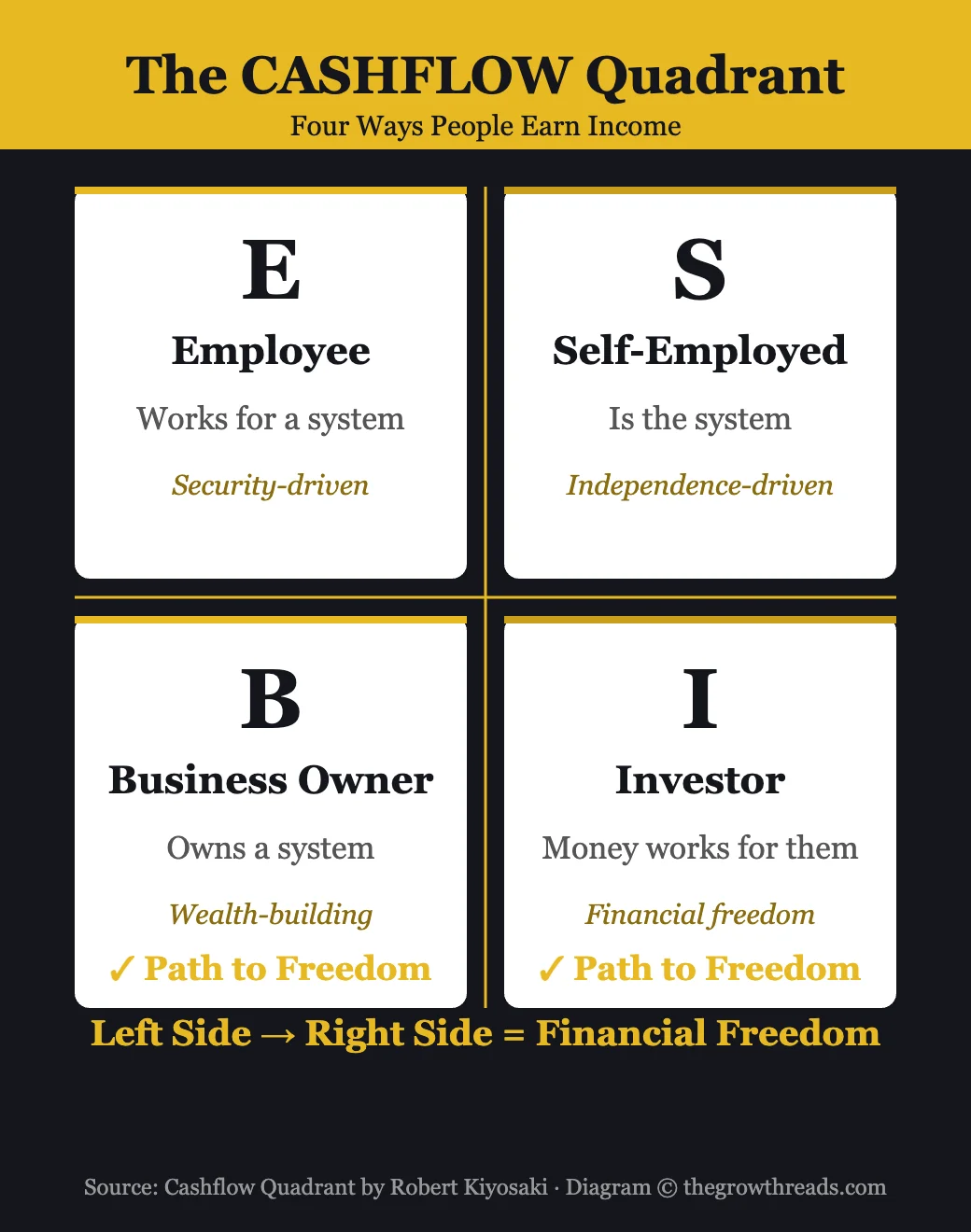
- Each quadrant reflects a core value: E values security, S values independence, B values wealth-building through systems, and I values financial freedom.
- True financial freedom lives on the right side: B and I quadrant earners build assets that generate income without their direct time and labor.
- The left side feels safe but carries hidden risk: Depending on one employer or one pair of hands is riskier than building a diversified portfolio of income-producing assets.
- Mindset is the biggest barrier to switching quadrants: Fear, cynicism, laziness, bad habits, and arrogance keep most people on the left side.
- Financial education is the bridge: Schools train people to be employees; moving right requires self-directed learning about business, investing, and taxes.
- Systems replace effort: A business owner builds a machine that works without them; an investor puts capital to work through other people’s businesses.
- Start small and stay patient: Kiyosaki recommends beginning with small investments and part-time businesses while still employed.
- Taxes favor the right side: Business owners and investors access legal tax advantages — deductions, deferrals, and lower rates — unavailable to employees.
- The path is emotional, not just intellectual: Managing fear, rejection, and disappointment is as important as learning financial mechanics.
What is Cashflow Quadrant About?
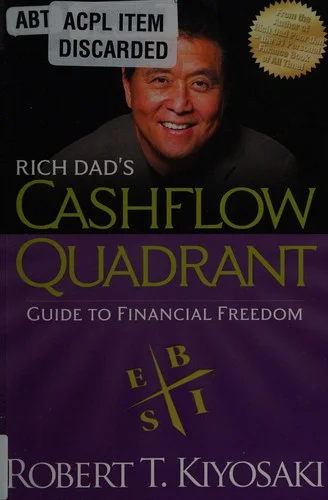
Cashflow Quadrant classifies all income earners into four categories — Employee, Self-Employed, Business Owner, and Investor — and argues that financial freedom requires moving from the left side (E/S) to the right side (B/I). Kiyosaki provides a step-by-step guide for making this transition through financial education, mindset shifts, and building systems that generate passive income.
About the Author
Robert T. Kiyosaki is an entrepreneur, investor, and the author of Rich Dad Poor Dad, the bestselling personal finance book of all time with over 40 million copies sold worldwide. Born in Hawaii to a well-educated but financially struggling father (his “poor dad”) and mentored by his best friend’s father (his “rich dad”), Kiyosaki built his career teaching financial literacy outside traditional education. He founded the Rich Dad Company and created the CASHFLOW board game to teach investing concepts. His work has been translated into dozens of languages and has shaped how millions of people think about money, assets, and passive income.
Key Concepts at a Glance
| Concept | What It Means | Use It When |
|---|---|---|
| The CASHFLOW Quadrant | Four ways people earn: E, S, B, I | Evaluating your income structure |
| Left Side vs Right Side | Trading time (E/S) vs building systems (B/I) | Deciding your financial path |
| Core Values | Each quadrant is driven by a dominant value | Understanding why you choose your current path |
| The B-I Triangle | Framework for building a business: mission, team, leadership | Structuring a new venture |
| Financial Literacy | Understanding assets, liabilities, cash flow, and tax strategy | Making informed investment decisions |
| Good Debt vs Bad Debt | Debt that makes you money vs debt that costs you money | Evaluating borrowing decisions |
| The 7-Step Path | Sequential process for transitioning from E/S to B/I | Planning your financial freedom journey |
| Systems vs Effort | Building machines that produce income without your labor | Scaling beyond your personal capacity |
Part 1: Why People Choose Security Over Freedom
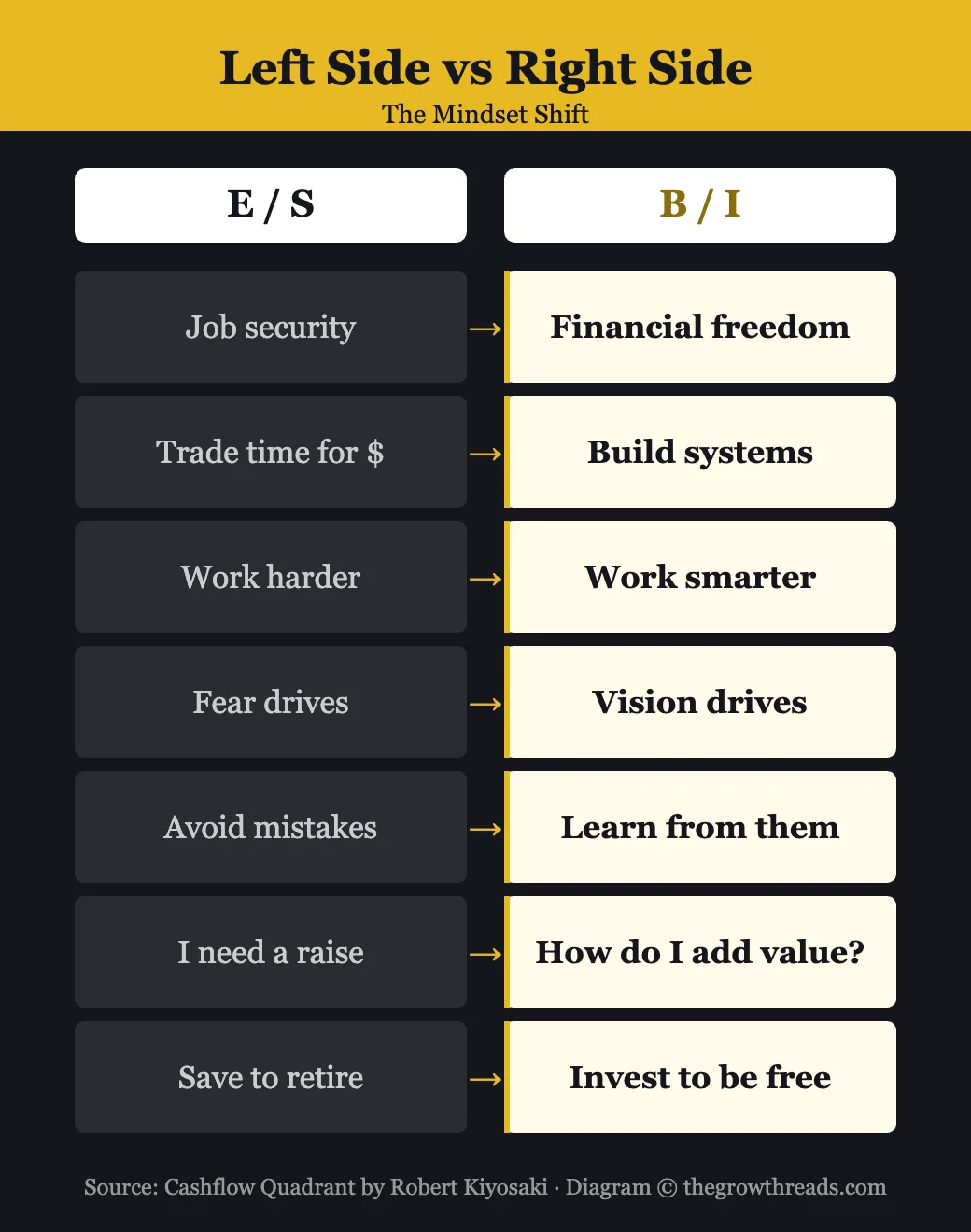
Kiyosaki opens by explaining why most people never leave the left side of the quadrant. The education system, family expectations, and cultural norms all push people toward the E quadrant. From childhood, the message is clear: get good grades, find a stable job, work hard, and save for retirement. This programming runs so deep that even highly intelligent, well-paid professionals never question whether trading time for money is the only option.
The Employee quadrant is defined by the phrase “I want a secure job with good benefits.” The Self-Employed quadrant — doctors, lawyers, freelancers, and small business owners — is defined by “If you want it done right, do it yourself.” Both are time-dependent. A surgeon earning a million dollars a year still cannot stop working without their income disappearing. That, Kiyosaki argues, is not true wealth.
The right side operates on fundamentally different logic. Business Owners say, “I’m looking for a good system and good people to run it.” Investors say, “What’s my return on investment?” The right side builds assets — businesses and investments — that produce cash flow whether you show up or not.
TGR Note: This concept pairs directly with the asset-vs-liability distinction from Rich Dad Poor Dad. While that book explains what to buy, Cashflow Quadrant explains how to position yourself to buy it. If you have read The Psychology of Money, you will notice Morgan Housel makes the same point about wealth being what you do not see — the unseen systems running behind the scenes.
Part 2: The Different Worlds of E, S, B, and I
Each quadrant represents not just a way of earning but a way of thinking. Kiyosaki devotes significant time to showing how the same situation — say, a real estate opportunity — looks completely different depending on which quadrant you think from.
An Employee sees risk: “What if I lose money?” A Self-Employed person sees work: “I could renovate it myself.” A Business Owner sees a system: “I’ll hire a property manager and use other people’s time.” An Investor sees cash flow: “What’s the cap rate and how does it fit my portfolio?”
The critical insight is that these are not personality types but learned patterns. Kiyosaki’s rich dad did not have more intelligence than his poor dad — he had different financial education and different mental models. The quadrant you operate in is a choice, even though it rarely feels like one.
Kiyosaki is particularly sharp on the Self-Employed trap. Many people leave the E quadrant thinking they have escaped, only to create a job for themselves that is harder and less secure than the one they left. A freelancer who cannot take a vacation without losing clients has not achieved freedom — they have bought a more demanding boss.
TGR Note: Michael Gerber makes the same argument in The E-Myth Revisited: most small businesses fail because the owner works in the business instead of on it. If you are self-employed and feeling trapped, that book is the perfect companion read to this chapter. For the investing mindset specifically, see our summary of The Intelligent Investor for Benjamin Graham’s framework on rational capital allocation.
Part 3: How to Become a Successful B and I
The middle section of the book tackles the practical and emotional mechanics of transitioning quadrants. Kiyosaki introduces the B-I Triangle — a framework for building a successful business that includes mission, leadership, team, product, legal structure, systems, communications, and cash flow.
He stresses that a B quadrant business must be able to run without you. If you are the smartest person in your company and nothing happens without your approval, you are an S disguised as a B. The test is simple: can you leave for a year and come back to a business that has grown?
For the I quadrant, Kiyosaki distinguishes between five levels of investors, ranging from those who do nothing (level zero — no savings, no investments) to sophisticated investors who create investment vehicles. He argues that most people stay at levels one or two — saving and investing in mutual funds — because financial education never taught them levels three through five.
The book introduces the concept of “good debt”: borrowing to acquire assets that produce income greater than the debt service. A rental property financed with a mortgage where rent exceeds all costs is good debt. A car loan for a depreciating vehicle is bad debt. This distinction, Kiyosaki argues, is invisible to most employees because their financial education stopped at “debt is bad.”
TGR Note: The “good debt vs bad debt” framework is one of Kiyosaki’s most influential — and most debated — ideas. For a more conservative approach to debt, see Dave Ramsey’s The Total Money Makeover, which advocates eliminating all debt. The truth for most people probably lies between these two poles: leverage can accelerate wealth building, but only when applied with financial literacy and margin of safety.
Part 4: The 7 Steps to Financial Freedom
The final section provides Kiyosaki’s seven-step roadmap for crossing from the left side to the right side. Unlike many personal finance books that focus exclusively on tactics, these steps are primarily about inner transformation.
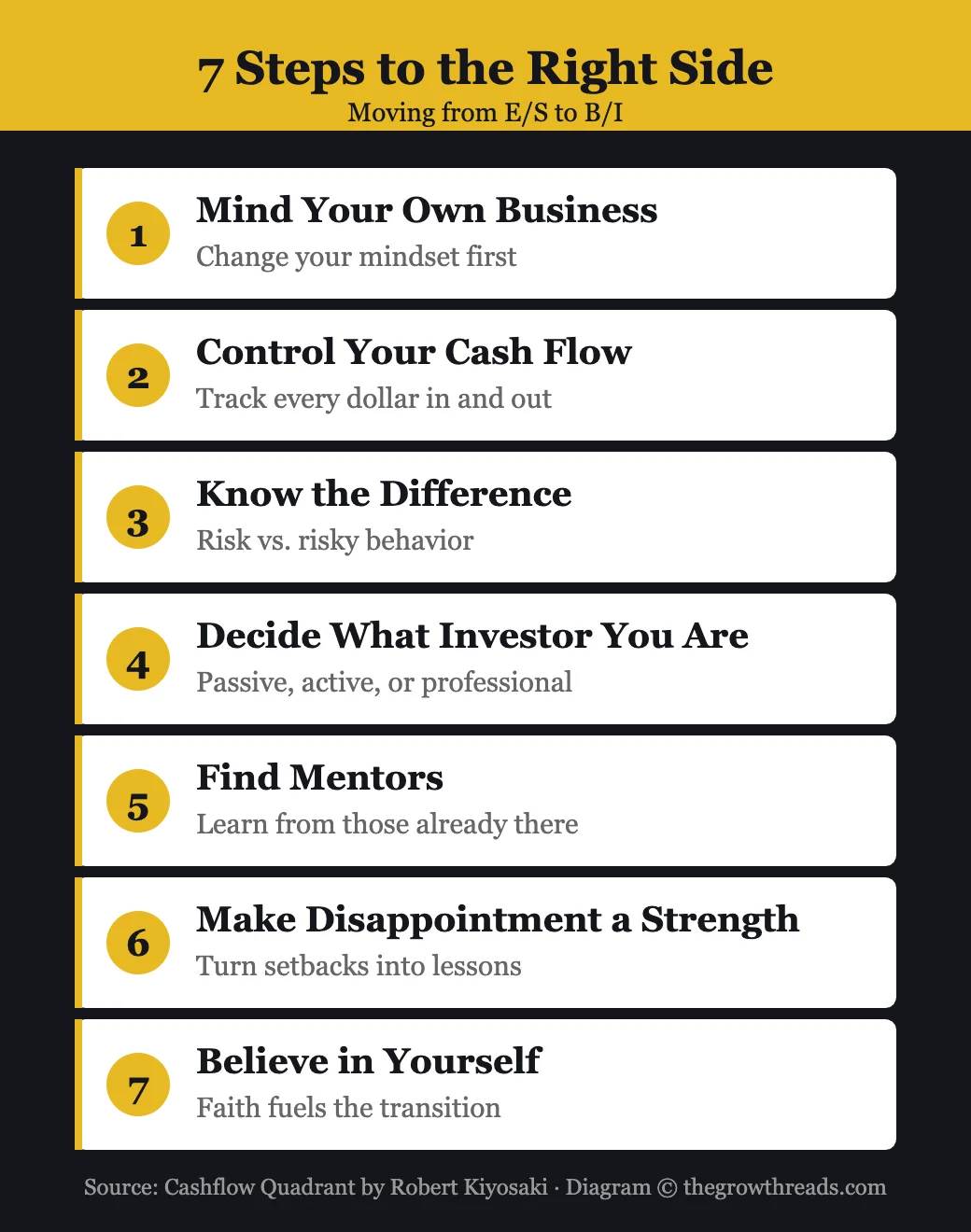
Step 1: Mind your own business. This means focusing on building your asset column rather than just increasing your salary. Even while employed, you can begin acquiring income-producing assets on the side.
Step 2: Take control of your cash flow. Before you can invest, you need to know exactly where your money goes. Kiyosaki recommends tracking every dollar and gradually redirecting spending from liabilities to assets.
Step 3: Know the difference between risk and risky. Investing is not inherently risky — investing without education is. A trained investor sees opportunities where an untrained person sees danger.
Step 4: Decide what kind of investor you want to be. Are you a passive investor who buys index funds, an active investor who manages properties, or a professional investor who creates deals? Each level requires different education and commitment.
Step 5: Seek mentors. Find people who are already in the B and I quadrants and learn from their experience, mistakes, and mental models.
Step 6: Make disappointment your strength. Every successful entrepreneur and investor has failed repeatedly. The difference is that they treat failure as tuition rather than a verdict.
Step 7: The power of faith. Kiyosaki closes with the importance of self-belief and persistence. The transition from E/S to B/I is emotionally difficult, and most people quit before results appear.
TGR Note: Step 6 — making disappointment a strength — echoes Carol Dweck’s growth mindset research. If you find the emotional side of this transition challenging, pair this with The Millionaire Fastlane by MJ DeMarco, which offers a more aggressive but equally systems-focused approach to building wealth outside traditional employment.
Who Is Cashflow Quadrant Best For — and Who Should Read Something Else First?
This book is ideal for employees who sense that something is structurally wrong with trading time for money but cannot articulate what. It is also excellent for self-employed professionals who feel trapped by their own businesses — the freelancers, consultants, and solo practitioners who have achieved independence but not freedom.
If you are brand new to personal finance, start with Rich Dad Poor Dad first — it lays the asset-vs-liability foundation that Cashflow Quadrant builds on. If you want more tactical investing guidance, The Simple Path to Wealth by JL Collins provides a concrete, low-cost index fund strategy. And if you are already entrepreneurial but want a sharper execution framework, Profit First by Mike Michalowicz will help you manage business cash flow effectively.
Questions to Reflect On
- Which quadrant do you currently earn most of your income from, and which quadrant do you want to be in five years from now?
- If you stopped working today, how long could your current assets sustain your lifestyle?
- What beliefs about money and security did you absorb from your family and education that might be keeping you on the left side?
- Are you building assets that generate income without your direct involvement, or are you only exchanging hours for dollars?
- What is one small step you could take this month to begin operating in the B or I quadrant — even part-time?
🔥 Ready to Move to the Right Side of the Quadrant?
Learn the framework that has helped millions rethink how they earn, invest, and build wealth.
How to Apply Cashflow Quadrant (7-Day Plan)
- Day 1: Draw the CASHFLOW Quadrant on paper. Write your current income sources under the appropriate letters. Be honest about where you actually earn.
- Day 2: Track every dollar you spent in the past 30 days. Categorize each expense as either feeding an asset (investment, business, education) or feeding a liability (consumption, depreciation).
- Day 3: Write down three beliefs about money you inherited from your parents or schooling. Challenge each one: is it a fact or a fear?
- Day 4: Research one B-quadrant opportunity you could start part-time — an online business, a franchise model, or a licensing arrangement. Spend 30 minutes learning the basics.
- Day 5: Identify one person in your network who operates in the B or I quadrant. Reach out and ask them one question about how they got started.
- Day 6: Open or fund an investment account if you do not have one. Even a small amount — $50 or $100 — begins the habit of thinking like an investor.
- Day 7: Write a one-page plan for your next 12 months. Include one specific goal for moving toward the B or I quadrant, the first three actions you will take, and how you will measure progress.
Frequently Asked Questions
Is Cashflow Quadrant worth reading if I already read Rich Dad Poor Dad?
Yes — they serve different purposes. Rich Dad Poor Dad introduces the concept of assets vs liabilities and challenges conventional thinking about money. Cashflow Quadrant goes deeper into the structural question of how you earn. It provides the four-quadrant framework and a practical seven-step roadmap for transitioning from employee or self-employed to business owner or investor. Many readers find it more actionable than the first book because it gives a clearer path forward rather than just shifting your mindset.
What is the main message of Cashflow Quadrant?
The main message is that financial freedom depends not on how much you earn but on which quadrant you earn from. People on the left side — employees and self-employed workers — trade time for money and remain financially vulnerable regardless of their income level. People on the right side — business owners and investors — build systems and assets that generate passive income. The book argues that anyone can make this transition through financial education, mentorship, and a willingness to change their relationship with risk and security.
What are the four quadrants in the CASHFLOW Quadrant?
The four quadrants are Employee (E), Self-Employed (S), Business Owner (B), and Investor (I). Employees work for someone else’s system and value security. Self-Employed individuals own their job and value independence. Business Owners create systems that others operate and value wealth-building. Investors put money to work through assets and value financial freedom. Kiyosaki groups E and S as the “left side” and B and I as the “right side,” arguing that lasting wealth comes from operating on the right.
How do you move from the E or S quadrant to the B or I quadrant?
Kiyosaki outlines seven steps: mind your own business by building assets alongside your job, take control of your cash flow through tracking and redirecting spending, learn the difference between risk and risky behavior, decide what type of investor you want to become, find mentors who already operate on the right side, turn disappointment into learning fuel, and maintain faith in yourself through the transition. The process is gradual — most people start part-time while still employed and build momentum over months or years.
Is Cashflow Quadrant good for beginners in personal finance?
It works for beginners, but ideally after reading Rich Dad Poor Dad, which establishes the foundational vocabulary. Cashflow Quadrant assumes you already understand the asset-vs-liability distinction and builds on it with the quadrant framework. If you are completely new to personal finance, start with Rich Dad Poor Dad for the mindset shift, then read Cashflow Quadrant for the structural roadmap. For specific investment tactics, complement both with a book like The Simple Path to Wealth or The Intelligent Investor.
What does Kiyosaki mean by good debt vs bad debt?
Good debt is money borrowed to acquire income-producing assets where the return exceeds the cost of the debt. A rental property where monthly rent covers the mortgage, taxes, maintenance, and still produces positive cash flow is financed with good debt. Bad debt is money borrowed for consumption or depreciating assets — car loans, credit card balances, and personal loans that do not generate income. Kiyosaki argues that financial education teaches you to use debt as a tool for wealth building rather than avoiding it entirely.
How long does it take to transition from Employee to Business Owner or Investor?
Kiyosaki does not give a specific timeline because it depends on the individual’s starting point, financial education, risk tolerance, and effort. However, he suggests that most people should plan for a multi-year journey. He recommends starting small — building a side business or making modest investments — while still employed, then gradually shifting as passive income grows to replace employment income. The emotional and educational work often takes longer than the financial mechanics, which is why he emphasizes mentorship and persistence as critical elements of the transition.
Related Summaries
- Rich Dad Poor Dad Summary & Review — The companion volume that started it all
- The Millionaire Fastlane Summary & Review — A sharper, more aggressive take on building wealth through systems
- The Simple Path to Wealth Summary & Review — The best index-fund investing guide for the I quadrant
- Best Money & Investing Books — Our complete ranked list