

⭐⭐⭐⭐ 4.4/5
One-liner: A raw, unflinching memoir that doubles as a manual for developing mental toughness through deliberate suffering and relentless self-accountability.
Best for: Anyone who feels stuck, complacent, or limited by their own comfort zone — and is ready for a confrontational wake-up call.
Reading time: ~6 hours (364 pages)
Difficulty to apply: High — the challenges demand genuine physical and mental discomfort.
Can’t Hurt Me in one minute
You are capable of far more than you believe, and the only way to prove it is through suffering. David Goggins grew up in an abusive household, was overweight, working a dead-end job, and had every excuse to accept a mediocre life. Instead, he lost 106 pounds in three months, became a Navy SEAL, completed Army Ranger School, set the Guinness World Record for pull-ups, and became one of the world’s top ultramarathon runners. His thesis is brutally simple: your mind has a built-in governor that tells you to stop long before your body actually needs to. By deliberately seeking discomfort, you build “callouses” on your mind — mental toughness that makes you capable of enduring anything. The book pairs his autobiography with ten practical challenges designed to push readers past their perceived limits.
Key takeaways
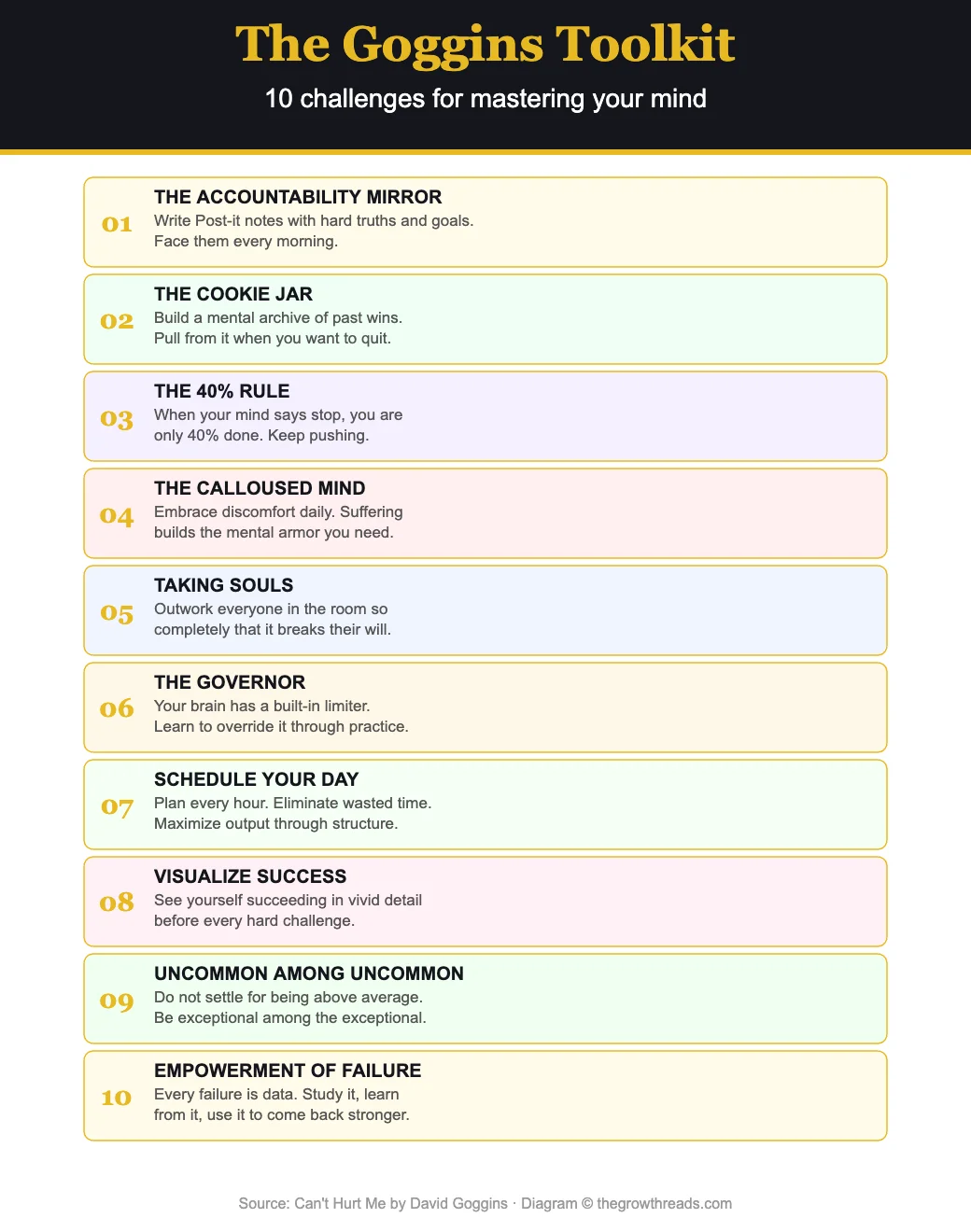
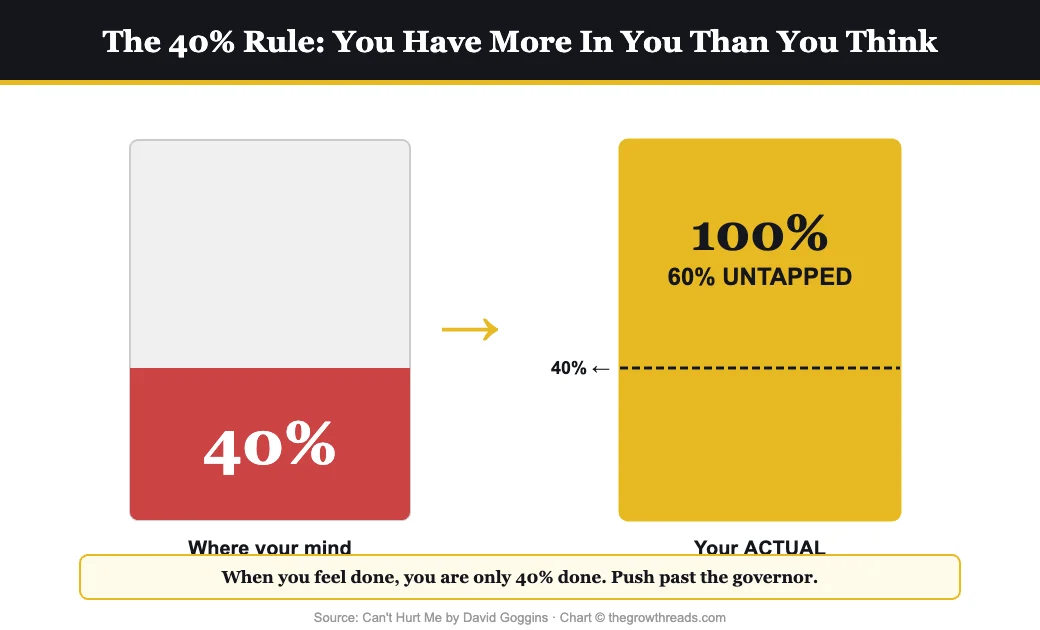
- The 40% rule: When your mind tells you that you are done, you are really only 40% of the way through your capacity. The remaining 60% is accessible through mental toughness, not physical ability.
- The Accountability Mirror: Write Post-it notes with honest truths about your life and goals. Face them every morning. Stop lying to yourself about where you are and what you need to change.
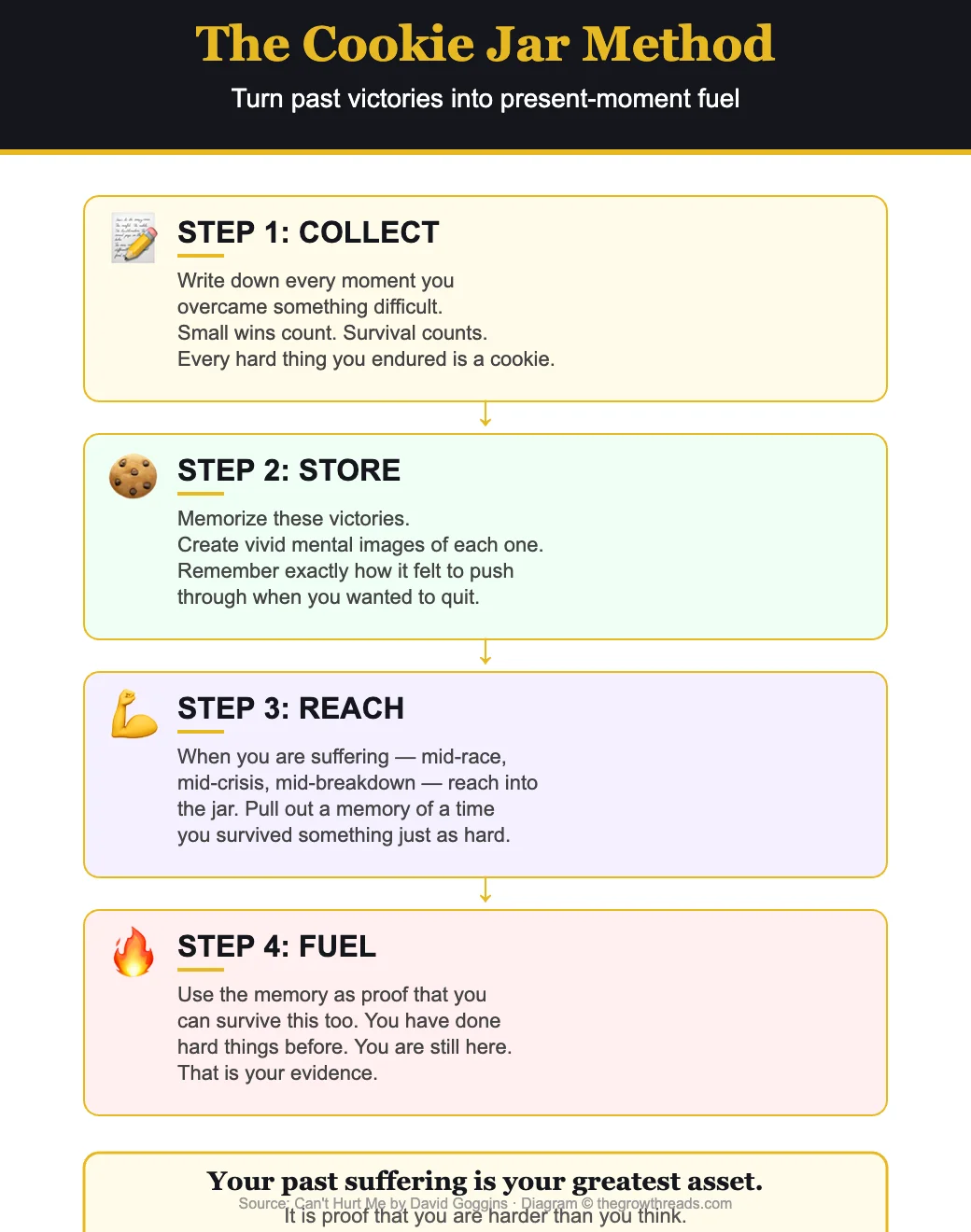
- The Cookie Jar: Build a mental archive of every difficult thing you have survived. When you want to quit, reach into the jar and remind yourself: you have endured worse and you are still here.
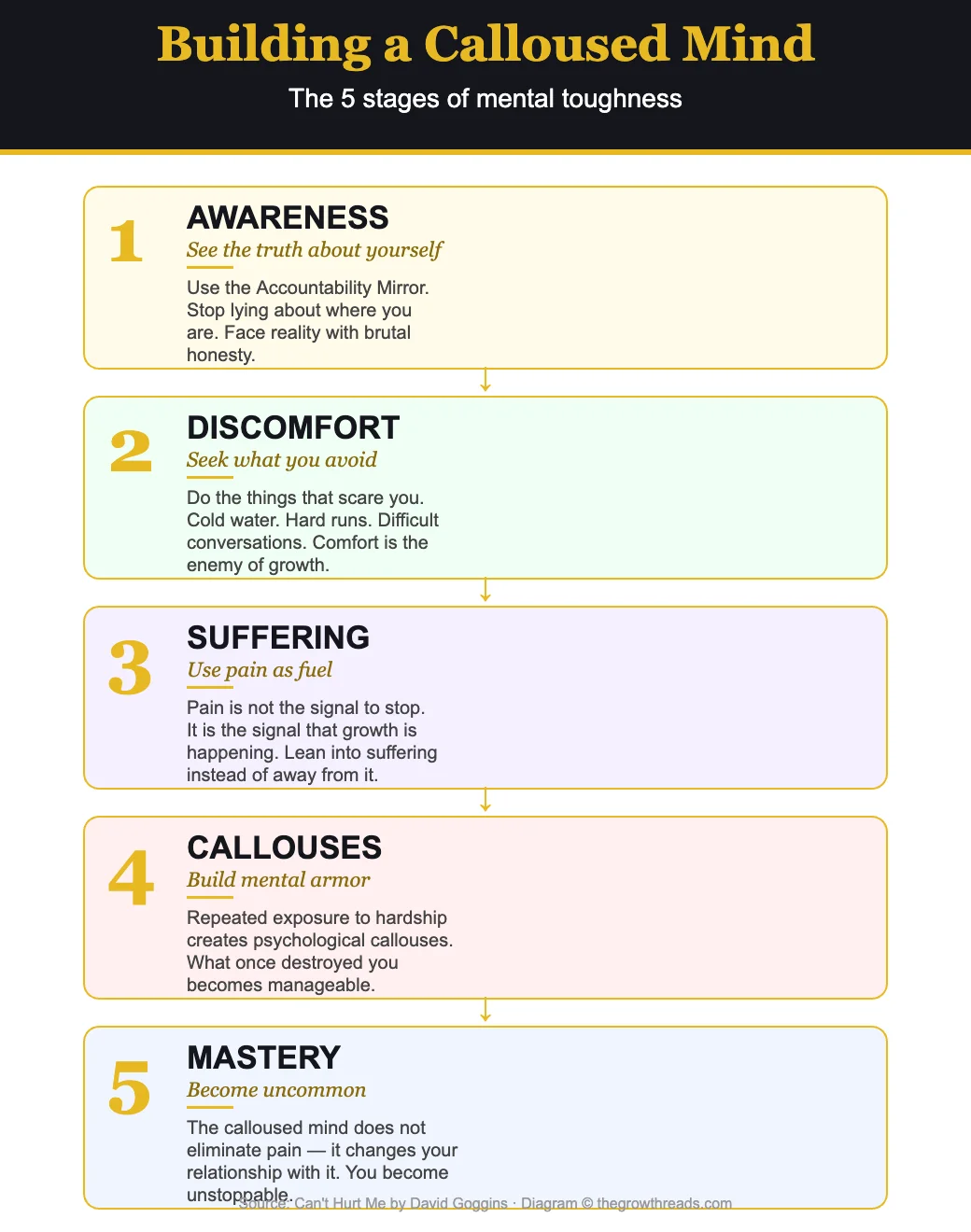
- Callous your mind: Mental toughness is not innate — it is built through repeated exposure to discomfort. Every hard workout, cold shower, and difficult conversation adds a layer of mental armor.
- Taking souls: Outwork everyone around you so completely that it is impossible to ignore. Excellence at that level becomes its own form of psychological warfare against mediocrity.
- Your past is your fuel, not your prison: Goggins turned childhood abuse, poverty, and racism into motivation rather than excuses. The worse your starting point, the more powerful your transformation story becomes.
- The governor in your brain: Your mind is designed to protect you from pain by telling you to stop early. This survival mechanism was useful in prehistoric times but now keeps you from reaching your potential.
- Embrace suffering as a tool: Pain is not a signal that something is wrong — it is a signal that growth is happening. The avoidance of suffering is what creates a weak, entitled mindset.
- Schedule every minute: Eliminate wasted time by planning every hour of your day. Structure creates accountability and prevents the drift that leads to complacency.
- Be uncommon among uncommon: Do not compare yourself to average people. Compare yourself to the best — and then outwork them too.
What is Can’t Hurt Me about?
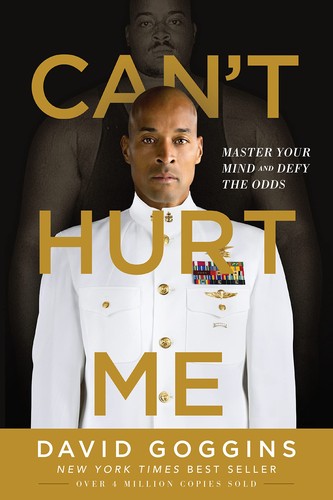
Can’t Hurt Me is a memoir and self-improvement guide in which David Goggins recounts his journey from an abused, overweight young man to one of the world’s toughest endurance athletes and military operators. Each chapter pairs a story from his life with a practical “challenge” designed to help readers build mental toughness through deliberate discomfort and radical self-honesty.
About the author
David Goggins is a retired Navy SEAL, Army Ranger, and ultramarathon runner widely considered one of the mentally toughest people alive. He grew up in Buffalo, New York, in a household marked by his father’s physical abuse and his own struggles with learning disabilities, obesity, and racial discrimination. After a transformative period in his early twenties where he lost over 100 pounds and was accepted into SEAL training on his third attempt, Goggins went on to complete some of the most grueling physical challenges in the world — including running over 60 ultramarathons and triathlons, completing Navy SEAL training (BUD/S) three times, and setting a pull-up world record of 4,030 in 17 hours. He has become one of the most followed motivational figures on social media. Explore all David Goggins book summaries →
Key concepts at a glance
| Concept | What it means | Use it when |
|---|---|---|
| The 40% Rule | When your mind says stop, you have 60% more capacity remaining | You want to quit a workout, project, or difficult task |
| Accountability Mirror | Confronting yourself daily with honest truths written on Post-it notes | You are avoiding the hard changes you know you need to make |
| Cookie Jar | A mental archive of past victories to draw strength from | You are in pain, exhausted, or losing motivation |
| Calloused Mind | Mental toughness built through repeated voluntary suffering | You want long-term resilience, not just short-term motivation |
| Taking Souls | Outworking everyone so completely that excellence becomes psychological leverage | You are in a competitive environment and want to set yourself apart |
| The Governor | The brain’s built-in limiter that protects you from pain | You suspect you are capable of more but cannot push past the mental wall |
| Uncommon Among Uncommon | Refusing to compare yourself to average — competing with the best | You have already achieved above-average results and risk complacency |
| After-Action Report | Analyzing failures forensically to extract lessons for next time | You fail at something and want to convert the failure into growth |
Part 1: The origin — forged in suffering
Goggins does not ease into his story. The opening chapters describe a childhood of extreme physical abuse at the hands of his father, who ran a roller-skating rink in Buffalo and forced young David and his mother to work through the night. The abuse was severe enough that David developed a stutter, had stress-related health problems, and barely learned to read through grade school. After his mother finally escaped the household, Goggins drifted into adolescence overweight, academically behind, and directionless.
The power of this origin story is not in the trauma itself — it is in what Goggins does with it. Rather than using his past as an excuse, he reframes it as his greatest asset. Every moment of suffering became a “cookie” in his Cookie Jar — proof that he had already survived things that would have broken most people. His argument is that everyone has a Cookie Jar, even if your suffering was less dramatic. Every hard exam, every heartbreak, every time you pushed through something you wanted to quit — that is evidence of your toughness.
The practical tool from this section is the Accountability Mirror. Goggins describes standing in front of his mirror at age 24, 297 pounds, working as a cockroach exterminator, and writing Post-it notes about every change he needed to make. Not affirmations — honest, uncomfortable truths. “You are fat.” “You are lazy.” “You need to study.” Then, one by one, he tackled each note. The mirror was not about self-love; it was about self-honesty. And self-honesty, Goggins argues, is the prerequisite for any genuine transformation.
Part 2: The transformation — becoming a SEAL
The middle section chronicles Goggins’s physical transformation and his three attempts to complete Navy SEAL training. He lost 106 pounds in three months through a punishing regimen of swimming, cycling, and running — sometimes completing multiple workouts per day while working full-time. The weight loss was not the point; it was proof of concept for his theory of mental toughness. If his mind could override his body’s protests long enough to lose 100 pounds, it could override anything.
SEAL training (BUD/S) became the ultimate laboratory for the 40% rule. During “Hell Week” — five and a half days of continuous physical activity with almost no sleep — Goggins’s body broke down repeatedly. Stress fractures, pneumonia, damaged knees. Twice he was pulled from training for medical reasons and had to restart from the beginning. On his third attempt, he completed it while running on broken legs. His takeaway is not that you should destroy your body. It is that the body can take far more punishment than the mind believes, and the only way to discover your true limits is to push past what your mind says is the limit.
The concept of taking souls also emerges here. Goggins describes outworking his fellow SEAL candidates so visibly and relentlessly that it became a form of psychological leverage. When instructors tried to break him with extra punishment, he did the punishment with such intensity that it demoralized them. This is not about ego — it is about using effort as a tool. When you work harder than anyone thinks is possible, you change the power dynamic in any situation.
Part 3: The calloused mind — building permanent toughness
The final section moves from story to philosophy. Goggins argues that mental toughness is not a trait you are born with — it is a skill you develop through deliberate practice, just like a callous develops on your hands from repeated friction. Each time you push through discomfort, your mind builds a slightly thicker layer of tolerance. Over years, what once felt impossible becomes merely uncomfortable, and what once felt unbearable becomes manageable.
The Cookie Jar is the practical tool that makes this sustainable. Goggins keeps a mental inventory of every difficult thing he has survived. When he is at mile 70 of a 100-mile ultramarathon and his body is screaming to stop, he reaches into the jar: “You survived Hell Week. You survived your father’s abuse. You survived being the only Black SEAL in your class. This is just running.” The past victories become evidence that the current suffering is survivable.
Goggins also introduces the concept of after-action reports — a military practice adapted for personal growth. After every failure, he sits down and forensically analyzes what went wrong, what he could have done differently, and what he learned. The goal is not self-punishment but data extraction. Every failure contains information that makes the next attempt better. People who never fail are people who never attempt anything difficult. People who fail and learn are the ones who eventually become extraordinary.
Who is Can’t Hurt Me best for — and who should read something else first?
This book is ideal for people who respond to confrontational, no-excuses motivation — the reader who needs a kick rather than a hug. It is particularly powerful for anyone who feels stuck in comfort, who knows they are underperforming relative to their potential, or who has been told they cannot do something and wants the mental framework to prove the doubters wrong.
If you prefer a gentler, research-backed approach to building mental resilience, start with The Comfort Crisis by Michael Easter, which makes a similar case for discomfort using evolutionary science rather than drill-sergeant energy. If you want the neuroscience of willpower and motivation, Dopamine Nation by Anna Lembke provides a clinical lens. Goggins’s strength is raw, unfiltered intensity — the book hits like a training session, not a lecture.
Questions to reflect on
- What is the most difficult thing you have ever done? How could you use that memory as fuel the next time you want to quit?
- If you wrote honest Post-it notes on your Accountability Mirror right now, what would they say?
- In which areas of your life are you operating at 40% of your capacity? What would 60% more effort look like?
- What discomfort are you avoiding that, if embraced, would produce the most growth?
- When you fail, do you analyze the failure forensically — or do you avoid thinking about it?
🔥 Ready to master your mind?
Can’t Hurt Me will push you past limits you didn’t know you had.
How to apply Can’t Hurt Me (7-day plan)
- Day 1 — Build your Accountability Mirror: Write 5 Post-it notes with honest truths about where you are and what needs to change. Stick them on your bathroom mirror. Read them every morning.
- Day 2 — Fill your Cookie Jar: Write down 10 difficult things you have survived or accomplished. Keep the list on your phone. Read it the next time you want to quit something.
- Day 3 — Apply the 40% rule: During your next workout, when you feel like stopping, tell yourself “I am only at 40%” and do 10% more. Notice how the limit was mental, not physical.
- Day 4 — Seek one discomfort: Do something that scares you or that you have been avoiding — a cold shower, a difficult conversation, an extra mile. The goal is one layer of mental callous.
- Day 5 — Schedule your day: Plan every hour from wake-up to sleep. Eliminate all drift time. At the end of the day, honestly assess how much time you wasted.
- Day 6 — Take a soul: In your work or training, outperform your own expectations so dramatically that it changes how you see yourself. Do the extra set, the extra revision, the extra hour.
- Day 7 — After-action report: Pick your most recent failure. Write down what went wrong, what you would do differently, and what you learned. Convert the failure into data for next time.
Frequently asked questions
What is the 40% rule in Can’t Hurt Me?
The 40% rule states that when your mind tells you that you are finished, you have actually only used about 40% of your total capacity. The remaining 60% is accessible through mental toughness and the willingness to push past discomfort. Goggins learned this concept from conversations with military psychologists and validated it through his own extreme physical challenges, from SEAL training to 100-mile ultramarathons. The practical application is simple: when you feel done, do more.
What is the Cookie Jar method?
The Cookie Jar is a mental tool for building resilience during moments of suffering. You create a mental (or written) archive of every difficult experience you have survived — past workouts, hardships, failures you overcame, moments you wanted to quit but kept going. When you are in pain and want to stop, you reach into this “jar” and pull out a specific memory, reminding yourself that you have endured worse and survived. The memory serves as evidence that you can survive the current challenge too.
What is the Accountability Mirror?
The Accountability Mirror is a daily practice of confronting yourself with uncomfortable truths. You write honest notes about your current situation, your weaknesses, and the changes you need to make, then stick them on your bathroom mirror. Every morning, you face these truths before starting your day. The practice is designed to eliminate self-deception — the lies we tell ourselves to avoid doing hard things. It is the first step in Goggins’s system because transformation requires brutal self-honesty.
Is Can’t Hurt Me only for athletes and military people?
No. While Goggins’s examples come from military training and ultramarathons, the principles apply to any domain that requires persistence, discomfort tolerance, and self-discipline — which includes business, academics, health, relationships, and creative work. The 40% rule applies as much to finishing a difficult project at work as it does to finishing a marathon. The Cookie Jar works whether you are in a boardroom or on a trail. Goggins himself has said the book is about mastering your mind, not your body.
What does “callousing your mind” mean?
Callousing your mind means building mental toughness through repeated voluntary exposure to discomfort — the same way physical callouses form on your hands from repeated friction. Each time you push through something difficult (a hard workout, an uncomfortable conversation, a challenging task), your mind develops a slightly thicker layer of tolerance. Over time, what once felt impossible becomes manageable. The key word is “voluntary” — you actively seek out discomfort rather than waiting for it to find you.
How long does it take to read Can’t Hurt Me?
The book is 364 pages and reads in about six hours. Goggins writes in a direct, conversational voice with vivid storytelling that moves quickly. The audiobook is particularly recommended — it runs about 13 hours and features podcast-style commentary between chapters where Goggins and the ghostwriter discuss each section in real time, adding context and additional stories not in the printed version.
What is the difference between Can’t Hurt Me and Never Finished?
Can’t Hurt Me (2018) is primarily a memoir that tells Goggins’s origin story and introduces his core mental toughness tools (the 40% rule, Cookie Jar, Accountability Mirror). Never Finished (2022) is the follow-up that focuses on sustaining excellence over time — how to maintain motivation and mental toughness after you have already achieved your initial goals. If Can’t Hurt Me is about becoming tough, Never Finished is about staying tough. Most readers benefit from reading them in order.
Related summaries
- The Comfort Crisis Summary — Michael Easter on why modern comfort is making us weaker and how to reclaim discomfort.
- Spark Summary — John Ratey on the neuroscience of how exercise transforms the brain and builds mental resilience.
- Dopamine Nation Summary — Anna Lembke on the neuroscience of pleasure, pain, and finding balance.
- Best Health Books — Our curated guide to the most impactful books on physical and mental health.