

★★★★☆ 4.2/5 — A refreshingly simple system for building wealth automatically — no budget, no willpower, no excuses.
Best for: Beginners and anyone who knows they should save more but never gets around to it — the entire system runs on autopilot once set up.
Reading time: ~4 hours (258 pages)
Difficulty to apply: Low — the whole point is that you set it up once and the system does the rest.
The Automatic Millionaire in one minute
You do not need a budget, willpower, or a high income to become wealthy — you need a system that moves money to the right places before you can spend it. David Bach tells the story of Jim and Sue McIntyre, a couple who never earned more than $55,000 combined yet retired as millionaires with two homes and zero debt. Their secret was automation: they paid themselves first through automatic payroll deductions and never relied on discipline to save. Bach builds on their example to lay out a complete financial automation system — from retirement accounts to emergency funds to mortgage acceleration to charitable giving — that anyone can implement in a single afternoon. The book’s radical claim is that budgets do not work because they require ongoing willpower, while automation works because it removes the human element entirely.
Key takeaways
- Budgets do not work: Most people fail at budgeting because it requires daily willpower. Automation removes the willpower requirement entirely by moving money before you see it.
- Pay yourself first — automatically: Set up automatic transfers to move at least 10–15% of your gross income to savings and investments before it reaches your spending account.
- The Latte Factor is real: Small daily expenses — $5 here, $10 there — compound into enormous sums over a lifetime. Redirecting even a fraction of these leaks to investments can produce hundreds of thousands of dollars.
- An hour of setup changes your life: The entire system can be configured in one afternoon: automatic retirement contributions, automatic savings transfers, automatic bill payments, automatic debt reduction.
- Max your employer match first: Failing to contribute enough to capture your employer’s 401(k) match is literally leaving free money on the table — it is an instant 50–100% return on your contribution.
- Bi-weekly mortgage payments save years: By splitting your monthly mortgage payment into bi-weekly payments, you make 26 half-payments (13 full payments) per year instead of 12, shaving years off your mortgage and saving tens of thousands in interest.
- Build an emergency fund automatically: Set up a separate automatic transfer to an emergency fund until you have three to six months of expenses. This prevents financial emergencies from derailing your wealth-building.
- Make it automatic and make it early: The difference between starting at 25 and starting at 35 is staggering — compound interest rewards early action more than any other variable.
- Automate your giving: Bach argues that wealth without purpose is hollow. Scheduling automatic charitable donations makes generosity a habit rather than an afterthought.
- One step, not twelve: The book’s power is its simplicity. There is one step: automate everything. No complex strategies, no stock picking, no daily monitoring.
What is The Automatic Millionaire about?
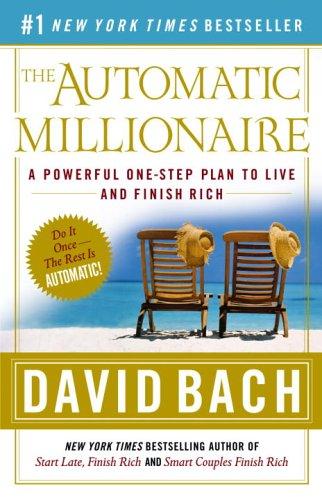
The Automatic Millionaire presents a complete system for building wealth through financial automation. Bach argues that budgets fail because they require willpower, while automatic transfers — set up once — remove the human element entirely. The book covers automated retirement saving, the Latte Factor, emergency funds, mortgage acceleration, and charitable giving.
About the author
David Bach is one of America’s most trusted financial authors, with over ten million books in print across fifteen titles including The Latte Factor, Smart Women Finish Rich, and Start Late, Finish Rich. He spent years as a senior vice president at Morgan Stanley and has appeared on The Today Show, Good Morning America, and Oprah. Bach co-founded AE Wealth Management and is a contributing writer for CNBC. His core philosophy — that ordinary people can build extraordinary wealth through automation rather than deprivation — has influenced millions of readers who never thought of themselves as investors. Explore all David Bach book summaries →
Key concepts at a glance
| Concept | What it means | Use it when |
|---|---|---|
| Pay yourself first | Automatically transfer savings before spending | You want to save but always spend first and save what is left |
| The Latte Factor | Small daily expenses compound into enormous sums | You think you do not earn enough to invest |
| Make it automatic | Remove willpower by automating every financial action | You know what to do but never actually do it |
| Employer match | Free money from your employer’s retirement contribution match | You are not contributing enough to capture the full match |
| Bi-weekly mortgage | Split monthly payment into bi-weekly to make 13 payments per year | You want to pay off your mortgage years early |
| Emergency fund | Three to six months of expenses in a separate account | You have no financial buffer against unexpected costs |
| Automatic giving | Scheduled charitable donations as part of your financial system | You want generosity to be a habit, not an afterthought |
Part 1: The Latte Factor and paying yourself first
Bach opens with the story that anchors the entire book: Jim and Sue McIntyre, a middle-class couple who walk into his financial planning office already millionaires. They never earned more than $55,000 a year combined. They never received an inheritance. They never picked a winning stock. What they did was simple: from the very first paycheque of their working lives, they automatically directed a percentage of their income into savings and investments before they could spend it. By the time they sat in Bach’s office, decades of compound growth had done the rest.
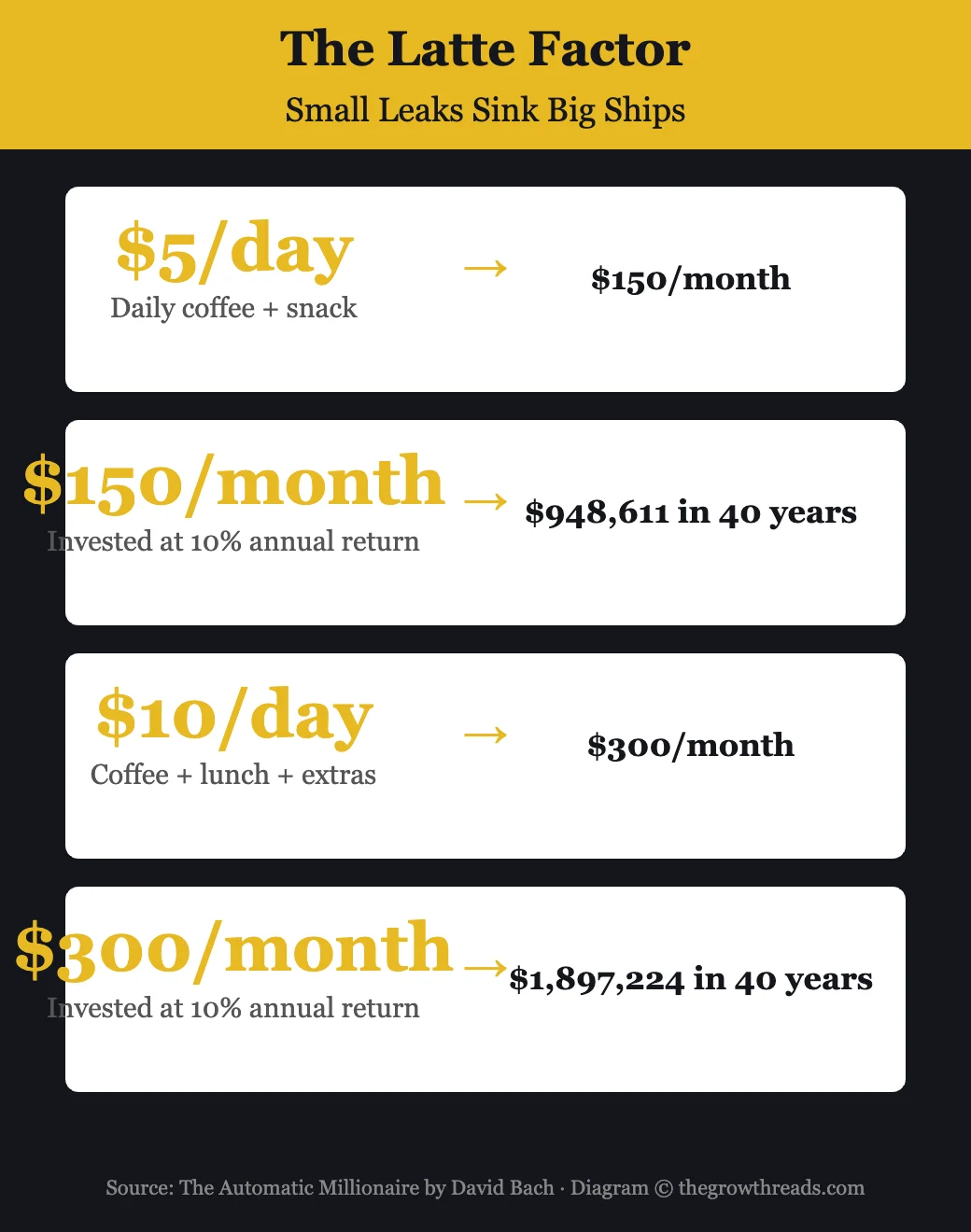
From this story, Bach introduces the Latte Factor — his signature concept. The Latte Factor is not really about coffee. It is about the dozens of small, unconscious daily expenditures that drain your income without producing lasting value. A $5 coffee, a $12 lunch, a $3 app subscription, a $7 impulse buy — individually trivial, collectively devastating. Bach calculates that $10 per day invested at a 10% average annual return becomes nearly $2 million over 40 years. The point is not that you must eliminate all small pleasures but that you should be conscious of the trade-off: every dollar spent on something forgettable is a dollar that could have been compounding for decades.
The second principle — pay yourself first — is the mechanism that captures those dollars. Bach is specific: paying yourself first means setting up an automatic transfer that moves money from your paycheque to your savings and investment accounts before it ever reaches your spending account. This is not “save what is left after spending.” It is “spend what is left after saving.” The distinction is critical because it eliminates the willpower requirement. You never see the money, so you never have to decide not to spend it.
Part 2: Building the automation system
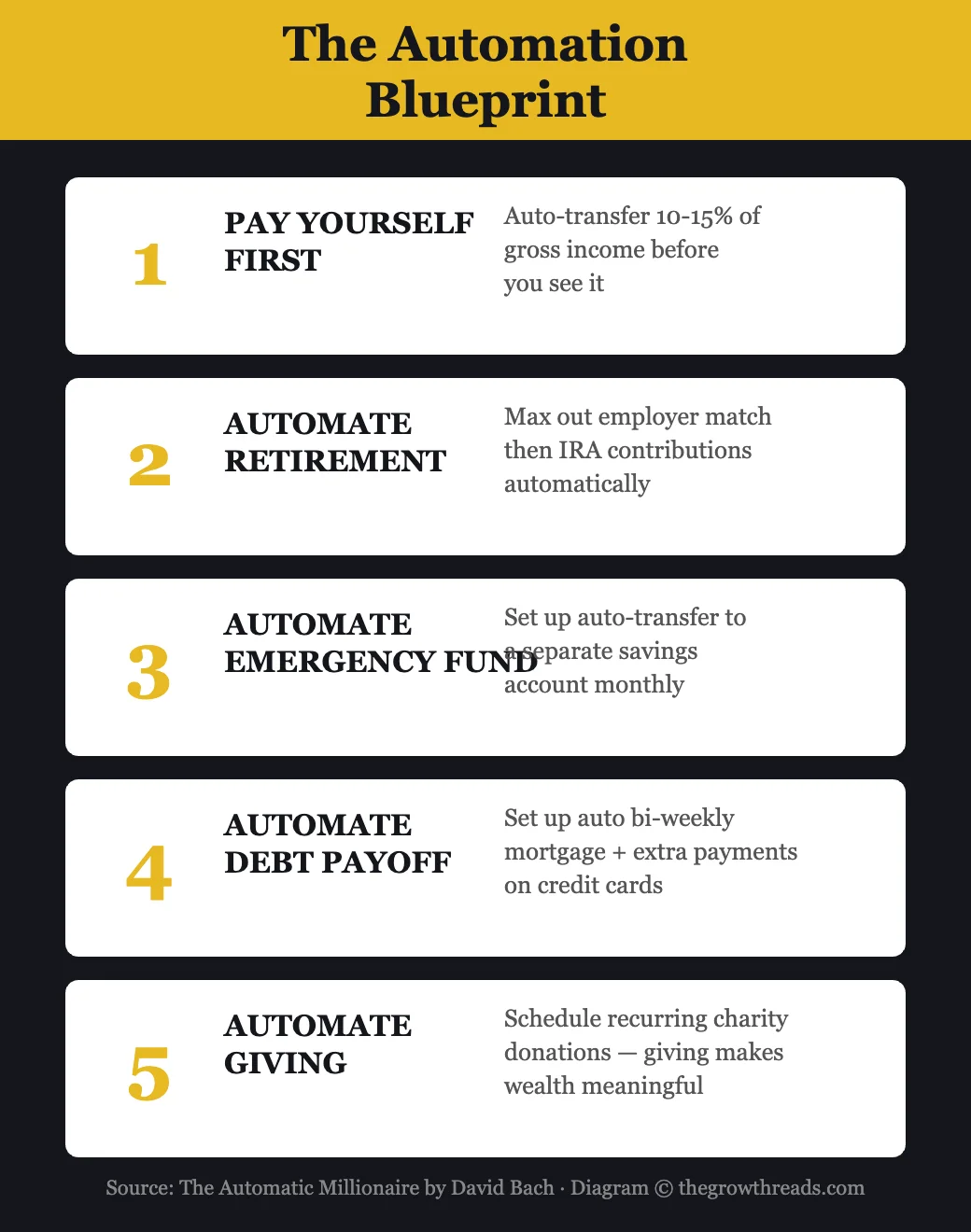
The heart of the book is Bach’s step-by-step automation blueprint. He walks through each component of a complete financial system and shows exactly how to automate it. The order matters: retirement first, then emergency fund, then debt, then giving.
For retirement, Bach insists on maximising your employer’s matching contribution before doing anything else. If your employer matches 50 cents on every dollar up to 6% of your salary, failing to contribute at least 6% is refusing free money — an instant 50% return that no investment can match. He recommends starting at the match percentage and increasing by 1% per year until you reach 12–15% of gross income, all through automatic payroll deduction.
For the emergency fund, Bach advocates a separate high-yield savings account with an automatic monthly transfer. The target is three to six months of living expenses. This fund is not optional — without it, any financial shock (job loss, medical bill, car repair) will force you to raid your retirement accounts or take on debt, undoing years of progress.
For debt elimination, Bach’s flagship strategy is the bi-weekly mortgage payment. By splitting your monthly mortgage payment in half and paying every two weeks, you make 26 half-payments per year — equivalent to 13 full payments instead of 12. That one extra payment per year, applied to principal, typically shaves five to eight years off a 30-year mortgage and saves tens of thousands in interest. For credit card debt, he advocates automatic payments above the minimum, directed at the highest-interest card first.
Part 3: The power of compound time
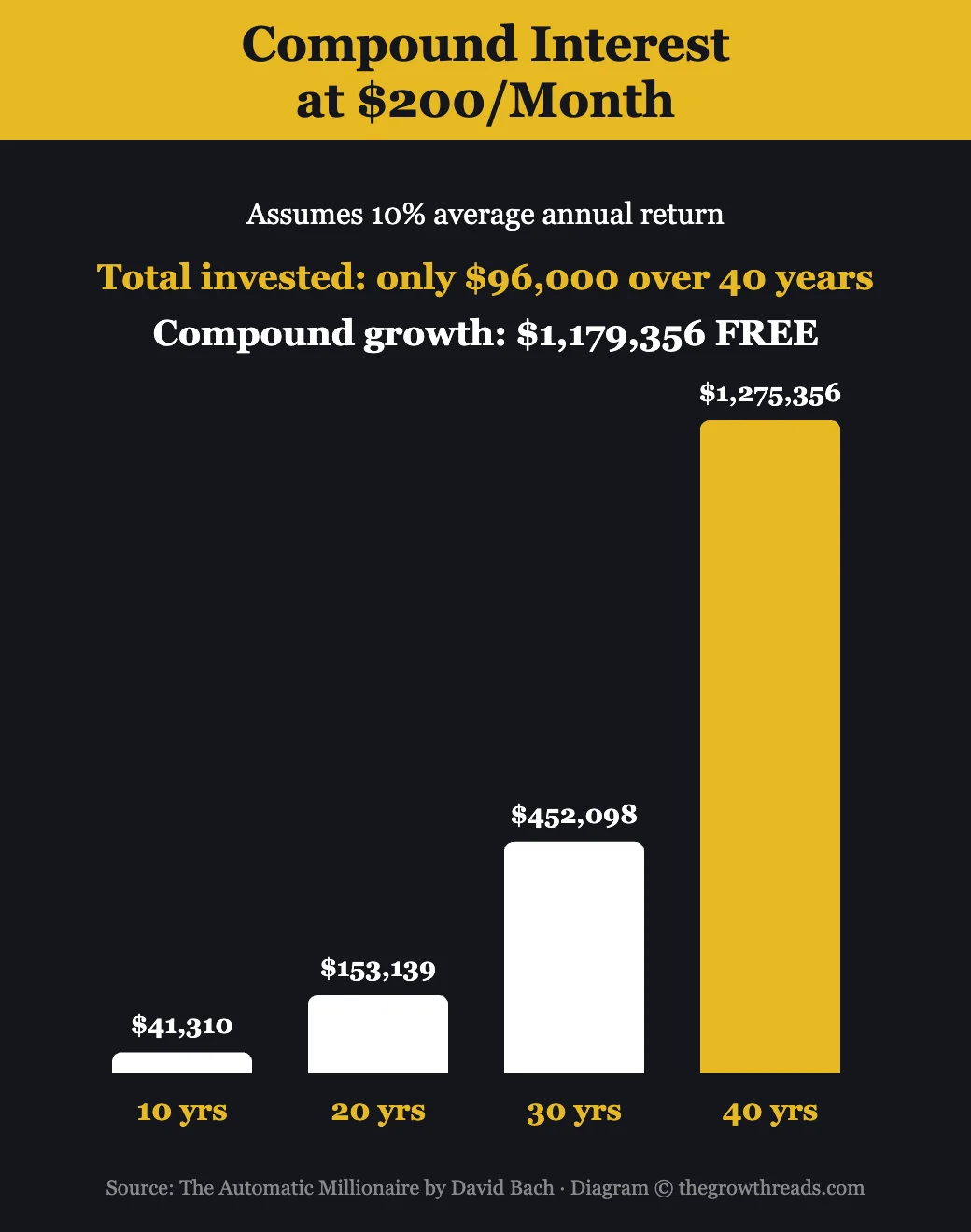
Bach devotes significant space to demonstrating why starting early matters more than starting big. His compound interest tables are among the most persuasive passages in the book. A 25-year-old who invests $200 per month at 10% average annual return will have over $1.2 million by age 65. A 35-year-old making the same investment will have roughly $452,000 — less than half, despite investing for only ten fewer years. The difference is not in the contributions (which differ by only $24,000) but in the decades of compounding the early starter captures.
Bach addresses the objection that 10% returns are optimistic by noting that the S&P 500’s historical average return from 1926 to 2024 has been approximately 10–11% annually, including dividends. Even at a more conservative 7%, the principle holds: time is the most powerful variable, and automation ensures you do not waste it. He also addresses inflation by noting that while $1 million in 40 years will not buy what $1 million buys today, the alternative — not investing at all — guarantees you will have far less.
The chapter on automatic giving rounds out Bach’s system. He argues that wealth without purpose is hollow and that scheduling automatic charitable donations — even small ones — transforms generosity from a sporadic impulse into a consistent practice. He recommends starting at 1% of income and increasing over time, treating giving as a non-negotiable line item alongside retirement and emergency savings.
Who is The Automatic Millionaire best for — and who should read something else first?
The Automatic Millionaire is ideal for absolute beginners and anyone who has struggled with traditional budgeting. Its greatest strength is its simplicity — you can implement the entire system in an afternoon. If you are already investing and want a deeper understanding of portfolio construction and asset allocation, move on to The Simple Path to Wealth or The Intelligent Investor. If you want a more philosophical framework for thinking about money and wealth, start with The Psychology of Money.
Questions to reflect on
- What is your current Latte Factor — how much do you spend daily on small, forgettable purchases?
- Are you paying yourself first, or are you saving whatever is left after spending?
- Are you capturing your full employer retirement match — and if not, what is stopping you?
- How would your financial trajectory change if you automated an extra $200 per month into investments starting today?
- What is one financial action you have been meaning to take but keep putting off — and could you automate it right now?
🔥 Ready to put your wealth-building on autopilot?
The Automatic Millionaire gives you a one-afternoon system that runs for life.
How to apply The Automatic Millionaire (7-day plan)
- Day 1 — Calculate your Latte Factor: Track every non-essential purchase for one day. Add them up. Multiply by 365 to see the annual total, then imagine that amount compounding for 30 years.
- Day 2 — Set up pay yourself first: Log into your bank and create an automatic transfer from your current account to a savings or investment account. Start with 10% of your take-home pay. Adjust later if needed.
- Day 3 — Max your employer match: Contact your HR department or log into your retirement plan portal. Increase your contribution to at least the percentage your employer will match.
- Day 4 — Open an emergency fund: Open a separate high-yield savings account. Set up an automatic monthly transfer of at least $100. Target three to six months of living expenses.
- Day 5 — Automate your bills: Set every recurring bill to automatic payment. This eliminates late fees and frees mental energy for the financial decisions that actually matter.
- Day 6 — Accelerate your debt: If you have a mortgage, call your lender about switching to bi-weekly payments. If you have credit card debt, set up automatic payments above the minimum on your highest-interest card.
- Day 7 — Automate giving: Choose a cause you care about and set up a recurring monthly donation — even $10. Review your entire automated system and confirm every transfer is running.
Frequently asked questions
Is The Automatic Millionaire still relevant today?
Yes. The core principles — automation, paying yourself first, compound interest — are timeless. The expanded edition updates the specific account types, contribution limits, and technology platforms, but the strategy itself has not changed. If anything, automation is easier today than when the book was first published in 2003, because virtually every bank and brokerage offers free automatic transfers and mobile apps that make setup take minutes rather than hours.
Does the Latte Factor actually work, or is it oversimplified?
The Latte Factor has been criticised for implying that cutting small expenses is more important than increasing income. Bach would agree that earning more is powerful — but his point is that even high earners often have nothing saved because spending expands to match income. The Latte Factor is not a substitute for earning more; it is a tool for recognising that small daily leaks, left unchecked, drain enormous potential wealth. For most people, the exercise of tracking small expenses is eye-opening even if they decide not to cut everything.
Is 10% average annual return realistic?
The S&P 500 has historically returned approximately 10–11% annually including dividends over the long term. However, this is a nominal figure that does not account for inflation (real returns are closer to 7%). Bach uses the 10% figure for illustration. Even at a more conservative 7%, the principle holds: early and consistent investment beats sporadic large contributions. The exact return matters less than the behaviour of investing consistently and automatically over decades.
What if I cannot afford to save 10% of my income?
Bach addresses this directly: start with whatever you can. Even 1% is better than nothing because it establishes the habit and the system. Once the automatic transfer is running, increase it by 1% every few months. Most people find they do not notice the incremental reductions in spending because the money disappears before they can miss it. The crucial step is setting up the automation — the percentage can grow over time.
How does this compare to The Total Money Makeover by Dave Ramsey?
Both books target people struggling with money management, but they take different approaches. Ramsey emphasises intensity: a detailed budget, cash envelopes, and the debt snowball method where you attack debts smallest to largest for psychological wins. Bach emphasises effortlessness: automate everything and remove willpower from the equation. Ramsey is better for people in crisis who need aggressive debt elimination. Bach is better for people who simply need a system that runs without daily attention.
Should I pay off my mortgage early or invest the extra money?
Bach advocates accelerating mortgage payoff through bi-weekly payments because it provides a guaranteed return equal to your mortgage interest rate and the psychological benefit of owning your home outright. Mathematically, if your mortgage rate is lower than your expected investment return, investing the extra money will likely produce more wealth over time. But Bach’s insight is behavioural: most people will not actually invest the difference, so the forced discipline of bi-weekly payments is more reliable in practice.
Does the book cover what to invest in?
Bach keeps investment selection deliberately simple. He recommends low-cost index funds or target-date retirement funds for most people, arguing that the specific investment matters far less than the behaviour of investing consistently and automatically over time. For a deeper guide to investment selection, he defers to books like Bogle’s The Little Book of Common Sense Investing. His focus is on the system — getting money from your income to your investments without friction — rather than on portfolio construction.
Related summaries
- The Psychology of Money by Morgan Housel — The deeper why behind our financial behaviours.
- The Simple Path to Wealth by JL Collins — A more detailed guide to index fund investing.
- The Total Money Makeover by Dave Ramsey — An intensity-driven approach to debt elimination.
- The Latte Factor by David Bach — Bach’s parable-format retelling of his core philosophy.
📚 Explore more in our Best Money Books guide.