

⭐⭐⭐⭐✰ 4.3/5
One-liner: A ruthless, historically sourced playbook for understanding how power actually operates — and how to protect yourself from those who wield it.
Best for: Ambitious professionals, entrepreneurs, and anyone navigating complex social hierarchies.
Reading time: ~12 hours (452 pages)
Difficulty to apply: Moderate — the principles are clear, but applying them requires emotional intelligence and situational awareness.
The 48 Laws of Power in One Minute
Power is a game, and most people lose because they refuse to learn the rules. Robert Greene distils 3,000 years of history — from Machiavelli to Sun Tzu, from Louis XIV to con artists — into 48 actionable laws that govern how power is won, held, and lost. Each law is illustrated with historical examples of masters who used it and victims who ignored it. The book is not about becoming ruthless; it is about understanding human nature clearly enough to stop being naive. Whether you want to lead, negotiate, or simply stop being outmaneuvered, these laws reveal the dynamics that operate beneath every interaction.
Key Takeaways
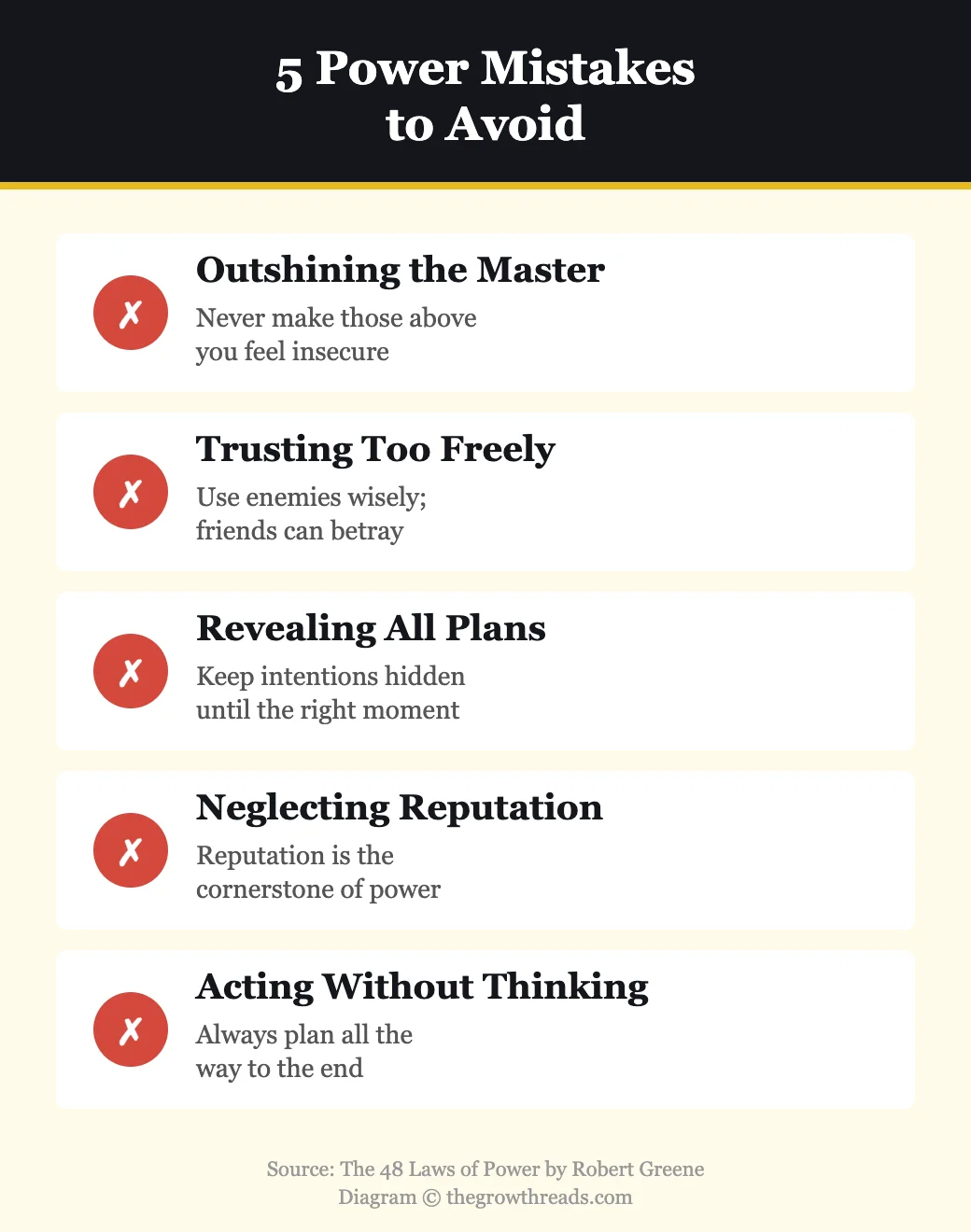
- Never outshine the master: Make those above you feel brilliantly superior — your own brilliance should uplift, not threaten, the people who hold power over your career.
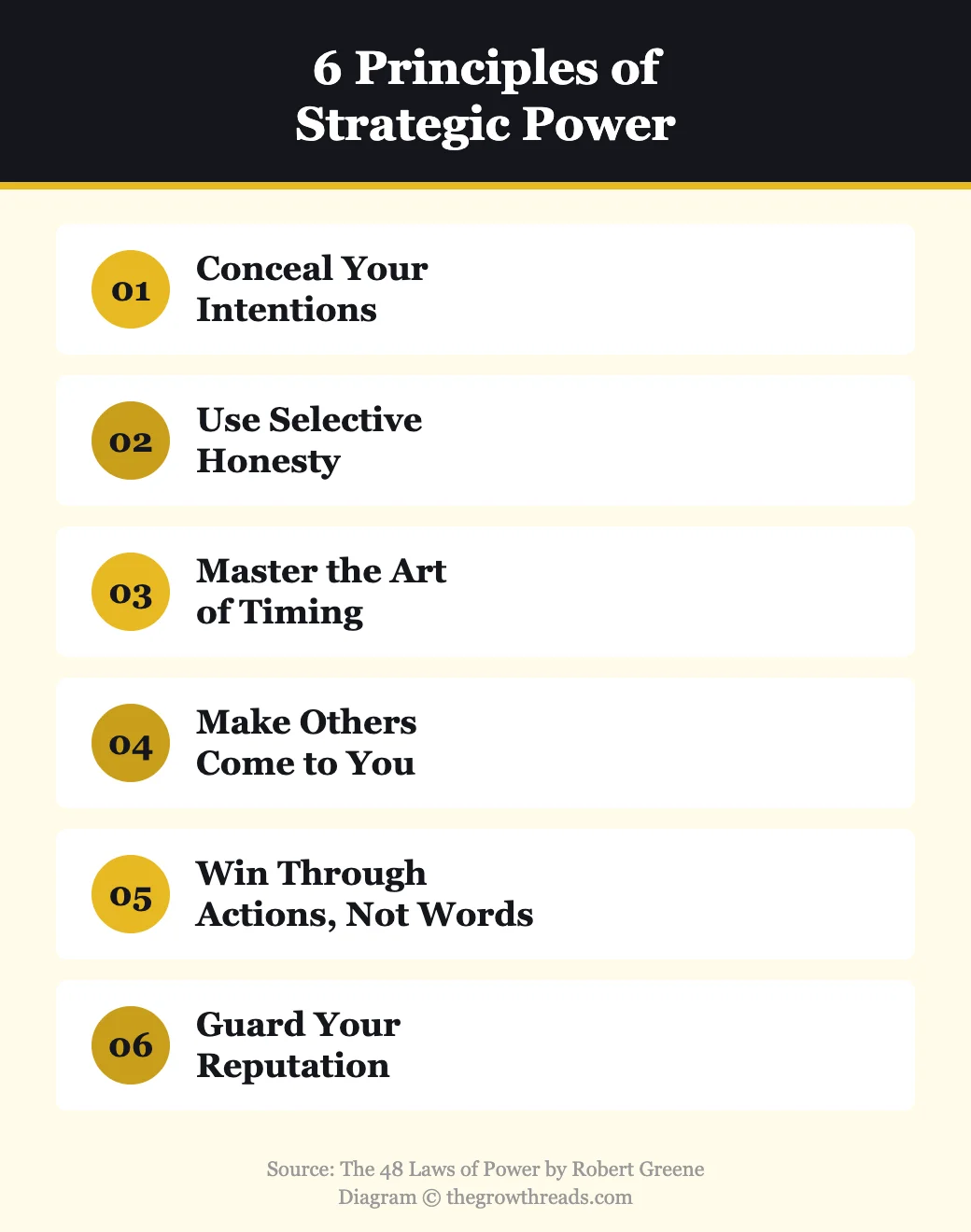
- Conceal your intentions: Keep people off-balance by never revealing the purpose behind your actions until the moment is right.
- Win through actions, not argument: Demonstrating your point is infinitely more powerful than debating it — actions end arguments permanently.
- Guard your reputation fiercely: Reputation is the cornerstone of power; once damaged, you become vulnerable to attack from every direction.
- Make others come to you: When you force others to act, you are the one in control — lure them with the promise of gain, then strike on your terms.
- Court attention at all costs: Everything is judged by its appearance; what is unseen counts for nothing in the arena of power.
- Plan all the way to the end: The ending is everything — plan all the way to it, taking into account all the possible consequences and obstacles.
- Master the art of timing: Never seem to be in a hurry — patience reveals opportunities that haste would destroy.
- Use selective honesty: One sincere move will cover over dozens of dishonest ones — use honesty as a tool to disarm and open doors.
- Know who you are dealing with: Never offend or deceive the wrong person — some opponents will spend a lifetime seeking revenge.
What Is The 48 Laws of Power About?
The 48 Laws of Power is a guide to the mechanics of social power drawn from 3,000 years of recorded history. Robert Greene presents 48 laws — from “Never Outshine the Master” to “Assume Formlessness” — each supported by historical examples showing the law in action and the consequences of violating it. The book teaches readers to recognize power dynamics in their own lives and make more strategic decisions.
About the Author
Robert Greene grew up in Los Angeles and studied classical studies at UC Berkeley and the University of Wisconsin. Before writing, he worked over fifty different jobs — from translator to Hollywood screenwriter — experiences that gave him firsthand exposure to every kind of power dynamic. His debut, The 48 Laws of Power (1998), became an underground bestseller that found audiences in boardrooms, hip-hop culture, and military strategy circles alike. Greene went on to write The Art of Seduction, The 33 Strategies of War, The 50th Law (with 50 Cent), Mastery, and The Laws of Human Nature — all focused on the intersection of psychology, strategy, and history. Explore all Robert Greene book summaries →
Key Concepts at a Glance
| Concept | What It Means | Use It When |
|---|---|---|
| Never Outshine the Master | Make those above you feel superior | Starting a new job or working under ego-driven leaders |
| Conceal Your Intentions | Use misdirection to keep others guessing | Negotiating deals or navigating office politics |
| Court Attention | Stand out deliberately — invisibility equals irrelevance | Building a personal brand or pitching ideas |
| Use Selective Honesty | A well-timed honest gesture disarms suspicion | Rebuilding trust after a conflict |
| Master the Art of Timing | Patience creates openings that haste destroys | Waiting for the right moment to ask for a raise or launch a project |
| Win Through Actions | Demonstrate, do not argue | Proving your competence to skeptics |
| Assume Formlessness | Stay adaptable — rigidity invites defeat | Entering new markets or adjusting strategy after failure |
| Crush Your Enemy Totally | Half-measures leave future threats intact | Competing against a direct rival who will not stop |
Part 1: Self-Mastery and Positioning (Laws 1–12)
Greene opens with what he considers the foundation of all power: understanding your position relative to others. Law 1, “Never Outshine the Master,” is illustrated through the story of Nicolas Fouquet, Louis XIV’s finance minister, who threw a party so lavish it made the king feel inferior. The result was Fouquet’s arrest and life imprisonment. The lesson is stark — your brilliance should always make the person above you look good, not threatened.
Law 3, “Conceal Your Intentions,” draws on the practices of Bismarck, who habitually misdirected opponents with emotional displays while pursuing entirely different objectives behind the scenes. Greene argues that transparency, while fashionable, hands your opponents the exact information they need to block you.
Law 5, “So Much Depends on Reputation — Guard It with Your Life,” uses the example of Barnum, who understood that reputation precedes action. A strong reputation multiplies your power exponentially because people defer to you before you even act. A damaged reputation invites challenges from every quarter.
Law 9, “Win Through Your Actions, Never Through Argument,” is supported by a story of the engineer Mucianus who, rather than argue with a skeptical emperor about the size of a column, simply moved the column to prove his point. Greene insists that argument creates resentment even when you win — demonstration ends the debate and earns respect.
Part 2: Strategy and Tactical Awareness (Laws 13–24)
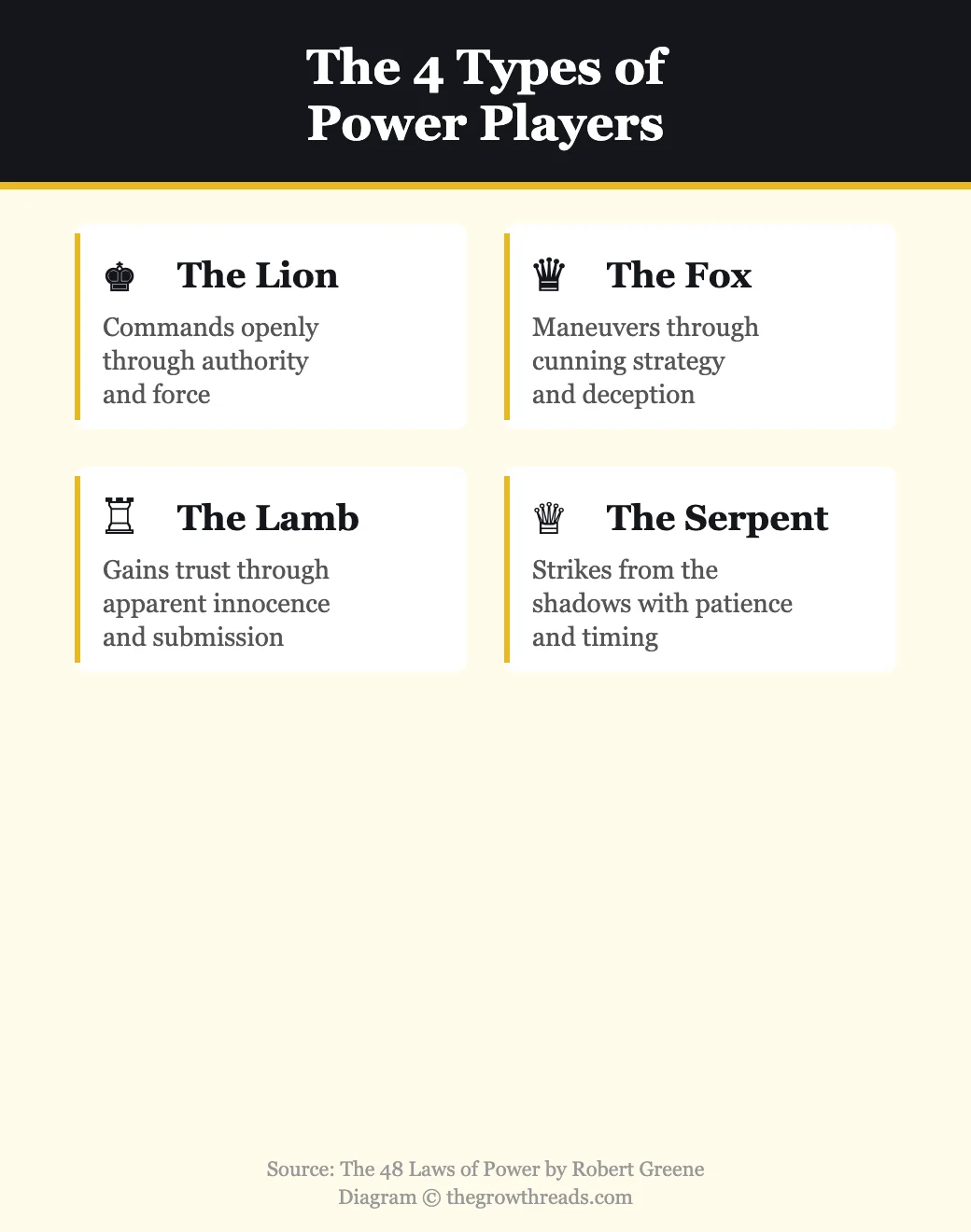
The middle section shifts from personal positioning to strategic interaction. Law 15, “Crush Your Enemy Totally,” uses historical warfare — particularly the failures of generals who showed mercy to defeated rivals only to face them again stronger — to argue that half-measures in competition are more dangerous than full commitment. In business terms, Greene means that leaving a direct competitor alive and resentful guarantees a future threat.
Law 16, “Use Absence to Increase Respect and Honor,” borrows from the court of Louis XIV, where courtiers who withdrew strategically from the king’s presence found their value increased. Greene applies this to modern contexts: overexposure, whether in meetings, emails, or social media, diminishes your perceived value. Strategic scarcity creates demand.
Law 17, “Keep Others in Suspended Terror — Cultivate an Air of Unpredictability,” draws on the methods of leaders like Mao Zedong, whose unpredictable behavior kept even his closest allies perpetually on edge. Predictability, Greene argues, gives others the ability to prepare defenses against you.
Law 20, “Do Not Commit to Anyone,” examines the strategy of Queen Elizabeth I, who used her uncommitted status as a negotiating tool for decades. By never fully aligning with any faction, she maintained leverage over all of them. In professional life, Greene suggests maintaining enough independence that no single relationship or alliance defines your options.
Part 3: Social Dynamics and Influence (Laws 25–36)
Greene turns to identity and social engineering. Law 25, “Re-Create Yourself,” uses the example of Julius Caesar, who consciously crafted a public persona that was part military genius, part man of the people. Greene argues that the most powerful figures in history were deliberate architects of their own image rather than passive recipients of how others saw them.
Law 27, “Play on People’s Need to Believe to Create a Cult-Like Following,” examines how figures from religious leaders to modern entrepreneurs harness human desire for meaning. Greene identifies five steps: keep it vague, emphasize enthusiasm over rationality, create rituals, ask followers to sacrifice, and set up an us-versus-them dynamic. He frames this analytically — not as a recommendation to manipulate, but as a lens for recognizing when you are being manipulated.
Law 28, “Enter Action with Boldness,” contrasts the timid with the bold and finds that audacity — even in the face of uncertainty — tends to produce better results than hesitation. Timidity signals weakness and invites resistance, while boldness creates the impression of certainty, which attracts followers and intimidates opposition.
Law 33, “Discover Each Man’s Thumbscrew,” teaches that everyone has a weakness — a key vulnerability that, once discovered, can be leveraged. Greene recommends understanding what drives people emotionally (insecurity, ego, fear, ambition) and using that knowledge not necessarily to exploit but to communicate more effectively and predict behavior.
Part 4: Mastery and Endgame (Laws 37–48)
The final section addresses long-term power. Law 38, “Think as You Like but Behave Like Others,” argues that openly challenging prevailing opinions invites persecution. Greene uses the fate of scientists and philosophers who were punished for unconventional thinking to illustrate that blending in publicly while thinking independently privately is the smarter path to influence.
Law 40, “Despise the Free Lunch,” cautions against anything offered for nothing. Greene traces how gifts throughout history — from the Trojan Horse to diplomatic presents — have been instruments of control. The law teaches that what is offered freely always comes at a hidden cost, usually your independence.
Law 46, “Never Appear Too Perfect,” warns that envy is the most dangerous emotion you can provoke. Even when you achieve greatly, displaying occasional weakness or attributing success to luck prevents others from turning against you. Greene’s historical cases show that people who appear flawless attract resentment precisely because they make others feel inadequate.
The book closes with Law 48, “Assume Formlessness,” drawing on Sun Tzu and water metaphors. Rigidity — in strategy, identity, or thinking — makes you predictable and therefore vulnerable. The ultimate expression of power is adaptability: the ability to change shape in response to circumstances while maintaining your core objectives.
Who Is The 48 Laws of Power Best For — and Who Should Read Something Else First?
This book is ideal for anyone navigating competitive environments — corporate hierarchies, entrepreneurship, politics, or creative industries — who wants to understand the unspoken dynamics that govern professional relationships. It is particularly useful for people who have been blindsided by office politics or feel like they keep losing to less talented but more strategically savvy competitors.
If you prefer a more empathetic approach to influence, start with How to Win Friends and Influence People by Dale Carnegie. If you want practical leadership without the Machiavellian edge, try Dare to Lead by Brené Brown. And if you want Greene’s framework applied specifically to career mastery, his own Mastery is the natural next step.
Questions to Reflect On
- Which of the 48 laws have you violated most often — and what did it cost you?
- Think of someone in your professional life who wields power effectively. Which laws do they seem to follow instinctively?
- Where in your life are you being too transparent about your intentions, and where might strategic concealment serve you better?
- Do you tend toward boldness or timidity when facing uncertainty? What would change if you shifted one degree toward boldness?
- How carefully are you guarding your professional reputation — and is there a vulnerability you have been ignoring?
🔥 Ready to Master the Game of Power?
Understand the 48 laws that govern every professional and social interaction.
How to Apply The 48 Laws of Power (7-Day Plan)
- Day 1 — Audit your current power position. List the three most important relationships at work. For each, note: Who has more power? How do they perceive you? Are you outshining anyone unintentionally?
- Day 2 — Practice concealing one intention. In your next meeting or negotiation, decide your objective beforehand but keep it to yourself. Observe how others fill the silence with their own assumptions.
- Day 3 — Win through action. Identify one argument or debate you have been trying to win with words. Instead, create a demonstration — a prototype, a result, a visible proof — and present that instead.
- Day 4 — Audit your reputation. Ask a trusted colleague how you are perceived in your organization. Compare their answer to the reputation you actually want. Note the gap.
- Day 5 — Practice strategic absence. Skip one meeting, email chain, or social engagement that you normally attend out of habit rather than value. Notice whether anyone asks about your absence.
- Day 6 — Study one person’s thumbscrew. Choose a colleague or client you find difficult. Spend the day observing what motivates them — insecurity, desire for approval, need for control — and adjust your communication accordingly.
- Day 7 — Assume formlessness. Identify one area of your professional life where you have become rigid — a process, a belief, an approach. Deliberately experiment with an alternative for the next week.
Frequently Asked Questions
Is The 48 Laws of Power manipulative?
The book describes how power has been wielded throughout history — it does not prescribe manipulation as a lifestyle. Greene himself has said the laws are as much about defense as offense. Understanding how influence works protects you from being manipulated by others who already use these tactics instinctively. Most readers find the book clarifying rather than corrupting: it gives language to dynamics they have already experienced but could not name.
What is the single most important law in the book?
Greene has suggested that Law 29, “Plan All the Way to the End,” is the master law because it underpins every other strategy. Without the discipline to think through consequences, even brilliant tactical moves fail. Planning to the end means considering not just how an action will work initially, but what second- and third-order effects it will create. This long-term thinking separates strategic operators from reactive ones.
Can you apply The 48 Laws of Power ethically?
Absolutely. Many of the laws — guard your reputation, win through actions, master timing, plan ahead — are straightforwardly good professional advice. The controversial laws (like “Crush Your Enemy Totally”) read more extreme than they are in practice: Greene means that half-hearted competitive responses create ongoing threats. Applied ethically, the book teaches awareness of social dynamics, strategic patience, and the importance of perception in professional life.
How long does it take to read The 48 Laws of Power?
At 452 pages, the book takes most readers between 10 and 14 hours to read cover to cover. However, many readers treat it as a reference book rather than a linear read — dipping into individual laws as situations arise. Each law is self-contained with its own historical examples, so you can read any chapter independently. A focused reader covering two to three laws per sitting can finish the book comfortably in two to three weeks.
What should I read after The 48 Laws of Power?
For Greene’s own deeper explorations, Mastery applies similar historical analysis to skill development, and The Laws of Human Nature covers the psychology behind the power dynamics described in this book. For a complementary perspective, Sun Tzu’s The Art of War offers the ancient strategic foundation Greene frequently references. For a modern, more collaborative take on influence, try Robert Cialdini’s Influence: The Psychology of Persuasion.
Why is The 48 Laws of Power so popular in hip-hop and sports?
The book resonated deeply in communities where navigating power dynamics is a daily reality rather than an abstract concept. Athletes and musicians often operate in environments with intense competition, predatory business partners, and sudden wealth — exactly the conditions Greene’s laws address. The book gave practical language to survival strategies that many people in these communities already practiced instinctively. Its popularity in prisons followed similar logic: understanding power dynamics is a literal survival skill in that environment.
Is The 48 Laws of Power relevant for leadership in 2026?
Yes, but with an important caveat: modern leadership also requires skills the book does not cover, like psychological safety, inclusive communication, and authentic vulnerability. The laws remain relevant for understanding competitive dynamics, office politics, negotiations, and strategic positioning. The most effective modern leaders combine Greene’s awareness of power dynamics with the relational intelligence taught in books like Dare to Lead and Radical Candor.
Related Summaries
- Mastery by Robert Greene — Greene’s deep dive into how extraordinary skill is built through apprenticeship, practice, and creative synthesis.
- The Art of War by Sun Tzu — The ancient strategic text that Greene draws on heavily throughout The 48 Laws of Power.
- Extreme Ownership by Jocko Willink & Leif Babin — A modern leadership framework built on radical personal accountability.
- Dare to Lead by Brené Brown — The empathetic counterpoint to Greene’s strategic approach — leading through vulnerability rather than calculation.
For more leadership book summaries, visit our Best Leadership Books pillar page.