

⭐⭐⭐⭐ 4.4 / 5
One-liner: The definitive study of how history’s greatest minds achieved mastery — and a blueprint for following their path.
Best for: Ambitious learners, career-changers, and anyone willing to commit years to becoming exceptional at their craft.
Reading time: ~8 hours (352 pages)
Difficulty to apply: High — mastery is a years-long commitment, but the daily steps are concrete.
Mastery in One Minute
Every person has the potential to become a master, and the path is always the same: deep apprenticeship, creative experimentation, and intuitive command. Robert Greene studies history’s greatest minds — Leonardo da Vinci, Darwin, Mozart, Einstein, and nine contemporary masters — and extracts the universal pattern behind their achievements. The secret is not talent but a process: discover your life’s task, submit to a rigorous apprenticeship, find and learn from mentors, develop social intelligence, and awaken what Greene calls “dimensional mind” — the fusion of deep knowledge and creative intuition. Mastery is not reserved for geniuses. It is available to anyone willing to put in the decades of deliberate, obsessive work.
Key Takeaways
- Everyone has a Life’s Task: There is a unique form of work you were born to do. Your deepest childhood inclinations point toward it. Ignoring it leads to a life of quiet frustration.
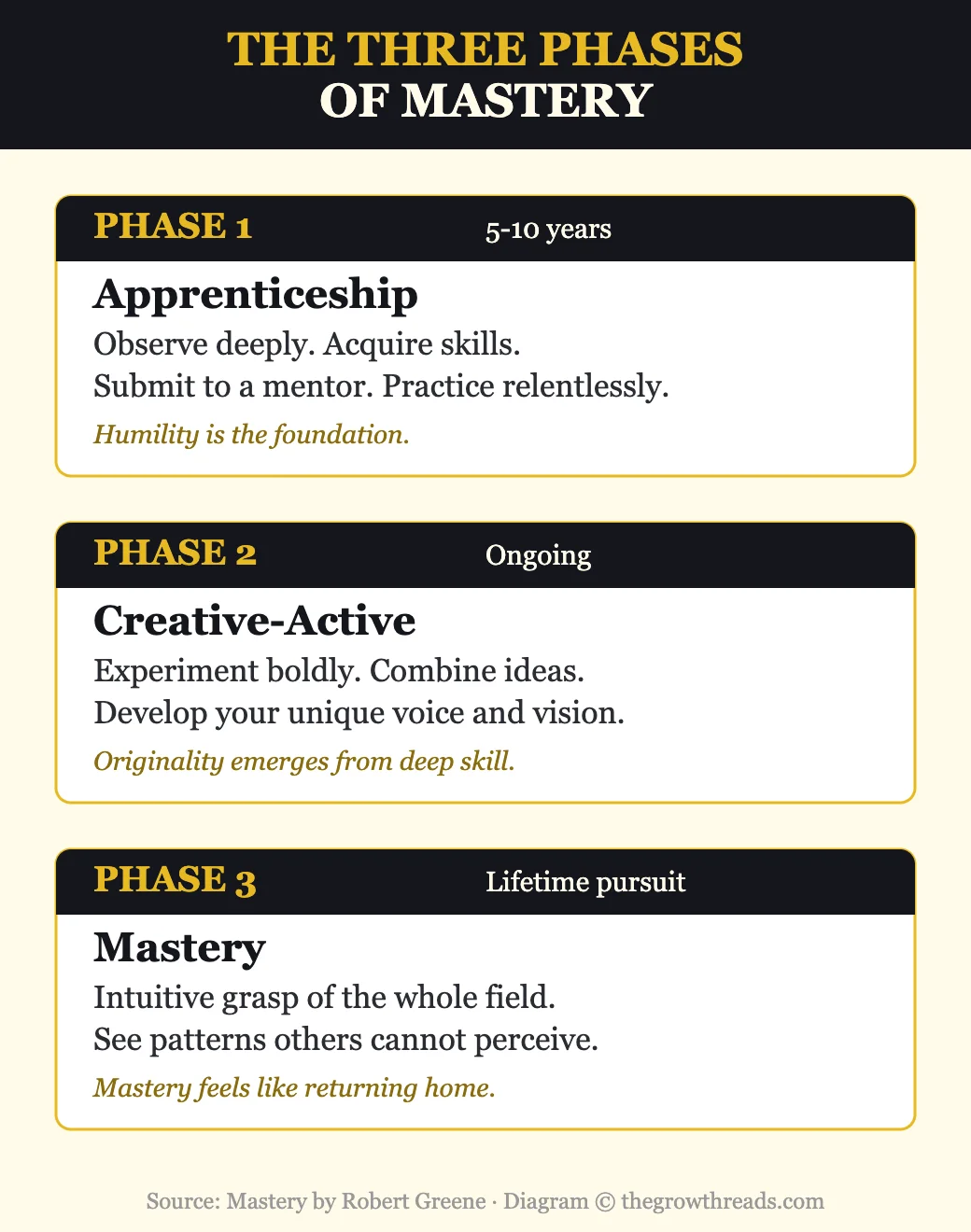
- Apprenticeship is non-negotiable: Every master in history served a long apprenticeship — typically 5 to 10 years — before producing original work. There are no shortcuts.
- Observation is the first skill: During apprenticeship, watch more than you act. Absorb the rules, culture, and power dynamics of your field before attempting to change anything.
- Find a mentor: A great mentor compresses decades of learning into years. Choose someone whose knowledge and style you deeply admire, then eventually surpass them.
- Social intelligence is essential: Technical brilliance without political awareness gets destroyed. Learn to read people, navigate envy, and avoid unnecessary conflicts.
- The Creative-Active phase requires experimentation: After mastering the fundamentals, deliberately break rules, combine disciplines, and develop your unique voice.
- Dimensional mind fuses intuition and analysis: At the highest level, masters perceive patterns and connections invisible to others — a kind of heightened intuition built on thousands of hours of deep practice.
- Resistance to boredom separates masters from amateurs: The apprenticeship phase is tedious by design. Those who push through the boredom reach the creative breakthroughs on the other side.
- Alive time versus dead time: Every moment can serve your mastery if you approach it with the right mindset. Greene argues that even setbacks, bad jobs, and failures contain lessons.
- Mastery is a return to childhood wonder: The master reconnects with the primal curiosity they had as a child, but now armed with decades of skill. Mastery feels less like arrival and more like coming home.

What Is Mastery About?
Mastery is about the process of becoming exceptionally skilled at your chosen field. Robert Greene analyses the lives of historical and contemporary masters to reveal a universal pattern: discover your calling, endure a deep apprenticeship, find mentors, develop social and creative intelligence, and ultimately achieve an intuitive command of your domain that others experience as genius.
About the Author
Robert Greene is one of the most influential non-fiction authors of the 21st century, known for books that decode the hidden dynamics of power, strategy, and human nature. Before writing, Greene held over fifty different jobs — from translator to Hollywood story developer — an experience that gave him an unusually wide-angle view of how people operate. His debut, The 48 Laws of Power, became a global phenomenon, followed by The Art of Seduction, The 33 Strategies of War, The Laws of Human Nature, and Mastery. Greene’s research method involves years of study per book, drawing on thousands of historical sources. His work is read by CEOs, athletes, artists, and military strategists worldwide.
Key Concepts at a Glance
| Concept | What It Means | Use It When |
|---|---|---|
| Life’s Task | The unique vocation aligned with your deepest inclinations | You feel directionless or stuck in the wrong career |
| Apprenticeship Phase | Years of deep skill-building under real-world pressure | You are starting in a new field and tempted to skip fundamentals |
| Deep Observation | Absorbing the rules and dynamics of a field before acting | You are new to a team, company, or industry |
| Mentor Dynamic | Learning from a master who compresses your timeline | You have hit a skill plateau and need outside guidance |
| Social Intelligence | Reading people accurately and navigating politics without losing focus | Office dynamics or envy threatens your creative work |
| Creative-Active Phase | Experimenting and combining disciplines after mastering fundamentals | You have solid skills but your work feels formulaic |
| Dimensional Mind | Fusing intuition and analysis to perceive hidden patterns | You want to make the leap from expert to visionary |
| Alive Time vs Dead Time | Using every moment — even setbacks — as fuel for growth | You are in a frustrating job or going through a difficult period |
Part 1: Discover Your Life’s Task
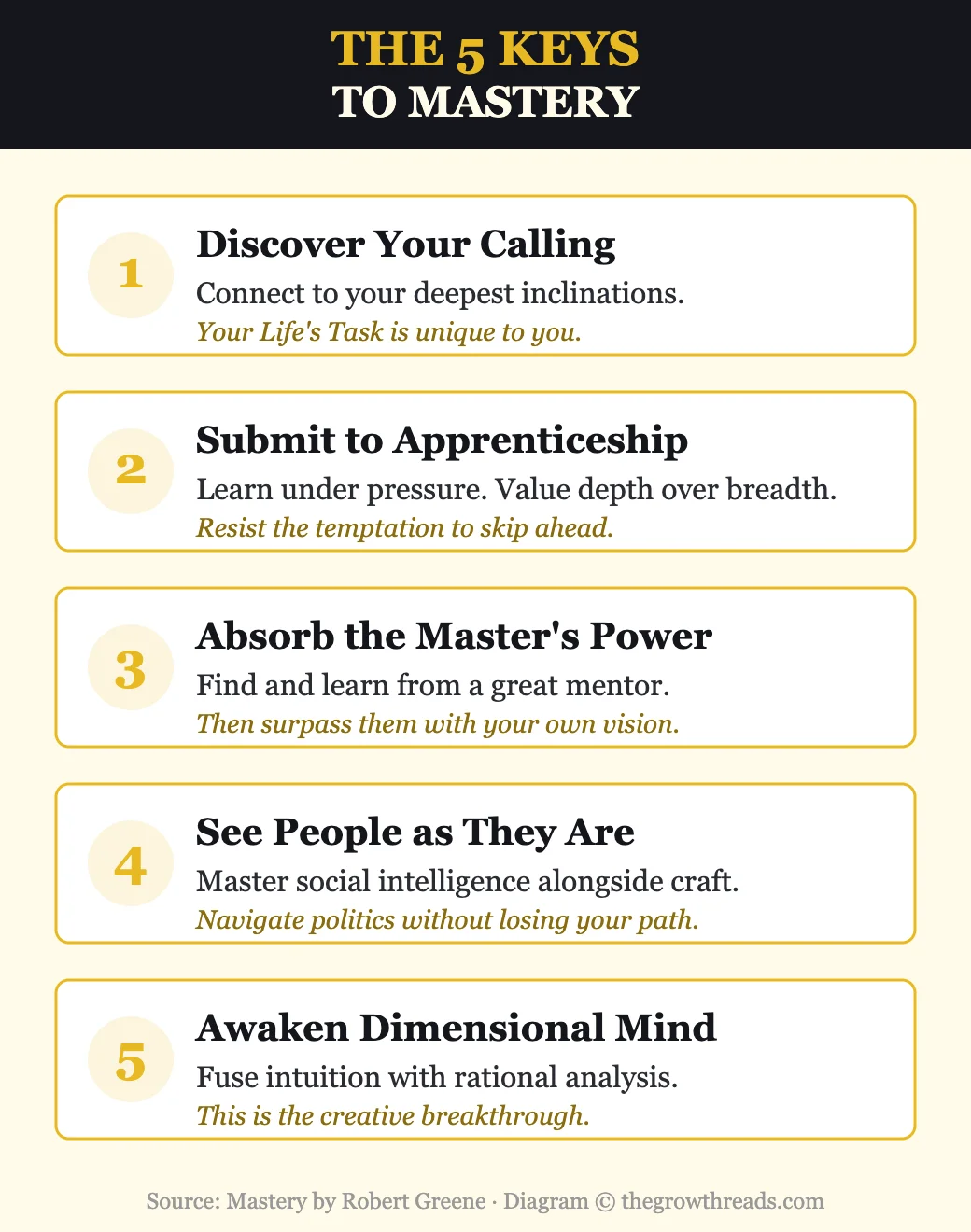
Greene opens Mastery with a bold premise: every person is born with a unique set of inclinations that point toward their ideal vocation — what he calls your Life’s Task. As children, we naturally gravitate toward certain activities, subjects, and ways of engaging with the world. These primal inclinations are not random; they reflect something deep in our neurological wiring and personality. The tragedy, Greene argues, is that most people lose touch with these inclinations as they grow up, bowing to parental expectations, social pressure, and the need for financial security.
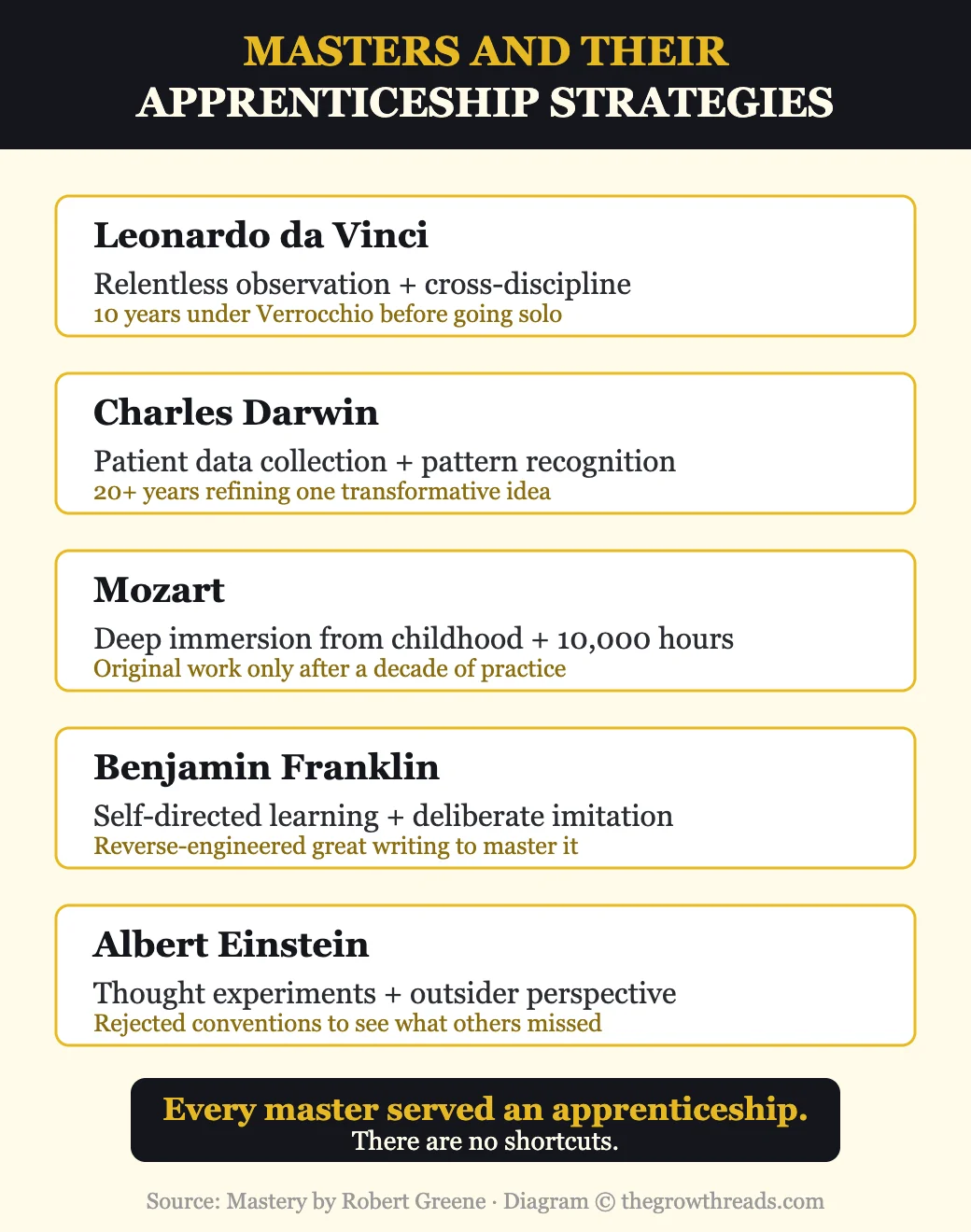
Greene illustrates this through the life of Leonardo da Vinci, who recognised his obsession with nature, art, and mechanics from a young age and pursued it with unwavering devotion despite being born illegitimate and largely self-educated. He contrasts Leonardo with people who drift from career to career without ever committing deeply, never tapping into the extraordinary energy that comes from working on what genuinely fascinates them.
The practical advice is clear: look backward. Examine your childhood interests, the activities that absorbed you completely, the subjects that made you lose track of time. These are not nostalgic curiosities — they are signals. Your Life’s Task will not be handed to you; you must actively reconnect with your inclinations and have the courage to organise your life around them, even if the path seems unconventional or risky.
Part 2: Submit to the Ideal Apprenticeship
The longest and most detailed section of the book concerns the apprenticeship — the phase Greene considers the true foundation of mastery. He breaks it into three stages: Deep Observation (watching and absorbing the rules of the new environment), Skills Acquisition (developing hands-on competence through deliberate practice), and Experimentation (testing your emerging skills in low-risk situations to find your own style).
Greene uses Darwin’s five-year voyage on the HMS Beagle as the archetypal apprenticeship. Darwin did not set out to revolutionise biology. He spent years meticulously collecting specimens, observing patterns, and building an enormous base of knowledge. Only after decades of this patient accumulation did the theory of natural selection crystallise. The lesson: mastery is built on a vast foundation of unglamorous, repetitive work that most people are unwilling to endure.
A critical insight is the concept of “resistance practice” — deliberately seeking out the most challenging aspects of a skill rather than repeating what you already do well. Greene draws on research showing that the brain physically rewires itself through focused, difficult practice. Myelin sheaths thicken around frequently used neural circuits, making complex skills increasingly automatic. This neuroplasticity is the biological basis of mastery — and it requires sustained effort over years, not weeks.
Greene warns against three common traps during apprenticeship: choosing a path for money rather than learning, trying to appear clever rather than actually absorbing knowledge, and quitting when the work becomes boring. The boredom, he insists, is a feature, not a bug. It is the resistance that separates future masters from eternal dabblers.
Part 3: Absorb the Master’s Power — The Mentor Dynamic
Greene devotes an entire chapter to the role of mentors, arguing that a great mentor is the single most powerful accelerant on the path to mastery. The right mentor does not just transfer knowledge — they compress your learning timeline by years, model the mindset of a master, and push you past plateaus that would otherwise stall your development.
The ideal mentor dynamic, according to Greene, has a lifecycle. In the early stages, you submit to the mentor’s authority, absorbing their knowledge and methods with humility. As your skills grow, you begin to push back, experimenting with your own ideas and developing an independent voice. Eventually, you surpass the mentor — and the greatest mentors welcome this. Greene uses the relationship between Freddie Roach and Manny Pacquiao, as well as the historical bond between Faraday and Humphry Davy, to illustrate how the mentor dynamic can transform both parties.
He also warns about toxic mentor relationships: mentors who become possessive, who feel threatened by the student’s growth, or who demand loyalty beyond what is healthy. The key is to extract maximum learning and then move on. Your goal is not to remain an apprentice forever but to eventually stand on your own.
Part 4: See People as They Are — Social Intelligence
This is the chapter many readers overlook, but Greene considers it essential. Technical mastery means nothing if you are destroyed by office politics, undermined by envious colleagues, or isolated by your own social obliviousness. Greene argues that social intelligence — the ability to read people’s motivations, navigate group dynamics, and manage envy — is a skill that must be developed alongside your craft.
He profiles several masters who were brilliant but socially inept (Ignaz Semmelweis, who discovered handwashing prevents infection but was destroyed by the medical establishment because he antagonised everyone around him) and contrasts them with masters who combined technical genius with political savvy (Benjamin Franklin, who used charm, strategic alliances, and careful self-presentation to advance both his ideas and his career).
The practical takeaway is uncomfortable but important: you cannot ignore people. No matter how talented you are, your work exists within a social context. Learn to observe non-verbal cues, identify hidden agendas, present your ideas in ways that make others feel included rather than threatened, and choose your battles wisely. Greene frames this not as manipulation but as maturity — the recognition that human beings are emotional creatures and that ignoring this reality is a form of arrogance.
Part 5: Awaken the Dimensional Mind
The final chapter describes the highest level of mastery: what Greene calls “dimensional mind.” After years of deep practice and broad experimentation, certain practitioners develop an almost uncanny ability to see the entire field in a single intuitive flash. They perceive connections, patterns, and possibilities that are invisible to everyone else. Greene argues that this is not magic — it is the inevitable result of thousands of hours of focused engagement with a domain, processed by a brain that has physically restructured itself around that knowledge.
Greene profiles contemporary masters to illustrate dimensional mind in action. He describes how a master martial artist reads an opponent’s intention before the punch is thrown, how a master chess player sees twenty moves ahead not through conscious calculation but through pattern recognition that operates below conscious awareness. These abilities look like genius from the outside, but they are the natural product of the mastery process.
The key creative strategy at this level is what Greene calls “Original Mind” — the capacity to return to the open, wondering perspective of a child, but now backed by an enormous reservoir of skill and knowledge. The master does not merely reproduce what has been done before. They synthesise, recombine, and create something genuinely new. This is where mastery and creativity converge: the master has so deeply internalised their field that they can play with it freely, the way a jazz musician improvises on a theme they know by heart.
Who Is Mastery Best For — and Who Should Read Something Else First?
This book is ideal for anyone at the beginning or middle of a long-term career who wants a strategic framework for becoming exceptional. It is particularly powerful for people in creative fields, entrepreneurship, science, or any domain that rewards deep expertise built over years. If you have a vague sense that you are capable of more but lack a roadmap, Mastery provides one grounded in centuries of historical evidence.
If you are looking for quick productivity wins or immediate habit changes, start with Atomic Habits or Deep Work instead. If you want a shorter, more urgent take on overcoming creative resistance, try The War of Art. Come back to Mastery when you are ready to think in decades rather than weeks.
Questions to Reflect On
- What activities absorbed you completely as a child — and how do those inclinations connect to your current work or interests?
- Are you currently in an apprenticeship phase, or are you trying to skip ahead to the creative-active phase before your foundations are solid?
- Who could serve as a mentor in your field, and what would you need to offer them in return for their time and knowledge?
- Where has a lack of social intelligence — not technical skill — held back your career or creative work?
- If you committed the next five years to deliberate practice in one domain, what would you choose?
🔥 Ready to start your path to mastery?
Get the book that maps the universal process behind every great achievement in history — and shows you how to follow it.
How to Apply Mastery (7-Day Plan)
- Day 1 — Reconnect with your inclinations: Spend 20 minutes writing about what fascinated you as a child. List activities, subjects, and moments of total absorption. Look for patterns.
- Day 2 — Audit your current apprenticeship: Honestly assess your skill level in your primary domain. What fundamentals are you still weak on? Write down three specific skills to improve.
- Day 3 — Start resistance practice: Identify the hardest, most uncomfortable aspect of your craft and spend your practice session on it today. Avoid the temptation to repeat what you already do well.
- Day 4 — Identify a potential mentor: List three people in your field whose work you deeply admire. Research their background and think about what you could offer them in exchange for guidance.
- Day 5 — Observe your social environment: Spend the day paying close attention to the social dynamics at work or in your creative community. Who holds informal power? Where does envy lurk?
- Day 6 — Cross-pollinate: Read, watch, or study something from a completely different field than your own. Look for one unexpected connection to your primary domain and write it down.
- Day 7 — Set your 5-year intention: Write a one-page vision of where your mastery path could lead in five years. Commit to the daily practice that will get you there and schedule it for tomorrow.
Frequently Asked Questions
Is Mastery by Robert Greene worth reading in 2026?
Yes. The book’s core argument — that deep, sustained practice in a chosen field leads to extraordinary ability — has only become more relevant as AI automates routine tasks and rewards people with rare, high-level expertise. Greene’s historical case studies provide a long-term perspective that most modern productivity books lack. If you are thinking about your career in terms of decades, not quarters, this is essential reading.
What is the main message of Mastery?
The main message is that mastery is not a gift reserved for geniuses — it is a process available to anyone willing to commit. The process involves discovering your unique calling, enduring a rigorous apprenticeship, finding mentors, developing social intelligence, and ultimately reaching an intuitive command of your field. Greene demonstrates this pattern through the lives of Leonardo da Vinci, Darwin, Einstein, and contemporary masters.
How long does it take to read Mastery?
Mastery is approximately 352 pages of dense, research-heavy prose. Most readers take 7 to 10 hours to finish it. Unlike Greene’s more aphoristic books like The 48 Laws of Power, Mastery reads more like extended biography and analysis. Many readers find it useful to read one chapter per week and spend time reflecting on the exercises and case studies before moving on.
How does Mastery differ from The 48 Laws of Power?
The 48 Laws of Power focuses on social strategy and navigating power dynamics. Mastery is about deep skill development and long-term creative achievement. Where the 48 Laws is tactical and Machiavellian, Mastery is strategic and aspirational. They complement each other: the 48 Laws teaches you how to survive in a competitive environment, while Mastery teaches you how to transcend it through genuine expertise.
Does Mastery apply to people who are not artists or scientists?
Absolutely. Greene deliberately includes case studies from business (Paul Graham, Henry Ford), sports (Freddie Roach), and technology alongside the artists and scientists. The mastery process — apprenticeship, mentorship, experimentation, intuitive command — operates identically whether you are building software, running a restaurant, practising medicine, or coaching athletes. If your field rewards deep expertise, this book applies to you.
What is the “Life’s Task” in Mastery?
Your Life’s Task is the unique form of work you were born to do, rooted in your deepest childhood inclinations and natural abilities. Greene argues that every person has one, but most lose sight of it under social pressure and the need for security. Reconnecting with your Life’s Task is the first and most important step on the path to mastery, because it provides the intrinsic motivation required to sustain years of difficult practice.
What should I read after Mastery by Robert Greene?
For deeper dives into deliberate practice, read Peak by Anders Ericsson or Grit by Angela Duckworth. For daily discipline and habit-building to sustain the mastery process, try Atomic Habits by James Clear or Deep Work by Cal Newport. For a complementary perspective on creative work and overcoming resistance, read The War of Art by Steven Pressfield. And if you want more from Greene, The Laws of Human Nature extends the social intelligence chapter into a full book.
Related Summaries
- Grit Summary & Review — Angela Duckworth’s research proving that passion and perseverance trump talent on the path to excellence.
- Peak Summary & Review — Anders Ericsson’s definitive guide to deliberate practice and how experts are really made.
- Deep Work Summary & Review — Cal Newport’s framework for the sustained focus that mastery demands.
- The War of Art Summary & Review — Steven Pressfield’s field manual for defeating the Resistance that blocks your creative work.
Explore more: Best Productivity Books · Best Self-Help Books
How we analyse books at The Growth Reads: Every summary is written from a full reading of the original text, distilled into actionable takeaways, and cross-referenced with related research and books. We rate each book on five criteria: actionability, evidence quality, writing clarity, uniqueness, and lasting impact. Read our full methodology.