

★★★★½ 4.5 / 5 — The most influential strategy text ever written, distilled into timeless principles that apply to business, leadership, and life.
Best for: Leaders, entrepreneurs, and strategists who want a framework for thinking about competition, positioning, and decision-making
Reading time: ~2 hours (68 pages of core text)
Difficulty to apply: Moderate — the principles are simple but require deep situational judgment to apply well
The Art of War in One Minute
The supreme art of war is to win without fighting. Written around 500 BC by Chinese military strategist Sun Tzu, this short treatise lays out principles for achieving victory through preparation, intelligence, positioning, and psychological advantage rather than brute force. Every chapter distills a strategic truth: know yourself and your enemy, move with speed and deception, attack weakness not strength, and adapt your strategy to changing conditions like water flowing around obstacles. The genius of the text is its universality — these principles apply equally to military campaigns, business competition, negotiations, and personal conflicts. At 68 pages, it is the most concentrated dose of strategic wisdom ever written.
Key Takeaways
- The best victory requires no battle: Supreme excellence is subduing the enemy without fighting — through positioning, alliances, diplomacy, and psychological advantage.
- Know yourself and know your enemy: If you know both, you need not fear the result of a hundred battles. If you know yourself but not the enemy, you will win half and lose half. If you know neither, you will lose every time.
- All warfare is based on deception: Appear weak when you are strong, and strong when you are weak. Control what your opponent believes about you.
- Speed is the essence of war: Take advantage of unpreparedness, travel by unexpected routes, and strike where they have not taken precautions.
- Attack weakness, not strength: Water avoids heights and rushes to the lowlands. Strategy should flow toward the point of least resistance.
- Strategy must adapt like water: Just as water shapes its course according to the ground, a leader must shape strategy according to the situation at hand.
- Every battle is won before it is fought: Victory belongs to the side that has calculated, planned, and positioned itself before engagement.
- A leader must unify their forces: A divided army cannot win. Alignment of purpose and discipline of execution are prerequisites for any strategic success.
- Retreat is a strategic option, not a failure: If you cannot win, reposition. There is no honor in losing a battle you should not have fought.
- Intelligence is the foundation of strategy: Without accurate information about the terrain, the enemy, and your own capabilities, strategy is guesswork.
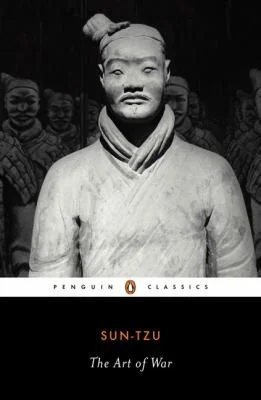
What Is The Art of War About?
The Art of War is a 2,500-year-old Chinese military treatise that distills the principles of strategy, leadership, and competitive advantage into 13 short chapters. Sun Tzu argues that victory comes from preparation, intelligence, adaptability, and psychological positioning rather than from strength alone — principles that have been applied to business, sports, politics, and personal development for centuries.
About the Author
Sun Tzu was a Chinese military strategist, philosopher, and general who lived during the Eastern Zhou period around 500 BC. According to historical records, he served as a military advisor to the King of Wu and led successful campaigns that expanded the kingdom. While some scholars debate whether Sun Tzu was a single individual or a composite figure, the text attributed to him has shaped military and strategic thinking for over 2,500 years. The Art of War has influenced leaders from Napoleon and Mao Zedong to modern CEOs and sports coaches, making it one of the most widely read non-fiction works in human history.
Key Concepts at a Glance
| Concept | What It Means | Use It When |
|---|---|---|
| Win Without Fighting | Achieve objectives through positioning, not confrontation | Negotiating, competing for market share |
| Know Yourself, Know Your Enemy | Deep intelligence about both sides determines outcomes | Entering any competitive situation |
| Deception | Control what opponents believe about your intentions | Competitive strategy, product launches |
| Speed and Surprise | Move faster than opponents can react | First-mover situations, crisis response |
| Terrain Analysis | Understand the ground — market, context, conditions | Before making any major strategic decision |
| Strategic Adaptation | Shape your approach to fit changing conditions | When plans meet reality and need adjusting |
| Unity of Command | Align all forces behind a single purpose | Building teams, launching initiatives |
| Intelligence Network | Information is the foundation of all strategy | Market research, competitive analysis |
Part 1: Laying Plans and Waging War
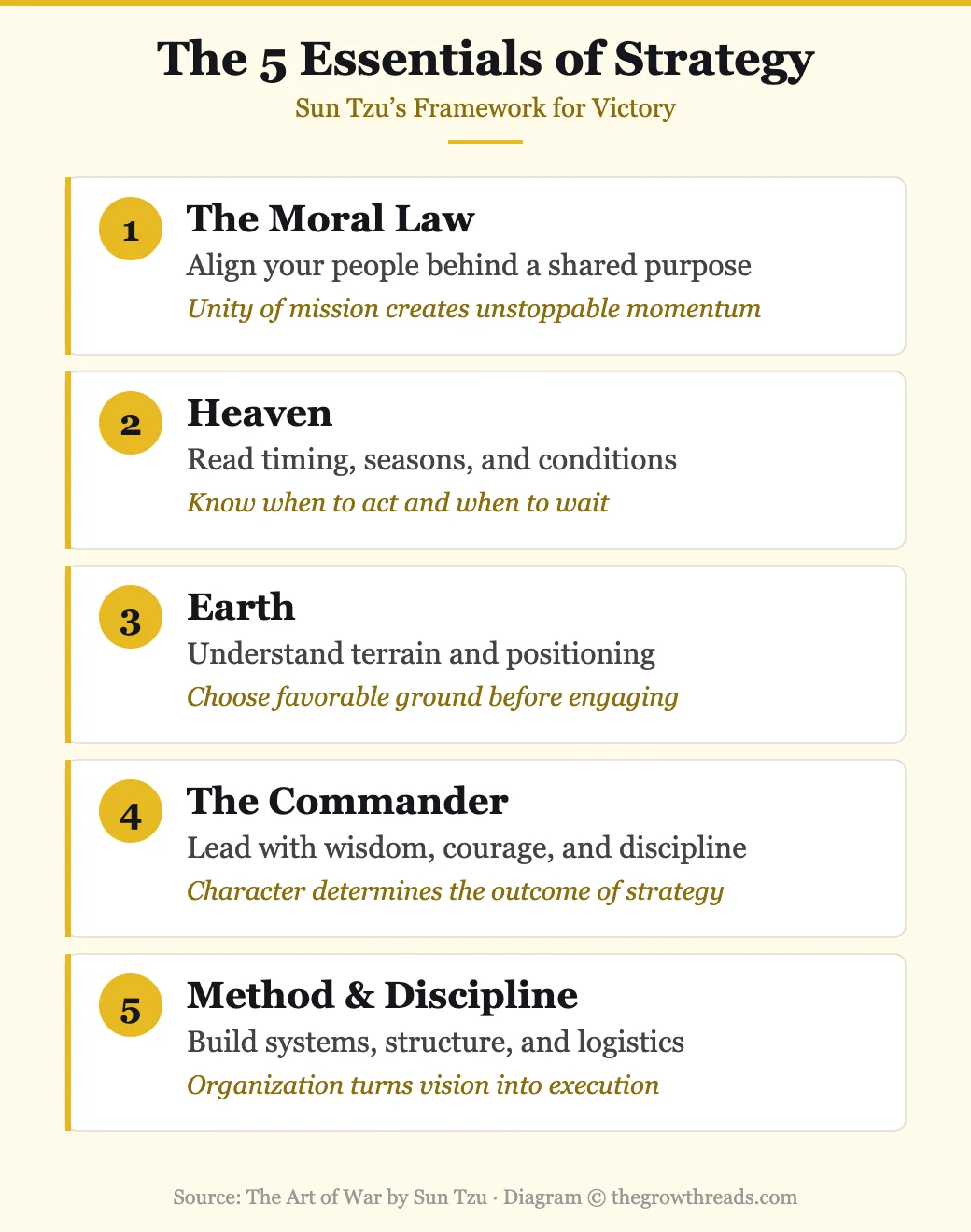
The opening chapters establish Sun Tzu’s foundational principle: war (or any competitive endeavor) is a matter of vital importance that must be studied with the utmost seriousness. He identifies five fundamental factors that determine the outcome of any conflict: the Moral Law (alignment of purpose between leader and followers), Heaven (timing and conditions), Earth (terrain and positioning), the Commander (character and competence of leadership), and Method and Discipline (organization and logistics).
Sun Tzu insists that the outcome of a battle is determined before it begins — by whichever side has better calculated these five factors. “Every battle is won before it is fought” is not mysticism; it is the argument that preparation, intelligence, and positioning matter more than bravery or force. A leader who has done the work — who knows the terrain, understands the opponent, has aligned their team, and chosen the right moment — has already won.
On waging war, Sun Tzu is remarkably modern in his emphasis on efficiency and cost. He warns against prolonged campaigns that drain resources and morale. Speed and decisiveness are preferred over size and endurance. A quick, efficient victory that preserves resources is always superior to a grinding war of attrition — a principle that applies directly to business competition, where startups routinely outmaneuver larger, slower incumbents.
TGR Note: The emphasis on preparation over execution echoes a principle in Good to Great by Jim Collins — the “Hedgehog Concept” of deeply understanding what you can be best at before committing resources. Sun Tzu would recognize Collins’s disciplined leaders who confront brutal facts while maintaining faith in the outcome.
Part 2: Strategic Positioning and Tactical Advantage
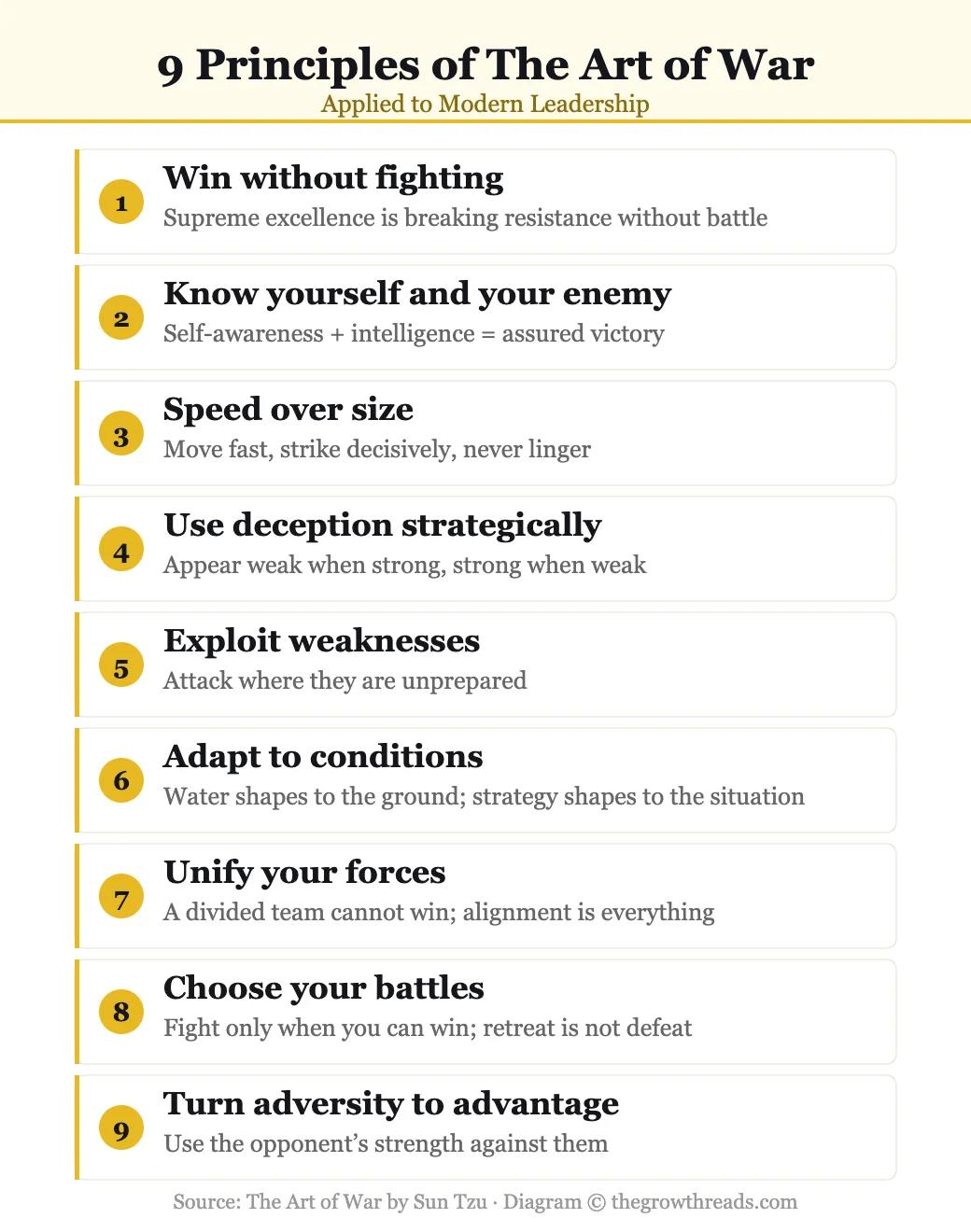
The middle chapters are the tactical core of the book. Sun Tzu introduces his most famous principles here: attack weakness, not strength; use deception to control what the enemy believes; and adapt your strategy to conditions like water flowing around rocks.
“All warfare is based on deception” is perhaps the most quoted line. Sun Tzu argues that controlling the narrative — what your opponent believes about your strength, intentions, and position — is as important as actual capability. In modern terms, this is competitive intelligence, product positioning, and strategic communication. You do not need to be stronger than your opponent; you need them to believe something about you that gives you an advantage.
The principle of attacking weakness is equally powerful. Sun Tzu compares strategy to water: just as water naturally flows downhill and around obstacles, strategy should flow toward the point of least resistance. Do not attack your competitor where they are strongest; find the gap, the underserved market, the overlooked customer segment, and concentrate your forces there.
Sun Tzu also introduces the concept of “shih” — strategic energy or momentum. A boulder sitting on flat ground has no energy. The same boulder at the top of a steep mountain has tremendous potential energy. Strategy is about positioning yourself at the top of the mountain before the engagement begins, so that when you move, the momentum is overwhelming and the effort required is minimal.
TGR Note: The “attack weakness” principle maps directly to modern business strategy. Clayton Christensen’s concept of disruptive innovation — entering markets from the bottom where incumbents are not competing — is pure Sun Tzu. For a contemporary application, see our summary of The Lean Startup by Eric Ries, which teaches rapid iteration and finding product-market fit before scaling.
Part 3: Terrain, Adaptation, and Intelligence
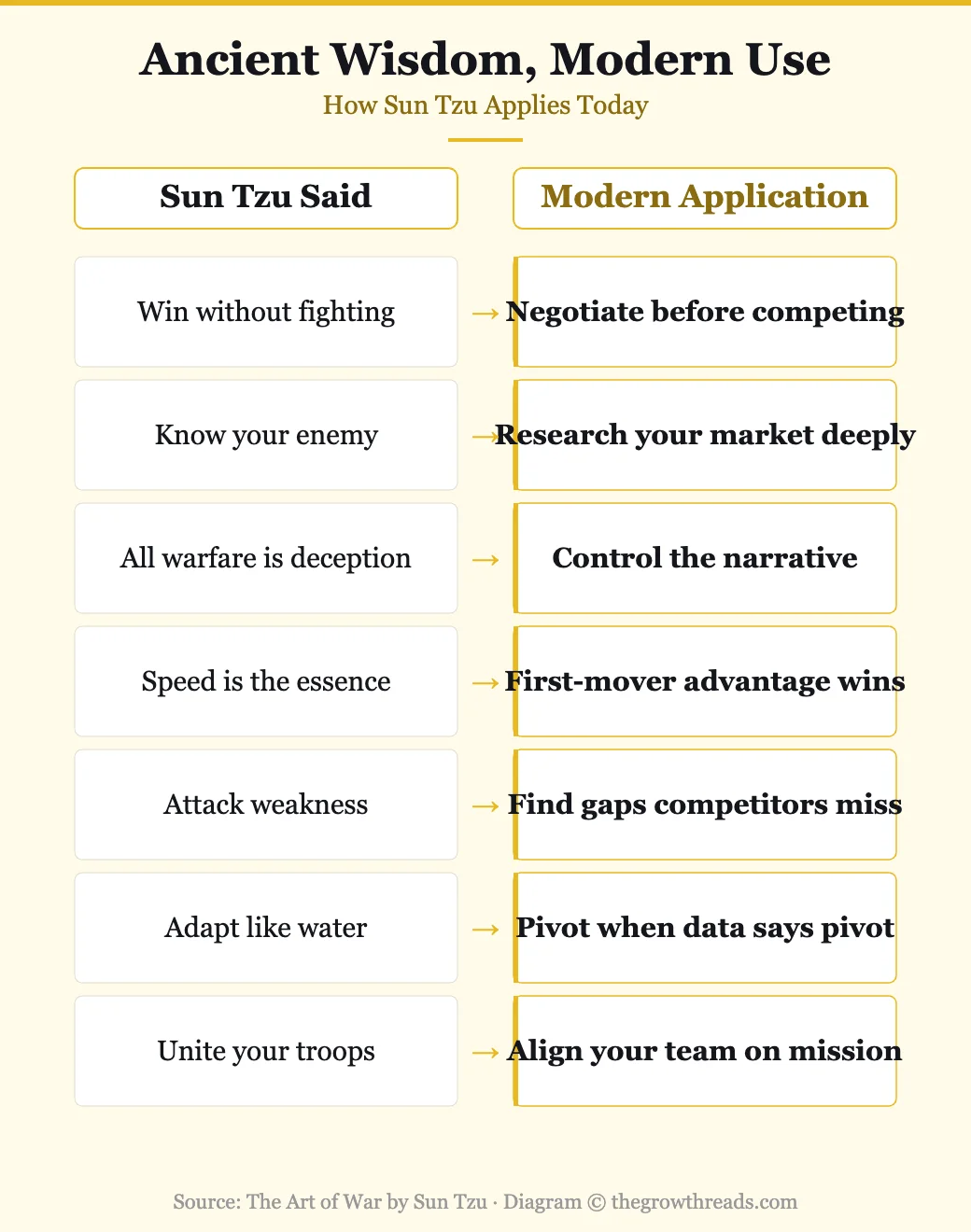
The later chapters deal with terrain (understanding the landscape of competition), the nine situations a leader will face (from easy ground to desperate ground), and the critical role of intelligence. Sun Tzu categorizes different types of terrain — dispersive, frontier, key, open, intersecting, serious, difficult, enclosed, and desperate — and prescribes different strategies for each. The modern equivalent is market analysis: understanding whether you are in a growing market, a saturated one, a niche, or a crisis determines the strategy you should employ.
On adaptation, Sun Tzu delivers his most elegant metaphor: “Water shapes its course according to the nature of the ground over which it flows; the soldier works out his victory in relation to the foe whom he is facing.” A leader who applies the same strategy to every situation is like a river trying to flow uphill. The best strategists read the situation and respond accordingly, sometimes attacking, sometimes retreating, sometimes waiting.
The final chapter on spies (intelligence gathering) is remarkably sophisticated. Sun Tzu identifies five types of intelligence agents and argues that no expense should be spared on information gathering. “What enables the wise sovereign and the good general to strike and conquer, and achieve things beyond the reach of ordinary men, is foreknowledge.” In modern terms: data-driven decision making, competitive intelligence, customer research, and market analysis are not optional luxuries — they are the foundation upon which all strategy must rest.
TGR Note: Sun Tzu’s emphasis on intelligence gathering as the foundation of strategy pairs well with Measure What Matters by John Doerr. While Sun Tzu provides the strategic philosophy, Doerr provides the modern execution framework (OKRs) for turning intelligence into aligned action across an organization.
Who Is The Art of War Best For — and Who Should Read Something Else First?
This book is ideal for leaders, entrepreneurs, and strategists who want a timeless framework for thinking about competition, positioning, and decision-making. It is especially valuable for anyone in a competitive environment — whether business, politics, sports, or negotiation — who wants to think more clearly about when to engage, when to wait, and how to win with minimal cost.
If you want modern leadership principles rather than strategic philosophy, start with Extreme Ownership by Jocko Willink, which translates military leadership directly into business contexts. If you want strategy applied specifically to startups, The Lean Startup by Eric Ries is more immediately actionable. And if you want the psychology of influence and persuasion — the “deception” angle applied ethically — see our summary of Influence by Robert Cialdini.
Questions to Reflect On
- In your current competitive situation, are you trying to win by force (outworking, outspending) or by positioning (being in the right place at the right time)?
- Do you truly know your competitor — their strengths, weaknesses, and likely moves — or are you guessing?
- Where are you attacking strength when you should be flowing around it to find undefended ground?
- Is your team aligned behind a shared mission, or are your forces scattered across too many priorities?
- What battle are you currently fighting that you should walk away from — and where would those resources be better deployed?
🔥 Ready to Think Like a Strategist?
Learn the timeless principles that have guided leaders for 2,500 years.
How to Apply The Art of War (7-Day Plan)
- Day 1: Identify your top competitive situation — a business rival, a negotiation, or a goal where you face opposition. Write down everything you know about the other side: their strengths, weaknesses, resources, and likely strategy.
- Day 2: Do the same analysis on yourself. Be honest about your strengths and weaknesses. Where does your intelligence have gaps? List three things you need to learn before making your next move.
- Day 3: Map the terrain. What is the landscape of your competition? Where is the market growing, where is it saturated, and where are the underserved gaps? Identify one area of weakness in the competitive landscape.
- Day 4: Design a “win without fighting” strategy. What would it look like to achieve your objective through positioning, alliances, or removing obstacles rather than direct confrontation?
- Day 5: Audit your team alignment. Does everyone on your team understand the mission and their role? Identify one area of misalignment and address it with a direct conversation.
- Day 6: Practice strategic patience. Identify one decision you have been rushing. Apply Sun Tzu’s principle: “He will win who knows when to fight and when not to fight.” Wait for better conditions or more information.
- Day 7: Write a one-page strategic plan for your competitive situation. Include: your objective, your opponent’s likely moves, your point of attack (weakness, not strength), your positioning advantage, and your exit criteria (when to disengage).
Frequently Asked Questions
Is The Art of War still relevant today?
Extremely. The principles Sun Tzu articulated 2,500 years ago are universal and timeless because they address the fundamental dynamics of competition, leadership, and strategic thinking. Modern business leaders, coaches, negotiators, and politicians regularly cite the book. The specific tactics (chariot formations, river crossings) are outdated, but the strategic principles — preparation, intelligence, adaptation, positioning, and psychological advantage — apply to any competitive situation. The book is required reading at many military academies and business schools worldwide.
What is the main message of The Art of War?
The main message is that victory comes from strategic intelligence and positioning, not from brute force. Sun Tzu argues that the highest form of strategy is winning without fighting — achieving your objectives through preparation, deception, speed, and attacking weakness rather than through costly direct confrontation. The book emphasizes knowing yourself and your opponent, adapting to conditions, and choosing when and where to engage rather than fighting every battle that presents itself.
How can I apply The Art of War to business?
The business applications are direct: know your market and competitors before entering (intelligence), position your product where competitors are weak rather than attacking them head-on (attacking weakness), move fast when you have an advantage (speed), build strong team alignment behind a clear mission (unity of command), and adapt your strategy when market conditions change (strategic flexibility). Many successful companies have applied these principles — from Apple’s positioning strategy to Amazon’s patient, long-term competitive approach.
What does Sun Tzu mean by “all warfare is based on deception”?
Sun Tzu means that controlling what your opponent believes about your intentions, strength, and position is a critical strategic advantage. If your opponent acts on false assumptions, they will make mistakes you can exploit. In business, this translates to competitive intelligence and information asymmetry — not outright lying, but strategically controlling your public narrative, timing product announcements, and maintaining operational secrecy until the right moment. The ethical application is about competitive positioning, not dishonesty.
Which translation of The Art of War is best?
The Penguin Classics translation by John Minford is excellent for general readers, offering clear modern English with helpful commentary. The translation by Samuel B. Griffith (Oxford University Press) is considered the scholarly standard, with extensive historical context and annotations. For business readers, the annotated edition by Thomas Cleary is popular because it includes practical commentary connecting the principles to modern strategy. Any of these three translations will give you the full text with good context — the core principles are consistent across translations.
How long does it take to read The Art of War?
The core text is only about 68 pages, making it one of the shortest books you will ever read. Most people can read the full text in one to two hours. However, the book rewards rereading — many readers return to specific chapters when facing particular strategic situations. The real time investment is not in reading but in reflection and application: each chapter contains principles dense enough to spend days thinking about how they apply to your specific situation.
Was Sun Tzu a real person?
Historians debate this. Traditional accounts place Sun Tzu as a military general who served the King of Wu around 500 BC. The historian Sima Qian, writing about 400 years later, included a biography of Sun Tzu in his Records of the Grand Historian. Some modern scholars believe Sun Tzu was a single historical figure; others argue the text was compiled by multiple authors over centuries. Regardless of authorship, the text itself has been remarkably consistent since its earliest known versions, and its principles have stood the test of 2,500 years of application.
Related Summaries
- Extreme Ownership Summary & Review — Military leadership principles applied directly to business
- Good to Great Summary & Review — What separates great companies from merely good ones
- The Lean Startup Summary & Review — Rapid strategy iteration for modern entrepreneurs
- Best Leadership Books — 2026 Rankings
Browse more in this category: