

★★★★☆ 4.3/5 — a compact field manual for the hour you keep negotiating with yourself.
Best for: People who already know the next right action and still wait to feel like doing it
Reading time: ~4.5 hours (217 pages) if you binge · this guide ~12 min
Difficulty to apply: Easy to understand — wait, start, move the treat. Hard to keep — you have to run the rule while the urge is loud
The Science of Self-Discipline in one minute
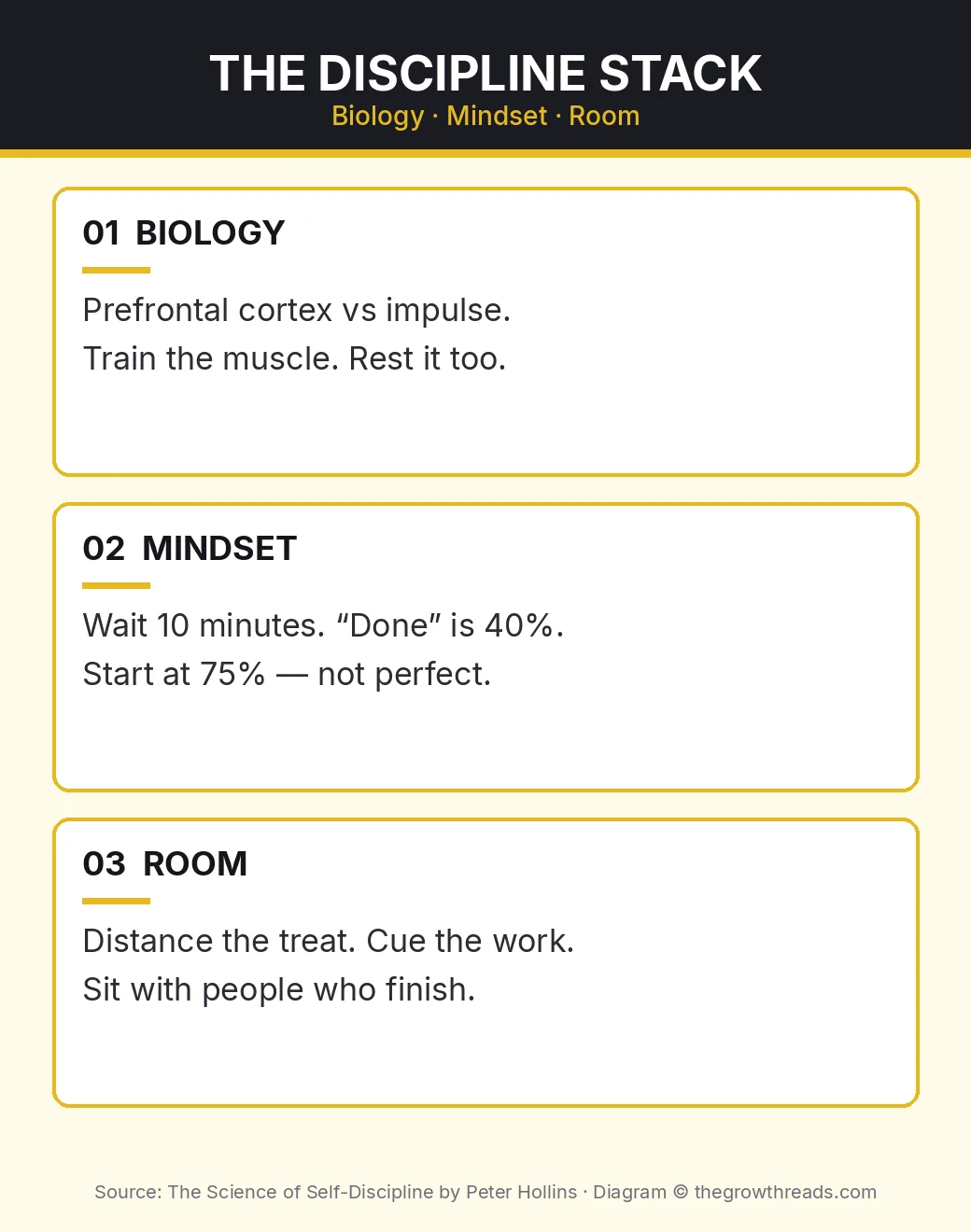
Motivation is a weather report. Discipline is the coat you packed. Peter Hollins’s The Science of Self-Discipline (CreateSpace, 2017) is a short manual for people who already have the list and still lose the next ten minutes. The claim is blunt: self-discipline is the skill of executing. A goal without that skill stays a speech. Hollins stacks three layers — the biology of the wait, a handful of in-the-moment rules (ten minutes, 40%, 10-10-10, start at 75%), and a room that makes the right action the default so willpower is spare. The usable move is small: delay the yes, take one more block when you feel empty, and put the treat out of reach. This summary is the application layer: one temptation, one rule, one environment change, and a 7-day plan — not a personality transplant.
Key takeaways
- Discipline is a skill, not a mood: Waiting to feel ready is how weeks disappear. Train the action, then the feeling follows.
- The brain is a tug of war: Impulse wants now. The prefrontal cortex can wait. You strengthen the wait by using it, not by reading about it.
- Willpower behaves like a muscle: It grows with reps and it tires. Rest and food are part of the program, not a moral failure.
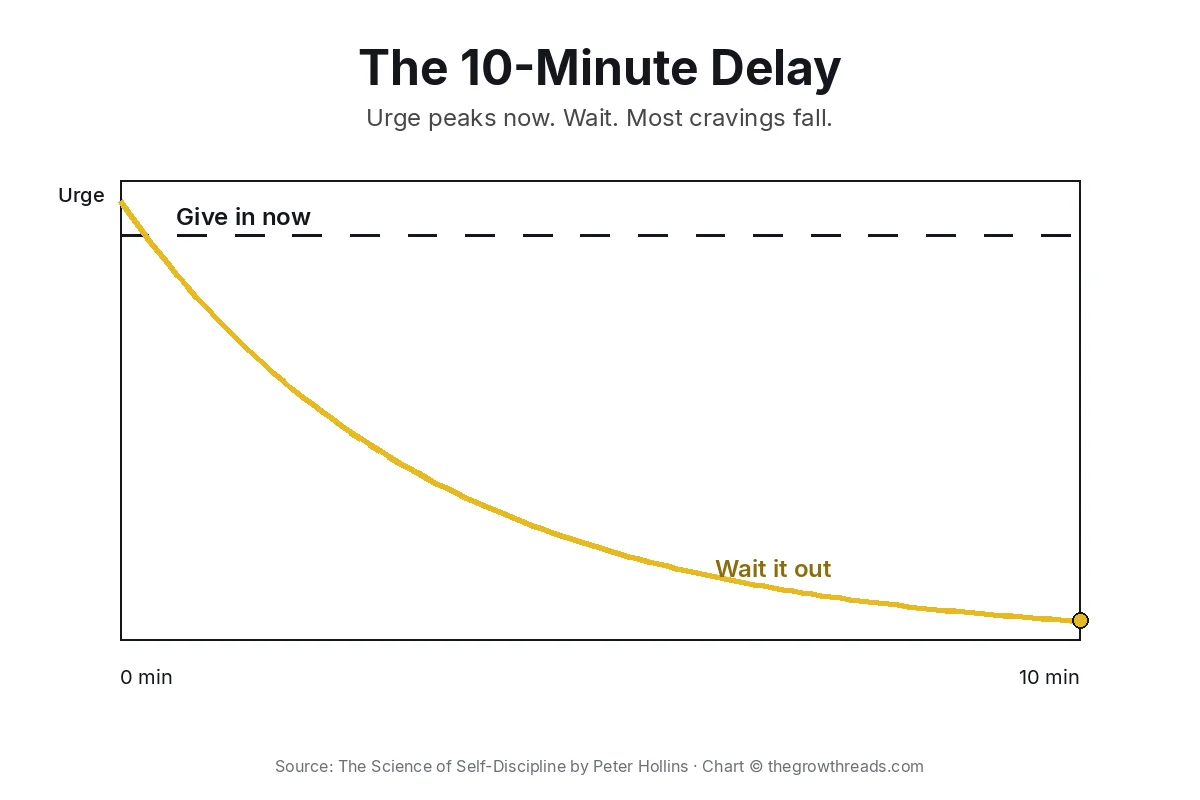
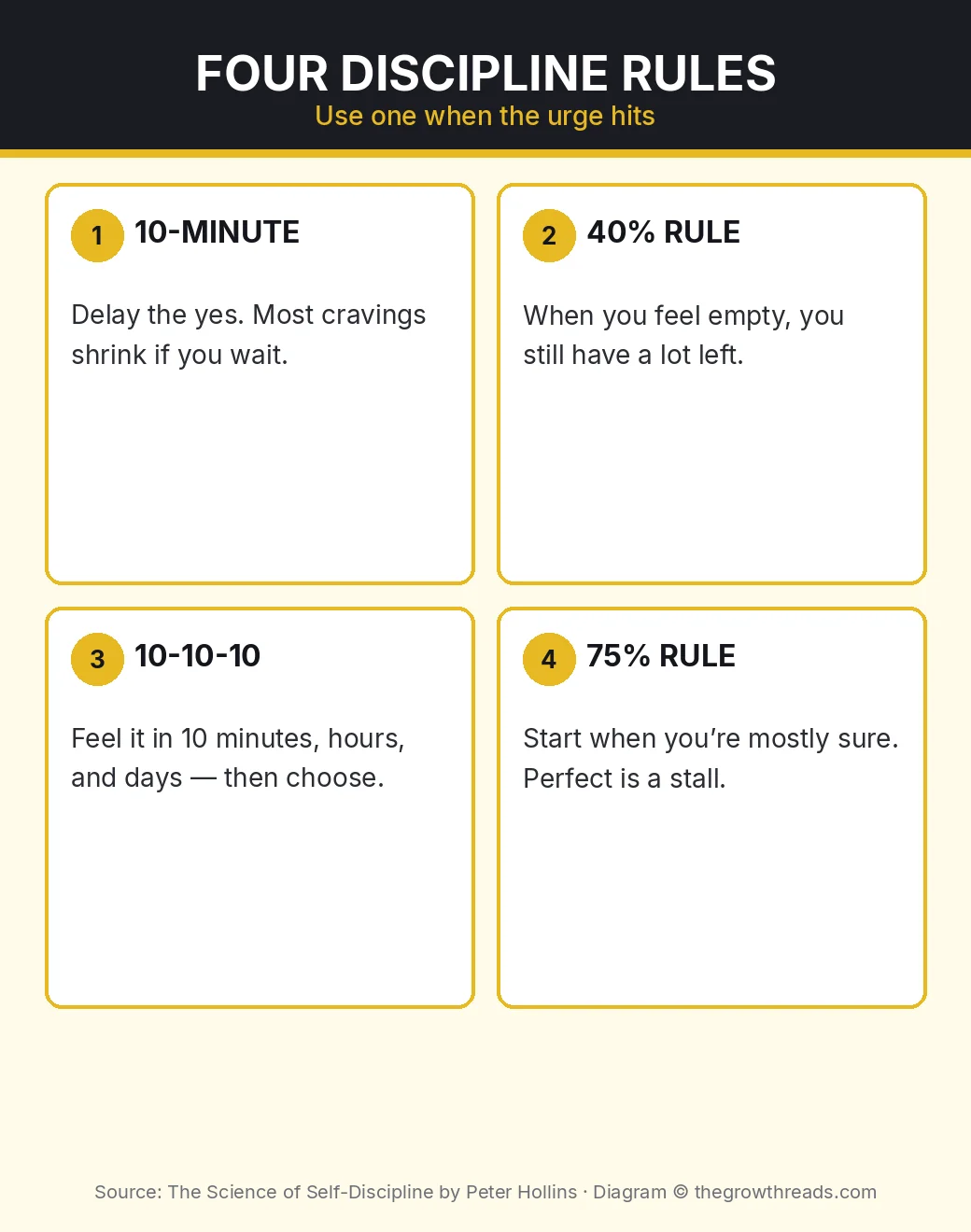
- The 10-minute rule: Most urges peak and fall. Delay the yes. If it still matters in ten minutes, you can choose with a cooler head.
- The 40% rule: The first “I’m done” is rarely empty. High performers treat that signal as a checkpoint, not a stop.
- 10-10-10: Ask how the choice will feel in ten minutes, ten hours, and ten days. Immediate relief stops winning every argument.
- The 75% rule: Start when you are mostly sure. Perfect information is a stall wearing a lab coat.
- Proximity runs you: The closer the treat, the more “discipline” you burn. Distance is cheaper than grit.
- Your circle is a cue: Sit with people who finish. Discipline spreads. So does the stall.
- GYAC — give yourself a chance: Design the default so you do not need a heroic Tuesday. Habits then carry what willpower started.
What is The Science of Self-Discipline about?
The Science of Self-Discipline is Peter Hollins’s 2017 field guide to doing the next right action without waiting to feel like it. He treats discipline as a trainable skill: a pause, a few in-the-moment rules, and a room that keeps temptation far. The point is a cooler ten minutes — not a new personality.
About the author
Peter Hollins writes short, research-flavored manuals for people who already know what they should do and still do not. He studied psychology and peak performance, coached privately, then turned that stack into a compact shelf — including Finish What You Start and this book — on focus, follow-through, and mental models. The voice is direct: fewer long stories, more levers you can run on a Tuesday. He is not a lab scientist publishing original trials. He is a translator who pulls delay-of-gratification research, willpower-as-muscle language, and high-performer tactics into a checklist. The through-line is the same across the shelf: feelings arrive late. Design the next ten minutes, then the room, then the people you sit with. Explore all Peter Hollins book summaries →
Key concepts at a glance
| Concept | What it means | Use it when |
|---|---|---|
| Discipline as skill | Executing without a mood upgrade | You keep waiting to “feel like it” |
| Prefrontal wait | The pause between urge and action | The hand is already reaching |
| Willpower muscle | Reps strengthen it; overload depletes it | You crash after a hard morning of no’s |
| 10-minute rule | Delay the yes until the peak passes | A craving or distraction just arrived |
| 40% rule | “I’m empty” is often a checkpoint | You want to quit a block halfway |
| 10-10-10 | Feel the choice at three timescales | Relief now is winning every vote |
| 75% rule | Start before certainty is complete | You are researching instead of beginning |
| Proximity effect | Near temptation spends your discipline | The phone or snack is in arm’s reach |
| GYAC | Design a default that does not need a hero | You rely on grit to save a messy room |
Part 1: The biology of the wait
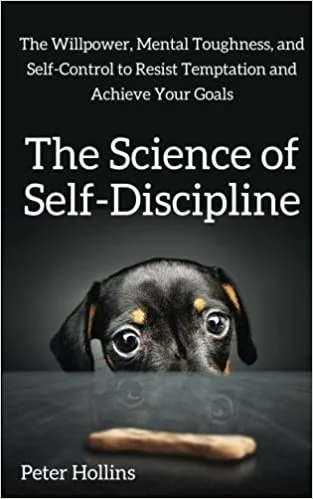
Hollins opens where most productivity blogs skip: you are not a spreadsheet. You are an animal with a fast “now” system and a slower “later” system. Impulse wants the treat, the tab, the relief. The prefrontal cortex can insert a pause. Self-discipline, in this frame, is whether that pause exists long enough for a better vote. Walter Mischel’s marshmallow work is the picture everyone already knows — some children wait for two treats — not a dissertation. The cover is that picture: a face staring at a biscuit. The work is the ten seconds before your hand moves.
He treats willpower like a muscle because the metaphor changes the week. Muscles grow when you use them and fail when you pretend they are infinite. After a morning of hard no’s, the afternoon “just this once” is predictable, not a character defect. Eat, rest, and stop stacking every refusal into the same hour. You cannot white-knuckle fourteen hours. You can train a pause, then stop asking the pause to do the job of a better room. Respect the hardware. Stop romanticizing exhaustion.
TGR Note: If the whole thesis is “stop using willpower as the plan,” our Willpower Doesn’t Work summary is the sibling — Hardy wants the environment to carry the load. Hollins still trains the muscle and moves the furniture. For the habit layer that makes the pause automatic, Atomic Habits and The Power of Habit are the next manuals.
Part 2: Rules you can run while the urge is loud
The middle of the book is a pocket kit. Hollins does not want a monk. He wants a protocol you can remember when blood is up. The 10-minute rule is the one you will actually use. When the urge arrives — scroll, snack, abandon the draft — you do not debate identity. You start a timer. Ten minutes is long enough for the peak to fall and short enough that you will try it. If it still deserves a yes after ten minutes, give it. A lot of “need” was just a spike. The chart after the takeaways is that spike as a line. Waiting is the tactic.
Three more rules sit next to it. The 40% rule, the same high-performer talk you will hear around SEAL training and Can’t Hurt Me: the first “I have nothing left” is often a story. You do not have to be Goggins. Treat the quit-signal as a checkpoint — one more small block, then reassess. 10-10-10 widens the vote: ten minutes, ten hours, ten days. Immediate relief always wins a one-timescale election. The 75% rule is for the smart stall. You wait because you want 100% certainty. Start at mostly-sure. The last 25% is information you only get by moving. Perfectionism here is not high standards. It is fear with a checklist.
TGR Note: Tiny first moves live in Mini Habits and Tiny Habits — if the block is size, shrink it before you 40% it. If the block is follow-through after the start, Hollins’s own Finish What You Start is the companion. For “just do the frog,” Eat That Frog and No Excuses! are the louder cousins.
Part 3: Engineer the room so grit is spare
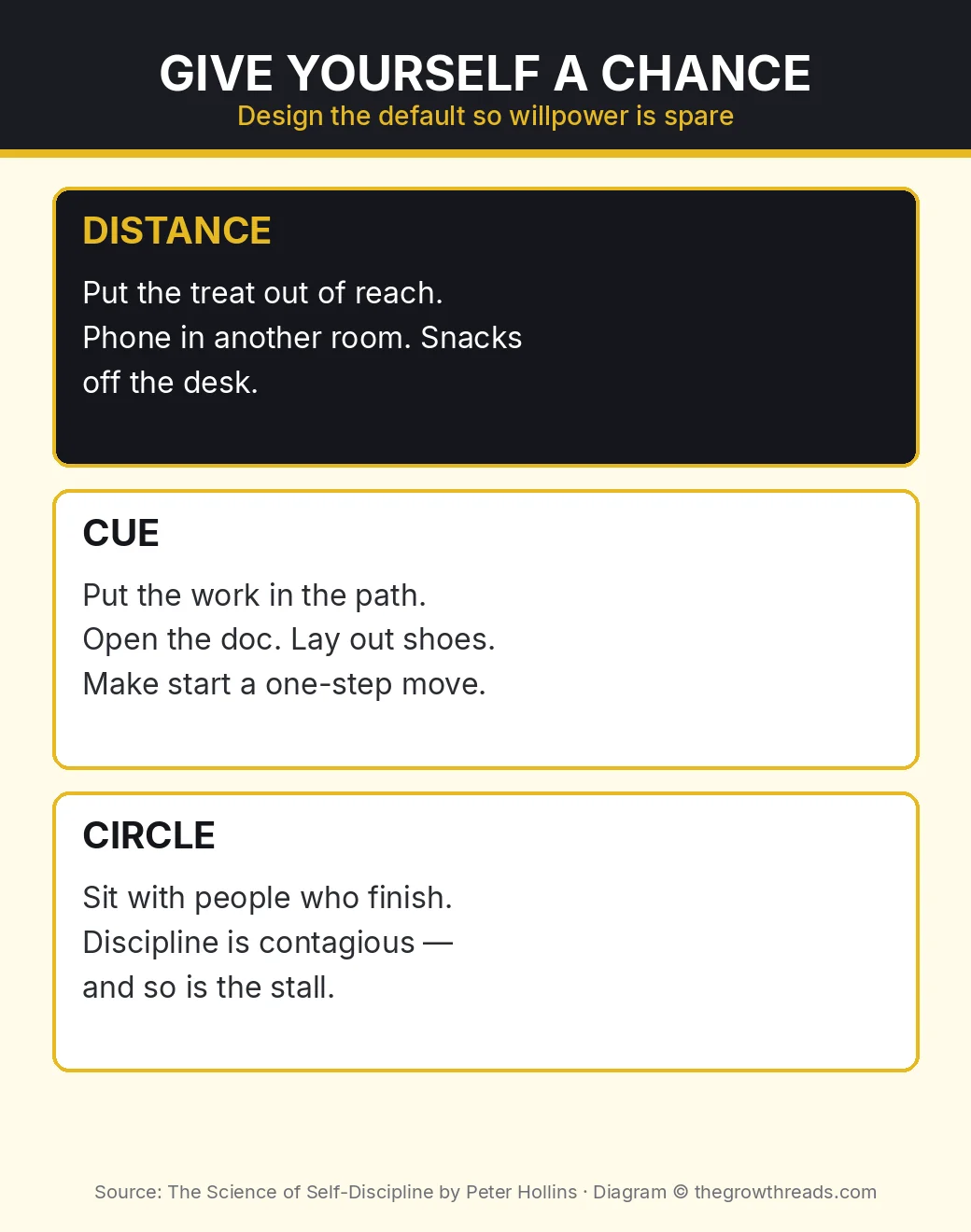
Hollins’s best chapter is the least heroic. Proximity runs behavior. The closer the cue — candy dish, phone face-up — the more “discipline” you spend just existing. You think you are deciding. You are standing next to a biscuit. GYAC — give yourself a chance — means stop asking a tired prefrontal cortex to outvote a treat six inches away. Phone in another room. Snacks off the desk. Log out. Make the wrong action require shoes. Make the right action one step: doc open, hour already on the calendar. Distance is a design choice, not a personality.
The social layer is the same idea with people. You become a little more like the room you sit in. A circle that finishes is a cue. A circle that narrates starting-over every Monday is also a cue. Notice which hour is spent with people who make the pause easier, and add one of those hours on purpose. Willpower is the backup generator. The grid should carry the house.
TGR Note: Environment-first is the whole plot of Willpower Doesn’t Work. If the room is noisy rather than tempting, Deep Work is the door you close. If the stall is a flinch before the hard conversation, not a snack, Courage Is Calling is the pairing — Hollins delays an urge; Holiday names a fear.
Part 4: Habits, lapses, and staying in the game
Rules get you through a spike. Habits get you through a quarter. Every 10-minute wait or 75% start carves a groove so next Tuesday needs less debate — the same compound logic as The Compound Effect and Atomic Habits, in a shorter voice. Identity helps: take the action a disciplined person takes in the next ten minutes. Lapses are expected. No drama. You broke the chain. You are not “undisciplined.” You run the next rule. A streak is evidence the muscle works, not a coupon for a binge.
Boredom and frustration are the quiet quitters. People quit when the work stops being novel, not when it becomes impossible. Shrink the next unit. Use 40% on the boring middle. Frustration is often a 75% problem: you wanted a clean result from an early draft. Ship the ugly pass. Motivation is a tailwind, not the engine. Diagnose what actually moves you — progress, people, a deadline — and put that next to the block. Remove one drain this week instead of adding another app. “A goal without the self-discipline necessary to enact it will remain just a dream or fantasy,” Hollins writes. The TGR translation: put the dream on a timer and move the biscuit.
TGR Note: For grit-as-perseverance rather than a ten-minute tactic, Grit is the long game. For showing up after the yes, Discipline Is Destiny and Discipline Equals Freedom are louder. If the week is lists, not urges, start with Getting Things Done — Hollins will not file your projects for you.
Who is The Science of Self-Discipline best for — and who should read something else first?
Best for people who already know the next action — write, train, close the tab — and still lose the negotiation. Run the 7-day plan on one real temptation, not on a highlight reel of SEAL quotes.
Read something else first if you cannot get any small daily act to stick: Atomic Habits or Mini Habits. If the problem is a messy capture system, not an urge: Getting Things Done. If you start and never finish: Hollins’s Finish What You Start. If you want environment to replace willpower entirely: Willpower Doesn’t Work. If the stall is fear, not craving: Courage Is Calling. If you want the hardest physical cousin: Can’t Hurt Me.
Questions to reflect on
- What urge stole last week’s important hour — and was it in arm’s reach?
- Where did you wait to “feel like it,” and what did that delay cost in days?
- Which rule would have changed Tuesday: 10 minutes, 40%, 10-10-10, or start at 75%?
- What treat can you move tonight so tomorrow’s you does not need to be a hero?
- Who in your week makes finishing easier — and how do you get one more hour with them?
🔥 Ready to train the wait instead of waiting to feel ready?
Get The Science of Self-Discipline, then run the 7-day plan on one real urge — not on a binge of willpower quotes.
How to apply The Science of Self-Discipline (7-day plan)
- Day 1 — Name the treat. One sentence: the urge that keeps beating the important hour. Write where it sits in the room. If you cannot point at it, you are still in a story.
- Day 2 — Run 10 minutes once. When the urge arrives, start a timer. Do not debate identity. After ten minutes, choose. Record whether the spike fell.
- Day 3 — Move the furniture. Distance the treat (phone, snack, tab). Put the work one step away (doc open, shoes out). GYAC: give tomorrow a chance.
- Day 4 — One 40% block. On a hard or boring unit, notice the first “I’m done.” Do one more small block, then reassess. A checkpoint, not a personality test.
- Day 5 — 10-10-10 a stall. Before a yes that is really relief, write how it will feel in ten minutes, ten hours, ten days. Let the later votes speak.
- Day 6 — Start at 75%. Pick one thing you have been researching. Begin the ugly version before the plan is perfect. Timestamp it.
- Day 7 — Circle and calendar. Spend one hour with someone who finishes, or book that hour. Put next week’s first 10-minute rule on the calendar. The book only works if Tuesday still has a job.
Frequently asked questions
What is The Science of Self-Discipline about in one paragraph?
The Science of Self-Discipline is Peter Hollins’s 2017 manual for doing the next right action without waiting to feel motivated. He treats discipline as a trainable skill: a biological pause between urge and action, a pocket of rules (wait ten minutes, treat “I’m done” as 40%, vote at three timescales, start at 75%), and a room that keeps temptation far so willpower is spare. The book is short, practical, and light on original experiments. This summary is the application layer: one real urge, one environment change, and a 7-day plan — not a new personality.
Does the 10-minute rule actually work?
It works as a delay, not as magic. Most urges — snack, scroll, abandon the draft — peak fast. Ten minutes is long enough for the peak to fall and short enough that you will try it on a workday. Start a timer instead of an identity debate. If it still deserves a yes after ten minutes, give it with a cooler head. If it does not, you bought the hour back. Pair it with distance: a phone in another room needs less waiting. Day 2 is one timed delay on a real treat, recorded, so you can see whether your spike actually falls.
What is the 40% rule in this book?
The 40% rule says the first wave of “I have nothing left” is often a story, not an empty tank. High-performer culture — including SEAL talk you will also meet in Can’t Hurt Me — treats that signal as a checkpoint. Hollins’s usable version is smaller: when you want to quit a block, do one more small unit, then reassess. You are not required to be extreme. You are required not to confuse discomfort with completion. Day 4 is one 40% block on something hard or boring. If the stall is fear of looking foolish, not fatigue, Courage Is Calling is the better pairing.
How is The Science of Self-Discipline different from Atomic Habits?
Atomic Habits is a system for making the right action obvious, attractive, easy, and satisfying until it is identity. Mini Habits and Tiny Habits shrink the start until you cannot fail. Hollins is the in-the-moment kit for the spike those systems still have to survive: wait ten minutes, vote at three timescales, start at 75%, move the treat. Read Atomic Habits or Mini Habits first if no small act sticks. Read Hollins if the act is clear and the negotiation is not. They stack. This summary does not replace Clear’s four laws; it installs the pause that lets a habit loop run when the biscuit is staring at you.
Is the willpower-as-muscle science still solid?
The metaphor is useful. Some of the famous lab stories are messier than they were sold. Ego-depletion studies (the radish-and-cookie era) have been debated and, in places, failed to replicate cleanly. Hollins wrote a practical book, not a review paper. Keep the application: you cannot white-knuckle every hour; rest, food, and a better room matter; reps still train a pause. Drop the claim that willpower is a single fuel tank science has fully mapped. If you want environment to replace the tank, Willpower Doesn’t Work is the sibling. FAQ is the right place for that caveat — the 7-day plan still runs without a perfect theory of glucose.
Should I read this or Finish What You Start first?
Read The Science of Self-Discipline if the failure is the negotiation — you know the action and still take the treat, the tab, or the stall. Read Finish What You Start, Hollins’s companion on our time-management shelf, if you begin easily and leak on the back half: boredom, novelty-seeking, no close. Many readers need both. Start here if Tuesday’s important hour loses to an urge in the room. Start with Finish if your calendar is full of launched projects and empty of landed ones. You do not need the whole Hollins shelf before Day 1. You need one named treat and a ten-minute timer.
Is The Science of Self-Discipline still useful in 2026?
The spike aged well. Phones got closer; the biscuit is now a feed. Tools got better; the ten-minute wait did not expire. Hollins’s claim is still the useful one: discipline is a skill you train, a delay you can run, and a room you can rearrange so you are not a hero by 4 p.m. Ignore the quote-graphic version that makes willpower a personality you missed. Keep the timer, the 75% start, and one furniture move. The research chapters are fuel, not a costume. Day 1 should still be a real urge you can point at in the room you actually work in — not a speech about SEALs.
Related summaries
- Atomic Habits Summary & Review
- Willpower Doesn’t Work Summary & Review
- Mini Habits Summary & Review
- Discipline Equals Freedom Summary & Review
- Best Productivity Books
How we analyze books: every book on The Growth Reads is read cover to cover, summarized in thousands of words of original analysis, and rated against our five-criteria rubric (lasting impact, evidence quality, practical application, writing & originality, external consensus). Read our full methodology.