

★★★★☆ 4.4/5 — Stop rehearsing the trophy. Practice this repetition, then the product shows up as a side effect.
Best for: anyone who knows the next action and still lives in the gap before “done” — musicians, operators, parents, and people whose inner judge turns every miss into a story.
Reading time: ~4 hours (168 pages) · this guide ~11 min
Difficulty to apply: Easy to understand. Medium to keep when the stakes feel public.
The Practicing Mind in one minute
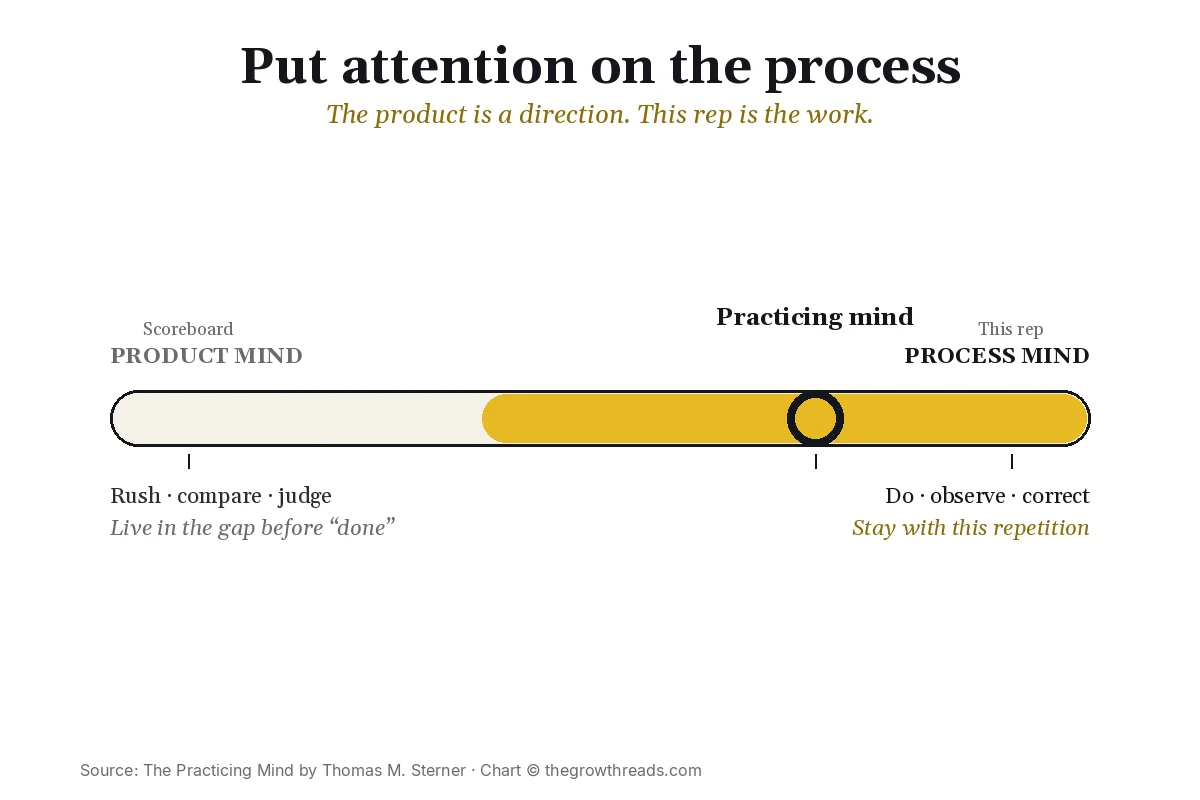
Most people practice the finish line. Thomas M. Sterner teaches you to practice this repetition. The Practicing Mind is a short book about where you put your attention while you improve — a piano, a swing, a slide deck, a hard conversation. We suffer twice: once because the goal is still out of reach, and again because we treat every imperfect rep as a verdict. Shift from the product (the score, the “done”) to the process (the next correctable action) and anxiety drops while the product arrives faster. The mechanic is DOC — Do, Observe, Correct — run without the inner judge.
Key takeaways
- Product vs process: The product is a direction. The process is the only thing you can actually do.
- The practicing mind: Present, non-judgmental, process-oriented — a child learning to walk, not a critic grading the fall.
- DOC: Do the next action. Observe a fact. Correct one thing. Repeat. Judgment is not observation.
- You still set a goal: Sterner is not anti-ambition. Aim at a product, then put your eyes back on this rep.
- Equanimity is the performance state: Even inner weather lets DOC run. Panic and celebration both yank you into the product.
- Patience is a skill: Train it by staying with the process when you want to skip to the result.
- Comparison is a process-killer: Other people’s highlight reels are products. Your work is this next correction.
- You never arrive: Mastery is continued practice. People who keep getting better never stop being beginners.
- Teach the process, not the grade: Praise the loop you can see — the attempt, the look, the fix — not only the scoreboard.
What is The Practicing Mind about?
The Practicing Mind is Thomas M. Sterner’s field guide to keeping attention on the action in front of you instead of the trophy you do not have yet. Using music, golf, and ordinary work, he shows how Do, Observe, Correct — without a verdict — grows skill and calms the inner judge.
About the author
Thomas M. Sterner spent decades as a concert-piano technician — regulating actions, voicing hammers, making tiny adjustments that only work if you are actually in the room with the instrument. That job, plus years as a musician and a serious amateur golfer, is the lab behind The Practicing Mind (2006, then New World Library in 2012). He later founded The Practicing Mind Institute and wrote Fully Engaged as a companion on using the same stance under pressure. Sterner is a tradesman-practitioner, not a lab psychologist: he noticed that the people who improve are the ones who can stay with this repetition without turning it into a verdict on their worth. Explore all Thomas M. Sterner book summaries →
Key concepts at a glance
| Concept | What it means | Use it when |
|---|---|---|
| Product | The goal, score, or “done.” Useful as a direction, poisonous as a place to live. | You are anxious about a result you cannot produce in this minute. |
| Process | The next action you can control: this phrase, this swing, this paragraph. | You know what “good” looks like but cannot begin. |
| Practicing mind | Present, non-judgmental attention on the process. | The inner narrator is grading you instead of helping. |
| DOC | Do, Observe, Correct — the loop that turns time into skill. | You keep repeating the same hour and calling it practice. |
| Observation vs judgment | A fact (“the note was sharp”) versus a verdict (“I have no talent”). | A miss spirals into a personality story. |
| Equanimity | Even inner weather so the loop can run. | A good rep makes you cocky or a bad one makes you quit. |
| Patience as skill | Staying with the process when you want the product now. | You skip steps, rush the last 10%, or abandon beginner drills. |
| Never arriving | Mastery is continued practice, not a finish line you occupy. | You thought “once I hit X, I can relax” — and X moved. |
Part 1: Product vs process — why the finish line makes you worse
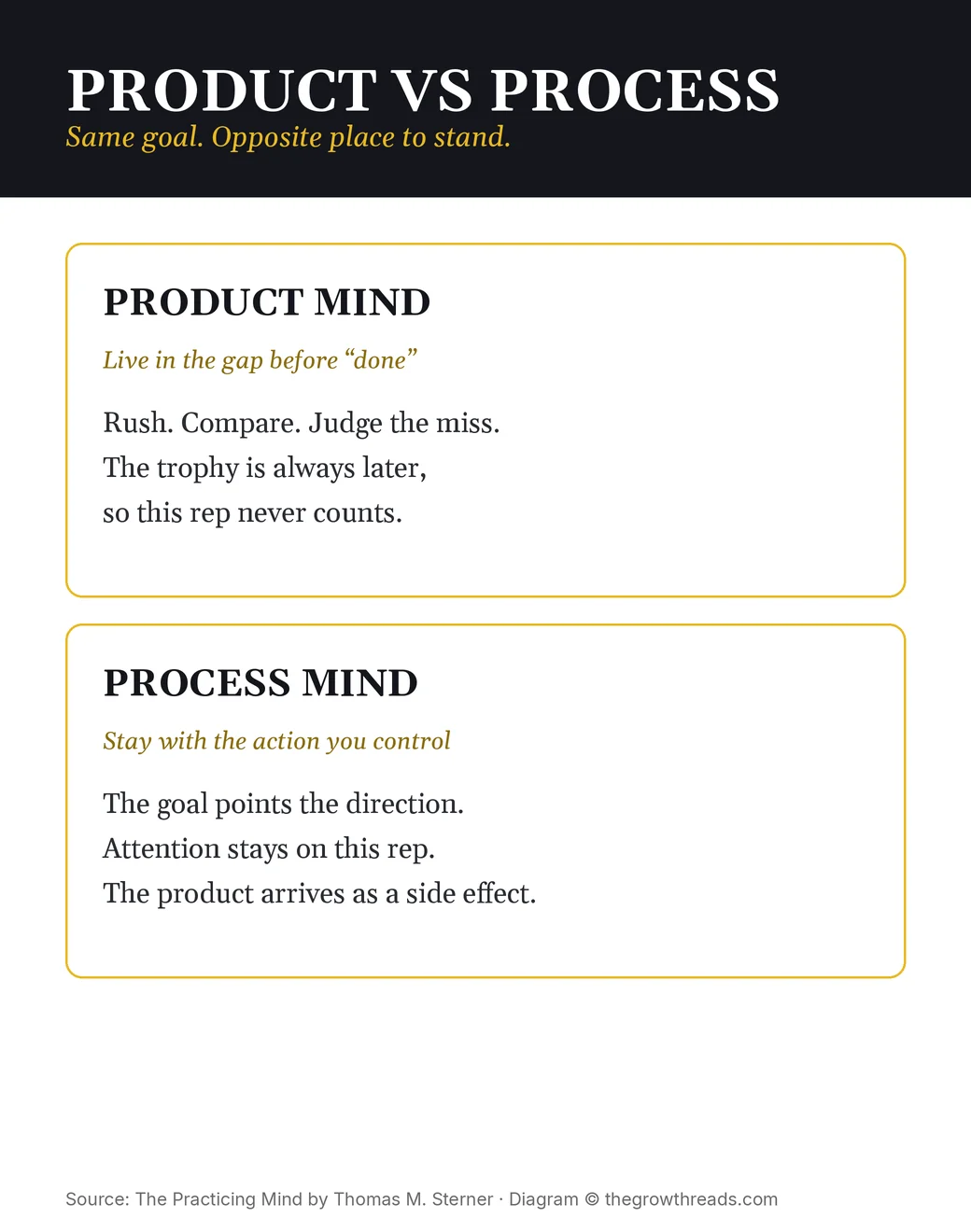
Sterner’s opening move is almost rude in its simplicity. You already have a product in mind: the recital, the handicap, the promotion, the clean inbox. That picture is useful — it tells you which way to walk. It becomes a problem the moment you try to live there before you have walked.
Product-mind has a texture. You check the scoreboard in the middle of the hole. You hear the finished piece while your hands are still learning the fingering. Every imperfect rep becomes evidence that you are behind an imaginary version of you who is already done. The weather is hurry plus self-attack.
Process-mind is not “not caring.” Sterner is explicit: you still choose a product. Then you put attention on the only thing that can produce it — this action, in this minute. A child learning to walk is the clean picture. They have a product (across the room). They do not stop after a fall to compose a story about being bad at walking. They get up. The getting-up is the practice. Adults add a second job — monitoring whether they have arrived — and that job steals the attention the first one needed. You cannot play the phrase and grade the phrase with the same spotlight. Sterner wants the grading to wait.
TGR Note: If “quiet the inner commentator” is why you came, read The Inner Game of Tennis next — Gallwey named Self 1 and Self 2 a generation earlier. Sterner is the civilian translation. For making the next rep obvious and small, pair this with Atomic Habits.
Part 2: DOC — Do, Observe, Correct
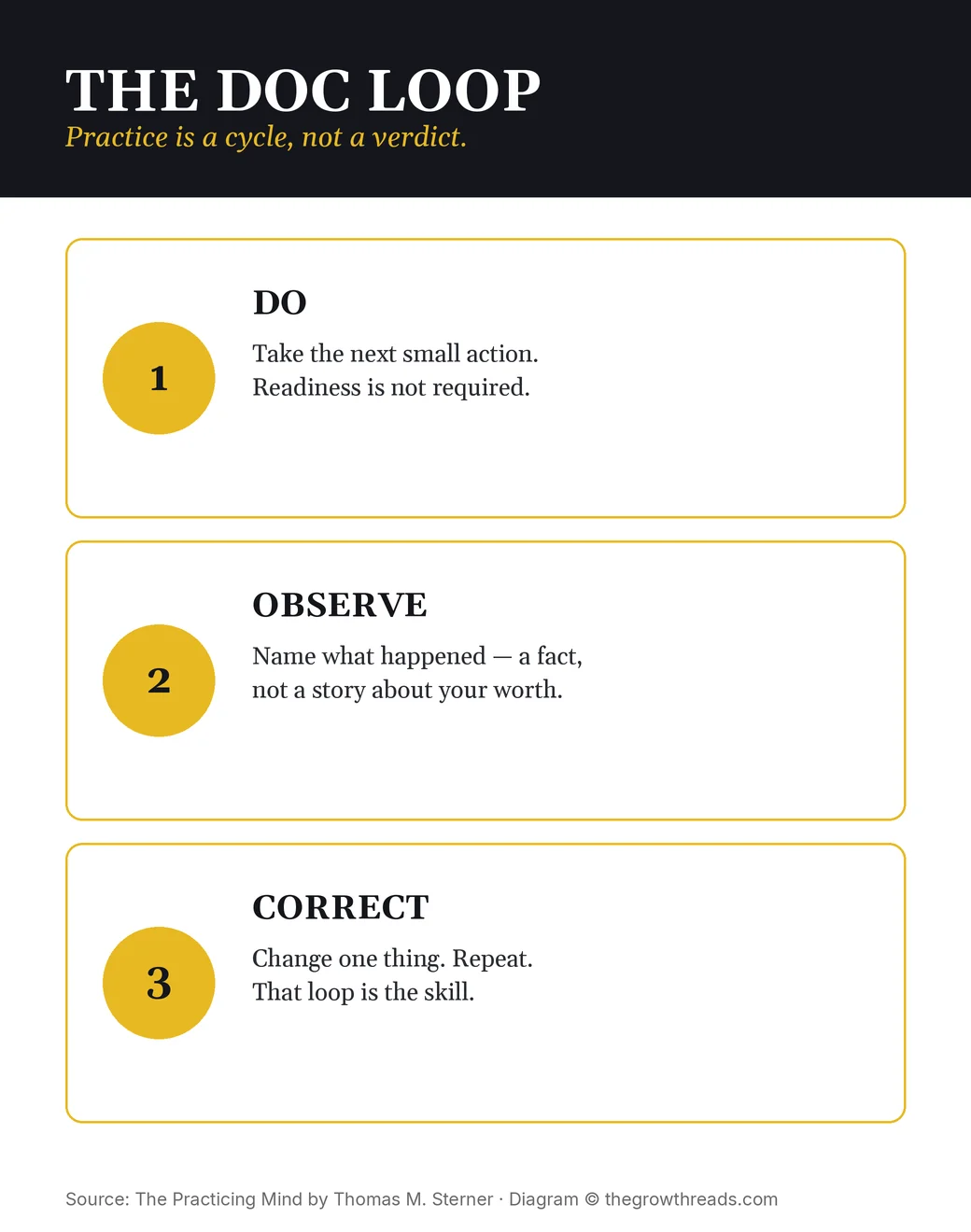
Once you agree to stand in the process, you need a loop you can run when you are tired. Sterner’s is three words: Do, Observe, Correct.
Do is unromantic. Take the next small action before you feel ready. Readiness is a stall: that state usually arrives after the third minute of work, not before. Sterner’s piano-tech life is full of this. You do not wait to feel like voicing a hammer. You put the tool on the felt and begin.
Observe is the part most people ruin. Observation is a fact: the note was sharp; the email was defensive in sentence two; the clubface was open. Judgment is a story: I have no talent; I always choke. The story feels like information. It is a hijack. You cannot correct an identity in the next thirty seconds. You can correct a fact.
Correct is one change, then another do. Not five changes, not a new life plan. If you “correct” by ripping up the system, you are back in product-mind — skipping to a future where the problem is already gone. Make the smallest honest adjustment and take another rep while the information is still warm. Music and golf give a clean signal if you will look. The rest of life is noisier, so you build one: a checklist, a recording, a colleague who saw what happened. Without a signal, “practice” is just time passing.
TGR Note: DOC is deliberate practice without the lab coat. For designed drills and a specific weakness, read Peak and Talent Is Overrated. For the under-pressure sibling, The Art of Learning. Sterner’s gift is that DOC still works on a Tuesday with no coach in the room.
Part 3: Equanimity, patience, and the inner judge
The loop only runs in a certain inner weather. Sterner calls it equanimity: you are not thrown by a good rep or a bad one. Both are information. The judge wants a different deal — a good rep means you are finally someone, a bad one means the opposite. That deal is exhausting. It makes you protect your ego instead of collecting data.
Patience here is not a personality trait. It is equanimity over time, trained the way you train a slow scale: stay with the process when every nerve wants the product now. Slow the first minutes. Feel the mechanics. If you cannot feel them, you are already ahead of yourself — product-mind in a hurry.
Comparison is the judge’s favorite shortcut. Someone else’s launch, round, or report card becomes the scoreboard for your process. That is a category error. You cannot DOC against a highlight reel. You can only DOC against the last rep you actually took. If your attention is on their result, it is not on your correction. Process is not a spa — piano regulation is tedious, and so is a sales sequence. The claim is narrower: suffering about not being done yet is optional, and it is expensive. Drop the extra job. Keep the real one.
TGR Note: The inner judge is close cousin to Resistance in The War of Art — the voice that would rather you stay promising than practicing. If the problem is not judgment but starting, Mini Habits shrinks the “Do” until it is too small to argue with.
Part 4: Installing the practicing mind at work and at home
A philosophy that only works on a golf course is a hobby. Sterner puts the stance into ordinary rooms: the job, the session you keep skipping, the child who melts down over a grade, the conversation you rehearse instead of having.
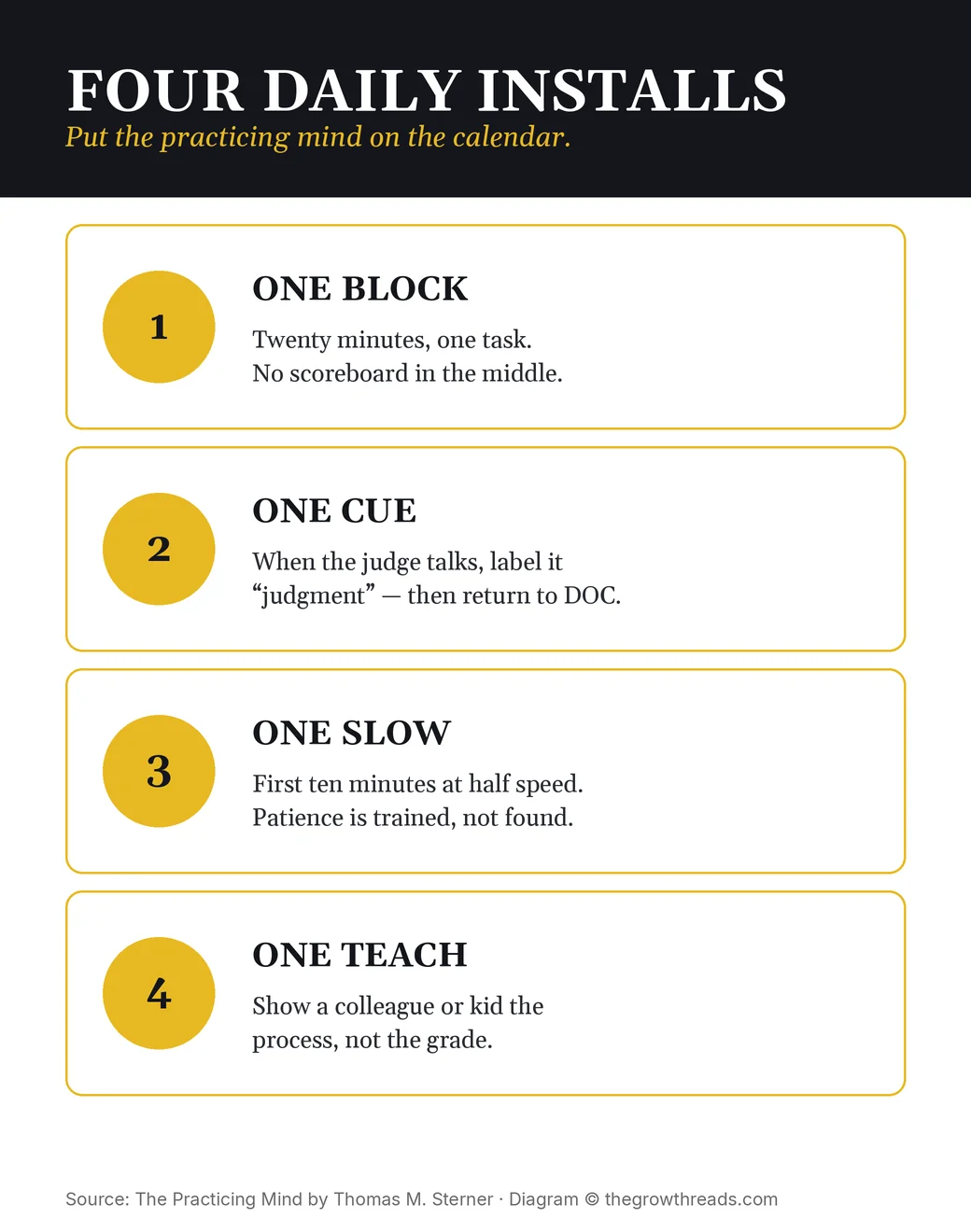
At work, pick one block where the product is allowed to wait. Twenty minutes, one task, no metric tab. The number is a product; the block is a process. Look once afterward as observation, then correct tomorrow’s setup. People who live in dashboards run product-mind as a job description. They feel busy and do not get better at the craft the dashboard is supposed to measure.
With a skill you care about, keep a beginner’s drill even after you are “good.” You never arrive. The day you decide you have, you start protecting the identity and stop collecting corrections — that is how competent people plateau. Keep one drill that is slightly too hard, and DOC it.
With other people, teach the process you want to see. Ask “what did you notice?” before “what was the score?” A child who only hears about the grade learns to hide the process. A teammate who only hears the ship date skips observation. You get the product you inspect. Inspect the loop. And when the judge talks, label it — “that’s judgment” — and return to the next Do. Arguing with the voice is another product. You do not need a mind that never criticizes you. You need the next honest rep.
Who is The Practicing Mind best for — and who should read something else first?
Best for people who already know the next action and still suffer in the gap before the result: intermediate musicians, operators who cannot stop checking the scoreboard, parents who narrate a child’s future in the middle of homework. It is short on purpose. Read it in an afternoon and run DOC the same evening.
Read something else first if you do not have a next action yet. If the problem is “I never start,” Atomic Habits or Mini Habits will get a behavior on the calendar; then come back here to stop strangling it with judgment. If you want the sports-psychology original, start with The Inner Game of Tennis. If you want the science of designed practice, start with Peak or Talent Is Overrated, then use Sterner as the inner stance that makes those drills survivable.
Questions to reflect on
- Where, this week, did I leave the work to live in a future where it was already done?
- What is the product I am aiming at — and what is the next process action that actually belongs to me?
- When I miss, do I observe a fact or issue a verdict?
- Who is watching me in a way that pulls me into product-mind (a metric, a person, a feed)?
- What would I praise if I cared about the loop, not the trophy?
🔥 Ready to stop living in the gap before “done”?
Pick one skill. Write the product as a direction. Then run DOC on the next twenty minutes — no scoreboard in the middle.
How to apply The Practicing Mind (7-day plan)
- Day 1 — Name both. Write one product you care about this month (one sentence). Under it, write the next process action you can finish in twenty minutes.
- Day 2 — One DOC block. Twenty minutes. Do the action. Write three observations that are facts. Circle one correction for tomorrow. No extra story.
- Day 3 — Label the judge. For one hour, when the inner verdict starts, say “judgment” and take the next Do. Count it. Do not try to win the argument.
- Day 4 — Slow the open. Start the same skill at half speed for ten minutes. If you cannot feel the mechanics, slow further.
- Day 5 — Work without the dashboard. Close the metric tab until the block ends. Look once afterward as observation. Write one process change.
- Day 6 — Teach the loop. With a colleague or a kid, ask “what did you notice?” before you ask about the result. Praise one correction you can see.
- Day 7 — Review the hijacks. List three moments product-mind stole the wheel. For each, write the DOC you will run next time. Schedule next week’s four installs.
Frequently asked questions
What is The Practicing Mind about in one paragraph?
The Practicing Mind is Thomas M. Sterner’s short guide to keeping attention on the action in front of you instead of the result you do not have yet. He splits experience into product (the goal) and process (the next controllable action), then gives you a loop — Do, Observe, Correct — for turning time into skill without an inner verdict after every miss. It grew out of his life as a piano technician, musician, and golfer, not a lab. Stay with this repetition, and the product becomes a side effect rather than a place you try to live.
What is the DOC method in The Practicing Mind?
DOC stands for Do, Observe, Correct. You take the next small action before you feel ready. You notice what happened as a fact — the note, the sentence, the clubface — not as a story about your talent. You change one thing and go again while the information is still warm. Judgment (“I have no talent”) is a different activity from observation, and a useless one in the moment: you cannot correct an identity in thirty seconds. You can correct a sharp note. Run the loop often enough and the skill moves while the inner weather calms down.
How is The Practicing Mind different from Atomic Habits?
Atomic Habits is about designing the next rep so it is obvious, attractive, easy, and satisfying. The Practicing Mind is about where your attention sits during the rep you already know you should take. Clear will get the guitar on the stand. Sterner will stop you from spending those two minutes rehearsing the concert you have not earned. They stack. If you have no system, start with Atomic Habits or Mini Habits. If you have a system and still suffer — rushing, comparing, turning misses into a personality — Sterner is the inner half. Neither book asks you to wait for motivation.
Is The Practicing Mind good for beginners?
Yes. The move is small and the book is short. You do not need a coach or a 10,000-hour plan to run DOC on one twenty-minute block tonight. Beginners often have an advantage: they have not yet built a self-image that needs protecting, so observation is cheaper. It is a weaker first read if your real problem is that nothing is on the calendar — use a starter-habit book to begin, then this one to stay. Intermediate people often need it more. They are good enough to compare, and comparison is how process dies.
How long does it take to read The Practicing Mind?
Most readers finish the 2012 New World Library edition in three to five hours. It is a thin book with a repeating core: product versus process, then DOC, then how to keep that stance when ego and comparison pull you back to the scoreboard. The repetition is the point — Sterner is installing a stance, and stances need more than one pass. This guide takes about eleven minutes and still gives you the loop. Read the book if you want the golf, piano, and parenting scenes that make the stance sticky. The 7-day plan above is the workbook.
Does The Practicing Mind work when I have a hard deadline?
Yes. Deadlines are products with a date, and Sterner does not tell you to ignore them. He tells you not to live in them. A deadline is a direction: it tells you which work to choose. The work is still a sequence of process actions. Product-mind under a deadline looks like refreshing the due date and skipping observation because there “isn’t time.” That is how the last 10% falls over. Process-mind looks like a shorter DOC loop: do the next slice, look once, correct, repeat. The date does not change. Your attention does. That was the only lever you had anyway.
What should I read after The Practicing Mind?
For the sports-psychology original, go to The Inner Game of Tennis. For designed drills and why some practice creates skill, read Peak and Talent Is Overrated. If the next problem is getting the first two minutes to happen, Atomic Habits and Mini Habits are the on-ramps. For remaining a student under pressure, The Art of Learning. Sterner’s sequel, Fully Engaged, extends the same stance into stress. Stay in the Productivity silo unless you specifically want the tennis court.
Related summaries
- Atomic Habits — make the next rep obvious and small, then let process take over.
- The Inner Game of Tennis — the sports original of quieting the inner commentator.
- Peak — the science of practice that actually creates skill.
- Talent Is Overrated — why naive hours plateau and designed hours do not.
- Best productivity books — the full Productivity silo, ranked and compared.
How we analyze books: every book on The Growth Reads is read cover to cover, summarized in thousands of words of original analysis, and rated against our five-criteria rubric (lasting impact, evidence quality, practical application, writing & originality, external consensus). Read our full methodology.