
Great leadership isn’t about authority — it’s about influence, trust, and the courage to serve others. Whether you’re a first-time manager, a seasoned executive, or someone building a team from scratch, the right book can transform how you lead.
Top 10 Leadership Books
Our highest-rated picks — based on depth, practicality, and lasting impact.
Latest Summaries
Recently published reviews in this topic.
All Leadership Book Reviews
On War Summary & Review: Pick the Political Object First
Clausewitz’s On War is a stop rule for operators: name the political object first, then spend only the force that object can justify through...
Read Review
Hagakure Summary & Review: Kill Hesitation, Serve the Mission
Yamamoto Tsunetomo’s Hagakure is a field manual for resolve: die to hesitation, serve the house, and decide before fear gets a vote.
Read Review
The Book of Five Rings Summary & Review: Timing Beats a Favorite Weapon
Miyamoto Musashi’s Book of Five Rings is a short field manual: train until you have no favorite weapon, take the initiative, and treat every...
Read Review
The Prince Summary & Review: Power That Lasts Without Being Hated
The Prince summary: Machiavelli’s 1513 handbook on holding power — virtù, fortune, fear without hatred, and a 7-day plan to apply it at work....
Read Review
The Power of Moments Summary & Review: How to Create Extraordinary Experiences
The Power of Moments reveals why certain experiences leave a lasting impact — and how to design them deliberately using the EPIC framework: Elevation,...
Read Review
Meditations Summary & Review: The Stoic Emperor’s Guide to Leading with Virtue
Written in private by a Roman emperor during wartime and plague, Meditations by Marcus Aurelius is the most enduring personal journal in history —...
Read Review
Delivering Happiness Summary & Review: Build Culture First, Profit Follows
How Tony Hsieh turned worm-farm hustle and a near-bankrupt shoe startup into Zappos — a $1.2B lesson in building culture, service, and lasting happiness.
Read Review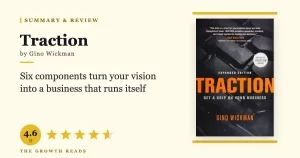
Traction Summary & Review: Get a Grip on Your Business
Gino Wickman's EOS framework for entrepreneurial businesses — Vision, People, Data, Issues, Process, and Traction — with the V/TO, GWC, Rocks, Scorecard, and the...
Read Review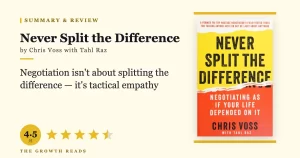
Never Split the Difference Summary & Review: The FBI Negotiator’s Playbook for Getting What You Want
Chris Voss turns 24 years of FBI hostage negotiation into practical tools, tactical empathy, mirroring, and calibrated questions, for salary talks, sales calls, and...
Read Review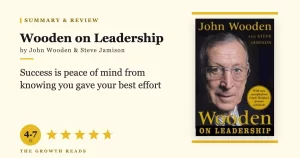
Wooden on Leadership Summary & Review: The Pyramid of Success Framework
John Wooden's Pyramid of Success distilled: 15 character blocks, the Four Laws of Learning, and why he separated effort from the scoreboard for 27...
Read Review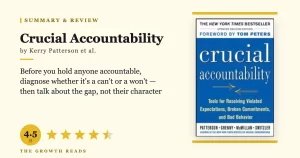
Crucial Accountability Summary & Review: How to Hold Anyone Accountable Without a Blowup
Crucial Accountability breaks down CPR and the Six Sources of Influence for diagnosing broken promises before you confront them — full framework, 3 infographics,...
Read Review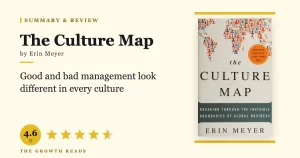
The Culture Map Summary & Review: Decode Any Culture Before It Costs You a Deal
Erin Meyer's The Culture Map maps eight scales — from direct feedback to flexible scheduling — that explain why good management looks different in...
Read ReviewBrowse All Leadership Summaries
We’ve reviewed 59 leadership books — each with key takeaways, practical lessons, and honest ratings.
How We Select & Review Leadership Books
The Growth Reads editorial team reads every leadership book we cover in full before writing a summary. We prioritize books grounded in real operational experience or peer-reviewed organizational research — combat leadership, Navy submarine command, long-run studies of company performance — over books that repackage generic management platitudes without evidence behind them.
Each book is evaluated against the same three criteria we use across every topic on this site: depth (does it go beyond generic “be a good leader” advice?), practicality (can you actually apply it with your own team tomorrow?), and lasting impact (does it still hold up years after publication, across different industries and team sizes?). Where a book makes a specific claim about team performance, psychological safety, or organizational outcomes, we check it against the author’s own cited evidence rather than taking the claim at face value.
Books enter this topic from several directions: military and high-stakes leadership accounts (Extreme Ownership, Turn the Ship Around!), research-driven organizational books (Good to Great, Multipliers, The Five Dysfunctions of a Team), and modern management-practice books covering feedback and psychological safety (Radical Candor, Dare to Lead). We periodically re-review earlier summaries to make sure the practical guidance still holds.
Every summary ends with a practical takeaway, not just a recap of the book’s argument, and every rating reflects an honest read of the whole book, not the publisher’s marketing copy. We are an independent publisher: our reviews aren’t affiliated with or endorsed by the authors or publishers of the books we cover, and while some links on this page are affiliate links (Amazon, Bookshop.org), that has no bearing on which books make this list or how we rate them.
For our full ranked countdown, see 20 Best Leadership Books of All Time.
Frequently Asked Questions
What’s the best book to understand leadership?
For a broad, foundational start, Extreme Ownership by Jocko Willink and Leif Babin is the most-cited modern classic — it applies combat-tested accountability principles to business teams of any size. For a research-driven alternative, Good to Great by Jim Collins is the most-recommended starting point for understanding what separates lasting companies from mediocre ones.
What leadership books do experienced executives actually read?
Good to Great, The Five Dysfunctions of a Team, and Multipliers are the three most frequently cited by senior executives and management consultants, since all three are grounded in structured research on team and organizational performance rather than motivational anecdotes.
Is Start With Why worth reading if I’m not a founder?
Yes — while Simon Sinek frames it around company strategy, the core idea (people follow leaders who articulate a clear purpose, not just tasks) applies just as directly to leading a small team or a single project. Pair it with Leaders Eat Last, his follow-up on building trust within a team.
Best leadership book for a first-time manager?
Radical Candor by Kim Scott and The Five Dysfunctions of a Team by Patrick Lencioni are the two most practical starting points for someone leading people for the first time — both give concrete frameworks for feedback and team dynamics rather than abstract theory.
How many leadership books should I read to get the fundamentals?
Three to five is enough to cover the fundamentals: one accountability/ownership book (Extreme Ownership), one team-dynamics book (The Five Dysfunctions of a Team or Multipliers), and one feedback/communication book (Radical Candor). Beyond that, further reading has diminishing returns unless you’re specializing in a specific challenge.
What leadership book should I start with?
Extreme Ownership for a direct, accountability-first framework that applies to any team, or Start With Why if you want to think through purpose and motivation before tactics.
Is Extreme Ownership just for military or business audiences?
The core principle — a leader owns every outcome on their team, good or bad, with no excuses — is written from a combat context but is deliberately generalized to business leadership throughout the book. Readers outside both military and business contexts (coaches, nonprofit leaders, team captains) commonly report it translates cleanly.
What do the most-cited leadership researchers actually study?
Jim Collins’s Good to Great is built on a multi-year comparative study of companies that sustained excellent long-term performance versus similar companies that didn’t. Patrick Lencioni’s Five Dysfunctions of a Team is a narrative-fable format built on his consulting experience diagnosing team dysfunction across hundreds of organizations.
Radical Candor vs. Dare to Lead — which should I read first?
They’re complementary. Radical Candor focuses specifically on giving direct, caring feedback — a communication skill. Dare to Lead focuses on the broader emotional and psychological groundwork (vulnerability, trust, courage) that makes feedback and hard conversations possible in the first place. Read Dare to Lead first if your team culture needs foundational trust-building; read Radical Candor first if you already have trust and need better feedback mechanics.
How often is this list updated?
We review and refresh this page at least yearly, and add new leadership books as they’re published and reviewed. Older summaries are periodically checked for dated examples even when their core arguments still hold.
Explore Other Topics
More book summary hubs on The Growth Reads.