

★★★★★ 4.7/5 — Name the political object first; force is only the spend that object can justify.
Best for: Founders, officers, PMs, and leads who keep adding effort after the goal has already gone mushy
Reading time: ~18 hrs for the Princeton Howard/Paret indexed edition (732 pages) · ~20 min for this guide
Difficulty to apply: The vocabulary is heavy; the drill is one sentence — then a stop
On War in one minute
On War is a stop rule disguised as a theory of fighting. Carl von Clausewitz, a Prussian staff officer writing after Napoleon, spent years trying to say what a contest actually is. The line people quote — in Howard and Paret’s English, “War is merely the continuation of policy by other means” — is not a permission slip to get louder. It is an instruction to name the political object before you spend force. Fog will hide the field. Friction will make simple plans heavy. If you cannot write the object in one sentence, you are decorating a spend. Translate war as the live contest and policy as the outcome that would still matter if nobody clapped.
Key takeaways
- Policy first: War is a continuation of policy. Write the object, then spend only the force it needs.
- The remarkable trinity: People (passion), commander (chance), government (reason). Plans that stand on one leg fall over in contact.
- Fog is normal: You will not see the whole field. Decide on a clear object anyway, and update without pretending you had certainty.
- Friction is the tax: Simple plans get heavy — delay, weather, tired people, a missing file. Budget for it or your Gantt is fan fiction.
- Absolute war is a thought experiment: Real contests stay limited. You live on the real-war side of the line.
- Center of gravity: Find the hub the other side needs. Hitting every moving surface is activity, not strategy.
- Culminating point: Attack has a peak. Past it, more spend makes you the overextended one.
- Defense is the stronger form: Holding a clear object is often cheaper than a theatrical push. Do not confuse motion with advantage.
- Genius is practiced judgment: Not a poster. The eye that still acts when the map is wrong, because the object is still named.
- Moral forces count: Mood, courage, and public heat are not soft extras. Ignore them and the “rational” plan is a slide.
What is On War about?
On War is Carl von Clausewitz’s 1832 treatise on war as a political instrument. It explains the trinity of people, commander, and government; fog and friction; and why real contests stay limited. The practical ask is to name the political object before you spend force.
About the author
Carl Philipp Gottfried von Clausewitz (1780–1831) was a Prussian general whose classroom was the Napoleonic wars. He entered service as a boy, was captured after Jena in 1806, served with Russian forces in 1812, and later directed the Prussian War Academy. He tried to think clearly about a contest that never matched the diagram: passion in the public, chance in the field, reason in the cabinet. Marie von Brühl, his wife, edited the unfinished manuscript and published it in 1832 after he died of cholera. Operators still need him because most modern “strategy” fails the same way — a spend with no political object. Explore all Carl von Clausewitz book summaries →
Key concepts at a glance
| Concept | What it means | Use it when |
|---|---|---|
| Policy by other means | Force exists to serve a political object, and the object also sets the stop. | You cannot say what a win is in one sentence. |
| Remarkable trinity | People/passion, commander/chance, government/reason — always together. | The plan only listens to one room. |
| Fog | Incomplete sight is the default, not a scandal. | You are waiting for a perfect picture before a named move. |
| Friction | The tax that makes simple plans heavy in contact. | The timeline assumes nothing will snag. |
| Absolute vs real war | Unlimited violence is a thought experiment; you live in limited contests. | Someone wants “whatever it takes” with no object. |
| Center of gravity | The hub the other side needs to stay in the fight. | You are hitting every surface that moves. |
| Culminating point | The peak of an attack, after which more spend weakens you. | The push is still going because stopping feels like loss. |
| Moral forces | Courage, mood, and public heat as real terrain. | The spreadsheet is clean and the room is not. |
Part 1: What war actually is — object, trinity, fog, and friction
Clausewitz opens by stripping the romance off. War, he says, is a duel on a larger scale: two living forces imposing will, not a puzzle you solve on paper. Then the move that still earns the book its keep: that duel is never only force. It is policy continued by other means. In the Howard/Paret English the sentence is calm: “War is merely the continuation of policy by other means.” Force is not a higher language. It is a spend that has to answer to an object. If the object is mush, more sprints, ads, or all-nights will not clarify it. They only make the mush expensive.
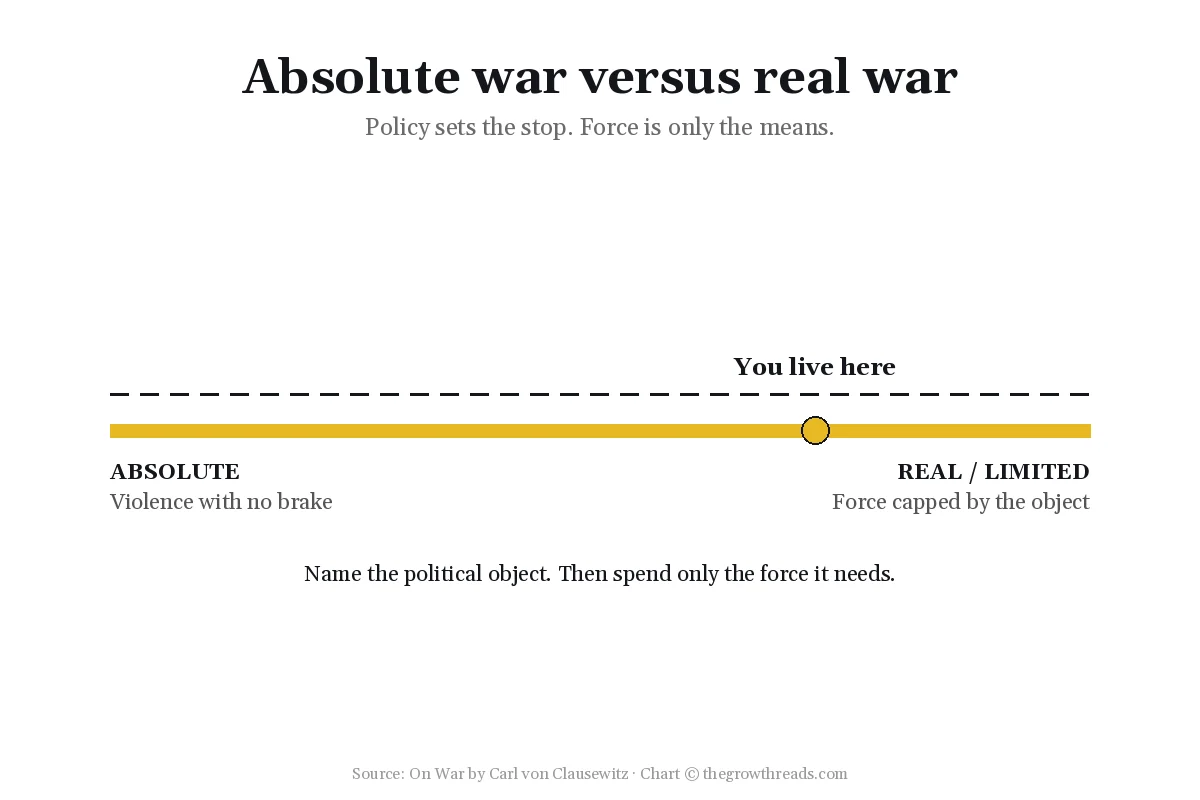
He then splits two pictures people still mash together. Absolute war is the thought experiment: violence with no brake. Real war is what you live in — politics, weather, tired people, and public mood pull the contest back from the extreme. Operators who skip this treat every quarter like absolute war and then wonder why the company is exhausted. The gift is permission to live on the real-war side of the line: name a limited object, spend a limited force, stop.
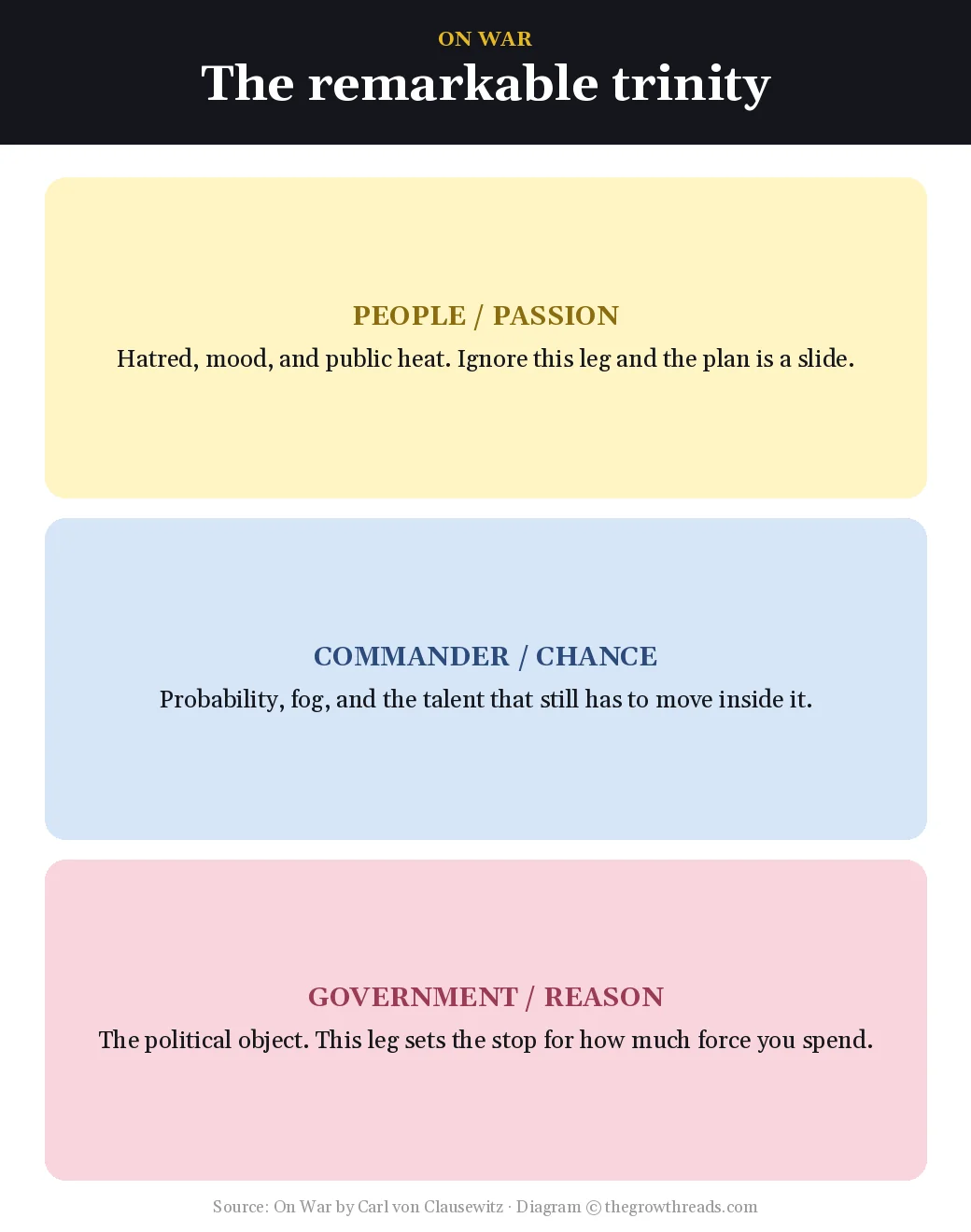
The remarkable trinity is the other opening tool. Passion in the people, chance and talent in the commander, reason in the government. Ignore public heat and your “rational” launch is a slide. Ignore chance and your Gantt is a wish. Ignore the object and the commander is just spending people. Fog is the missing information you will not get in time. Friction is the rest: the late courier, the jammed tool, the meeting that eats the morning. Clausewitz’s line that everything in war is very simple, but the simplest thing is difficult, is that chapter in one breath. Budget for it.
TGR Note: Sun Tzu in The Art of War wants terrain before the flourish. Clausewitz wants the object before the spend. Pair them: Sun Tzu for the ground this week, On War for whether the ground is even worth a fight.
Part 2: Theory, genius, and the moral forces that actually move people
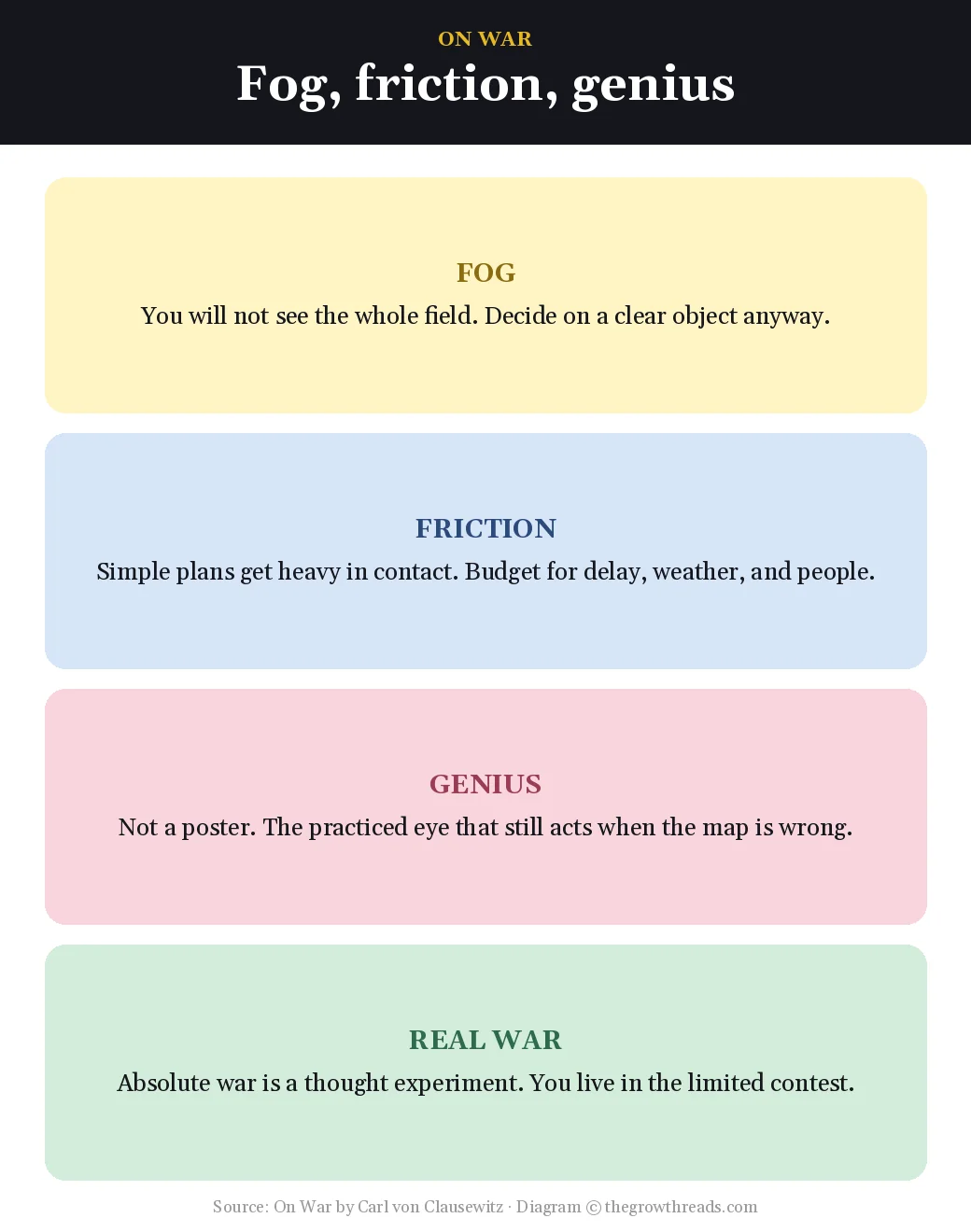
Books 2 and 3 sound like a seminar. They are the operator chapters. Clausewitz is allergic to a theory that cannot survive contact. Criticism, for him, asks whether the means still served the object once fog arrived. A plan that only works if everyone is fresh, the data is complete, and the other side is still is a wish with formatting. Genius is the practiced eye that still acts when the map is wrong. Boldness sits next to it: not volume, a willingness to move on a named object without waiting for cinematic certainty.
Moral forces are the part dashboards still under-count. Courage, mood, and the confidence of a crew that has been told the truth are terrain. Clausewitz watched Napoleon win and lose as much in spirit as in marches. A team that does not believe the object will not carry friction. If your “strategy” ignores the room’s heat, you have already picked the wrong leg of the trinity. The fix is not a pep talk. It is an object people can repeat, plus a commander who will not pretend the fog is gone.
TGR Note: Holiday in Ego Is the Enemy and Willink in Extreme Ownership get the self out of the steering wheel. Clausewitz adds the noun those books assume — the political object you are owning the miss for.
Part 3: Defense, attack, and the culminating point of the push
Clausewitz’s most counter-intuitive claim is that defense is the stronger form of war. Not more glorious. Stronger. The defender can use the ground and spend less to hold a named object. The attacker has to move, expose, and keep feeding the push. That is not an argument for passivity. It is an argument against theatrical motion. A lot of “aggressive leadership” is attack without an object: more features, more meetings, more markets, because stopping feels like loss. If the object is already in hand, holding it is the job. If it is not, attack is justified — and it still has a clock.
The clock is the culminating point of the attack. There is a peak after which more budget and more late nights make you weaker: supply stretches, the crew frays, the other side’s defense gets cheaper. The campaign that should have shipped at the good-enough object keeps going because the identity of the team is “we push.” Mark the peak in advance. What would “enough” look like? What spend past that line is vanity? Defense here means protecting a named win, not hiding.
TGR Note: Musashi’s The Book of Five Rings and Yamamoto’s Hagakure train the body that still moves in fog. Clausewitz trains the stop. Initiative without a culminating point is just a longer attack.
Part 4: Center of gravity, the plan of war, and a policy that can say stop
Late in the book Clausewitz gives the targeting rule. A center of gravity is the hub of power and movement — the thing the other side needs in order to keep contesting. In a company it might be a distribution lock, a key hire, a default customers will not leave. Hitting every surface that moves is how tired teams look busy. Hitting the hub is how a limited force still serves a policy. You will guess wrong sometimes. Fog guarantees that. The error is refusing to name one, so every ping becomes a “strategic” front.
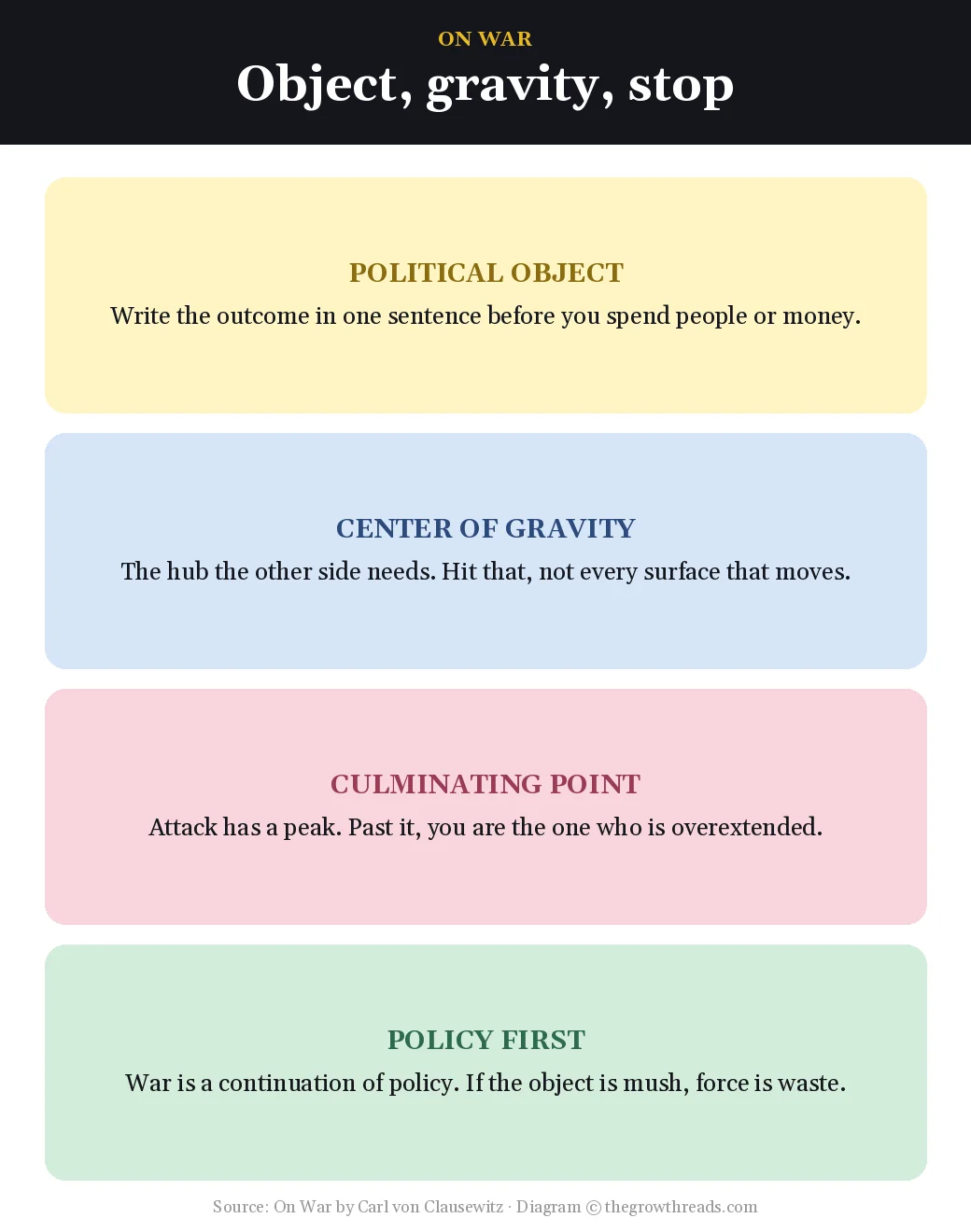
The plan of war, in Book 8, is where policy and force have to sit in the same sentence. How far will you go? What is the object worth? Clausewitz is unfinished here — Marie published what he left — and the unfinishedness is honest. Real policy is unfinished too. The usable move is still available on a Tuesday. Write the object. Name the hub. Mark the culminating point. Then spend. If you cannot do that on one page, you are not waiting on more intelligence. You are avoiding a stop. Policy that cannot say enough is appetite with a staff.
TGR Note: Machiavelli’s The Prince asks whether you can hold power. Clausewitz asks whether the force you spend still serves a political object, or whether you are just still in motion.
Who is On War best for — and who should read something else first?
Best for: founders, officers, product leads, and senior ICs who already have a live contest and keep adding force after the goal has gone vague. If you can name a political object, you get a vocabulary for fog, gravity, and the stop.
Read something else first: a shorter map — The Art of War. A modern ownership loop — Extreme Ownership. A carpenter’s OS — High Output Management. A why before a contest — Start With Why. Craft without the staff college — The Book of Five Rings or Hagakure. On War assumes you already have a fight and are using motion to hide from the object.
Questions to reflect on
- What is the political object of the contest I am in this month — in one sentence, with a stop attached?
- Which leg of the trinity is doing all the talking: passion, chance, or reason?
- What am I calling “strategy” that is actually just more spend past the culminating point?
- Where is the center of gravity — the hub the other side needs — and what surfaces am I hitting instead?
- What fog am I pretending I will clear before I move, and what friction have I refused to budget for?
🔥 Ready to name the object before you spend?
Get On War and start treating force as a means with a stop.
How to apply On War (7-day plan)
- Day 1 — Write the object. One sentence: the political outcome this contest is for, plus what “enough” looks like. Put it where you spend.
- Day 2 — Map the trinity. Name the passion (who is hot), the commander (who actually moves people), and the reason (who is supposed to set policy). Circle the leg you have been ignoring.
- Day 3 — Fog and friction list. Write five things you do not know and five things that will get heavy in contact. Do not wait to clear the fog list before tomorrow’s move.
- Day 4 — Center of gravity. Guess the hub the other side needs. Cut one activity that is only hitting a surface.
- Day 5 — Mark the culminating point. Decide in advance the spend or date after which more push makes you weaker. Share the stop with one person who can hold you to it.
- Day 6 — Moral force. Have the one conversation the object requires — the truth the room has been dressing up. No extra speech after it.
- Day 7 — After-action on the object. Did this week’s force serve the sentence from Day 1? If not, rewrite the object or cut the spend. Schedule next week’s first move before you sleep.
Frequently asked questions
What is On War about?
On War is Carl von Clausewitz’s treatise on war as an instrument of policy, published in 1832 after his death. It is not a bag of battlefield tricks. It asks what a contest is for, then how much force that object can justify. The famous line — war as a continuation of policy by other means — is the hinge. Around it sit the remarkable trinity (people, commander, government), fog and friction, the center of gravity, and the culminating point of attack. The Howard and Paret Princeton edition is the English standard. Use it to name the object before you spend people, money, or attention.
What does “war is a continuation of policy by other means” mean?
In the Howard and Paret English, Clausewitz says war is merely the continuation of policy by other means. He is not saying politics is fake and force is the real talk. He is saying the opposite: the political object is the reason the force exists, and it also sets the stop. If you cannot name the object in one sentence, you will spend past usefulness and call it commitment. Translate war as the contest you are in — a launch, a negotiation, a reorg — and policy as the outcome that would still matter if the room went quiet. Force is only the spend.
Who was Carl von Clausewitz?
Carl Philipp Gottfried von Clausewitz (1780–1831) was a Prussian general and military theorist. He entered service as a boy, was captured after Jena in 1806, served with Russian forces in 1812, and later became director of the Prussian War Academy. The Napoleonic wars were his laboratory. He married Marie von Brühl, who edited and published On War in 1832 after he died of cholera. He is not a poster general. He is a staff officer who tried to think clearly about a contest that never matched the diagram. That is why operators still read him: most modern “strategy” fails the same way — a spend with no political object.
What is Clausewitz’s remarkable trinity?
The trinity is three tendencies that always show up together: the people (passion, mood, hatred), the commander and the army (probability, chance, talent), and the government (reason, the political object). Clausewitz’s point is not to pick a favorite leg. It is to notice when your plan is only standing on one. A slide that ignores public heat, a charge that ignores the object, a speech that ignores fog — those are one-legged plans. Before a hard week, name all three for your contest. If you cannot, you are about to spend force on a story, not on a policy.
How is On War different from The Art of War?
Sun Tzu’s Art of War is a compact field book: terrain, deception, winning before the clash when you can. Clausewitz is a theory of the contest itself. He wants you to know what the fight is for, what fog will do to your map, and when attack has already peaked. Read Sun Tzu when you need a map of the ground this week. Read On War when the team is already moving and nobody can say the political object out loud. They compound. Terrain without an object is busywork. An object without terrain is a speech. Pair them; do not treat them as rival posters.
Which On War translation should I read?
The edition we rate here is the Princeton indexed paperback edited and translated by Michael Howard and Peter Paret (ISBN 9780691018546, ASIN 0691018545) — 732 pages, first issued in this form in 1976 and revised in 1984, with essays by Paret, Howard, and Bernard Brodie plus Brodie’s reading guide. It is the English standard for operators who will actually use the vocabulary. Shorter abridgments exist if you only want the famous chapters. Do not treat a quotation site as the book. The usable work is the argument about policy, fog, gravity, and the stop — not a single tattoo line about war and politics.
How do I apply On War without a military command?
Pick a live contest: a launch, a hire, a negotiation, a budget fight. Write the political object in one sentence. Map the trinity: who is passionate, who is actually commanding, and who is supposed to set the reason. List fog (what you do not know) and friction (what will get heavy in contact). Name the center of gravity — the hub the other side needs — and the culminating point, the hour after which more spend makes you weaker. Then spend only what the object needs. That is the whole method. You do not need a staff. You need a stop that policy is allowed to set.
Related summaries
- The Art of War — terrain before the flourish.
- The Prince — keep the state; do not confuse love with the ability to act.
- Extreme Ownership — own the miss, not the method you prefer.
- Hagakure — die to hesitation once the object is named.
Browse every title in our Best Leadership Books pillar page.
How we analyze books: our summaries are built from a full read of the source text, cross-referenced against the author’s published interviews and research where relevant, and structured around practical application rather than critique. We disclose our editorial process and affiliate relationships in full. Read our full methodology.