

★★★★☆ 4.5/5 — A briefing you can send before the file opens, so a nod is not the job.
Best for: A solo founder or a new manager whose last “sure” came back as a different file.
Reading time: the 2011 article is a short reprint; the linked edition’s Amazon listing says 228 pages.
Difficulty to apply: Low, if you will wait for their words. High, if you treat silence as a yes.
The Art of Action in one minute
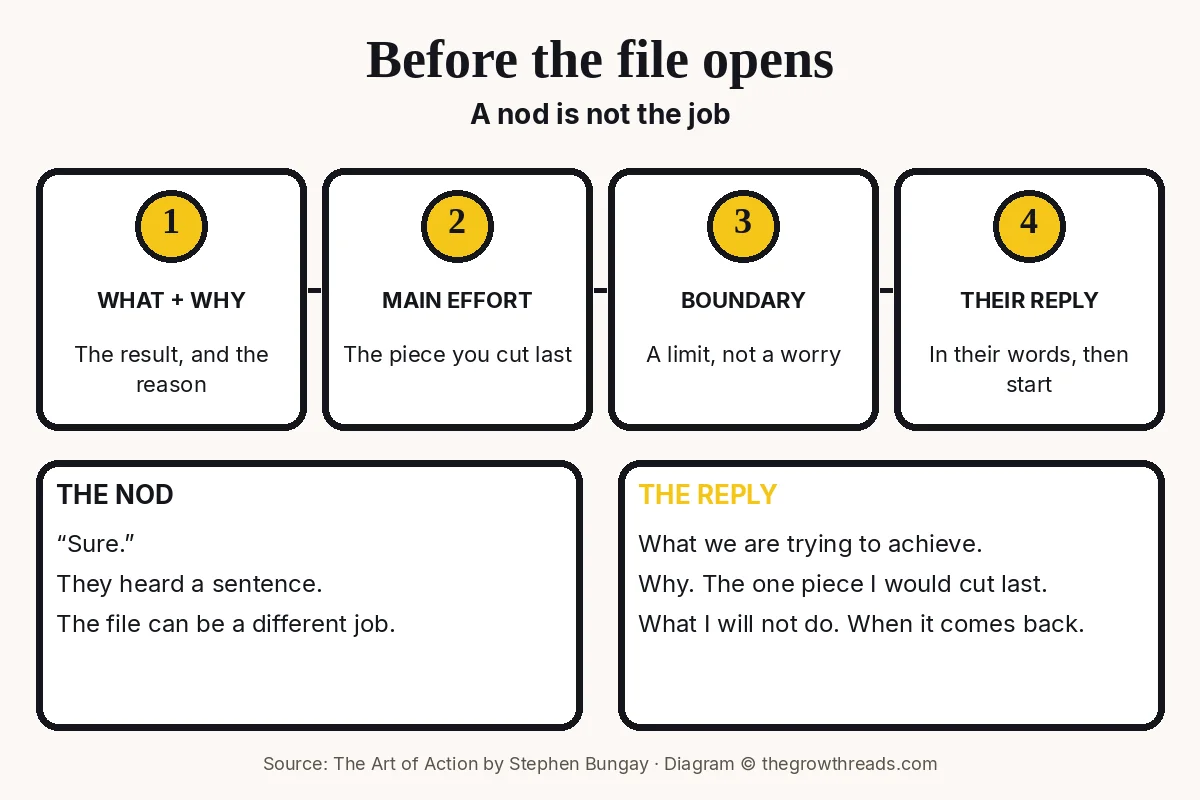
They nodded, and the work came back as a different job, because agreement is not a restatement. Stephen Bungay’s The Art of Action is the book behind a method he published as strategy briefing. The copy in front of this review is the January–February 2011 Harvard Business Review article the byline says is based on the book. You state what is to be done and why. You mark the one task you would cut last. You set boundaries that limit the other objectives. Then the person doing the work comes back and says how they will tackle it. That return is the back-brief. Do not open the file until it matches.
On a two-person job the loop is the same and faster. Send the what, the why, the main effort, and the boundaries, and wait for their written reply. The morning article on the nod that produced a different file is that problem. It returned HTTP 200 on 16 November 2026.
Key takeaways
- The question: Under a pile of goals, ask what you want them to do.
- What and why: An aspiration and a bare description of the activity both fail.
- Situation first: Write the facts before you revise the intent.
- Dashboard: A count of pages can look like progress on the wrong job.
- Main effort: Circle the one task you would cut last.
- Boundary: A limit on the other objectives, not a list of worries.
- Their words: They say how they will tackle it. A nod is not that sentence.
- Your what, their why: The task you assign becomes what they do in order to serve your result.
What is The Art of Action about?
The Art of Action is Stephen Bungay’s book on the gap between a plan and the job that comes back. The January–February 2011 Harvard Business Review article based on it shows a briefing: a what and a why, one main effort, boundaries, and a back-brief before people start.
About the author
Stephen Bungay (1954–2026) was a British management consultant, military historian, and author. The 2011 article’s byline calls him a director of the Ashridge Strategic Management Centre and the author of The Art of Action. His Wikipedia biography says he took a first-class degree at Oxford, studied philosophy at Oxford and Tübingen, and spent seventeen years in the London and Munich offices of the Boston Consulting Group. He also wrote the histories The Most Dangerous Enemy (2000) and Alamein (2002). The publisher’s page calls the linked hardcover the CMI Management Book of the Year for 2012. Explore all Stephen Bungay book summaries →
Joe, the manager in the article, is fiction stitched from Bungay’s consulting and teaching. He is an illustration, not a measured case. The article’s military close was not checked here.
Key concepts at a glance
| Concept | What it means | Use it when |
|---|---|---|
| Intent | What is to be done, and why | The sentence in the room could be heard as two jobs |
| Context | The situation, written before the intent is revised | The first draft is an aspiration or a description of activity |
| Measures | A dashboard for the destination, not the destination | A count of output would reward the wrong task |
| Implied tasks | The work the intent actually requires | The current list is whatever people were already doing |
| Main effort | The task you would cut last | Every item is marked vital |
| Boundary | A limit on the other objectives | The constraint list is a list of worries |
| Back-brief | They say how they will tackle the task | You have a nod and you do not yet have their words |
| Cascade | Your what becomes their why | More than one person will touch the job |
The question under the goals
Bungay opens on goal processes that arrive late and blur what matters. The question he says is still unanswered, and the first line this review quotes, is “What do you want me to do?” Strategy briefing is his answer. Managers and their reports move from a cloud of goals to a short list: which objectives each person will focus on, and in what order. The briefing also sets how far people act in line with the leader’s intent, and how much freedom they have to act on their own.
Joe, a fictional manager stitched from Bungay’s consulting and teaching, has already presented the company goals when a technician asks what they are really trying to achieve. Joe thinks he has said it. He stops and writes two headings on a flip chart: what, and why.
A what, a why, and the situation
The first drafts fail in familiar ways. “Build a world-class development facility” is an aspiration anyone could have. “Build a new development facility” only describes the activity. Joe writes the situation, and the pair that survives is to accelerate delivery of the critical products, in order to let sales halt a loss of share by year-end. The second line this review quotes is his: “If we give ourselves a target we can’t achieve, we’re setting ourselves up for failure.”
A founder has no two layers of bosses. The order still transfers. Write the situation before the what and the why. The client already bought the shop page. The form drops entries. Friday is the date you named. “Rebuild the brand” is the world-class facility. “Update the deck” is only the activity. The what and the why that survive are the price on the first page, so the client can sign the scope already sold.
Main effort, and a boundary that is not a worry
Joe separates the destination from the dashboard. A bonus for the number of new products would reward the easy projects nearest completion, so he commits to renegotiate targets that score the wrong task. The group then notices a missing task: nobody is choosing which products are critical. He asks which task they would cut last, circles fast development, and writes “Main effort.” If headcount were cut, people would move onto that task. Two circles means the choice was not made.
He will not dictate the how. The first constraint list is worries, and he sends it back. A boundary limits the other objectives. He can optimize time. Quality and cost become minimum standards. The article’s line for his role is that a leader manages the team’s boundaries.
On the proposal, the main effort is the price on page one. You would cut the polish before you cut the number. “I will not redesign the deck or add a page” is a boundary. “I hope the client likes it” is a worry. “I will not miss Friday” is a second objective unless Friday is the thing you are optimizing and the page count is the fence.
The back-brief before the file opens
Joe assigns the tasks and does not accept a nod. Each person leading a task says how they will tackle it. Their why is his what. Their what is the task he gave them. They are not repeating his paragraph.
Bungay names three results of a back-brief. The person checks their understanding. The leader sees what the direction implies and may revise it. If the notes come back together, gaps, overlaps, and coherence show up. A large team gets a week. A solo founder or a new manager needs the note before the clock starts. The lines below are the morning article’s application. They are not printed in the 2011 piece.
Send this before the file opens.
What I think we are trying to achieve: ____.
Why: ____.
Main effort, the piece I would cut last: ____.
I will not: ____.
I will bring the first piece back on: ____.
Read the reply against the job, not against their confidence. A match names the price on page one, the reason (the scope already sold), the one piece they would cut last, the page they will not add, and the day the first piece returns. “Rethink the proposal so it feels like the new brand” is a miss, even in a steady voice.
Answer with one of three lines. Only the first two allow a start. The article says a back-brief may make you revise the original direction. Sometimes their note shows that the job you said is not the job you meant. That revision is useful. Accepting a different job because they already built it is not.
That matches. Start.
Change this line, then start: ____.
Do not start. The job is: ____, in order to ____.
Silence is not a match, and neither is “looks good” unless you can point at the what, the why, and the main effort. Change one line when one line is wrong. Do not rewrite their note in your voice.
If the wrong file is open, close it and ask for the lines. If it already went to the client, you write the client and name what to ignore, then run the lines again for the repair. Two notes with the same main effort are an overlap: pick one name. If you are the only pair of hands, write the lines to yourself before you open the file. A contractor still has to answer in their own words.
Who is The Art of Action best for — and who should read something else first?
This book supports one problem. They nodded, and the work came back as a different job. You are a solo founder handing a file to a contractor, or a new manager handing a task in a hallway. You need the back-brief before they start: the what and the why, the main effort, the boundaries, and their written reply.
Read something else first when the problem is different. Two owners: The One Minute Manager Meets the Monkey. A status recital: The Effective Manager. Work that waits on you: The Great CEO Within, and use “I intend to” only after the lines match. Someone can intend, clearly, to do the wrong job.
Bungay is writing about a department, not a two-person studio. The transfer is the order of the questions. The nod is a missing sentence, not a flaw in their character.
Questions to reflect on
- Which live job has a nod and no restatement in their words?
- Is your current what an aspiration, a description of activity, or a result tied to a reason?
- If you had to cut every task but one, which piece would you cut last?
- Which line on your constraint list is a worry, and which line actually limits another objective?
- If their reply arrived right now, which of the three answers would you give, and which line would you point at?
🔥 Ready to get the written reply?
Read Bungay’s briefing, then send the what, the why, the main effort, and the boundaries before the file opens.
How to apply The Art of Action (7-day plan)
- Day 1 — Situation only. Pick one job. Write who bought what, what is broken, and the date. Do not write the task yet.
- Day 2 — What and why. One result and one reason. Cross out an aspiration and a bare description of activity. Drop a target the week cannot hit.
- Day 3 — One circle. List the implied tasks. Circle the piece you would cut last. Two circles means you have not chosen.
- Day 4 — One boundary. Write the limit on the other objectives. If the line is a worry, rewrite it as what they will not do.
- Day 5 — Their words. Send the five lines. Do not open the file. A contractor still replies in their own words.
- Day 6 — One reply. Match, change one line, or do not start. If two notes share a main effort, pick one name.
- Day 7 — Your own file. Write the same lines to yourself before you open it. No main effort means you are not ready to start.
Frequently asked questions
What is The Art of Action about?
The Art of Action is Stephen Bungay’s book on the gap between a plan and the job that comes back. This review checks the January-February 2011 Harvard Business Review article, reprint R1101L, which the byline says is based on the book. He calls the method strategy briefing: a what and a why, revised against the situation, measures that show whether the goal is happening, the tasks that intent implies, and boundaries that limit the team. The person doing the work then says how they will tackle it. That return is the back-brief. On a small team it is the note you wait for after a nod, before the file opens.
What does Bungay mean by a back-brief?
A back-brief is the loop after a briefing. The person who received the direction says how they will tackle the task. Bungay says three things happen. They check their understanding. The leader sees what the direction implies and may revise it. If the notes come back together, the leader can look for gaps, overlaps, and coherence. In the fiction, Joe asks for that conversation by the end of the next week. A founder does not need the off-site. The written reply before the file opens is the same loop, shortened. The five lines on this page are that application. They are not a form printed in the article.
What is a main effort?
Main effort is the task the group would cut last. Joe’s group lists the tasks the intent implies, then he asks what they would protect if they had to cut. They circle fast development of the critical products and he writes “Main effort” beside it. If headcount were cut, people would move onto that task so it would not slip. One piece is the point. A reply that names three pieces has not answered the question. Ask again for the one they would cut last. The question is his. The email line that carries it is ours.
How is a boundary different from a worry?
Bungay says people need boundaries in order to adapt, and that this sounds paradoxical. If they are not given boundaries, he writes, they make more rigid ones themselves. The first lists in the fiction are not boundaries. One side is good news and the other is worries about what might go wrong. A boundary limits the other objectives. Joe can optimize time. Cost and quality become minimum standards, not extra goals. “I will not add a page” is a boundary. “I hope the client likes it” is a worry. The article says his job as leader is to manage that fence.
Did this review quote numbered pages of the book?
No. The steps, the fictional manager, and the two short quotations are from the January-February 2011 article, read in full on 16 November 2026. The byline says that article is based on The Art of Action. The edition linked here is ISBN 9781857885590. The Amazon listing checked the same day names John Murray Business, 4 November 2010, and a print length of 228 pages. Open Library files the same ISBN under Nicholas Brealey Pub., 2011. No numbered page of the book was opened, so none is cited. Joe’s company figures stay in the fiction.
What do you send before they start?
Send the what, the why, the main effort, and the boundary, and wait for their words. The lines ask what they think you are trying to achieve, why, the piece they would cut last, what they will not do, and when the first piece comes back. A match can start. One wrong line can be changed, then start. A different result means do not start, and you say the job again as one what and one why. Silence is not a match. The 2011 article allows you to revise the direction. It does not print those three replies. They are the rule on this page.
Who should read this, and who should read something else first?
Read this if a nod came back as a different file, or if you are about to hand work to a contractor or a new report. The article is about a department, not a two-person studio. The transfer is the order of the questions. If two people already think they own the task, put one name on it first. If the 1:1 is only a status recital, fix the agenda before you add another brief. If you need better questions rather than a clearer assignment, that is a different book and a different author. A back-brief does not replace an owner.
Related summaries
- The One Minute Manager Meets the Monkey — one name on the task, before two back-briefs claim the same main effort
- The Effective Manager — the 1:1 that ends in a decision and an owner
- The Great CEO Within — the handoff that moves a decision after the job matches
- The Coaching Habit — questions, when the brief is already clear and you are still talking
- Best leadership books — the shelf this summary sits on