


You still speak like a peer when the hard thing leaves your mouth as just an idea. Julie Zhuo, on the publisher page dated 19 March 2019, writes that she framed criticism as a suggestion because her peers owned the decision. As the manager, she owns the outcome. Say the call.
Key takeaways
- You still speak like a peer when you already own the outcome and the hard thing still comes out as just an idea.
- Julie Zhuo, on the Penguin page dated 19 March 2019, writes that she used to say “Hey, just an idea, but have you considered…” because her peers owned their own decisions.
- On that page she writes that you are now responsible for the outcome of the team, including all the decisions that are made within it.
- She names four paths into the job, apprentice, pioneer, new boss, and successor, and she writes that a new boss’s first months are for listening, questions, and learning.
- The role note and the sentence on this page are The Growth Reads’ own script. The print book was not opened. No sentence here is taken from a numbered page.
What speaking like a peer is
You still speak like a peer when the seat has changed and the sentence has not. You are a new manager. Yesterday you and this person swapped comments as equals. Today the work is yours to answer for, and the correction still starts with “just an idea,” so they can keep the decision. You are a solo founder. You hired someone to take a piece of the work. The review still sounds like a collaborator offering a thought, because that is how you talked when you did the piece yourself. The hard thing is real. The cushion makes it optional.
A suggestion was the honest shape when they owned the decision and you did not. Zhuo’s page, dated 19 March 2019, is about the week that shape stops fitting. The fix is small. Name which path you are on. Name the one outcome you now own. Say the one hard thing as the call. Ask what gets in the way, and stop. If you are new to this team, the same page says the first months are for questions. A performed call, offered so you look like the boss, is a different failure.
Use the feedback script when the call is about a behaviour and you are about to name a trait. Use the one-page position when the decision was spoken and the what was never written. Use the delegation cut when the work is waiting on you and the question is what you still decide. Use the first-week checklist when the new person has no shape to the days. This page is the sentence. The seat changed. The words still belong to the old seat.
What the page actually says
The checked copy is one publisher article, not a chapter. “Tips for your first three months as a new manager” is dated 19 March 2019 on Penguin’s site and was read in full on 20 November 2026. The page says the book is The Making of a Manager and that she lists the types of new managers and what to watch for in the first three months. Porchlight’s page for ISBN 9780735219564, read the same day, lists Portfolio, hardcover, 19 March 2019, 336 pages. Penguin Random House’s page, read the same day, lists a hardcover published 19 March 2019 at 336 pages, an ebook the same day at 288 pages, and a paperback ISBN 9780593852781 published 9 September 2025 at 336 pages. The 2019 ISBN did not appear in the Penguin Random House text this run could read. The print book was not opened. No sentence on this page is taken from a numbered page.
She opens with four routes. An apprentice is asked to manage part of a growing team. A pioneer is a founding member of a new group and is now responsible for its growth. A new boss comes in to manage a team that already exists, inside the company or at a new one. A successor takes a manager’s place after that manager leaves. She says different things are easy or hard depending on the path. The rest of the page is those four watches, and two of them point back at the apprentice section.
On the apprentice path she writes that the new dynamic with former peers feels awkward. You were an individual contributor. Now you are the boss. With reports she considered friends, three things were hard. The first is playing coach: career goals, which projects suit their strengths and interests, what they need help with, and how they are doing relative to expectations. She names two questions that felt strange. “What do you want to be working toward in a year’s time?” “What do you consider your strengths?” She says do not avoid those conversations. Give feedback on what they are doing well and where they might stretch. She points that feedback to a later chapter. This page did not open that chapter.
The second is the hard conversation, and it is the mechanism this article uses. She writes that, as a peer, she framed criticisms as suggestions: “Hey, just an idea, but have you considered…” She knew that, ultimately, they owned their own decisions. As their manager she found it difficult to change that mindset even when she needed to. She writes that the manager–report relationship is different from the peer relationship. “You are now responsible for the outcome of your team, including all the decisions that are made within it.” If something is getting in the way of great work, address it swiftly and directly. That may mean difficult feedback or hard calls. “The sooner you internalize that you own the outcomes of your team, the easier it becomes to have these conversations.”
The third is that people share less. Peers who used to be transparent stopped telling her when they were struggling, annoyed, or in a disagreement. She walked in on two of them venting and they stopped. She says this was normal. They were wary of bothering her or of coming across poorly. Establishing trust was her work. She points that to the next chapter. This page did not open it. The detail that belongs here is her account that the picture gets worse if you pretend the seat did not change, and that the repair is yours to start.
She then writes about the individual-contributor work that stays on the apprentice’s plate. A new apprentice rarely starts with a big team. Most are still doing their old work. She uses the picture of still selling lemonade while supporting others. She thought that was fine. She was afraid that if she stopped doing design work she would lose the skills that made her a useful leader. She calls the continuation past the sustainable point the mistake she made and the mistake she sees virtually every apprentice manager make. When her team became six or so, she was still the lead designer on a complex project. Extra one-on-ones and reviews ate the hours. The quality of her work suffered, her peers got frustrated, and, in her image, the balls she was juggling plopped to the ground. She writes that she had to give up wanting to be both a design manager and a designer, because in attempting both she was doing neither well. Her instruction: “at the point in which your team becomes four or five people, you should have a plan for how to scale back your individual contributor responsibilities so that you can be the best manager for your people.” That is her plan point for an apprentice whose team has grown. It is her experience at “six or so.” It is not a headcount law for a founder with one hire.
The pioneer section is about being the only one of your kind. She gives the first designer asked to grow a user-experience discipline, with nobody inside to ask about hiring and onboarding. Her remedy is two groups: other managers in the organisation who support related functions, and managers in your craft outside it. At Facebook, she writes, engineering was many times bigger than design. When her weekly meeting became inefficient, or her reports asked for clearer career paths, she asked engineering manager friends. “Eight times out of ten” they had met the problem three years earlier, when they were her size, and they told her what they had learned. That fraction is her account of those conversations. It is not a rate you can expect from your own ask. She also reports a friend who treats founder dinners as “informal CEO training,” and her own coffees with design managers at other companies, where they keep away from the specifics of the work. The pioneer section then points the balance of individual work and management back to the apprentice description.
The new-boss section is the counter-case. She writes that one of the biggest mistakes new bosses make is thinking they need to jump in and exert their opinions right away to show they are capable, and that this tends to backfire. Few things are more annoying, she writes, than a new person wasting time proving they know something when the opinion is not informed. “In your first few months, your primary job is to listen, ask questions, and learn.” She lists questions a new manager can ask their own manager to calibrate what is normal: what a great job looks like versus an average or poor one, with examples; how a named project or meeting went, and why; whether something you noticed is normal or a concern; what keeps that manager up at night, and why; how they decide what to prioritise. On trust, she reports a friend who says the quiet part: because they are new, people may not feel comfortable sharing everything yet; they hope to earn trust; they will start by sharing more about themselves, including their biggest failure. She reports one new manager on her team who said he was having more difficulty connecting with peers than he expected, and so could not influence decisions. Because he raised it, they made a plan for honest conversations. She writes that within a week the situation turned around. That week is one person’s story on her team. It is not a promise about your first week.
The successor section points the former-peer awkwardness back to the apprentice. She says the jump in responsibility can feel like too much, because you are now doing your former boss’s job and most successors are surprised by the size of it. A colleague told her, in her report, “I had no idea the lengths my former manager went to shield us from the many requests from other teams.” She says ask for support, and be up front that a transition is coming. She reports a friend’s repeated line in those weeks: the last manager left big shoes to fill; he will do his best; he expects bumps; he wants their help and support during the period. She also warns against doing things exactly as the former manager did, because everyone remembers the old way. She calls “Be yourself; everyone else is already taken” a well-known adage. She does not name who said it. This page does not add a name.
The role note
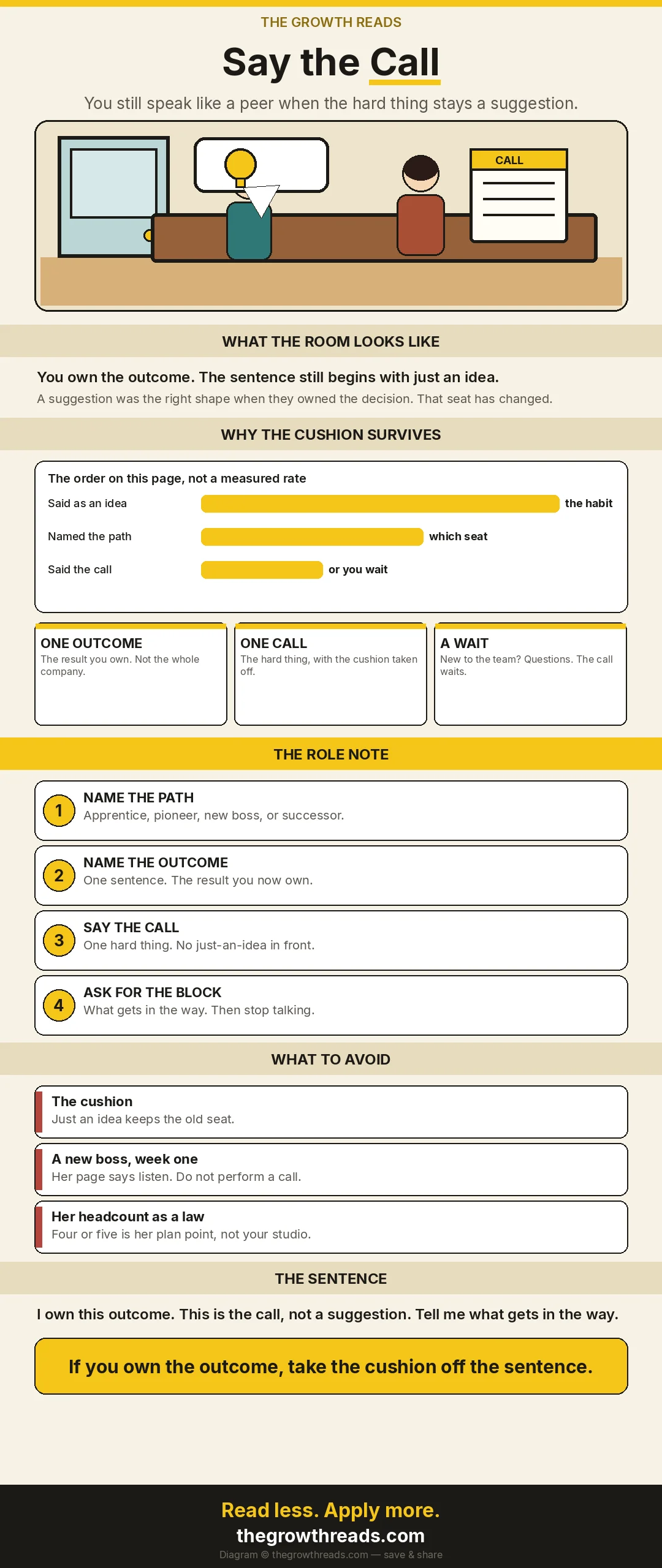
Before the next hard conversation, write four lines. If the path line says new boss, the note stops at questions. The four lines are this page’s script. They are not on the Penguin page. They are the minimum that turns her split, between a suggestion and an owned outcome, into a note you can read before you speak.
One conversation. One outcome. Not the company.
1. Path. Apprentice, pioneer, new boss, or successor. A solo founder with a first hire is closest to the pioneer. A founder whose new person was a peer last month is closest to the apprentice. If the line says new boss, stop here and use her questions.
2. Outcome. One sentence: the result you now own.
3. Call. The one hard thing, in one sentence, with no “just an idea” in front of it.
4. Return. What you need back: the obstacle, the date, or the done. Then you stop talking.
Read the four lines out loud once. If line 3 still wants a cushion, the cushion is the peer seat. Take it off, or admit you have not decided.
Path is her taxonomy, used as a label so you do not give the successor’s speech to a new boss, or the new boss’s silence to a person you have managed for a year. A solo founder is not one of her four job titles. The closest seats are the ones above. If none of them fit, write the seat in plain words: “I hired them last month and I still do the work.” The label is there so the next line has a reason.
Outcome is one result, in her sense of being responsible for the outcome, reduced to a sentence a tired person can say. “The launch” is a mood. “The invoice page shows the price we already agreed, and the client sees it on Thursday” is an outcome. The whole company does not fit on the line. If you cannot name the result, you are about to give a speech about being the boss. That is the performed opinion she warns the new boss against.
Call is the hard thing with the cushion removed. Her example of the old shape is “Hey, just an idea, but have you considered…” The new shape is the consideration, stated as the call, because you own the outcome and they no longer own the decision alone. If the call is about how they did the work, leave this note and use the behaviour, the impact, and the ask. A trait is a personality comment. This line is the decision. Return is how you keep the conversation from becoming a monologue. She says people share less once you are the boss, and that the repair starts with you. Asking what gets in the way is the repair in one question. Then stop, so they have room to answer.
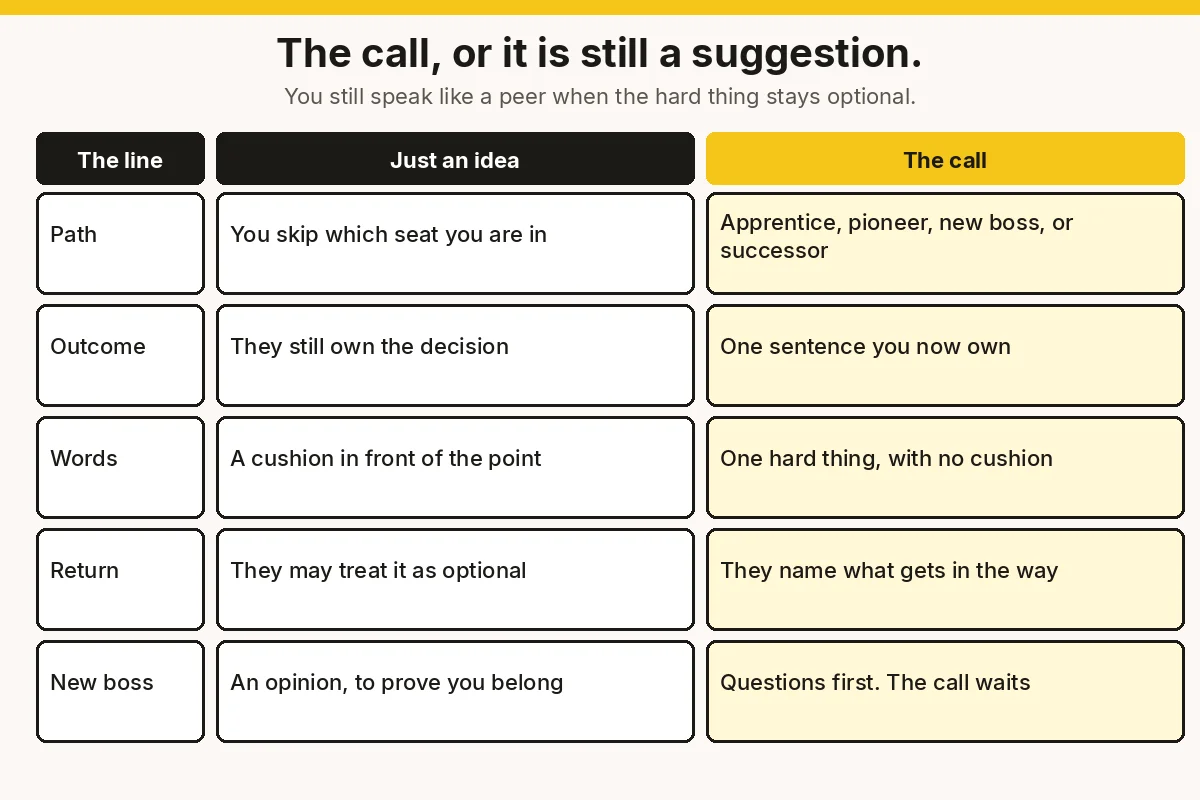
| The line | What just an idea looks like | What the call looks like |
|---|---|---|
| Path | You skip the seat and talk as you did last month. | You name apprentice, pioneer, new boss, or successor, or you write the seat in plain words. |
| Outcome | They still own the decision, because you never said otherwise. | One sentence states the result you now own. |
| Words | A cushion sits in front of the point, so the point can be ignored. | One hard thing, with no “just an idea” in front of it. |
| Return | You keep talking, and they wait for the suggestion to pass. | You ask what gets in the way, and you stop. |
| New boss | You announce an opinion so the room can see you are in charge. | You ask her questions. The call waits until you have learned the team. |
The sentence that replaces just an idea
When you hear the cushion starting, replace it with one sentence and then wait. The sentence is ours. It is the spoken form of lines 2, 3, and 4.
“I own this outcome. This is the call, not a suggestion. Tell me what gets in the way.”
Use it when you are about to say “just an idea,” when a review has turned into a list of optional thoughts, or when a founder is correcting the first hire in the same voice they used with a cofounder. Say the outcome in the sentence only if line 2 is already written. A call with no outcome is a louder suggestion. Paste nothing under it. The note stays in front of you. Their answer is the obstacle, the date, or the done. If they go quiet, that quiet matches what she describes: people share less, and they are wary of coming across poorly. Ask once more, in the same words. Then leave the silence.
If you are the only person in the company and the “team” is a contractor, you still owe the sentence when the work is yours to answer for. Write the four lines before the review. A voice note full of ideas is the peer seat. The call is one sentence they can repeat back. If you have not decided, line 3 says “not decided” and names the date you will. A fake call, typed so you sound like a manager, is the new-boss mistake in a smaller room.
The new boss uses a different sentence, and it is hers by way of the friend she reports. You are new. They may not be ready to share everything. You will earn the trust. You can start by telling them something true about a failure of yours. Then ask the questions she lists, of your own manager if you have one, and of the team if you do not: what a great job looks like here, how the last project actually went, whether the thing you noticed is normal, what they are worried about, and how priority is chosen. The call waits. Her page puts listening first for months, not for a single polite question before you announce the plan.
When the call is the wrong tool
The call is the wrong tool when you do not yet own a decision, or when you are new to the team and still learning what normal is. If the what was never written, write the page before you perform a call. A firm sentence with no target is still a hallway. If they nodded and the work came back as a different job, the missing piece is their backbrief. If the 1:1 is a tour of status, fix the agenda. This sentence can be said inside that meeting. It does not replace the agenda. If two people think they own the task, name one owner before you give a call to both of them. If you answer before they finish, that is a different hold. Here you may already know the call. You still ask what gets in the way, and you still stop.
A solo founder with one hire is still doing the work. She says that early arrangement is ordinary for an apprentice, and her picture is still selling lemonade while you support the others. The failure she names is continuing past the point where it is sustainable, which she locates at a team of four or five for the plan, and at six or so in her own design team. A studio of two does not inherit that headcount. What the studio does inherit is the speech. If you own the client result, the correction is the call. If you are still deciding, say so. Her “eight times out of ten” stays in her Facebook conversations. It is not the odds that a neighbouring founder has solved your problem.
Leave her design-manager title, her engineering-to-design ratio, and the dinners she calls informal CEO training in the article where she put them. They describe a large company and a network you may not have. Copying them onto a two-person studio produces a costume. The part that fits the studio is the part this script keeps: one outcome, said as the call, with the cushion off, unless you are new to the team and your job is still to learn it.
Common mistakes
- Leaving the cushion on so the friendship survives. She writes that the suggestion was honest when they owned the decision. Once you own the outcome, the cushion lets them treat a real call as optional. The friendship is a reason to be specific and to stop talking. It is not a reason to hide the call.
- Announcing a call in your first weeks as a new boss. She writes that jumping in with opinions, to prove you are capable, tends to backfire. The first months are for listening, questions, and learning. Use her question list. Keep line 3 blank until you can say what normal is.
- Treating “four or five” as a rule for every founder. That figure is her instruction for an apprentice whose team has grown, next to her own “six or so.” A founder with one hire is still in the early arrangement she describes. Plan the scale-back when the individual work is already slipping. Do not quote her headcount as a law.
- Borrowing “eight times out of ten.” That is her account of asking engineering managers at Facebook. Your neighbouring founder may have nothing useful. Ask anyway if you are the only person in the seat. Do not put her fraction in your note.
- Turning the call into a personality comment. “You are careless” is a trait. The call is the outcome and the decision. If you need to talk about the work itself, use behaviour, impact, and the ask, and stop when the ask is clear.
- Using the sentence to avoid a scope or price decision. If the outcome depends on a price or a change of scope, decide it on the pricing page or the change page first. This sentence records a call you have made. It does not invent the number.
- Filling the silence because it feels rude. She writes that people share less, and that they are wary of bothering you. A second speech puts the peer habit back in the room. One repeat of the question is enough. Then wait.
What the source does and does not say
| Source | What was read | What this page uses | What this page does not use |
|---|---|---|---|
| Julie Zhuo, “Tips for your first three months as a new manager,” Penguin, dated 19 March 2019. | The full article, on 20 November 2026. | The four paths. The suggestion she used as a peer. The line that you own the team’s outcome, including the decisions made within it. People sharing less. Her plan to scale back individual work at four or five, and her own “six or so.” The new boss’s job to listen. The questions. The reported lines from a friend, a colleague, and one manager on her team. | The later chapter on feedback, and the next chapter on trust, which she names and this page did not open. Her Facebook ratio and “eight times out of ten” as a rate for anyone else. Design-manager craft advice. The adage, beyond the fact that she calls it well known and does not name a speaker. |
| Porchlight’s page for ISBN 9780735219564, and Penguin Random House’s book page. | Both catalogue pages, on 20 November 2026. | Portfolio, hardcover, 19 March 2019, 336 pages, ISBN 9780735219564, from Porchlight. Hardcover date and page count, ebook page count, and paperback ISBN 9780593852781 dated 9 September 2025, from Penguin Random House. | The chapter text. Every sentence that may or may not be on a numbered page. The 2019 ISBN was not in the Penguin Random House text this run could read. The paperback is a later edition. This page does not claim the 2019 article and the 2025 text are the same. |
She is writing about managers inside companies, including a design team at Facebook, and about the first three months. A founder correcting a first hire is close enough for the mechanism: the sentence is still a suggestion, and the outcome is already yours. It is not close enough for a claim about team size, about how often a peer manager has the answer, or about a turnaround inside a week. The four lines and the sentence are our application. They have not been tested on her teams. If line 3 is still cushioned in two weeks, the note is telling you the seat has not moved. That is a fact about your sentences. It is not a finding from her page.
Frequently asked questions
What does it mean that you still speak like a peer?
You still speak like a peer when the seat has changed and the hard thing still comes out as a suggestion. Julie Zhuo, on the Penguin page dated 19 March 2019, writes that she used to say “Hey, just an idea, but have you considered…” because her peers owned the decision. She writes that the manager is responsible for the outcome, including the decisions made within it. This page applies that shift to one conversation. The role note is our script. The print book was not opened.
What goes on the role note?
Four lines, and they are this page’s script. Name the path: apprentice, pioneer, new boss, or successor. A founder with a first hire is closest to the pioneer. Someone who managed a peer last month is closest to the apprentice. Write the outcome in one sentence. Write the hard thing with no “just an idea” in front of it. Write what you need back, then stop talking. If the path says new boss, stop. Her page says the first months are for questions.
What do you say instead of just an idea?
Say: “I own this outcome. This is the call, not a suggestion. Tell me what gets in the way.” Use it when the cushion is about to come out, or when you are correcting a first hire in a peer’s voice. Write the outcome before you say it. Then wait. She writes that people share less once you are the boss. One repeat of the question is enough. A second speech puts the suggestion back in the room. The sentence is ours. It is not a line on the 2019 page.
What if you are new to the team?
You ask, and you do not perform the call. Zhuo writes that a new boss’s job in the first months is to listen, ask, and learn, and that jumping in with opinions to look capable tends to backfire. Ask what a great job looks like, how the last project went, whether what you noticed is normal, what worries them, and how priority is chosen. Keep line 3 blank until you can say what normal is. A firm call in week one is the mistake she names on that path.
Does this apply to a solo founder with one hire?
The speech does. The headcount does not. Her plan to scale back individual work is for an apprentice at four or five people, beside her own account of six or so. A founder with one hire is still in the early arrangement she calls ordinary. If you own the client result, the correction is the call. If you have not decided, say so and name the date. Her “eight times out of ten” stays her account of conversations at Facebook. It is not a rate for your own ask.
How is this different from a feedback script or a written direction?
The feedback script is behaviour, impact, and the ask, for when you might name a trait. The written direction is the page that states the what. This note is narrower. You already own the outcome, and you are about to hide the call inside “just an idea.” Say the call, then use the feedback script if the content is about how they worked. Write the direction page if there is still no what. A 1:1 agenda and a single owner are other tools. This sentence can sit inside them.
What did she say about still doing the old work?
She writes that most new apprentice managers still do individual work, and that she thought this was fine because she feared losing her design skills. She calls it a mistake to continue past the sustainable point. At six or so she was still the lead designer, the work slipped, and she stopped trying to hold both jobs. Her instruction is a plan to scale back at four or five people. Those figures are hers. A two-person studio does not inherit them. What carries is doing neither job well when the old work stays after the seat has changed.
Did this page open The Making of a Manager?
No. The text read on 20 November 2026 is the Penguin article dated 19 March 2019, in full. Porchlight lists Portfolio, hardcover, 19 March 2019, 336 pages, ISBN 9780735219564. Penguin Random House lists a hardcover of that date at 336 pages, and paperback ISBN 9780593852781 of 9 September 2025. The chapters were not opened. No sentence is taken from a numbered page. The role note and the sentence are our application.
Sources
- Zhuo, J. “Tips for your first three months as a new manager.” Penguin, dated 19 March 2019. Read in full on 20 November 2026 at penguin.co.uk/discover/articles/new-manager-first-three-months-tips. The page presents the piece as her account from The Making of a Manager. Used for the four paths, the peer suggestion “Hey, just an idea, but have you considered…”, the line that the manager is responsible for the team’s outcome including the decisions made within it, the account that people share less, the plan to scale back individual work at four or five people and her own “six or so,” the new boss’s job to listen and the questions she lists, and the reported remarks from a friend, a colleague, and one manager on her team. “Eight times out of ten” is her account of Facebook conversations. The chapters she points to were not opened.
- Porchlight Book Company, product page for ISBN 9780735219564, read 20 November 2026. It lists The Making of a Manager: What to Do When Everyone Looks to You, by Julie Zhuo, publisher Portfolio, hardcover, publish date 19 March 2019, 336 pages, ISBN 9780735219564. Penguin Random House’s book page, read the same day, lists a hardcover published 19 March 2019 at 336 pages, an ebook of that date at 288 pages, and a paperback ISBN 9780593852781 published 9 September 2025 at 336 pages. The 2019 ISBN did not appear in the Penguin Random House text this run could read. The print book was not opened. No sentence is taken from a numbered page. The role note and the sentence “I own this outcome. This is the call, not a suggestion. Tell me what gets in the way.” are not on the pages that were read.
Related reading on The Growth Reads
- Feedback turns into a personality comment — behaviour, impact, and the ask, once the call is about the work
- The direction never gets written — the what, on a page, before anyone starts
- You are the bottleneck — what you still decide, and what you hand off
- The first hire, week one — three outcomes, and what you will not assign
- The first hire’s week one has no shape — five days, and the Friday review
- The 1:1 is a status recital — one decision and one owner at the end of the meeting
- You answer before they finish — one question before the advice
- Two people own the same task — one name on the work
- Productivity — the cluster this article sits in
- How we review — what a checked source is, and what an unread chapter is not
How this was checked
Who it is for. A solo founder or a new manager who already owns the outcome, and whose hard sentence still sounds like a suggestion from a peer.
What was read. Zhuo’s Penguin article dated 19 March 2019, in full, on 20 November 2026. Porchlight’s record for ISBN 9780735219564. Penguin Random House’s catalogue page for the hardcover date and the 2025 paperback.
What was not read. The print chapters, including the feedback chapter and the trust chapter she names. Any numbered page.
Limit. The four lines and the sentence are our application. Her headcount, her “eight times out of ten,” and the one-week turnaround stay her accounts. A new boss’s first months are for questions.
How we work: every article on The Growth Reads is built from books we have read and from primary accounts we can check, and it is date-stamped when those sources change. Read our methodology.