

★★★★☆ 4/5 — Use it to put one name on the function that is waiting. Do not use it as a first-week handbook.
Best for: a solo founder or a new manager who is still the person every function waits on.
Reading time: the ownership chapters are a short sitting. The whole 2019 paperback is 202 pages.
Difficulty to apply: moderate. The list is easy. Leaving the function with that person is the work.
The Great CEO Within in one minute
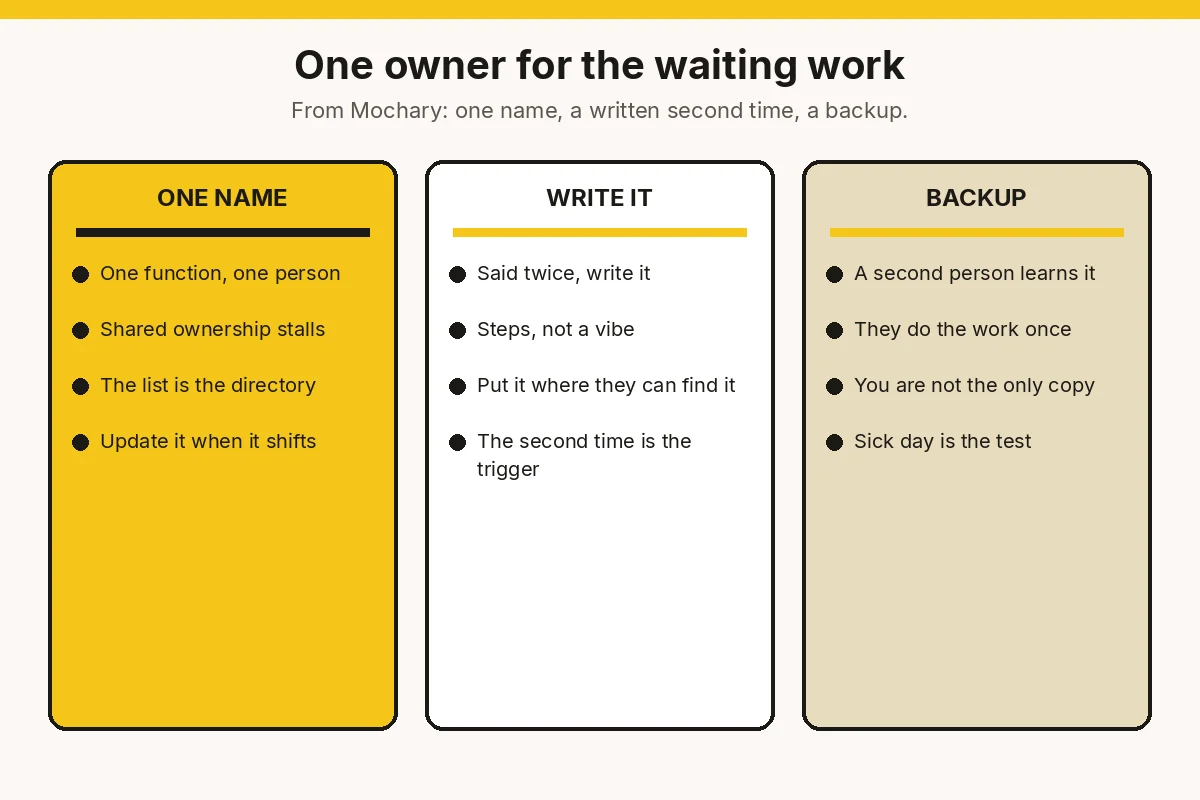
If several people own a function, the function often does not get done. Matt Mochary’s fix is an Area of Responsibility: one name beside one function, the steps written the second time you do them, and a second person who has actually performed the work. That is the page that serves a founder who is the bottleneck. The rest of the book is a company playbook. You do not need the playbook to name one owner this week.
Key takeaways
- One name: group the work into functions and put one person, only one, next to each.
- Shared ownership stalls: he calls it the tragedy of the commons. The list exists so functions do not fall through.
- Say it twice, write it: the second explanation is the signal that you will keep saying it. Write the steps.
- A backup is a drill: someone else does the function once. A name on a slide is not a backup.
- Waiting For has a date: person, action, and the day you asked. Aging items come back onto your list as a follow-up, not as silent hope.
- Some functions stay yours: the appendix keeps customers, investors, and the team with the founder.
- Top Goal is a fence: a block of time for the one quarterly goal, before the inbox. It does not name an owner.
- A chief of staff is later: someone who sits beside you and takes tasks until you are in your zone of genius. That is not the first handoff.

What is The Great CEO Within about?
The Great CEO Within is Matt Mochary’s tactical notebook for a founding CEO who is still the person every function waits on. The move that matters here is an Area of Responsibility: one named owner per function, the process written the second time you do it, and a backup who has actually done the work.
About the author
Matt Mochary is a founder who later coached technical CEOs. In the 2018 introduction he says the book is the set of fixes he and those CEOs kept rebuilding, written down because a verbal description was hard to copy and an example was easy to repeat. The 2019 paperback, published by Mochary Films, lists Alex Maccaw and Misha Talavera as contributors. This review uses the 2018 text that is public as a PDF, formerly titled Founder to CEO. Where the later book adds chapters, this review does not invent them. Explore all Matt Mochary book summaries →
Key concepts at a glance
| Concept | What it means | Use it when |
|---|---|---|
| Area of Responsibility | One function, one person, on a list everyone can open. | Two people think they own the same wait. |
| Say it twice | The second telling means you will tell it again. Write the steps. | You just explained the same task to a second person. |
| No single point of failure | Write the process, then have a backup do it once. | The work stops when you are out. |
| Waiting For | Person, requested action, and the date you asked. | You handed something off and it went quiet. |
| Top Goal | A protected block for the one quarterly goal, inbox closed. | The week is full and the important work never starts. |
| Keep these | Customers, investors, and the team stay with you. | You are about to hand off a relationship only you hold. |
One name, or the work waits
Chapter 20 is short. When several people share a function, the function often is not done well, or at all. He names that the tragedy of the commons. The counter is a document: every function, and beside it one responsible person. The list is the company directory. People need to know where it is. You update it when a function appears or when the name changes.
That is the bottleneck in list form. If the proposal, the invoice, or the inbox has no single name, it has you. “We all watch it” is the shared function. For a solo founder the first version of the list can be ten lines. For a new manager it can be the work of one team. The mistake is a chart of departments. He asks for functions and names.
The second time, write it down
Chapter 7 is one rule. If you hear yourself saying something for a second time, to a second person or in a second situation, you will say it again. Write it down. Share the page. If the whole team must remember it, it goes where they already look.
Chapter 21 pairs that rule with a backup. A single point of failure is a function only one person knows how to do. Write the steps the second time the work appears. Then a second person does the role with the primary until they can perform it. He is explicit that the writing comes first, because the training is worse without it.
Applied to the handoff: you do not delegate by mood. You delegate a function that has happened twice, with the steps on a page, and you watch the backup do it once. If it has only happened once, it is not ready to leave your hands. If you cannot stand to watch them do it once, you have not handed it off. You have hoped.
What you still do not hand off
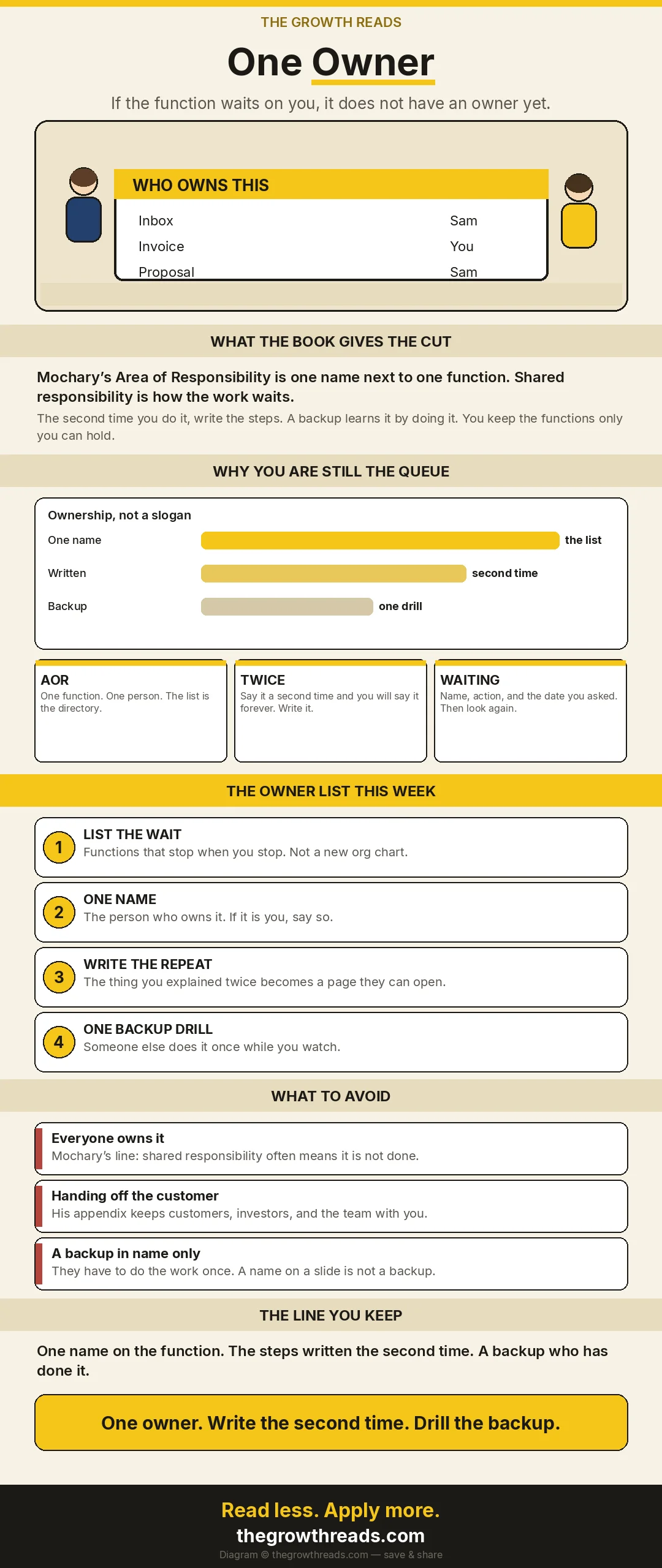
The appendix, written with a founder’s note from Danny An, is the brake. A week of practice might be a budget, a list of problems, and a capable person. At the end you ask what you would have finished yourself, in number and in quality. The same note keeps three functions: product marketing, because you must know the customers; fundraising, because you must know the investors; and team management, because you must know the team.
For the solo founder in today’s bottleneck article, those three map cleanly. The price and the promise stay. The people decision stays. A repeatable piece can leave, with the steps written and a time you will look again. The book does not say “trust more.” It says which functions are still yours.
The waiting list is the check
In the Getting Things Done chapter he keeps a Waiting For list: the person, the action you asked for, and the date you asked. You scan it for aging requests. An aging request moves back to your Next Actions as a follow-up. That is the veto time, in list form. A handoff without a date is an item you will discover late.
His Top Goal chapter is a different tool. Greg McKeown’s line, as Mochary uses it, is a daily block for the one quarterly goal, with messages closed. Useful, and it does not name an owner. A founder can protect two hours and still be the person every function waits on. Do the list first. Then protect the hour.
Who is The Great CEO Within best for — and who should read something else first?
Read this if you are the founder or the new manager and the work stops when you stop. The ownership chapters are the part that matches that problem.
Read High Output Management first if you need how close to stand on a task the person has never done. Read Turn the Ship Around if you need the words of a handoff, “I intend to,” rather than a list of functions. Read The Making of a Manager if the problem is your first months as a manager, not a function with no name. This book will not do those jobs. It will give you the line on the list.
Questions to reflect on
- Which function stopped last week because you were the only person who knew the steps?
- Where do two names sit on the same function, which is another way of saying no name?
- What did you explain twice this month that is still not written?
- Who has done that function once, with you watching, besides you?
- Which of customers, investors, or the team are you about to hand off because you are tired?
🔥 Ready to put one name on the function that is waiting?
The 2019 paperback is the edition to buy. The ownership chapters are the ones to use this week.
How to apply The Great CEO Within (7-day plan)
- Day 1 — List the functions that stopped when you stopped. Ten lines is enough. Do not draw an org chart.
- Day 2 — Put one name on each line. If the name is you, write “you.” Shared names are not allowed.
- Day 3 — Circle one function that has already happened twice and is not the customer, the investor, or the team.
- Day 4 — Write the steps of that function the way you would hand them to someone who was not in the room.
- Day 5 — Ask that person to do it once while you watch. Correct the page, not their character.
- Day 6 — Add the item to a Waiting For line: their name, the action, today’s date.
- Day 7 — Read the line. If it aged, it returns to you as a follow-up. If it held, leave it. Do not add a second function this week.
Frequently asked questions
What is an Area of Responsibility?
An Area of Responsibility is one function with one person’s name beside it, on a list the company can open. Mochary’s chapter says that when several people share a function, the work often is not done. The list is the directory and the check. For a solo founder the list can be short. The rule does not change with headcount. If the invoice, the proposal, or the inbox has no single name, the name is yours, whether you wrote it or not. Update the list when the function moves. Do not leave two names in the box and call it shared leadership.
How does this book help if I am the bottleneck?
It gives the waiting work a name that is not automatically yours. You list the functions that stop when you stop, you put one owner on each, and you write the steps the second time you perform them. A second person does that function once while you watch. The appendix still keeps customers, investors, and the team with you. That matches the cut in our bottleneck article: the price, the people, and the promise stay, and one repeatable piece can leave. The book is not a speech about letting go. It is a list with a drill.
What should I not delegate, according to Mochary?
The appendix note keeps three functions with the founder: product marketing, because you must know the customers; fundraising, because you must know the investors; and team management, because you must know the team. A practice week can hand a capable person a budget and a list of smaller problems. It does not hand them those three. If you are tired, those are the functions you will be tempted to dump. Write them in the “you” column before you pick the piece that leaves.
Is a chief of staff the first hire?
Not on this reading. The department note describes a chief of staff who sits next to the CEO, learns how the CEO works, and takes tasks until the CEO is only doing work they are uniquely good at and want to do. That picture assumes you already know which tasks are yours. A first hire this week gets one written function, or three dated outcomes, not the instruction to become you. Give the chief-of-staff shape later, after the list exists and one backup has done the work once.
Which edition is this review based on?
This review is based on the 2018 text hosted as a PDF, formerly titled Founder to CEO. The buy buttons point at the 2019 paperback, ISBN 9780578599281, published by Mochary Films, which lists Alex Maccaw and Misha Talavera as contributors. We do not cite page numbers, because the PDF we read is not the paginated paperback. Where a later chapter is outside that text, we do not describe it. The ownership chapters we use are in the 2018 text and are the part that serves the bottleneck.
How is this different from High Output Management?
Grove is the book for how close to stand when the person is new to the specific task. Mochary is the book for putting a single name on the function so the task has an owner before you decide how close to stand. Use Grove when the piece is new to them. Use this list when the piece is repeating and still sitting with you because nobody’s name is on it. Our High Output Management review is the longer Grove read. Do not treat the two as the same instruction.
What if I have no second person?
Then the backup drill has no recipient, and a name that is not yours would be fiction. Write the functions down anyway, with your name, so the queue is visible. Write the steps the second time you do a task, so the page exists before a person does. Do not hire in order to complete a framework. When one person can take one repeating function that is not the customer, the investor, or the team, that is the week to add a name that is not yours.
Related summaries
- High Output Management summary — how close to stand on a task
- Turn the Ship Around summary — the words of a handoff
- The Making of a Manager summary — first months as a manager
- Best leadership books