

★★★★★ 4.8/5 — Win the campaign, not the skirmish.
Best for: Founders, operators, and leads who keep winning the argument and losing the quarter
Reading time: ~12 hrs for the Penguin paperback (496 pages, 2008; originally Viking 2006) · ~14 min for this guide
Difficulty to apply: The stories are easy; the drill is naming one live conflict and refusing the last-war play
The 33 Strategies of War in one minute
The 33 Strategies of War is a field manual for people who are busy, competitive, and somehow still fighting last quarter’s fight. Robert Greene’s claim is not that you need a louder push. It is that most of us have no campaign. We react to the newest ping, copy the move that worked in a different war, and call the noise “taking charge.” Thirty-three strategies, five terrains — self, team, defense, offense, unconventional — reverse that. Name the real opponent. Drop the last-war play. Keep your mind. Put yourself on death-ground. Spend force on the hinge, then stop. Read it for the conflict you will still recognize on Friday.
Key takeaways
- Polarity comes first: A fog of “everyone” is not an opponent. Write the name.
- Do not fight the last war: The play that already failed is still in your hands.
- Presence of mind is a tactic: Panic is useful — to the other side.
- Death-ground concentrates force: Cheap exits leak attention. Design the door you close.
- A crew needs a crusade and a map: Morale without segments is a crowd.
- Pick your battles: Economy of force is leadership, not timidity.
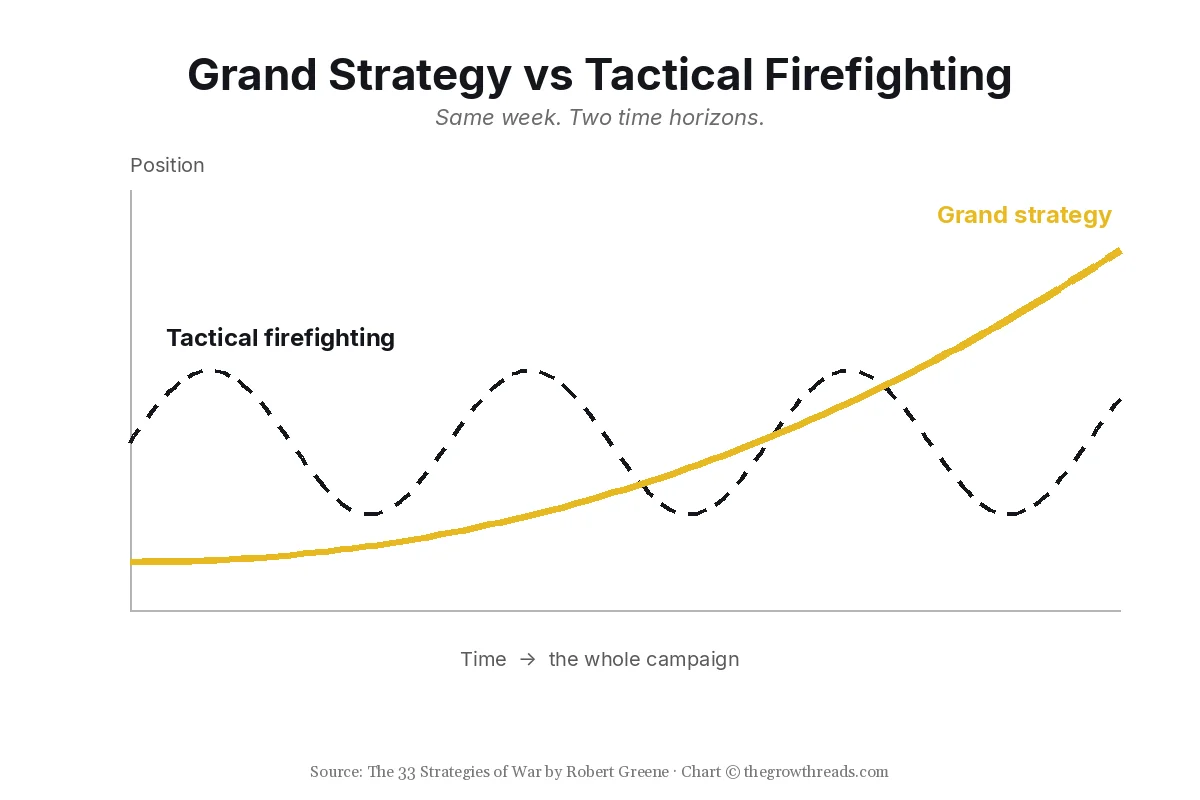
- Grand strategy beats a won skirmish: Lose the small fight if it buys the hinge.
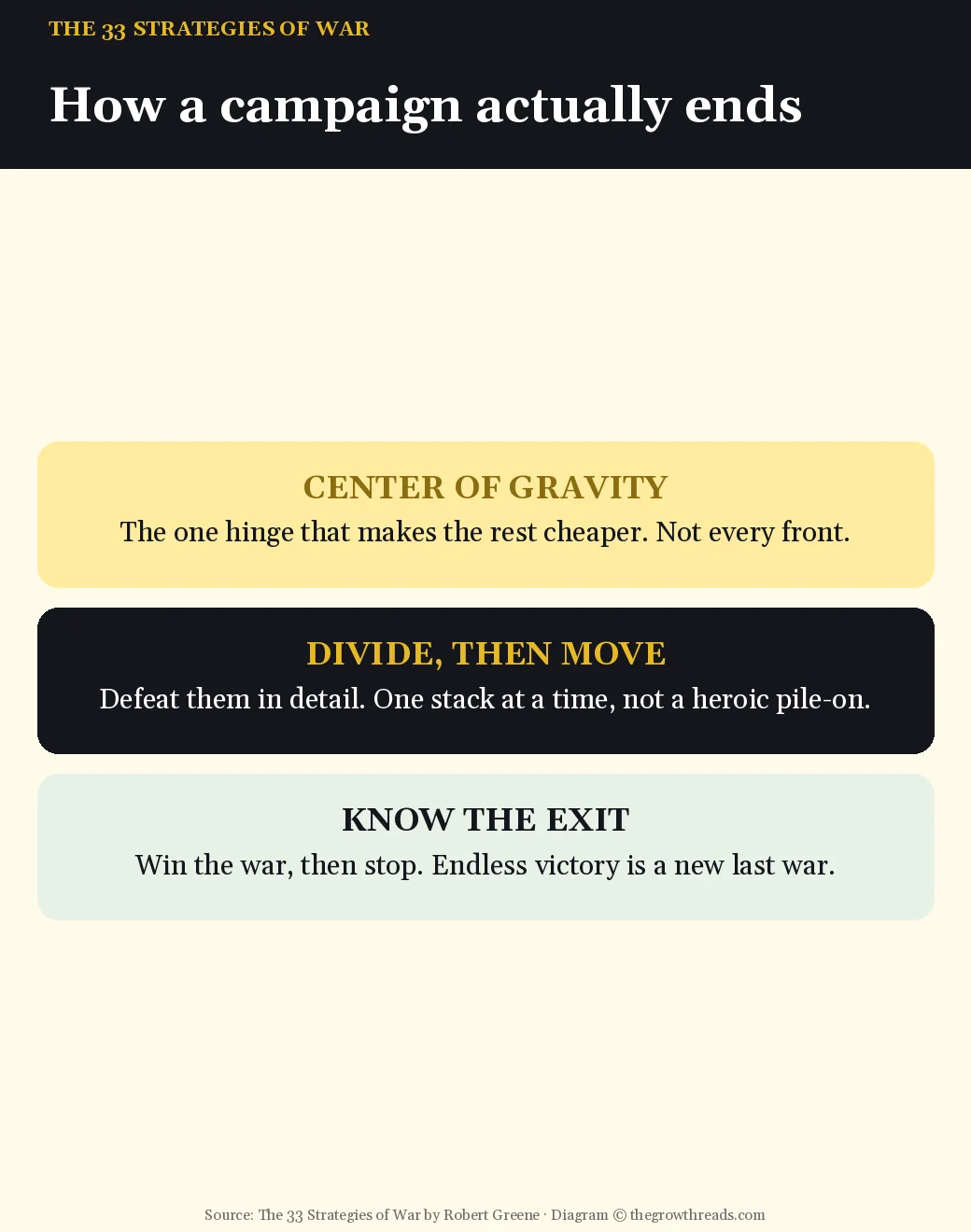
- Hit the center of gravity: The one point that makes the rest cheaper.
- Divide, then move: Defeat them in detail. A heroic pile-on is not speed.
- Know how to end things: Endless victory is just a new last war.
What is The 33 Strategies of War about?
The 33 Strategies of War is Robert Greene’s 2006 handbook for seeing conflict as a campaign. It groups thirty-three strategies into five terrains — self, team, defense, offense, and unconventional war — and argues that most people waste force on the last war, the wrong front, and a fight with no exit.
About the author
Robert Greene (born 1959) is an American writer of strategy and power. He studied classical studies at the University of California, Berkeley, and the University of Wisconsin–Madison, then spent years in New York magazines and Hollywood development before meeting book packager Joost Elffers. The 48 Laws of Power (1998) set his method: a historical case, a blunt law, a modern translation. The Art of Seduction followed in 2001. The 33 Strategies of War (January 2006; Penguin paperback 2008) is the campaign book — five terrains, thirty-three plays, written so a meeting and a market can share a vocabulary. He later wrote The 50th Law with 50 Cent, Mastery, The Laws of Human Nature, and The Daily Laws. The usable stance: see the conflict clearly before you pick a tactic. Explore all Robert Greene book summaries →
Key concepts at a glance
| Concept | What it means | Use it when |
|---|---|---|
| Polarity | Name the real opponent so force has a direction. | The room is “aligned” and nobody can say against whom. |
| Last-war thinking | Replaying a move that already failed, on a new map. | The deck is last year’s win with this week’s logo. |
| Presence of mind | Stay usable when the noise spikes. | The thread is hotter than the decision. |
| Death-ground | Cut the exits that keep you half committed. | Every plan has a polite escape hatch. |
| Command and control | One mind that still lets the edges think. | Groupthink is being sold as “alignment.” |
| Perfect economy | Refuse fights that are not the hinge. | You are winning every argument and missing the quarter. |
| Grand strategy | The whole war, including the peace after it. | A skirmish win is being treated as the campaign. |
| Center of gravity | The one point that makes the rest cheaper. | You have twelve “priorities” and no hinge. |
| Exit | Know how the fight ends before you start it. | Victory keeps spawning a new front. |
Part 1: Self-directed warfare — name the fight before you enter it
Greene opens where most leadership books skip: you. Strategy 1 is polarity. Life presents opponents whether you enjoy the word or not — a rival product, a committee that stalls, a habit that spends the week. If you cannot name the opponent, you spend force on weather. Write one sentence. Not “the market.” The specific resistance that, if it moved, would make Tuesday cheaper.
Strategy 2 is the one operators feel in their hands: do not fight the last war. The last launch’s playbook is sitting on your desktop because it once worked. Greene’s historical drumbeat is armies that polished yesterday’s formation while the ground changed. Your version is the same email sequence, the same escalation, the same “we always do a big push.” Presence of mind (strategy 3) is what lets you see the new map while the room is loud. Counterbalance the mood. Breathe. The person who stays usable owns the next five minutes.
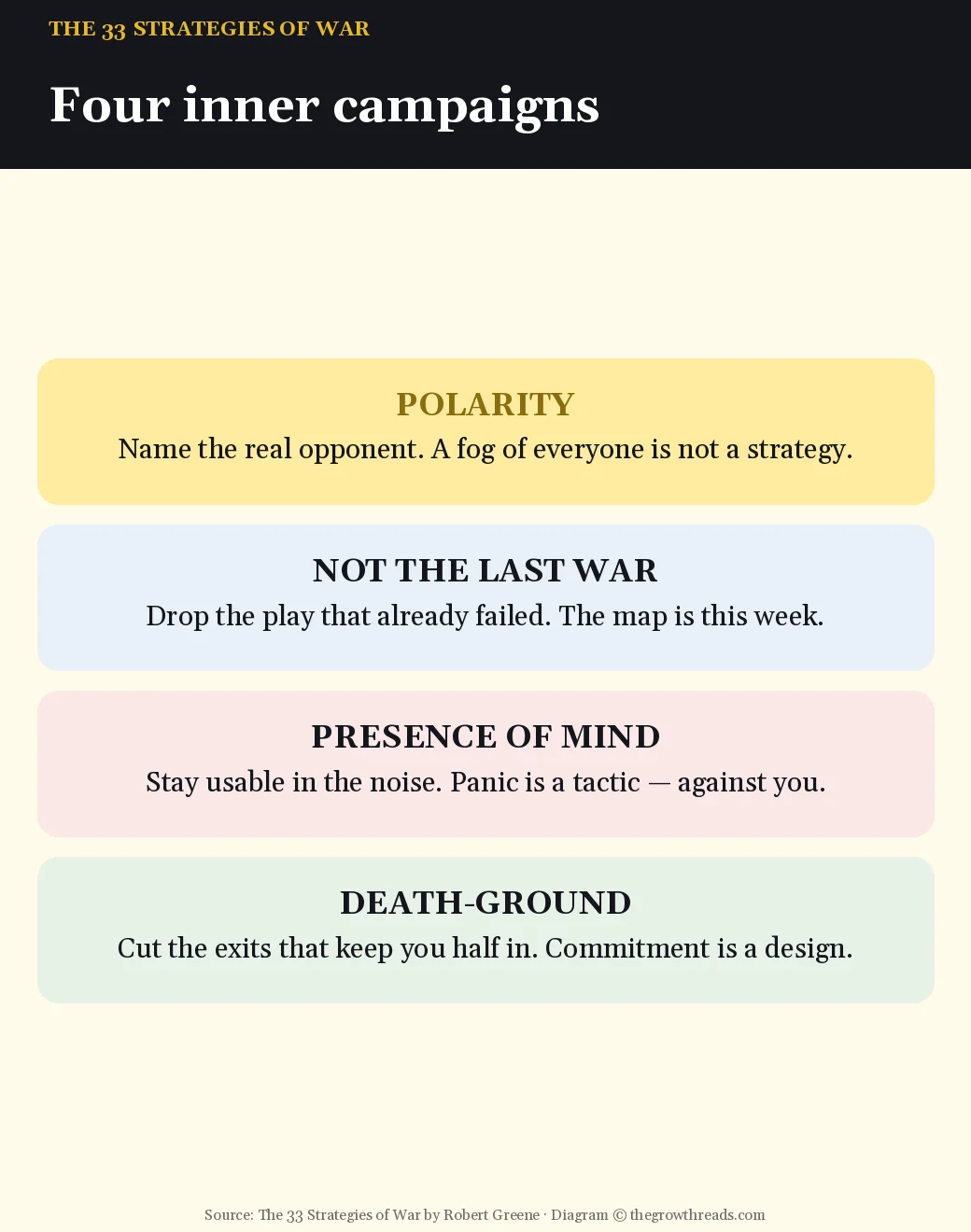
Death-ground (strategy 4) is the most stolen idea in the book and the most often faked. Greene’s version is not a motivational scream. It is the design of commitment. When retreat is cheap, you keep a second story ready: the soft launch, the “we were just exploring,” the calendar that never quite arrives. Close one door. A public draft. A date the customer can see. A room that will watch the result. Then do the work that only exists after that door is gone. A calendar full of fake red is not death-ground. It is noise wearing a costume.
TGR Note: Greene’s court book is The 48 Laws of Power — rooms, reputation, restraint. Holiday’s Ego Is the Enemy is the inner opponent when polarity turns into a grudge. This book is the campaign layer: time horizon and force, not a new personality.
Part 2: Organizational warfare — a crew that can move
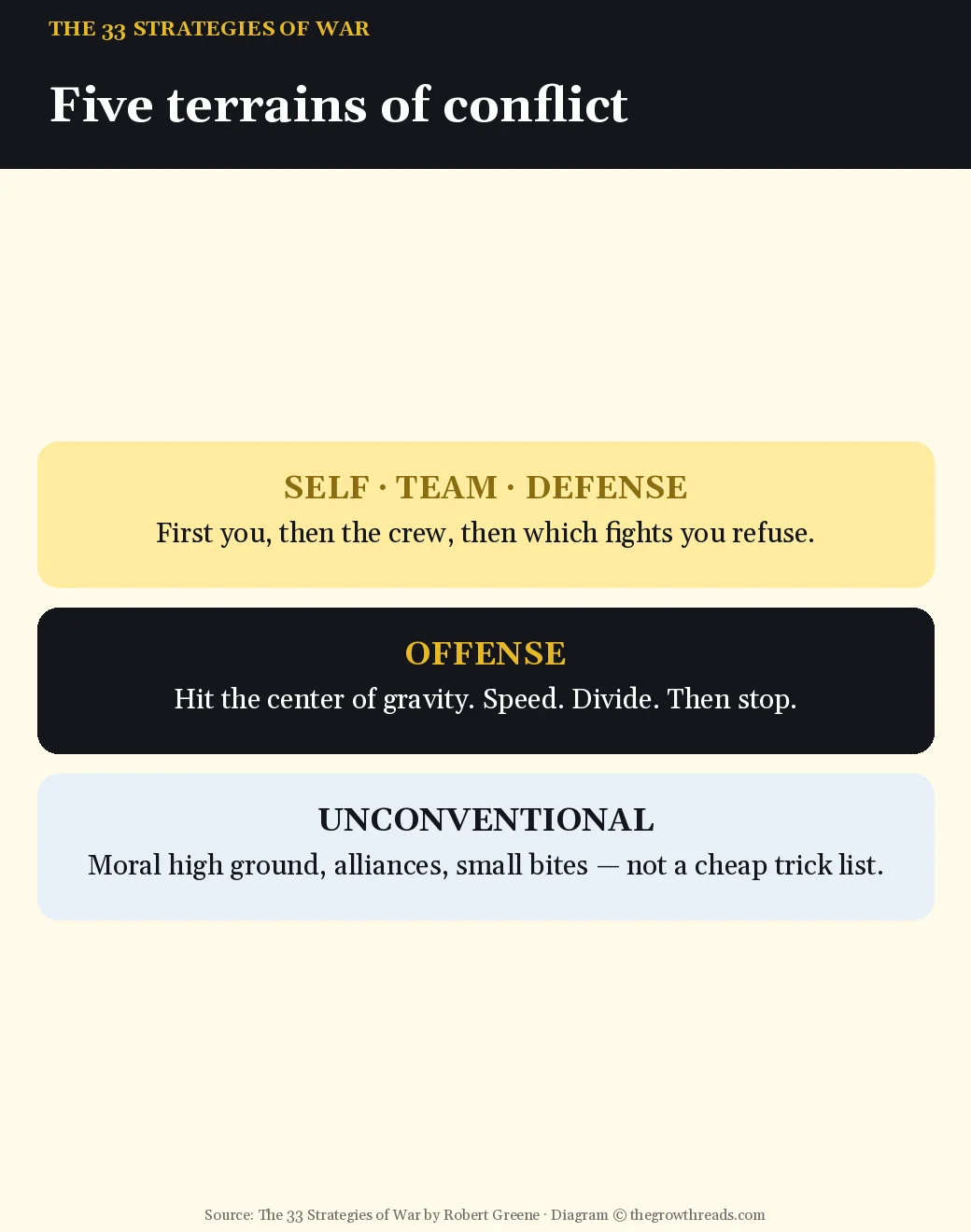
Part II is short and easy to skip if you lead a “team” that is actually a meeting. Strategy 5 is command-and-control without the cartoon. Groupthink feels like alignment. Greene wants a mind at the center that still lets the edges see. If every decision waits for the all-hands, you do not have a crew. You have an audience. Segment your forces (strategy 6): give a slice of the work a captain and a finish line. Controlled chaos is not sloppiness. It is smaller wars that can finish.
Strategy 7 is morale — transform the work into a crusade people can join without lying. A slogan nobody would stay late for is not a crusade. A picture of the customer who is stuck, plus a move they will feel this month, is. Your translation is smaller: one sentence the crew can repeat that is true on a bad Wednesday. If they can only recite the values slide, you have compliance, not morale.
TGR Note: Willink in Extreme Ownership wants the miss owned in the open. Lencioni in The Five Dysfunctions of a Team wants trust before tactics. Greene adds the map those newly honest people still need: who is the opponent, and who captains which slice.
Part 3: Defensive warfare — the battles you refuse
Defense in this book is not hiding. It is economy. Strategy 8 — pick your battles carefully — is the sentence most readers already believe and do not practice. Every thread can be won. Winning them all is how you lose the quarter. Greene’s “perfect economy” is a budget of attention. If a fight does not move the hinge, you can be right and still be wasteful. Write the fights you will not enter this week. Put them where the crew can see them. Silence is a strategy when it is chosen.
The rest of the defensive set is how you stay in the game without becoming the event. Turn the tables (strategy 9): let the other side spend first, then hit the overreach. Create a threatening presence (strategy 10): deterrence is being ready in public so you do not have to fire. Trade space for time (strategy 11): give up a meeting, a feature, a corridor of the market if it buys you the week you actually need. Nonengagement is not fear. It is refusing to let someone else pick the ground. Greene’s addition is the modern calendar — the way a Slack storm tries to choose the ground for you.
TGR Note: The Art of War is the shortest classic of positioning. Clausewitz in On War wants the political object named before the tactics. Greene is the operator expansion: the same economy, written for a product meeting and a career fight, not a staff college.
Part 4: Offensive warfare — hit the hinge, then stop
Offense starts with the title strategy of the whole book: lose battles but win the war (strategy 12). Grand strategy is the whole campaign, including the peace after it. A skirmish win that creates three new enemies is a loss with a trophy. Know the enemy (strategy 13) is not stalking. It is intelligence — what they actually protect, what they will abandon, where they are already tired. Overwhelm with speed (strategy 14) only after that picture is clear. A fast move on the wrong hinge is just last-war thinking with a louder clock.
Control the dynamic (strategy 15) means you pick the tempo. Hit the center of gravity (strategy 16): the one customer, decision, or bottleneck that makes the other fronts cheaper. Defeat them in detail (strategy 17): one stack at a time, not a heroic pile-on. The flanking and enveloping plays (18–20) are the same idea in space — do not charge the wall they prepared. Negotiate while advancing (strategy 21) is the grown-up version of “talk and ship.” Then strategy 22, the one ambitious teams skip: know how to end things. An exit is not quitting. It is the definition of done so victory does not become a new last war.
Part V, unconventional warfare, is the chapter people quote and the one to handle with a shorter leash. Misperception, moral high ground, alliances, small bites, and the inner front are real tools. They are also easy to turn into office theater. Greene’s useful residue here is not a dirty-trick list. It is this: occupy ground that is actually righteous, take the bite you can keep, and do not become the chaos you were trying to use. Stay in the first four terrains until the campaign has a name, a hinge, and an exit.
TGR Note: Machiavelli’s The Prince is the cold classroom of holding a seat. Musashi’s The Book of Five Rings is timing against a favorite weapon. Greene’s offensive set is the weekly translation: hinge, speed, divide, stop. Mastery, his later book, is the long apprenticeship — Mastery if the fight is a craft, not a quarter.
Who is The 33 Strategies of War best for — and who should read something else first?
Best for: founders, operators, and department leads who already have a live conflict — a rival, a stuck launch, a political room — and can stand to see it as a campaign. If you can write the opponent in one sentence and retire one last-war play, you get the book.
Read something else first: The Art of War if you want the shortest classic. Extreme Ownership if the miss still has no owner. The Fifth Discipline if the fire is a loop, not an opponent. The 48 Laws of Power if the problem is a court, not a campaign. The First 90 Days if you are new in the seat. The 33 Strategies of War assumes you already have something to aim at.
Questions to reflect on
- Who is the opponent in one sentence — not “the market,” the specific resistance?
- Which last-war play am I still running because it once worked?
- Where do I still have a polite exit that keeps me half in?
- What is the center of gravity this month, and which fights are not it?
- If we won on Friday, what would “ended” look like — and who would we stop fighting?
🔥 Ready to stop fighting the last war?
Get The 33 Strategies of War and run one live conflict as a campaign this week.
How to apply The 33 Strategies of War (7-day plan)
- Day 1 — Name the opponent. One sentence. A rival, a committee, a habit. Not “everything.”
- Day 2 — Retire the last-war play. Write the move you keep repeating. Do not run it for seven days.
- Day 3 — Design a small death-ground. A date and a visible draft. One door closed.
- Day 4 — Segment the crew. One captain, one slice, one finish line. No fog of “we.”
- Day 5 — Refuse one fight. A thread or meeting that is not the hinge. Let it go in writing.
- Day 6 — Strike the center of gravity. The customer, decision, or bottleneck. One move, shipped.
- Day 7 — Write the exit. What “ended” looks like. Who you stop fighting. Schedule the next campaign, not a trophy lap.
Frequently asked questions
What is The 33 Strategies of War about?
The 33 Strategies of War is Robert Greene’s 2006 field guide to conflict at work, in a market, and inside your own head. After The 48 Laws of Power and The Art of Seduction, he grouped thirty-three strategies into five terrains: self, team, defense, offense, and unconventional war. The claim is not that every Tuesday is a battlefield poster. It is that most people fight the “last war,” spend force on the wrong front, and never name an exit. Read it to pick one live conflict, find its center of gravity, and stop treating every skirmish as the campaign.
What are the 33 strategies in The 33 Strategies of War?
Greene does not ask you to memorize a numbered poster. He walks five terrains. Self-directed warfare is polarity, not fighting the last war, presence of mind, and death-ground. Organizational warfare is command that still thinks, segmented force, and a crusade people can actually join. Defensive warfare is economy — pick the battle, counterattack, deter, trade space for time. Offensive warfare is grand strategy, intelligence, speed, the center of gravity, divide-and-conquer, and a clean exit. Unconventional warfare is perception, moral high ground, alliances, and small bites. Use the terrain that matches this week’s fight, not all thirty-three at once.
What is the death-ground strategy?
Death-ground is Greene’s name for cutting the exits that keep you half in. When retreat is cheap, energy leaks into options, backups, and a story you can tell if the work fails. When the boat is burned — a ship date, a public draft, a room that will see the result — attention concentrates. The point is not melodrama. It is design. Pick one commitment that removes the polite escape, then do the work that only becomes possible after that door is gone. Pair it with presence of mind so urgency does not become panic. A fake death-ground (a calendar full of red) is just noise.
Who is Robert Greene?
Robert Greene is an American writer of strategy, power, and human nature. He studied classical studies at UC Berkeley and the University of Wisconsin–Madison, then spent years in New York magazines and Hollywood development before meeting book packager Joost Elffers. The 48 Laws of Power (1998) set the method: a historical case, a blunt law, a modern translation. The Art of Seduction followed in 2001. The 33 Strategies of War (2006) is the campaign book. He later wrote The 50th Law with 50 Cent, Mastery, The Laws of Human Nature, and The Daily Laws. The usable stance: see the conflict clearly before you pick a tactic.
Is The 33 Strategies of War still relevant in 2026?
Yes, if you read it as a campaign checklist rather than a license to treat colleagues as enemies. Remote tools made last-war thinking cheaper: the same deck, the same escalation, a louder thread. Greene’s useful residue did not age. Name the real opponent. Drop the play that already failed. Keep your mind when the room heats up. Spend force on the hinge, not every front. End the fight you actually won. Some of the unconventional chapters are easy to misuse; keep those in the FAQ drawer and practice the first four terrains on a live project. The calendar still rewards people who think past the next ping.
How is The 33 Strategies of War different from The Art of War and The 48 Laws of Power?
Sun Tzu’s The Art of War is a short classic of positioning, deception, and winning without a wasted battle. Greene quotes that tradition, then writes a modern operator’s expansion with stories from Napoleon to Hollywood. The 48 Laws of Power is a court book — how power is gained, displayed, and lost in rooms. The 33 Strategies of War is the campaign book: time horizon, force, morale, and the exit. If you only want court craft, start with the 48 Laws. If you want a week you can run, start here. If you want the shortest military classic, read Sun Tzu first, then come back for Greene’s five terrains.
How do I apply The 33 Strategies of War at work this week?
Pick one live conflict, not the company. Write the opponent in one sentence — a rival product, a stuck committee, a habit of yours. Name the last-war play you keep repeating and retire it for seven days. Put yourself on a small death-ground: a date and a visible draft. Ask who actually owns the next move so the crew is not a fog. Refuse one fight that is not the center of gravity. Then strike the hinge — the customer, the decision, the bottleneck — and write the exit before you start. You do not need thirty-three tactics. You need one campaign you will still recognize on Friday.
Related summaries
- The Art of War — the shortest classic of positioning; Greene is the expansion pack.
- On War — name the political object first, then pick a tactic.
- The Prince — how a seat is held; this book is how a campaign is run.
- Extreme Ownership — own the miss, then aim the force.
Browse every title in our Best Leadership Books pillar page.
How we analyze books: our summaries are built from a full read of the source text, cross-referenced against the author’s published interviews and research where relevant, and structured around practical application rather than critique. We disclose our editorial process and affiliate relationships in full. Read our full methodology.