

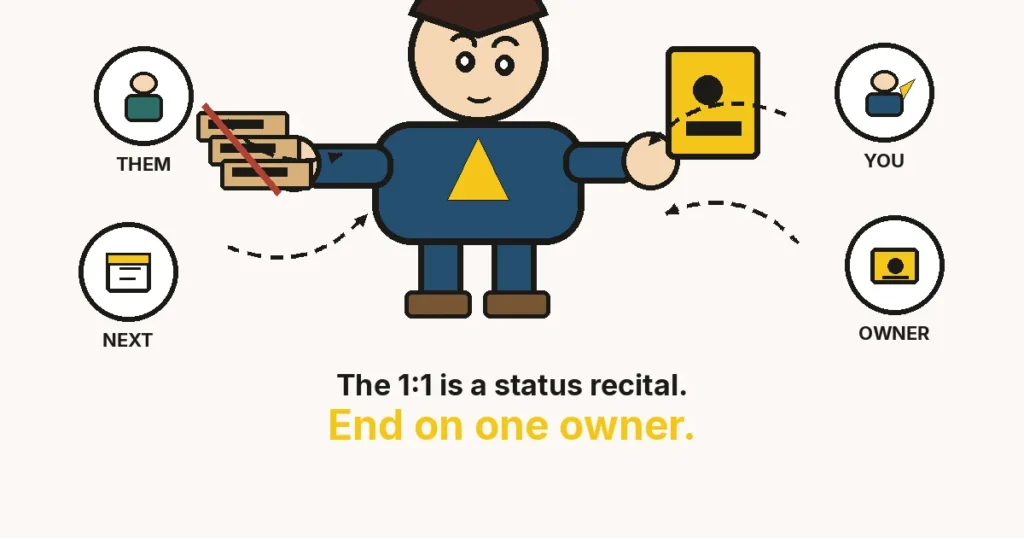
The 1:1 is a status recital when the half hour only retells work that already happened. Give the other person the first ten minutes, take the next ten, and keep the last ten for what comes next. Close on one decision and one owner. Put the status in a note before you sit down.
Key takeaways
- The 1:1 is a status recital when the meeting only retells finished work, and nobody leaves owning a decision.
- Manager Tools’ 2005 one-on-one sheet says the meeting is regularly scheduled, rarely missed, and the primary focus is the team member.
- That sheet sets the length at 30 minutes: 10 minutes for them, 10 minutes for you, and 10 minutes for development.
- The 2023 second edition of The Effective Manager lists a weekly 30-minute one-on-one in which the direct’s issues are primary and the manager takes notes.
- Before you stand up, name one decision and one owner. The sheet’s own close is a dated commitment and a question about what you owe, and by when.
What a status recital actually is
The 1:1 is a status recital when the only thing that happens is a reading of work that already happened. You are a new manager, so the half hour is on the calendar with each person who reports to you. You are a solo founder, so the half hour is with the first hire or the contractor who does the work beside you. Either way the meeting has a shape you did not choose. They open a list. They walk the tasks. You nod. You both stand up holding the same list you walked in with. Nothing was decided, and nobody’s name is on a next step, because the next step was never the point. The point was to be heard reporting.
A status note is useful. A meeting that only reads the note is not. The cut for this week is narrower than a new management system. Three blocks of ten minutes. A note that carries the report so the room does not. One decision, and one owner, before anyone stands up.
Why the half hour has three blocks
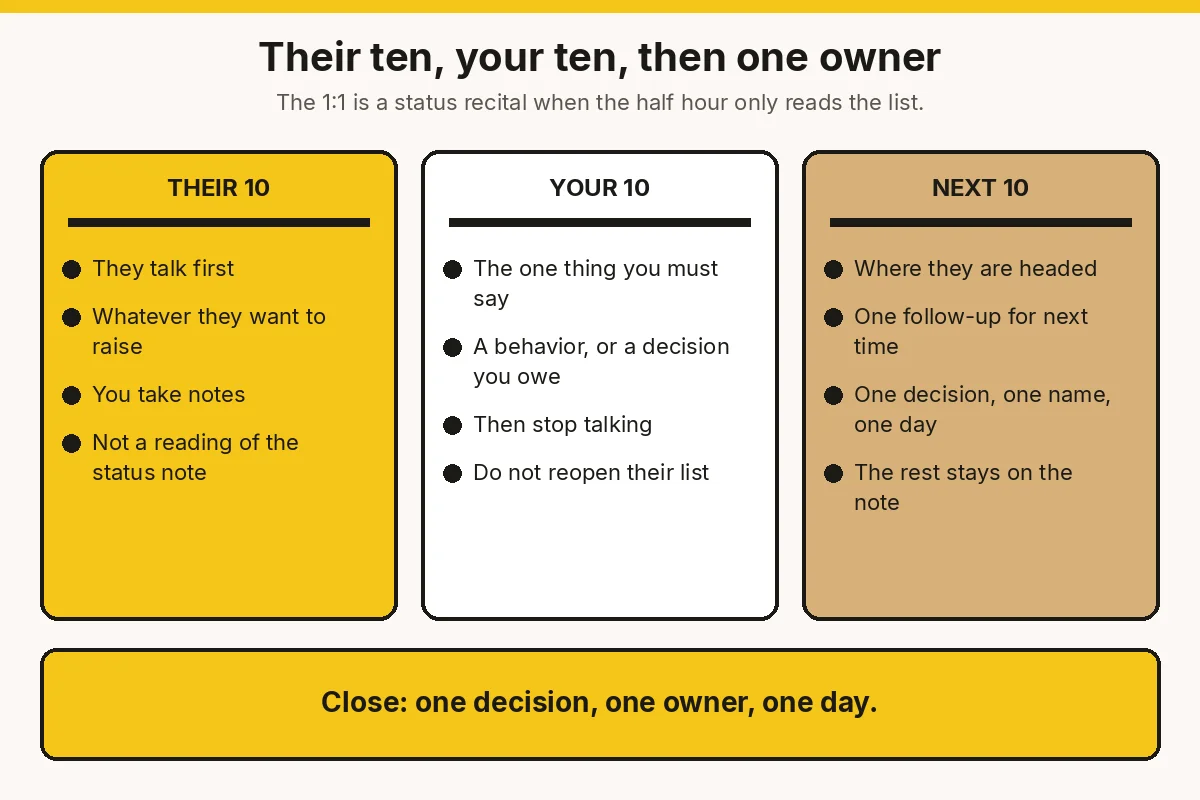
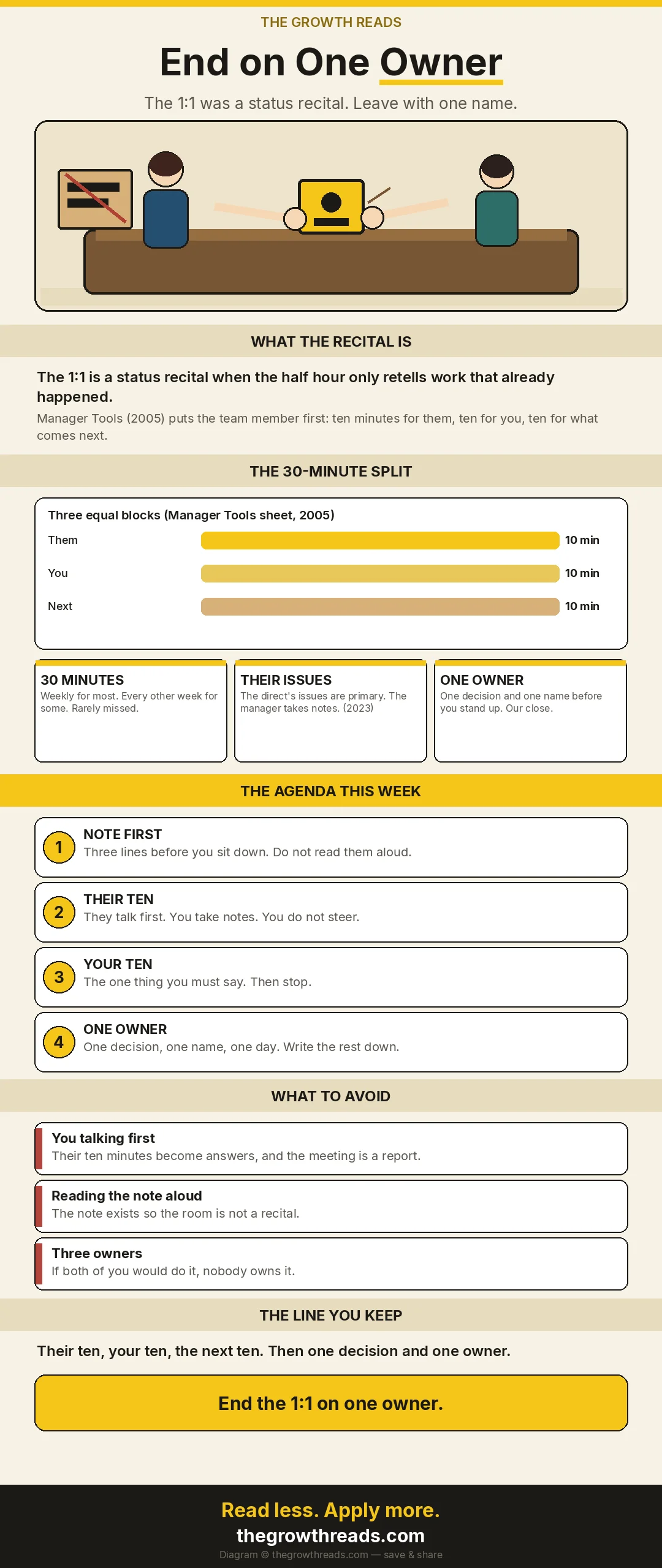
The meeting already has a structure. A status recital is what you get when you delete the first block and the last one. Manager Tools published a one-page sheet in 2005, “The Basics of Effective One-on-Ones.” It says the meeting is regularly scheduled, rarely missed, and the primary focus is the team member. For most managers it is weekly with each team member. For some it is bi-weekly. The length on the sheet is 30 minutes, split into 10 minutes for them, 10 minutes for you, and 10 minutes for development. Notes and follow-up are marked critical. The tracking form on the second page has three writing blocks: what you heard in their ten minutes, what you prepared for your ten minutes, and a future and follow-up block for where they are headed and what you will review next time.
The book that carries this system is The Effective Manager, second edition, by Mark Horstman, Kate Braun, and Sarah Sentes (Wiley, May 2023). Harvard.com lists the hardcover as 9 May 2023, ISBN 9781394181612, 240 pages. Wiley’s product page lists the same edition, May 2023, 240 pages. The table of contents on O’Reilly, which we read, titles chapter 4 “Get to Know Your People—One on Ones” and lists these lines under it: scheduled, weekly, 30 minutes, with each of your directs, where the direct’s issues are primary, and the manager takes notes. A later chapter heading says to send an invitation and to review the intent, the ground rules, and the agenda. We did not read a numbered page of the book, and this article does not invent one.
The 10-minute split is the 2005 sheet. The weekly 30-minute meeting, with the direct’s issues primary and the manager taking notes, is the 2023 contents. They agree on the part a status recital throws away: the other person goes first, and the meeting is not a report you extract.
Their ten, your ten, and one owner
Their ten minutes are whatever they want to talk about. Your ten minutes are the one thing you must say. The last ten minutes end when one decision has one name. The sheet’s question list includes status questions, including “Would you update me on Project X?” and “Are you on track to meet the deadline?” So a project check can live inside their ten minutes. It is one question. It is not the agenda. If the whole half hour is that question repeated down a list, you are back in the recital, and the development block on the sheet never starts.
| What the half hour is doing | Whose ten minutes | What you do with status | How it ends |
|---|---|---|---|
| They talk first, about whatever they brought | Theirs. You take notes. | Already read, in the note they sent. You do not read it aloud. | Not yet. You still have your ten, and the close. |
| You say the one thing you owe them | Yours. Then you stop. | You do not reopen the list to look busy. | Not yet, unless that one thing is the decision. |
| Where they are headed, and the follow-up | The last ten. Development, then the close. | A stuck project can be the decision. The rest of the list waits. | One decision, one owner, one day. |
| A tour of everything that moved this week | Nobody’s. It is a recital. | The meeting is the note. | No owner. Same list on the way out. |
The sheet’s tracking form has room for more than one follow-up. This article’s close is stricter than the form, and it is ours, not a line we found in the book: before you stand up, one decision has one owner. The other follow-ups are written down for the next meeting. They do not each get a speech. If you and they would both “just handle it,” it is not owned. Put one name on it, or it returns next week as another item in the recital.
Two questions already on the 2005 sheet are the shape of that close. “So, you’re going to do X by Tuesday, right?” And, “Is there anything I need to do, and if so by when?” The sentences in the next section use those two questions. They are not a quotation. If the decision is theirs, their name is the owner. If the decision is a thing only you can unblock, your name is the owner. One of those, not both, and not neither.
The agenda you send
Send the agenda once, and send the status note every time. Do not invent the agenda while they are reading a list at you. The 2023 contents say to send an invitation and to review the intent, the ground rules, and the agenda. They do not print the email on the contents page, so the wording below is this article’s. Leave the shape. Replace the brackets.
The invitation, once
Our one-on-one is 30 minutes, [weekly or every other week]. You have the first ten minutes, for whatever you want to raise. I take the next ten. The last ten is what comes next. We will end with one decision and one owner.
The note, before you sit down
Before we meet, send three lines: what moved, what is stuck, and what you need from me. I will read them. We will not read them aloud.
The close, out loud
So you are going to [the decision] by [day]. You own it. I will [the one thing I owe] by [day], or I owe nothing on this one. Everything else goes on the follow-up note.
Then stop talking. A second paragraph that adds “and we’ll stay on top of the rest of the list” puts the recital back in the room. If you are a new manager, a report can write the three lines. They do not pick a second decision, and they do not turn the close into a comment about the person’s character. That is a different conversation, and it has its own script in feedback that names the behavior. Your ten minutes can hold one piece of that. It cannot hold a label.
The decision in the close is still yours to require, in the same way the call you do not hand off stays with you. They can draft the note. They do not decide that the meeting is a status reading.
How to run this week’s 1:1
Do this before the next half hour, including if one is already on today’s calendar. Six moves. None of them is a new tool.
- Put 30 minutes on the calendar with the person, if it is not already there. Weekly if you are a new manager with directs. The 2005 sheet says some managers use every other week. Pick one, and rarely miss it. The sheet’s words are “rarely missed.”
- Ask for the three-line note before the meeting. Read it. Do not put it on a shared screen.
- They talk first, for about ten minutes, about whatever they want. Take notes. Do not steer them back to the note. A single project question is allowed. A tour of the list is not.
- Use your ten minutes for the one thing you must say: a behavior and its effect, an assignment, or a decision you owe. Then stop. The 2023 contents say not to rush into feedback when you are starting these meetings. If you are in week one of the habit, your ten minutes can be a question, not a verdict.
- In the last ten minutes, ask where they are headed, then say the close. One decision, one owner, one day. Write any other follow-up in the note you will open before the next meeting. The sheet says notes and follow-up are critical.
- If you erased the meeting, put it back this week. A missed one-on-one does not get replaced by a chat thread. The thread is how the recital learned to live outside the calendar.
The sheet also says the meeting is not in public. An office with the door closed, or a desk with some care if you do not have an office. A standup in front of the team is a different meeting. Do not launder a status recital by calling the standup a one-on-one.
When it is you and one other person
A solo founder uses this agenda with the one person who does the work with them. A client call is a different meeting. The sources say “team member” and “direct.” They do not describe a one-on-one with yourself, and they do not describe a sales call. If the other person is your first hire, give them this agenda in week one, before they learn that time with you means reading the task list back. If the other person is a contractor you already meet every week, replace the recital with the three blocks. You do not need a department.
If the person across from you is a client, stop. A client who wants more than the price is a scope conversation, and it has its own sentence in what the price covers. Do not spend their call on a development block, and do not spend your hire’s one-on-one negotiating a change order. If nobody reports to you yet, do not invent a meeting. The first time there is a person, this is the agenda. Until then, the urgent pile is a different cut, the one in a week where everything is marked urgent.
Common mistakes
- You talk first. The sheet puts their ten minutes first, and the 2023 contents say the direct’s issues are primary. Your update, however urgent it feels, turns their time into answers.
- The status note becomes the script. The note exists so you do not read it aloud. If you share the screen and walk the three lines, you rebuilt the recital with cleaner stationery.
- Three decisions, no owner. The form can hold several follow-ups. The room still names one decision and one name. “We’ll both keep an eye on it” is how it returns next week.
- Skipping it because you already chat. The sheet says good managers rarely miss the meeting. A Slack thread is not the ten minutes, and it does not take the notes.
- A personality comment in your ten minutes. Say the behavior and the effect, then stop, as in the feedback script. “You are not strategic” is not an agenda item.
- No notes. The sheet says notes and follow-up are critical, and the 2023 contents list “The Manager Takes Notes.” Without the note, the next meeting starts from memory, which remembers the loudest status and forgets the owner.
- Using a priority sort as a substitute. The time-management matrix and ABCDE can order a week. Neither one is a one-on-one, and neither one names the owner in the room.
What the sources do and do not say
The sheet gives you the 30 minutes and the three blocks. The 2023 contents give you the weekly meeting where their issues come first. Neither source gives you this article’s one-owner sentence. We checked the 2005 PDF on manager-tools.com and the O’Reilly table of contents for the second edition. We checked the edition against Wiley’s product page and the Harvard.com listing. We did not invent a page number, a sample size, or a success rate. The publisher’s description says the authors offer advice that has been used over many years. That is marketing copy. We did not read a data note inside the book, and we are not going to quote a number we did not see.
| Source | What it is | What we took | What it does not show |
|---|---|---|---|
| Manager Tools, “The Basics of Effective One-on-Ones,” 2005 PDF, manager-tools.com. Two pages. No study. | The organisation’s own sheet for the meeting: schedule, length, the three blocks, notes, and a list of questions. | Regularly scheduled, rarely missed, primary focus on the team member. Weekly for most, bi-weekly for some. 30 minutes: 10 for them, 10 for you, 10 for development. Notes and follow-up are critical. Not in public. The close questions: you are going to do X by a named day, and do you owe anything, by when. | The three-line status note. The rule that the room names only one decision. A promise that 30 minutes fixes a broken week. Those are this article, or they are outside the sheet. |
| Mark Horstman, Kate Braun, and Sarah Sentes, The Effective Manager, 2nd edition, Wiley, May 2023. ISBN 9781394181612, as listed by Harvard.com (hardcover, 9 May 2023, 240 pages) and by the Wiley product path. Contents read on O’Reilly. No page numbers. | A management book. Chapter 4 is the one-on-one. Later chapters are feedback, coaching, and delegation. Not a study we read. | Scheduled, weekly, 30 minutes, with each direct. The direct’s issues are primary. The manager takes notes. Send an invitation. Review the intent, the ground rules, and the agenda. Do not rush to feedback. Pushback the contents name, and do not answer for us: “It’s micromanaging,” and “I’m too busy.” | The 10/10/10 split, which we took from the 2005 sheet rather than from a page of this edition. The wording of the invitation. Any statistic. The one-owner close. |
Limit: a weekly 30-minute meeting is the plan those sources describe for a manager and a direct. If you have one contractor and the work is quiet, the sheet itself allows every other week. If the only urgency in the half hour is a real break, payroll or a client who is down, handle the break and put the meeting back the same week. A list that feels hot is not a reason to turn the half hour back into a reading. The one-owner close will not tell you which of those you are holding. You still have to tell them apart before you erase the agenda.
Frequently asked questions
What do you do when the 1:1 is a status recital?
The 1:1 is a status recital when the half hour only retells work that already happened. Ask for that report in a three-line note before you sit down, and do not read the note aloud. Give the other person the first ten minutes, take the next ten, and keep the last ten for what comes next. That split is the Manager Tools sheet from 2005. Before you stand up, name one decision and one owner. If you leave holding the same list, the next meeting will be the same reading.
How long should a one-on-one be, and how often?
The 2005 Manager Tools sheet sets the meeting at 30 minutes. For most managers it is weekly with each team member, and for some it is every other week. The sheet says good managers rarely miss them. The 2023 contents of The Effective Manager describe it as scheduled, weekly, and 30 minutes, with each direct, where that person’s issues are primary. A short tour of tasks is not that meeting. If you cannot find 30 minutes, you do not have a one-on-one yet. Put the block on the calendar before you change the questions.
Who talks first in the one-on-one?
The other person talks first. The 2005 sheet says the primary focus is the team member, and the first ten minutes are for them. The 2023 contents say the direct’s issues are primary. They can raise the work, a worry, or the week, and you take notes. You do not open with your update, and you do not steer them back to the status note. If you talk first, their time becomes a string of answers, and the meeting is a report again. A project check can be one question. The sheet includes “Would you update me on Project X?” It does not make that question the whole half hour.
What should you say at the end of the 1:1?
Use two questions that are already on the 2005 sheet, then stop. “So, you’re going to do X by Tuesday, right?” And, “Is there anything I need to do, and if so by when?” This article’s application is one decision and one owner. If both of you would do it, it is not owned. If three things feel urgent, name the one that has to be true before the next meeting, and write the other two on the follow-up note. The sheet’s form can hold more than one item. The close in the room is still one name. Then stop talking.
What if you are a solo founder and not a manager of a team?
Use the same agenda with the one person who does the work with you, a first hire or a contractor you meet every week. The sources describe team members and directs. They do not describe a client call, and they do not describe a meeting with yourself. A client who wants more than the price is a scope conversation, not this half hour. If nobody reports to you yet, do not invent a one-on-one. When the first person starts, give them the three blocks before they learn that time with you is a status reading. You do not need a department for that.
Should you take notes in a one-on-one?
Yes. The 2005 sheet says notes and follow-up are critical, and the form has a block for what you will review next time. The 2023 contents list “The Manager Takes Notes,” and they also list pushback on note-taking. We have not read that section, so this article will not invent the book’s reply. The notes exist so the next meeting starts from the last follow-up, not from memory. If you take none, the recital comes back. Memory keeps the loudest update and drops the owner.
What if they say a weekly meeting is micromanaging?
The 2023 contents name “It’s micromanaging” and “I’m too busy” as common pushback. We have not read the book’s replies, and we will not invent them. What you can say from the 2005 sheet is the shape: their issues come first, it is 30 minutes, and the follow-up lives there so you are not chasing the same status all week. Then hold the meeting. The contents also say not to rush straight into feedback. A task recital does not answer the complaint. Their ten minutes, going first, is what makes the half hour theirs.
Where does feedback belong in the 1:1?
In your ten minutes, as one behavior and one effect, and then you stop. It does not replace their ten minutes, and it does not become a comment about their personality. The second edition has a later feedback chapter, and the contents say not to rush feedback while you are starting the meetings. If you are in the first weeks, your ten minutes can be a question. If the only thing you needed to say was a label, that is a different script. Name what they did, name the effect, and leave the rest of the half hour to the agenda.
Sources
- Manager Tools. (2005). The Basics of Effective One-on-Ones. Two-page sheet, manager-tools.com. States the schedule, the 30-minute length, the split of 10 minutes for them, 10 for you, and 10 for development, the note-taking form, and the question list, including the dated commitment and the question about what the manager owes. Manager Tools one-on-one basics (PDF). Not a study. No page numbers beyond the two sheets.
- Horstman, M., Braun, K., & Sentes, S. (2023). The Effective Manager: Completely Revised and Updated (2nd ed.). Wiley, May 2023. ISBN 9781394181612, as listed by Harvard.com for the hardcover dated 9 May 2023, 240 pages, and by the Wiley product page for the same edition. The one-on-one chapter headings were read on O’Reilly. No page numbers. We did not use the publisher’s marketing lines about data as findings.
Related reading on The Growth Reads
The decision next to this one
- You are the bottleneck — the agenda is a call you do not hand off
- The first hire’s week one — give them this half hour before a status habit forms
- Feedback that turns into a personality comment — the behavior, the effect, then stop
- Everything is marked urgent — a different cut, for the week rather than the half hour
- More than the price — a client call is scope, not this agenda
- The time-management matrix — a sort of the week, not a one-on-one
- The ABCDE method — a labelled list, not an owner in the room
Where this sits
How this article was researched
The three blocks are the 2005 Manager Tools one-on-one sheet, read as the PDF on manager-tools.com. The weekly 30-minute meeting, the direct’s issues first, and the manager’s notes are the chapter headings of The Effective Manager, second edition (Horstman, Braun, and Sentes, Wiley, May 2023), read on O’Reilly. The edition and ISBN were checked on Wiley’s product page and on Harvard.com. We did not read a numbered page, and we did not turn the publisher’s line about years of data into a finding. The three-line status note, and the close that allows only one decision and one owner, are our application for a solo founder or a new manager.
Limit: the sheet allows every other week for some managers. A solo founder with one person can use that cadence. A client call is out of scope. The book’s answers to “this is micromanaging” were not in the contents we read, so they are not in this article.
How we work: every article on The Growth Reads is built from sources we can check, and it is date-stamped when those sources change. Read our methodology.