

★★★★★ 4.6/5 — The team that sees the system stops fighting the same fire.
Best for: Founders, department heads, and ops leads who keep solving last quarter’s problem with a louder version of last quarter’s fix
Reading time: ~12 hrs for the 2006 Currency/Doubleday revised paperback (445–464 pages) · ~14 min for this guide
Difficulty to apply: The vocabulary is learnable in a week; the drill is mapping one fire as a loop, not finishing a systems certificate
The Fifth Discipline in one minute
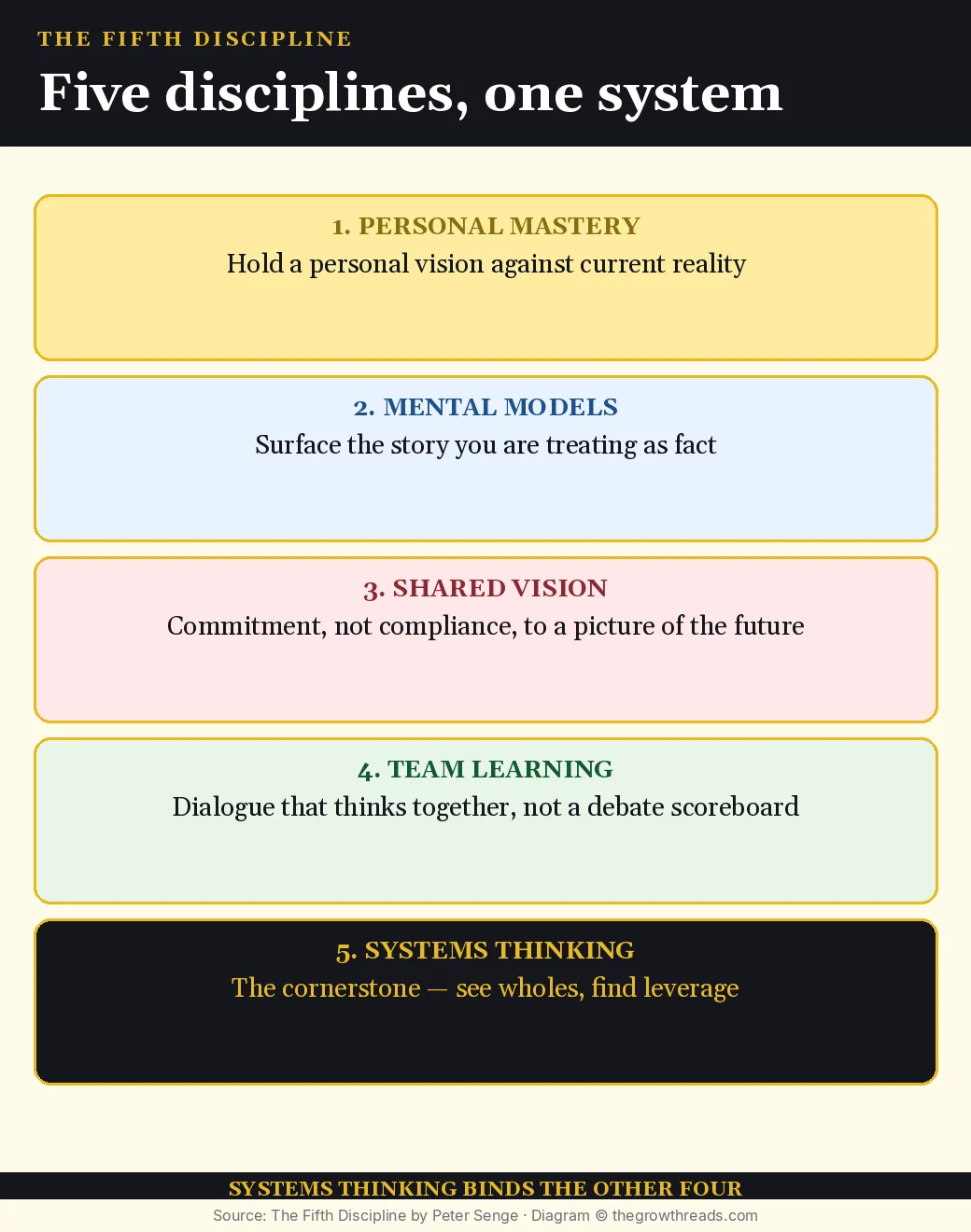
The Fifth Discipline is a field manual for teams that are busy, smart, and somehow still stuck. Peter Senge’s claim is not that you need a more inspiring offsite. It is that most organizations cannot learn. They treat this week’s crisis as unique, export the miss to “the enemy out there,” and call a louder push “taking charge.” Five disciplines reverse that: personal mastery, mental models, shared vision, team learning, and — the cornerstone — systems thinking. See wholes. Find the delay. Change the structure, not the heroics. Read it for the loop you will draw on Tuesday, not for a poster.
Key takeaways
- Systems thinking is the fifth discipline: The other four stay decorative until you can see wholes, delays, and leverage.
- Today’s problems come from yesterday’s “solutions”: The fix you shipped last quarter is often this week’s fire.
- Structure drives behavior: Smart people over-order when delays are invisible. The Beer Game is the proof.
- Creative tension is the engine: Hold a vision against current reality. Do not lower the vision to ease the feeling.
- Mental models run the shop: The ladder of inference turns a glance into a policy.
- Shared vision is commitment, not compliance: A slogan people recite is not a picture they would stay late for.
- Team learning is dialogue, not a scoreboard: Discussion picks a winner. Dialogue thinks together.
- The leader’s new work is designer, teacher, steward: Less heroic closer. More design that outlasts you.
- Leverage is usually unglamorous: Shorten a delay, stop a symptomatic fix, change a goal.
- There is no blame in a well-drawn loop: If you still need a villain, you have not finished the diagram.
What is The Fifth Discipline about?
The Fifth Discipline is Peter Senge’s 1990 handbook — revised in 2006 — for building a learning organization. It names five disciplines, puts systems thinking at the center, and shows how seven learning disabilities keep smart teams fighting the same fire.
About the author
Peter Senge (born 1947) is an American systems scientist and a senior lecturer at MIT Sloan. He trained as an aerospace engineer at Stanford, then took an M.S. in social systems modeling and a Ph.D. in management at MIT, in Jay Forrester’s system-dynamics tradition. The Fifth Discipline (1990, revised 2006) put “learning organization” into the operating vocabulary of managers tired of heroic change programs. He founded the Society for Organizational Learning and later helped start the Academy for Systems Change. He treats awareness — including a long meditation practice — as part of seeing the system, not a side hobby. The usable claim: the only durable advantage is learning faster than the problem is changing. Explore all Peter Senge book summaries →
Key concepts at a glance
| Concept | What it means | Use it when |
|---|---|---|
| Learning organization | People expand their capacity to create the results they truly want. | Busy, aligned on slides, still repeating last quarter. |
| Systems thinking | See wholes, delays, and leverage — the fifth discipline. | Every “root cause” is a person or this week’s event. |
| Personal mastery | Hold personal vision against current reality; keep creative tension. | The team lowered the bar so the feeling would stop. |
| Mental models | The unsaid story that governs what you can see. | The conclusion arrives before the data does. |
| Shared vision | Commitment to a picture of the future, not compliance. | People recite the values and cannot name the picture. |
| Team learning | Dialogue that thinks together; discussion that picks a winner. | The real meeting happens after the meeting. |
| Creative tension | The gap between vision and reality, used as energy. | You are about to shrink the vision to “be realistic.” |
| Leverage | A small, well-placed change beats a heroic push. | You are adding headcount to an unnamed delay. |
| Learning disabilities | Seven structural habits that keep smart people stuck. | The postmortem named a villain and kept the same fix. |
Part 1: The seven learning disabilities — why smart teams stay stuck
Senge opens with a lever long enough to move the world, then refuses the heroic reading. The point is seeing the system the lever sits in. Organizations have learning disabilities because the structure trains people to mis-see. “I am my position” shrinks identity to a job title. “The enemy is out there” exports the miss to a vendor or another floor. You cannot learn a loop you have already prosecuted.
The illusion of taking charge looks like leadership: push harder on the same lever and miss that the system is pushing back. The fixation on events treats this week’s fire as unique. The boiled-frog parable is slow drift nobody yells about. The delusion of learning from experience: the important consequences arrive after the people who made the decision have been promoted. The myth of the management team is looking aligned in the room and protecting turf in the hallway. Skilled incompetence is keeping a threatening topic off the table while sounding like a team.
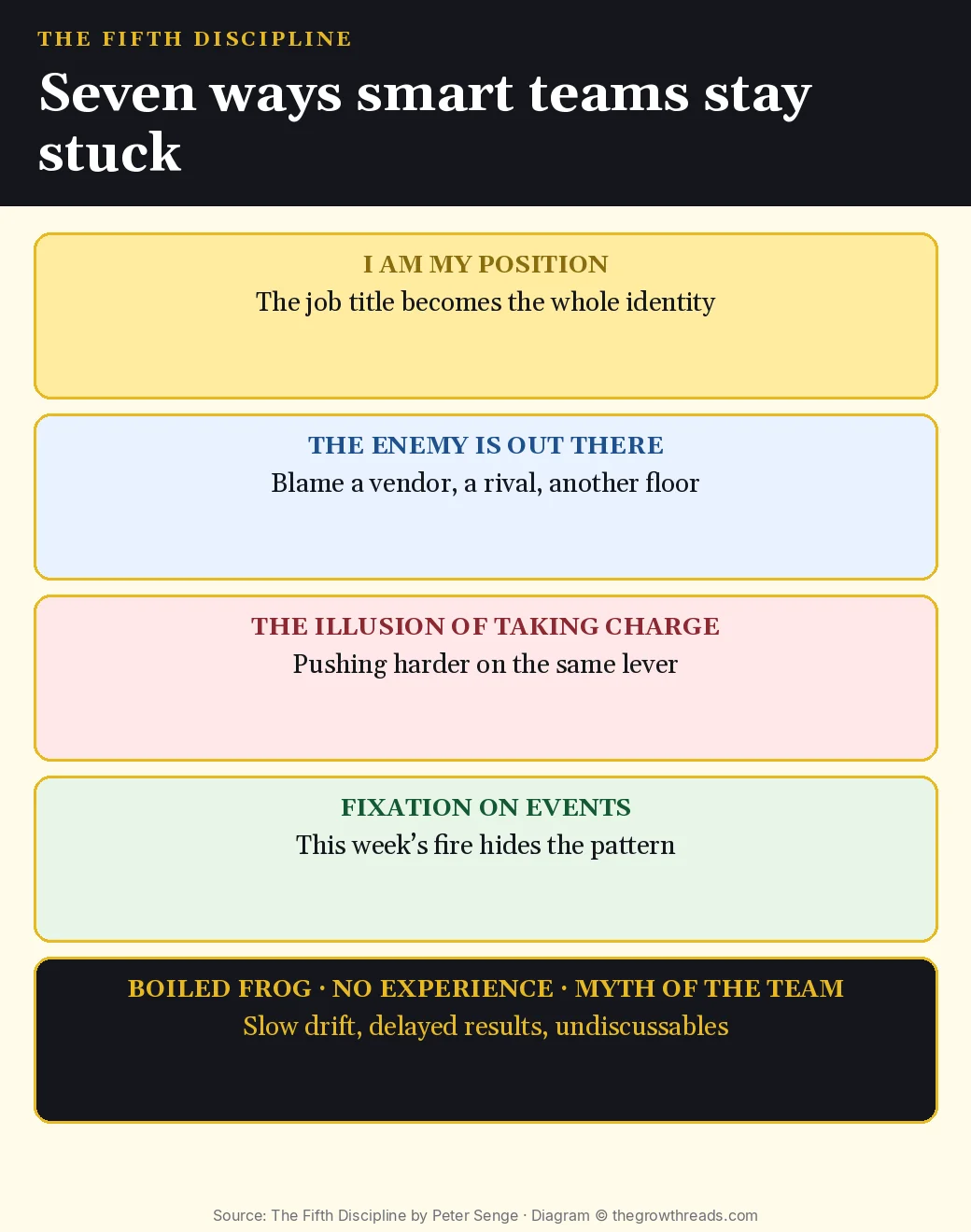
Translate the list onto this week. If the incident review always ends with a person, you are in “the enemy is out there.” If the same outage returns every quarter with a new ticket number, you are fixing events. If the real argument happens after the steering meeting, you are living the myth of the management team. You cannot practice systems thinking on a story that still needs a villain. Name the disability in one sentence, in the room that owns the work.
TGR Note: Goldratt’s The Goal finds the constraint. Donella Meadows in Thinking in Systems is the shorter primer. Senge is the leadership translation — the disabilities that keep a smart team from using either book.
Part 2: Systems thinking — the fifth discipline that holds the others
Part II is the title of the book. Systems thinking is a discipline for seeing wholes — interrelationships rather than things, patterns of change rather than snapshots. A few laws do most of the work. Today’s problems come from yesterday’s “solutions.” The harder you push, the harder the system pushes back. Behavior grows better before it grows worse — the lag that makes a bad fix look like a win. Faster is slower. The highest leverage is often the least obvious. There is no blame.
The Beer Game, run for years at MIT Sloan, is the demonstration. Players managing a simple beer supply chain produce wild swings in orders and inventory. They are not foolish. They cannot see the delays. Structure drives behavior. Draw the loop: reinforcing processes that compound, balancing processes that seek a goal, delays that make both lie to you in the short run. Archetypes name the loops: limits to growth, shifting the burden, eroding goals, fixes that fail. You need the one that matches the fire you already have.
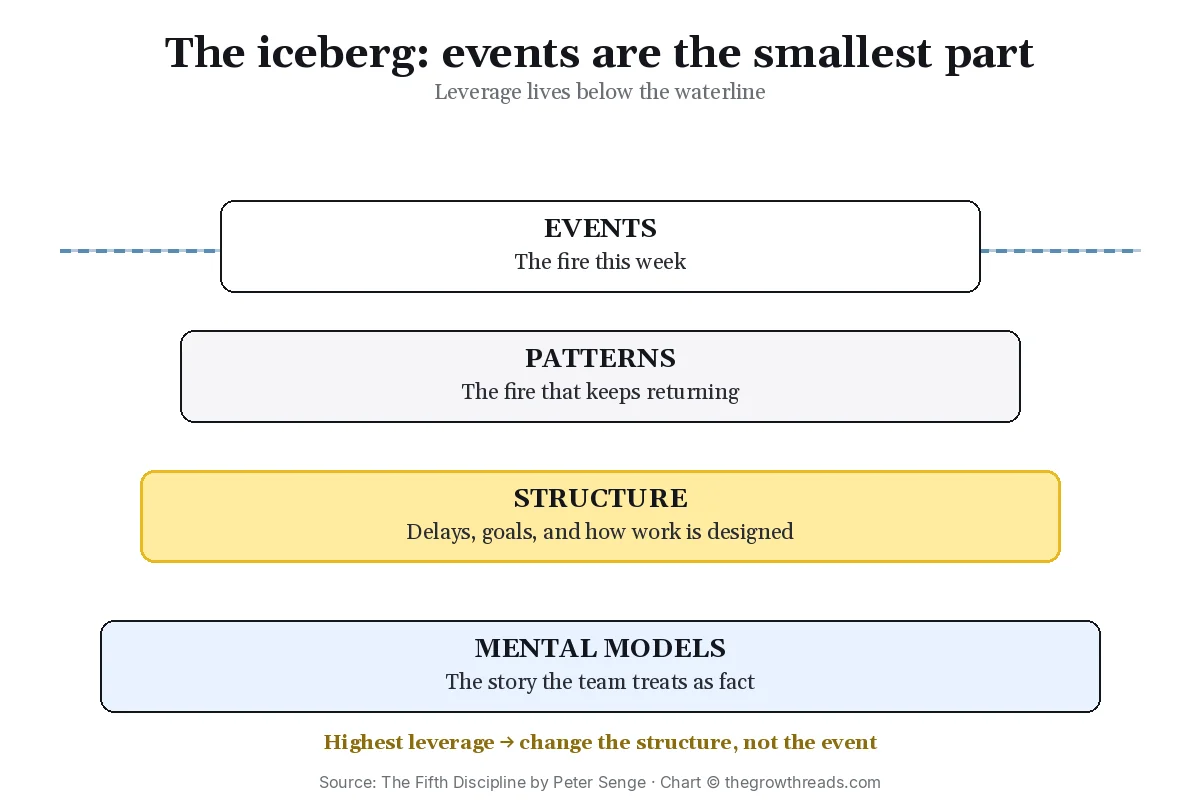
Leverage is the punchline. The obvious intervention — more people on the event, a louder target — is often the low-leverage push the system is designed to absorb. High leverage is unglamorous: shorten a delay, stop a symptomatic helper, raise a goal you have been quietly eroding. The iceberg is the picture. Events sit above the waterline. Structure and mental models sit underneath, which is where a small change actually moves the week.
TGR Note: Grove in High Output Management is the weekly OS. Christensen in The Innovator’s Dilemma is what happens when a well-run system cannot hear a small new loop. Senge is why a good weekly still fights the same fire if the structure is unnamed.
Part 3: Personal mastery, mental models, and shared vision
The other four disciplines are how a person stays in a system long enough to change it. Personal mastery is personal vision plus a commitment to current reality. Senge calls the gap creative tension. Emotional tension is the cheap cousin: you feel the gap, then you lower the vision so the feeling stops. Two columns on one page: the result we want, the result we have. Do not close the gap on the page. Use it.
Mental models are the stories that shape what you can see. The ladder of inference: data, added meaning, a conclusion, a belief, an action that then selects the next data. Two people in the same meeting climb different ladders. The left-hand column makes the climb visible — what you said versus what you thought. Advocacy without inquiry is a speech. Inquiry without advocacy is a dodge. You need both, in the room, on a live issue.
Shared vision is the discipline most abused by posters. Compliance is “I’ll do it because I have to.” Commitment is “I want this picture.” You cannot install a shared vision from the top the way you install a target. Offer a personal vision, ask who actually wants it, and build from the people who do. If the picture dies in a bad quarter, it was printed, not shared.
TGR Note: Sinek’s Start With Why is the enrollment speech. Primal Leadership is the climate that makes inquiry possible. Senge’s test: a vision you cannot put next to current reality is a feeling, not a discipline.
Part 4: Team learning and the leader’s new work
Team learning is alignment, not agreement. The skill is dialogue, in David Bohm’s sense: suspending assumptions so the group can think. Discussion is a ping-pong match that ends with a winner. You need both. Time-box it: twenty minutes of dialogue with no decision, then a close. If every conversation must produce an owner and a date, you will never hear the assumption running the week.
The 2006 revision is Senge after fifteen years of watching people try this at companies such as Intel, Ford, HP, and Unilever. The work is slower than a launch event and more durable than a slogan. Localness means decisions live where the work is. Microworlds are practice fields where you can see a delay without billing a customer for the lesson. If the calendar is only events, there is no room to see patterns.
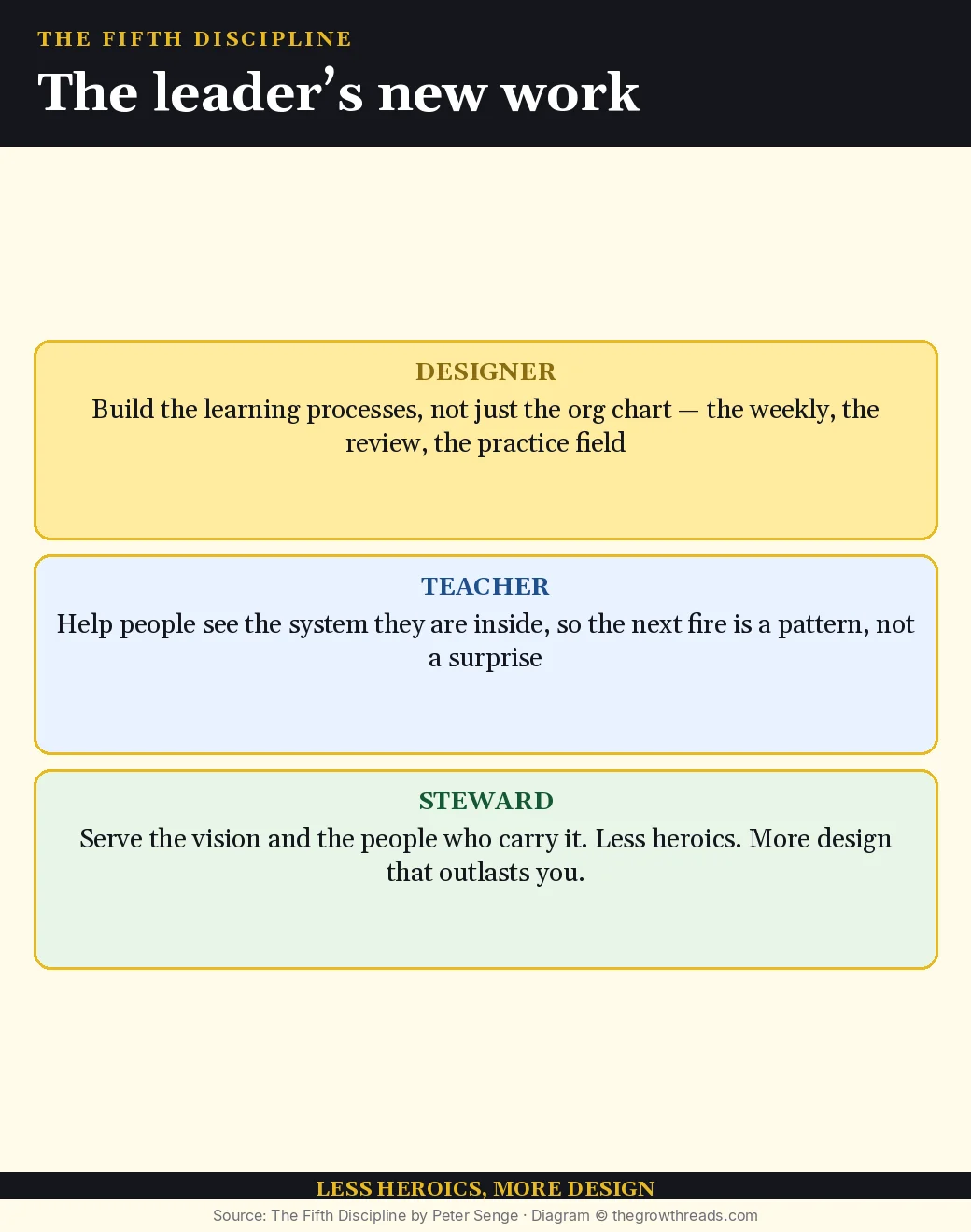
The leader’s new work is three roles. Designer: build the learning processes — the weekly, the review, the practice field — not just the org chart. Teacher: help people see the system they are inside. Steward: serve the vision and the people who carry it, which includes not making yourself the bottleneck. Less heroics. More design that outlasts you. If you cannot point to a process that still works when you are on leave, you have performed the book, not finished it.
TGR Note: Willink in Extreme Ownership wants the miss owned in the open. Lencioni in The Five Dysfunctions of a Team wants trust first. Marquet in Turn the Ship Around pushes intent down. Senge adds the diagram those newly empowered people are still inside.
Who is The Fifth Discipline best for — and who should read something else first?
Best for: founders, department heads, and ops leads who already have a shop and can name a fire that has returned at least twice. If you can hold a vision next to current reality without turning it into a pep talk, you get the book.
Read something else first: The First 90 Days if you are new in the seat. Extreme Ownership if the miss still has no owner. High Output Management for a weekly OS. Start With Why if there is no picture of success. Thinking in Systems for Meadows’ shorter primer. The Fifth Discipline assumes you already have something to redesign.
Questions to reflect on
- What fire has returned at least twice this year, and which learning disability keeps it nameless?
- Where are we pushing harder on a lever the system is designed to push back?
- What personal vision did we quietly lower so the feeling of the gap would stop?
- After the last steering meeting, what did people think that they did not say?
- Which of designer, teacher, and steward am I performing as heroics instead of as a process that works when I am gone?
🔥 Ready to stop fighting the same fire?
Get The Fifth Discipline and start treating this week’s crisis as a loop you can redesign.
How to apply The Fifth Discipline (7-day plan)
- Day 1 — Draw one fire as a loop. One recurring miss. Action, delay, result that comes back.
- Day 2 — Name the disability. One sentence from Senge’s seven, in the room that owns the work.
- Day 3 — Write creative tension. Vision for the outcome next to current reality. Do not close the gap on the page.
- Day 4 — Left-hand column. After one meeting, write what you said and what you thought.
- Day 5 — Test shared vision. Ask three people if they want the picture, not if they can recite it.
- Day 6 — Twenty minutes of dialogue. No decision at the end. Suspend one assumption in the open.
- Day 7 — Pick the unglamorous leverage. Shorten one delay or stop one symptomatic fix. Schedule the next loop.
Frequently asked questions
What is The Fifth Discipline about?
The Fifth Discipline is Peter Senge’s handbook for building a learning organization — a shop that expands its capacity to create the results it actually wants. First published in 1990 and revised in 2006, it names five disciplines: personal mastery, mental models, shared vision, team learning, and systems thinking. The fifth is the cornerstone. Without it the other four stay as posters. The usable output is a loop you can draw on one recurring fire, plus a new job description for the leader as designer, teacher, and steward — not a culture campaign.
What are the five disciplines in The Fifth Discipline?
Personal mastery holds a personal vision against current reality so creative tension does the work. Mental models surfaces the story you treat as fact — the ladder of inference, the left-hand column. Shared vision is commitment to a picture of the future, not compliance with a slogan. Team learning is dialogue that thinks together, closer to David Bohm than to a debate. Systems thinking is the fifth: seeing wholes, delays, and leverage so the other four have somewhere to live. Practice all five. A vision without systems is a pep talk. A system without personal mastery is a diagram nobody owns.
What is systems thinking in The Fifth Discipline?
Systems thinking is a discipline for seeing interrelationships rather than things, and patterns of change rather than snapshots. Senge’s shortest laws do the teaching: today’s problems come from yesterday’s “solutions”; the harder you push, the harder the system pushes back; the highest leverage is often the least obvious. The iceberg is the picture: events above the water, patterns just below, structure and mental models underneath. Stop asking who caused this week’s fire. Ask which delay, goal, or story keeps lighting it. There is no blame in a well-drawn loop. There is a place to intervene.
Who is Peter Senge?
Peter Senge is an American systems scientist, a senior lecturer at MIT Sloan, and the author of The Fifth Discipline. He studied aerospace engineering at Stanford, then completed graduate work in social systems modeling and management at MIT, in Jay Forrester’s system-dynamics tradition. He founded the Society for Organizational Learning and later helped start the Academy for Systems Change. Harvard Business Review called the book one of the seminal management works of the previous seventy-five years. The operator takeaway is the vocabulary: learning disabilities, leverage, and the leader’s new work as designer, teacher, and steward.
What are the seven learning disabilities?
Senge names seven ways smart teams stay stuck. “I am my position” shrinks identity to a job title. “The enemy is out there” exports the miss to a vendor or another floor. The illusion of taking charge is pushing harder on the same lever. The fixation on events treats this week’s fire as unique. The boiled frog is slow drift. The delusion of learning from experience is that the real consequences arrive after the people who caused them have moved on. The myth of the management team is looking aligned in the room and fighting in the hallway. Name the disability before you buy a new tool.
Is The Fifth Discipline still relevant in 2026?
Yes, if you read it as a method rather than a 1990s culture slogan. The “learning organization” label got fuzzy after the book landed; some later writers used it as wallpaper. The usable core did not age: map a loop, find the delay, stop a fix that fails, practice dialogue instead of a hallway. The 2006 revision added practice from companies that had already tried the work. Pair it with Meadows’ Thinking in Systems, or with Grove’s High Output Management if you need a weekly OS. The fires it describes are still on the calendar.
How do I apply The Fifth Discipline at work this week?
Pick one recurring fire, not the company. Draw it as a loop: action, delay, result that comes back. Name the learning disability in one sentence. Write a personal vision next to current reality and sit in the gap. After one meeting, fill a left-hand column: what you thought versus what you said. Ask who is committed to the picture, not who nodded. Run twenty minutes of dialogue with no decision at the end. Then shorten one delay or stop one symptomatic fix. You do not need a transformation office. You need one loop you will redraw on Tuesday.
Related summaries
- High Output Management — the weekly OS that makes leverage a calendar, not a slogan.
- Good to Great — the research story of the leap; Senge is the loop underneath.
- Start With Why — the enrollment speech; Senge tests whether anyone is committed.
- Extreme Ownership — own the miss in the open, then draw the system it sits in.
Browse every title in our Best Leadership Books pillar page.
How we analyze books: our summaries are built from a full read of the source text, cross-referenced against the author’s published interviews and research where relevant, and structured around practical application rather than critique. We disclose our editorial process and affiliate relationships in full. Read our full methodology.