

⭐⭐⭐⭐ 4.2 / 5
One-liner: A Nobel laureate reveals how your daily habits shape your chromosomes — and how to slow biological aging from the inside out.
Best for: Health-conscious readers who want the hard science behind why lifestyle changes actually work at the cellular level.
Reading time: ~8 hours (396 pages)
Difficulty to apply: Low to moderate — the lifestyle changes are familiar, but understanding the science adds powerful motivation.
The Telomere Effect in one minute
Your chromosomes have a biological clock, and you can influence how fast it ticks. Elizabeth Blackburn, who won the Nobel Prize for discovering telomerase, teams with health psychologist Elissa Epel to explain how telomeres — the protective caps on the ends of your chromosomes — determine how quickly your cells age. Short telomeres accelerate aging and disease; longer telomeres keep cells healthy and dividing. The breakthrough: your telomere length is not fixed by genetics. Chronic stress, poor sleep, sedentary living, and processed food shorten them. Meditation, exercise, quality sleep, and strong social connections lengthen them — by activating telomerase, the enzyme that rebuilds what daily life wears down. This is not a wellness manifesto; it is peer-reviewed biology translated into practical action.
Key takeaways
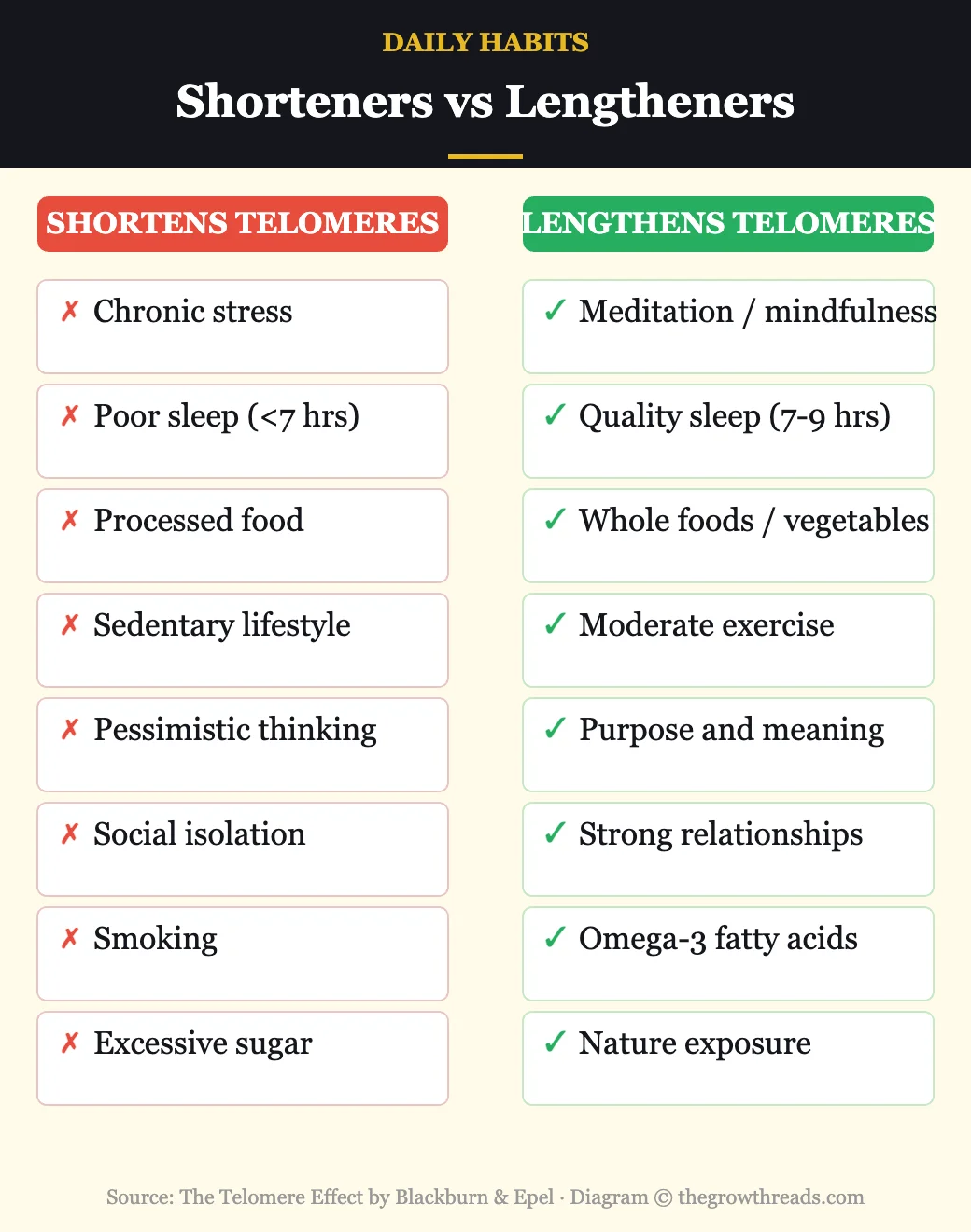
- Telomeres are biological aging markers: These DNA caps shorten with each cell division. When they get too short, cells stop functioning — driving aging and disease.
- Telomerase can rebuild them: The enzyme telomerase adds DNA sequences back to shortened telomeres, partially reversing cellular aging.
- Chronic stress is a telomere destroyer: Perceived stress — not just objective hardship — accelerates telomere shortening. How you interpret stress matters as much as the stress itself.
- Sleep is non-negotiable: Consistently sleeping fewer than seven hours is linked to significantly shorter telomeres across every age group studied.
- Exercise activates telomerase: Moderate aerobic exercise (about 45 minutes three times a week) measurably increases telomerase activity.
- Meditation measurably lengthens telomeres: Studies show that mindfulness meditation and yoga increase telomerase activity by as much as 30%.
- Food affects your chromosomes: Diets high in omega-3 fatty acids, vegetables, and whole foods correlate with longer telomeres. Sugar and processed meat correlate with shorter ones.
- Social connection is cellular medicine: Strong relationships and community belonging are independently linked to longer telomeres — isolation is as damaging as smoking.
- Prenatal telomere effects are real: A mother’s stress during pregnancy can affect her child’s telomere length at birth, shaping health outcomes from day one.
- Neighborhoods shape biology: Living in high-threat, low-trust environments measurably shortens telomeres — health is not purely an individual choice.
What is The Telomere Effect about?
The Telomere Effect explains how telomeres — protective caps on your chromosomes — shorten with age and stress, driving cellular aging and disease. Nobel laureate Elizabeth Blackburn and psychologist Elissa Epel reveal that lifestyle factors like sleep, exercise, stress management, and diet can activate telomerase to rebuild these caps, offering a science-backed path to slower biological aging.
About the authors
Elizabeth Blackburn is a molecular biologist who won the 2009 Nobel Prize in Physiology or Medicine for her co-discovery of telomerase, the enzyme that maintains telomere length. Born in Tasmania, Australia, she conducted her groundbreaking research at the University of California, San Francisco, where she remains a professor emerita. Elissa Epel is a health psychologist at UCSF whose research focuses on how psychological stress gets “under the skin” to affect cellular aging. Together they bridge the gap between laboratory science and everyday health — Blackburn provides the molecular biology, Epel translates it into behavioral interventions anyone can apply. Their collaboration has produced over a decade of peer-reviewed research on the connection between lifestyle and telomere health.
Key concepts at a glance
| Concept | What it means | Use it when |
|---|---|---|
| Telomeres | Protective DNA caps on chromosome ends that shorten with each cell division | Understanding why cells age and stop functioning |
| Telomerase | An enzyme that rebuilds shortened telomeres, partially reversing cellular aging | Learning what your body uses to repair chromosomal damage |
| Threat vs Challenge Response | How you frame stress determines its biological impact on your cells | Facing any stressful situation at work or home |
| Disease Span | The years spent living with chronic disease before death — the opposite of healthspan | Reframing longevity goals as quality-of-life goals |
| Stress Resilience | The capacity to recover from stress without lasting telomere damage | Building mental habits that protect cellular health |
| Biological Age | Your cellular age measured by telomere length — often different from chronological age | Assessing how your lifestyle is affecting your actual health trajectory |
| Social Determinants | Neighborhood safety, social trust, and community shape telomere length independently | Understanding why health outcomes differ by environment |
Part 1 — The science of telomeres: your cellular aging clock
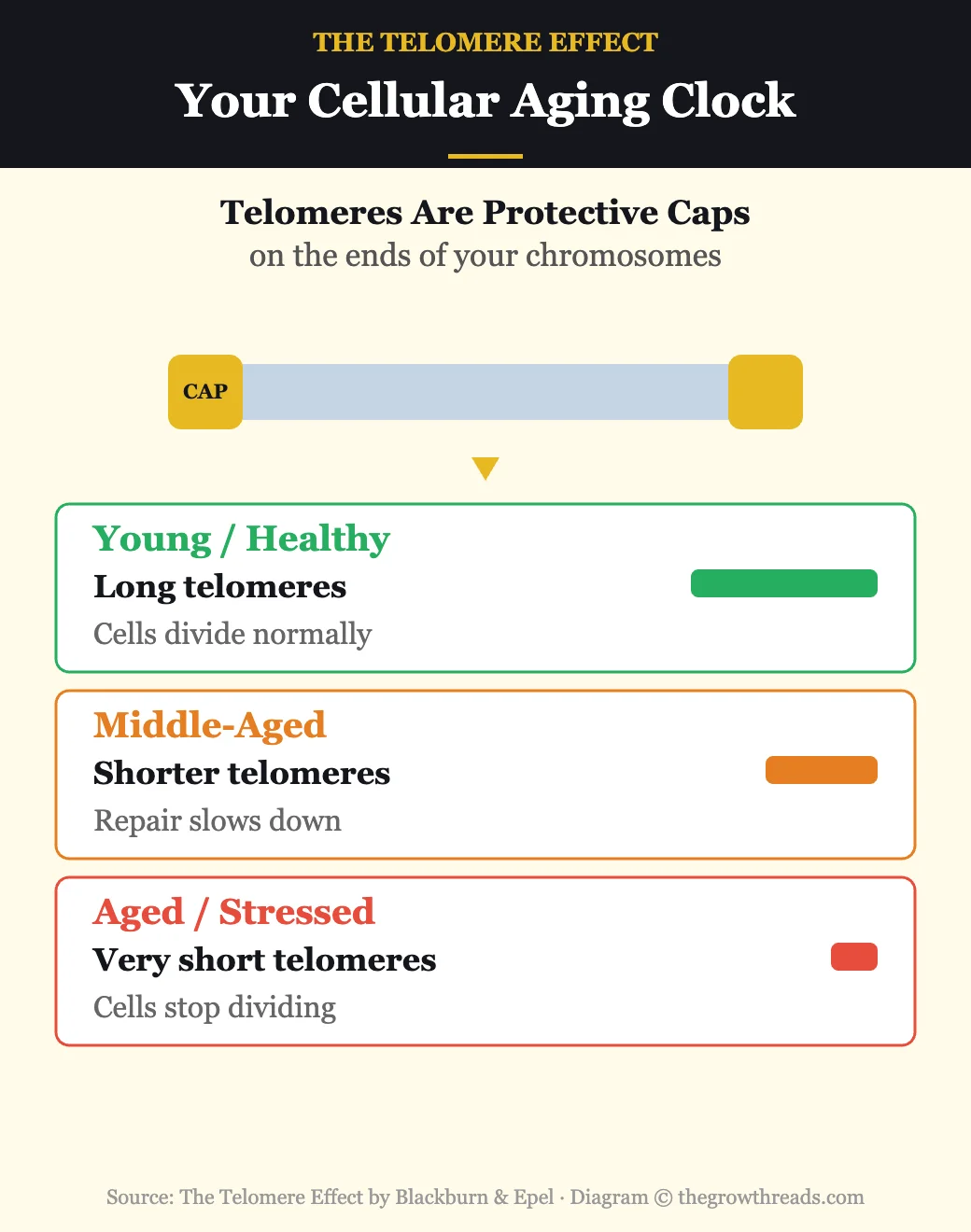
Blackburn opens with the discovery that earned her the Nobel Prize. In the late 1970s and early 1980s, she and her colleagues identified telomeres — repetitive DNA sequences (TTAGGG, repeated thousands of times) that cap the ends of chromosomes, much like the plastic tips on shoelaces. Without these caps, chromosomes fray, fuse with neighboring chromosomes, and trigger mutations. Every time a cell divides, telomeres shorten slightly. When they reach a critical minimum length, the cell enters senescence — it stops dividing, begins emitting inflammatory signals, and eventually dies.
The critical insight is that telomere length is not merely a marker of aging — it is a causal mechanism. Short telomeres do not just correlate with cardiovascular disease, diabetes, certain cancers, and dementia; they help drive those conditions by impairing cellular renewal in the organs that need it most. Blackburn presents data from large population studies showing that people in the lowest quartile of telomere length have significantly higher rates of early death than those in the highest quartile, even after controlling for age, income, and other health factors.
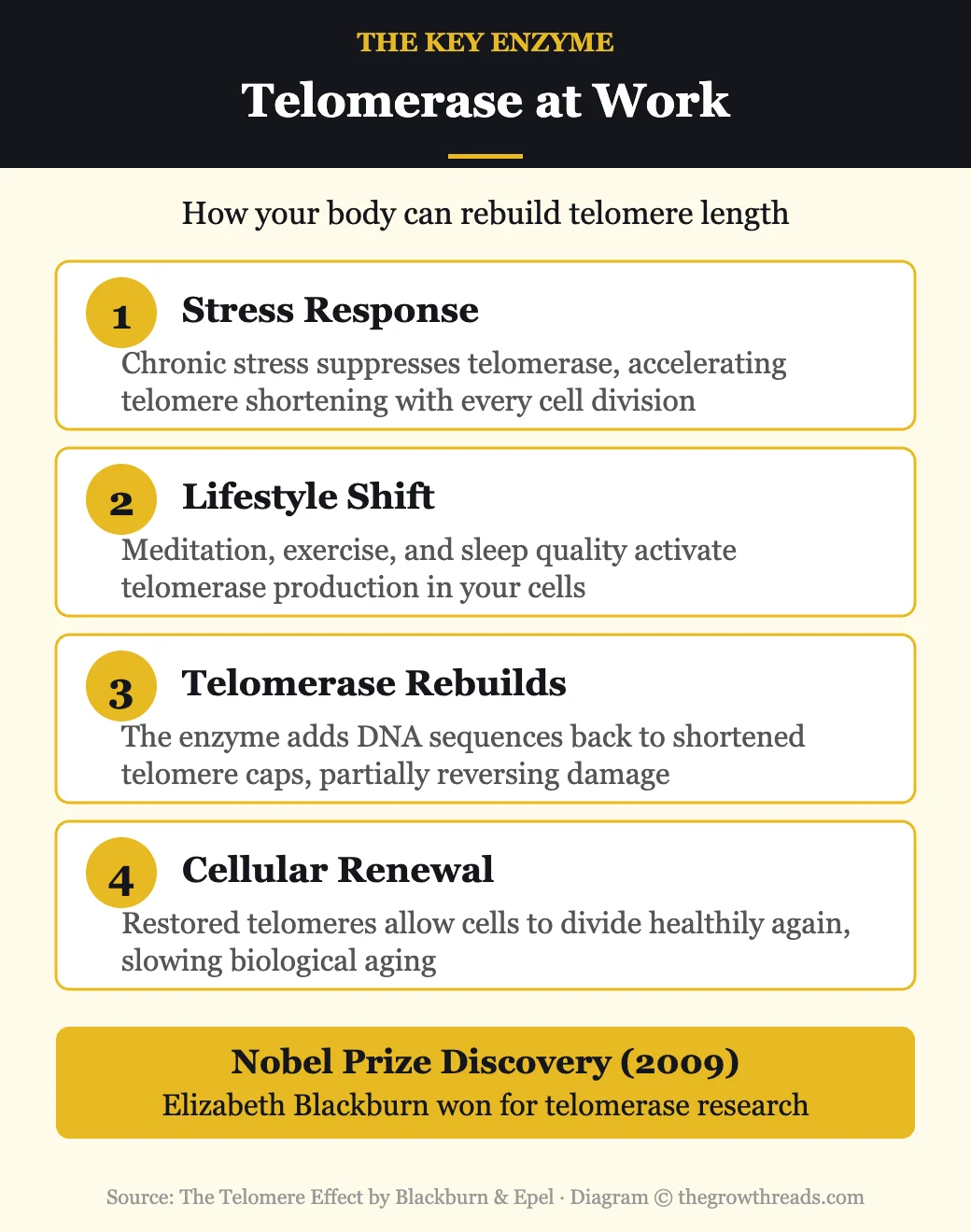
Then comes the revelation that transformed the field: telomere shortening is not a one-way street. In 1984, Blackburn and her graduate student Carol Greider discovered telomerase, an enzyme that adds DNA sequences back to telomere ends. Telomerase is active in stem cells and reproductive cells (which need to divide indefinitely), but it is present at low levels in most adult cells — and those levels respond to environmental signals. This means your behavior, your stress patterns, and your daily habits can literally increase or decrease the enzyme that protects your chromosomes.
Part 2 — Your mind shapes your telomeres
Epel’s research enters the picture with a landmark 2004 study she conducted with Blackburn. They measured telomere length in mothers caring for chronically ill children — one of the most sustained stressors in human experience. The results were striking: the longer a mother had been a caregiver, the shorter her telomeres, and the lower her telomerase activity. In the most stressed caregivers, the telomere difference was equivalent to approximately ten years of additional biological aging compared to low-stress controls.
But the study’s most important finding was subtler. It was not the objective duration of caregiving that predicted telomere length — it was the mother’s perceived stress level. Two women caring for equally sick children could have dramatically different telomere outcomes depending on how they interpreted their experience. Those who saw caregiving as a meaningful challenge maintained longer telomeres than those who experienced it as a threat they could not handle. This distinction between “threat response” and “challenge response” becomes a central theme of the book.
Blackburn and Epel present evidence that rumination — the tendency to replay stressful events mentally — is particularly damaging to telomeres. It extends the body’s cortisol response far beyond the original stressor, bathing cells in stress hormones for hours or days instead of the minutes an acute stress response requires. They cite studies showing that people who score high on rumination measures have shorter telomeres independent of their actual life circumstances. The practical implication: learning to notice and interrupt rumination cycles (through mindfulness, cognitive reframing, or simple distraction) is not merely a comfort strategy — it is a cellular protection mechanism.
Part 3 — The lifestyle levers: sleep, exercise, food, and connection
The book’s practical core covers four lifestyle domains with the strongest evidence for telomere effects. Sleep comes first: studies consistently show that adults sleeping fewer than seven hours per night have shorter telomeres, and the relationship is dose-dependent. Blackburn cites research indicating that even the quality of sleep — independent of duration — predicts telomere length, with disrupted sleep patterns (common in shift workers and new parents) associated with accelerated shortening.
Exercise is the most potent telomere protector in the research. Moderate aerobic exercise — approximately 45 minutes, three times per week — increases telomerase activity measurably. Extreme endurance exercise does not appear to provide additional telomere benefits and may actually increase oxidative stress. The sweet spot is consistent, moderate movement: walking, jogging, swimming, cycling. Blackburn emphasizes that exercise’s telomere benefits are independent of its effects on weight, blood pressure, or cardiovascular fitness — it protects chromosomes through a separate molecular pathway.
The nutrition chapter focuses on dietary patterns rather than individual foods. Diets high in omega-3 fatty acids (fish, flaxseed, walnuts), fresh vegetables, and whole grains correlate with longer telomeres across multiple population studies. Sugar and processed meat show the strongest negative associations. Blackburn is careful to distinguish correlation from causation here, but the consistency across studies is notable: the Mediterranean diet pattern appears particularly telomere-protective, likely because it combines anti-inflammatory and antioxidant elements.
Social connection rounds out the lifestyle pillars. Epel presents data showing that people with strong social bonds have longer telomeres than isolated individuals — an effect comparable in magnitude to the exercise effect. The mechanism appears to involve both stress buffering (relationships reduce cortisol) and direct oxytocin pathways that activate telomerase. Loneliness and social isolation, conversely, are associated with shorter telomeres at levels comparable to smoking.
Part 4 — Beyond the individual: pregnancy, childhood, and society
The final section widens the lens from individual behavior to intergenerational and societal effects. Blackburn presents evidence that a mother’s stress during pregnancy can affect her child’s telomere length at birth. Babies born to highly stressed mothers start life with shorter telomeres — a biological disadvantage that may influence their health trajectory for decades. This is not genetic inheritance in the traditional sense; it is epigenetic programming, where the uterine environment shapes how genes are expressed.
Childhood adversity — abuse, neglect, household instability — is one of the strongest predictors of short telomeres in adulthood. Epel cites the landmark ACE (Adverse Childhood Experiences) studies alongside telomere research, showing that each additional category of childhood adversity is associated with measurably shorter telomeres decades later. The biological mechanism involves prolonged cortisol exposure during critical developmental windows when telomere maintenance systems are being established.
The book closes with a social justice argument rooted in biology. Neighborhoods with high crime rates, environmental toxins, poor food access, and low social trust produce shorter telomeres in their residents — independent of individual behavior. Blackburn and Epel argue that public health policy is, at its root, telomere policy: investments in safe neighborhoods, green spaces, quality schools, and food security are not merely social goods but biological interventions that operate at the chromosomal level. It is one of the most compelling arguments for structural health investment in recent popular science.
Who is The Telomere Effect best for — and who should read something else first?
This book is ideal for readers who want hard science behind common health advice. If you already know you should sleep more, stress less, and eat vegetables but lack the motivation, understanding the chromosomal mechanisms may provide the missing push. It is also valuable for healthcare professionals, caregivers, and anyone interested in the biology of aging.
If you want a broader longevity framework that goes beyond telomeres to cover other aging pathways, start with Outlive by Peter Attia. If your primary interest is the psychology of stress rather than its cellular effects, The Body Keeps the Score may be more immediately useful.
Questions to reflect on
- When you face a stressful situation, do you default to a threat response (this could destroy me) or a challenge response (this is difficult but I can handle it) — and what would it take to shift?
- How many hours of sleep are you actually getting, and what one change to your evening routine could add thirty minutes?
- Which of the four lifestyle levers — stress management, sleep, exercise, or nutrition — would give you the biggest telomere return on investment right now?
- Who in your life provides the kind of deep social connection that Blackburn links to telomere protection, and when did you last invest in that relationship?
- If you could see a real-time readout of your biological age versus your chronological age, would it change any daily habit?
🔥 Ready to protect your chromosomes?
Discover the Nobel Prize-winning science behind slowing biological aging.
How to apply The Telomere Effect (7-day plan)
- Day 1 — Audit your sleep: Track your actual sleep hours tonight (not time in bed — time asleep). If under seven hours, identify one barrier to an earlier bedtime and remove it.
- Day 2 — Start a stress log: Each time you feel stressed today, note whether your response was “threat” (I can not handle this) or “challenge” (this is hard but I will manage). Just noticing the pattern begins to shift it.
- Day 3 — Move for 45 minutes: Walk, jog, cycle, or swim at a pace where you can talk but not sing. This is the intensity level most strongly linked to telomerase activation.
- Day 4 — Add omega-3s: Include one serving of fatty fish, walnuts, or flaxseed in your meals today. Reduce one source of added sugar.
- Day 5 — Practice a 10-minute meditation: Use a guided meditation app or simply sit quietly and focus on your breath. When your mind wanders, return to the breath without judgment. Studies show even brief sessions increase telomerase.
- Day 6 — Invest in a relationship: Reach out to someone whose connection matters to you — a friend, family member, or neighbor. Have a real conversation, not just a text exchange.
- Day 7 — Interrupt one rumination loop: The next time you catch yourself replaying a stressful event, deliberately redirect your attention — take a walk, call a friend, or write the worry down and close the notebook. Practice ending the cortisol cycle early.
Frequently asked questions
Can you actually lengthen your telomeres, or just slow the shortening?
Both. Telomerase, the enzyme Blackburn discovered, actively adds DNA sequences back to shortened telomere ends. Studies on meditation practitioners and regular exercisers show measurable increases in telomerase activity, which can partially rebuild telomere length over time. However, the primary practical goal is to slow the rate of shortening rather than dramatically regrow telomeres — think of it as slowing the clock rather than turning it backward.
How much of telomere length is genetic versus lifestyle?
Research suggests genetics account for roughly 20-30% of telomere length variation, with the remaining 70-80% influenced by environmental and behavioral factors. Identical twin studies confirm this: twins with different lifestyles (one sedentary, one active; one stressed, one not) develop measurably different telomere lengths over time. Blackburn emphasizes that while you cannot change your genetic starting point, the lifestyle component is large enough to make a meaningful difference.
Is there a test I can take to measure my telomere length?
Yes, commercial telomere testing is available through companies that analyze blood samples. However, Blackburn offers a nuanced view: a single measurement provides limited information because telomere length varies between cell types and fluctuates over time. Serial measurements (tracking changes over months or years) are more useful than a single snapshot. She also notes that the science of interpreting individual telomere results is still maturing.
Does meditation really affect telomeres, or is that overstated?
Multiple peer-reviewed studies support the connection. A landmark study by Toole and colleagues found that participants in a three-month meditation retreat had 30% higher telomerase activity than a control group. Other studies show similar effects with mindfulness-based stress reduction (MBSR) programs. The mechanism appears to involve reduced cortisol exposure and lower chronic inflammation. While more research is needed, the evidence is stronger than for most lifestyle interventions.
What type of exercise is best for telomere health?
Moderate aerobic exercise shows the strongest and most consistent telomere benefits in research — roughly 45 minutes of activity like brisk walking, jogging, swimming, or cycling, performed three or more times per week. High-intensity interval training (HIIT) also shows positive effects in some studies. Extreme endurance exercise (ultramarathons, excessive training volumes) does not appear to provide additional telomere benefits and may increase oxidative stress. Consistency matters more than intensity.
Is this book only relevant for older adults worried about aging?
No. Blackburn and Epel emphasize that telomere maintenance begins in utero and is most impactful when started early. Young adults who establish protective habits — managing stress, sleeping well, exercising moderately — build a telomere reserve that pays compounding dividends over decades. The book is equally relevant for parents (prenatal stress affects a child’s telomeres), young professionals (early career stress patterns set biological trajectories), and anyone curious about the molecular biology of health.
How does The Telomere Effect compare to Outlive by Peter Attia?
The two books complement each other well. Outlive takes a broader approach to longevity, covering multiple aging pathways, metabolic health, cancer screening, cardiovascular fitness, and emotional health. The Telomere Effect goes deep on one specific mechanism — telomere biology — and provides the most thorough scientific explanation of how lifestyle affects chromosomal aging. Read The Telomere Effect for the molecular “why” behind healthy habits, and Outlive for a comprehensive “how” across all longevity domains.
Related summaries
- Lifespan — David Sinclair’s broader framework of the nine hallmarks of aging
- Outlive — Peter Attia’s comprehensive strategy for extending healthspan
- Why We Sleep — the full science of why sleep is the foundation of health
- The Blue Zones — how community and environment drive longevity worldwide
Best Health Books — The Full TGR List