

⭐⭐⭐⭐✬ 4.3 / 5
One-liner: A compelling investigation into how talent is built — not born — through deep practice, ignition, and master coaching.
Best for: Anyone who wants to understand the science of skill-building and accelerate their own learning.
Reading time: ~5 hours (256 pages)
Difficulty to apply: Medium — requires deliberate, sustained effort over weeks.
The Talent Code in One Minute
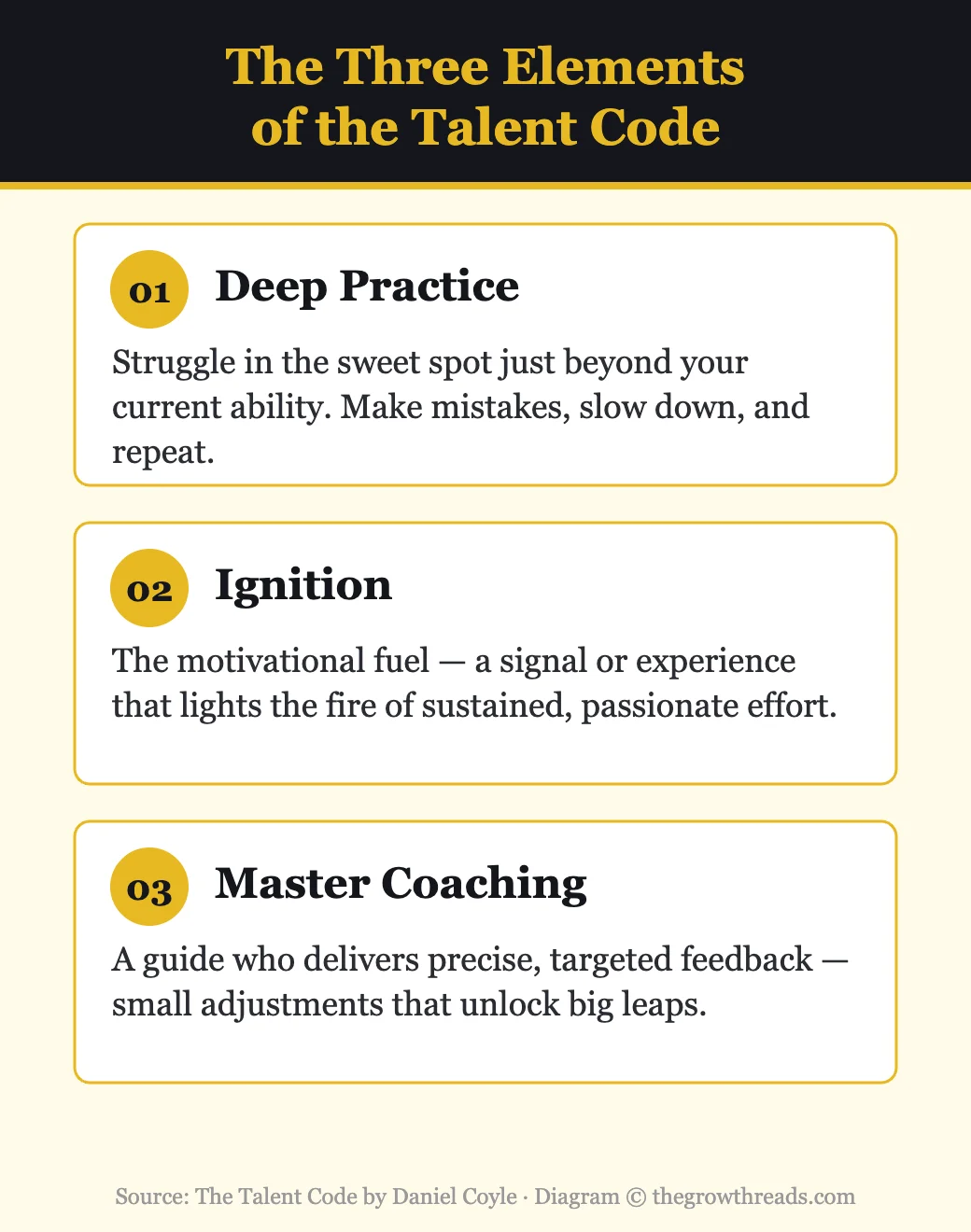
Greatness is not born — it is grown. Daniel Coyle traveled to talent hotbeds around the world — tiny tennis clubs in Russia, music academies in Dallas, soccer fields in Brazil — and discovered they all share three elements. Deep practice, where you struggle at the edge of your ability, wraps neural circuits in myelin, an insulating substance that makes signals faster and more accurate. Ignition provides the motivational fuel — a primal cue that says “I want to be that.” And master coaching delivers short, targeted bursts of feedback that accelerate the myelin-wrapping process. Together, these three elements explain why certain pockets of the world produce disproportionate amounts of talent — and how you can replicate the process yourself.
Key Takeaways
- Myelin is the mechanism: Every skill is a chain of nerve fibers, and myelin is the insulation that wraps those fibers — making signals faster, stronger, and more accurate with each repetition.
- Deep practice is productive struggle: Operating at the edge of your ability, making mistakes, correcting them, and repeating — this is what wraps myelin most efficiently.
- Chunk, repeat, feel: Deep practice follows three rules — absorb the whole skill, break it into chunks, slow down, repeat obsessively, and develop sensitivity to errors.
- Talent hotbeds share a blueprint: From Brazilian soccer to Meadowmount music camp, the world’s most productive talent factories all combine deep practice, ignition, and master coaching.
- Ignition is not motivation — it is identity: A single signal (seeing someone like you succeed) can trigger years of deep practice by connecting effort to a future self.
- Master coaches are not cheerleaders: The best coaches deliver targeted, bite-sized corrections — GPS-like guidance rather than inspirational speeches.
- Struggle is not failure — it is the path: The sensation of difficulty is evidence that your brain is building new circuitry, not a sign that you lack talent.
- Small differences compound: Slightly more myelin-wrapped circuits don’t produce slightly better performance — they produce exponentially better performance over time.
- Age matters less than practice quality: While younger brains wrap myelin more easily, adults who practice deeply can still build remarkable skills.
- Talent is democratic: The talent code gives everyone access to greatness — it requires effort and method, not genetic gifts.
What Is The Talent Code About?
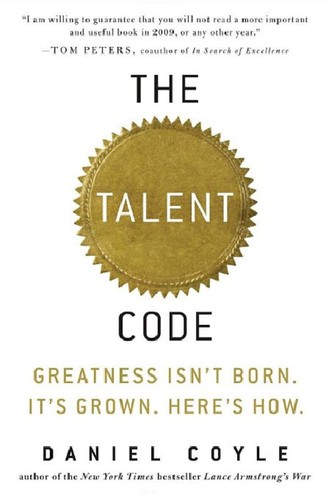
The Talent Code explores the neuroscience of skill development, arguing that talent is not an innate gift but a product of deep practice, motivational ignition, and master coaching. Drawing on visits to talent hotbeds worldwide, Daniel Coyle shows how myelin — the neural insulation wrapped through targeted repetition — is the biological mechanism behind every skill.
About the Author
Daniel Coyle is a New York Times bestselling author and contributing editor for Outside magazine. He spent years embedded in talent hotbeds across the globe, from Russian tennis academies to inner-city charter schools, to understand what makes certain places produce outsized numbers of world-class performers. His research combines neuroscience with immersive journalism, giving readers both the science and the stories behind skill development. He later extended his work in The Culture Code, applying similar investigative rigor to the dynamics of successful groups. Explore all Daniel Coyle book summaries →
Key Concepts at a Glance
| Concept | What It Means | Use It When |
|---|---|---|
| Myelin | Neural insulation that wraps nerve fibers, making skill circuits faster and more accurate | You want to understand why practice works at a biological level |
| Deep practice | Struggling at the edge of ability — making errors and correcting them repeatedly | You want to improve any skill faster than casual repetition allows |
| Chunking | Breaking a skill into its smallest components and mastering each piece | You face a complex skill and don’t know where to start |
| Ignition | A motivational signal that connects effort to identity — “I want to be that” | You need to sustain motivation through months of difficult practice |
| Talent hotbeds | Small, unremarkable places that produce disproportionate numbers of world-class performers | You’re designing a training environment or culture |
| Master coaching | Short, targeted feedback — a GPS guiding micro-corrections rather than long lectures | You’re coaching, teaching, or mentoring someone |
| The sweet spot | The zone where you’re reaching just beyond your current ability | You want to calibrate the difficulty of your practice sessions |
Part 1: Deep Practice — The Sweet Spot
Coyle opens with a puzzle: why does a tiny tennis club in Moscow, with one indoor court and a modest budget, produce more top-20 women’s tennis players than the entire United States? The answer, he discovers, lies not in genetics or funding but in a specific kind of practice.
Deep practice looks different from what most people think of as training. It is slow, halting, and full of errors. Coyle describes watching Brazilian soccer players in futsal courts — a small-sided, fast-paced version of the game that forces players to touch the ball six times more often than in regular soccer. The constant contact, the cramped space, and the pressure to improvise create an environment where deep practice happens naturally.
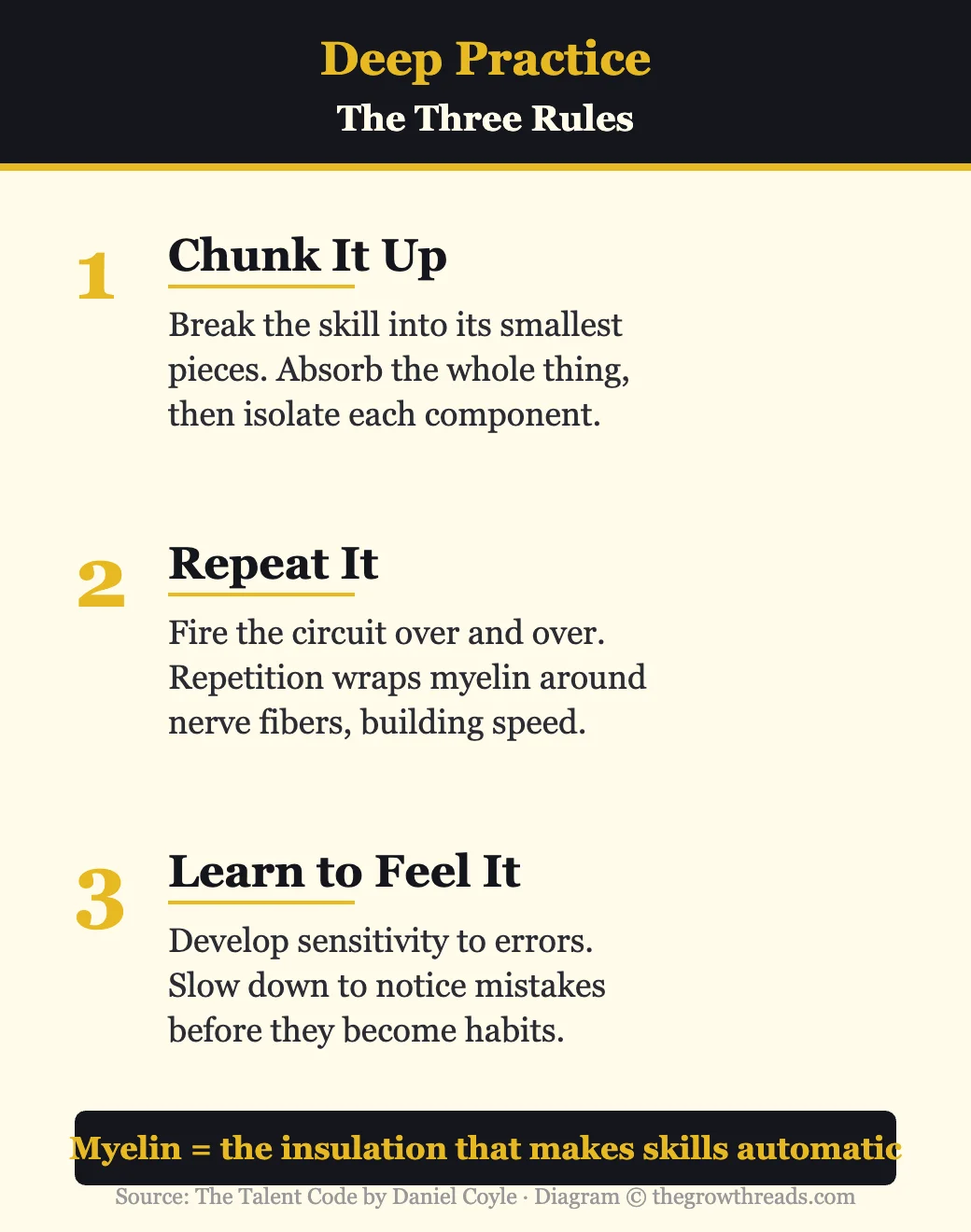
The biological mechanism behind deep practice is myelin. Coyle explains the neuroscience: every time you fire a neural circuit — every time you practice a skill — oligodendrocytes (myelin-producing cells) wrap another layer of insulation around the nerve fibers. More myelin means faster, more accurate signals. The critical insight is that myelin responds to one thing above all: targeted repetition at the edge of your ability.
Coyle introduces the three rules of deep practice. First, chunk it up: absorb the whole skill, break it into its smallest pieces, then slow down to master each chunk. Second, repeat it: fire the circuit again and again, building layers of myelin with each repetition. Third, learn to feel it: develop sensitivity to errors so you can correct them before they become habits.
Part 2: Ignition — The Motivational Fuel
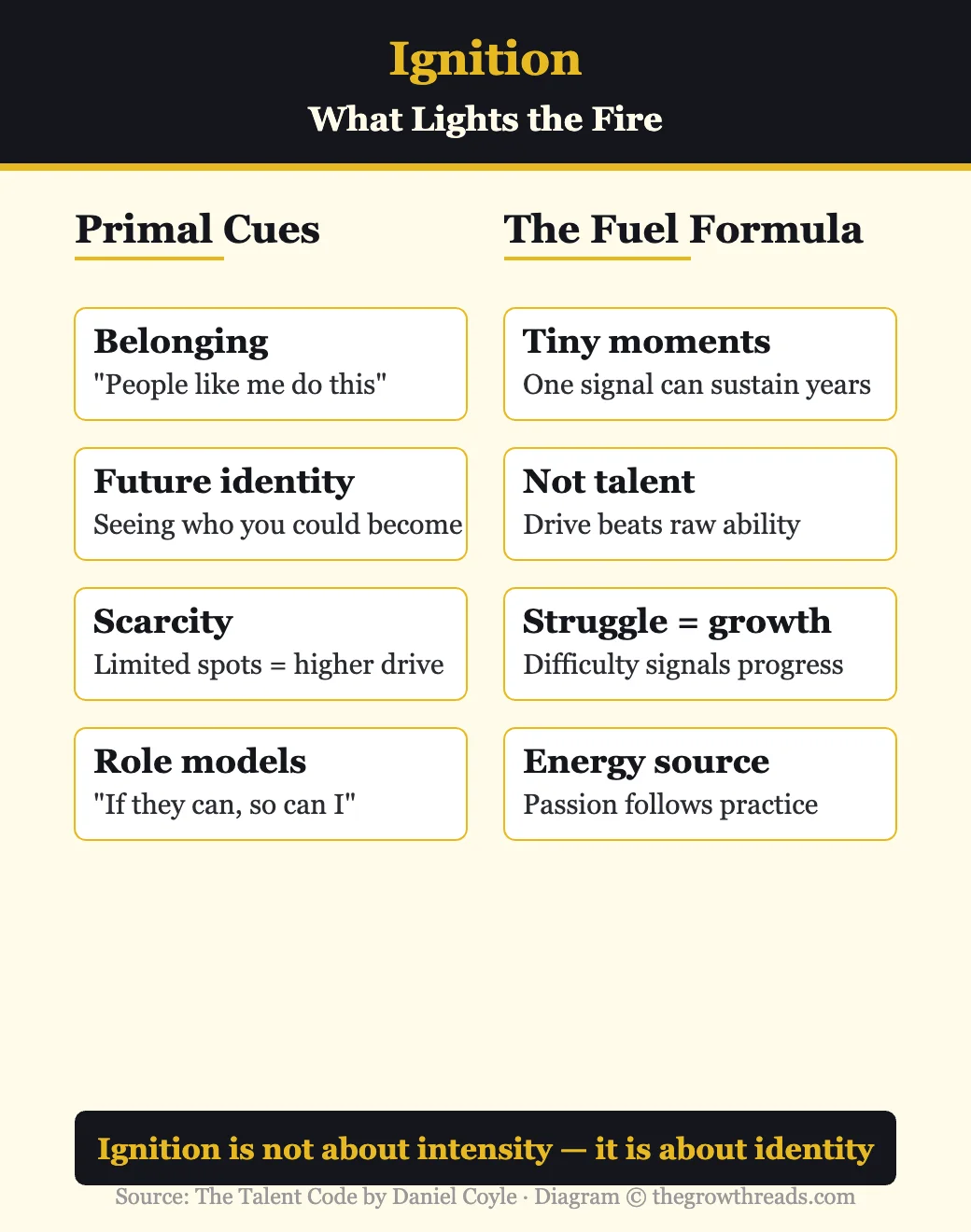
If deep practice is the mechanism, ignition is the fuel. Coyle investigates what drives people to put in the thousands of hours of struggling, failing, and repeating that deep practice demands.
His answer is surprising: ignition often comes from a single, seemingly small moment. He describes the “Curaçao effect” — how a tiny Caribbean island began producing major-league baseball players after one native son, Andruw Jones, made it to the Atlanta Braves. That single signal — “someone like me did this” — ignited a chain reaction of effort across the island.
Coyle identifies the core ignition signals. They are primal, identity-based cues: belonging (“people like me do this”), future self (“I could become that”), and scarcity (“there are limited spots”). These signals do not create motivation through conscious goal-setting; they work at a deeper, almost unconscious level, connecting practice to identity.
The key insight is that ignition is not about intensity of emotion — it is about clarity of identity. The children who become world-class performers are not necessarily the most passionate ones. They are the ones for whom practice connects to a clear sense of who they want to become. Coyle found that the best predictor of musical skill was not IQ, income, or even ear quality — it was a simple question: “How long do you plan to play?”
Part 3: Master Coaching — The GPS of Skill
Coyle spent time with coaches who consistently produce extraordinary performers — John Wooden in basketball, Robert Lansdorp in tennis, Linda Septien in voice — and found they share a coaching style radically different from the motivational-speaker model.
Master coaches deliver short, precise, targeted corrections. Coyle analyzed Wooden’s practices and found that 75% of his feedback consisted of brief, information-dense instructions: “Do this, not that.” No speeches. No elaborate explanations. Just GPS-like course corrections that help the student fire the right circuit.
The master coaching style has several hallmarks. First, deep observation: these coaches watch intensely, reading the student’s body language, effort level, and micro-errors before speaking. Second, surgical precision: when they do speak, it is a specific instruction that addresses exactly one thing. Third, connection: they build a relationship of trust that lets the student accept correction without defensiveness.
Coyle also explores how master coaches handle the emotional dimension. They create a safe space for struggle — normalizing difficulty and failure as signs of growth rather than inadequacy. This psychological safety, combined with precise technical guidance, creates the optimal environment for myelin growth.
Part 4: Putting It Together — Building Your Own Talent Hotbed
In the book’s final section, Coyle synthesizes his findings into a practical framework. Talent hotbeds — whether in music, sports, academics, or business — are not magical places. They are environments that accidentally or intentionally combine all three elements of the talent code.
The KIPP charter schools in the South Bronx, for example, produce college-graduation rates five times higher than neighborhood averages — not through superior resources, but through a culture of deep practice (struggle is normalized), ignition (students see graduates like themselves succeeding), and master coaching (teachers deliver targeted interventions rather than lectures).
Coyle also addresses the age question. While younger brains wrap myelin more readily, the process does not stop in adulthood. Adults can still build remarkable skills through deep practice — it simply requires more sustained effort. The key is maintaining the three elements: practice that challenges, motivation that connects to identity, and feedback that guides.
The book ends with a democratic, empowering message. Talent is not a fixed resource distributed at birth. It is a process — available to anyone willing to struggle, sustain effort, and seek guidance. The talent code is open-source.
Who Is The Talent Code Best For — and Who Should Read Something Else First?
This book is ideal for coaches, teachers, parents, and self-directed learners who want to understand why certain practice methods work at a biological level. If you’re designing training programs or trying to build a skill from scratch, The Talent Code provides the scientific foundation to structure your approach.
If you’re looking for a more prescriptive, step-by-step guide to learning, start with Ultralearning or Peak. If your primary interest is habit formation rather than skill development, Atomic Habits is the better starting point. And if you want the coaching dimension explored more deeply, pair The Talent Code with The Coaching Habit.
Questions to Reflect On
- When you practice a skill, do you operate in the sweet spot — just beyond your current ability — or do you stay in your comfort zone?
- What was your ignition moment: the signal that first made you believe “I could do this”?
- Who serves as your master coach today, and are you getting targeted, GPS-like feedback or generic encouragement?
- How could you restructure your daily practice to include more chunking, repetition, and error-sensitivity?
- What identity are you building through your current skill-building efforts — and does that identity sustain your motivation?
🔥 Ready to crack the talent code?
Discover the science of deep practice, ignition, and master coaching.
How to Apply The Talent Code (7-Day Plan)
- Day 1 — Pick your skill: Choose one skill you want to improve. Write down specifically what “better” looks like for you.
- Day 2 — Find your ignition: Identify one person who has mastered this skill and whose story resonates with you. Watch an interview, read their biography, or study their work for 20 minutes.
- Day 3 — Chunk it up: Break your chosen skill into 3–5 sub-skills. Rank them from most fundamental to most advanced.
- Day 4 — Enter the sweet spot: Spend 30 minutes practicing the most fundamental chunk at a difficulty level where you make errors about 20–30% of the time. Slow down when you struggle.
- Day 5 — Learn to feel it: During your 30-minute practice, keep a brief error log. Write down the 3 most common mistakes you made and what correction you tried.
- Day 6 — Seek a master coach: Find one source of targeted feedback — a teacher, a peer, an online community, or even a video comparison. Get specific guidance on your top error.
- Day 7 — Review and repeat: Compare your Day 4 performance with today. Notice improvements. Adjust your chunks and difficulty level. Commit to repeating the cycle for the next four weeks.
Frequently Asked Questions
What is myelin and why does it matter for talent?
Myelin is a microscopic layer of insulation that wraps around nerve fibers in your brain and body. Every time you practice a skill and fire a neural circuit, oligodendrocytes add another layer of myelin to that circuit. More myelin means faster, more accurate electrical signals — which translates to smoother, more automatic skill execution. Coyle argues that myelin is the universal mechanism behind all forms of talent, from playing violin to hitting a baseball to solving math problems. It explains why practice works and why targeted repetition outperforms casual repetition.
What is a talent hotbed?
A talent hotbed is a place that produces a disproportionate number of world-class performers relative to its size and resources. Examples include the Spartak Tennis Club in Moscow (one indoor court, yet producing multiple top-20 players), Brazilian futsal courts (the training ground behind the country’s soccer dominance), and the Meadowmount School of Music in the Adirondacks. These places share no common geography, culture, or wealth — but they all combine deep practice, ignition, and master coaching in a self-reinforcing cycle.
How is deep practice different from regular practice?
Regular practice often means repeating what you already know — playing through a song you’ve memorized or running drills below your ability level. Deep practice, by contrast, means operating at the edge of your ability, where you make mistakes roughly 20–30% of the time. It involves slowing down, isolating specific chunks of a skill, making errors, correcting them, and repeating. Deep practice is harder, slower, and less immediately rewarding than regular practice — but it wraps significantly more myelin per unit of time.
Can adults still develop talent or is it too late?
Adults can absolutely still develop talent. While younger brains produce myelin more readily (the process peaks in childhood and adolescence), myelination continues throughout adulthood. Adults who practice deeply can still build remarkable skills — it simply takes more sustained, deliberate effort. The key variables remain the same at any age: practice at the edge of ability, sustain motivation through identity-based ignition, and seek targeted feedback from a coach or mentor.
What makes a master coach according to Coyle?
Master coaches share a distinctive style that is more surgical than inspirational. They watch intensely before speaking, deliver short and precise corrections (John Wooden’s average instruction lasted less than five seconds), focus on one specific adjustment at a time, and build deep trust with their students. They are less like motivational speakers and more like GPS systems — providing constant, targeted course corrections. They also normalize struggle, creating a psychologically safe environment where errors are treated as data rather than failures.
How does The Talent Code compare to Malcolm Gladwell’s 10,000-hour rule?
Gladwell popularized the idea that 10,000 hours of practice produces expertise, but Coyle’s work adds critical nuance. The Talent Code shows that not all practice hours are created equal: one hour of deep practice (struggling, correcting, repeating at the edge of ability) wraps far more myelin than ten hours of casual repetition. In this sense, Coyle’s model is closer to Anders Ericsson’s original research, which Gladwell simplified. The talent code is about practice quality, not just quantity.
What is ignition and how do I find mine?
Ignition is the motivational fuel that drives sustained deep practice. It often comes from a single signal — seeing someone like you succeed, encountering a compelling role model, or experiencing a moment that connects effort to a future identity. To find your ignition, look for people who have mastered the skill you want and whose story resonates with your own background. The most powerful ignition signals are identity-based (“someone like me did this”) rather than outcome-based (“I want to win a prize”). Even a small, seemingly insignificant moment can sustain years of practice.
Related Summaries
- Peak by Anders Ericsson — the original deliberate practice research that complements Coyle’s myelin model.
- Ultralearning by Scott Young — a practical nine-principle framework for designing intensive self-study projects.
- Mastery by Robert Greene — historical profiles of masters and the apprenticeship process that builds deep skill.
- Atomic Habits by James Clear — identity-based behavior change that sustains long-term practice.
📚 Explore more in our Best Productivity Books pillar page.