

⭐⭐⭐⭐ 4.3/5
One-liner: A tactical blueprint for mastering hard skills fast through aggressive, self-directed learning projects.
Best for: Self-taught learners, career changers, ambitious professionals, and anyone who wants to acquire valuable skills without spending years in formal education.
Reading time: ~6 hours (304 pages)
Difficulty to apply: Moderate to high — requires sustained focus and willingness to embrace discomfort.
Ultralearning in one minute
You can teach yourself almost anything faster than you think — if you are willing to be strategic and uncomfortable. Scott Young argues that the most effective learners do not passively consume information. They design intense, self-directed projects that put them in direct contact with the skill they want to master. Young distills his approach into nine principles — from metalearning (researching how to learn before you start) to experimentation (pushing beyond mastery into creative territory). Drawing on case studies of rapid language learners, MIT challenge completers, and competition-winning artists, the book provides a practical framework for anyone who wants to accelerate skill acquisition without relying on traditional institutions.
Key takeaways
- Metalearning saves months: Spending 10% of your total learning time researching how experts learned the skill dramatically improves your strategy and prevents wasted effort.
- Directness beats theory: You learn to code by building apps, learn a language by speaking it, and learn to paint by painting — not by reading about those activities.
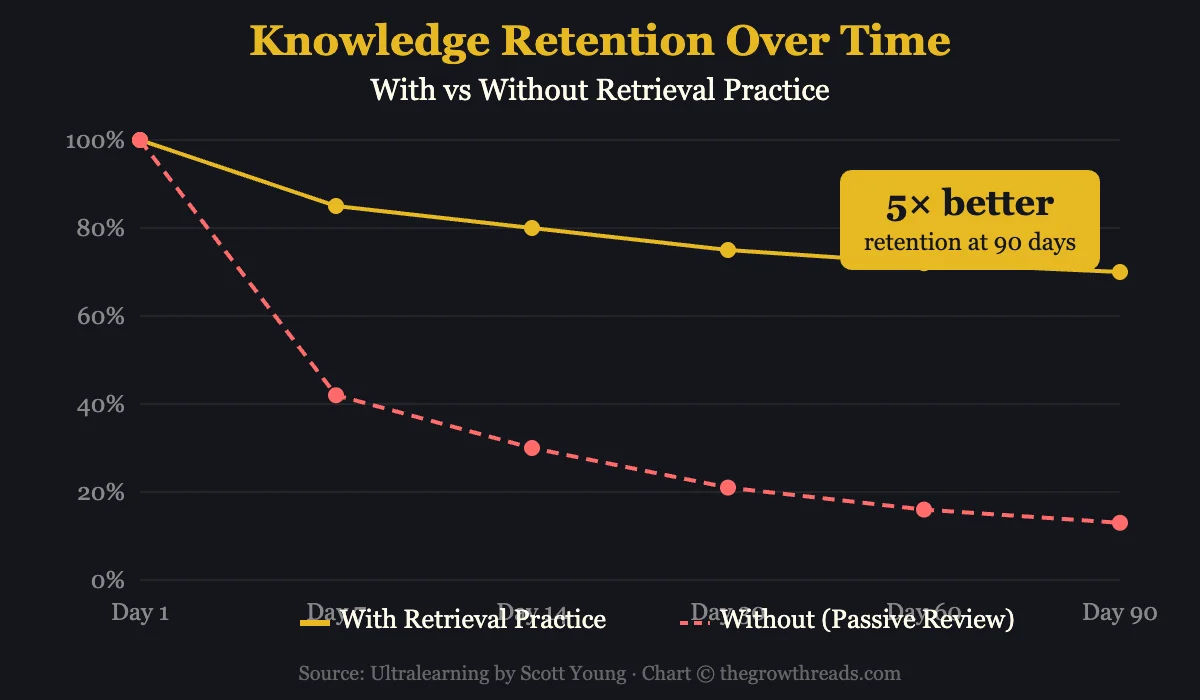
- Retrieval practice is five times more effective than passive review: Testing yourself on material before you feel ready is the single most powerful study technique available.
- Drill your weakest link: Identify the specific sub-skill holding you back and isolate it for intensive, targeted practice until it no longer bottlenecks your progress.
- Feedback must be specific to be useful: Outcome feedback (pass/fail) is nearly useless compared to corrective feedback that tells you exactly what to change and how.
- Spacing and interleaving fight the forgetting curve: Distributing practice across days and mixing different problem types builds durable knowledge that lasts.
- Intuition comes from struggle: The deep understanding that lets experts solve novel problems grows from wrestling with hard material — not from memorising solutions.
- Time-boxing creates urgency: Setting aggressive deadlines for learning projects increases focus and forces you to prioritise what matters most.
- Experimentation is the final stage: Once you reach competence, the path to mastery requires exploring new methods, styles, and approaches that go beyond what any teacher would assign.
- Ultralearning is a skill itself: The more learning projects you complete, the better you get at designing and executing future ones.
What is Ultralearning about?
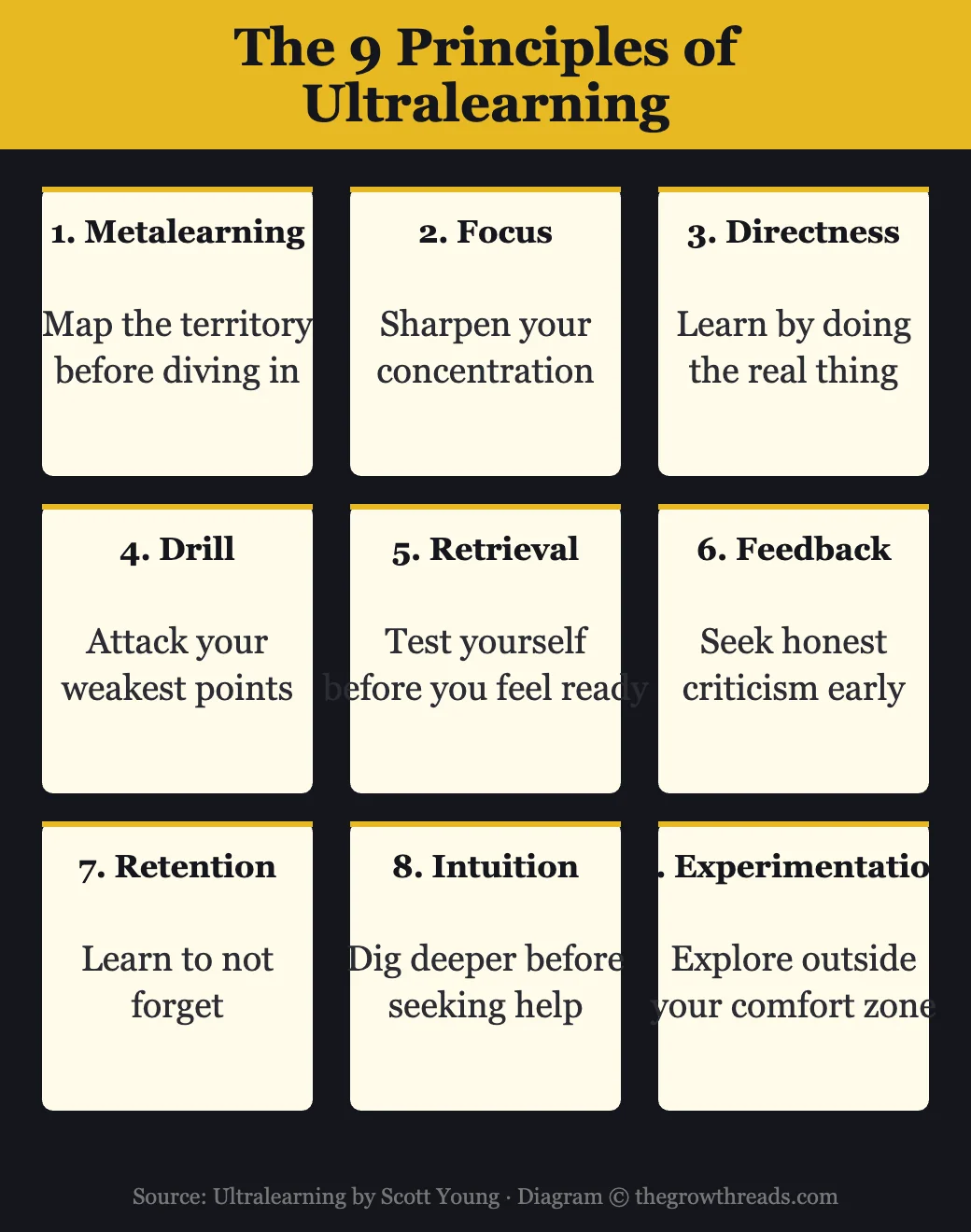
Ultralearning is a strategy for aggressive, self-directed learning that uses intensity and smart tactics to acquire hard skills quickly. Scott Young presents nine core principles — metalearning, focus, directness, drill, retrieval, feedback, retention, intuition, and experimentation — and shows how ordinary people have used them to pass MIT courses, learn multiple languages, and master competitive skills in months instead of years.
About the author
Scott Young is a Canadian writer and self-experimenter best known for completing MIT’s four-year computer science curriculum in twelve months using only free online resources. That project, the MIT Challenge, attracted international media attention and established Young as a leading voice in self-directed learning. He followed it with the Year Without English, during which he learned four languages by living in the countries where they are spoken and refusing to use English. Young holds a degree in business from the University of Manitoba and has been writing about learning, productivity, and personal development since 2006. He continues to experiment with ultralearning projects and writes at scottyoung.com. Explore all Scott Young book summaries →
Key concepts at a glance
| Concept | What it means | Use it when |
|---|---|---|
| Metalearning | Researching the optimal approach before starting a project | Beginning any new skill or subject |
| Directness | Learning by doing the target activity itself, not a proxy | You notice a gap between what you study and what you need to perform |
| Drill | Isolating and intensely practising the weakest sub-skill | Progress has plateaued and one component is the bottleneck |
| Retrieval practice | Testing yourself on material from memory without notes | You want to move information into long-term memory |
| Corrective feedback | Specific guidance on what to fix and how | You need to improve rapidly and know exactly what is wrong |
| Spacing | Distributing practice sessions across time rather than cramming | You need to retain knowledge for months or years |
| The Feynman technique | Explaining a concept in simple language to expose gaps | You think you understand something but are not sure |
| Overlearning | Continuing to practise beyond the point of initial mastery | The skill must be performed under pressure or automatically |
Part 1: The case for ultralearning
Young opens by asking a provocative question: why do some people acquire valuable skills in a fraction of the time it takes others? He introduces the concept of ultralearning — a strategy for intense, self-directed learning — and argues that it is not about genius or natural talent. It is about approach.
He presents several case studies. Eric Barone spent five years teaching himself programming, pixel art, music composition, and game design to create the indie hit Stardew Valley entirely by himself. Roger Craig used data analysis to optimise his Jeopardy preparation and became the first player to exceed one million dollars in winnings. Benny Lewis, a self-described language hacker, developed methods to reach conversational fluency in new languages within three months.
The common thread across these stories is not raw intelligence. It is a willingness to design an unconventional, focused approach to learning and to invest intense effort over a defined period. Young argues that in a rapidly changing economy where skills become obsolete quickly, the ability to learn hard things fast is itself the most valuable meta-skill you can develop.
Part 2: The nine principles — learning strategy
The heart of the book unpacks the first four principles that form the strategic foundation of any ultralearning project.
Metalearning is the act of learning how to learn a specific skill before you begin. Young recommends a three-step research process. First, map the “why” — what is your motivation and what level of mastery do you need? Second, map the “what” — break the skill into concepts (things you need to understand), facts (things you need to memorise), and procedures (things you need to practise). Third, map the “how” — study how experts and top performers acquired the skill, looking for common methods and resources. Young suggests spending roughly 10% of your expected total learning time on metalearning research.
Focus is the ability to sustain concentrated attention during learning sessions. Young identifies three problems: failing to start (procrastination), failing to sustain attention (getting distracted), and failing to create the right kind of focus (too relaxed or too intense for the task). He recommends the Pomodoro technique for overcoming procrastination and suggests that creative tasks often benefit from a more relaxed attentional state, while analytical tasks require sharp, narrow focus.
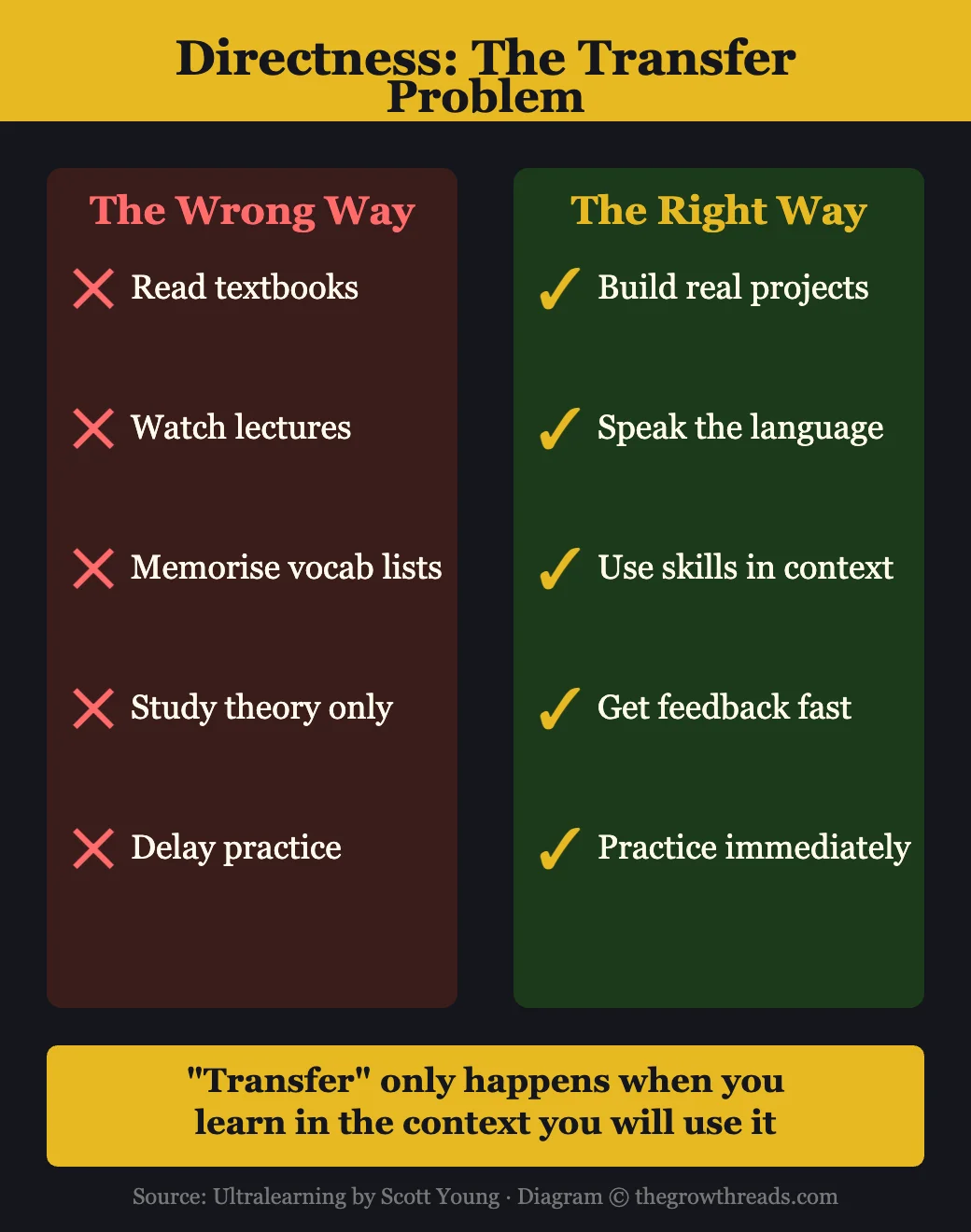
Directness is the principle that you should learn by doing the thing you want to become good at. Young calls this the most counterintuitive principle because our education system is built on the opposite assumption — that you should study theory first and apply it later. Research on transfer of learning consistently shows that knowledge learned in one context rarely transfers automatically to another. The solution is to make your learning environment as close as possible to the environment where you will use the skill.
Drill is the practice of isolating a specific component of a complex skill for focused, intensive practice. Young uses the analogy of a chain: your overall ability is limited by the weakest link. A musician who plays pieces from start to finish will improve slowly. A musician who identifies the hardest four bars and drills them hundreds of times will improve fast. Young outlines several drill types: time-slicing (practising one segment), cognitive-component isolation (practising one type of mental operation), and the copycat method (reproducing expert work to isolate specific skills).
Part 3: The nine principles — memory and understanding
The middle three principles focus on how to make what you learn stick and transform surface knowledge into deep understanding.
Retrieval is the practice of recalling information from memory without looking at your notes. Young cites extensive research showing that retrieval practice is dramatically more effective than re-reading or highlighting — studies suggest it can improve long-term retention by a factor of five or more. The key insight is that retrieval should feel difficult. If you can easily recall something, you are not getting much benefit from the practice. Young recommends free recall (closing the book and writing everything you remember), flash cards with spaced repetition, and self-generated questions.
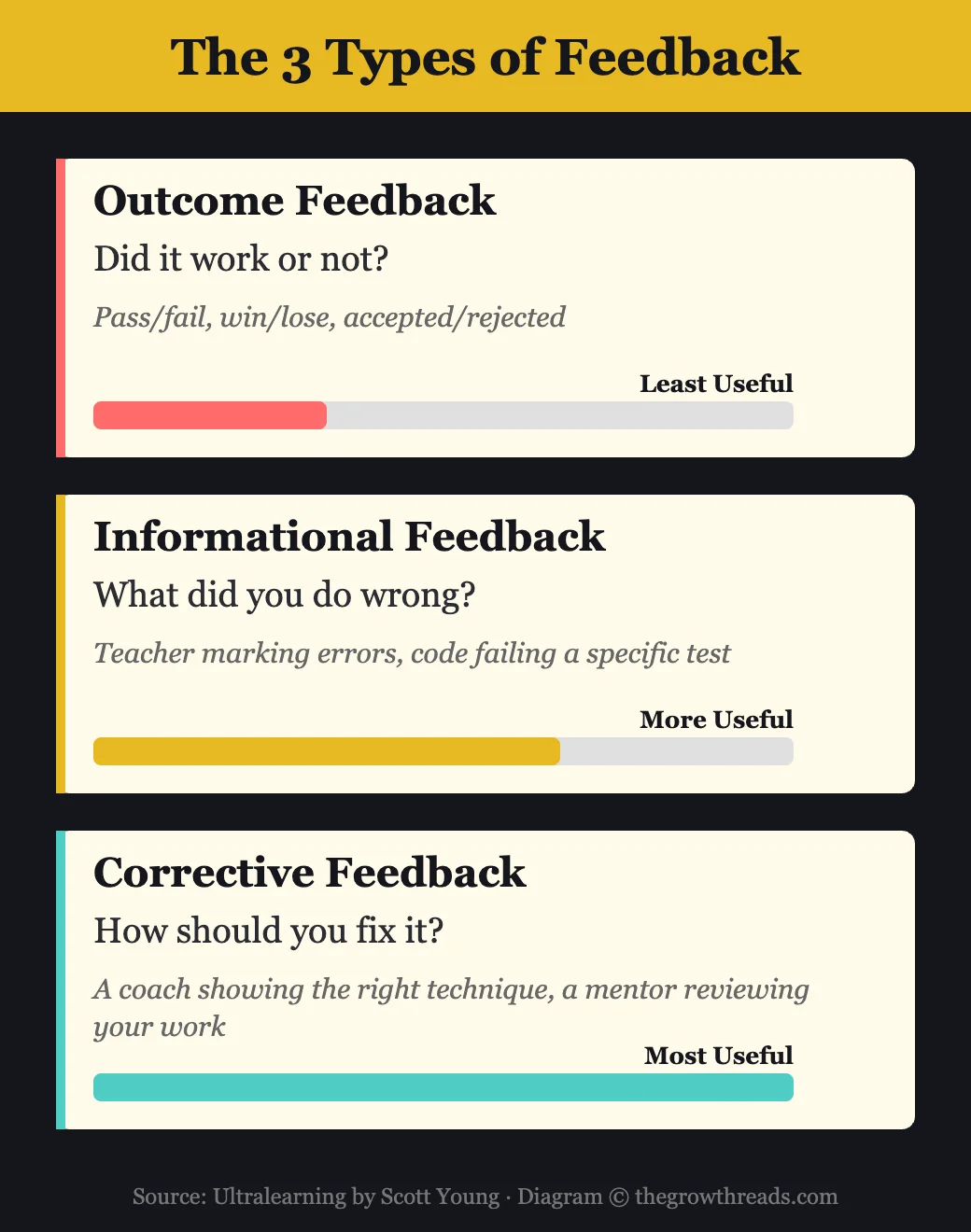
Feedback is essential for improvement, but not all feedback is created equal. Young identifies three types arranged on a spectrum of usefulness. Outcome feedback is the least useful — it tells you whether you passed or failed but not why. Informational feedback identifies what you got wrong. Corrective feedback, the most valuable kind, tells you what you got wrong and how to fix it. Young warns that many learners avoid feedback because it is emotionally uncomfortable, and he recommends seeking it out as early and as often as possible — while filtering out noise that does not contain actionable information.
Retention addresses the problem that we forget most of what we learn. Young presents four mechanisms for fighting the forgetting curve: spacing (distributing practice over time), procedural learning (converting knowledge into actions that become automatic), overlearning (continuing to practice beyond initial mastery), and mnemonics (using memory techniques for facts that resist natural retention). He emphasises that spacing is by far the most important — even a simple commitment to reviewing material at increasing intervals dramatically improves long-term retention.
Part 4: The nine principles — mastery and beyond
The final two principles address the leap from competence to genuine mastery.
Intuition is the deep understanding that allows experts to solve problems they have never seen before. Young argues that intuition is not magical — it develops through extensive experience with the fundamental principles of a domain. He introduces the Feynman technique as a practical tool for developing intuition: take a concept, try to explain it in simple language as if teaching a child, identify the gaps in your explanation, go back to the source material, and repeat until you can explain it clearly without jargon. Young emphasises that the temptation to look up answers quickly is the enemy of intuition — you build deep understanding by struggling with problems, not by seeking shortcuts.
Experimentation is the final principle, and it separates competent practitioners from creative masters. Once you have a solid foundation, improvement requires exploring new techniques, styles, and approaches that go beyond what any curriculum or teacher would prescribe. Young describes three types of experimentation: experimenting with learning resources (trying different books, courses, or methods), experimenting with technique (modifying how you perform the skill), and experimenting with style (developing a personal approach that reflects your unique perspective). He argues that the willingness to try unconventional approaches and tolerate failure is what ultimately produces originality.
Who is Ultralearning best for — and who should read something else first?
Ultralearning is ideal for ambitious self-learners who have a specific skill they want to acquire quickly — whether that is programming, a foreign language, public speaking, data science, or any other hard skill. It is particularly powerful for career changers who cannot afford to spend years in formal programmes. The book also works well for experienced professionals who want to add a complementary skill to their existing expertise.
However, if you struggle with basic habit formation and consistency, you may benefit more from starting with Atomic Habits or Tiny Habits to build your daily practice muscle before attempting an intense ultralearning project. If your primary challenge is distraction and shallow work, Deep Work provides the focus foundation that ultralearning requires.
Questions to reflect on
- What is one skill that, if you mastered it in the next three months, would meaningfully change your career or personal life?
- Where in your current learning are you substituting a proxy activity (reading about the skill) for direct practice (doing the skill)?
- When was the last time you deliberately sought honest, corrective feedback on your work — and what did you do with it?
- Which of the nine principles do you already practise naturally, and which ones would require the biggest change in your current approach?
- How could you design a time-boxed learning project that would force you to reach a defined level of competence within a specific deadline?
🔥 Ready to master any skill faster?
Get Scott Young’s complete framework for aggressive, self-directed learning.
How to apply Ultralearning (7-day plan)
- Day 1 — Choose your skill and define the finish line. Pick one specific skill you want to learn. Write a clear statement of what “done” looks like — for example, “Hold a 15-minute conversation in Spanish” or “Build and deploy a working web app.”
- Day 2 — Metalearning research. Spend two hours researching how experts learned this skill. Identify the top three resources, the most important sub-skills, and the most common mistakes beginners make. Map out your project plan.
- Day 3 — Set up directness. Design your first practice session so that it involves doing the real skill, not reading about it. If you are learning to code, write code. If you are learning a language, have a conversation. Schedule at least 90 minutes of direct practice.
- Day 4 — First drill session. After your first direct practice, identify your weakest sub-skill. Spend 30 minutes drilling only that component in isolation. Notice how it feels different from general practice.
- Day 5 — Retrieval practice. Before your study session, close all notes and write down everything you remember from the past four days. Check what you missed. Study only the gaps. Use flash cards for any facts you keep forgetting.
- Day 6 — Seek feedback. Share your work with someone who can give corrective feedback. Post in a community, ask a mentor, or record yourself and self-evaluate against an expert example. Write down the three most actionable pieces of feedback.
- Day 7 — Review and plan the next sprint. Assess your progress against your original “done” statement. Adjust your metalearning map based on what you learned this week. Schedule your next seven days of practice with specific time blocks.
Frequently asked questions
What is ultralearning?
Ultralearning is a self-directed learning strategy that uses intense focus and smart tactics to acquire new skills rapidly. Coined by Scott Young, it involves designing a project around a specific skill, applying nine evidence-based principles, and compressing what might take years of casual study into months of focused effort. It does not require special talent — only the willingness to be strategic and to tolerate discomfort during the learning process.
How long does an ultralearning project take?
Most ultralearning projects run between one and twelve months, depending on the complexity of the skill and the hours you can invest per week. Young’s own MIT Challenge took twelve months of full-time effort. His language projects took three months each with immersive practice. A more modest project — like learning to build websites or mastering a new software tool — might take four to eight weeks with consistent daily sessions of one to two hours.
What is the difference between ultralearning and deliberate practice?
Deliberate practice, as defined by Anders Ericsson, focuses on practising specific components of a skill with immediate feedback, usually under the guidance of a teacher. Ultralearning encompasses deliberate practice but is broader — it also includes the metalearning phase (figuring out what to practise), the directness principle (learning in context), and the experimentation phase (going beyond what a teacher would assign). Ultralearning is designed for self-directed learners who may not have access to expert coaching.
Do I need to quit my job to do an ultralearning project?
Not at all. While Young’s MIT Challenge was a full-time project, most ultralearning projects can be done alongside a job. The key is consistency and intensity during your practice sessions, not the total number of hours per day. Even 60 to 90 minutes of focused, direct practice daily — combined with smart drilling and retrieval — can produce significant results within a few months. The principles scale to whatever time you have available.
What is the most important of the nine principles?
Young does not rank them explicitly, but directness and retrieval practice are arguably the two with the most research backing and the largest impact. Directness solves the transfer problem — ensuring you can actually use what you learn in real situations. Retrieval practice has been shown in dozens of studies to be the most effective study technique for long-term retention, outperforming re-reading, highlighting, and note-taking by a wide margin.
Is Ultralearning worth reading if I am still in school?
Yes — students may benefit the most. The principles of retrieval practice, drilling, and directness can immediately improve how you study for exams, write papers, and complete projects. Metalearning helps you evaluate which courses and resources deserve your time. The main adjustment is that students typically have less control over their curriculum than self-directed learners, so the focus should be on applying the principles within existing coursework rather than designing independent projects from scratch.
How does Ultralearning compare to Atomic Habits?
The two books complement each other rather than compete. Atomic Habits by James Clear focuses on building small, consistent daily habits through identity change and environmental design. Ultralearning focuses on intensive, project-based skill acquisition over defined time periods. Think of Atomic Habits as the operating system for daily behaviour and Ultralearning as the application you run when you need to acquire a specific skill fast. Many readers find that reading both provides the complete toolkit — habits for consistency and ultralearning for acceleration.
Related summaries
- Deep Work by Cal Newport — Summary & Review
- Atomic Habits by James Clear — Summary & Review
- Range by David Epstein — Summary & Review
- Peak by Anders Ericsson — Summary & Review
- Best Productivity Books — The Complete TGR List