

★★★★☆ 4.1/5 — A practical, no-fluff guide to leading through questions instead of answers.
Best for: Managers and team leads who give too much advice and want to develop their people instead.
Reading time: ~2.5 hours (170 pages)
Difficulty to apply: Low on paper, high in practice — the seven questions are simple, but breaking the advice-giving habit requires real discipline.
Actionability: Exceptional — you can start using the seven questions in your next one-on-one meeting.
The Coaching Habit in one minute
You’re working too hard, and your people aren’t growing — because you give too much advice. Michael Bungay Stanier argues that most managers default to telling instead of asking, which creates a vicious cycle: teams become dependent, managers become bottlenecks, and everyone works harder while accomplishing less. His solution is ruthlessly simple: seven essential questions that shift any conversation from advice-giving to genuine coaching. The book’s core promise is that by staying curious ten seconds longer — asking “And what else?” before jumping in — you can transform your leadership, develop your team, and actually do less work.
Key takeaways
- The Advice Monster is your enemy: The instinct to immediately offer solutions feels helpful but creates dependency, burns you out, and often solves the wrong problem.
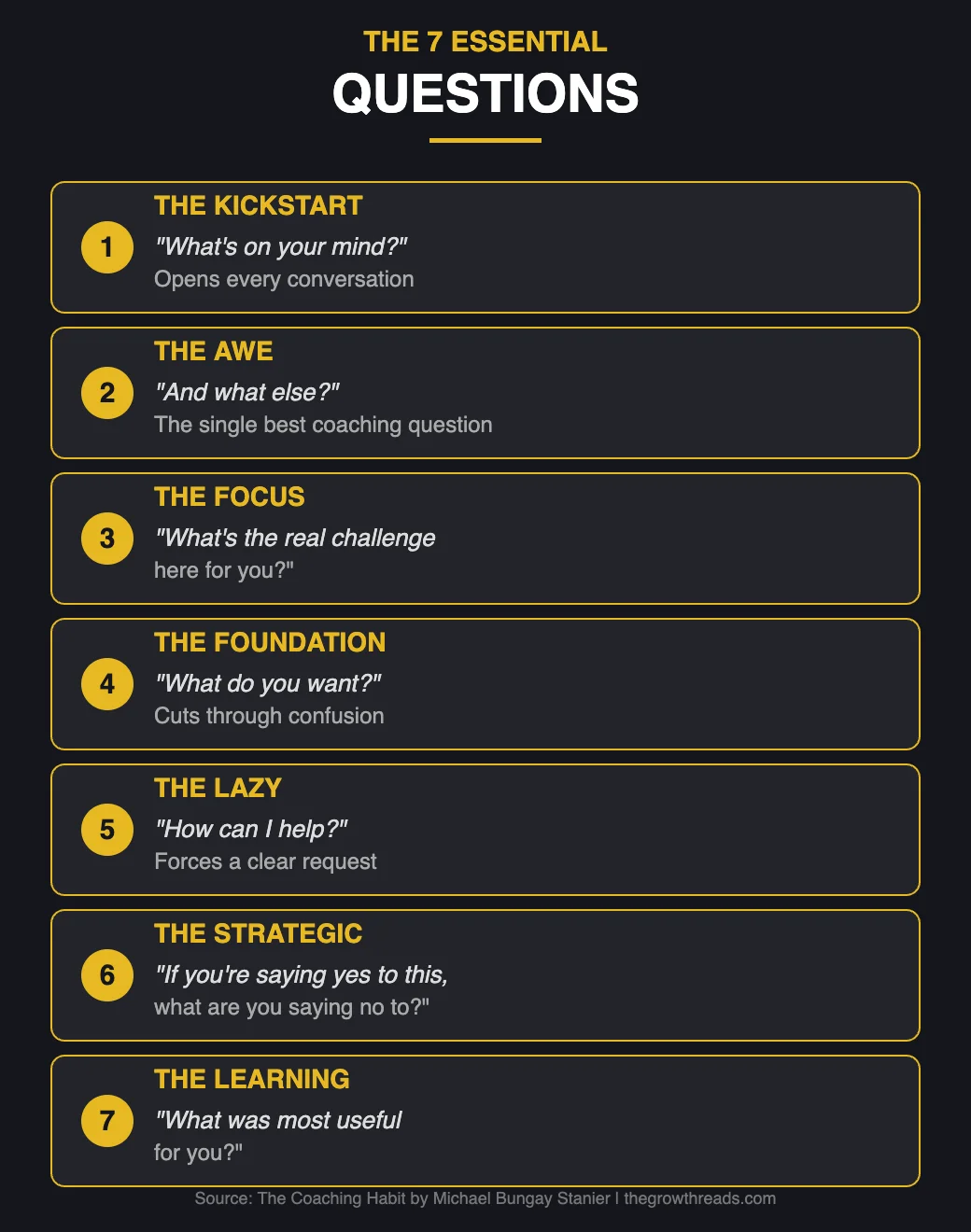
- Seven questions are all you need: Kickstart, AWE, Focus, Foundation, Lazy, Strategic, and Learning — each serves a specific purpose in coaching conversations.
- “And what else?” is the best coaching question: AWE (And What Else) keeps the conversation going, prevents premature problem-solving, and surfaces the real issue.
- The first challenge is rarely the real challenge: The Focus Question — “What’s the real challenge here for you?” — cuts through surface noise to the actual problem.
- Asking “How can I help?” is not lazy — it’s strategic: It forces people to make a clear request instead of dumping vague problems on you.
- Every yes has a hidden no: The Strategic Question reveals the trade-offs people haven’t considered.
- Close with learning: “What was most useful for you?” creates a moment of reflection that doubles the value of any conversation.
- Stay curious ten seconds longer: The gap between hearing a problem and offering advice is where coaching happens. Extend that gap.
- Coaching should be a daily habit, not a formal event: These questions work in hallway conversations, Slack messages, and five-minute check-ins — not just scheduled coaching sessions.
- You can coach in ten minutes or less: Most coaching conversations don’t need an hour. Focused questions make brief interactions powerful.
What is The Coaching Habit about?
The Coaching Habit teaches managers to lead through questions instead of answers. Michael Bungay Stanier provides seven essential questions that transform any conversation from advice-giving into genuine coaching, helping leaders develop their teams, reduce dependency, and create more autonomous, capable organizations.
About the author
Michael Bungay Stanier is the founder of Box of Crayons, a learning and development company that has trained managers at organizations including Microsoft, Salesforce, and TELUS. He was named the #1 Thought Leader in Coaching by Thinkers50 and has been recognized as a Global Coaching Fellow. Born in Australia and based in Toronto, Bungay Stanier holds a Rhodes Scholarship from Oxford and a degree in English Literature from the Australian National University. The Coaching Habit has sold over a million copies worldwide and is the best-selling coaching book of the decade. His follow-up, The Advice Trap, goes deeper into the psychology of why we default to telling instead of asking. Explore all Michael Bungay Stanier book summaries →
Key concepts at a glance
| Concept | What it means | Use it when |
|---|---|---|
| The Advice Monster | The compulsive urge to jump in with solutions before understanding the real problem | You notice yourself formulating answers while someone is still talking |
| AWE question | “And What Else?” — the single best coaching question that keeps conversations going | You are about to give advice after hearing only the first issue raised |
| The real challenge | The first problem presented is rarely the actual problem; the Focus Question finds it | Conversations keep circling without resolution |
| Lazy Question | “How can I help?” — forces the other person to make a specific, actionable request | Someone is venting or dumping without clarity on what they need from you |
| Strategic Question | “If you say yes to this, what are you saying no to?” — reveals hidden trade-offs | Someone is overcommitting or not considering opportunity costs |
| The Learning Question | “What was most useful for you?” — creates reflection and embeds the learning | Ending any coaching conversation or meeting |
Part 1: The problem — why managers give too much advice
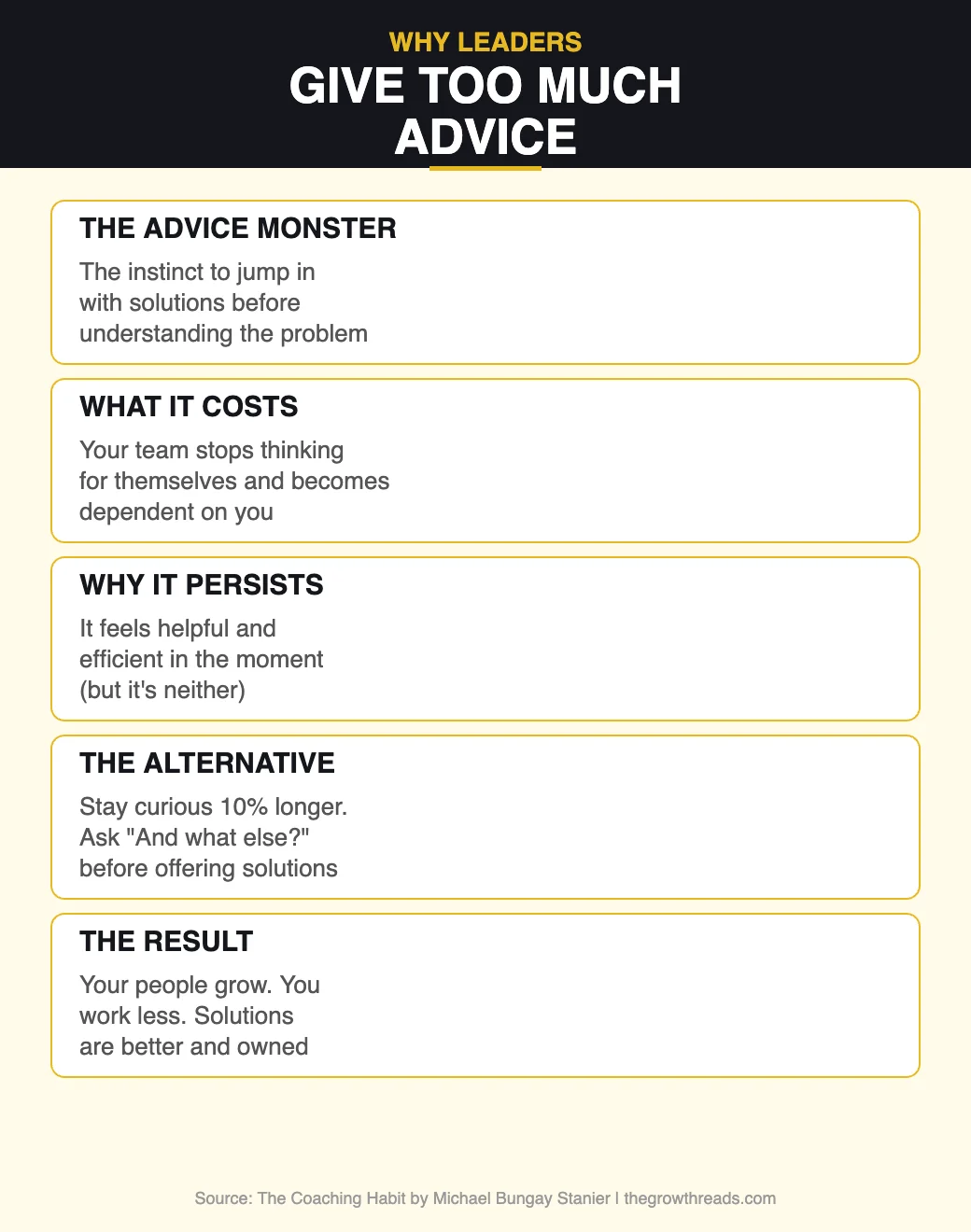
Bungay Stanier opens with a provocative claim: most managers are addicted to giving advice, and it is hurting everyone. He calls this the Advice Monster — the compulsive urge to hear a problem and immediately jump in with a solution. The Advice Monster feels productive. It feels helpful. It feels like leadership. But it creates three serious problems.
First, you end up solving the wrong problem. The issue someone raises first is almost never the real issue. If you jump in with advice immediately, you are solving a surface problem while the deeper challenge goes unaddressed. Second, you create dependency. When you always provide the answers, your team learns to come to you for everything — you become a bottleneck rather than a multiplier. Third, you work harder than you should. You carry the cognitive load for problems that your people should be solving themselves.
The Advice Monster persists because it satisfies three psychological needs: the need to feel competent (“I have the answer”), the need to feel in control (“I’m steering this”), and the need to feel helpful (“I’m adding value”). Bungay Stanier argues that all three are illusions — the manager who asks great questions is more competent, more in control, and more helpful than the one who gives constant advice.
Part 2: The seven questions in practice
The heart of the book walks through each question with examples and practice scenarios. The Kickstart Question — “What’s on your mind?” — opens any conversation with focus. It is broad enough to let the other person choose the topic but focused enough to avoid small talk. Bungay Stanier recommends using it to start every one-on-one meeting, every hallway conversation, and every check-in.
The AWE Question — “And what else?” — is the single most powerful coaching tool in the book. Its purpose: to prevent premature problem-solving. When someone shares a challenge, your instinct is to respond. AWE forces you to hear more before reacting. Bungay Stanier recommends asking it at least three times in any coaching conversation. The first answer is rarely the best answer; the third or fourth often reveals the real issue.
The Focus Question — “What’s the real challenge here for you?” — is the diagnostic tool. It does two things: “real challenge” pushes past the presenting issue to the underlying problem, and “for you” ensures you’re coaching the person, not analyzing the situation abstractly. The Foundation Question — “What do you want?” — sounds simple but is surprisingly hard for most people to answer. It forces clarity and ownership.
The Lazy Question — “How can I help?” — is strategic, not lazy. It prevents you from guessing what the person needs and forces them to make a specific request. The Strategic Question — “If you’re saying yes to this, what are you saying no to?” — reveals trade-offs. Every commitment has an opportunity cost, and this question surfaces it before the commitment is made.
Finally, the Learning Question — “What was most useful for you?” — closes every conversation with reflection. It creates a moment where the person identifies their own takeaway, which significantly increases retention. It also provides you with feedback on what’s actually landing.
Part 3: Building the coaching habit
The final section tackles the hardest part: making coaching a habit rather than an occasional practice. Bungay Stanier uses Charles Duhigg’s habit loop (cue, routine, reward) as his framework. For each of the seven questions, he defines a specific trigger (e.g., “When someone comes to me with a problem”) and a specific new routine (e.g., “I will ask ‘What’s on your mind?’ instead of immediately offering advice”).
He emphasizes that coaching is not a scheduled event — it is a daily behavior. You don’t need an hour-long session to coach someone. A well-placed “And what else?” in a two-minute Slack exchange is coaching. A “What’s the real challenge here for you?” before a five-minute hallway conversation is coaching. The goal is to make these questions your default response rather than your deliberate effort.
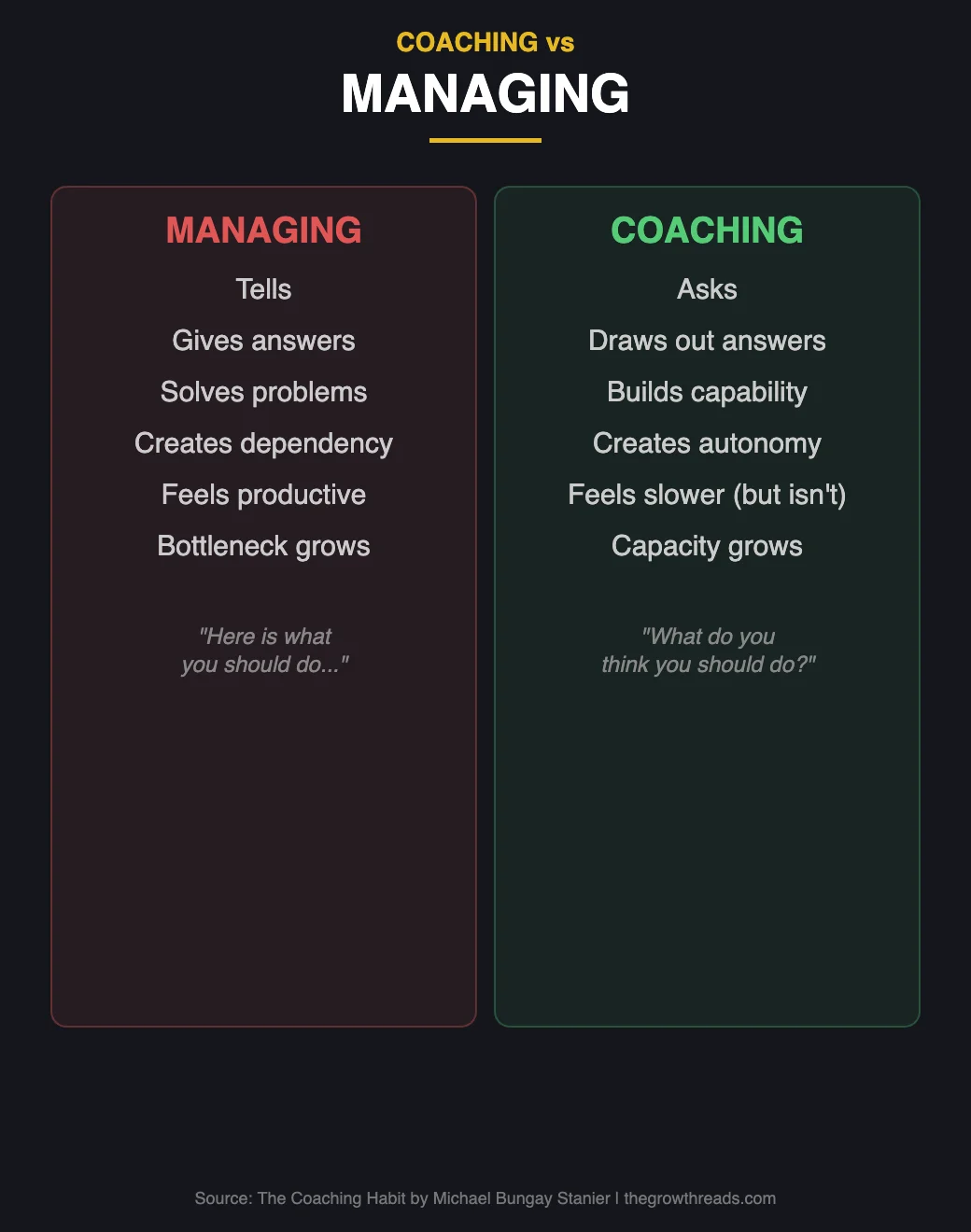
The book closes with a critical insight about organizational culture. Coaching is not just a management technique — it is a signal about what kind of leader you want to be. When you ask questions instead of giving answers, you communicate trust. You communicate that you believe your team is capable. Over time, this shifts the entire culture from dependency to autonomy, from bottleneck leadership to distributed intelligence.
Who is The Coaching Habit best for — and who should read something else first?
This book is ideal for managers, team leads, and anyone who regularly has one-on-one conversations where they tend to give advice instead of asking questions. It is especially valuable for new managers who haven’t yet developed a coaching style and experienced leaders who recognize they’ve become bottlenecks. Mentors, teachers, and parents will also find the questions immediately applicable.
If your challenge is more about organizational culture than individual conversations, Radical Candor by Kim Scott provides a broader framework. If you want a deeper model of how to develop leaders rather than just coach them, Multipliers by Liz Wiseman is the companion read. And if your team’s fundamental issue is trust, start with The Five Dysfunctions of a Team by Patrick Lencioni.
Questions to reflect on
- In my last five conversations at work, how many times did I give advice versus ask a genuine question?
- Who on my team has become dependent on me for answers — and how did I create that dependency?
- What is my Advice Monster’s favorite justification? “I’m saving time?” “They need my expertise?” “It’s faster if I just do it?”
- If I committed to asking “And what else?” three times before offering any solution, what would change in my team’s capability?
- When was the last time someone on my team surprised me with a solution I hadn’t thought of — and how often do I create space for that to happen?
🔥 Ready to say less, ask more, and transform your leadership?
Learn the seven questions that turn every conversation into a coaching moment.
How to apply The Coaching Habit (7-day plan)
- Day 1 — Open with curiosity: In every conversation today, start with “What’s on your mind?” instead of jumping into your agenda.
- Day 2 — Master AWE: Ask “And what else?” at least three times before offering any advice or solution. Notice what emerges on the third ask.
- Day 3 — Find the real challenge: When someone brings you a problem, ask “What’s the real challenge here for you?” before discussing solutions.
- Day 4 — Clarify wants: Ask “What do you want?” in at least two conversations. Watch how it forces clarity and ownership.
- Day 5 — Stop guessing: When someone asks for help, respond with “How can I help?” instead of assuming what they need.
- Day 6 — Surface trade-offs: When someone proposes a plan, ask “If you’re saying yes to this, what are you saying no to?” before approving.
- Day 7 — Close with reflection: End every meeting or important conversation with “What was most useful for you?” Track the patterns.
Frequently asked questions
Do I really need all seven questions?
No — and Bungay Stanier would be the first to say that mastering even two or three will transform your conversations. Start with the AWE Question (“And what else?”) and the Focus Question (“What’s the real challenge here for you?”). These two alone will break the advice-giving habit and surface better problems. Add the others as the habit solidifies. The full seven form a complete coaching conversation arc, but partial adoption is still powerful.
Is this only for managers?
No. The questions work in any relationship where influence matters — parenting, mentoring, teaching, sales, consulting, and peer conversations. The underlying principle — ask before you advise — is universally applicable. Bungay Stanier’s corporate examples are drawn from management contexts, but the framework is about human communication, not org charts. Anyone who tends to give unsolicited advice will benefit.
What is the Advice Monster?
The Advice Monster is Bungay Stanier’s term for the compulsive urge to offer solutions the moment you hear a problem. It operates through three personas: Tell-It (the compulsion to add value by having answers), Save-It (the need to rescue people from difficulty), and Control-It (the desire to maintain control by directing outcomes). The Advice Monster feels like leadership but actually creates dependency, solves wrong problems, and burns out both the leader and the team.
How long does a coaching conversation take?
Most coaching conversations take ten minutes or less when you use focused questions. The book’s central argument is that coaching is not a formal, hour-long event but a daily micro-behavior. A two-minute exchange using the Kickstart and AWE questions can be more impactful than a rambling thirty-minute check-in. The questions create structure that makes brief interactions powerful and purposeful.
What makes “And what else?” so effective?
Three things. First, it prevents premature problem-solving — the first answer to any question is rarely the complete or most important answer. Second, it generates more options — asking AWE three times typically surfaces three to five ideas instead of one. Third, it signals genuine curiosity, which builds trust and makes people feel heard. Bungay Stanier calls it the single best coaching question in existence because of its simplicity and universal applicability.
How is this different from Radical Candor?
Radical Candor by Kim Scott focuses on the balance between caring personally and challenging directly — it is a framework for giving feedback and building culture. The Coaching Habit focuses specifically on asking questions instead of giving advice — it is a framework for developing people through conversation. They complement each other well: Radical Candor tells you what kind of leader to be; The Coaching Habit tells you what to say in the moment.
Can asking too many questions be annoying?
Yes, if you turn every conversation into an interrogation. Bungay Stanier addresses this: the questions should feel like genuine curiosity, not a technique. The key is to actually listen to the answers and follow the thread rather than mechanically cycling through all seven. He also emphasizes that some situations genuinely call for direct advice — if a building is on fire, don’t ask “And what else?” Just say “Get out.” The goal is making questions your default, not your only tool.
Related summaries
- Radical Candor by Kim Scott — the feedback framework that complements coaching questions.
- Multipliers by Liz Wiseman — why asking-based leaders get twice the output of telling-based leaders.
- The Five Dysfunctions of a Team by Patrick Lencioni — fix the trust foundation before layering in coaching.
- Best Leadership Books — our full curated list of essential leadership reads.
How we analyze books: Every book review at The Growth Reads follows a structured evaluation across five criteria: practical applicability, scientific rigor, writing quality, uniqueness of insight, and lasting impact. We read each book cover to cover, cross-reference key claims with primary research, and test the frameworks in real life before publishing. Read our full methodology.