

★★★★½ 4.4 / 5
One-liner: The world’s foremost relationship researcher reveals that the quality of every relationship — romantic, familial, professional — depends on one deceptively simple variable: how you respond to bids for emotional connection.
Best for: Anyone who wants stronger connections in any relationship, couples who feel emotionally disconnected, and readers who prefer data-driven relationship advice.
Reading time: ~7 hrs (guide: 26 min)
Difficulty to apply: Moderate (awareness is the hardest part; the actions are simple)
The Relationship Cure in one minute
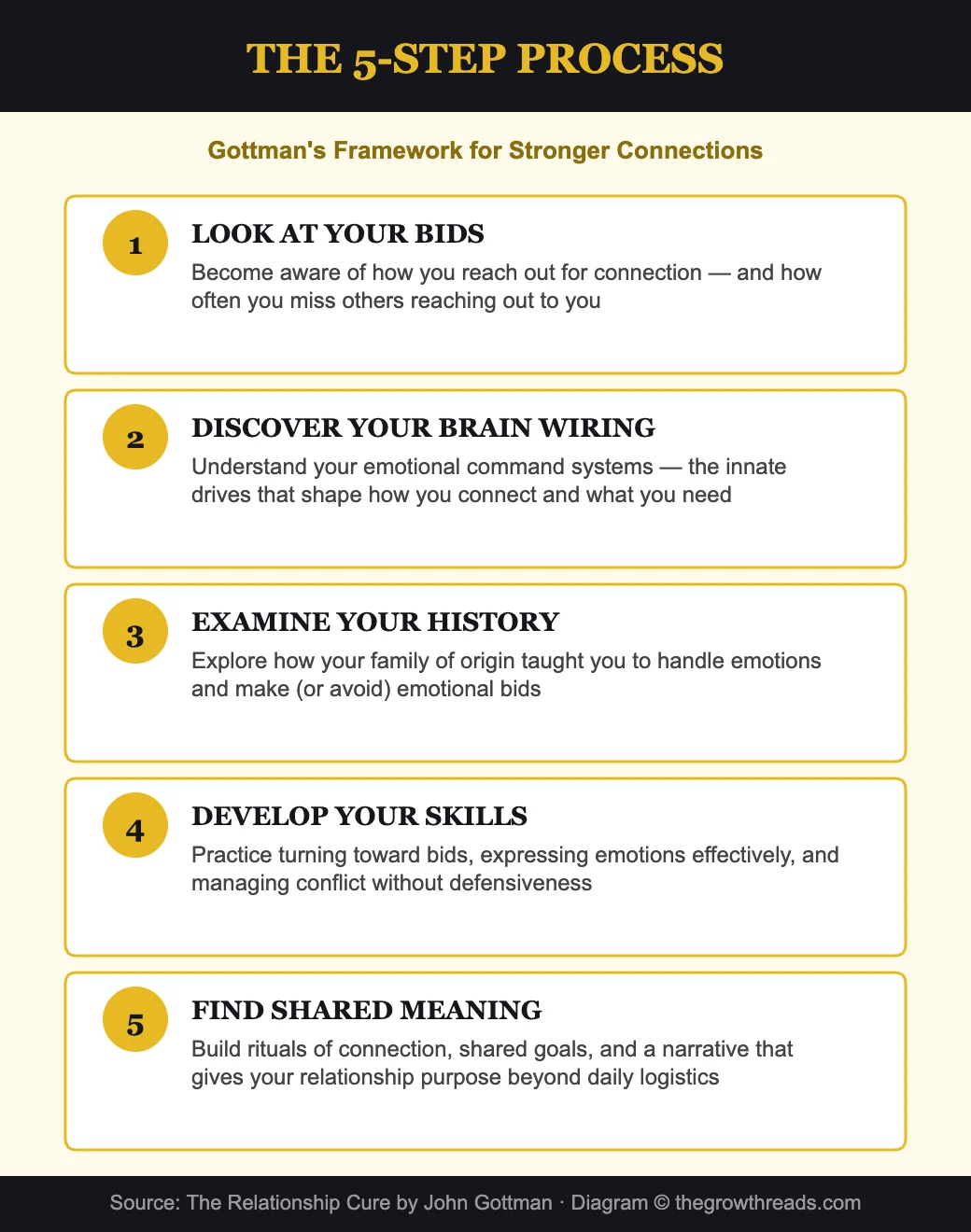
The difference between relationships that thrive and relationships that die comes down to one thing: how you respond when someone reaches out to you. John Gottman, the psychologist who famously predicted divorce with 94% accuracy by watching couples interact for just 15 minutes, wrote The Relationship Cure to make his laboratory findings practical. The core concept is the “bid” — any attempt to connect with another person, from a dramatic declaration of love to a casual comment about the weather. Gottman’s research shows that partners in happy relationships “turn toward” each other’s bids 86% of the time, while partners heading for divorce turn toward only 33% of the time. The book provides a five-step framework for becoming aware of bids, understanding your emotional wiring, examining how your history shapes your connecting style, developing turning-toward skills, and building shared meaning. It applies to every relationship, not just romantic ones.
Key takeaways
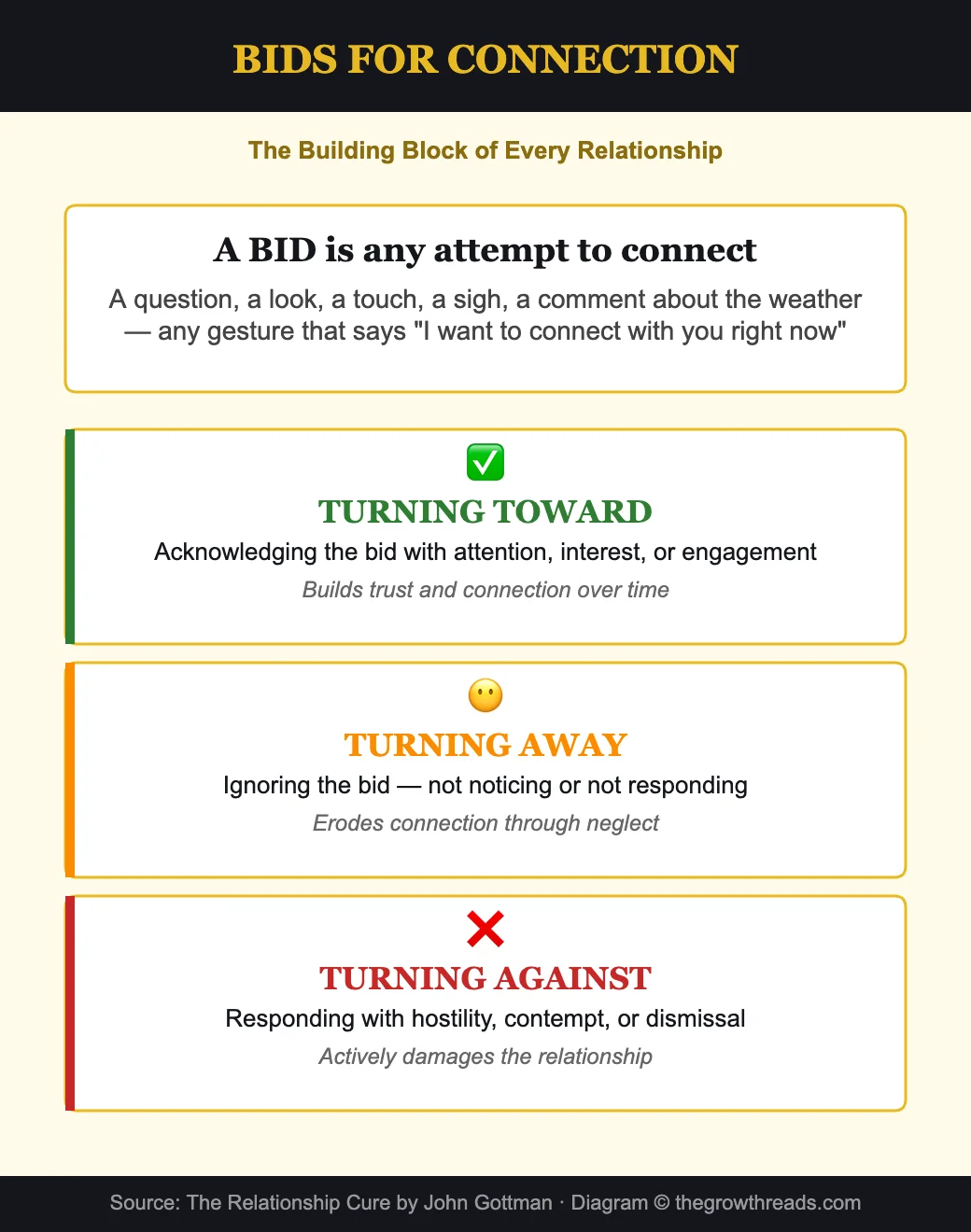
- Bids are the fundamental unit of connection: A bid is any gesture — verbal or non-verbal — that says “I want to connect with you.” A question, a sigh, a touch on the arm, a joke, a comment about the news. Most bids are small and easy to miss.
- There are three responses to a bid: Turning toward (acknowledging with attention), turning away (ignoring, not noticing), and turning against (responding with hostility or contempt). Only turning toward builds connection.
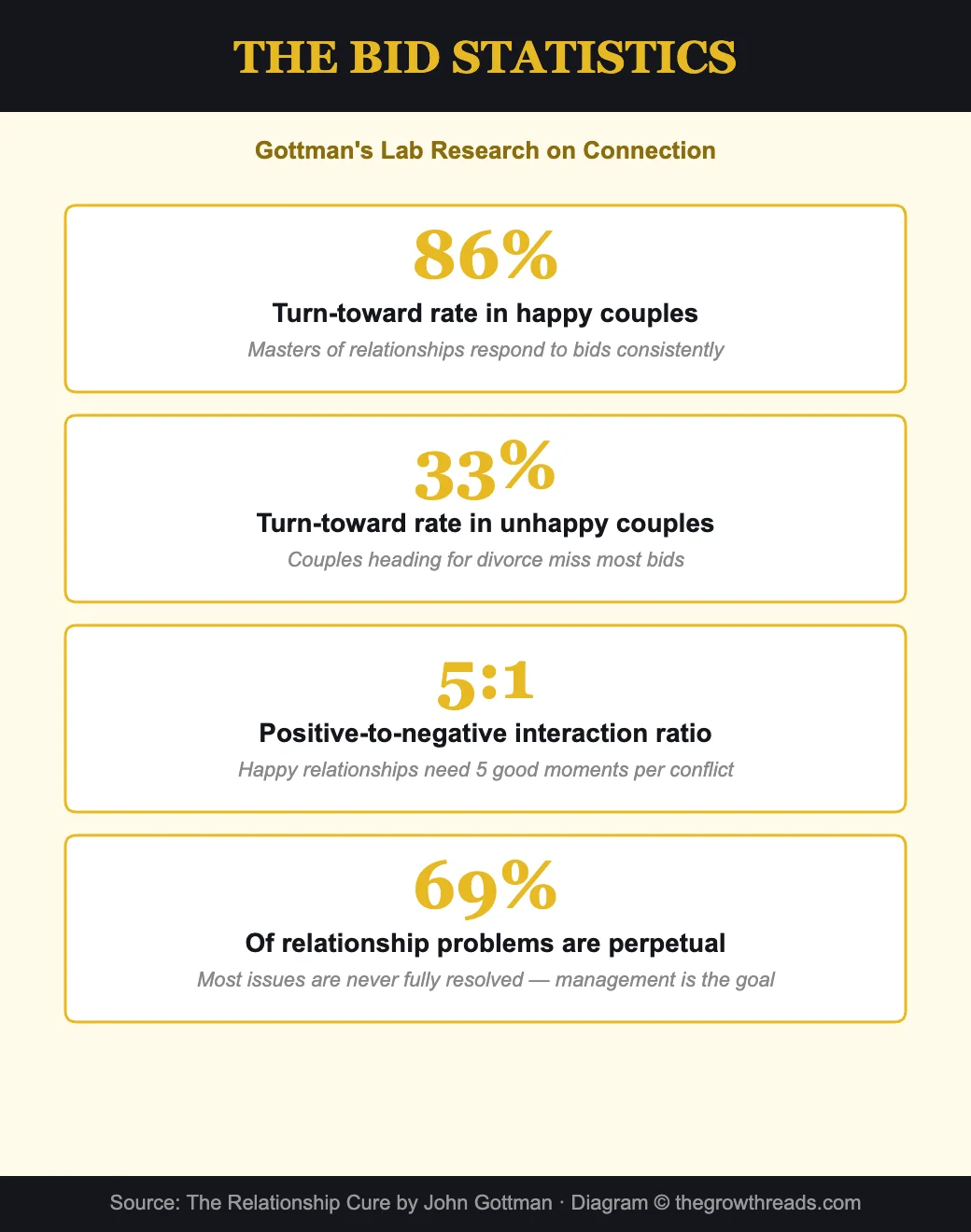
- Happy couples turn toward 86% of the time: Gottman’s lab observations show that the ratio of turning toward to turning away/against is the single strongest predictor of relationship satisfaction and longevity.
- Most bids are small and indirect: The most consequential bids are not dramatic declarations — they are the small moments: “Look at that bird,” “How was your day?” “I had a weird dream.” Missing these small bids consistently erodes trust more than any single conflict.
- The 5:1 ratio predicts relationship health: Stable, happy relationships maintain at least five positive interactions for every negative one. Below this ratio, the relationship deteriorates regardless of how the couple handles conflict.
- 69% of relationship problems are perpetual: Most issues between partners are never fully resolved — they are managed. This is normal, not failure. The difference between happy and unhappy couples is not whether they have perpetual problems but whether they can discuss them with humour and acceptance.
- Emotional command systems shape your bid style: Gottman identifies innate emotional drives (commander-in-chief, explorer, sensualist, energy czar, jester, nest-builder, sentry) that influence how you connect and what you need from others.
- Your family of origin taught you to bid (or not): How your parents handled emotional expression directly shapes how comfortable you are making and responding to bids as an adult.
- Shared meaning is the highest level of connection: Beyond managing conflict and turning toward bids, the deepest relationships build shared rituals, goals, values, and narratives that give the partnership meaning beyond daily logistics.
- These principles work in every relationship: Bids, turning toward, and the 5:1 ratio apply to friendships, parent-child relationships, work teams, and extended family — not just romantic partnerships.
What is The Relationship Cure about?
The Relationship Cure translates John Gottman’s laboratory research on couples into a practical five-step framework for strengthening any relationship. The book centres on the concept of “bids for connection” and shows that how you respond to small, everyday moments of reaching out determines the quality of your most important relationships.
About the author
John Gottman, PhD, is a psychologist and professor emeritus at the University of Washington who has spent over 40 years studying what makes relationships succeed or fail. His “Love Lab” — where he observed thousands of couples interacting and measured physiological responses including heart rate, cortisol, and facial microexpressions — produced the most rigorous empirical data on relationships in the history of psychology. He is famous for being able to predict whether a couple will divorce with 94% accuracy after watching them interact for just 15 minutes. Gottman and his wife Julie Schwartz Gottman co-founded the Gottman Institute, which trains therapists worldwide. His books, including The Seven Principles for Making Marriage Work and The Relationship Cure, have sold millions of copies and shaped modern couples therapy. Explore all John Gottman book summaries →
Key concepts at a glance
| Concept | What it means | Use it when |
|---|---|---|
| Bid for connection | Any attempt to connect — a question, a look, a comment, a touch | You want to understand the micro-moments that build or erode relationships |
| Turning toward | Acknowledging a bid with attention, interest, or engagement | Someone reaches out and you want to connect |
| Turning away | Missing or ignoring a bid — not hostile, just absent | You realise you have been preoccupied during a conversation |
| Turning against | Responding to a bid with hostility, contempt, or dismissal | You catch yourself snapping at a small request |
| 5:1 ratio | Happy relationships need 5 positive interactions per negative one | You want a benchmark for relationship health |
| Emotional command systems | Innate emotional drives that shape how you connect and what you need | You want to understand your own connecting style |
| Shared meaning | Rituals, goals, and narratives that give the relationship purpose | Your relationship feels functional but flat |
Part 1 — The bid
Gottman opens with the research finding that grounds the entire book: in his laboratory observations of thousands of couples, the single strongest predictor of relationship satisfaction, stability, and longevity was not communication style, conflict management, or sexual compatibility — it was how partners responded to small, everyday bids for emotional connection. A bid is any gesture that says “I want to connect with you.” It can be as dramatic as “I love you” or as mundane as “Look at that sunset.” Most bids are small, indirect, and easy to miss — which is precisely why they matter so much.
The data is striking. In a 1998 study, Gottman observed newlywed couples and tracked their bids and responses over a weekend. Six years later, he checked which couples had divorced. The couples still together had turned toward each other’s bids 86% of the time during the observation period. The couples who had divorced had turned toward only 33% of the time. The difference was not in how they argued — it was in how they responded to “Look at that beautiful bird out the window.” The partner who looked up and said “Oh, that’s a goldfinch!” was building connection. The partner who continued scrolling their phone was eroding it. Not maliciously — just by failing to notice the bid.
Gottman distinguishes three responses. Turning toward means acknowledging the bid with any form of attention — full engagement is ideal, but even a brief “Hmm, nice” counts. Turning away means not noticing or not responding — the most common and most quietly destructive response because it communicates “you are not worth my attention.” Turning against means responding with hostility (“Can’t you see I’m busy?”), which is less common but actively damages trust. The cumulative effect of thousands of small turning-toward or turning-away moments is what determines whether a relationship feels warm or cold, connected or lonely.
Part 2 — Understanding your wiring
Steps 2 and 3 of Gottman’s framework explore why people have different bidding and responding styles. He introduces the concept of “emotional command systems” — innate neurological drives that shape what kind of connection you seek and how you express it. The Commander-in-Chief system drives the need for control and competence. The Explorer drives curiosity and adventure. The Sensualist drives the need for physical pleasure and comfort. The Energy Czar drives the need for rest and conservation. The Jester drives playfulness and humour. The Nest-Builder drives domesticity and caregiving. The Sentry drives vigilance and protection.
Everyone has all seven systems, but they are active at different levels. A couple where one partner has a dominant Explorer system and the other has a dominant Nest-Builder system will experience friction — not because they are incompatible, but because they make different kinds of bids and interpret the same bids differently. The Explorer’s bid might be “Let’s go somewhere new this weekend!” while the Nest-Builder’s bid might be “Let’s stay home and cook together.” Neither is wrong — but if either partner cannot recognise the other’s bid as a genuine attempt to connect, they will turn away without meaning to.
The family-of-origin chapter examines how your parents modelled emotional connection. Gottman identifies several dysfunctional family styles — emotion-dismissing families (feelings are minimised or ignored), emotion-disapproving families (feelings are punished or criticised), and laissez-faire families (feelings are acknowledged but no guidance is offered). Each style produces adults with specific blind spots around emotional bids. If your family dismissed emotions, you may struggle to recognise bids. If your family punished emotional expression, you may flinch when someone makes a vulnerable bid. Understanding your history is not about blaming your parents — it is about seeing the patterns so you can choose differently.
Part 3 — Building connection
Steps 4 and 5 focus on developing skills and building shared meaning. The skill-building section is pure Gottman: practical, specific, and grounded in what the data shows works. The primary skill is simply noticing bids — which requires presence, not technique. Most people miss bids not because they are cold-hearted but because they are distracted. Putting down your phone, making eye contact, and giving a brief response to a partner’s comment is turning toward. It takes five seconds. Over a year, those five-second moments accumulate into the emotional bank account that determines whether the relationship feels warm or hollow.
The 5:1 ratio provides a benchmark. Gottman found that stable, happy relationships maintain at least five positive interactions for every negative one during conflict discussions. Below this ratio, even couples with good communication skills deteriorate. The positive interactions do not need to be grand — a smile, a joke, a touch, a word of agreement, an expression of interest — they just need to be consistent. The ratio explains why criticism is so corrosive: one contemptuous comment requires five acts of repair to restore the emotional balance.
The shared meaning chapter is the book’s most aspirational section. Beyond managing bids and maintaining ratios, the deepest relationships build something larger than the sum of their parts: shared rituals (weekly date nights, morning coffee together, annual traditions), shared goals (raising children, building a business, travelling), and a shared narrative (“here is who we are as a couple, here is what we stand for”). Shared meaning transforms a functional partnership into a meaningful one — the difference between a relationship that survives and one that gives both partners’ lives purpose.
Who is The Relationship Cure best for — and who should read something else first?
This book is for anyone who wants to understand the science of connection — not just romantic love, but friendship, family, and professional relationships. The bid concept is so fundamental that it improves every form of human interaction. It is particularly valuable for couples who feel emotionally disconnected but cannot identify why, and for anyone who knows they “should” be more present but does not know what that looks like in practice.
If you want Gottman’s framework applied specifically to marriage, start with The Seven Principles for Making Marriage Work. If emotional reconnection is urgent, Hold Me Tight by Sue Johnson is more immediately therapeutic. And if the desire dimension needs attention alongside the emotional connection, Mating in Captivity explores the complementary paradox.
Questions to reflect on
- How often do you turn toward your partner’s small bids — the casual comments, the glances, the sighs — versus turn away into your phone or your thoughts?
- What would change in your closest relationship if you responded to 86% of bids instead of 33%?
- Which emotional command system is most dominant in you — and does your partner know this about you?
- What shared rituals, goals, or narratives give your relationship meaning beyond daily logistics?
- If most relationship problems are perpetual, how would it change your approach to know that management — not resolution — is the realistic goal?
🔥 Ready to master the art of connection?
Learn the one skill that predicts relationship success — and start turning toward the people you love.
How to apply The Relationship Cure (7-day plan)
- Day 1 — Count your bids: For one day, notice every bid for connection you make and receive. A comment, a question, a touch, a look. Tally how many you make, how many you receive, and how many you turn toward versus away. This is your baseline.
- Day 2 — Turn toward 5 bids: Consciously respond to at least five bids from people you care about today. Put down your phone, make eye contact, and engage — even briefly. Notice how the other person responds.
- Day 3 — Make 3 deliberate bids: Instead of waiting for others to reach out, make three clear bids yourself: share something interesting, ask a genuine question, or initiate physical contact. Observe which bids get turned toward.
- Day 4 — Identify your command systems: Which emotional drives are strongest in you — Commander, Explorer, Sensualist, Energy Czar, Jester, Nest-Builder, or Sentry? How do these shape the type of bids you make?
- Day 5 — Explore your family patterns: How did your family handle emotional expression? Were feelings dismissed, punished, or welcomed? How does that history shape your comfort with making and receiving bids today?
- Day 6 — Repair a missed bid: Think of a recent moment when you turned away from someone’s bid. Go back and acknowledge it: “I realised earlier when you said X, I was distracted. Tell me more.” This is a repair bid — and it is powerful.
- Day 7 — Create a shared ritual: Establish one small daily or weekly ritual with someone you love: morning coffee together, a bedtime check-in, a weekly walk. Rituals create reliable opportunities for bids and turning toward.
Frequently asked questions
Is this book only about romantic relationships?
No. While Gottman’s research began with couples, The Relationship Cure explicitly extends the bid concept to friendships, parent-child relationships, sibling relationships, and work teams. The principle — connection is built through small moments of turning toward — applies universally. Many readers report that the book improved their work relationships and friendships as much as their romantic partnerships.
How is this different from The Seven Principles for Making Marriage Work?
The Seven Principles is focused specifically on marriage and provides the “Sound Relationship House” framework with seven specific principles for marital success. The Relationship Cure is broader in scope (all relationships, not just marriage) and deeper on the bid concept specifically. Seven Principles is more prescriptive (“do these seven things”); The Relationship Cure is more explanatory (“here is why connection works the way it does”). Most Gottman readers benefit from reading both — Seven Principles for the marriage toolkit, and The Relationship Cure for the underlying science.
What exactly counts as a bid?
Almost anything. A bid is any attempt to connect — verbal (“Did you see the news today?”), physical (a touch on the shoulder), emotional (“I had a tough day”), non-verbal (a sigh, a look), or even a bid for shared attention (“Look at that dog!”). Gottman estimates that in a typical day, partners make dozens of bids to each other, most of which are so small they do not register consciously. The skill is learning to notice them — because the ones you miss are the ones that erode connection.
What if my partner consistently turns away from my bids?
First, consider whether they are turning away because they are distracted or stressed, not because they do not care. Bring the concept of bids into the open: share what you have learned and ask them to practise noticing. If turning away is chronic and resistant to conversation, it may indicate a deeper issue — unprocessed resentment, depression, or a fundamental mismatch in connection needs. In that case, couples therapy (ideally Gottman-trained) is recommended.
Is the 5:1 ratio really that precise?
The 5:1 ratio is an empirical finding from Gottman’s lab, not a rigid prescription. It means that in healthy relationships during conflict discussions, positive interactions (humour, affection, interest, agreement, validation) outnumber negative interactions (criticism, contempt, defensiveness, stonewalling) by at least five to one. The exact number is less important than the principle: you need a substantial surplus of positive moments to buffer the inevitable negative ones. It is a benchmark for relationship health, not a scorecard to track daily.
What are emotional command systems?
Gottman borrowed this concept from neuroscience researcher Jaak Panksepp’s work on core emotional systems in the brain. The seven systems (Commander-in-Chief, Explorer, Sensualist, Energy Czar, Jester, Nest-Builder, Sentry) represent innate drives that shape what kind of connection you seek and how you express it. They are not personality types — everyone has all seven — but they are active at different levels. Understanding your dominant systems helps explain why certain bids feel natural and others feel foreign, and why you and your partner may make very different kinds of bids.
Can I really predict relationship success by watching bid responses?
Gottman’s research says yes, with impressive accuracy. In multiple studies, the ratio of turning toward to turning away/against during a brief observation period predicted relationship outcomes years later. The 86% versus 33% turning-toward rate reliably distinguished “masters” (still happy together) from “disasters” (separated or chronically unhappy). This does not mean every single bid must be responded to — but the overall pattern of responsiveness is the strongest leading indicator of relationship health that research has identified.
Related summaries
- The Seven Principles for Making Marriage Work by John Gottman — The companion book applying Gottman’s research specifically to marriage.
- Hold Me Tight by Sue Johnson — Emotionally Focused Therapy for reconnecting when emotional bonds have frayed.
- Getting the Love You Want by Harville Hendrix — The imago theory of partner selection and conscious relationship.
- Attached by Amir Levine — Attachment theory explains why some people turn toward bids naturally and others turn away.
- See all Relationships book summaries on our Best Relationship Books pillar page.