

★★★★½ 4.4 / 5
One-liner: A relationship therapist reveals that you unconsciously chose your partner to heal your childhood wounds — and that the conflict you experience is not a sign of failure but the doorway to a deeper, more conscious love.
Best for: Couples in the power-struggle phase, anyone who keeps choosing the same type of partner, and therapists working with romantic relationships.
Reading time: ~7 hrs (guide: 26 min)
Difficulty to apply: High (requires both partners to engage in structured exercises)
Getting the Love You Want in one minute
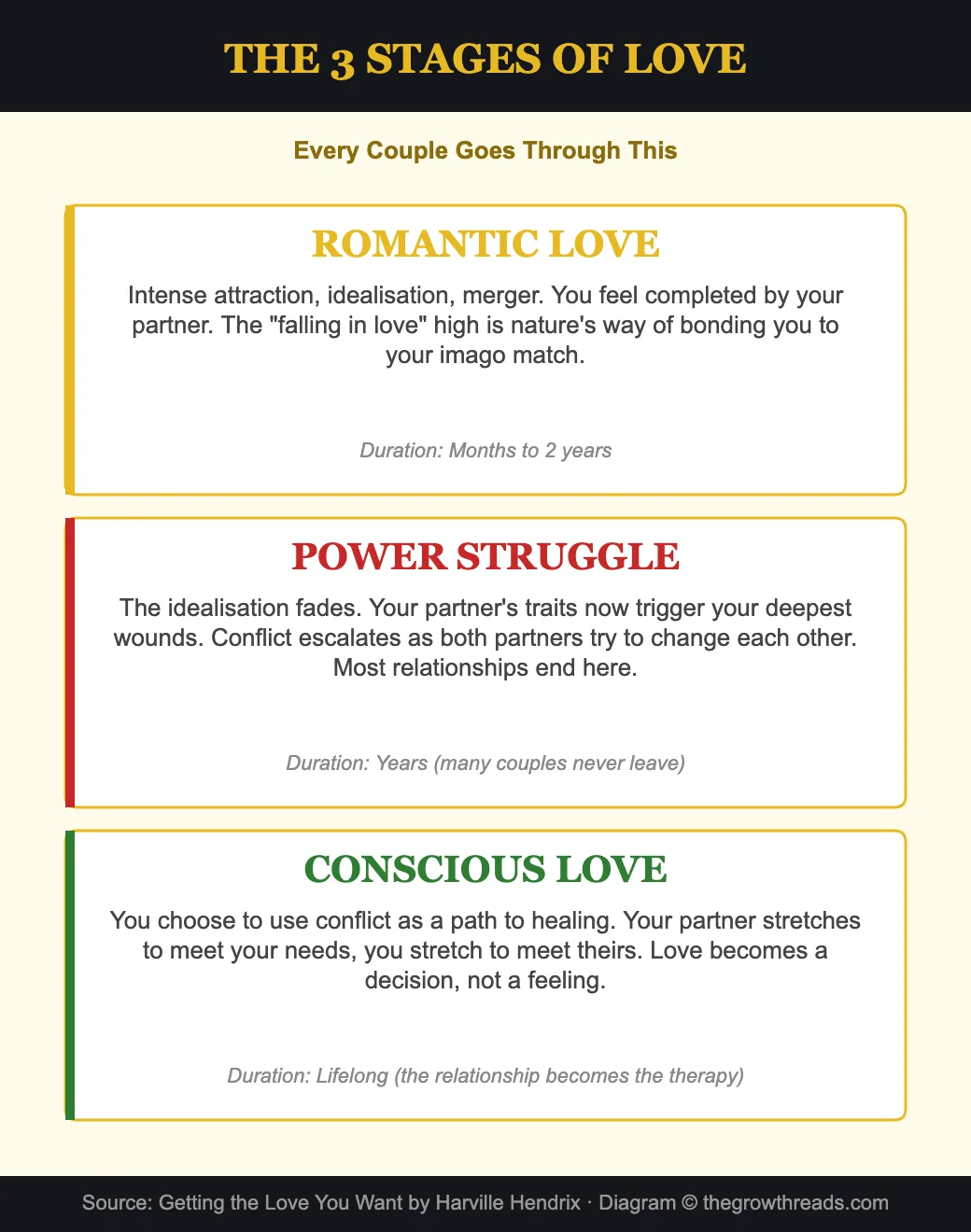
You did not choose your partner by accident — your unconscious selected them because they resemble the caregivers who wounded you, offering you the chance to heal those wounds through adult love. Harville Hendrix, a couples therapist and relational theorist, developed Imago Relationship Therapy (IRT) based on a striking observation: people consistently fall in love with partners who are temperamentally similar to the parent who hurt them most. This is not masochism — it is the psyche’s attempt at completion. The unconscious “imago” (Latin for “image”) is a composite of your caregivers’ traits, and it draws you toward partners who can re-create the conditions of your original wounding — but this time, with the possibility of a different outcome. The book maps three stages every relationship passes through (romantic love, power struggle, conscious love) and provides Intentional Dialogue — a structured communication process — as the primary tool for transforming conflict into healing.
Key takeaways
- Your partner is your unconscious match: The imago — an unconscious composite of your caregivers’ traits — draws you to partners who trigger your deepest childhood wounds. This is not bad luck; it is your psyche seeking healing.
- Romantic love is nature’s anaesthesia: The intoxication of early love numbs the awareness that your partner triggers your wounds. It feels like completion because your unconscious recognises the familiar — even the painful familiar.
- The power struggle is inevitable and necessary: When romantic love fades, each partner’s childhood wounds surface. The traits that attracted you now trigger you. This conflict is not the relationship failing — it is the real work beginning.
- Most couples quit during the power struggle: They assume the conflict means they chose wrong. Hendrix argues they chose exactly right — but they need tools to work with the conflict rather than escape it.
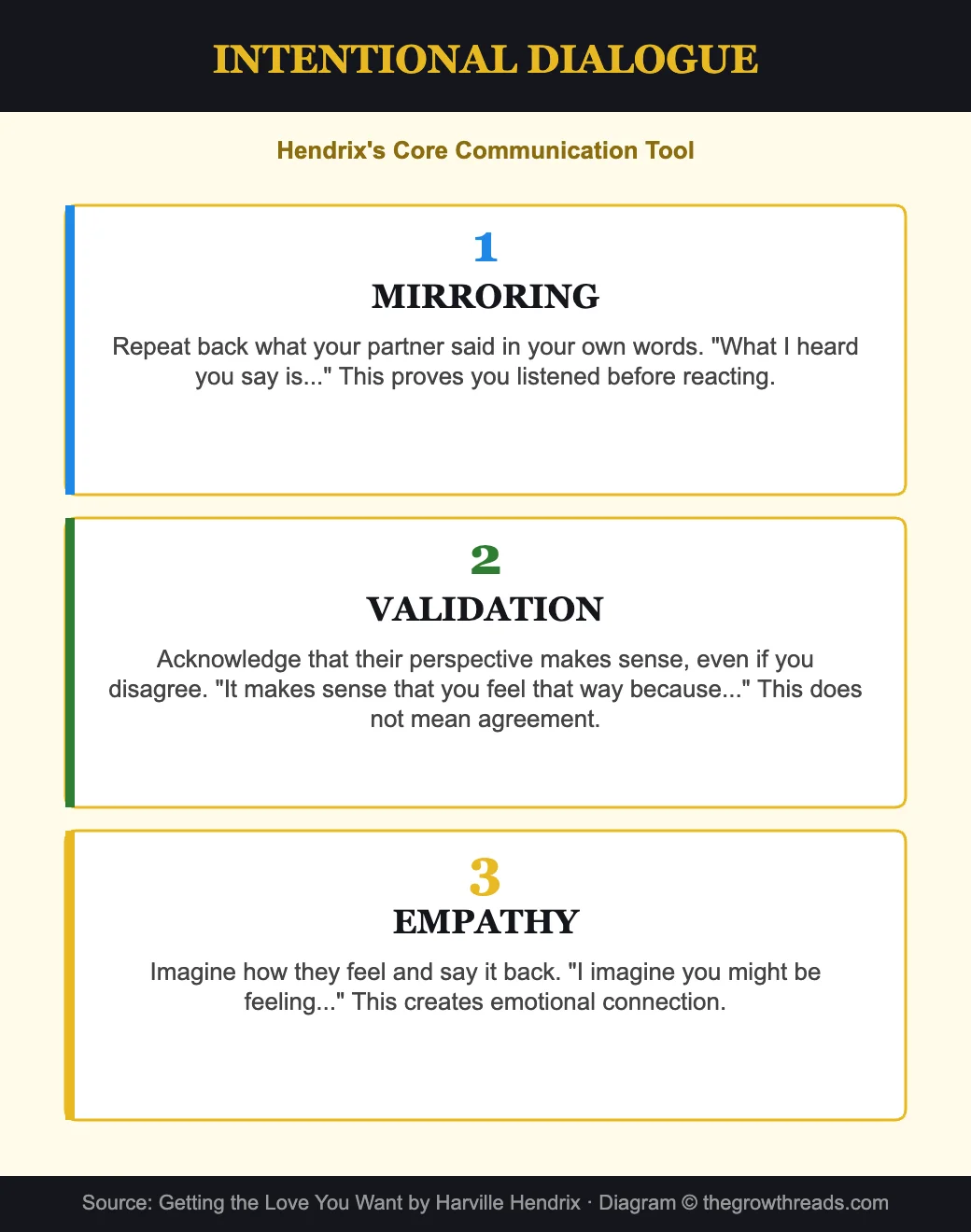
- Intentional Dialogue is the master tool: Mirror (repeat what you heard), Validate (acknowledge it makes sense), Empathise (imagine how they feel). This three-step process transforms reactive arguments into connecting conversations.
- Stretching is how love heals: Your partner needs something from you that is difficult for you to give (because it requires you to grow beyond your comfort zone). Giving it heals their wound and develops your underdeveloped capacity.
- Conscious love is a choice, not a feeling: The third stage — a mature, intentional partnership — requires deciding to use the relationship as a vehicle for mutual growth rather than expecting it to make you happy effortlessly.
- Frustrations reveal unmet childhood needs: What frustrates you most about your partner is usually a disguised version of what you needed from your parents but did not receive.
- The relationship is the therapy: Hendrix argues that a conscious partnership is the most powerful healing environment available — more potent than individual therapy because it occurs in the same relational context where the wounds were created.
- Both partners must participate: IRT is designed as a couples process. While individual insight is valuable, the transformative power comes from both partners practising the dialogue and stretching exercises together.
What is Getting the Love You Want about?
Getting the Love You Want introduces Imago Relationship Therapy — a framework showing that romantic attraction is driven by unconscious childhood patterns, that conflict is the doorway to healing, and that a conscious partnership using Intentional Dialogue can transform a struggling relationship into a therapeutic alliance for mutual growth.
About the author
Harville Hendrix, PhD, is a couples therapist, pastoral counsellor, and relational theorist who developed Imago Relationship Therapy in the 1980s with his wife and collaborator Helen LaKelly Hunt, PhD. The framework emerged from his personal experience (a painful divorce) and his doctoral research integrating psychoanalytic object relations theory, developmental psychology, and neuroscience. Getting the Love You Want was published in 1988, became a New York Times bestseller after Oprah Winfrey featured it multiple times, and has sold over four million copies worldwide. Hendrix and Hunt have trained over 2,500 certified Imago therapists in 53 countries, making IRT one of the most widely practised couples therapy modalities in the world. Explore all Harville Hendrix book summaries →
Key concepts at a glance
| Concept | What it means | Use it when |
|---|---|---|
| Imago | An unconscious composite image of your caregivers that guides partner selection | You want to understand why you are attracted to a specific type |
| Romantic love stage | The initial phase of idealisation, merger, and neurochemical intoxication | You are in a new relationship and feel “this is the one” |
| Power struggle | The conflict phase where childhood wounds surface and partners try to change each other | You are in recurring conflict and considering leaving |
| Conscious love | The intentional phase where conflict is used for healing rather than fought or fled | You want to transform your relationship from reactive to intentional |
| Intentional Dialogue | Mirror → Validate → Empathise: the structured communication tool | You need a framework for difficult conversations |
| Stretching | Giving your partner something they need that is difficult for you | You are asked to grow beyond your comfort zone for the relationship |
| Behaviour change request | Translating a frustration into a specific, positive action request | You want to stop complaining and start asking for what you need |
Part 1 — The unconscious marriage
Hendrix opens with a claim that initially feels uncomfortable: you married your parent. Not literally, but emotionally — you selected a partner whose temperamental profile matches the composite of your caregivers’ traits, including (especially) the traits that wounded you. The imago forms in early childhood as the brain catalogues every emotional experience with caregivers: the mother who was emotionally distant, the father who was critical, the parent who was unpredictable. These traits merge into an unconscious template that later guides romantic attraction with the precision of a heat-seeking missile.
This explains one of the most common relationship puzzles: why do people keep choosing the same type of partner? A woman who grew up with a distant father is drawn to emotionally unavailable men — not because she enjoys being hurt, but because her unconscious recognises the familiar wound and seeks an opportunity to heal it. A man raised by a critical mother finds himself attracted to demanding women for the same reason. The attraction feels like chemistry, but it is actually the unconscious saying: “This person can give me what I missed — if I can just get them to change.”
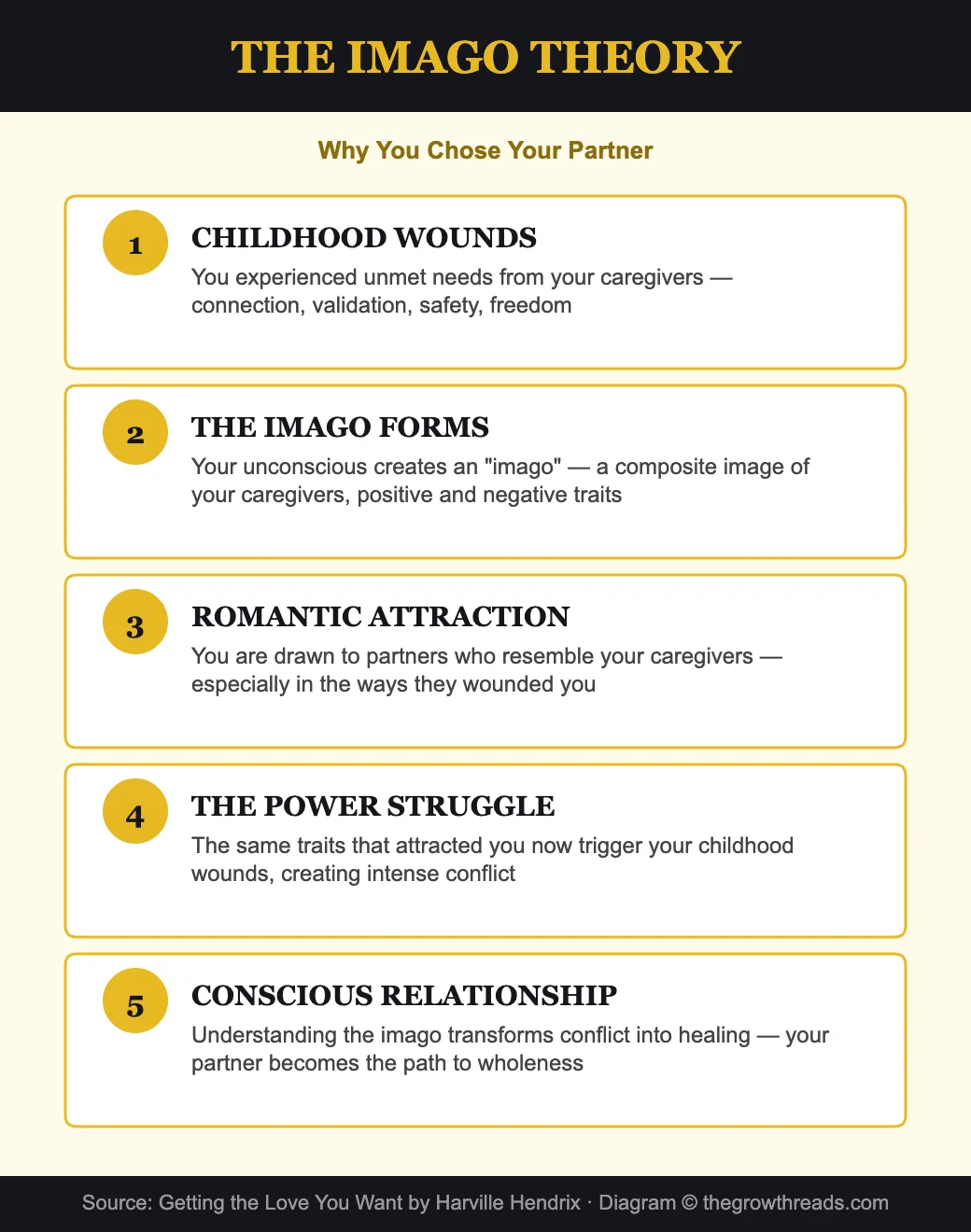
Romantic love, in this framework, is not a random emotion but an evolutionary bonding mechanism that serves the imago’s purpose. The neurochemical cocktail of dopamine, oxytocin, and serotonin creates a state of blissful merger that allows two imago-matched partners to bond before the real work begins. Hendrix calls romantic love “nature’s anaesthesia” — it numbs awareness of the wounds that will surface later. This is not cynical; it is pragmatic. Without the bonding power of romantic love, most couples would never stay together long enough to reach the healing phase.
Part 2 — The power struggle and the dialogue
When romantic love fades — typically 6 months to 2 years — the power struggle begins. The same traits that attracted you now trigger you. The partner who seemed “strong and decisive” now feels “controlling.” The partner who seemed “warm and nurturing” now feels “suffocating.” This is not because the partner changed; it is because the anaesthesia wore off and the wounds became visible. Each partner now projects their childhood frustrations onto the other: “You never listen” (my parent never listened). “You are too needy” (my parent’s needs overwhelmed me). “You are pulling away” (my parent was emotionally absent).
The Intentional Dialogue is Hendrix’s central tool for transforming the power struggle into conscious love. It has three steps, each deceptively simple and extraordinarily difficult in practice. Mirroring: repeat back what your partner said without interpreting, judging, or defending. “What I heard you say is…” This alone is revolutionary — most couples have never experienced being truly heard. Validation: acknowledge that your partner’s perspective makes sense from their point of view, even if you disagree. “It makes sense that you feel that way because…” This does not mean agreement; it means granting legitimacy to another person’s inner experience. Empathy: imagine how your partner feels and say it back. “I imagine you might be feeling hurt and unseen.” This creates the emotional connection that the power struggle destroys.
Part 3 — The conscious partnership
The final section describes what Hendrix calls the “conscious marriage” — a partnership where both people have agreed to use their relationship as a vehicle for mutual healing and growth. This is not the absence of conflict; it is a fundamentally different relationship with conflict. In a conscious partnership, when your partner triggers you, the response is not “you need to change” but “this trigger is telling me something about my own wound — what childhood need is being activated, and how can we work with it together?”
The stretching concept is central. Your partner’s deepest need typically requires you to do something that does not come naturally — because it requires growth in an area your own childhood left underdeveloped. If you grew up with critical parents, your partner may need unconditional acceptance from you — the very thing that feels most foreign. If you grew up with enmeshed parents, your partner may need autonomy from you — which triggers your abandonment fear. The stretch is not comfortable, but it is the mechanism through which both partners grow: by giving what is difficult, you develop capacities you lacked; by receiving what you needed, your childhood wound heals.
Hendrix provides a structured process for translating frustrations into behaviour change requests. Instead of “you never pay attention to me” (a criticism from the Parent ego state, as Berne would say), the request becomes: “Would you be willing to put your phone away and make eye contact for 10 minutes after dinner three times this week?” The specificity is crucial — it gives the partner something concrete to do rather than a character flaw to fix. And the requestor takes responsibility for their own wound: “When I don’t feel seen, it activates the part of me that felt invisible to my mother.”
Who is Getting the Love You Want best for — and who should read something else first?
This book is essential for any couple experiencing recurring conflict who suspects they might be “stuck.” The imago framework reframes conflict from a sign of incompatibility into evidence that you chose exactly the right person for your growth. It is particularly powerful for couples who are considering separation — Hendrix argues that leaving this partner often means choosing the next partner from the same imago, repeating the cycle.
If you are single and want to understand your attraction patterns before entering another relationship, the imago framework is highly illuminating — start here before reading dating books. If attachment style is your primary framework, Attached is more focused. If you want a communication tool without the theoretical depth, Crucial Conversations is more immediately actionable. And if the Gottman research approach appeals more to you than the psychodynamic approach, The Seven Principles for Making Marriage Work provides the data-driven companion.
Questions to reflect on
- Which of your caregivers’ traits — both positive and negative — do you recognise in your current or most recent partner?
- What frustrates you most about your partner, and what unmet childhood need might that frustration be pointing to?
- If your power-struggle conflicts are actually invitations to heal, what would change about how you approach them?
- When was the last time you truly mirrored your partner — repeated back what they said without interpreting, judging, or defending?
- What would your partner ask you to “stretch” toward — and what childhood conditioning makes that stretch so difficult?
🔥 Ready to transform conflict into connection?
Learn why you chose your partner and how the Intentional Dialogue can heal your deepest wounds.
How to apply Getting the Love You Want (7-day plan)
- Day 1 — Map your imago: Write down the positive and negative traits of each of your primary caregivers. Then list your partner’s traits. Circle the overlaps. You are now looking at your imago — the unconscious template that guided your choice.
- Day 2 — Identify your frustrations: List your three biggest frustrations with your partner. For each, ask: “What childhood need does this frustration point to? What did I need from my parent that I did not receive?” The frustration is a coded message from your past.
- Day 3 — Practice mirroring: In one conversation today, mirror your partner: “What I heard you say is…” Do not add interpretation, judgment, or rebuttal. Just reflect. Ask: “Did I get that right?” Notice how different the conversation feels.
- Day 4 — Add validation: After mirroring, add: “It makes sense that you feel that way because…” Remember, validation is not agreement — it is granting legitimacy to your partner’s experience. This may be the hardest step.
- Day 5 — Add empathy: After mirroring and validating, say: “I imagine you might be feeling [emotion].” Let your partner confirm or correct. You have now completed a full Intentional Dialogue. Notice its effect on the emotional temperature.
- Day 6 — Make a behaviour change request: Take your biggest frustration and translate it into a specific, positive, time-bound request. Not “pay more attention to me” but “Would you put your phone away for 15 minutes after dinner and ask me about my day, three times this week?”
- Day 7 — Stretch together: Identify one thing your partner needs from you that does not come naturally. Commit to practising it this week. Ask them to do the same. You are now entering the conscious partnership — the real work and the real reward.
Frequently asked questions
Does the imago theory mean I chose my partner to get hurt?
Not exactly. You chose your partner because they match your imago — a composite of your caregivers’ traits. This means they have the capacity to trigger your wounds, but they also have the capacity to heal them. The attraction is the unconscious recognising an opportunity for completion, not a desire for pain. The key insight is that the conflict you experience is not a mistake — it is the signal that your deepest healing work has begun.
What if only one partner is willing to do the work?
IRT is designed as a couples process, and Hendrix acknowledges that it works best when both partners engage. However, even one partner practising mirroring, validation, and empathy can significantly shift the dynamic — because relationships are systems, and when one element changes, the system adapts. That said, if one partner consistently refuses to engage, the other partner may need individual therapy to process their own imago patterns and decide how to proceed with the relationship.
Is Imago therapy evidence-based?
IRT has a growing evidence base. Several studies have shown improvements in relationship satisfaction, empathy, and communication quality among couples who undergo Imago therapy. A 2017 meta-analysis found moderate effect sizes comparable to other established couples therapy approaches. However, the research base is smaller than for approaches like Emotionally Focused Therapy (EFT) or the Gottman Method, and some critics argue the imago theory relies more on clinical intuition than controlled evidence. The Intentional Dialogue technique itself has strong face validity and overlaps with validated communication skills from other modalities.
How is this different from The Seven Principles for Making Marriage Work?
Gottman’s approach is empirical and behavioural — based on decades of observational research, it identifies specific behaviours that predict relationship success or failure and provides practical interventions. Hendrix’s approach is psychodynamic — it traces relationship patterns to childhood origins and uses the therapeutic relationship with your partner as the healing mechanism. Gottman tells you what to do; Hendrix explains why you do what you do. Both are excellent. For most couples, starting with Gottman’s practical tools and then deepening with Hendrix’s insight is an effective sequence.
Does the power struggle ever end?
Hendrix would say it transforms rather than ends. The triggers do not disappear — your partner will always have the capacity to activate your childhood wounds because that is why you chose them. What changes is your response: instead of reacting from your wounded Child (defensiveness, withdrawal, rage), you learn to pause, recognise the wound being activated, and respond from your Adult with curiosity and compassion. Over time, the triggers lose intensity as the underlying wounds heal. But the process is ongoing — it is a practice, not a destination.
Can I use the Intentional Dialogue outside my romantic relationship?
Absolutely. The Mirror-Validate-Empathise structure works in any relationship where deeper understanding is needed: parent-child, friendships, work relationships, and even conflicts with strangers. The technique is essentially a structured practice of listening, which is valuable in every interpersonal context. Some Imago therapists have adapted the Intentional Dialogue for workplace teams, parent-teen relationships, and community conflict resolution.
Is this book better for couples or for individuals?
It is written for couples and is most powerful when both partners read it and practise the exercises together. However, individuals gain significant value from understanding the imago theory — it explains attraction patterns, recurring relationship dynamics, and the childhood origins of adult frustrations. Single readers often report that the imago framework helps them understand past relationships and make more conscious choices in future ones. If you are single, read it for the insight; when you are in a relationship, return to it for the exercises.
Related summaries
- Attached by Amir Levine — The attachment-theory framework for understanding romantic relationship dynamics.
- The Seven Principles for Making Marriage Work by John Gottman — The data-driven companion: behavioural research on what makes marriages succeed.
- Nonviolent Communication by Marshall Rosenberg — The communication framework that complements the Intentional Dialogue.
- Hold Me Tight by Sue Johnson — Emotionally Focused Therapy for couples — a complementary therapeutic approach.
- See all Relationships book summaries on our Best Relationship Books pillar page.