

★★★★☆ 4.3/5 — a year of self-run productivity experiments distilled into a practical case for managing time, attention, and energy together, not just time alone.
Best for: readers who want a tested, unbundled toolkit rather than one big system to adopt wholesale · Reading time: ~7 hrs (this guide: ~14 min) · Difficulty to apply: Easy — most tactics can start today
The Productivity Project in one minute
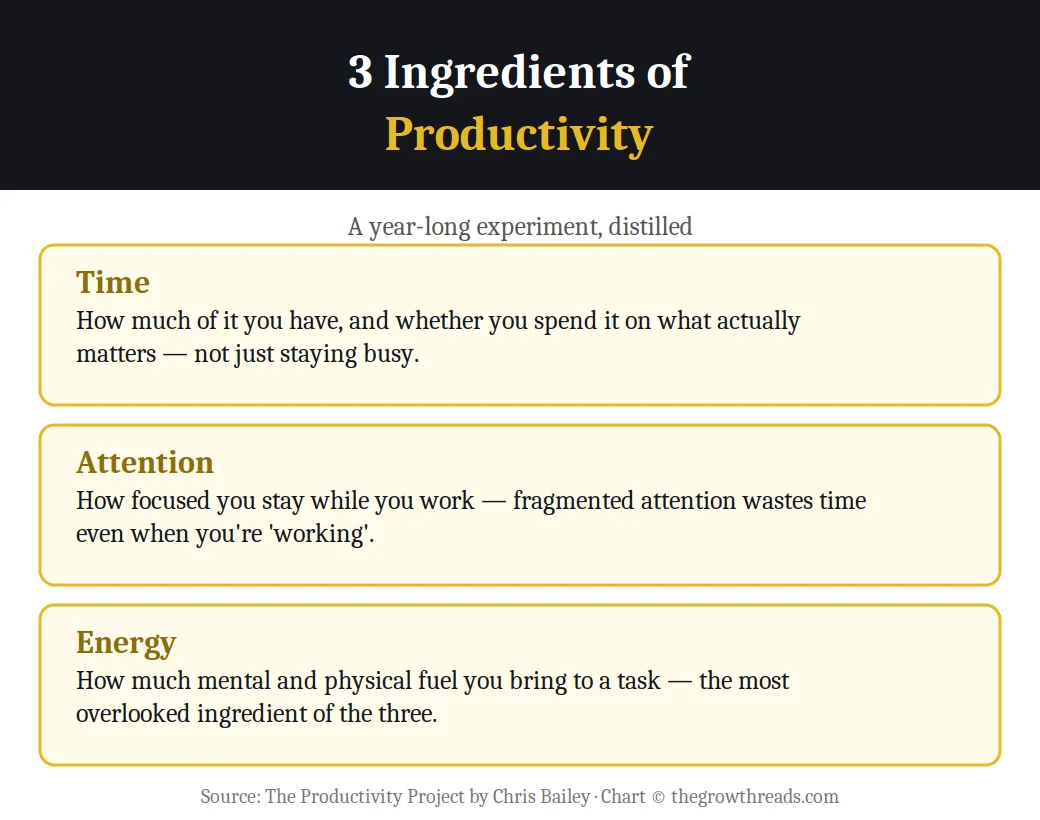
Being productive isn’t about cramming more into your day — it’s about accomplishing more of what actually matters. Chris Bailey spent a full year running structured experiments on himself, testing dozens of specific productivity tactics to see which ones held up and which were just folk wisdom. His conclusion is that productivity rests on three ingredients working together: time, attention, and energy. Manage only time and you’ll still burn out or lose focus; manage all three, and simple tools like the Rule of 3, working during your Biological Prime Time, and recognizing what actually triggers procrastination do more than any single productivity hack.
Key takeaways
- Productivity has three ingredients, not one: time, attention, and energy all have to be managed together — optimizing your calendar alone won’t fix scattered focus or low energy.
- Busyness isn’t the same as productivity: being constantly occupied can be a way of avoiding the harder question of whether the work is actually valuable.
- The Rule of 3 replaces sprawling to-do lists: naming three intended outcomes for the day, and three for the week, keeps effort aimed at what matters instead of whatever feels urgent.
- Your Biological Prime Time is real: everyone has hours of the day when energy and focus naturally peak, and matching demanding work to those hours beats forcing it into a fixed schedule.
- Procrastination has six specific triggers: tasks that are boring, frustrating, difficult, ambiguous, personally meaningless, or lacking intrinsic reward are disproportionately likely to get delayed.
- The 20-second rule works both ways: adding twenty seconds of friction to a bad habit makes it easier to skip, and removing twenty seconds of friction from a good one makes it easier to start.
- The 80-20 rule applies ruthlessly to tasks: a small fraction of what’s on your plate generates most of the meaningful results, and finding that fraction matters more than doing more of everything.
- Maintenance days protect focus: batching errands, admin, and routine tasks into a dedicated day keeps them from fragmenting the rest of the week.
- Not every opportunity deserves a yes: Bailey’s 90% rule — only accepting commitments that clear a high bar — is a deliberate defense against a calendar quietly filling with “good enough.”
What is The Productivity Project about?
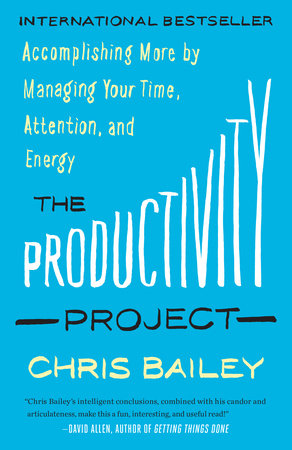
The Productivity Project is Chris Bailey’s account of a year he spent as his own productivity test subject — trying dozens of specific tactics, from working 90-hour weeks to waking up at 5:30am to unplugging from technology for extended stretches, then keeping only what actually produced better results. Rather than proposing one grand system, the book organizes what he learned around three ingredients that together determine how much you actually accomplish: time, attention, and energy. Each section pairs a concept with a specific, testable tactic, reflecting the book’s own experimental origin.
About the author
Chris Bailey is a productivity writer who, immediately after finishing his undergraduate degree, turned down two job offers to spend a year running structured personal experiments on time, attention, and energy management, documenting the results on his blog before compiling them into The Productivity Project. The book became an international bestseller and established Bailey as one of the more research-minded, self-testing voices in the productivity space, in contrast to writers who work primarily from theory or anecdote. He later narrowed his focus specifically to attention and distraction in his second book, Hyperfocus, and continues to write and speak on productivity, attention, and the way information consumption shapes both. Explore all Chris Bailey book summaries →
Key concepts at a glance
| Concept | What it means | Use it when |
|---|---|---|
| Time, attention, energy | The three ingredients that together determine how much you actually get done, not time alone | You’re managing your calendar tightly but still feel unproductive |
| The Rule of 3 | Naming three intended outcomes for the day and the week instead of working from an open-ended list | Your to-do list keeps growing faster than you can clear it |
| Biological Prime Time | The hours of the day when your energy and focus naturally peak | You want to know when to schedule your hardest, most important work |
| Procrastination triggers | Six specific task qualities — boring, frustrating, difficult, ambiguous, meaningless, unrewarding — that predict avoidance | You keep delaying a specific task and want to know why |
| The 20-second rule | Adding or removing twenty seconds of friction to make bad habits harder and good ones easier to start | A habit change keeps failing despite good intentions |
| The 90% rule | Only accepting new commitments and opportunities that clear a high value bar | Your schedule keeps filling with things that are fine but not truly important |
Part 1: Why busyness isn’t productivity, and the Rule of 3
Bailey opens by dismantling a habit most people mistake for productivity: staying constantly busy. Busyness, he argues, is often a way of avoiding a harder and more uncomfortable question — whether the work being done is actually valuable. Someone who answers 50 emails a day and attends every meeting they’re invited to can feel thoroughly productive while accomplishing very little that actually matters, simply because activity feels like progress even when it isn’t tied to real outcomes.
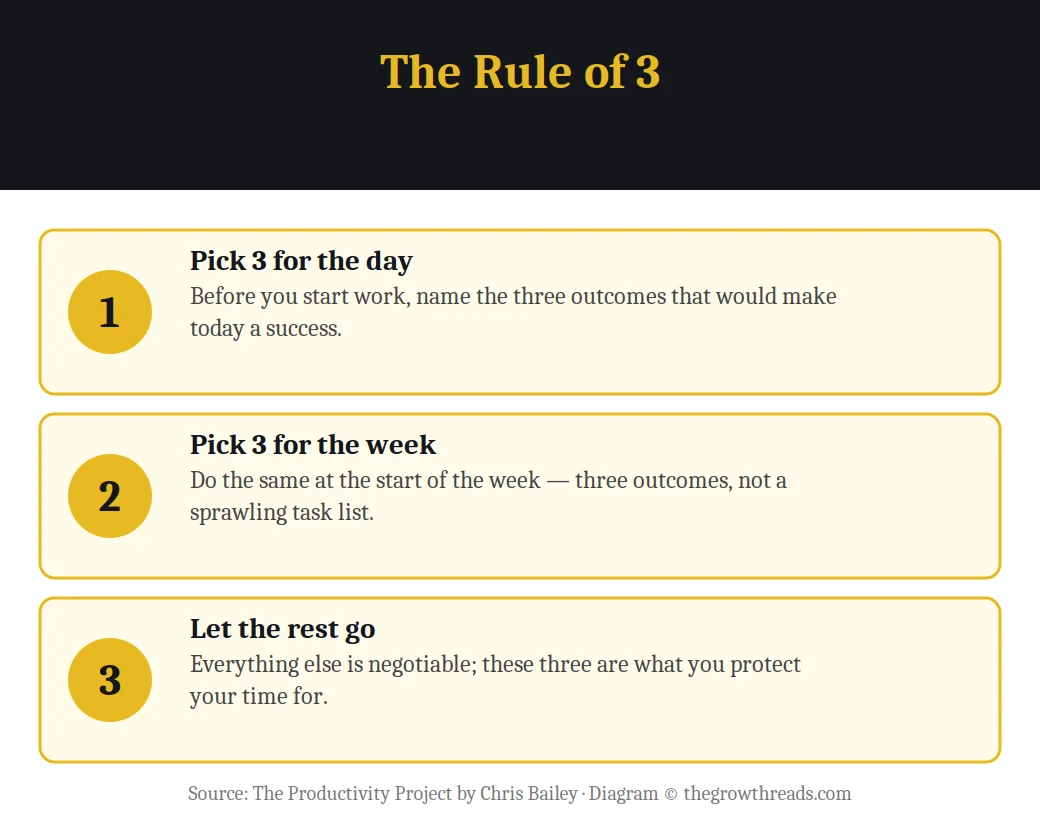
His antidote is the Rule of 3: instead of working from an open-ended to-do list that never gets shorter, name three specific outcomes that would make today a success before you start working, and three outcomes that would make the week a success before it begins. The constraint is deliberate — three is few enough to force real prioritization, and concrete enough that “checking email” or “being available” can’t disguise themselves as one of the three.
TGR Note: The Rule of 3’s insistence on a short, specific list echoes the same instinct behind The 4 Disciplines of Execution‘s single Wildly Important Goal — both treat a long priority list as functionally the same as having no priorities at all.
Part 2: Managing energy and finding your Biological Prime Time
Bailey’s second ingredient, energy, is the one he found most consistently overlooked. Time management assumes every hour is interchangeable, but his year of experiments showed his output varied enormously depending on when he worked, not just how long. He introduces the idea of Biological Prime Time — the hours in your day when energy and focus are naturally at their peak — and argues that matching your most demanding work to those specific hours produces disproportionately better results than treating all work hours as equivalent.
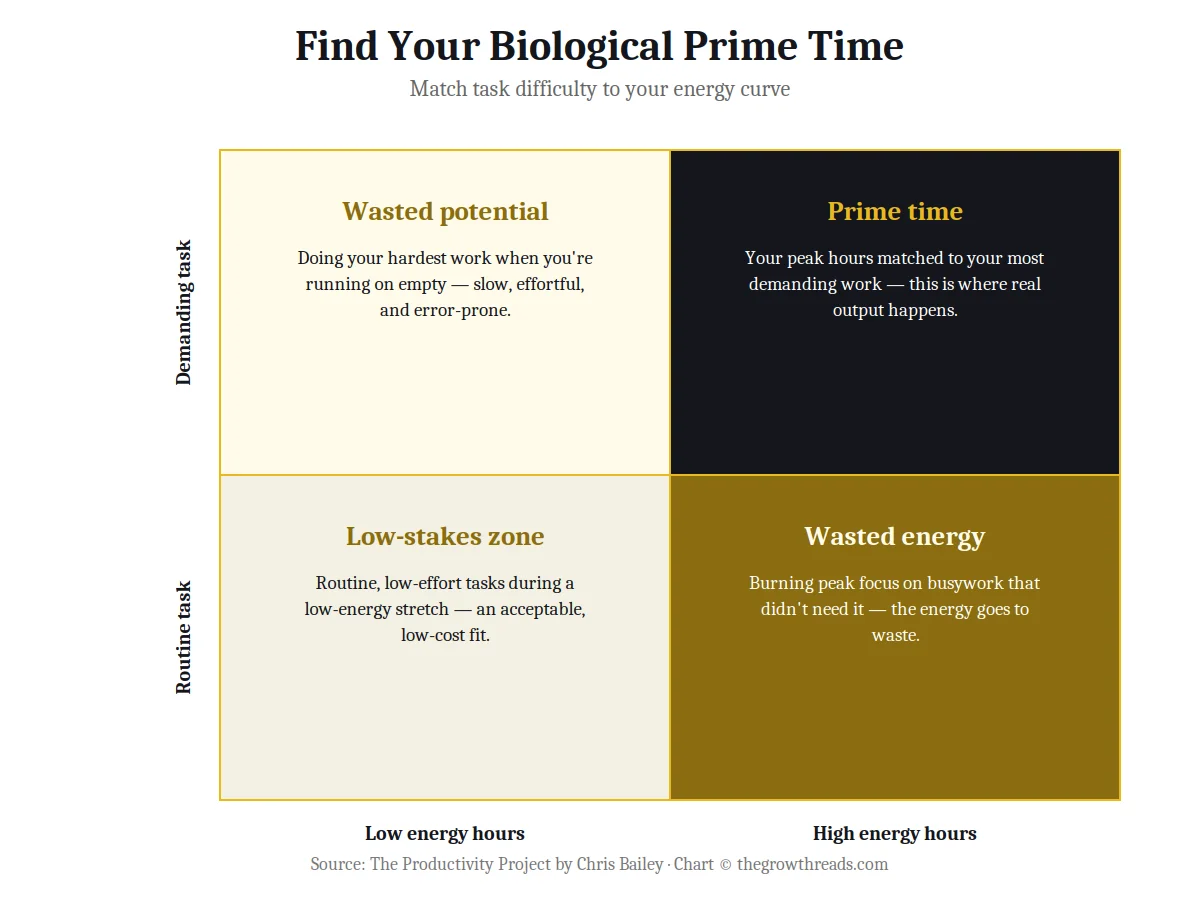
Identifying your own prime time, Bailey suggests, takes a week or two of honest tracking — noting energy and focus levels every hour or two rather than assuming you already know your own patterns. Once identified, the practical move is simple but frequently ignored: protect those hours for your hardest, highest-value work, and push routine, low-effort tasks into the lower-energy stretches of the day instead of the reverse.
TGR Note: Biological Prime Time is a practical, schedule-level version of the attention management Bailey later expands on in Hyperfocus — this book identifies when your best attention is available; Hyperfocus focuses on how to protect and direct it once you’re there.
Part 3: The six triggers of procrastination
Rather than treating procrastination as a single, vague character flaw, Bailey breaks it down into six specific task qualities that predict avoidance: tasks that are boring, frustrating, difficult, ambiguous or unstructured, personally meaningless, or lacking any intrinsic reward. A task can trigger procrastination through any one of these, and the more of them a task has, the more likely it is to get delayed — which is why some tasks get avoided for weeks despite being genuinely important.
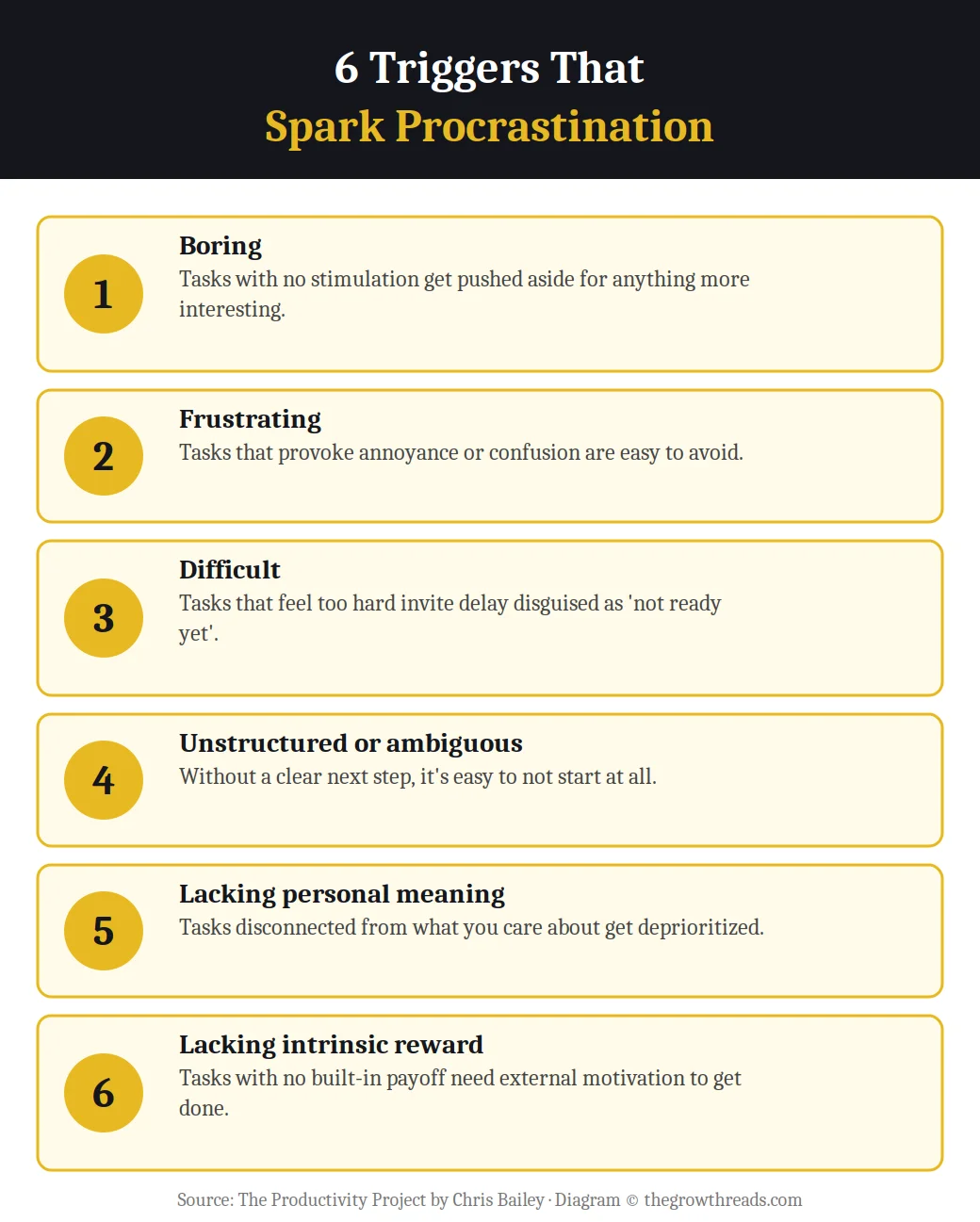
Once you can name which specific trigger is driving avoidance, the fix becomes more targeted than generic willpower advice. A boring task might just need a clearer sense of why it matters; an ambiguous one might just need to be broken into a concrete first step. Bailey pairs this diagnosis with the 20-second rule — adding small friction to distractions (like logging out of email between sessions) and removing friction from the task you’re avoiding (like leaving it half-open on your screen) to nudge behavior in the direction you actually want.
TGR Note: These six triggers are a more granular, diagnostic companion to the fear-based explanation of procrastination in The Now Habit — Fiore explains why procrastination happens emotionally, while Bailey’s list helps you spot which specific task property is causing it in the moment.
Part 4: The 80-20 rule, maintenance days, and saying no
Bailey applies the 80-20 rule directly to task selection: a small fraction of what’s on any given to-do list tends to generate most of the meaningful results, and identifying that fraction matters more than working through the list in order. This runs alongside his idea of maintenance days — a dedicated block, often a full day, for batching low-value but necessary tasks like errands, admin, and routine emails, so they don’t fragment the rest of the week into constant task-switching.
His final defense against an overcrowded calendar is the 90% rule: evaluate new opportunities and commitments on a 1-100 scale, and only accept the ones that score 90 or above. Anything in the middle — good, reasonable, but not exceptional — gets declined, on the logic that a calendar filled with “good enough” opportunities leaves no room for the rare genuinely great one when it appears.
Who is The Productivity Project best for — and who should read something else first?
This book is best for readers who want a broad, tested toolkit of specific tactics rather than one big system to adopt wholesale, and who appreciate that the author actually ran each experiment on himself before writing about it. It’s a strong starting point for anyone newer to productivity reading who hasn’t yet settled on a single framework.
If your main struggle is specifically with distraction and where your attention goes rather than time management broadly, Hyperfocus, Bailey’s own follow-up, goes deeper into that single problem. If procrastination is your central issue and you want to understand the emotional root rather than the task-level triggers, The Now Habit is a better fit. And if you want to protect long stretches of deep, undistracted work rather than optimize your whole day, Deep Work addresses that more specific problem directly.
Questions to reflect on
- What are your three intended outcomes for today — and would your actual schedule reflect that if someone looked at it?
- Have you actually tracked your energy and focus by hour, or are you assuming you know your own Biological Prime Time?
- Which of the six procrastination triggers — boring, frustrating, difficult, ambiguous, meaningless, unrewarding — best explains the task you’re currently avoiding?
- Where could you add twenty seconds of friction to a habit you want less of, or remove it from one you want more of?
- Is there a recurring commitment on your calendar that wouldn’t clear a 90-out-of-100 bar if you evaluated it honestly today?
🔥 Ready to run your own productivity experiments?
This guide covers the core framework — the book gives you Bailey’s full year of experiments, tactics, and the reasoning behind each one.
How to apply The Productivity Project (7-day plan)
- Day 1: Write down your three intended outcomes for today before opening email or messages.
- Day 2: Track your energy and focus every two hours to start identifying your Biological Prime Time.
- Day 3: Name your three intended outcomes for the week ahead, not just the day.
- Day 4: Pick one task you’ve been avoiding and diagnose which of the six procrastination triggers is driving it.
- Day 5: Schedule your single hardest task of the day into what you now believe is your prime time window.
- Day 6: Add 20 seconds of friction to one distraction, and remove 20 seconds of friction from one task you keep avoiding.
- Day 7: Review one upcoming commitment on your calendar using the 90% rule, and decline it if it doesn’t clear the bar.
Frequently asked questions
What is the main idea of The Productivity Project?
The Productivity Project argues that real productivity depends on managing three ingredients together — time, attention, and energy — rather than time alone. Chris Bailey spent a year testing dozens of tactics on himself and distilled what actually worked into practical tools like the Rule of 3, finding your Biological Prime Time, and understanding the specific triggers behind procrastination.
What is the Rule of 3 in The Productivity Project?
The Rule of 3 means naming three specific outcomes that would make today a success before you start working, and three outcomes for the week before it begins, instead of working from an open-ended to-do list that never actually gets shorter.
What is Biological Prime Time?
Biological Prime Time refers to the hours of the day when your energy and focus naturally peak. Bailey argues that matching your hardest, most important work to those specific hours produces significantly better results than treating every work hour as interchangeable.
What are the six procrastination triggers in the book?
Bailey identifies six task qualities that predict procrastination: being boring, frustrating, difficult, unstructured or ambiguous, lacking personal meaning, and lacking intrinsic reward. Tasks with more of these qualities are more likely to be delayed, regardless of how important they actually are.
What is the 20-second rule?
The 20-second rule means adding about twenty seconds of friction to a habit you want less of, such as logging out of distracting apps, and removing twenty seconds of friction from a habit or task you want more of, such as leaving a document open and ready to continue.
How is The Productivity Project different from Bailey’s other book, Hyperfocus?
The Productivity Project is broader, covering time, attention, and energy across a full year of varied experiments. Hyperfocus is Bailey’s more focused follow-up, narrowing in specifically on attention and distraction, and introducing the hyperfocus and scatterfocus framework in more depth.
Is The Productivity Project based on real research?
The book is grounded in Bailey’s own year-long self-experimentation, where he tested specific tactics on himself and documented the results, rather than a large-scale academic study. He also draws on existing psychological and productivity research to explain why particular tactics work.
Related summaries
If The Productivity Project resonated, these dig further into related territory: Hyperfocus on managing attention and distraction specifically, The Now Habit on the emotional roots of procrastination, and Deep Work on protecting long stretches of undistracted focus. For more, see our best productivity books pillar page.
How we analyze books: We work from the full book — reconstructing its core arguments in our own words, adding commentary that connects it to related research and other books in our library, and pressure-testing the advice in a practical 7-day plan. Ratings weigh usefulness, readability, and evidence quality. Read our full methodology.