

★★★★★ 4.5/5 — the psychologist’s case that procrastination is fear wearing a to-do list, with a calendar system built to dismantle it.
Best for: chronic procrastinators who’ve already tried willpower and stricter schedules and watched them fail · Reading time: ~6 hrs (this guide: ~15 min) · Difficulty to apply: Easy — the Unschedule can start today
The Now Habit in one minute
You don’t procrastinate because you’re lazy — you procrastinate because some part of the task feels threatening. Neil Fiore, a psychologist who has treated procrastination in clients from graduate students to Olympic athletes, breaks from the productivity advice of his era by treating procrastination as a fear response rather than a discipline failure: fear of failure, fear of success, or an unconscious need to resist being controlled. His fix isn’t a stricter schedule — it’s the “Unschedule,” a calendar that puts guilt-free rest and play in first, then tracks only the 30-minute blocks of real work you actually complete. Paired with five specific shifts in your internal self-talk, the goal is to make starting feel safe again, because once starting stops being scary, finishing takes care of itself.
Key takeaways
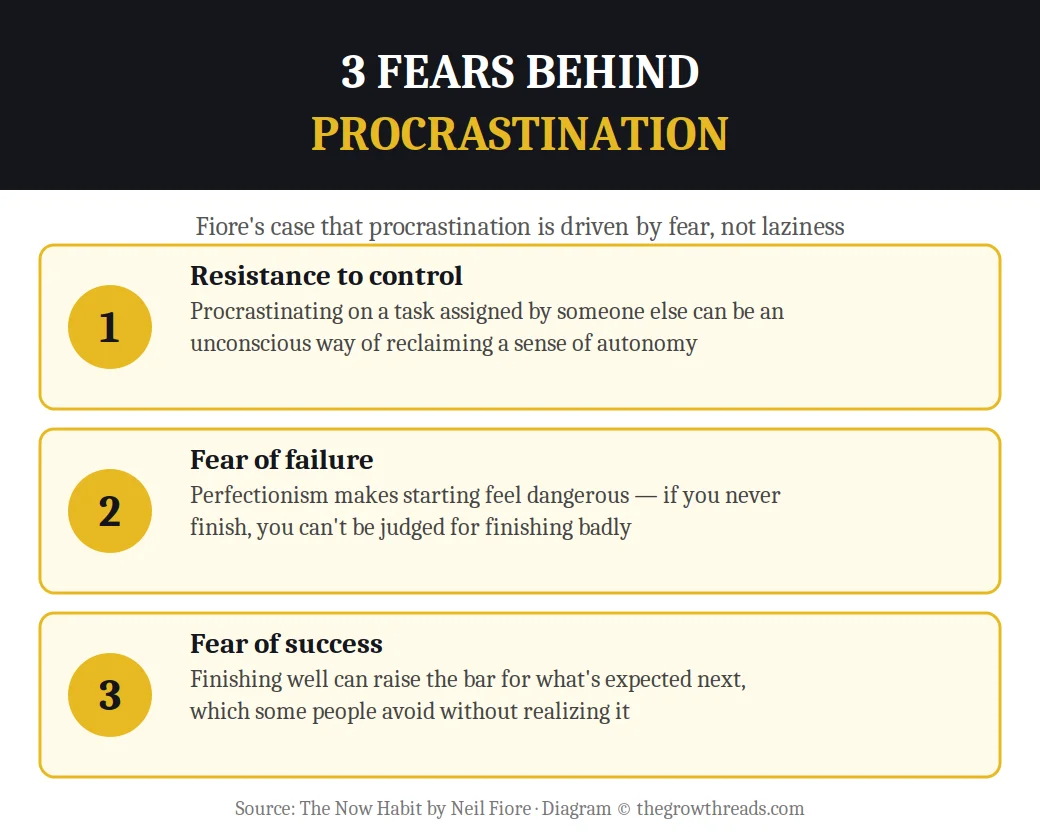
- Procrastination is driven by fear, not laziness: resistance to control, fear of failure, and even fear of success all show up as delay, and treating it as a motivation problem misses the actual cause.
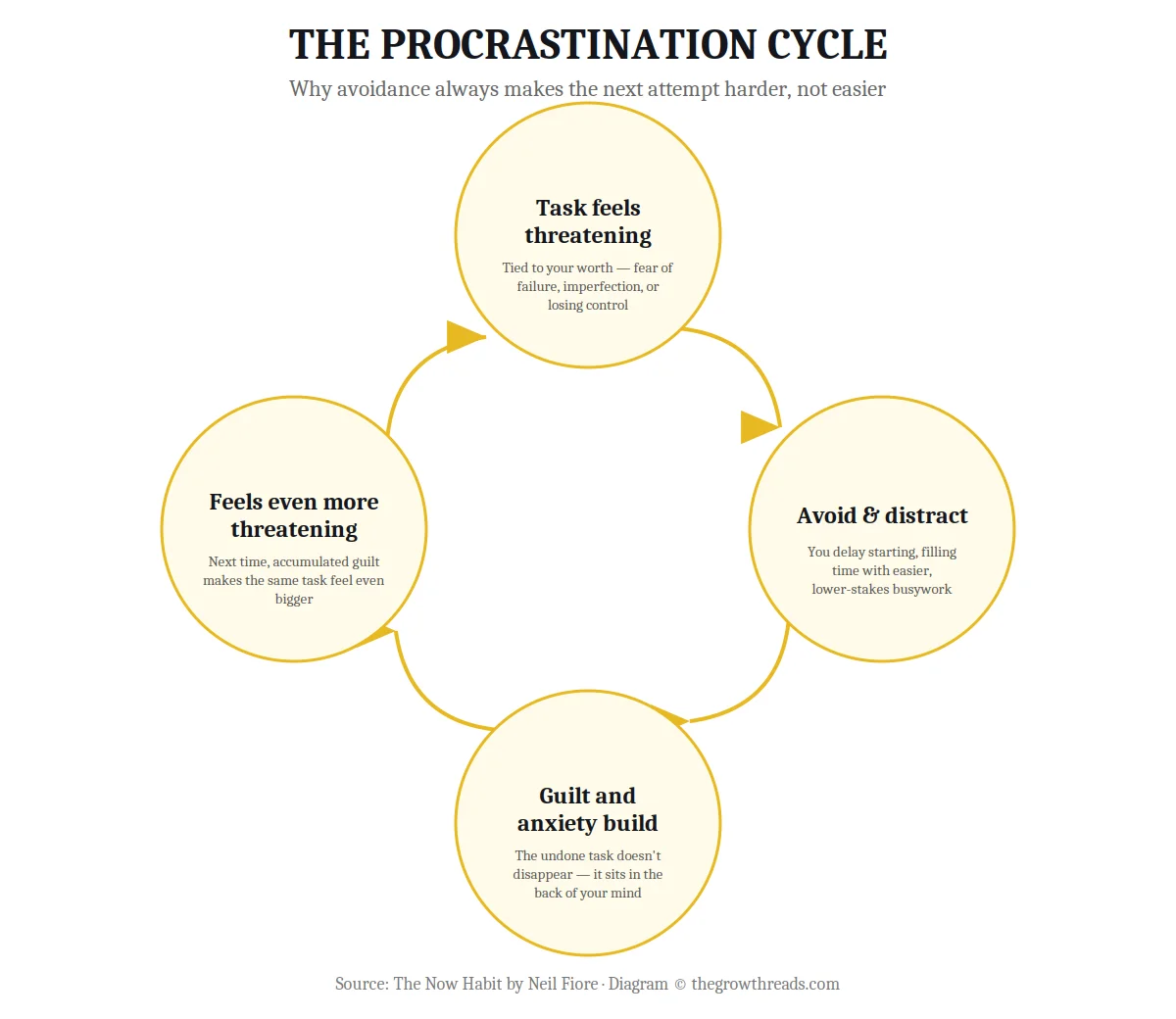
- The procrastination cycle is self-reinforcing: avoiding a threatening task builds guilt, and that guilt makes the same task feel even bigger the next time you approach it.
- The Unschedule reverses the to-do list: block guilt-free rest and fixed commitments first, then only log completed 30-minute work sessions — the calendar becomes proof of progress, not a source of pressure.
- Play has to be scheduled, not earned: guilt-free rest that comes before work, not after finishing, is what breaks the association between work and deprivation.
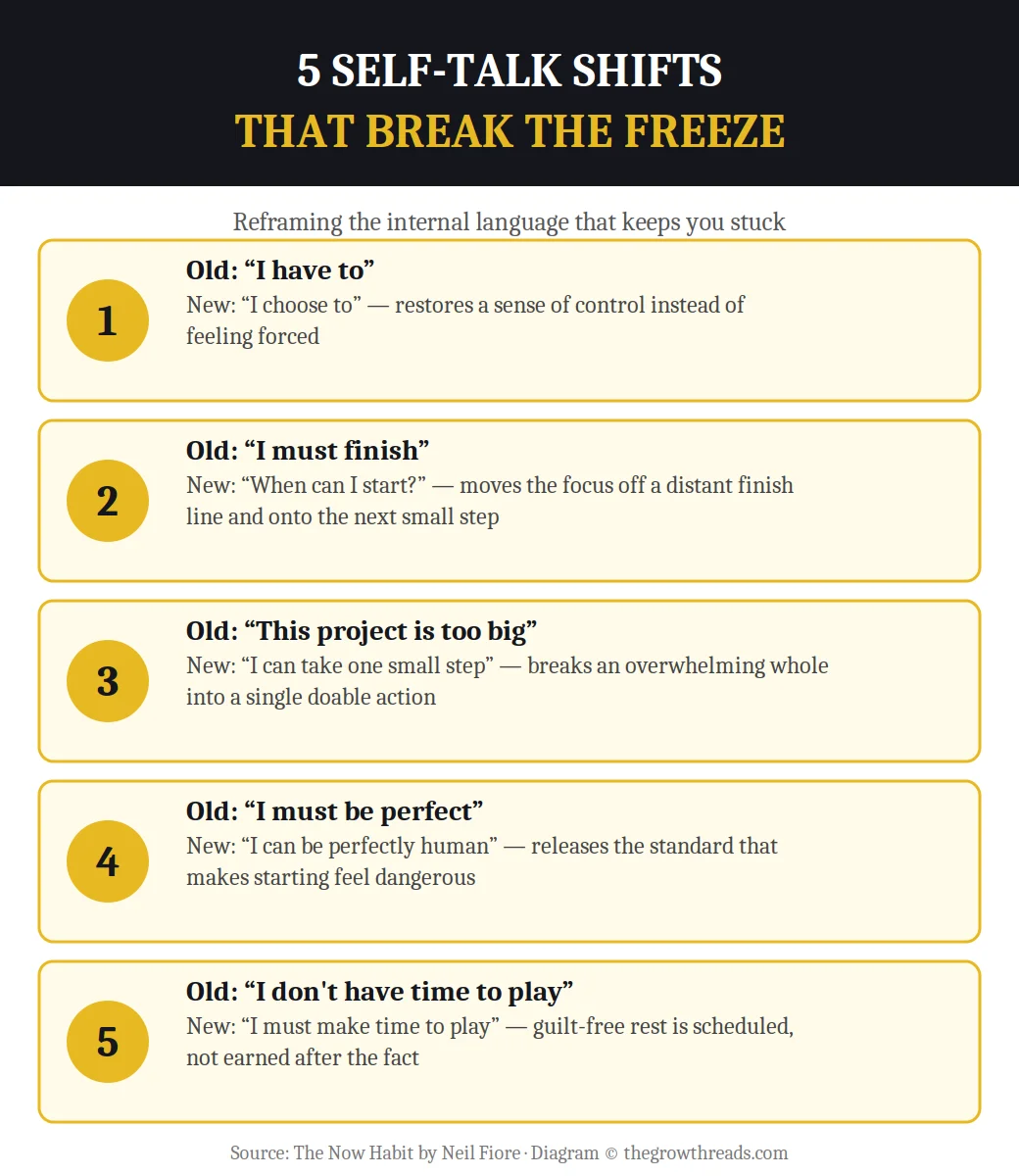
- Five language shifts undo the internal pressure that causes freezing: “I have to” becomes “I choose to,” “I must finish” becomes “when can I start,” and so on.
- The goal is to start, not to finish: committing to a single uninterrupted 30-minute block removes most of the psychological barrier that a full project creates.
- Perfectionism is one of the biggest hidden drivers: if you never finish, you can never be judged for finishing badly — which makes starting feel dangerous for high-standard people specifically.
- Three-dimensional thinking breaks overwhelm: understanding a project’s size, length, and breadth lets you set mini-deadlines instead of facing one intimidating, undifferentiated block of work.
- Recovery from a setback matters more than avoiding one: treating an off day as data, not proof the system failed, is what keeps momentum from collapsing after a single missed session.
What is The Now Habit about?
The Now Habit is Neil Fiore’s program for overcoming procrastination by treating it as a fear-driven response rather than a discipline problem. Rather than prescribing stricter schedules or more willpower, Fiore gives readers specific psychological reframes and a calendar tool — the Unschedule — designed to make starting a dreaded task feel safe, so that the avoidance cycle stops renewing itself.
About the author
Neil Fiore, Ph.D., is a licensed psychologist and executive coach who has spent decades treating procrastination, burnout, and performance anxiety in clients ranging from graduate students to Fortune 500 executives and Olympic athletes. Trained in clinical psychology and stress management, Fiore built The Now Habit — first published in 1988 and revised multiple times since — around the then-unconventional idea that procrastination is fear wearing the disguise of laziness. The book has sold hundreds of thousands of copies and remains a standard recommendation in university counseling centers, and Fiore has since extended its ideas into The Now Habit at Work and a set of Now Habit motivation cards. Explore all Neil Fiore book summaries →
Key concepts at a glance
| Concept | What it means | Use it when |
|---|---|---|
| The procrastination cycle | A self-reinforcing loop where avoidance builds guilt, which makes the task feel even more threatening next time | You want to understand why the same task keeps getting harder to start |
| The Unschedule | A calendar that blocks guilt-free rest first, then logs only completed 30-minute work sessions | Traditional to-do lists make you feel behind no matter what you finish |
| Guilt-free play | Rest and recreation scheduled before work, not earned by finishing it | You associate any relaxation with falling behind |
| Three-dimensional thinking | Breaking a project down by size, length, and breadth to set concrete mini-deadlines | A project feels like one undifferentiated, overwhelming block |
| The 30-minute start | Committing to a single uninterrupted block of work rather than to finishing the whole task | The size of a project is what’s stopping you from beginning |
| Self-talk shift | Replacing pressuring internal language (“I have to”) with agency-restoring language (“I choose to”) | You notice dread or resistance before you’ve even started |
Part 1: Why procrastination is fear, not laziness
Fiore opens by rejecting the idea that procrastination is a character flaw or a simple failure of willpower. In his clinical experience, chronic procrastination usually traces back to one of three fears: fear of failure, where perfectionism makes starting feel dangerous because an unfinished project can’t be judged; fear of success, where finishing well raises the bar for what’s expected next time, which some people avoid without realizing it; and resistance to control, where procrastinating on a task assigned by someone else becomes an unconscious way of reclaiming a sense of autonomy. None of these fears look like fear on the surface — they look like distraction, disorganization, or low motivation, which is exactly why the standard advice to “just try harder” so reliably fails.
This reframe matters because it changes what actually needs to be fixed. If procrastination were a discipline problem, more willpower or a stricter schedule would solve it — but Fiore’s clients, often high-achieving professionals and students, already have plenty of both, and still procrastinate on the specific tasks tied to their fears. The fix has to address the fear directly, not just add pressure on top of it.
TGR Note: Fiore’s three fears are a useful, more clinical companion to the automatic-thought framework in Feeling Good — both treat a self-defeating pattern as something to identify and correct with a specific technique, rather than a fixed trait to feel bad about.
Part 2: The procrastination cycle and the fears that drive it
Fiore maps the mechanics of the cycle explicitly: a task starts to feel threatening, you avoid and distract yourself instead of starting, the avoided task doesn’t disappear but generates guilt and anxiety in the background, and next time you approach it, that accumulated guilt makes the task feel even more threatening than before. Each pass through the cycle makes the next pass harder, which is why procrastination tends to get worse over time rather than resolving on its own.
Breaking the cycle, in Fiore’s framework, doesn’t start with the task itself — it starts with removing the fear that made the task threatening in the first place. That’s why his tools focus on restoring a sense of choice and safety (the self-talk shifts) and on lowering the stakes of any single work session (the 30-minute start), rather than on time-management tricks aimed at the schedule alone.
TGR Note: The self-reinforcing cycle here is structurally similar to the habit loop in Atomic Habits — cue, response, and consequence feeding back into the next cue — except Fiore’s version runs on avoidance instead of a rewarded behavior, which is exactly what makes it feel so hard to interrupt from the outside.
Part 3: The five self-talk shifts and the Unschedule
Fiore identifies five specific phrases that keep the procrastination cycle running, and a replacement for each: “I have to” becomes “I choose to,” restoring a sense of agency; “I must finish” becomes “when can I start,” which moves the focus off a distant finish line; “this project is too big” becomes “I can take one small step,” breaking overwhelm into a single action; “I must be perfect” becomes “I can be perfectly human,” releasing the standard that makes starting feel dangerous; and “I don’t have time to play” becomes “I must make time to play,” restoring guilt-free rest to the schedule.
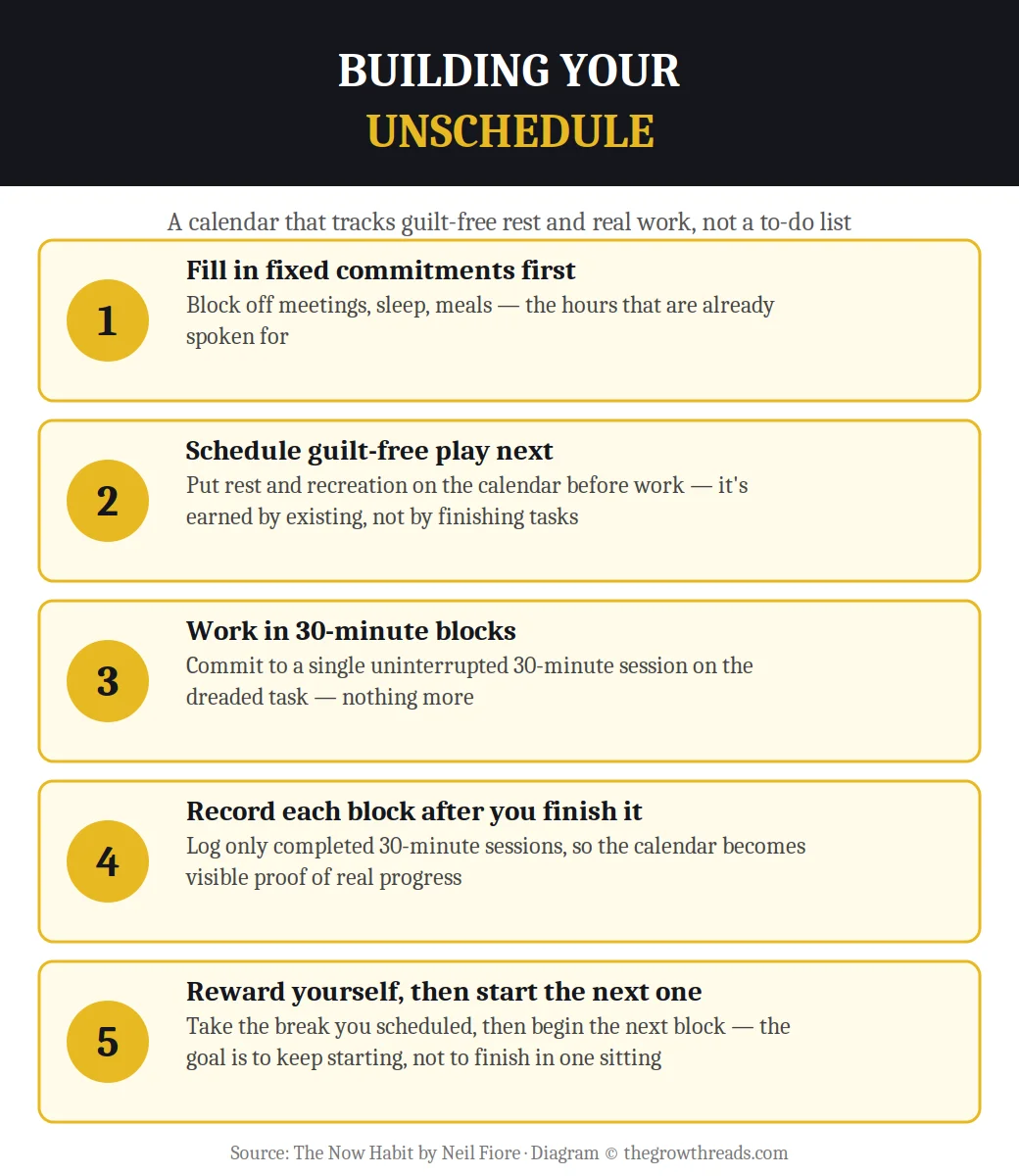
The Unschedule is where these shifts become a concrete daily practice. Instead of listing tasks to complete, you first block off fixed commitments and then guilt-free play and rest — before any work goes on the calendar at all. Work itself is logged only after a 30-minute uninterrupted session is actually completed, which means the calendar becomes visible evidence of real progress rather than a running reminder of everything still undone.
TGR Note: The Unschedule’s insistence on scheduling rest before work is a sharper, guilt-focused version of the “protect the important from the urgent” problem The 4 Disciplines of Execution tackles at the team level — Fiore’s version operates on the individual’s relationship with a single dreaded task.
Part 4: Three-dimensional thinking and staying resilient after a setback
For projects that feel too large to even approach, Fiore recommends three-dimensional thinking: understanding a task’s size, length, and breadth well enough to set concrete mini-deadlines along the way, rather than facing one undifferentiated block labeled “the project.” This turns a vague, intimidating whole into a series of specific, dated steps — closer to a reverse calendar than a single due date looming in the distance.
Fiore is also candid that the system won’t be followed perfectly, and treats a missed session as data to learn from rather than proof the whole approach failed. A single lapse doesn’t require restarting a stricter version of the old, willpower-based approach — it just means logging the next 30-minute block whenever it happens, which keeps a bad day from spiraling back into the avoidance cycle the book is designed to break.
TGR Note: Treating a lapse as information rather than failure is the same relapse-prevention logic Feeling Good applies to mood work — in both books, expecting occasional setbacks in advance is what keeps one bad day from undoing the whole system.
Who is The Now Habit best for — and who should read something else first?
This book is best for chronic procrastinators who have already tried stricter schedules and more willpower and watched both fail — especially perfectionists and high achievers whose procrastination is tied to fear of judgment rather than a genuine lack of motivation. It also rewards readers who want a psychological explanation for their patterns, not just a list of productivity hacks.
If your main challenge is a team execution problem rather than a personal procrastination pattern, The 4 Disciplines of Execution is a better fit. If your low mood or self-criticism goes well beyond procrastination into broader depression or anxiety, start with Feeling Good, which addresses the underlying thought patterns more directly. And if procrastination shows up specifically around deep, demanding creative or intellectual work rather than everyday tasks, Deep Work addresses a related but distinct problem: protecting focus, not dismantling fear.
Questions to reflect on
- Which of the three fears — resistance to control, fear of failure, or fear of success — best explains the task you’re currently avoiding?
- Where in your own life does guilt about an undone task keep making that task feel bigger, rather than getting you closer to starting it?
- Which of the five self-talk shifts would make the biggest difference if you actually used it the next time you felt resistance?
- Have you scheduled guilt-free rest this week, or are you still waiting to earn it by finishing something first?
- What’s the very next 30-minute block you could commit to today, without needing to finish the whole project?
🔥 Ready to make starting feel safe again?
This guide covers the framework — the book gives you the full Unschedule templates, worksheets, and Fiore’s clinical case studies in detail.
How to apply The Now Habit (7-day plan)
- Day 1: Identify your single most avoided task and figure out which of the three fears — control, failure, or success — is really driving the avoidance.
- Day 2: Build your first Unschedule: block fixed commitments and guilt-free play first, leaving work blocks for whatever time remains.
- Day 3: Practice the five self-talk shifts out loud whenever you notice resistance, especially “I have to” to “I choose to.”
- Day 4: Commit to one uninterrupted 30-minute block on the avoided task — no goal beyond starting and logging it when it’s done.
- Day 5: Apply three-dimensional thinking to your biggest project: break it into size, length, and breadth, and set one mini-deadline.
- Day 6: Take your scheduled guilt-free play time without editing it down, even if you didn’t “earn” it by finishing something first.
- Day 7: Review your Unschedule for the week: how many 30-minute blocks did you actually log, and what pattern do you notice in when they happened?
Frequently asked questions
What is the main idea of The Now Habit?
The Now Habit argues that chronic procrastination is driven by fear — of failure, of success, or of losing control — rather than laziness or a lack of discipline. Neil Fiore, a psychologist who has treated procrastination for decades, provides specific tools, most centrally the Unschedule, to reduce that fear and make starting a task feel safe again. The core claim is that once starting stops feeling threatening, finishing follows naturally, without needing more willpower.
What is the Unschedule in The Now Habit?
The Unschedule is a calendar tool that reverses the usual to-do list: you block fixed commitments and guilt-free rest and play first, then log only the 30-minute blocks of work you actually complete. This turns the calendar into visible evidence of real progress instead of a running list of what’s still undone, and it removes the guilt of “not earning” rest by putting rest on the calendar before any work happens.
What are the three fears behind procrastination, according to Fiore?
Fiore identifies resistance to control, where delaying a task assigned by someone else unconsciously reclaims a sense of autonomy; fear of failure, where perfectionism makes starting feel dangerous because an unfinished project avoids judgment; and fear of success, where finishing well raises expectations for next time. None of the three look like fear on the surface, which is part of why standard advice to simply try harder tends to fail.
Does The Now Habit actually work, or is it just relabeling procrastination?
The book has been in print since 1988 and remains a standard recommendation in university counseling centers, which suggests the framework has held up across decades of use with real clients. Its core mechanism — lowering the stakes of starting through the 30-minute block and restoring a sense of choice through the self-talk shifts — is consistent with how fear and avoidance are addressed in clinical psychology more broadly, not just a relabeling exercise.
How is The Now Habit different from typical time-management advice?
Most time-management advice assumes the problem is organization or willpower and responds with stricter schedules, task lists, or accountability. Fiore’s approach assumes the underlying problem is fear, so his tools focus on removing that fear — through the Unschedule, guilt-free play, and self-talk shifts — rather than adding more structure or pressure on top of a system that was never the actual issue.
Can The Now Habit help with procrastination at work, not just personal tasks?
Yes — Fiore later wrote a dedicated follow-up, The Now Habit at Work, applying the same fear-based framework and Unschedule concept specifically to workplace procrastination and team performance. The core techniques from the original book, especially the 30-minute start and the self-talk shifts, transfer directly to work tasks without modification.
What’s three-dimensional thinking in The Now Habit?
Three-dimensional thinking means understanding a project’s size, length, and breadth clearly enough to set concrete mini-deadlines throughout its timeline, rather than facing it as one intimidating, undifferentiated block of work. It functions similarly to a reverse calendar, working backward from a final deadline to create a staged plan with specific checkpoints along the way.
Related summaries
If The Now Habit resonated, these dig further into related territory: Feeling Good on identifying and correcting the automatic thoughts behind self-defeating patterns, Atomic Habits on the cue-response loop underlying any repeated behavior, and The 4 Disciplines of Execution on protecting focus at the team level. For more, see our best productivity books pillar page.
How we analyze books: We work from the full book — reconstructing its core arguments in our own words, adding commentary that connects it to related research and other books in our library, and pressure-testing the advice in a practical 7-day plan. Ratings weigh usefulness, readability, and evidence quality. Read our full methodology.