

★★★★★ 4.7/5 — the clearest operating system in print for actually executing a strategic goal, instead of just setting one.
Best for: team leaders and managers who can set a good goal but watch it lose to the daily whirlwind of urgent work · Reading time: ~7 hrs (this guide: ~15 min) · Difficulty to apply: Moderate — requires a real weekly meeting, not just reading
The 4 Disciplines of Execution in one minute
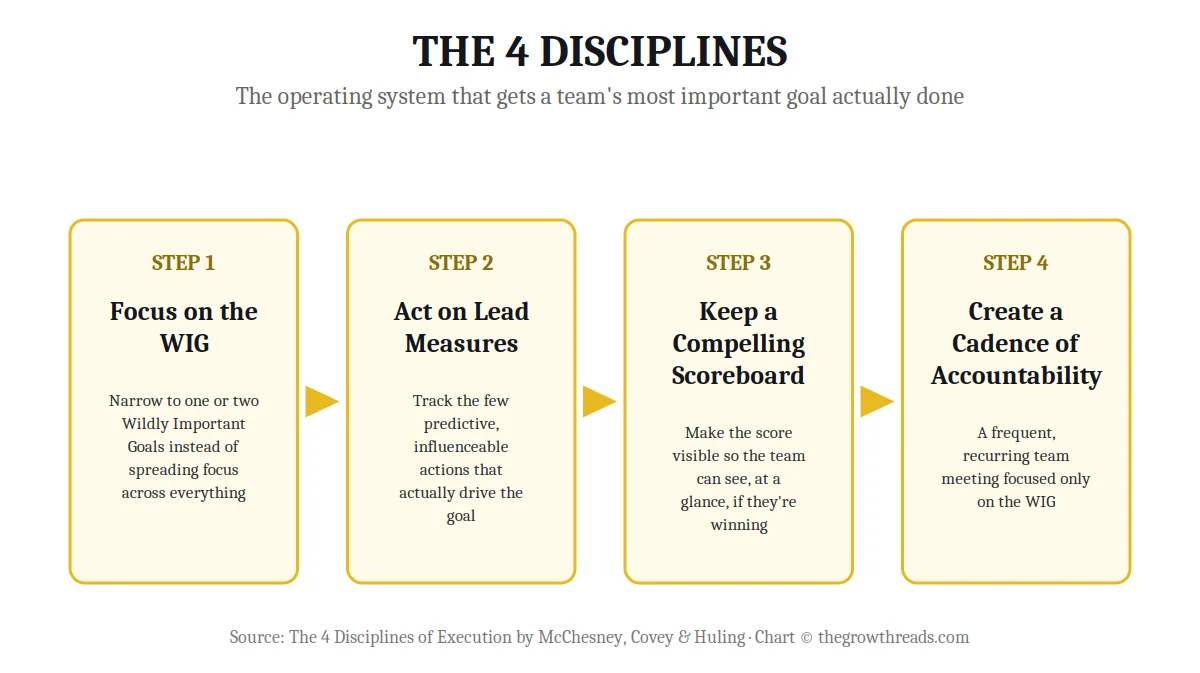
Setting a great goal is the easy part — protecting it from your own day-to-day operation is what actually fails. Chris McChesney, Sean Covey, and Jim Huling, all senior leaders at FranklinCovey, call that day-to-day operation “the whirlwind”: the urgent, consuming work of keeping the business running today, which will always out-shout a strategic goal that only pays off later. Their four disciplines are a deliberately simple operating system for protecting one Wildly Important Goal from that whirlwind: narrow to one goal, track the handful of actions that actually move it, make the score visible, and hold a short weekly meeting about nothing else. None of the four disciplines is individually clever — the book’s real contribution is field-testing the combination across thousands of teams until it reliably survives contact with a busy operation.
Key takeaways
- The whirlwind will always beat a strategic goal for your attention: daily operational demands are urgent and immediate, while a WIG’s payoff is distant — so without a deliberate system, the whirlwind wins by default.
- A real WIG is narrow, not a wish list: teams that try to treat five or six priorities as “wildly important” end up executing none of them well.
- State the goal as a finish line: “from X to Y by when” turns a vague direction into something a team can actually tell it has hit.
- Lag measures tell you the score too late to act on it: revenue, satisfaction, and weight lost are all lag measures — they move only after the real work already happened.
- Lead measures are what a team can actually influence this week: they’re predictive of the lag measure and within the team’s direct control, which is what makes them actionable.
- A visible scoreboard changes behavior on its own: people play differently when they can see whether they’re winning, which is why the authors insist on a real, visible scoreboard, not a buried spreadsheet.
- The weekly WIG session is the actual engine of the system: a short, frequent, recurring meeting focused only on the WIG is what keeps the other three disciplines from quietly lapsing.
- Commitments must be made by the team, not assigned by the leader: people follow through more reliably on commitments they stated themselves than on tasks handed down to them.
- 4DX is a system for execution, not for strategy: the book explicitly assumes you already know what your WIG should be — its job starts after that decision is made.
What is The 4 Disciplines of Execution about?
The 4 Disciplines of Execution (4DX) is a practical operating system for getting a team to actually achieve its most important goal, developed and field-tested by FranklinCovey across thousands of client organizations. Rather than another framework for choosing a strategy, the book assumes the goal is already set and focuses entirely on the harder, more neglected problem: making sure daily operational demands don’t quietly consume all the time and attention the goal needed to succeed.
About the author
Chris McChesney, Sean Covey, and Jim Huling are senior leaders at FranklinCovey who spent years co-developing and field-testing the 4DX methodology inside client organizations before writing it up. McChesney is FranklinCovey’s global practice leader for Execution; Sean Covey — son of Stephen R. Covey, author of The 7 Habits of Highly Effective People — is a FranklinCovey executive and author in his own right; Huling is a longtime consultant who helped test and refine 4DX across industries from manufacturing to healthcare to hospitality. The book was first published in 2012 and revised and updated in 2021 with additional case studies and a sharper framing of the “whirlwind” concept that opens the book. Explore all Chris McChesney, Sean Covey & Jim Huling book summaries →
Key concepts at a glance
| Concept | What it means | Use it when |
|---|---|---|
| The whirlwind | The urgent, day-to-day operational work required just to keep the business running | You want to understand why a good strategic goal keeps losing to daily busywork |
| WIG (Wildly Important Goal) | The one or two goals that matter more than everything else on the team’s plate | You’re deciding what deserves the team’s real, protected focus |
| Lag measure | A measure of the goal itself, which moves only after the real work already happened | You want to define what “winning” ultimately looks like |
| Lead measure | A predictive, influenceable action that drives the lag measure | You need something the team can actually act on this week |
| Compelling scoreboard | A simple, visible tracker showing whether the team is winning or losing right now | You want behavior to change without having to police it directly |
| Cadence of accountability | A short, frequent, recurring team meeting focused only on the WIG | You need the other three disciplines to actually stick past week one |
Part 1: Why the whirlwind always wins by default
The authors open with a deceptively simple observation: every organization already runs on a whirlwind of urgent, necessary work — answering customers, hitting production numbers, putting out fires — and that whirlwind is not optional. The problem isn’t that the whirlwind is bad; it’s that it is immediate and loud, while a strategic goal’s payoff is distant and quiet, so in any moment-to-moment contest for attention, the whirlwind wins by default. Most execution failures, in the authors’ telling, aren’t failures of strategy or motivation — they’re failures to protect a good goal from an operation that was never designed to make room for it.
This reframes the execution problem usefully: instead of asking “how do we get people to care more,” 4DX asks “how do we build a system that keeps working even when people are, understandably, consumed by today’s fires.” That’s why the four disciplines are built to be lightweight and mechanical rather than motivational — the whole point is that they have to survive being run by busy, distracted humans in a real whirlwind, not by an idealized, fully-focused team.
TGR Note: The whirlwind is a sharper, execution-focused cousin of the “urgent versus important” distinction that shows up across the productivity canon — the discipline 4DX adds is a specific weekly mechanism for protecting the important, rather than just a reminder to try harder to prioritize it.
Part 2: Picking a real WIG and finding its lead measures
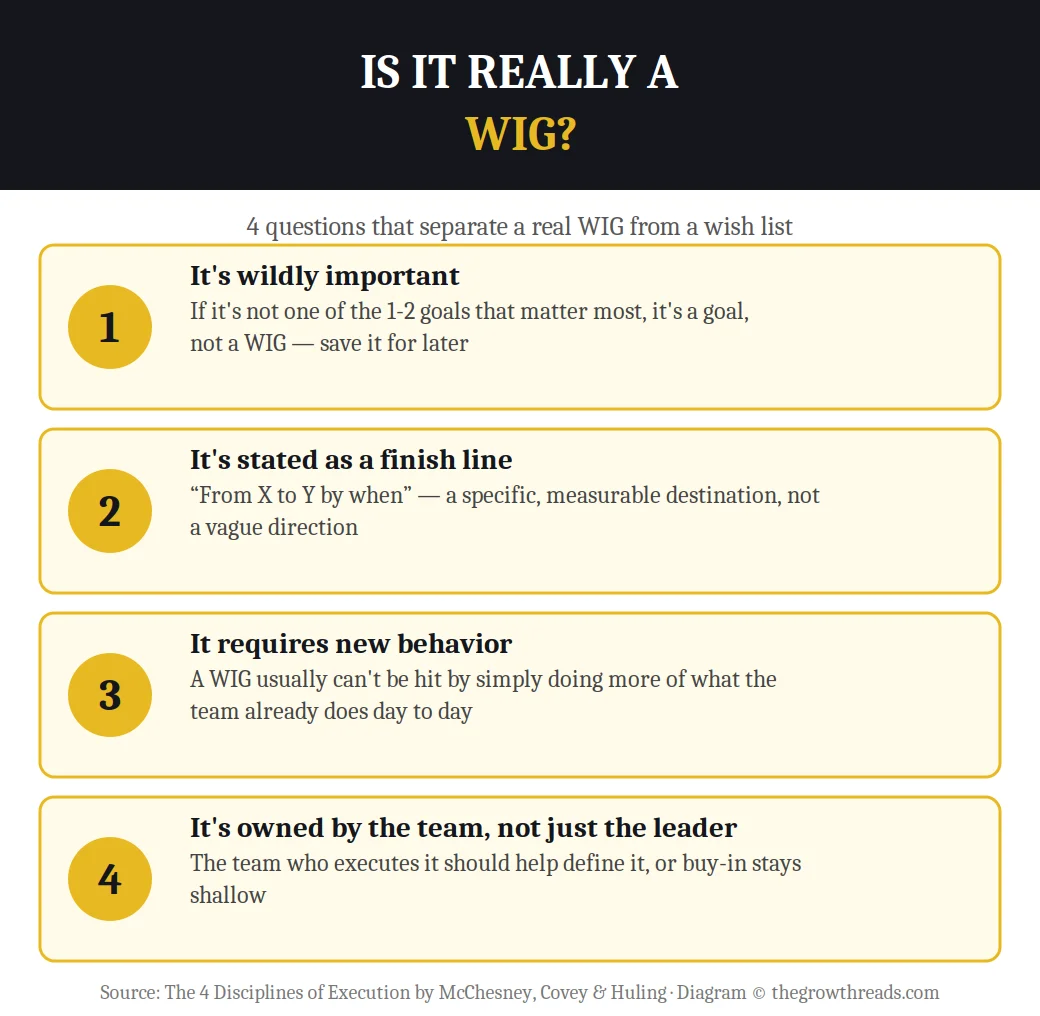
The first discipline, Focus on the Wildly Important, forces a narrowing that most teams resist: pick one or two goals, not five or six, because trying to treat everything as wildly important guarantees excellent execution on nothing. A real WIG is stated as a finish line — “from X to Y by when” — not a vague direction, so the team can tell, unambiguously, whether it actually hit the target.
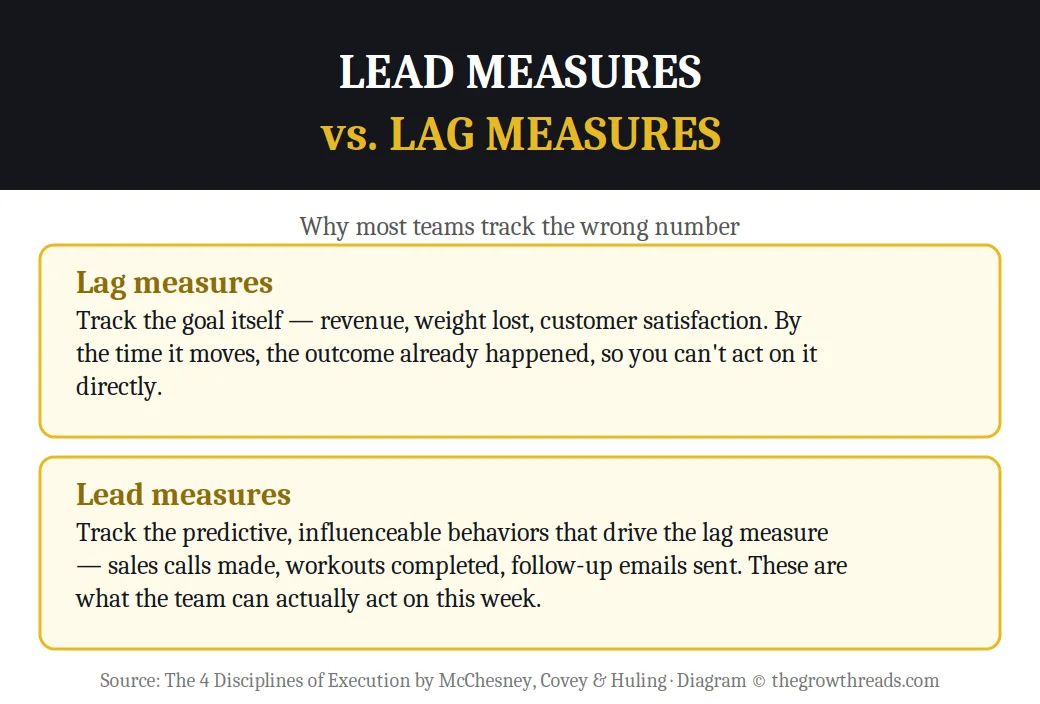
The second discipline, Act on Lead Measures, is where most teams go wrong even after picking a good WIG: they track the lag measure (revenue, defect rate, customer satisfaction) obsessively, but a lag measure only tells you the outcome after the work is already done — by the time it moves, it’s too late to change what produced it. A lead measure is different: it’s predictive of the lag measure and, crucially, it’s something the team can directly influence this week. The authors are blunt that finding good lead measures is genuinely hard and usually takes real experimentation, but it’s the discipline that turns a goal from a hope into something with a controllable input.
TGR Note: Lead versus lag measures is close kin to the cue-craving-response-reward loop in Atomic Habits — both frameworks push you toward tracking the small, controllable input rather than obsessing over an outcome you can’t directly move.
Part 3: Making the score visible and running the weekly session
The third discipline, Keep a Compelling Scoreboard, rests on an observation the authors say holds up across every team they’ve studied: people play differently when they can see the score. A scoreboard has to be simple enough to read in five seconds, visible to the whole team, and show both the lead and lag measures so people can connect today’s actions to the eventual outcome — a scoreboard buried in a shared drive or a monthly report doesn’t count, because nobody actually looks at it in the moment that matters.
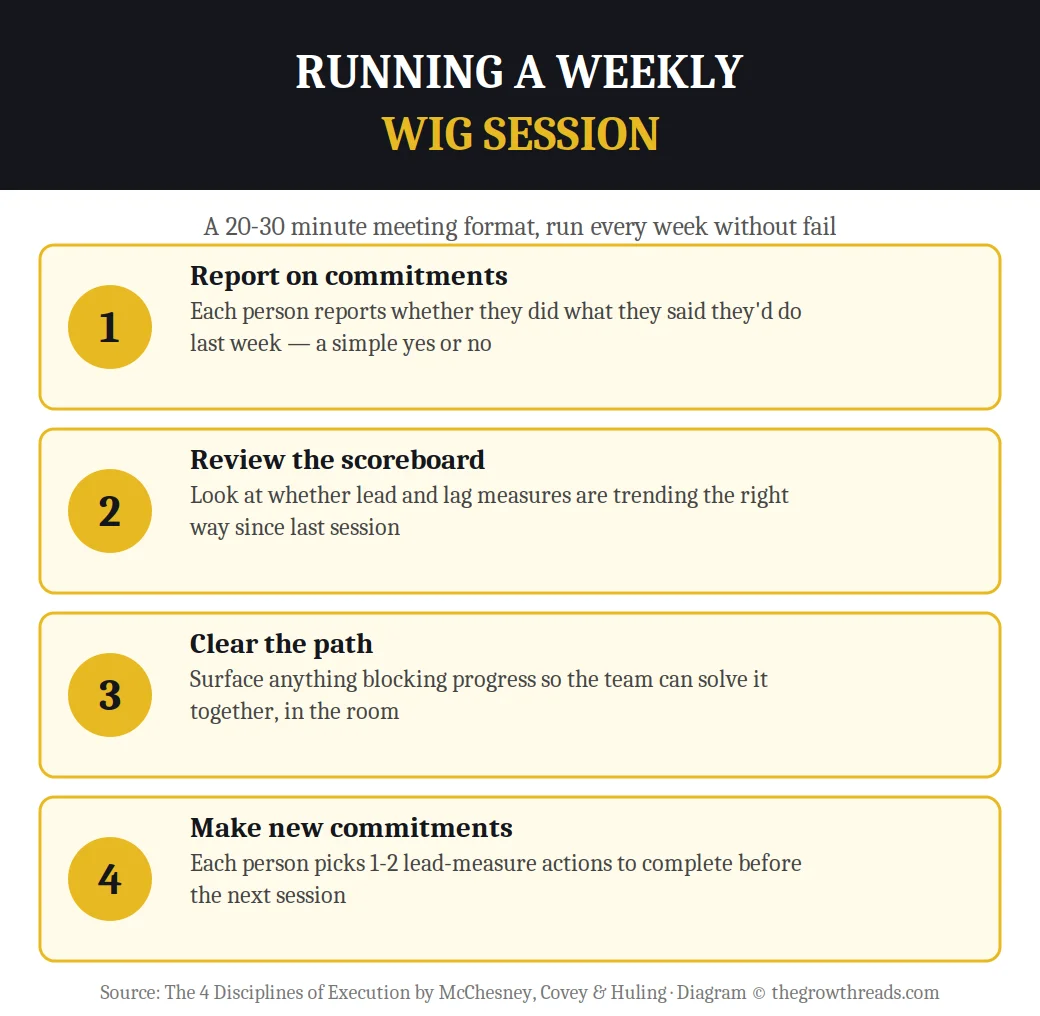
The fourth discipline, Create a Cadence of Accountability, is the one the authors consider non-negotiable: a short, frequent, recurring WIG session — 20 to 30 minutes, ideally weekly — where the team reports on last week’s commitments, reviews the scoreboard, clears any obstacles, and makes new commitments for the coming week. Without this cadence, the authors argue, the other three disciplines quietly decay: the WIG fades from attention, the lead measures stop getting tracked, and the scoreboard goes stale.
TGR Note: The insistence on team-made, not leader-assigned, commitments echoes the accountability research behind Measure What Matters‘s OKR system — in both frameworks, people follow through more reliably on a target they stated in their own words than one that was simply handed to them.
Part 4: Where 4DX fits — and where it doesn’t
The authors are careful to scope what 4DX is for: it’s an execution system, not a strategy system. It assumes leadership has already decided what the WIG should be, and it says relatively little about how to choose a good strategy in the first place — teams looking for help setting direction, not executing on one already set, will find this book thinner than they expect. It’s also a system that requires a real recurring meeting to work; teams that read the book and skip the weekly WIG session tend to see the other three disciplines fade within a month or two, which the authors are unusually candid about for a business book.
4DX also assumes a team that meets regularly and can make and track commitments together — solo practitioners or highly fluid, project-based teams may need to adapt the cadence more than the book anticipates. Where it excels is exactly the case it was built for: a stable team with a genuinely important goal that keeps losing to daily operational noise.
TGR Note: If your bottleneck is actually choosing the right goal rather than executing on one you’ve already picked, pair this with a strategy-focused read — 4DX is deliberately silent on that earlier step.
Who is The 4 Disciplines of Execution best for — and who should read something else first?
This book is best for managers and team leaders who already have a clear, important goal but keep watching it lose to the daily whirlwind of urgent work — it gives you a specific weekly mechanism, not just a motivational push. It also rewards operations-minded readers who want something they can implement literally next Monday rather than a broader leadership philosophy.
If your actual problem is deciding what the goal should be in the first place, a strategy-focused book will serve you better than this one — 4DX explicitly starts after that decision. If you’re looking for a more personal, individual productivity system rather than a team execution system, Atomic Habits is a better fit. And if your team’s real gap is psychological safety and dysfunction rather than lack of a tracking system, address that first — a scoreboard doesn’t fix a team that doesn’t trust each other.
Questions to reflect on
- If you had to pick exactly one Wildly Important Goal for your team right now, stated as “from X to Y by when,” what would it be?
- What’s the lag measure you’re currently tracking that you can’t actually act on directly — and what lead measure might predict it instead?
- Is your team’s scoreboard genuinely visible and readable in five seconds, or is it buried somewhere nobody checks?
- Does your team have a real, recurring meeting focused only on your top goal — and if not, what’s actually been happening to that goal between updates?
- Are your team’s weekly commitments something people state themselves, or are they assigned from above?
🔥 Ready to stop losing your goal to the whirlwind?
This guide covers the framework — the book gives you the full implementation playbook, dozens of real case studies, and templates for building your own scoreboard.
How to apply The 4 Disciplines of Execution (7-day plan)
- Day 1: Write down every goal competing for your team’s attention right now, then circle the one or two that are genuinely wildly important — not just important.
- Day 2: Rewrite your chosen WIG as a finish line: “from X to Y by when,” specific enough that anyone could tell if you hit it.
- Day 3: List 3-5 candidate lead measures — actions your team can directly influence this week that should predict progress on the WIG.
- Day 4: Pick your best 1-2 lead measures and sketch a simple scoreboard design — readable in five seconds, showing both lead and lag measures.
- Day 5: Put the scoreboard somewhere genuinely visible to the whole team, not buried in a shared drive.
- Day 6: Schedule a recurring 20-30 minute WIG session for next week and invite the team.
- Day 7: Run your first WIG session: report on the week, review the scoreboard, clear one obstacle, and have each person make one commitment for next week.
Frequently asked questions
What is the main idea of The 4 Disciplines of Execution?
The book argues that most execution failures aren’t caused by a bad strategy but by the “whirlwind” of urgent daily operations that inevitably crowds out attention for a longer-term strategic goal. The authors, all senior FranklinCovey leaders, present four disciplines — focus on a Wildly Important Goal, act on lead measures, keep a compelling scoreboard, and create a cadence of accountability — as a lightweight, repeatable system for protecting that goal without requiring a full culture change first. The core claim is that execution is a learnable operating system, not a matter of trying harder.
What is a WIG in The 4 Disciplines of Execution?
A WIG, or Wildly Important Goal, is the one or two goals a team decides matter more than everything else competing for its attention. The authors insist a real WIG is stated as a finish line — “from X to Y by when” — so a team can unambiguously tell whether it hit the target, and that trying to treat five or six goals as equally wildly important guarantees weak execution on all of them.
What’s the difference between a lead measure and a lag measure?
A lag measure tracks the goal itself — revenue, weight lost, customer satisfaction — but only moves after the underlying work already happened, so you can’t act on it directly. A lead measure tracks a predictive, influenceable action, like sales calls made or workouts completed, that the team can directly control this week and that should drive the lag measure over time. The authors argue most teams fail because they obsess over lag measures instead of finding and acting on the right lead measures.
Do I really need a weekly meeting for 4DX to work?
The authors are explicit that the cadence of accountability — a short, frequent, recurring WIG session — is non-negotiable, not optional. Without it, they argue the other three disciplines quietly decay: the goal fades from daily attention, lead measures stop getting tracked, and the scoreboard goes stale. Teams that read the book but skip the actual recurring meeting tend to see the system fall apart within a month or two.
Is 4DX a strategy framework or an execution framework?
It’s explicitly an execution framework, not a strategy framework — the authors assume leadership has already decided what the Wildly Important Goal should be, and the book focuses entirely on the harder, more neglected problem of actually achieving it despite daily operational demands. Readers looking for help choosing the right strategic goal in the first place will find this book intentionally silent on that earlier step.
Can 4DX work for a small team or a solo professional?
The framework was designed and field-tested primarily on stable teams that meet regularly, so small teams can generally apply it directly. Solo practitioners can adapt the core ideas — a real WIG, lead measures, and a visible scoreboard — but the fourth discipline’s team-based weekly accountability session needs more adaptation, since its power partly comes from reporting commitments to other people.
How is this different from OKRs (Objectives and Key Results)?
Both systems try to keep a team focused on what matters most, but 4DX puts more weight on a single weekly meeting ritual and a strict lead-versus-lag measure distinction, while OKRs typically run on a quarterly cycle with less prescription about a specific recurring meeting format. Some teams successfully combine the two, using OKRs to set the goal and key results and 4DX-style weekly sessions to keep execution from lapsing between quarterly check-ins.
Related summaries
If The 4 Disciplines of Execution resonated, these dig further into related territory: Measure What Matters on the OKR goal-setting system, Atomic Habits on building the individual habits that support a team goal, and The 7 Habits of Highly Effective People on the broader Covey framework this book builds on. For more, see our best productivity books pillar page.
How we analyze books: We work from the full book — reconstructing its core arguments in our own words, adding commentary that connects it to related research and other books in our library, and pressure-testing the advice in a practical 7-day plan. Ratings weigh usefulness, readability, and evidence quality. Read our full methodology.