

⭐⭐⭐⭐☆ 4.3 / 5
Actionability: 4.5/5 — Concrete techniques you can use within an hour of reading
Evidence: 4.0/5 — Draws on attention science and neuroscience research
Readability: 4.5/5 — Conversational and light, easy to finish in a weekend
Depth: 4.0/5 — Solid coverage of both focus and creative modes
Uniqueness: 4.5/5 — The scatterfocus concept fills a gap most productivity books ignore
Best for: Knowledge workers who feel scattered and want a system for directing attention deliberately
Reading time: ~5 hours (256 pages) | Difficulty to apply: Low to moderate — requires building new attention habits
Hyperfocus in one minute
Your attention is the most limited resource you have — far scarcer than time, energy, or willpower — and most people waste it without realizing. Chris Bailey argues that productivity is not about managing time but about managing attention. He introduces two complementary modes: hyperfocus, where you deliberately channel all your attention onto one task, and scatterfocus, where you intentionally let your mind wander to connect ideas and solve problems. The book provides a practical system for toggling between these modes throughout your day. The central revelation is that mind-wandering is not the enemy of productivity — it is its secret partner, provided you do it on purpose.
Key takeaways
- Attention is your scarcest resource: You can only hold about four things in your attentional space at once. Everything you let in crowds out something else.
- Hyperfocus is intentional: True focus is not a personality trait but a deliberate practice — choose one task, eliminate distractions, and direct all your attention to it for a set period.
- Scatterfocus is equally valuable: Intentional mind-wandering — in the shower, on a walk, during routine tasks — is when your brain connects dots, solves problems, and generates creative ideas.
- Four types of tasks: All work falls into necessary (productive, unattractive), purposeful (productive, attractive), distracting (unproductive, attractive), or unnecessary (unproductive, unattractive). Spend most time on the first two.
- Attentional space is fixed: You cannot expand your attention capacity, but you can learn to fill it with the right things and keep the wrong things out.
- Distractions have two sources: External distractions (notifications, interruptions) are easy to control. Internal distractions (wandering thoughts, impulses) are harder but more important.
- Set intentions before every task: Deciding what to focus on before you begin is the single highest-leverage productivity habit.
- The 40-second rule: Make distractions 40 seconds harder to access (log out of social media, put your phone in another room) and they lose most of their pull.
- Capture during scatterfocus: Keep a notepad nearby when you intentionally let your mind wander. The ideas that surface are often your most valuable creative output.
- Alternate modes daily: Schedule blocks of hyperfocus for your most important work and blocks of scatterfocus (walks, simple tasks) to recharge creativity and solve stuck problems.

What is Hyperfocus about?
Hyperfocus is a productivity guide that reframes attention — not time — as the fundamental resource of knowledge work. Chris Bailey introduces two complementary modes of attention management (hyperfocus and scatterfocus) and provides practical techniques for using both to accomplish more meaningful work while generating more creative ideas.
About the author
Chris Bailey is a Canadian productivity researcher and writer who spent a year conducting intensive experiments on himself to discover what makes people productive. That project became his first book, The Productivity Project. He has consulted for organizations including Google, the Gates Foundation, and the U.S. Treasury. Bailey is known for his self-experimentation approach — he has tested everything from working 90-hour weeks to meditating for 35 hours — and for translating attention science into practical, conversational advice. Hyperfocus is his second book and focuses specifically on attention as the missing variable in most productivity systems. Explore all Chris Bailey book summaries →
Key concepts at a glance
| Concept | What it means | Use it when |
|---|---|---|
| Attentional space | The mental capacity you have at any moment — about 4 chunks of information | Deciding how many tasks to juggle at once |
| Hyperfocus | Deliberately directing all attention to one chosen task | Doing complex, high-value work like writing, coding, or strategy |
| Scatterfocus | Intentionally letting your mind wander to connect ideas | Solving creative problems, brainstorming, or recharging after deep work |
| The four task types | Necessary, purposeful, distracting, unnecessary — based on productivity and attractiveness | Auditing where your attention actually goes each day |
| Attentional residue | Mental fragments from previous tasks that clog your focus on the current one | Understanding why multitasking destroys deep work quality |
| The 40-second rule | Making distractions 40 seconds harder to reach drastically reduces their pull | Setting up your environment for sustained focus |
| Intention setting | Deciding what deserves your attention before each work block | Starting any work session, meeting, or creative block |
| Capture habit | Writing down thoughts during scatterfocus to harvest creative ideas | Walking, showering, or doing routine tasks with a notepad nearby |
Part 1: Hyperfocus — how to direct your attention
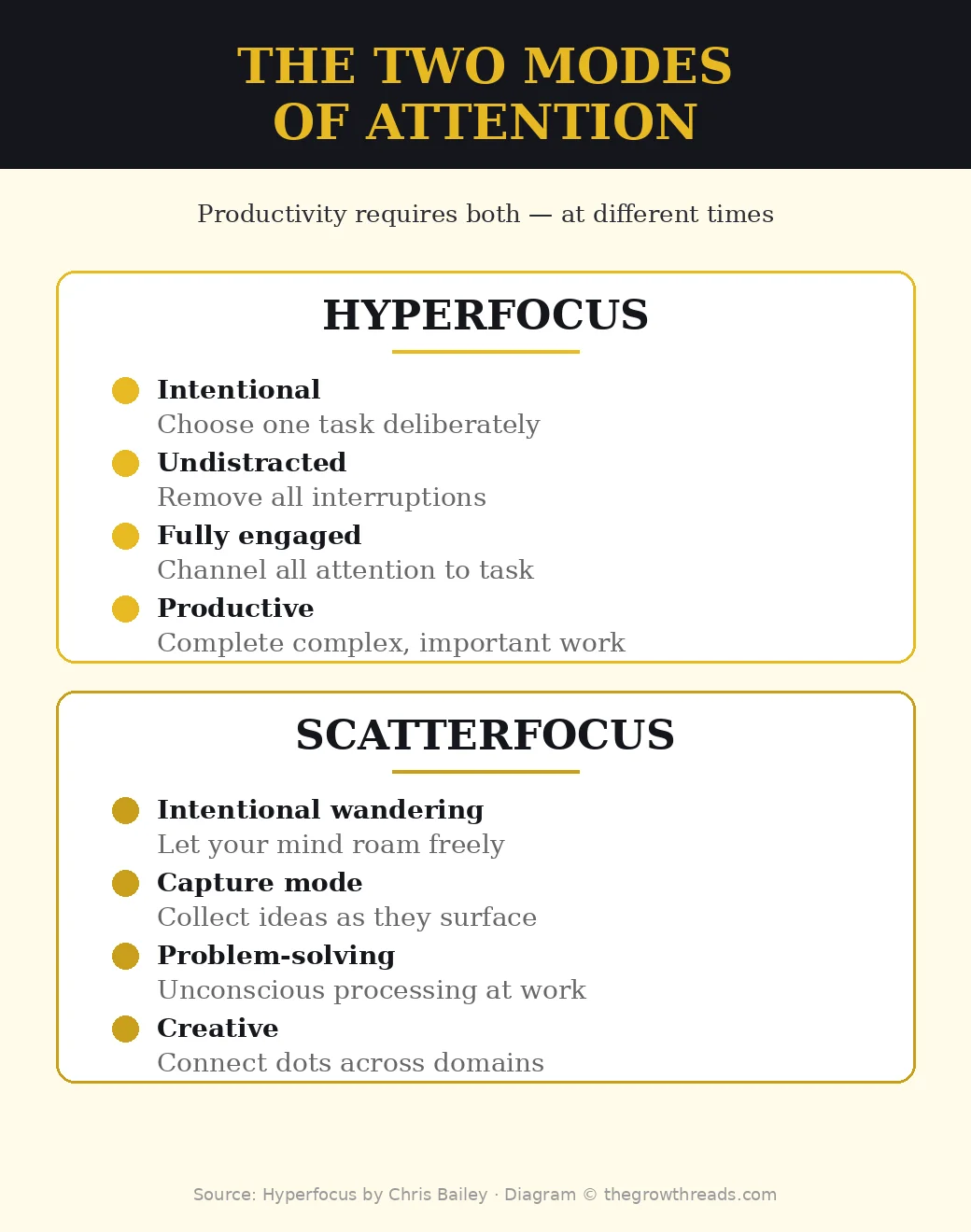
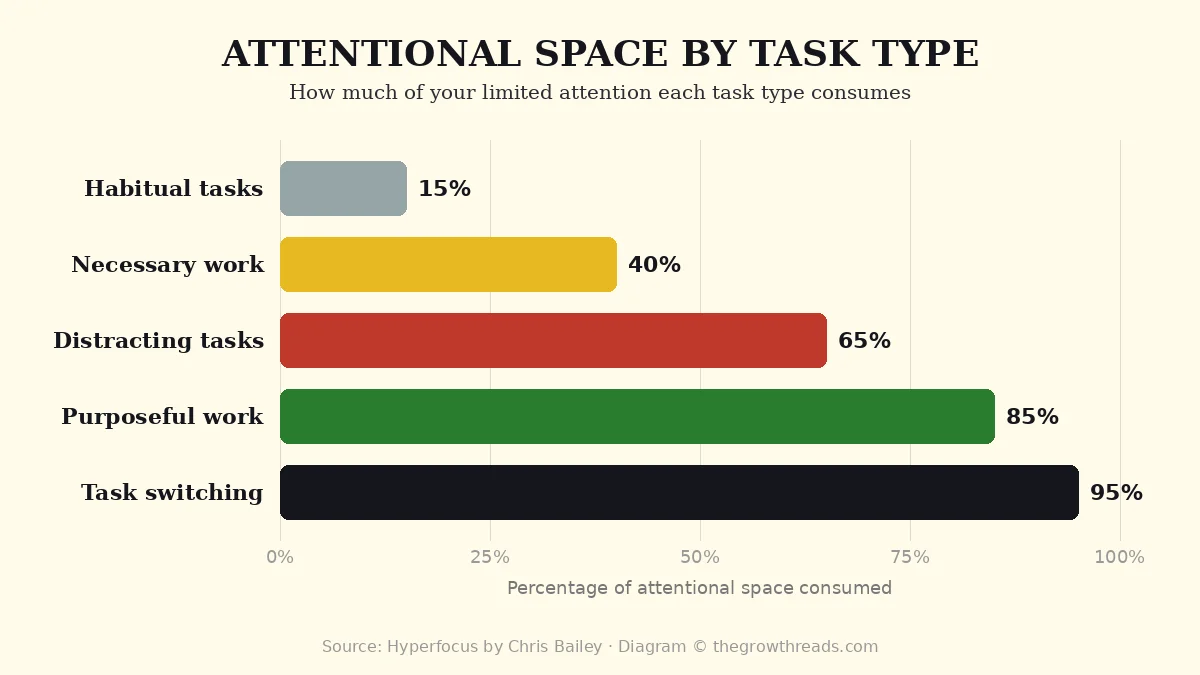
The first half of the book establishes that attention, not time, is the bottleneck of modern productivity. Bailey opens with a striking finding from neuroscience: your attentional space can hold roughly four independent pieces of information at once. When a task is complex enough to consume all four slots — like writing, coding, or strategic planning — you enter a state of total engagement that Bailey calls hyperfocus.
The problem is that most people never achieve this state during their workday. Bailey cites research showing that the average knowledge worker checks email 88 times per day and switches tasks every 40 seconds when working on a computer. Each interruption creates what psychologist Sophie Leroy calls “attentional residue” — mental fragments from the previous task that degrade performance on the current one. A University of California study found that it takes an average of 23 minutes and 15 seconds to return to the original task after an interruption.
Bailey presents hyperfocus as a four-step protocol: choose one worthwhile task, eliminate as many distractions as possible, focus on the task for a predetermined period, and continuously redirect your attention back when it wanders. He is candid that the last step happens constantly — your mind will wander roughly 47% of the time even under ideal conditions. The skill is not preventing mind-wandering but noticing it quickly and returning.
Part 2: The productivity of tasks and the role of distraction
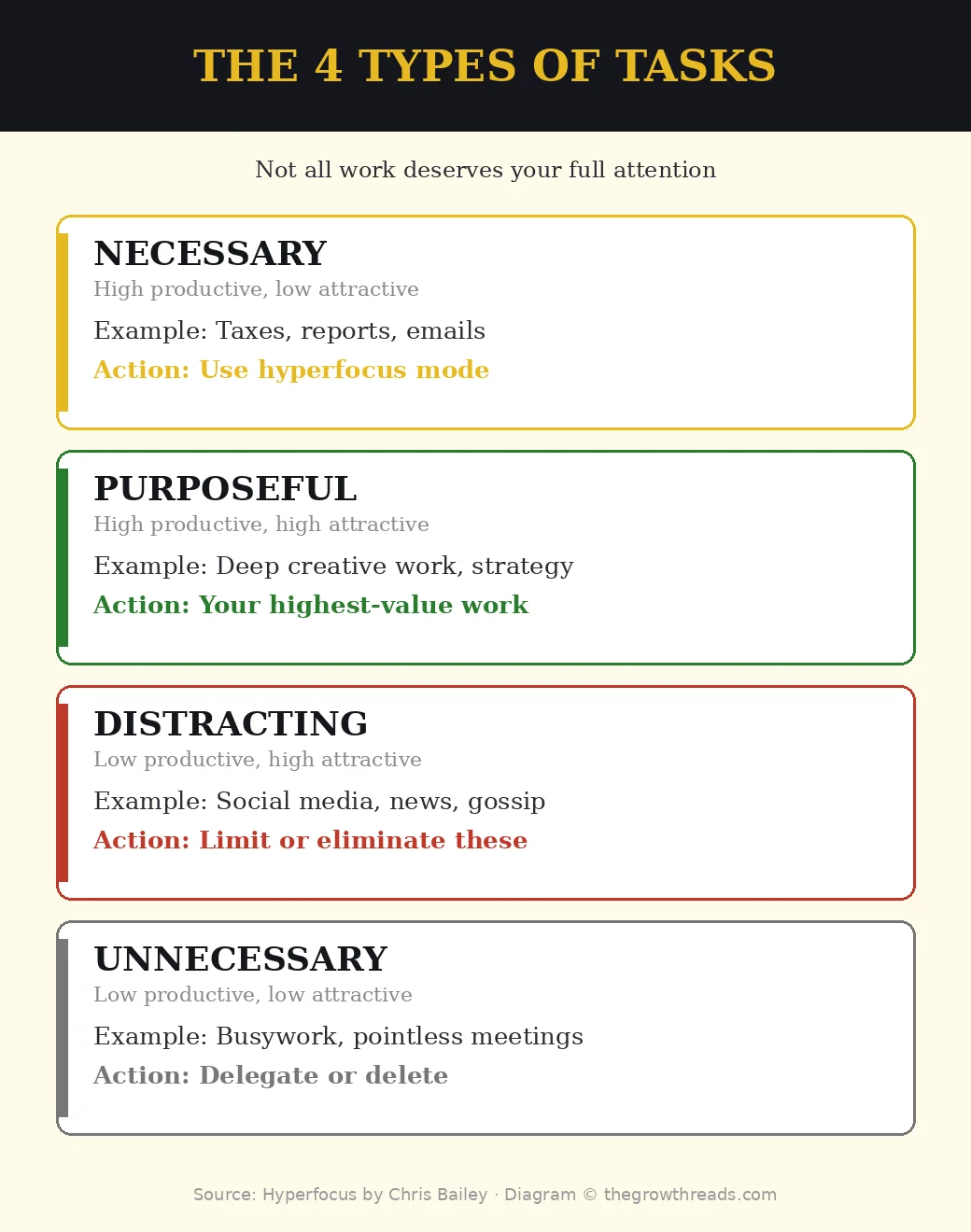
Bailey introduces a two-axis framework for categorizing all tasks: productive vs. unproductive, and attractive vs. unattractive. This creates four quadrants. Purposeful work (productive and attractive) is where you create the most value and should spend the most hyperfocus time. Necessary work (productive but unattractive) includes things like email and admin that must be done but should be batched and time-limited. Distracting tasks (attractive but unproductive) are the real enemy — social media, news, and gossip that hijack your attention because they feel rewarding. Unnecessary work (neither productive nor attractive) should be delegated or deleted entirely.
The insight is that attractive tasks are not inherently bad — the problem is that they crowd out productive ones. Bailey suggests an audit: track what you actually do for a week, then sort each activity into the four quadrants. Most people discover that 30–50% of their day goes to distracting or unnecessary tasks.
His solution is environmental design. The 40-second rule — making any distraction require at least 40 seconds of effort to access — exploits the brain’s laziness. Log out of social media (so you have to type your password), put your phone in another room (so you have to walk to get it), close your email client (so you have to reopen it). Each 40-second barrier reduces the probability of mindless engagement by roughly 60%.
Part 3: Scatterfocus — the creative power of mind-wandering
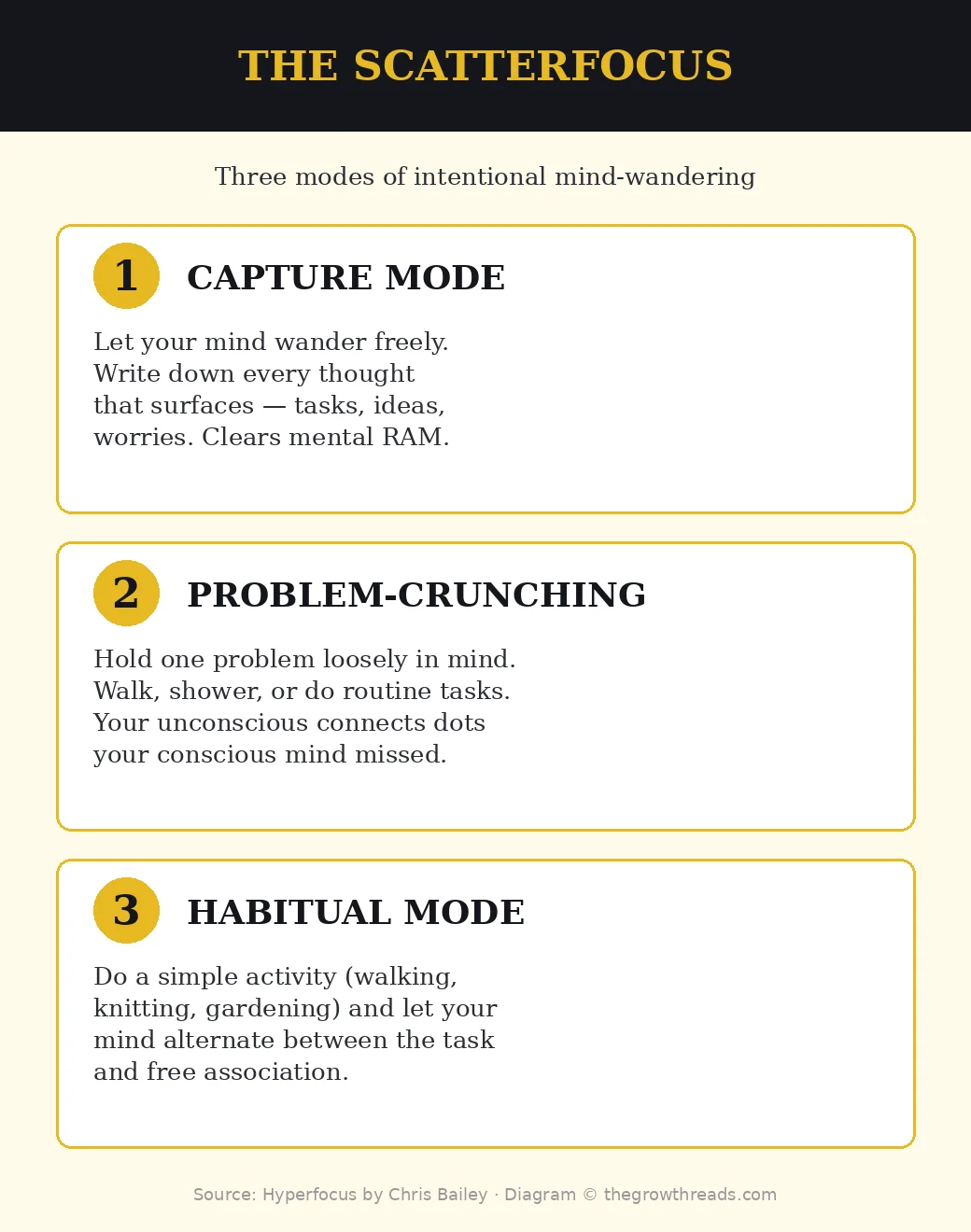
The second half of the book is what sets Hyperfocus apart from every other productivity guide. Bailey argues that intentional mind-wandering is not a productivity failure but a productivity strategy. He calls it scatterfocus and presents three distinct modes.
Capture mode is the simplest: let your mind roam freely and write down every thought that surfaces — tasks you forgot, ideas for projects, worries you need to address. This is essentially a mental defragmentation that clears your attentional space for the next hyperfocus session.
Problem-crunching mode is more targeted: hold a specific problem loosely in mind while doing a routine physical activity like walking, showering, or doing dishes. Research from the University of California, Santa Barbara found that people who engaged in simple tasks after being presented with a creative problem generated 40% more creative solutions than those who rested or worked on demanding tasks. The key is that the activity must be simple enough to leave attentional space free for unconscious processing.
Habitual mode is the richest: engage in a simple, enjoyable activity and let your mind toggle between the activity and free-ranging thought. This is where the most surprising creative connections happen because your brain draws on its vast store of experiences and knowledge without the constraints of conscious, logical thinking.
Part 4: Feeding your attention
The final section addresses the inputs that shape the quality of both hyperfocus and scatterfocus. Bailey argues that what you consume — information, media, conversations, experiences — determines what your mind has to work with during scatterfocus sessions. If you feed it only shallow content (social media, news headlines, reality TV), your mind-wandering sessions produce shallow ideas. If you feed it rich, diverse content (books, deep conversations, new experiences), the connections your unconscious makes become far more valuable.
He recommends deliberately scheduling “scatter-friendly” activities into your week: long walks without podcasts, silent commutes, creative hobbies that occupy your hands but free your mind. He also suggests a weekly review where you look at how you split your time between hyperfocus and scatterfocus, adjusting the balance depending on whether your current work requires more execution (lean toward hyperfocus) or more creativity (lean toward scatterfocus).
The book closes with a powerful reframe: the goal of attention management is not to be focused 100% of the time. It is to be focused when focus serves you and unfocused when wandering serves you. Both states are productive. The difference between a productive person and an unproductive one is not how much they focus — it is how intentionally they choose between focus and diffusion.
Who is Hyperfocus best for — and who should read something else first?
This book is ideal for knowledge workers, writers, programmers, and anyone whose output depends on sustained attention. If you frequently end your day feeling busy but unaccomplished, Bailey’s framework will show you exactly where your attention is leaking and how to plug the holes. It is particularly valuable for creative professionals who need both execution ability and idea generation.
If you need a broader distraction-proofing system, start with our Indistractable summary. If you want to restructure your entire schedule around deep work, read our Deep Work summary first. And if you are looking to build specific daily habits rather than manage attention, our Atomic Habits summary is a better starting point.
Questions to reflect on
- If you tracked your attention for a day, how would your four-quadrant task breakdown actually look — and how would you want it to look?
- When was the last time you had a breakthrough idea, and what were you doing physically at the time? Was it a scatterfocus moment?
- What is the biggest source of attentional residue in your work — and what would it take to add a 40-second barrier to it?
- Do you schedule time for intentional mind-wandering, or do you treat every gap as a chance to check your phone?
- What is the single most important task you could hyperfocus on tomorrow morning for 45 minutes that would make the rest of the day feel successful?
🔥 Ready to take control of your attention?
Get Hyperfocus and learn to toggle between deep work and creative mind-wandering.
How to apply Hyperfocus (7-day plan)
- Day 1 — Audit your attention: Track what you actually do for one full workday in 30-minute increments. Sort each block into Bailey’s four categories: necessary, purposeful, distracting, or unnecessary.
- Day 2 — Set a daily intention: Before starting work, write down the three most important tasks that deserve your attention today. Commit to hyperfocusing on the top one first.
- Day 3 — Apply the 40-second rule: Log out of your top three distracting apps. Put your phone in a drawer or another room. Close your email client. Add friction to every attractive distraction.
- Day 4 — Do your first hyperfocus block: Set a timer for 45 minutes. Choose one purposeful task. Eliminate all notifications. Every time your mind wanders, gently bring it back. Note how many times you redirect.
- Day 5 — Try capture-mode scatterfocus: Take a 20-minute walk without your phone or headphones. Carry a small notepad. Let your mind wander and write down every thought, idea, or task that surfaces.
- Day 6 — Try problem-crunching scatterfocus: Before a routine activity (shower, cooking, cleaning), load one work problem into your mind. Do the activity and let your subconscious process. Write down any solutions afterward.
- Day 7 — Design your ideal week: Map out a weekly template alternating blocks of hyperfocus (complex, important work) and scatterfocus (walks, routine tasks, free thinking). Start implementing it on Monday.
Frequently asked questions
How is Hyperfocus different from Deep Work?
Deep Work by Cal Newport focuses on scheduling extended blocks of distraction-free work and building a lifestyle that supports them. Hyperfocus by Chris Bailey focuses on the mechanics of attention within those blocks — how to direct it, how to recover it when it wanders, and critically, how to use intentional mind-wandering (scatterfocus) as a complement to deep concentration. Newport answers “when should I focus?” while Bailey answers “how do I actually focus, and what do I do when I am not focusing?”
What is scatterfocus and why does it matter?
Scatterfocus is Bailey’s term for intentional mind-wandering. It has three modes: capture mode (free-ranging thought to clear mental clutter), problem-crunching mode (holding a specific problem loosely while doing a routine task), and habitual mode (doing a simple activity while letting your mind toggle between the activity and creative thinking). It matters because research shows that the brain’s default mode network — active during mind-wandering — is responsible for creative insight, future planning, and autobiographical reflection.
What is the 40-second rule?
The 40-second rule is Bailey’s environmental design principle: make any distraction require at least 40 seconds of effort to access. Log out of social media so you have to re-enter your password, put your phone in another room so you have to walk to get it, close your email client so you have to reopen it. Each barrier exploits the brain’s natural laziness, reducing the probability of mindless distraction engagement by roughly 60%. It is the simplest high-leverage intervention in the book.
How big is your attentional space?
Bailey draws on cognitive science showing that working memory can hold approximately four independent chunks of information at once. This is your attentional space — the total cognitive bandwidth you have to work with at any given moment. Complex tasks like writing or programming consume most or all of this space, which is why they require distraction-free environments. Simple tasks like walking or folding laundry consume only one or two chunks, leaving the rest free for unconscious creative processing during scatterfocus.
Can you actually train yourself to focus better?
Yes, but not by expanding your attentional capacity (which is largely fixed). Bailey argues that you train focus by practicing the redirect: noticing when your mind has wandered and gently bringing it back to the chosen task. This is essentially a secular mindfulness practice applied to work. Research he cites suggests that regular meditation improves this redirect speed, and that even without meditation, the simple act of setting an intention before each work block significantly improves focus duration and quality over time.
What are the four types of tasks in Hyperfocus?
Bailey classifies all tasks along two axes: productive vs. unproductive, and attractive vs. unattractive. This creates four types: purposeful work (productive and attractive — your highest-value output), necessary work (productive but unattractive — emails, admin, reports), distracting tasks (unproductive but attractive — social media, news, gossip), and unnecessary tasks (neither productive nor attractive — busywork, pointless meetings). The goal is to spend most time on purposeful work and batch necessary work, while minimizing or eliminating the other two.
Is this book only for office workers?
No. While Bailey writes primarily for knowledge workers, the attention management principles apply to anyone whose work requires thinking: students, entrepreneurs, teachers, creative professionals, and even parents managing a household. The scatterfocus techniques are especially universal — anyone can benefit from intentional mind-wandering during walks, commutes, or routine chores. If your work involves solving problems, generating ideas, or sustaining concentration on any task, the book’s framework is relevant regardless of your profession.
Related summaries
- Deep Work Summary — Cal Newport’s foundational guide to scheduling and protecting extended blocks of distraction-free concentration.
- Indistractable Summary — Nir Eyal’s comprehensive four-part system for becoming immune to distraction in a world designed to hijack your attention.
- Stolen Focus Summary — Johann Hari’s investigation into the systemic forces destroying our ability to pay attention — and what to do about it.
- Atomic Habits Summary — James Clear’s framework for building the small daily habits that support sustained attention and productivity.
📚 Explore more Productivity books
This summary is part of our Best Productivity Books collection — curated summaries of the most impactful books on focus, habits, time management, and deep work.