

⭐⭐⭐⭐ 4.2 / 5 — The foundational theory of why well-managed companies fail when disruptive technologies emerge, still essential reading for anyone leading in competitive markets.
Best for: Startup founders, corporate strategists, product leaders, investors, and anyone trying to understand why dominant companies lose to smaller, seemingly inferior competitors.
Reading time: ~8 hours (286 pages)
Difficulty to apply: Moderate — the theory is crystal clear, but applying it requires overcoming the exact organizational pressures Christensen describes. That is the dilemma.
The Innovator’s Dilemma in one minute
The companies most likely to be destroyed by disruptive innovation are not poorly managed — they are brilliantly managed, and that is precisely the problem. Clayton Christensen, a Harvard Business School professor, spent years studying why leading companies in the disk drive, excavator, steel, and retail industries were repeatedly toppled by smaller, less resourced competitors offering seemingly inferior products. His answer upended conventional business thinking: great companies fail not because they ignore innovation, but because they follow the rules of good management too well. They listen to their best customers, invest in higher-margin improvements, and rationally reject small, unprofitable markets — the exact markets where disruptive innovations are born. By the time the disruption improves enough to threaten the mainstream, it is too late to respond.
Key takeaways
- Good management causes failure: The practices that make companies successful — customer focus, disciplined investment, margin improvement — are the same practices that make them vulnerable to disruption.
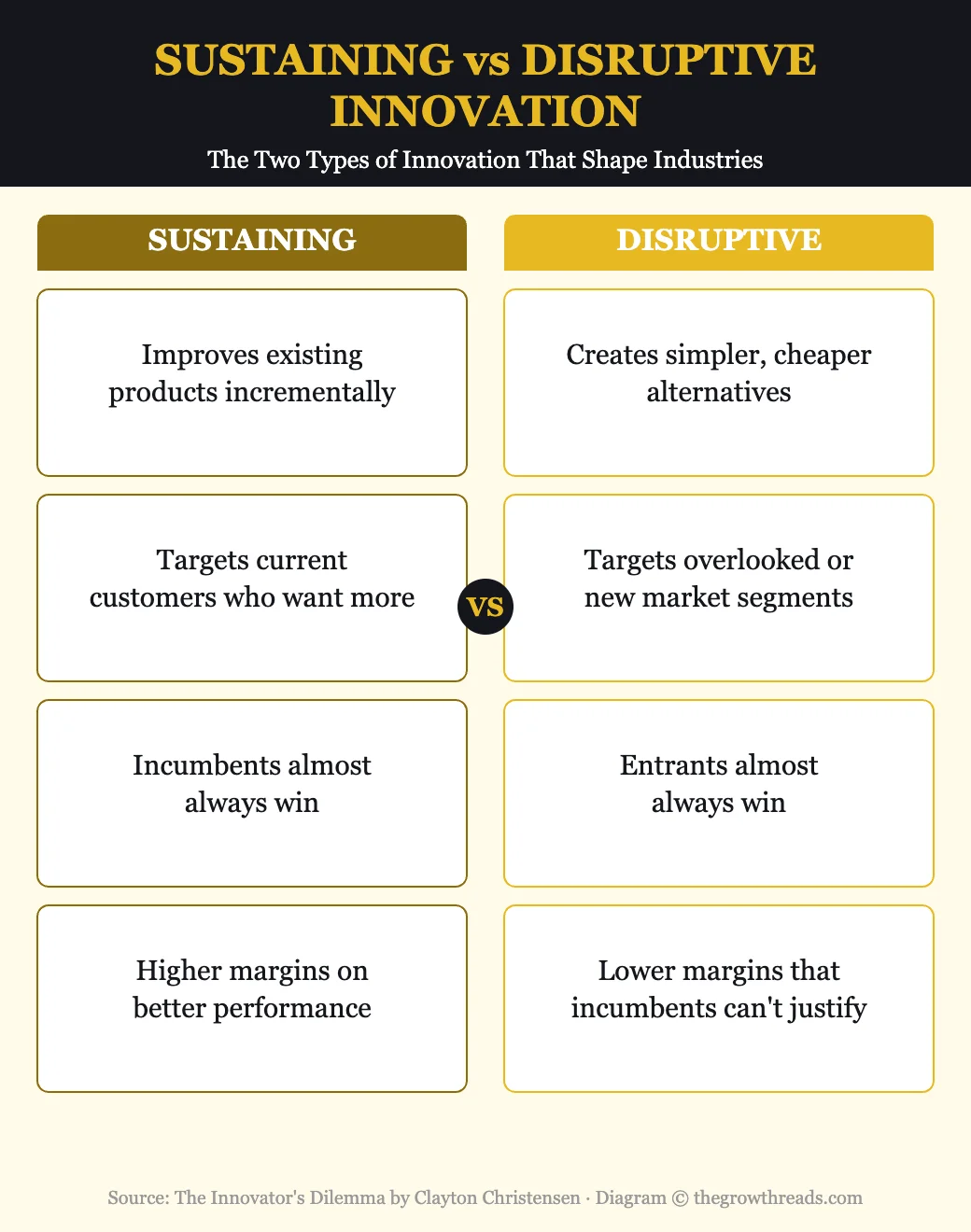
- Sustaining vs. disruptive innovation: Sustaining innovations improve existing products for existing customers. Disruptive innovations create simpler, cheaper alternatives that initially serve only overlooked or new markets.
- Incumbents almost always win sustaining battles: Established companies have the resources, relationships, and expertise to win any fight over improving existing products. They almost never lose to startups in their own market.
- Incumbents almost always lose disruptive battles: Disruptive markets start too small and too low-margin for large companies to justify entering. By the time these markets grow large enough to matter, the entrant has an insurmountable head start.
- Value networks shape decisions: Companies exist within value networks — ecosystems of suppliers, customers, and investors — that define what problems are worth solving and what margins are acceptable. Disruption comes from outside these networks.
- Resource dependence is real: Even visionary leaders cannot force organizations to pursue opportunities that their customers, investors, and employees do not value. Resources flow toward what the value network rewards.
- The solution is organizational, not technological: Incumbents can survive disruption, but only by creating separate, independent organizations with different cost structures, customers, and success metrics.
- Small markets don’t solve growth problems: A billion-dollar company needs to find billion-dollar opportunities. A ten-million-dollar disruptive market cannot solve that problem, even if it will become a billion-dollar market in a decade.
- Discovery-driven planning beats conventional planning: In disruptive markets, the right strategy cannot be known in advance. Companies must plan to learn — iterating quickly with small bets rather than committing to a fixed plan.
- Performance overshooting creates disruption windows: When incumbents overshoot what mainstream customers actually need, they leave an opening for simpler products that are “good enough” at a much lower price.
What is The Innovator’s Dilemma about?
The Innovator’s Dilemma explains why successful, well-managed companies fail when confronted with disruptive technologies — not because of bad management, but because the rational pursuit of profit and customer satisfaction systematically blinds them to emerging threats from below.
About the author
Clayton M. Christensen (1952–2020) was the Kim B. Clark Professor of Business Administration at Harvard Business School, widely regarded as one of the most influential management thinkers of the modern era. He developed the theory of disruptive innovation that has shaped strategy in industries from technology to healthcare to education. Christensen founded the consulting firm Innosight and authored several follow-up works, including The Innovator’s Solution and Competing Against Luck. He was named the world’s most influential management thinker by Thinkers50 twice. His theories were famously embraced by leaders including Steve Jobs, Andy Grove, and Jeff Bezos, and “disruption” entered the business lexicon largely through his work. Explore all Clayton Christensen book summaries →
Key concepts at a glance
| Concept | What it means | Use it when |
|---|---|---|
| Disruptive Innovation | Simpler, cheaper products that initially serve overlooked segments then improve to capture the mainstream | Evaluating whether a new competitor is a real threat |
| Sustaining Innovation | Improvements to existing products that serve current customers better | Understanding where incumbents have natural advantages |
| Value Network | The ecosystem of customers, suppliers, and investors that defines what a company values | Understanding why rational decisions can be strategically fatal |
| Resource Dependence | Organizations cannot pursue opportunities their value network does not reward | Why promising initiatives get defunded or deprioritized |
| Performance Overshooting | When products exceed what customers actually need | Spotting when “good enough” alternatives could win |
| Discovery-Driven Planning | Planning to learn rather than planning to execute a fixed strategy | Entering markets where the right approach is unknown |
| Autonomous Organization | A separate unit with its own cost structure and metrics | Pursuing disruptive opportunities within an established company |
| New Market Disruption | Creating demand among non-consumers rather than stealing existing customers | Finding opportunities incumbents structurally cannot see |
Part 1: The evidence — why great companies fail
Christensen builds his case through meticulous analysis of the disk drive industry — a field he chose specifically because its rapid pace of technological change compressed decades of competitive dynamics into a few years, making patterns visible that would take much longer to emerge in slower-moving industries.
Between 1976 and 1995, the disk drive industry experienced wave after wave of disruption. The dominant makers of 14-inch drives were toppled by companies making 8-inch drives. The 8-inch leaders were then defeated by 5.25-inch makers. And the 5.25-inch leaders fell to 3.5-inch drives. The pattern was remarkably consistent: in every generation, the established leaders were well-managed companies that listened carefully to their customers, invested heavily in next-generation sustaining technologies, and rationally declined to pursue the smaller, lower-margin market for the new smaller drives.
The key insight is that disruptive technologies are almost always worse than existing products when they first appear — worse on the dimensions that existing customers care about. The first 5.25-inch drives had less capacity and slower performance than 8-inch drives. No customer of 8-inch drives wanted them. But they were smaller and cheaper, which made them attractive to a completely different market: personal computer makers who needed something small and affordable, not fast and capacious.
This is the mechanism of the dilemma. When a well-managed company asks its best customers whether they want the new technology, the answer is always no. When the financial analysts run the numbers, the new market is always too small. When the engineers compare performance, the new technology always looks inferior. Every rational signal says: ignore it. And so they do — until it is too late.
Part 2: The mechanism — value networks and resource dependence
The theoretical engine of the book is the concept of value networks. Every company exists within a network of customers, suppliers, partners, and investors that collectively define what problems are worth solving, what costs are acceptable, and what margins justify investment. Companies do not make decisions in a vacuum — they make decisions that their value network rewards.
This creates what Christensen calls resource dependence: regardless of what senior leaders want to do, the organization’s resources inevitably flow toward projects that the value network values. A large company’s best salespeople will spend their time selling to the biggest, most profitable customers. Its engineers will work on the highest-margin products. Its financial systems will kill any project that cannot demonstrate adequate returns within the planning horizon. No CEO memo can override these structural forces for long.
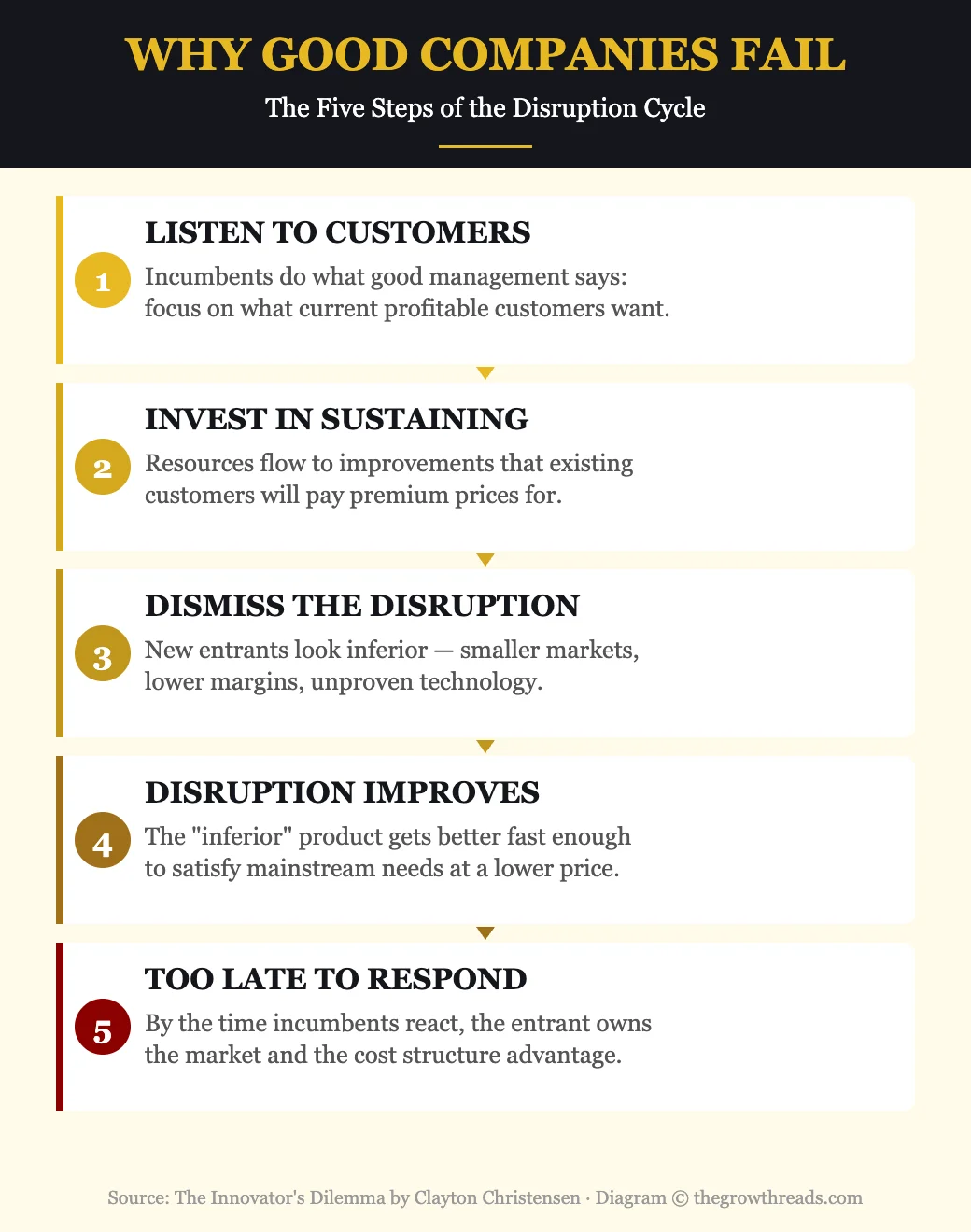
The mechanism creates a predictable five-step cycle of disruption. First, a disruptive technology appears in a small, unattractive market. Second, the incumbent’s best customers express no interest in it. Third, the incumbent’s financial analysis shows the market is too small to solve its growth problem. Fourth, the disruption improves — slowly at first, then rapidly — until it meets the needs of mainstream customers. Fifth, the incumbent tries to respond, but the entrant now has years of experience, a loyal customer base, and a cost structure the incumbent cannot match.
Christensen extends his analysis beyond disk drives to excavators (where hydraulics disrupted cable-actuated machines), steel (where minimills disrupted integrated mills), and retail (where discount stores disrupted department stores). The pattern holds across all these industries: disruption succeeds not because incumbents are ignorant or lazy, but because the economics of disruption are structurally invisible within the incumbent’s value network.
Part 3: The principles of disruptive innovation
Christensen distills his findings into five principles that govern how disruptive technologies reshape industries. Understanding these principles is the key to recognizing and responding to disruption before it is too late.
Principle 1: Companies depend on customers and investors for resources. This is not a statement about weak leadership — it is a structural reality. Even the strongest CEO cannot redirect resources toward opportunities that the company’s ecosystem does not value. The implication is profound: you cannot fight disruption from within the existing organization. You need a separate unit with different customers and different success metrics.
Principle 2: Small markets don’t solve the growth needs of large companies. A company doing $5 billion in revenue needs to find $500 million in new revenue to grow at 10%. A $50 million disruptive market — even one growing at 50% per year — is not a meaningful needle-mover. This is why large companies rationally ignore early-stage disruptive opportunities, and why smaller companies, for whom $50 million represents a transformative opportunity, are naturally attracted to them.
Principle 3: Markets that don’t exist can’t be analyzed. Conventional market research and financial forecasting are useless for disruptive technologies because the customers and applications do not yet exist. Companies that demand rigorous analysis before committing resources will always be late to disruption. The alternative is discovery-driven planning — making small bets, testing assumptions, and learning your way into the market.
Principle 4: An organization’s capabilities define its disabilities. The processes, values, and cost structures that make a company great at serving its current market are the same things that make it terrible at pursuing disruptive opportunities. An organization optimized for 40% gross margins cannot survive in a market that demands 20% margins, even if that market is growing explosively.
Principle 5: Technology supply may not equal market demand. Christensen calls this performance overshooting. Companies often improve their products faster than customers’ needs evolve. When products overshoot what the market requires, the basis of competition shifts from performance to reliability, convenience, and price — exactly the dimensions where disruptive products excel.
Part 4: Solutions — how incumbents can survive disruption
Christensen does not leave leaders without a path forward. His prescription is specific and actionable, though he is candid that it requires organizational courage that few companies demonstrate.
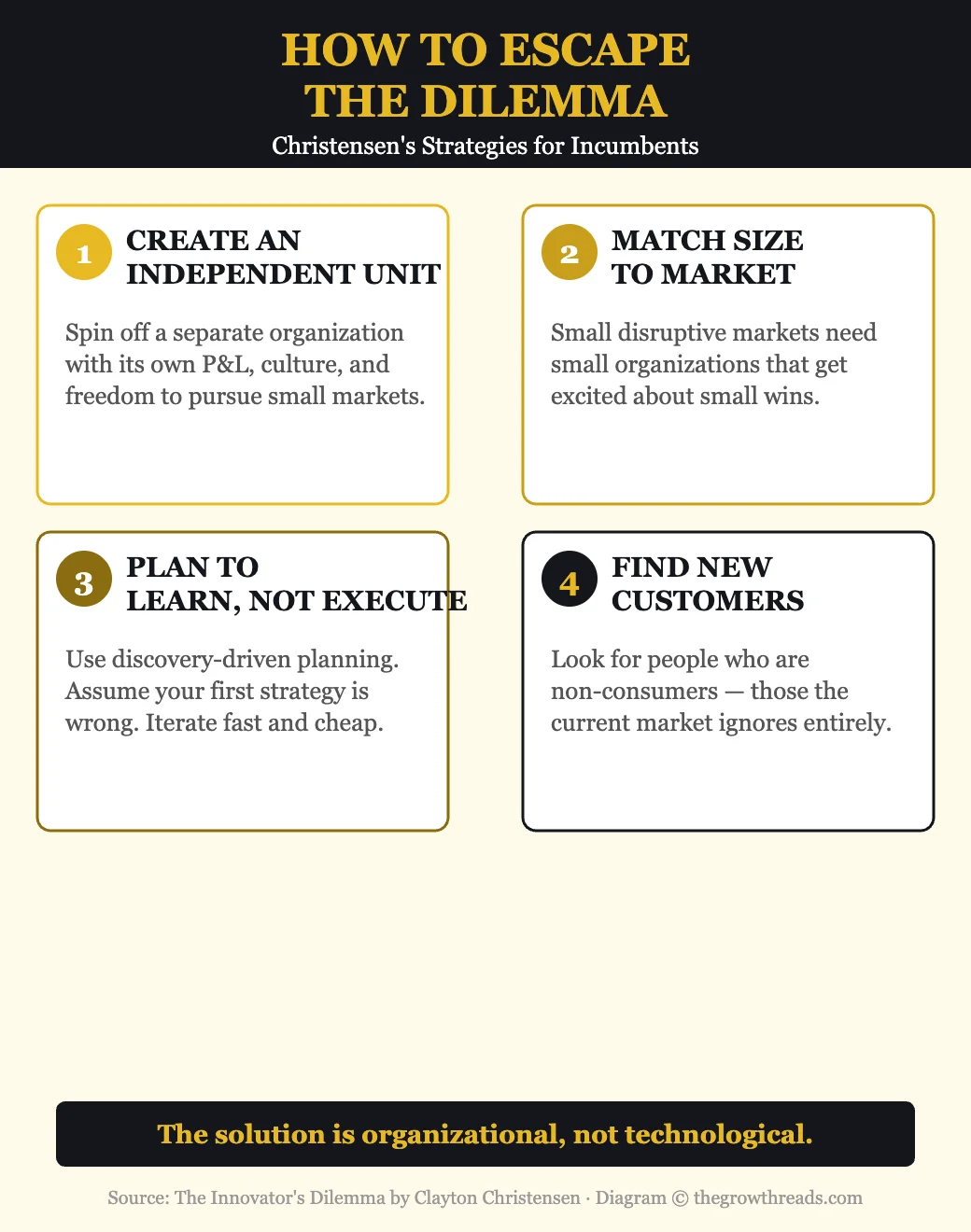
The primary solution is to create an independent organization — a separate business unit or spin-off with its own cost structure, its own customers, its own success metrics, and its own culture. This unit must be small enough that the disruptive market’s small revenues are exciting rather than trivial. It must report to executives who understand that early-stage disruptive markets require different metrics than established businesses.
Christensen emphasizes that this is not a “skunkworks” that develops technology and hands it back to the parent — that approach fails because the parent’s value network will reject the disruptive product. The independent unit must have its own commercial engine: its own salespeople selling to its own customers at its own price points. Only when the disruptive market has grown large enough to matter should integration with the parent be considered — if at all.
The second critical insight is discovery-driven planning. In disruptive markets, the right strategy cannot be determined through conventional analysis because the data does not exist yet. Instead of committing to a plan and executing it, companies should plan to learn. This means making small, reversible bets; testing assumptions quickly; and being willing to pivot when the market reveals that your initial assumptions were wrong. The goal is to fail cheaply and learn fast.
Who is The Innovator’s Dilemma best for — and who should read something else first?
This book is essential for anyone making strategic decisions in competitive markets — startup founders evaluating their competitive position, corporate leaders assessing emerging threats, investors judging whether an incumbent can survive a challenge, and product managers deciding where to invest development resources. If you work in technology, healthcare, finance, or any industry facing rapid change, Christensen’s framework is indispensable.
If you are an entrepreneur looking for a practical how-to guide for building a startup, The Lean Startup by Eric Ries translates Christensen’s theory into an actionable methodology. If you are interested in building organizational culture that can adapt to disruption, No Rules Rules by Reed Hastings shows how Netflix implemented many of Christensen’s principles. If you want to understand how great companies sustain excellence over time, Good to Great by Jim Collins provides the complementary internal perspective.
Questions to reflect on
- In your industry, what products or services are currently “good enough” for most customers even though incumbents keep adding features and raising prices? Where is performance overshooting creating an opening?
- Think about your organization’s value network. What kinds of opportunities does it structurally reward — and what kinds does it systematically ignore or reject?
- If a competitor offered a simpler, cheaper version of your product that served only your least profitable customers, would your organization treat that as a serious threat or a minor nuisance?
- Where in your market are there non-consumers — people who currently do not use any product in your category because existing options are too expensive, too complex, or too inconvenient?
- If you needed to create an independent unit to pursue a disruptive opportunity, what organizational pressures would you face — and how would you overcome them?
🔥 Ready to understand why great companies fail — and how to avoid the trap?
Get Christensen’s foundational theory that every business leader needs to understand.
How to apply The Innovator’s Dilemma (7-day plan)
- Day 1 — Map your value network: Draw a map of your organization’s key customers, suppliers, and investors. For each stakeholder, write what they value most and what they would reject. This is your value network — and it defines your blind spots.
- Day 2 — Identify sustaining vs. disruptive investments: Review your current product roadmap or investment portfolio. Classify each initiative as sustaining (improving for current customers) or potentially disruptive (creating simpler solutions for new segments). Notice the ratio.
- Day 3 — Find performance overshooting: Talk to five customers at the low end of your market. Ask: “What features do you never use? What do you wish was simpler or cheaper?” Their answers reveal where your product has overshot and where disruption could enter.
- Day 4 — Identify non-consumers: List three groups of people who don’t use any product in your category. Why not? What would a product need to look like to serve them? These are your potential disruptive markets.
- Day 5 — Run the disruption test: Think of the newest, smallest competitor in your space. Score them on Christensen’s disruption criteria: Are they simpler? Cheaper? Serving overlooked customers? Improving rapidly? If yes on three or more, take them seriously.
- Day 6 — Design an independent unit: On paper, design a small autonomous team that could pursue one disruptive opportunity. Define its separate customers, cost structure, success metrics, and reporting line. Notice where the parent organization’s processes would kill it.
- Day 7 — Write your disruption brief: Summarize your findings in a one-page memo: the disruptive threats you identified, the non-consumers you could serve, and the organizational changes needed to respond. Share it with one decision-maker.
Frequently asked questions
What is the innovator’s dilemma in simple terms?
The innovator’s dilemma is the paradox that well-managed companies fail precisely because they do everything right. By listening to their best customers, investing in high-margin improvements, and ignoring small unprofitable markets, they create the conditions for disruption. The “dilemma” is that the rational, responsible thing to do — focus on what customers want today — is the thing that makes you vulnerable to what the market will want tomorrow.
What is the difference between sustaining and disruptive innovation?
Sustaining innovations improve existing products along dimensions that current customers already value — faster processors, better cameras, higher reliability. Incumbents almost always win these battles. Disruptive innovations create simpler, cheaper, or more convenient alternatives that initially appeal only to overlooked segments or non-consumers. They start worse on traditional metrics but improve over time until they satisfy the mainstream market at a lower price.
What are examples of disruptive innovation?
Christensen’s primary example is the disk drive industry, where each generation of smaller drives disrupted the previous one. Other examples include steel minimills disrupting integrated steel mills, hydraulic excavators disrupting cable-actuated machines, and discount retailers disrupting department stores. Modern examples often cited include Netflix disrupting Blockbuster, smartphones disrupting PCs, and digital photography disrupting film.
Is The Innovator’s Dilemma still relevant?
Yes. While some specifics have been debated and refined since 1997, the core framework remains one of the most powerful tools for understanding competitive dynamics. The pattern Christensen identified — incumbents being rationally blind to threats from below — continues to play out across industries including media, finance, healthcare, and education. The theory has been refined by Christensen himself and others, but its fundamental insight has held up remarkably well.
How can established companies avoid disruption?
Christensen’s primary recommendation is to create a separate, independent organization — with its own cost structure, customers, and success metrics — to pursue the disruptive opportunity. This unit must be small enough that the disruptive market’s revenues are exciting rather than trivial. It must use discovery-driven planning (small bets, rapid iteration) rather than conventional forecasting. And it must be shielded from the parent company’s value network, which will otherwise kill it.
What is a value network?
A value network is the ecosystem of customers, suppliers, partners, and investors within which a company operates. It defines what the company perceives as valuable — which problems to solve, which margins to target, which markets to pursue. Companies make rational decisions within their value network, but those decisions can be strategically fatal when a disruptive technology emerges outside the network’s boundaries. Value networks explain why smart people make decisions that look foolish in retrospect.
Should I read The Innovator’s Dilemma or The Innovator’s Solution?
Start with The Innovator’s Dilemma. It establishes the foundational theory with rigorous evidence and is the more essential read. The Innovator’s Solution, published in 2003, extends the framework with more prescriptive advice on how to create and sustain disruptive growth businesses. Think of the Dilemma as the diagnosis and the Solution as the expanded treatment plan. Most readers find the Dilemma more intellectually compelling and the Solution more practically useful.
Related summaries
- The Lean Startup by Eric Ries — The practical methodology for entrepreneurs that operationalizes Christensen’s discovery-driven planning into a repeatable system.
- Good to Great by Jim Collins — The complementary internal perspective on why some companies sustain excellence while others fail.
- No Rules Rules by Reed Hastings — How Netflix built a culture designed to disrupt itself before competitors could.
- Principles by Ray Dalio — A parallel framework for building organizations that can adapt to changing conditions rather than optimizing for the past.
Explore more leadership books: This summary is part of our Best Leadership Books collection. Browse the full list for more evidence-based guides to leading teams and organizations.