

★★★★☆ 4.2/5 — The definitive framework for building products people actually want, using rapid experimentation instead of blind faith.
Best for: Founders, product managers, intrapreneurs, and anyone launching something new under conditions of extreme uncertainty.
Reading time: ~6 hrs (guide: 20 min)
Difficulty to apply: Moderate — the concepts are clear but require organizational courage to implement.
The Lean Startup in one minute
Most startups fail not because they cannot build a product, but because they build a product nobody wants. Eric Ries proposes a scientific approach to entrepreneurship: instead of spending months perfecting a product before launch, build a Minimum Viable Product (MVP), measure how real customers respond, and learn whether to pivot or persevere — then repeat. This Build-Measure-Learn feedback loop, borrowed from lean manufacturing and scientific experimentation, replaces gut instinct with validated learning and transforms entrepreneurship from an art into a rigorous discipline. The framework has been adopted by startups, Fortune 500 companies, and government agencies worldwide.
Key takeaways
- Validated learning over opinions: The only way to know if a product idea works is to test it with real customers, not to debate it in conference rooms.
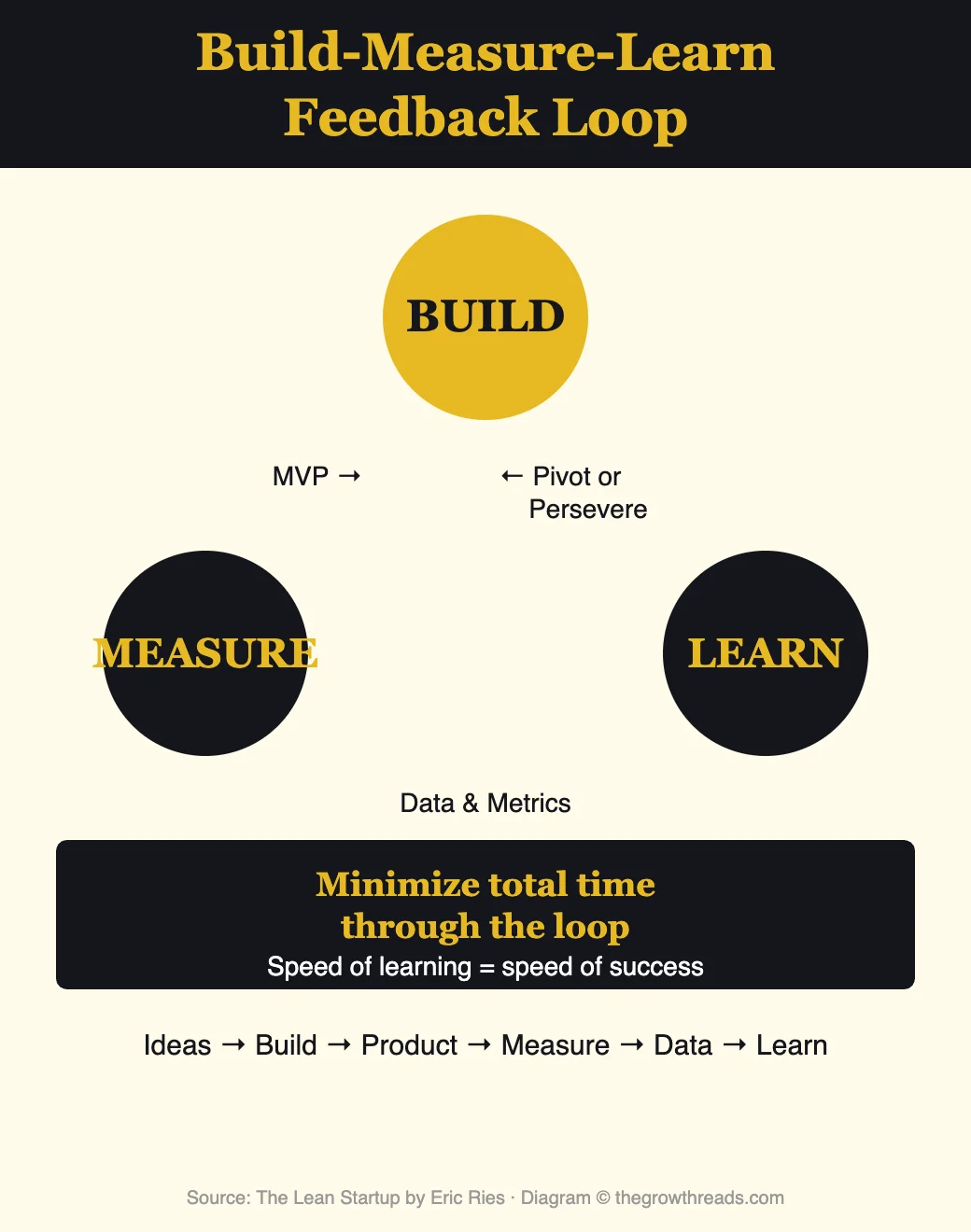
- Build-Measure-Learn is the core engine: Minimize the total time through this feedback loop, and you maximize your chances of finding a sustainable business model before running out of money.
- The MVP is not a bad product: A Minimum Viable Product is the fastest experiment that lets you collect the maximum amount of validated learning with the least effort.
- Innovation accounting replaces vanity metrics: Track actionable metrics (conversion rates, retention cohorts) instead of vanity numbers (total signups, page views).
- Pivot or persevere is the crucial decision: Regularly and honestly assess whether your current strategy is working, and have the courage to change direction when the data says so.
- Small batches beat big launches: Shipping frequently in small increments catches problems earlier and produces faster learning than massive, infrequent releases.
- Startups exist under uncertainty: A startup is not a smaller version of a large company — it is a temporary organization searching for a repeatable, scalable business model.
- The five whys prevent recurring problems: When something breaks, ask “why” five times to reach the root cause, then make a proportional investment in prevention.
What is The Lean Startup about?
The Lean Startup is a methodology for developing businesses and products by combining rapid experimentation, iterative releases, and validated customer learning to reduce waste and discover what customers truly value before committing significant resources.
About the author
Eric Ries is an entrepreneur, author, and the creator of the Lean Startup methodology. He co-founded IMVU, a social networking startup, where he first developed the principles that would become the book. Ries began his career as a software engineer and was deeply influenced by Steve Blank’s customer development model and the Toyota Production System’s emphasis on eliminating waste. After publishing The Lean Startup in 2011, he became one of the most influential voices in the global startup ecosystem. He has advised startups, corporations, and government agencies including GE, the U.S. Department of Education, and the World Bank. His follow-up book, The Startup Way, extended the lean methodology to large organizations. Explore all Eric Ries book summaries →
Key concepts at a glance
| Concept | What it means | Use it when |
|---|---|---|
| Build-Measure-Learn | The core feedback loop: build an MVP, measure results, learn from data | Launching any new product or feature |
| Minimum Viable Product | The simplest experiment that tests your riskiest assumption | You have an idea but no customer validation |
| Validated Learning | Demonstrated progress through experiments, not just activity | You need to prove to investors or leadership that you are on track |
| Innovation Accounting | Metrics framework for startups: baseline, tune, pivot-or-persevere | Vanity metrics are masking real performance |
| Pivot | A structured course correction to test a new fundamental hypothesis | Metrics are flat despite sustained effort |
| Small Batches | Ship frequently in small increments instead of large, infrequent releases | You want faster feedback and fewer catastrophic bugs |
| Five Whys | Root-cause analysis: ask why five times, invest proportionally in fixes | A problem keeps recurring and quick patches do not work |
| Genchi Gembutsu | Go see for yourself — observe customers directly, not through reports | You are making decisions based on assumptions instead of observation |
Part 1: Vision — why startups need a new management science
Ries opens by defining a startup as any human institution designed to create a new product or service under conditions of extreme uncertainty. This definition is deliberately broad — it includes two founders in a garage, a team inside a Fortune 500 company, and a government agency piloting a new program. The common thread is uncertainty: you do not yet know who your customer is, what they want, or how to deliver it sustainably.
Traditional management, Ries argues, fails under these conditions because it assumes predictability. When a large company launches version 12 of an existing product, forecasts and project plans work reasonably well. When a startup launches version one of something entirely new, those tools become exercises in creative fiction. The business plan becomes a document of assumptions, the financial projections become fantasies, and the Gantt chart becomes a map of a country that does not exist.
The alternative is validated learning — a rigorous method for demonstrating progress when the usual metrics (revenue, users, profit) are too early to measure meaningfully. Each experiment answers a specific question: Will customers use this feature? Will they pay for it? Can we deliver it at this cost? The accumulation of validated learnings, not the accumulation of features, is the true measure of a startup’s progress.
Part 2: Steer — the Build-Measure-Learn engine in practice
The heart of the book is the Build-Measure-Learn feedback loop, and Ries is emphatic that the goal is to minimize the total time through the loop. Every day spent building a feature nobody wants is a day of waste. The MVP is the tool that prevents this waste — not by delivering a polished product, but by testing the riskiest assumption as cheaply and quickly as possible.
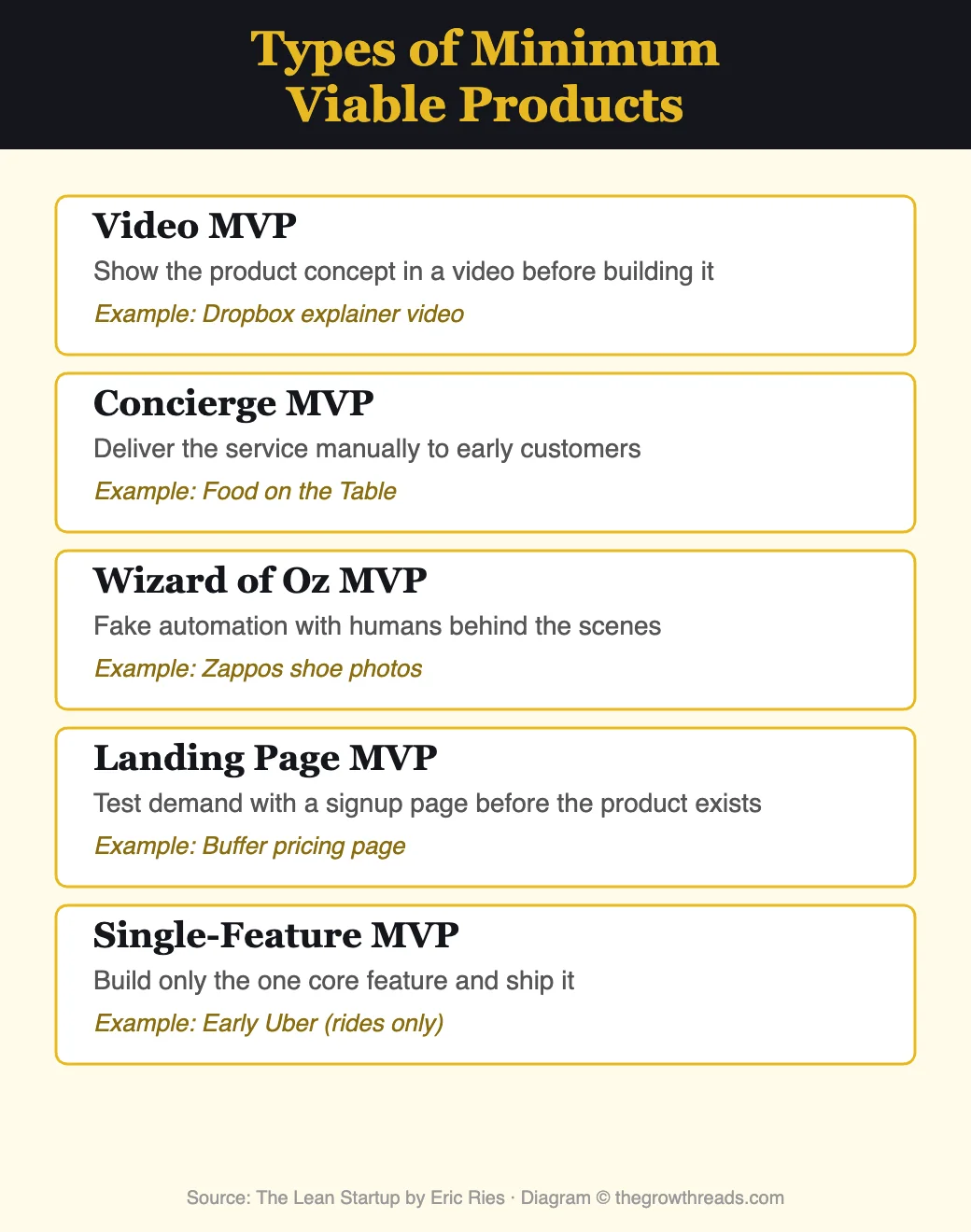
Ries catalogs several MVP archetypes. The “video MVP” (used by Dropbox, which posted a three-minute demo video and measured signups before writing a line of backend code) tests demand without building anything. The “concierge MVP” (used by Food on the Table, which manually curated meal plans for a single family before automating) tests whether the service delivers value. The “Wizard of Oz MVP” (used by Zappos, which posted photos of shoes from local stores and bought them at retail when orders came in) tests the business model with a human-powered backend.
The common thread is speed of learning. An MVP that takes three months to build and six months to evaluate teaches you far less per dollar than three MVPs that each take two weeks. Ries acknowledges that shipping an imperfect product feels uncomfortable — especially for engineers trained to value quality — but argues that the discomfort of shipping early is far less painful than the discomfort of building something beautiful that nobody uses.
Part 3: Accelerate — scaling without losing the learning engine
Innovation accounting is Ries’s framework for measuring startup progress when traditional financial metrics are premature. The process has three steps: establish a baseline (what do your metrics look like today?), tune the engine (run experiments to improve those metrics), and make the pivot-or-persevere decision (is the improvement fast enough to justify continuing on this path?).
The pivot-or-persevere meeting is perhaps the most operationally important concept in the book. Ries recommends scheduling these meetings on a regular cadence — every six to ten weeks — and approaching them with discipline. Teams present their innovation accounting data, honestly assess whether validated learning is occurring at a sufficient rate, and make a structured decision: continue on the current path (persevere) or change one fundamental element of the strategy (pivot).
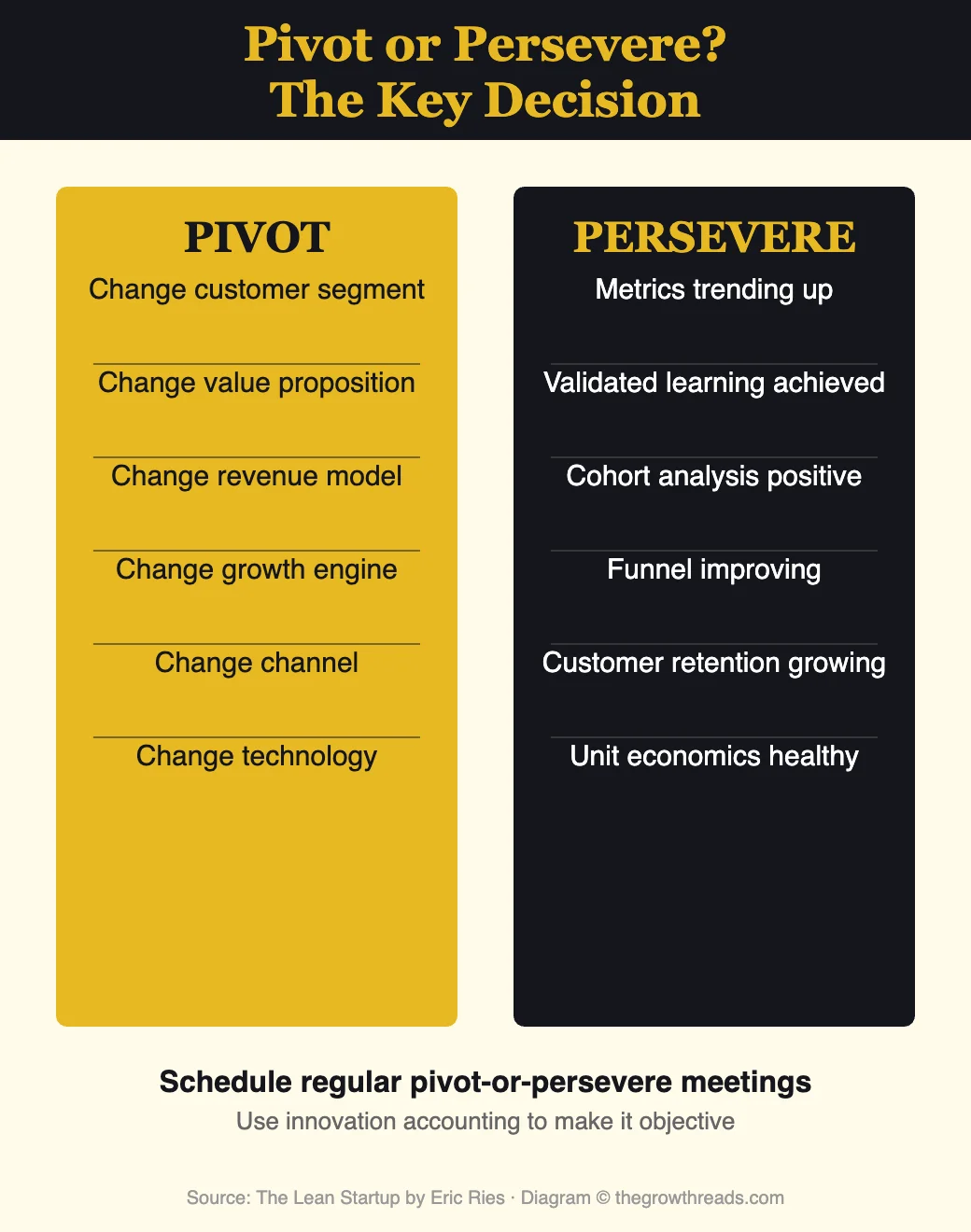
Ries identifies several types of pivots: zoom-in (a single feature becomes the whole product), zoom-out (the whole product becomes a single feature of a larger product), customer segment pivot, customer need pivot, platform pivot, business architecture pivot, value capture pivot, engine of growth pivot, channel pivot, and technology pivot. The taxonomy matters because it turns “we need to change direction” from a vague panic into a structured decision with clear options.
Part 4: The five whys and building an adaptive organization
The final section addresses how to scale the lean methodology without losing its experimental core. Ries introduces the “five whys” technique, borrowed from Toyota: when a problem occurs, ask why five times in succession to peel back layers of causation until you reach a systemic root cause. Then invest proportionally — a minor problem gets a minor fix, a catastrophic one gets a systemic overhaul.
He also tackles the challenge of applying lean principles inside large organizations, where political dynamics, existing revenue streams, and institutional inertia resist experimentation. His prescription is to create a “sandbox” — a protected space where a small team can run rapid experiments with real customers, shielded from the metrics and processes of the parent organization. The sandbox has clear boundaries (scope, budget, timeline) but total freedom within those boundaries.
Ries closes with a vision of “the long-term stock exchange” — a financial market designed to reward companies that invest in sustainable innovation rather than short-term gains. It is a utopian coda to an otherwise practical book, but it underscores his core belief: the lean methodology is not just a toolkit for startups but a philosophy of management that could reshape how all organizations create value under uncertainty.
Who is The Lean Startup best for — and who should read something else first?
The Lean Startup is essential reading for anyone building a new product, launching a new business, or leading an innovation team inside a large company. Product managers, founders, venture capitalists, and intrapreneurs will find immediately applicable frameworks. It is also valuable for non-technical leaders who want to understand how modern software companies operate.
If your primary challenge is personal leadership rather than product strategy, start with Dare to Lead or Extreme Ownership. If you are looking for a broader business strategy framework that applies beyond startups, Good to Great offers a complementary perspective on what makes companies endure.
Questions to reflect on
- What is the riskiest assumption in your current project, and how could you test it this week without building anything new?
- Are you measuring vanity metrics (total users, page views) or actionable metrics (conversion rates, retention cohorts)?
- If you were forced to launch a version of your product with only one feature, which feature would it be?
- When was the last time your team had an honest pivot-or-persevere conversation — and what happened?
- What are you afraid of learning from your customers, and what is that fear costing you?
🔥 Ready to build smarter, not harder?
Learn to test your ideas before betting everything on them.
How to apply The Lean Startup (7-day plan)
- Day 1: Write down your product or project’s three riskiest assumptions. Rank them by how catastrophic it would be if each were wrong.
- Day 2: Design a test for your top-ranked assumption using the simplest MVP type: a landing page, a concierge offer, or a 60-second video explainer.
- Day 3: Define your actionable metrics. What specific number would tell you the assumption is validated? Write the success threshold before running the test.
- Day 4: Launch your MVP to a small group of real potential customers. Resist the urge to polish — speed of learning is the goal.
- Day 5: Collect and analyze results. Compare against your pre-defined threshold. Write down exactly what you learned, not what you hoped to learn.
- Day 6: Hold a mini pivot-or-persevere meeting (even with yourself). Based on the data, decide: continue this direction, or change one fundamental element?
- Day 7: Apply the five whys to any problem that surfaced during the week. Trace it to its root cause and make one proportional systemic fix.
Frequently asked questions
What is a Minimum Viable Product?
An MVP is the simplest version of a product that allows you to collect the maximum amount of validated learning with the least effort. It is not a prototype or a beta — it is an experiment designed to test a specific hypothesis. The form varies: it could be a video, a landing page, a manual service, or a stripped-down app with one feature. The key criterion is that it reaches real customers and generates real data about their behavior and willingness to pay.
Does The Lean Startup only apply to tech companies?
No. While Ries draws most of his examples from Silicon Valley, the methodology applies to any venture operating under uncertainty — restaurants testing new menus, nonprofits piloting new programs, corporate teams launching internal tools, and government agencies redesigning services. The principles of rapid experimentation, validated learning, and iterative development are universal. The updated edition includes case studies from healthcare, manufacturing, and education.
What is the difference between a pivot and a failure?
A pivot is a structured change in strategy without a change in vision. A failure is running out of resources (time, money, morale) before finding a viable model. Pivots are healthy — they mean you are learning and adapting. Ries argues that the most successful companies (Twitter, YouTube, Flickr) all pivoted at least once. The danger is not pivoting too often but pivoting too late, after months or years of ignoring negative data.
What is innovation accounting?
Innovation accounting is a three-step framework for measuring startup progress. First, establish a baseline by launching an MVP and measuring where you stand. Second, tune the engine by running experiments to improve your key metrics. Third, decide whether to pivot or persevere based on the rate of improvement. The framework replaces traditional financial projections, which are meaningless in the early stages, with a learning-oriented measurement system.
How do I convince my boss to try the lean approach?
Ries recommends starting with a sandbox: propose a small, time-boxed experiment with clear success criteria. Frame it as risk reduction rather than revolution — you are not asking to change the company, you are asking to test one idea cheaply before committing significant resources. Present the alternative honestly: the traditional approach risks months of development on unvalidated assumptions. Most executives respond well to the argument that a two-week experiment is cheaper than a six-month project that fails.
What are vanity metrics?
Vanity metrics are numbers that look impressive but do not indicate whether a business is healthy. Total registered users, total page views, and total downloads are classic examples — they only go up, which makes them feel good but reveals nothing about retention, engagement, or willingness to pay. Actionable metrics, by contrast, are specific, comparative, and tied to behavior: conversion rate by cohort, seven-day retention, revenue per user. Ries insists that every metric should be actionable (you can act on it), accessible (everyone understands it), and auditable (you can verify the data).
Is The Lean Startup still relevant in 2026?
Yes. The core principles — validated learning, rapid experimentation, and the Build-Measure-Learn loop — remain the foundation of modern product development. The startup ecosystem has evolved since 2011, with new tools (no-code platforms, AI prototyping) making MVPs even faster and cheaper to build. Some critics argue that Ries underestimates the role of vision and conviction, but even visionary founders like Steve Jobs ran rapid prototyping cycles internally. The methodology has only become more practical as the tools to execute it have improved.
Related summaries
- Good to Great Summary & Review — Jim Collins on what separates enduring companies from mediocre ones.
- Extreme Ownership Summary & Review — Leadership principles for high-stakes decision-making.
- Multipliers Summary & Review — How the best leaders amplify the intelligence around them.
- Best Leadership Books — Our complete guide to the top books on leading teams and organizations.
How we analyze books: Every summary on The Growth Reads is built from a close reading of the full text, cross-referenced with the author’s published interviews, peer-reviewed research where applicable, and reader feedback from multiple platforms. We focus on extracting actionable frameworks rather than abstract theory. Read our full methodology.