

⭐⭐⭐⭐ 3.9/5 — The definitive research on why some companies endure for generations while equally capable competitors fade. A blueprint for institutional greatness.
Best for: Founders, CEOs, and organizational leaders who want to build something that outlasts them — not just a successful product but an enduring institution.
Reading time: ~8 hours (368 pages) | Difficulty to apply: Medium-high (requires long-term thinking and cultural transformation)
Built to Last in one minute
The greatest companies are not built on great ideas — they are built on the ability to preserve core values while relentlessly driving change. Jim Collins and Jerry Porras spent six years studying eighteen visionary companies that have outperformed the stock market by a factor of fifteen since 1926. They compared each to a carefully matched competitor that started in the same era, in the same industry, with similar resources. The difference was not charismatic founders, brilliant strategies, or superior products. It was architecture — the visionary companies built organizational clocks that keep ticking regardless of who is in charge. They set Big Hairy Audacious Goals (BHAGs) that galvanized action, cultivated cult-like cultures around core values, promoted leaders from within, and embraced the genius of the AND — holding two seemingly contradictory ideas at once rather than choosing between them.
Key takeaways
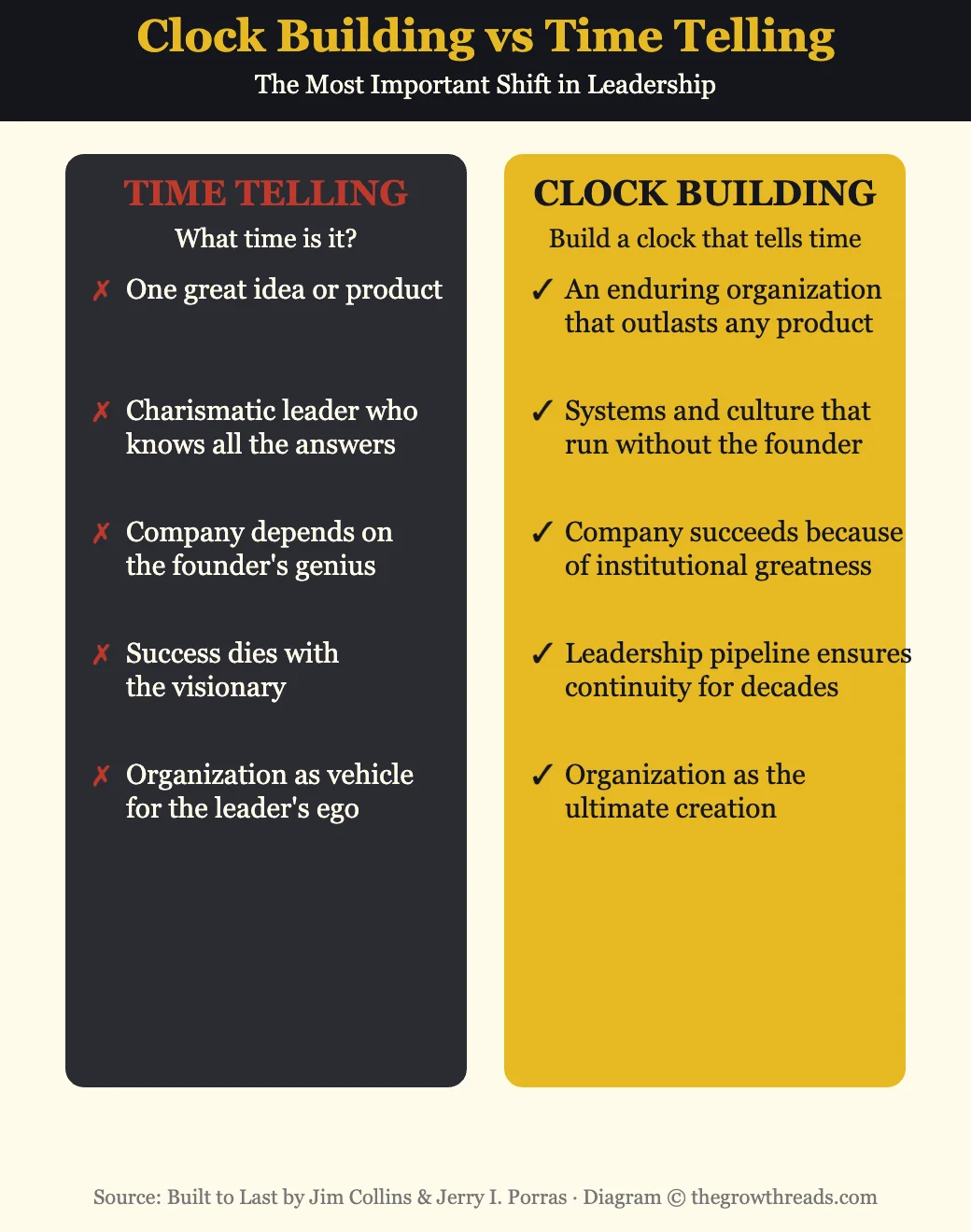
- Be a clock builder, not a time teller: Great leaders build organizations that thrive without them. The company itself — not a single product or leader — is the ultimate creation.
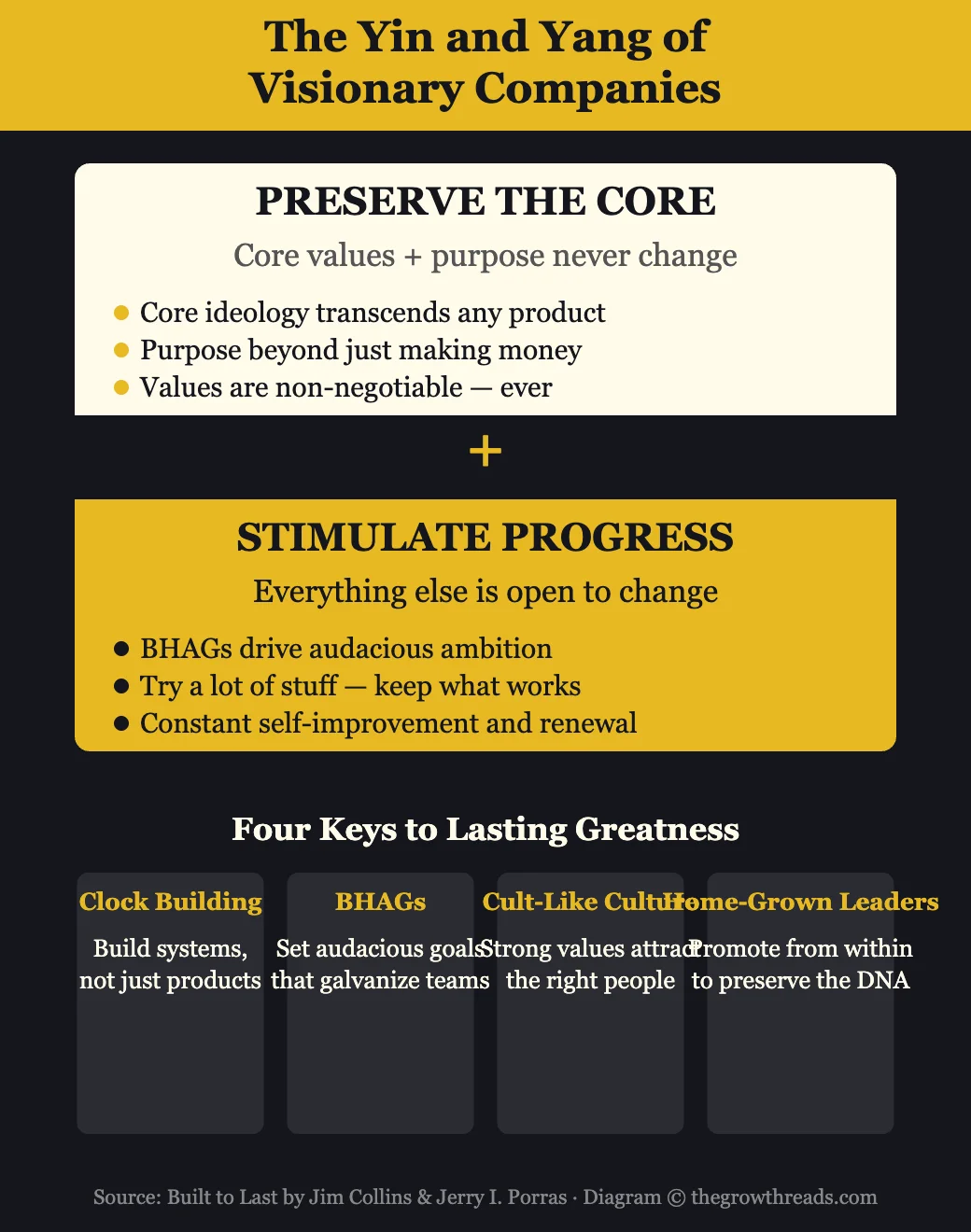
- Preserve the core, stimulate progress: Visionary companies hold their core values and purpose sacred while changing everything else — strategies, products, practices — in pursuit of progress.
- Embrace the genius of the AND: Reject the tyranny of OR. Visionary companies pursue purpose AND profit, continuity AND change, freedom AND discipline simultaneously.
- Set BHAGs: Big Hairy Audacious Goals are so ambitious they seem almost unreasonable — but they galvanize teams, create momentum, and push organizations beyond what incremental thinking would ever achieve.
- Try a lot of stuff, keep what works: Visionary companies experiment constantly, like evolutionary branching. They accept failure as the price of innovation and keep what succeeds.
- Grow your own leaders: Every visionary company in the study promoted its CEO from within. Insider leaders preserve the core ideology while driving change — outsiders often destroy both.
- Good enough never is: Visionary companies create a culture of disciplined self-improvement. They compete not against rivals but against their own standards of excellence.
- Cult-like cultures attract the right people: Strong ideology acts as a filter — people who share the values thrive, and those who do not self-select out. This is a feature, not a flaw.
- Core ideology is discovered, not created: You cannot manufacture authentic core values. They must be excavated from the organization’s deepest beliefs about why it exists.
- It is not about having the right idea — it is about building the right organization: Many visionary companies started with mediocre products. Their greatness came from organizational design, not initial brilliance.
What is Built to Last about?
Built to Last is a research-driven study of what makes truly exceptional companies endure for generations. Collins and Porras identified eighteen visionary companies — including 3M, Boeing, Disney, Hewlett-Packard, Johnson & Johnson, Procter & Gamble, Sony, and Walmart — and compared each to a matched competitor. The research reveals that lasting greatness comes not from brilliant strategy or charismatic leaders but from deliberate organizational architecture built around core ideology, audacious goals, and a culture of disciplined progress.
About the author
Jim Collins is one of the most influential business researchers alive. A former faculty member at Stanford Graduate School of Business, he left academia to pursue independent research, founding a management laboratory in Boulder, Colorado. His body of work — Built to Last, Good to Great, How the Mighty Fall, and Great by Choice — represents one of the most rigorous longitudinal studies of organizational performance ever conducted. Jerry I. Porras is the Lane Professor of Organizational Behavior and Change, Emeritus, at Stanford Graduate School of Business, where he taught for over 30 years. Together, they spent six years and reviewed over 3,300 documents to write Built to Last. Explore all Jim Collins book summaries →
Key concepts at a glance
| Concept | What it means | Use it when |
|---|---|---|
| Clock Building vs Time Telling | Build an enduring organization rather than depending on one great idea or leader | You want your company to thrive long after you leave |
| Preserve the Core / Stimulate Progress | Hold core values sacred while changing everything else to drive innovation | You need to grow without losing your identity |
| The Genius of the AND | Pursue seemingly contradictory goals simultaneously instead of choosing between them | Someone presents a false either/or choice |
| BHAGs | Big Hairy Audacious Goals that seem almost impossible but galvanize collective effort | Your team lacks direction, energy, or ambition |
| Cult-Like Culture | Strong ideology that attracts believers and repels non-fits — by design | You want to strengthen organizational culture without losing diversity of thought |
| Try a Lot of Stuff | Experiment constantly, accept failures, and keep what works — like evolutionary branching | You are stuck in analysis paralysis or need more innovation |
| Home-Grown Leadership | Promote CEOs from within to preserve institutional DNA and core ideology | You are planning succession or building a leadership pipeline |
Part 1: The myths — what visionary companies are NOT
Collins and Porras begin by demolishing twelve common myths about great companies. The most important: you do not need a great idea to start a great company. Hewlett-Packard began with no specific product idea — Bill Hewlett and Dave Packard just wanted to build a great technology company and figured they would find products along the way. Sony started as a rice cooker company. 3M began as a failed mining company. In each case, the founders were not time tellers (people with one great insight) but clock builders (people creating organizations that would generate great insights over and over).
The clock-building metaphor is the book’s most powerful image. A charismatic leader with one great idea is telling time — they know what time it is right now. But a clock builder creates an instrument that tells time even when the original builder is gone. Steve Jobs at Apple was a time teller for most of his career — brilliant, but the company nearly died without him. Walt Disney was a clock builder — he created an organization that has thrived for decades after his death because the systems, culture, and values he embedded were the real product, not any single film.
Collins and Porras also debunk the myth that visionary companies are great places to work for everyone. They are not. These companies have “cult-like” cultures built around strong ideologies. People who fit thrive; people who do not fit are either expelled or leave on their own. This is not accidental — it is a deliberate mechanism for preserving core values. Nordstrom, for instance, has one of the highest turnover rates in retail because its fanatical customer service culture is not for everyone. Those who stay become legendarily committed.
Part 2: The engine — how visionary companies drive themselves
The central mechanism Collins and Porras discover is what they call “preserve the core, stimulate progress.” Visionary companies hold their core ideology — their deepest values and fundamental purpose — absolutely sacred. They will not compromise these regardless of market conditions, competitive pressure, or short-term opportunity. But everything else is open to change. Strategies, products, organizational structures, cultural practices — all are tools in service of the core ideology, and all can be replaced when they stop working.
This dual nature explains how companies like Johnson & Johnson can adapt dramatically over a century while remaining fundamentally recognizable. Their credo — putting patients, doctors, nurses, employees, and communities first (ahead of shareholders) — has guided every major decision since 1943, including the famous Tylenol recall of 1982. The specific products change constantly; the values never do.
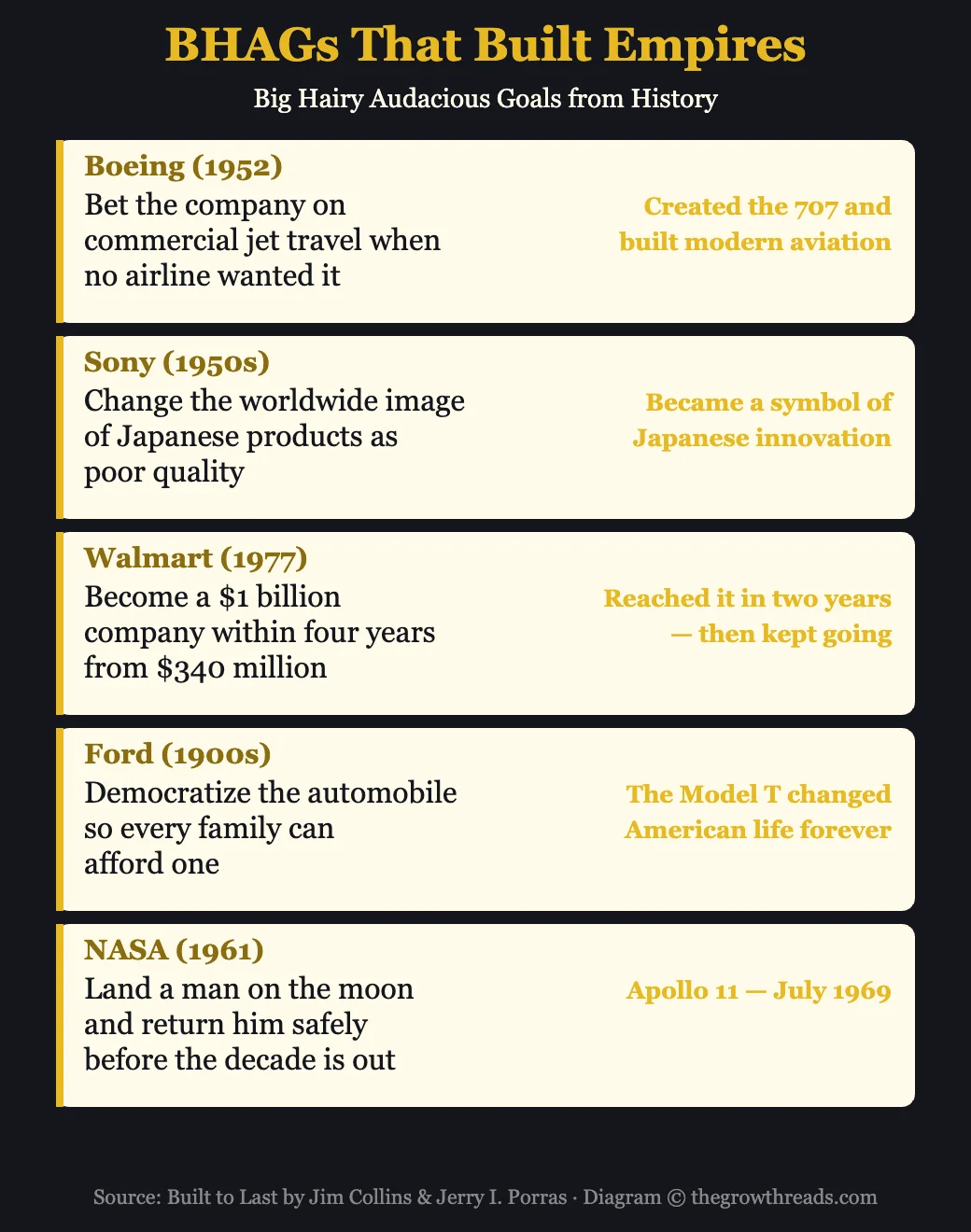
BHAGs — Big Hairy Audacious Goals — are the primary mechanism for stimulating progress. Collins and Porras found that visionary companies consistently set goals so ambitious they seemed almost impossible. Boeing bet the company on the 707 when no airline had expressed interest in commercial jets. Ford committed to democratizing the automobile when cars were luxury items. These goals work because they are vivid, tangible, and emotionally compelling — they do not need explanation. Everyone in the organization can understand them and feel motivated by them.
The “try a lot of stuff and keep what works” principle explains how visionary companies innovate. Rather than relying on strategic planning to identify the right moves in advance, they encourage experimentation at all levels. 3M’s legendary policy of allowing employees to spend 15% of their time on any project they choose produced Post-it Notes, Scotch tape, and hundreds of other innovations that no strategic planner could have predicted. The method is evolutionary: generate lots of variations, select the winners, and scale them.
Part 3: The alignment — making it all work together
Collins and Porras argue that the individual concepts — clock building, core ideology, BHAGs, cult-like culture — only create lasting greatness when they work together as a system. They call this “alignment” — ensuring that every element of the organization, from hiring practices to incentive structures to office layout, reinforces the core ideology. Misalignment — saying you value innovation but punishing failure, or claiming to put people first but cutting benefits at the first downturn — destroys credibility and undermines everything else.
Home-grown leadership is a critical alignment mechanism. Every visionary company in the study promoted its CEO from within the organization. This is not coincidence — insider CEOs have been socialized in the core ideology for years or decades. They understand it intuitively. Outsider CEOs, no matter how talented, often misread or disregard the core ideology, treating it as an obstacle rather than a foundation.
The “good enough never is” mindset creates a culture of perpetual self-improvement. Visionary companies do not compare themselves primarily to competitors — they compare themselves to their own potential. Merck, Procter & Gamble, and Motorola all built internal mechanisms for self-criticism and continuous improvement decades before these practices became trendy. The constant dissatisfaction with the status quo — even during periods of great success — is what prevents complacency.
Who is Built to Last best for — and who should read something else first?
This book is essential for founders who want their company to outlast them, CEOs navigating organizational culture, and anyone responsible for long-term strategy. It is also valuable for investors evaluating which companies will endure and which will fade. The research methodology is rigorous, making it useful for anyone who wants evidence-based leadership rather than anecdote-driven advice.
If you are an individual contributor or early in your career, the concepts may feel abstract. Start with Good to Great for the personal leadership component, or The Lean Startup for a more startup-applicable version of the experimentation principles. If you lead a team but not a company, The Culture Code by Daniel Coyle translates these organizational insights into team-level practices.
Questions to reflect on
- If your company’s founder disappeared tomorrow, would the organization thrive, survive, or collapse? What does your answer reveal about clock building versus time telling?
- What are your organization’s actual core values — not the ones on the wall, but the ones that drive real decisions under pressure?
- When was the last time your organization set a BHAG that made people simultaneously excited and terrified? What happened?
- Does your culture attract the right people and repel the wrong ones — or does it try to be comfortable for everyone and end up standing for nothing?
- Are you grooming your successor, or is succession something you plan to figure out later?
🔥 Ready to build something that outlasts you?
Collins and Porras reveal exactly what separates companies that endure for a century from those that fade in a decade.
How to apply Built to Last (7-day plan)
- Day 1 — Excavate your core: Write down the three to five values your organization actually lives by (not aspires to). Test each: would you keep it even if it became a competitive disadvantage? If not, it is not core.
- Day 2 — Define your purpose beyond profit: Complete this sentence: “We exist to ___ .” If your answer is about products or revenue, dig deeper until you find the purpose that would remain even if your industry disappeared.
- Day 3 — Set a BHAG: Propose one goal that is vivid, tangible, and so ambitious it makes people nervous. It should be achievable in 10-25 years and require no explanation — everyone immediately understands what it means.
- Day 4 — Audit your alignment: Pick three organizational practices (hiring, compensation, meetings) and ask: does this reinforce our core ideology or contradict it? Fix one misalignment this week.
- Day 5 — Launch an experiment: Identify one low-cost experiment you can try this week. Do not analyze it to death — launch it, measure the results, and decide quickly whether to scale or stop.
- Day 6 — Start your leadership pipeline: Identify two people inside your organization who could eventually lead it. Schedule a development conversation with each — invest in their growth now.
- Day 7 — Apply the genius of the AND: Find one either/or choice you have been debating. Reframe it: how could you pursue both objectives simultaneously? Write down three ways to make the AND work.
Frequently asked questions
How does Built to Last relate to Good to Great?
Built to Last (1994) came first and examines what makes companies endure for generations. Good to Great (2001) asks a different question: what makes a good company become a great one. Collins himself says Good to Great should be read first — it covers the transition from mediocrity to excellence, while Built to Last covers sustaining that excellence over decades. Together, they form a complete framework: get great, then stay great.
Have any of the visionary companies declined since the book was published?
Yes — some companies in the study (like Motorola and HP) have experienced significant challenges since publication. Collins addresses this in his later book How the Mighty Fall, which examines how even great companies can decline when they abandon the principles that made them great. The decline of some studied companies does not invalidate the principles — it actually reinforces them, since the declines correlate with abandoning core ideology, hiring outsider CEOs, and losing disciplined self-improvement.
Can a startup apply these principles or is this only for established companies?
Startups can and should apply these principles from day one. In fact, it is easier to build a clock from scratch than to retrofit one. Define your core values before you hire your first employee. Set a BHAG that gives your company a north star. Build a culture of experimentation from the start. The companies in the study that were most successful applied these principles earliest — they did not wait until they were large to start building clocks.
What is the difference between a BHAG and a regular ambitious goal?
A BHAG has four characteristics that distinguish it from ordinary ambition: it is vivid (everyone immediately understands it), tangible (you can measure whether you achieved it), audacious (it requires a massive leap beyond current capabilities), and it takes 10-25 years to achieve. “Increase market share by 15%” is an ambitious goal. “Put a man on the moon before the decade is out” is a BHAG. The emotional and motivational power is categorically different.
Does cult-like culture mean unhealthy groupthink?
No. Collins and Porras are careful to distinguish between ideological intensity (strong shared values) and groupthink (suppressing dissent). Visionary companies demand absolute alignment on core values but encourage enormous diversity and debate on everything else. 3M’s 15% innovation time is a perfect example: unwavering commitment to innovation as a value, combined with complete freedom in how to pursue it. The culture is strict about values and loose about methods.
How do you discover core values versus just inventing them?
Collins distinguishes between authentic and aspirational values. Core values are not what you wish you believed — they are what you actually believe, the principles you would keep even if they cost you money. To discover them, Collins recommends a “Mars Group” exercise: choose five to seven people who truly embody the organization’s values and ask them to articulate what the company stands for at its best. If you cannot find those people, your values may be aspirational rather than authentic.
Why does the book recommend promoting CEOs from within?
The research found that every visionary company in the study promoted its CEO from within. Insider CEOs understand and embody the core ideology because they have been socialized in it for years or decades. Outsider CEOs — even highly talented ones — often misjudge or disregard the core ideology, treating it as disposable rather than foundational. The data is striking: companies that brought in outsider CEOs were significantly more likely to decline in the years following, especially when the outsider attempted to “transform” the culture.
Related summaries
- Good to Great Summary & Review — Collins’ prequel on how good companies make the leap to greatness.
- The Infinite Game Summary & Review — Sinek on playing for perpetuity rather than quarterly wins.
- Creativity, Inc. Summary & Review — How Pixar built a visionary company through creative culture.
- Best Leadership Books — Our full ranked guide to books that build lasting leadership capacity.