

★★★★★ 4.6/5 — the simplest, most repeatable framework for spotting, and building, teammates who make everyone around them better.
Best for: hiring managers, team leads, and HR partners who want a screening test for culture fit, not just skill.
Reading time: ~4 hours for the book · ~18 minutes for this guide
Difficulty to apply: Moderate — expect to rewrite interview questions and change how you coach people already on the team.
The Ideal Team Player in one minute
Skill can be taught. Character mostly can’t — so screen for character first. Patrick Lencioni, the consultant behind The Five Dysfunctions of a Team, spent years watching smart, talented hires quietly wreck team cultures from the inside. His answer is a three-part test: is this person humble, hungry, and smart — meaning people-smart, not book-smart? Miss even one virtue and you get a predictable, flawed type of teammate: charming but manipulative, hardworking but oblivious, or pleasant but passive. Get all three and you get someone who makes every team they join measurably better. The book delivers the model through a short business fable set inside a struggling construction company, then converts it into a practical system for hiring, promoting, and coaching.
Key takeaways
- Talent isn’t the same as team fit: a brilliant individual performer can still be the person quietly destroying trust on a team.
- Humble means low ego, not low confidence: humble team players share credit, admit mistakes quickly, and highlight others’ contributions before their own.
- Hungry means self-driven: they look for more responsibility without being asked and rarely coast, even when no one is watching.
- Smart means people-smart: emotional intelligence — reading a room, sensing how words land, adjusting tone in real time — not IQ or credentials.
- Missing one virtue creates a predictable, flawed type: the Pawn, the Bulldozer, the Charmer, the Accidental Mess-Maker, or the Skillful Politician.
- The Skillful Politician is the most dangerous combination: hungry and smart without humility looks like ambition until it curdles into manipulation.
- All three virtues can be screened for in a single interview: targeted behavioral questions surface each one long before the first paycheck.
- The model works on people you’ve already hired: it’s a coaching tool, not only a hiring filter, for developing someone’s missing virtue.
- Culture erodes from the middle, not just the top: one unchecked Skillful Politician can undo years of leadership work.
- Hiring for character is a system, not a gut feeling: the book gives concrete interview questions, reference-check scripts, and onboarding language.
What is The Ideal Team Player about?
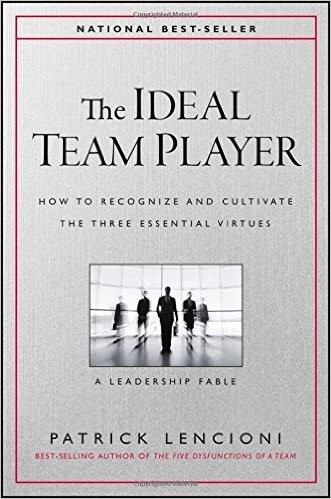
The Ideal Team Player by Patrick Lencioni argues the best teammates share three virtues — humble, hungry, and smart (people-smart) — and that missing even one produces a predictable, flawed type of team member. Through a short fable and a practical model, it teaches leaders how to hire, coach, and build culture around these three traits.
About the author
Patrick M. Lencioni is the founder and president of The Table Group, a management consulting firm focused on executive team development and organizational health. Over more than two decades he has advised leadership teams at organizations ranging from Fortune 500 companies to high-tech startups, universities, and nonprofits, and is best known for teaching management ideas through short business fables rather than dense theory. The Ideal Team Player functions as a companion to his best-known book, The Five Dysfunctions of a Team: where that book explains how teams fail, this one explains who to hire so they don’t fail in the first place. Lencioni has written more than a dozen bestsellers, including The Advantage and The Motive, and continues to consult and speak on leadership and team health worldwide.
Key concepts at a glance
| Concept | What it means | Use it when |
|---|---|---|
| Humble | Low ego; quick to credit others and own mistakes | Screening candidates for culture fit, not just skill |
| Hungry | Self-motivated; seeks out more work and responsibility | Telling apart a true self-starter from someone who needs constant pushing |
| Smart (people-smart) | Emotionally intelligent; reads the room and adjusts | Diagnosing why a technically strong hire keeps causing friction |
| The Pawn | Humble + smart, missing hungry | Spotting a well-liked teammate who’s quietly coasting |
| The Bulldozer | Hungry only, missing humble and smart | Recognizing a driven hire who runs over everyone else |
| The Charmer | Smart only, missing humble and hungry | Seeing past likability to a lack of real output |
| Accidental Mess-Maker | Humble + hungry, missing smart | Coaching a hard worker who keeps hurting feelings unintentionally |
| Skillful Politician | Hungry + smart, missing humble | Flagging a high performer before ambition turns manipulative |
| Ideal Team Player | All three virtues present | The standard for every hire and every promotion |
Part 1: Why Talent Alone Wasn’t Enough
The book opens with a fable. Jeff Shanley takes over his uncle Bob’s construction company, Valley Builders, after Bob’s sudden death. The culture of teamwork Bob was proudest of is unraveling, and Jeff has inherited a critical project team that includes technically excellent people who are, in very different ways, terrible teammates. One is a talented operator who charms clients while quietly undermining colleagues behind closed doors. Another is hardworking and well-meaning but tone-deaf, alienating people without ever intending to.
Jeff’s dilemma is one every manager eventually faces: do you keep a high performer who is quietly poisoning the team, or do you let them go and risk the project’s deadline? Bob, it turns out, had left behind notes describing three qualities he looked for in every single hire — long before Jeff understood why they mattered so much. The rest of the book follows Jeff, and the reader, reconstructing what those three qualities were and why Bob considered them completely non-negotiable, even when it meant passing on obviously talented candidates.
The fable format is deliberate. Lencioni’s belief, carried over from The Five Dysfunctions of a Team, is that people remember stories about flawed, recognizable colleagues far longer than they remember a bullet-point framework. Nearly every reader has worked with a Bulldozer or a Charmer at some point; the fable simply gives the pattern a name and a face, which is what makes it stick in team conversations months later.
Part 2: The Three Virtues, Defined
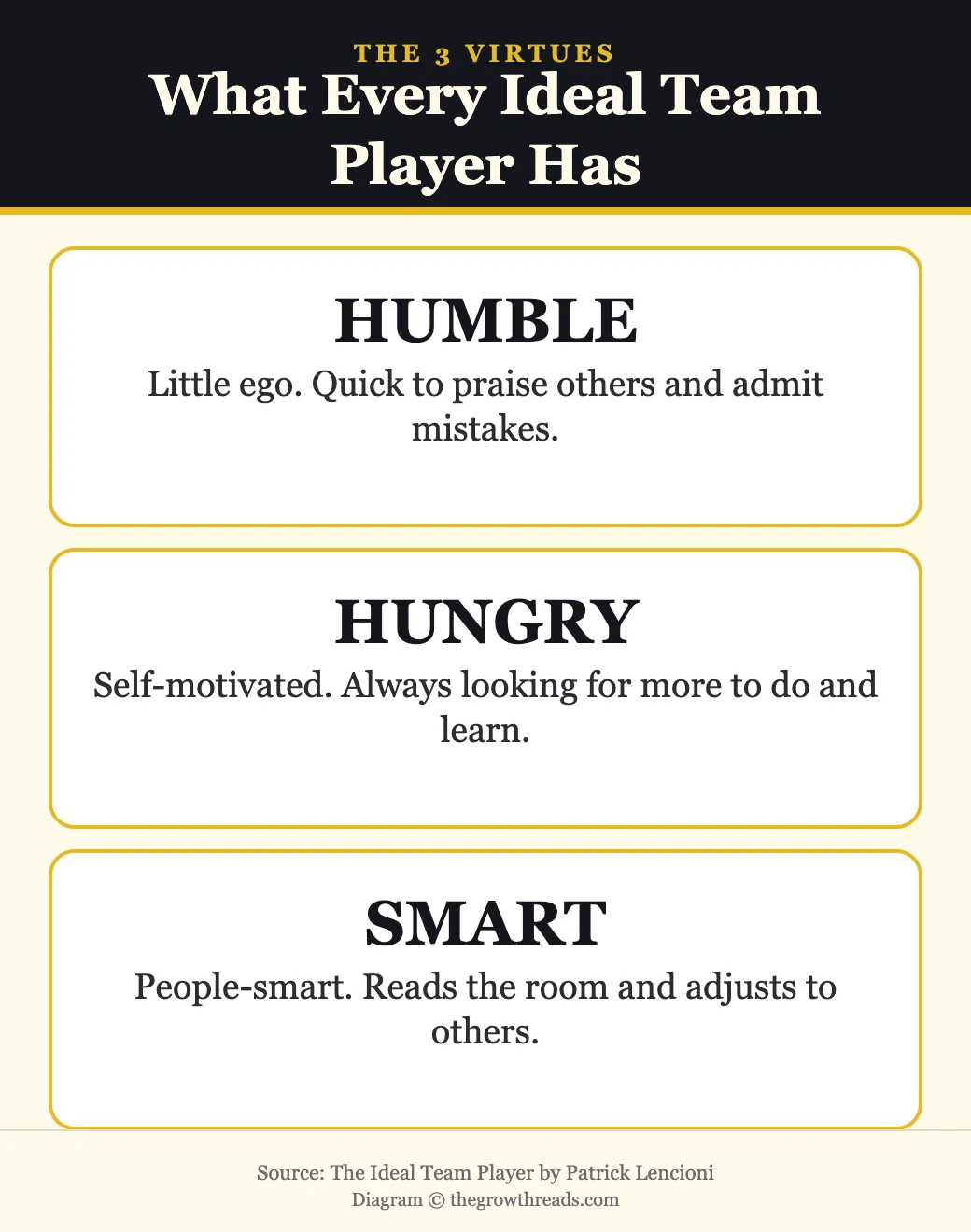
Lencioni’s model rests on three virtues, and the book is careful to define each one narrowly so it’s actually testable in an interview — not just a vague compliment you’d give anyone you liked.
Humble isn’t the same as being a pushover or lacking confidence. Humble team players define themselves by what they contribute to the team, not by personal status or title; they’re quick to point out others’ contributions and slow to claim credit for their own. In practice, this shows up as someone who says “we” more than “I” when a project goes well, and “I” more than “we” when it goes badly.
Hungry people are self-motivated. They don’t need to be assigned more work — they look for it, and they rarely need a manager standing over them to stay productive. This is the easiest virtue to spot, but also the easiest to mistake for ambition alone; hunger without humility is exactly what produces the Skillful Politician, covered in Part 3.
Smart, in Lencioni’s model, has nothing to do with intelligence or credentials. It means people-smart: good judgment about how words and actions land on others, and the emotional intelligence to adjust in real time. A brilliant engineer who can’t read a room isn’t “smart” in this sense, no matter how high their IQ or how many degrees they hold.
Any one virtue on its own is common. Any two, missing the third, is common enough that Lencioni names each combination individually. All three together, reliably, is genuinely rare — which is exactly why hiring for it deliberately, rather than hoping for it, is the point of the book.
TGR Note: This model reads as a natural sequel to Lencioni’s own The Five Dysfunctions of a Team — that book explains the dysfunctions (absence of trust, fear of conflict, lack of commitment, avoidance of accountability, inattention to results) that wreck a team, while this one explains who to hire so those dysfunctions never take root in the first place. It also echoes Jim Collins’ “Level 5 Leadership” research from Good to Great, where the highest-performing executives combined fierce professional will with genuine personal humility — the same pairing Lencioni calls humble and hungry.
Part 3: The Seven Team Player Types
Because there are three virtues, there are exactly seven possible combinations a real person can show up as — having none of the three effectively disqualifies someone from being a team player at all. Lencioni names the most instructive combinations.
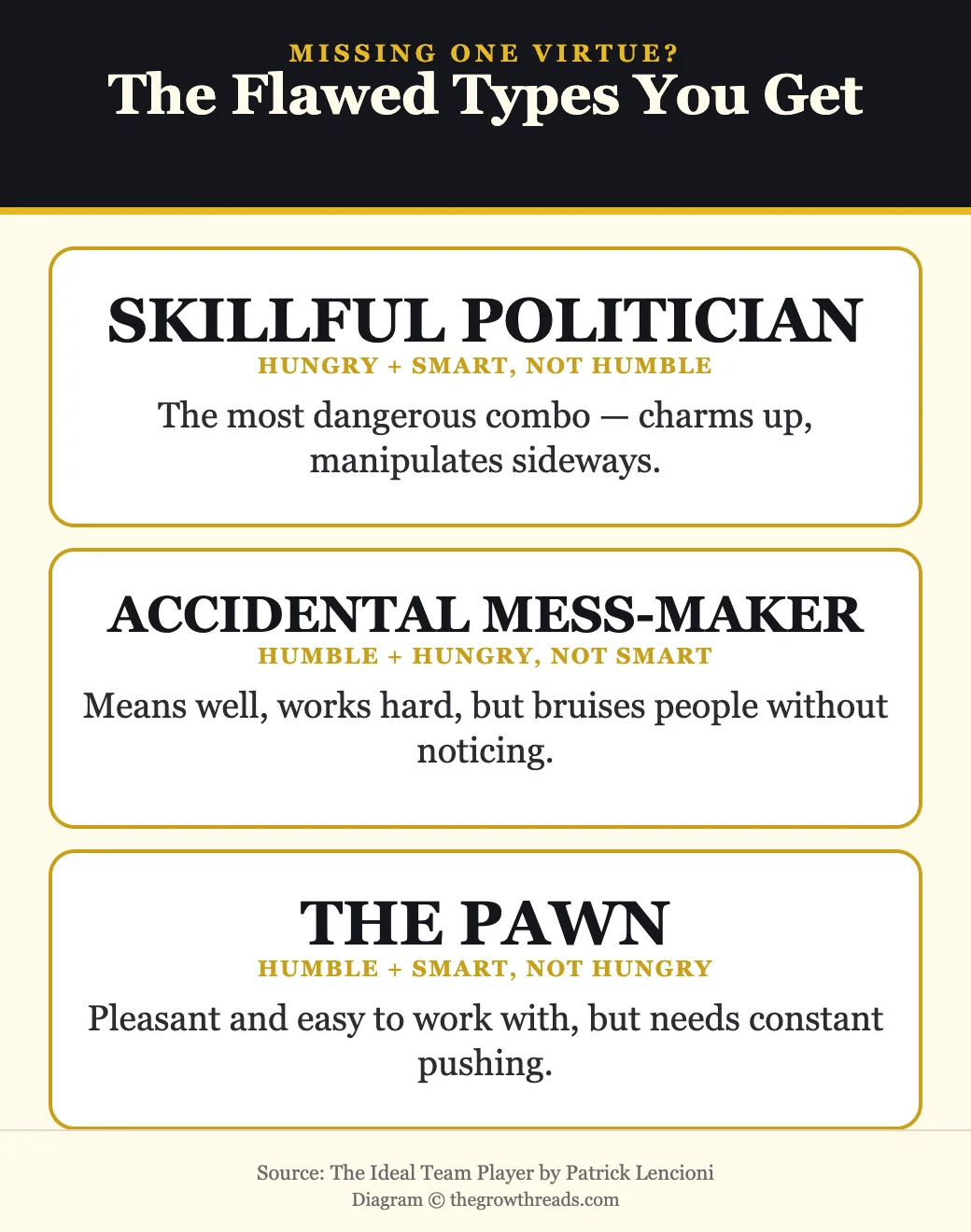
The Skillful Politician — hungry and smart, missing humble — is the type Lencioni singles out as the most dangerous. This person is driven and socially skilled enough to manage up convincingly, which means their lack of humility can go undetected by leadership for a long time while it quietly corrodes trust among peers who see the pattern much sooner than management does.
The Accidental Mess-Maker — humble and hungry, missing smart — is well-intentioned and hardworking, but their lack of people-awareness means they leave a trail of bruised feelings without ever noticing. Of the flawed types, this is usually the easiest to coach, because the missing piece — self-awareness — tends to respond well to direct, specific feedback.
The Pawn — humble and smart, missing hungry — is likeable and easy to manage, but needs to be actively pushed to do more than the minimum. Teams often keep Pawns around far longer than they should, mistaking pleasantness and lack of conflict for genuine performance.
The single-virtue types — the Bulldozer (hungry only), the Charmer (smart only), and someone who is only humble with neither drive nor social skill — round out the full model, but Lencioni spends comparatively little time on them. In practice, they tend to be obvious enough that teams identify, and manage out or redirect, them fairly quickly.
TGR Note: If you recognize a Skillful Politician on your team right now, Radical Candor pairs well with this book — its “challenge directly, care personally” framework gives a concrete way to confront the behavior instead of waiting for it to become a bigger problem. And if the friction is more about how feedback lands than what’s actually said, The Culture Code‘s research on psychological safety explains why some teams tolerate a Politician for years before anyone finally names it out loud.
Part 4: Hiring, Coaching, and Building Culture Around It
The back half of the book turns the model into a repeatable system rather than leaving it as an interesting idea.
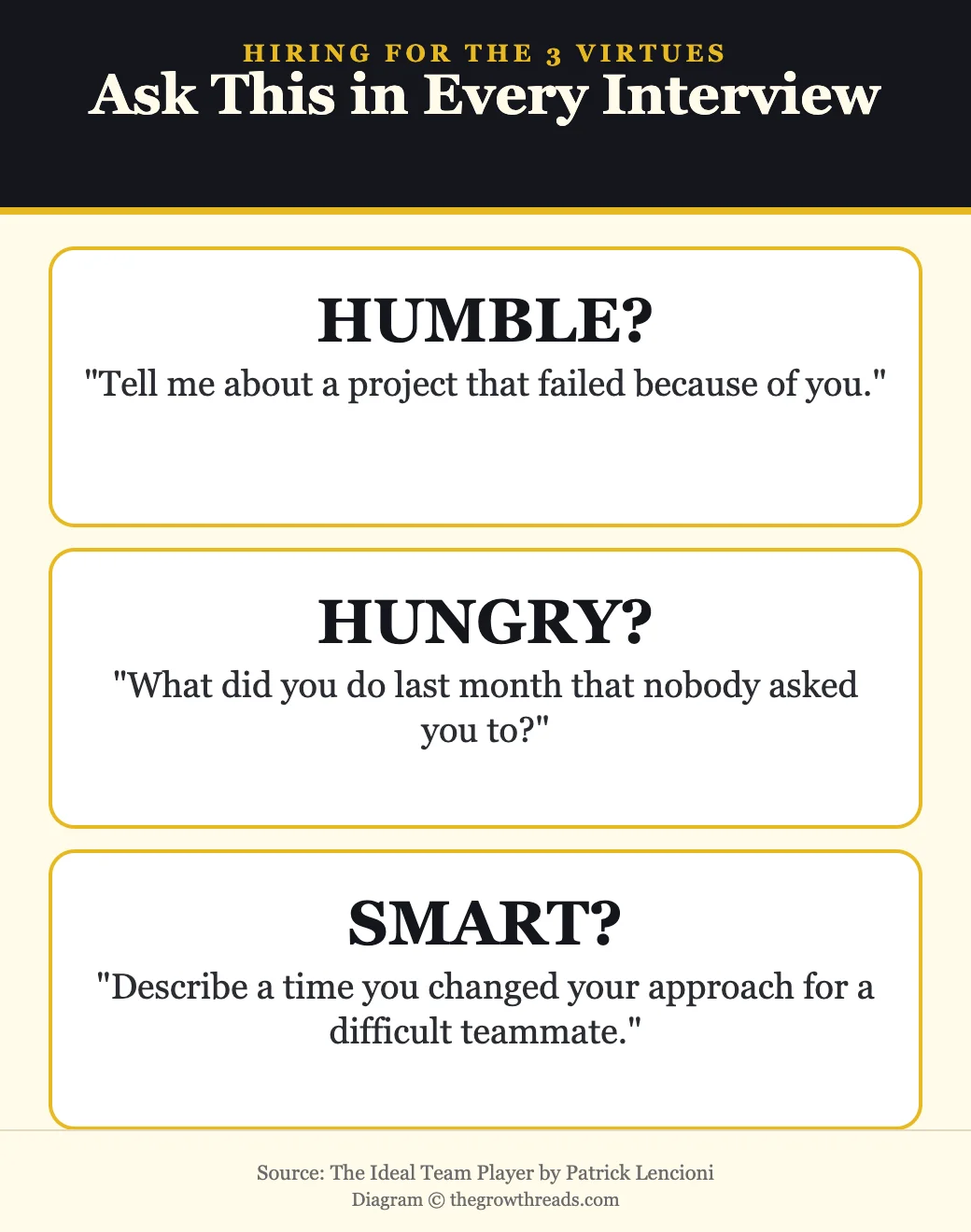
Lencioni gives specific behavioral interview questions for each virtue — versions of “tell me about a time a project failed because of you” (humble), “what have you done recently that nobody asked you to do” (hungry), and “describe a time you had to change your approach for a difficult colleague” (smart) — along with guidance on what a red-flag answer sounds like versus a genuinely convincing one.
Reference checks get the same treatment. Instead of asking a former manager the generic “would you rehire this person,” the book recommends asking about specific situations that reveal humility, drive, and social awareness, since a standard reference rarely surfaces a Skillful Politician — who tends to have glowing references from people above them and quietly damaged relationships with the peers who actually worked alongside them.
Crucially, Lencioni argues the model isn’t only a hiring filter. Existing employees can be assessed against the same three virtues, and most people are coachable in the virtue they’re missing: an Accidental Mess-Maker can build self-awareness through direct feedback and deliberate practice, and a Pawn can be given more ownership and clearer expectations. The Skillful Politician is the one type the book is candid about being hardest to develop, because the missing virtue — humility — resists direct instruction more than the other two.
Finally, the book pushes leaders to bake the language of the three virtues into everyday culture: performance reviews, team retrospectives, even casual feedback in the hallway, so that “be more hungry” or “that was a smart read of the room” becomes shared team vocabulary instead of an abstract framework nobody references again after the first read.
TGR Note: For the actual coaching conversations this requires, The Coaching Habit offers a simpler question-based structure that works well for developing someone’s missing virtue without it feeling like a formal performance write-up. And if your challenge is less about individuals and more about how you evaluate talent as a leader in the first place, Multipliers makes a related case: leaders who draw out people’s best thinking build stronger teams than leaders who simply rely on their own.
Who is The Ideal Team Player best for — and who should read something else first?
This book is best for hiring managers, team leads, and HR partners who need a repeatable way to screen for culture fit rather than relying on gut feeling. It’s equally useful for anyone who has just inherited a team and is trying to diagnose why it isn’t gelling, even though the people on it are individually talented.
If you want the underlying theory of how teams break down in the first place, start with Lencioni’s own The Five Dysfunctions of a Team — it’s the natural prequel to this book. If your problem is specifically about how leaders create, or destroy, team performance through their own behavior rather than who they hire, Multipliers is a better fit. And if the friction on your team is more about communication style and feedback than character, Radical Candor addresses that more directly.
Questions to reflect on
- Think of the best teammate you’ve ever worked with. Which of the three virtues — humble, hungry, smart — were they strongest in, and which took visible effort?
- Is there someone on your team right now who fits one of the flawed types? What would change if you named the pattern to them directly, in private?
- When you last hired someone, did your interview process actually test for humility and people-smarts, or mostly for skill and hunger?
- Which virtue is hardest for you personally, and how would a teammate you trust answer that same question about you?
- If you had to coach one person toward their missing virtue this quarter, who would it be, and what’s the first conversation you’d have with them?
🔥 Ready to build a team of ideal team players?
Grab a copy and start screening for humble, hungry, and smart today.
How to apply The Ideal Team Player (7-day plan)
- Day 1: Write down the three virtues and rate yourself honestly, 1–5, on each one.
- Day 2: Rate one current teammate on the same scale, privately — don’t share it with anyone yet.
- Day 3: Identify which of the seven types best describes anyone on your team who’s currently causing friction.
- Day 4: Rewrite one interview question for each virtue that you’ll use in your next hiring round.
- Day 5: Have one direct, low-stakes conversation naming a specific behavior tied to a virtue — as praise or as feedback.
- Day 6: Ask a trusted colleague to rate you on the three virtues, then compare it honestly to your Day 1 self-rating.
- Day 7: Pick one recurring team ritual — a retro, a 1:1 template, a review form — where you’ll start using “humble/hungry/smart” language going forward.
Frequently asked questions
What are the three virtues in The Ideal Team Player?
The three virtues are humble, hungry, and smart. Humble means low ego and a habit of crediting others; hungry means self-motivated and always looking for more responsibility; smart means people-smart, or emotionally intelligent — reading a room and adjusting your approach, rather than raw intelligence. Lencioni argues that all three, present together, are what separate a genuinely great teammate from someone who’s merely talented. The book gives concrete ways to test for each virtue in interviews, reference checks, and ongoing team coaching, rather than leaving it as an abstract ideal.
Is “smart” in the title about intelligence or test scores?
No — this is one of the most common misreadings of the book. In Lencioni’s model, “smart” refers specifically to people-smarts: emotional intelligence, social awareness, and the judgment to know how your words and actions affect others. Someone can be highly intelligent or credentialed and still fail this test if they’re tone-deaf in how they treat teammates. Conversely, someone without an impressive resume can score high on “smart” simply by being perceptive and considerate in everyday interactions with colleagues.
What is a “Skillful Politician” and why is it called the most dangerous type?
A Skillful Politician is hungry and smart but not humble — driven and socially adept, but self-serving underneath. Lencioni singles this type out as the most dangerous because their social skill lets them manage impressions upward, so leadership often doesn’t notice the damage they’re doing to peer relationships until trust has already eroded. Unlike a Bulldozer, whose lack of tact is obvious to everyone immediately, a Skillful Politician’s behavior can look like ordinary ambition for a long time before it’s recognized as manipulation.
Can someone actually develop the virtue they’re missing, or is it fixed?
Lencioni is fairly optimistic that people can grow, with two caveats. Hunger and people-smarts respond reasonably well to direct feedback, clearer expectations, and deliberate practice — an Accidental Mess-Maker, for instance, often improves quickly once someone points out specific blind spots. Humility is the hardest of the three to coach, because it requires the person to want to change something fairly core to how they see themselves, which is why the book treats a true Skillful Politician as the most difficult type to develop.
How is this different from Lencioni’s The Five Dysfunctions of a Team?
The Five Dysfunctions of a Team diagnoses how teams fail: absence of trust, fear of conflict, lack of commitment, avoidance of accountability, and inattention to results. The Ideal Team Player is a companion piece that answers a different question — who should you hire and promote so those dysfunctions never take root in the first place? The two books share a fable format and consulting philosophy, and many readers use them together: Five Dysfunctions for team process, Ideal Team Player for team composition.
What interview questions does the book recommend for each virtue?
The book suggests behavioral questions rather than direct ones, since almost nobody will admit outright to lacking humility. Examples include asking candidates to describe a project that failed because of something they personally did (tests humble), what they did recently that nobody asked them to do (tests hungry), and a time they had to change their approach for a difficult colleague (tests smart). The book also covers how to phrase reference-check questions so former managers reveal specifics rather than a generic recommendation.
Does this model only apply to new hires, or can I use it on my current team?
It applies just as well to people already on your team. Lencioni recommends privately rating current team members against the three virtues, identifying which of the seven types best describes anyone causing friction, and using that as the basis for a specific, honest coaching conversation rather than a vague performance concern. Several readers report the model is most useful not for hiring at all, but for finally naming a dynamic with an existing teammate that everyone could feel but nobody could quite describe before.
Related summaries
- The Five Dysfunctions of a Team Summary & Review
- Multipliers Summary & Review
- Radical Candor Summary & Review
- The Culture Code Summary & Review
See all our picks on the best leadership books pillar page.
How we analyze books: every TGR summary is built from a close reading of the original text, cross-checked against the author’s own interviews and published talks, and organized around practical application rather than plot recap. We never rely on other summary sites. Read our full methodology.