

★★★★☆ 4.5/5
Content Depth: 5/5 · Practicality: 5/5 · Readability: 4/5 · Originality: 5/5 · Overall Value: 4.5/5
One-liner: The foundational text on personal effectiveness — five practices that turn ordinary knowledge workers into people who get the right things done.
Best for: Managers, knowledge workers, anyone who wants to multiply their impact through better decisions and time use
Reading time: ~4 hours (174 pages)
Difficulty to apply: Moderate — the concepts are simple but require consistent self-discipline and honest self-assessment
The Effective Executive in one minute
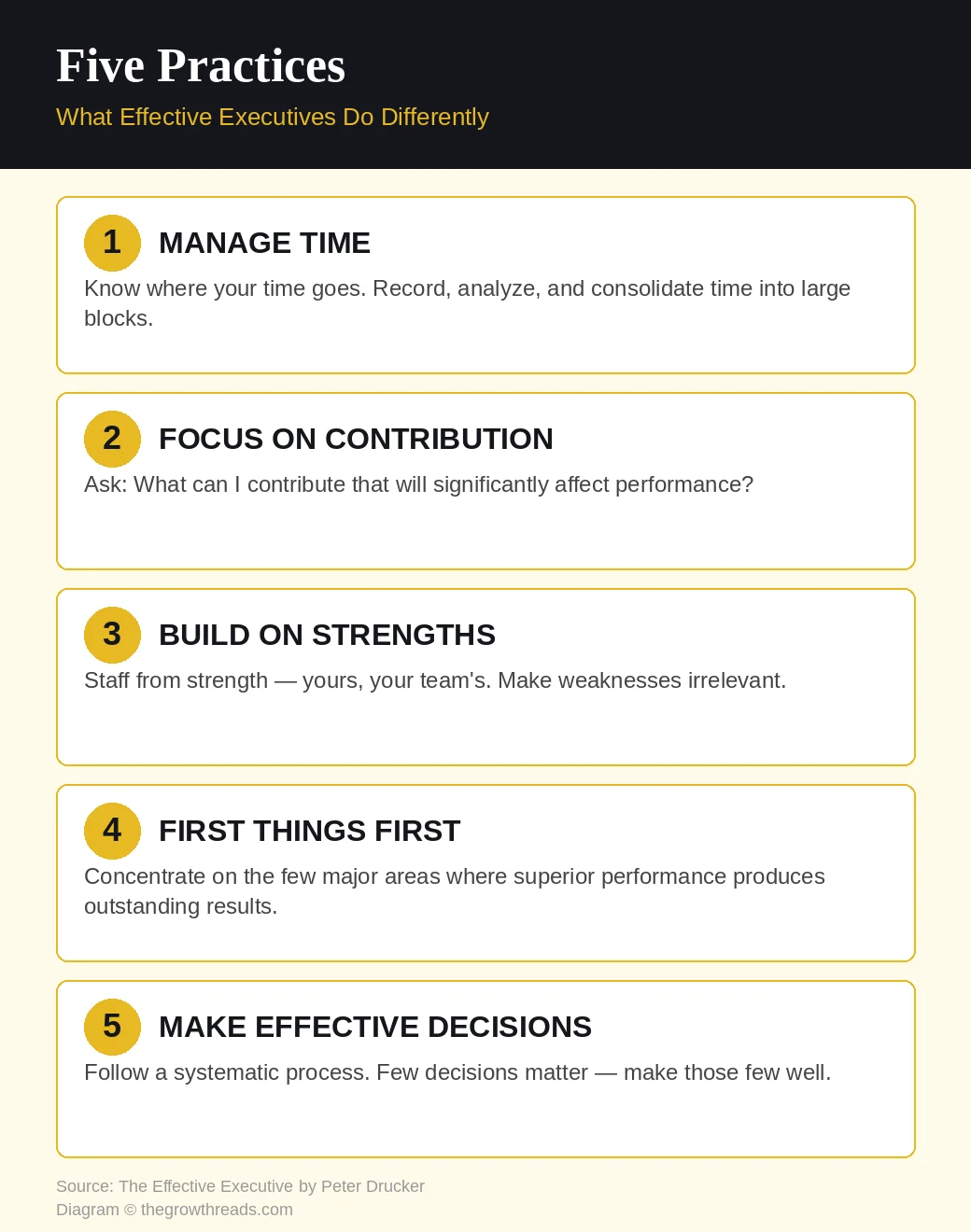
Effectiveness is a habit — a complex of practices that can be learned. Peter Drucker argues that intelligence, imagination, and knowledge are essentially useless without the habit of effectiveness. The book identifies five practices that any executive (which Drucker defines as anyone in a knowledge role who makes decisions affecting performance) must master: managing time systematically, focusing on outward contribution rather than effort, building on strengths rather than fixing weaknesses, concentrating on the few areas where superior performance will produce outstanding results, and making effective decisions through a disciplined process. Written in 1967, the book remains the most influential guide to personal productivity in organizations — not because it offers hacks, but because it reframes effectiveness as a learnable discipline rooted in clear thinking.
Key takeaways
- Effectiveness can be learned: It is not a gift. It is a set of practices — and like any practice, it must be acquired through systematic work over time.
- Know where your time goes: Record your time, then analyze it. Most executives massively overestimate how much discretionary time they have and underestimate how much is consumed by organizational demands.
- Focus on contribution, not effort: The effective executive asks “What can I contribute?” rather than “What tasks do I need to do?” This outward focus connects daily work to organizational results.
- Build on strengths: Staff positions to make the most of what people do well. Trying to build on weaknesses frustrates everyone and produces mediocrity at best.
- First things first, second things not at all: Concentration is the secret of effectiveness. Do one thing at a time, and do the most important thing first. The courage to set posterior priorities — to decide what not to do — matters as much as setting priorities.
- Effective decisions are few and fundamental: Do not make many decisions. Make the few that matter, make them at the highest conceptual level, and make them well through a systematic process.
- Classify the problem before solving it: Most problems are not unique — they are manifestations of generic situations that require rules and policies, not one-off judgments.
- Disagreement is essential: Start with the assumption that the other person is probably right. The effective executive deliberately builds disagreement into the decision process to test assumptions and find alternatives.
- Meetings are a symptom of bad organization: If people spend more than a quarter of their time in meetings, the organization has a structural problem. Every meeting must have a clear purpose and a clear end.
- The executive exists to make strength productive: The task of leadership is not to minimize weakness but to maximize strength — in yourself, in colleagues, in the organization as a whole.
What is The Effective Executive about?
The Effective Executive is Peter Drucker’s argument that effectiveness — the ability to get the right things done — is a specific practice that can be systematically learned by any knowledge worker. Across eight chapters, Drucker lays out five essential habits: managing time, choosing contribution over busyness, staffing from strength, concentrating effort on priorities, and making decisions through a disciplined process. The book has remained in print for nearly sixty years because its core insight has only grown more relevant: in a knowledge economy, your output depends not on hours worked but on the quality of the few decisions and contributions that actually matter.
About the author
Peter Ferdinand Drucker (1909–2005) was an Austrian-born American management consultant, educator, and author who is widely regarded as the founder of modern management theory. Born in Vienna, he fled to London and then the United States as fascism rose in Europe. His 1946 book Concept of the Corporation, based on a study of General Motors, essentially invented the discipline of management as a field of study. Over a career spanning more than six decades, Drucker wrote 39 books, coined terms like “knowledge worker” and “management by objectives,” and consulted for organizations ranging from General Electric to the Girl Scouts of America. He taught at Claremont Graduate University until shortly before his death at age 95, and his ideas continue to shape how organizations think about leadership, innovation, and effectiveness. Explore all Peter Drucker book summaries →
Key concepts at a glance
| Concept | What it means | Use it when |
|---|---|---|
| Know Thy Time | Record, analyze, and consolidate your time into uninterrupted blocks | You feel busy but unproductive, or have no idea where your hours go |
| Focus on Contribution | Ask what results you can contribute that will make a real difference | You are doing tasks without connecting them to outcomes |
| Making Strengths Productive | Staff and organize around what people do well, not around their gaps | You are hiring, delegating, or building a team |
| First Things First | Concentrate on one priority at a time; abandon yesterday’s successes | You are spread across too many initiatives |
| Posterior Priorities | Decide what NOT to do — the tasks to deliberately postpone or drop | Everything on your list feels urgent and important |
| The Effective Decision | Classify, define boundary conditions, convert to action, test with feedback | You face a consequential judgment call |
| Organized Disagreement | Build dissent into decisions to surface hidden assumptions | Everyone is agreeing too quickly and you suspect groupthink |
| The Knowledge Worker | Anyone whose work requires applying knowledge and judgment, not physical labor | You want to understand why traditional supervision does not work for your team |
Part 1: Know thy time — The foundation of effectiveness
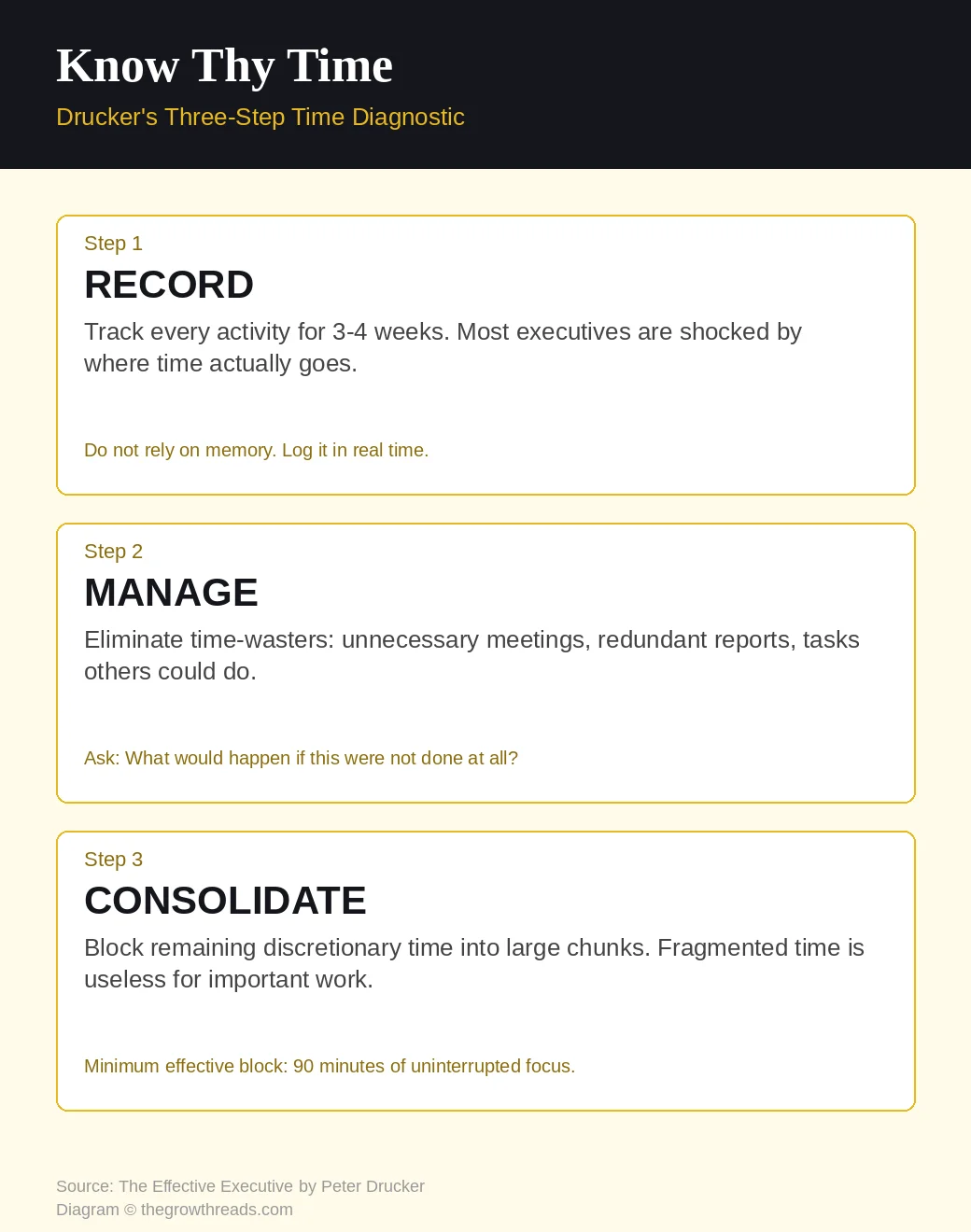
Drucker begins not with goals or planning but with time — because time, he argues, is the one truly irreplaceable resource. Money can be borrowed, people can be hired, but time spent is gone forever. His prescription is blunt: record your time for three to four weeks, writing down every activity as it happens (not from memory — memory is unreliable). Then analyze the log by asking three diagnostic questions. First, what would happen if this activity were not done at all? If the answer is nothing, stop doing it. Second, which of these activities could someone else do just as well? Delegate those. Third, what do I do that wastes other people’s time? Eliminate those.
The real insight comes in the third step: consolidation. Drucker observes that knowledge work requires large, uninterrupted blocks of time to be productive. Fifteen minutes here and there are useless for writing, thinking, or meaningful conversation. The effective executive blocks discretionary time into the largest possible chunks — ideally a full morning or a full day — and fiercely protects those blocks from the organizational demands that constantly try to fragment them. This idea, revolutionary in 1967, anticipated by decades what Cal Newport would later call “deep work.”
Drucker is also remarkably candid about where executive time actually goes. Organizational demands — meetings, reports, personnel issues, ceremonial functions — consume an enormous portion of every executive’s day. The higher you rise, the less discretionary time you have. This is not a bug; it is a structural feature of organizations. The effective executive does not fight this reality — they accept it and work within it by being ruthless about protecting whatever discretionary time remains.
TGR Note: Drucker’s time-recording exercise is the ancestor of every modern time audit. In Deep Work, Cal Newport builds on this foundation by distinguishing between “deep” and “shallow” work and scheduling accordingly. And in The ONE Thing, Gary Keller’s “time blocking” chapter is essentially Drucker’s consolidation principle repackaged for individual contributors. The original remains the most concise version.
Part 2: Focus on contribution and making strengths productive
The second and third practices form a natural pair. Focusing on contribution means shifting your orientation from inward (“What do I need to do?”) to outward (“What results does the organization need from me?”). Drucker identifies three areas of contribution: direct results (revenue, patients served, students taught), building and reaffirming values (what the organization stands for), and developing people for the future. The effective executive keeps all three in view, because neglecting any one of them eventually undermines the others.
This outward focus transforms how you approach every interaction. In meetings, you ask what the meeting should accomplish rather than what topics to cover. In communication, you ask what the recipient needs rather than what you want to say. In staffing decisions, you ask what the role demands rather than which candidate is most pleasant to work with. The single question “What can I contribute?” is, Drucker argues, the most powerful reorientation tool available to any executive.
Making strengths productive follows directly. Drucker is uncompromising on this point: the effective executive staffs for strength and tolerates weaknesses. The alternative — trying to staff for the absence of weaknesses — guarantees mediocrity. “Strong people always have strong weaknesses too,” he writes. The task is to make those strengths productive while making the weaknesses irrelevant through job design and team composition. This applies equally to managing yourself: focus your development efforts on areas where you already show ability, not on shoring up areas of hopeless inadequacy.
Drucker’s treatment of staffing decisions is especially practical. He offers four rules: do not design jobs that require superhuman abilities (if two or three people have failed in a role, redesign the role). Make each job demanding and big enough to challenge a strong person. Start with what a person can do, not what the job requires. And tolerate weaknesses — the only question is whether the strengths are relevant to the task at hand.
TGR Note: Drucker’s “build on strengths” philosophy directly influenced the strengths-based leadership movement. In Good to Great, Jim Collins found that Level 5 leaders put the right people in the right seats before deciding where to drive the bus — a Druckerian insight. And Marcus Buckingham’s entire career, from “First, Break All the Rules” onward, is essentially an empirical validation of Drucker’s argument that managing from strength outperforms managing from weakness.
Part 3: First things first — The courage of concentration
Drucker’s fourth practice is the most demanding: concentrate your effort on the one thing that will make the biggest difference, and do not dilute that concentration. “If there is any one ‘secret’ of effectiveness,” he writes, “it is concentration.” The effective executive does one thing at a time, and that one thing is the most important thing.
What makes this chapter distinctive is its emphasis on posterior priorities — deciding what not to do. Setting priorities is relatively easy: most people can identify what matters most. The hard part is setting “posteriorities” — deliberately abandoning tasks, projects, and even past successes that no longer justify the time they consume. Drucker argues that organizations are weighed down by yesterday’s successes far more than by yesterday’s failures, because successful programs develop constituencies that fight to keep them alive long after they have stopped producing results.
His rules for setting priorities reveal a contrarian streak: choose the future over the past, focus on opportunity rather than problems, choose your own direction rather than following the crowd, and aim high for something that will make a difference rather than playing it safe. The common thread is courage — the willingness to let go of the comfortable and the proven in order to concentrate resources on what matters now.
Drucker also addresses the organizational habit of “adding” without “subtracting.” Every time a new initiative is launched, he recommends asking: what existing activity will we abandon to make room? Without this discipline, the executive’s attention fragments, the organization becomes bloated, and nothing receives the concentrated effort it needs to succeed.
TGR Note: The concept of posterior priorities — the courage to stop doing things — appears throughout the best productivity literature, though rarely credited to Drucker. In Essentialism, Greg McKeown calls this “the disciplined pursuit of less.” In The 4-Hour Workweek, Tim Ferriss frames it as “elimination” — the first step before automation or delegation. Drucker said it first, and said it most clearly: doing the right things means not doing most things.
Part 4: The elements of effective decision-making
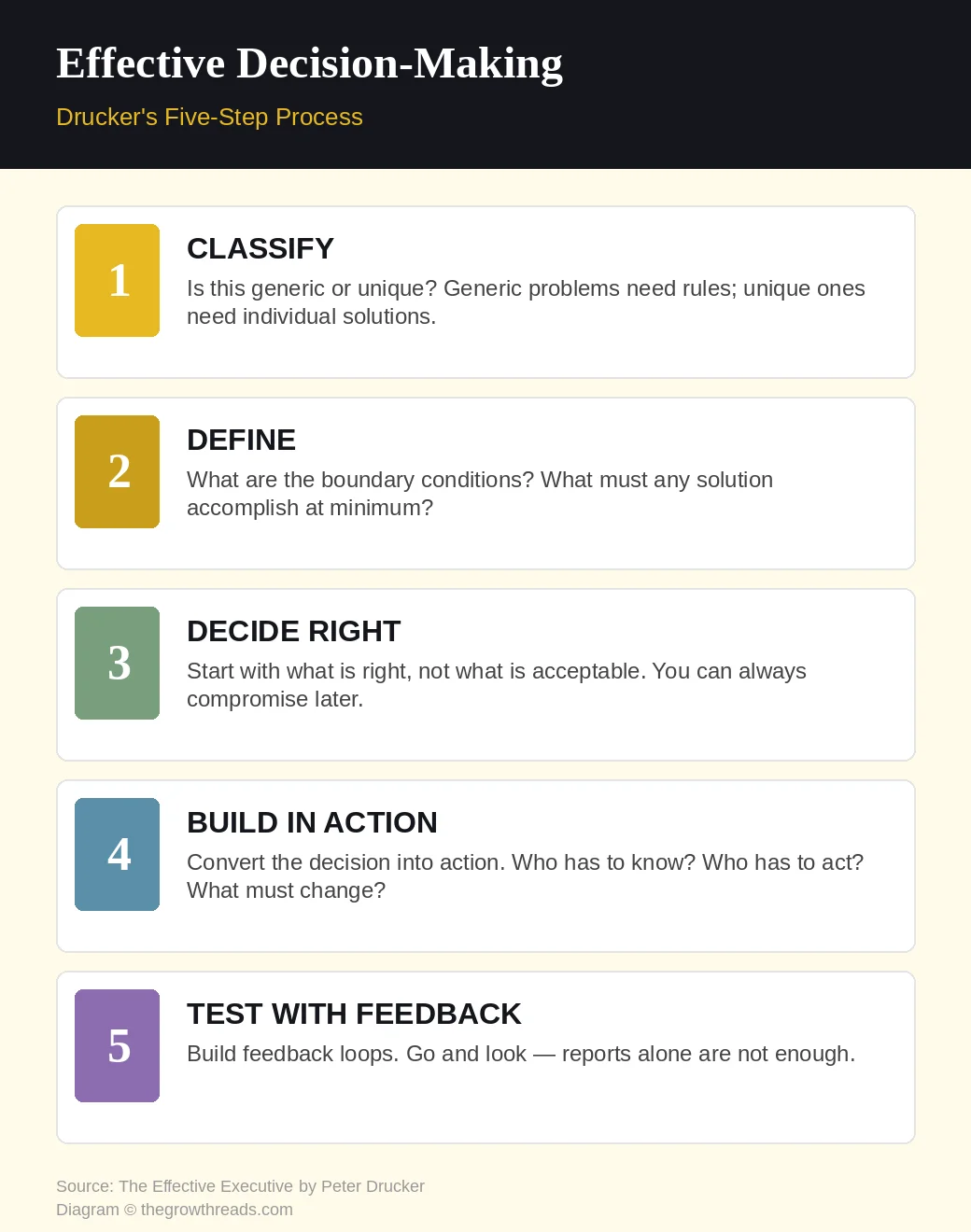
Drucker devotes his final two chapters to decision-making, which he considers the specific task of the executive. His framework begins with classification: is this a generic problem (a symptom of an underlying pattern) or a truly unique event? Most problems that appear unique are actually generic — they require a rule or a policy, not a case-by-case judgment. The truly unique event is extremely rare, and even then, Drucker recommends treating it as potentially generic until proven otherwise.
The second element is defining boundary conditions — the minimum specifications that any acceptable solution must satisfy. A decision that does not satisfy its boundary conditions is worse than no decision at all, because it creates the illusion of progress while failing to solve the problem. Drucker uses the example of Alfred Sloan’s decision-making at General Motors: Sloan would begin every major decision by asking what the decision must accomplish, then test every proposed solution against those specifications before proceeding.
The third element is starting with what is right rather than what is acceptable. Compromise will always be necessary in execution, but the decision itself should begin from the ideal. If you start by asking what is acceptable, you have already compromised twice — once in the decision and once in the implementation — and the result is usually useless.
Converting decisions into action is the fourth element, and the one Drucker finds most commonly neglected. A decision that does not specify who must do what, by when, with what resources, is not a decision — it is a good intention. Finally, feedback must be built into the decision from the start. Drucker insists on firsthand observation — “go and look” — because reports are filtered through the assumptions of whoever prepared them.
TGR Note: Drucker’s insistence on “organized disagreement” prefigured modern concepts like “red teaming” and “pre-mortem analysis.” In Thinking, Fast and Slow, Daniel Kahneman provides the cognitive science behind why disagreement improves decisions — it counteracts the confirmation bias and overconfidence that plague individual judgment. And in Principles, Ray Dalio builds an entire organizational culture around “radical transparency” and “believability-weighted disagreement” — an institutional version of what Drucker recommended as personal practice.
Who is The Effective Executive best for — and who should read something else first?
This book is essential reading for anyone in a management or leadership role, or anyone transitioning into one. It is equally valuable for individual contributors who want to understand why some people produce outsized results — the five practices apply regardless of title. Consultants, entrepreneurs, and nonprofit leaders will find it especially relevant because Drucker wrote for anyone who must produce results through the application of knowledge and judgment.
If you are looking for a more tactical, step-by-step productivity system, start with Getting Things Done by David Allen or The ONE Thing by Gary Keller. If you want the science behind focus and concentration, Deep Work by Cal Newport extends Drucker’s time-management insights with neuroscience. And if you are specifically interested in the decision-making chapters, pair this book with Thinking in Bets by Annie Duke for a modern probabilistic approach to judgment under uncertainty.
Questions to reflect on
- If you tracked every minute of your workday for three weeks, what percentage would you estimate goes toward your highest-value contributions — and what would the actual number reveal?
- When someone asks what you do, do you describe your tasks and activities, or the results and contributions your organization expects from you? What would change if you consistently answered with the latter?
- What strengths do your direct reports (or close colleagues) have that you are not fully utilizing — and what weaknesses are you spending too much energy trying to fix?
- What is one commitment, project, or routine from the past that you continue out of habit or loyalty, even though it no longer produces meaningful results? What would happen if you abandoned it?
- Think of a recent important decision. Did you classify the problem first? Did you define boundary conditions? Did you specify who must act? Where did the process break down?
🔥 Ready to master the five practices of effectiveness?
The Effective Executive gives you Drucker’s complete framework for getting the right things done — a system that has shaped leadership thinking for nearly sixty years.
How to apply The Effective Executive (7-day plan)
- Day 1 — Start a time log: Today, record every activity you engage in and how long it takes. Do not rely on memory — log it as it happens. Use a simple notebook, spreadsheet, or time-tracking app. Commit to continuing this for at least two full weeks.
- Day 2 — Define your contribution: Write down the three most important results your organization (or team, or clients) needs from you. Not tasks — results. Post this where you will see it every morning.
- Day 3 — Audit for elimination: Review yesterday’s time log and ask Drucker’s first question about each entry: what would happen if this were not done at all? Mark every activity where the honest answer is “nothing” and plan to stop doing them.
- Day 4 — Map strengths: List the top three strengths of each person you work with closely (including yourself). Then ask: are these strengths being fully utilized in their current roles and assignments?
- Day 5 — Set posterior priorities: Identify one project, commitment, or routine that you will abandon, decline, or delegate starting this week. Choose the one that consumes the most time relative to the results it produces.
- Day 6 — Apply the decision framework: Take a pending decision and run it through Drucker’s five steps. Classify the problem, define boundary conditions, decide what is right (not what is acceptable), specify the action steps and who must act, and identify how you will get feedback.
- Day 7 — Consolidate your time: Based on your time log so far, block a minimum three-hour chunk of uninterrupted time on your calendar for next week. Dedicate it entirely to your single most important contribution. Protect it as you would a meeting with your most important client.
Frequently asked questions
What is The Effective Executive about in one sentence?
The Effective Executive argues that effectiveness — the ability to get the right things done — is not an inborn talent but a discipline that can be learned through five specific practices: managing time, focusing on contribution, building on strengths, concentrating effort on priorities, and making decisions through a systematic process. Drucker wrote the book for anyone in a knowledge role who must produce results through judgment and decision-making, regardless of whether they hold a formal management title. The book has remained continuously in print since 1967 because its core insight — that working on the right things matters more than working hard — has only become more relevant in the knowledge economy.
Is The Effective Executive still relevant today?
Remarkably so. Although Drucker wrote the book in 1967, its core arguments have become more relevant, not less. His concept of the “knowledge worker” — someone whose productivity depends on applying knowledge and judgment rather than physical labor — now describes the majority of the workforce in developed economies. His emphasis on time management, concentration, and decision-making discipline anticipated the attention-economy challenges that modern productivity books like Deep Work address. The specific examples (General Motors, the Kennedy administration) feel dated, but the principles are timeless. Many readers find that The Effective Executive provides the philosophical foundation that makes tactical productivity books more meaningful.
What are the five practices of an effective executive?
Drucker identifies five practices that together constitute the habit of effectiveness. First, effective executives know where their time goes — they record it, analyze it, and consolidate it into large blocks. Second, they focus on outward contribution rather than inward effort, asking what results the organization needs from them. Third, they build on strengths — their own, their colleagues’, and their organization’s — rather than trying to fix weaknesses. Fourth, they concentrate on the few areas where superior performance will produce outstanding results, doing first things first and second things not at all. Fifth, they make effective decisions through a disciplined process of classification, boundary definition, and feedback.
What does Drucker mean by “first things first, second things not at all”?
Drucker means that concentration — doing one important thing at a time — is the secret of effectiveness. The phrase “second things not at all” is deliberate: it is not enough to prioritize; you must actively abandon the things that do not make the cut. Drucker calls these “posterior priorities” and argues that setting them requires more courage than setting priorities, because it means letting go of past successes, familiar routines, and popular programs. The effective executive regularly asks which activities, if they were not already being done, would not be started today — and then stops doing them to free up time and resources for what matters now.
How is The Effective Executive different from other productivity books?
Most productivity books focus on efficiency — doing things faster or with fewer inputs. Drucker focuses on effectiveness — doing the right things. This distinction is fundamental. An efficient person who works on the wrong priorities produces impressive activity but negligible results. Drucker’s book operates at a higher level of abstraction: instead of offering to-do list hacks or time-boxing techniques, it asks what you should be working on in the first place, how to make better decisions about where to direct your attention, and how to structure your role around contribution rather than busyness. It is best read before (or alongside) more tactical books like Getting Things Done or Atomic Habits.
What does Drucker mean by “knowledge worker”?
Drucker coined the term “knowledge worker” to describe anyone whose work primarily involves applying knowledge, judgment, and ideas rather than performing physical labor. Programmers, doctors, teachers, lawyers, managers, consultants, writers, analysts, and designers are all knowledge workers. The key characteristic is that knowledge workers own their primary means of production — their expertise — which means they cannot be supervised in the traditional sense. They must manage themselves. This is why effectiveness is so important: unlike manual labor, knowledge work cannot be measured by quantity of output alone. What matters is whether the knowledge worker is contributing the right knowledge to the right problems.
What is Drucker’s approach to decision-making?
Drucker outlines a five-step process. First, classify the problem: is it generic (requiring a rule or policy) or genuinely unique (requiring a one-time judgment)? Most problems that appear unique are actually generic. Second, define the boundary conditions — the minimum requirements any acceptable solution must meet. Third, start with what is right rather than what is acceptable — compromises will come in implementation, so the decision itself should aim high. Fourth, build action into the decision by specifying who must do what, by when, and with what resources. Fifth, build in feedback — and go look for yourself rather than relying solely on reports. He also emphasizes “organized disagreement,” deliberately seeking out opposing views before committing to a course of action.
Related summaries
- High Output Management by Andy Grove — Grove applies Drucker’s principles to the specific challenges of managing technology teams
- Good to Great by Jim Collins — Collins finds that the best leaders embody Drucker’s strengths-based, contribution-focused philosophy
- Deep Work by Cal Newport — The neuroscience behind Drucker’s time-consolidation principle
- Best Productivity Books — Our complete guide to the top productivity reads
How we analyze books: Every summary on The Growth Reads follows a structured process: we read the full book, identify core frameworks and actionable insights, cross-reference claims with primary sources where possible, and rate each book on five criteria — Content Depth, Practicality, Readability, Originality, and Overall Value. Read our full methodology.