

★★★★☆½ 4.5/5 — The original blueprint for trading a 9-to-5 for freedom, and still one of the sharpest playbooks for designing your time instead of just filling it.
Best for: Employees and freelancers who want more autonomy without waiting for retirement, and early-stage entrepreneurs testing a low-risk side income.
Reading time: ~7 hrs to read the book (this guide: 15 min)
Difficulty to apply: Moderate — the individual tactics are simple, but elimination and outsourcing take deliberate practice to stick.
The 4-Hour Workweek in one minute
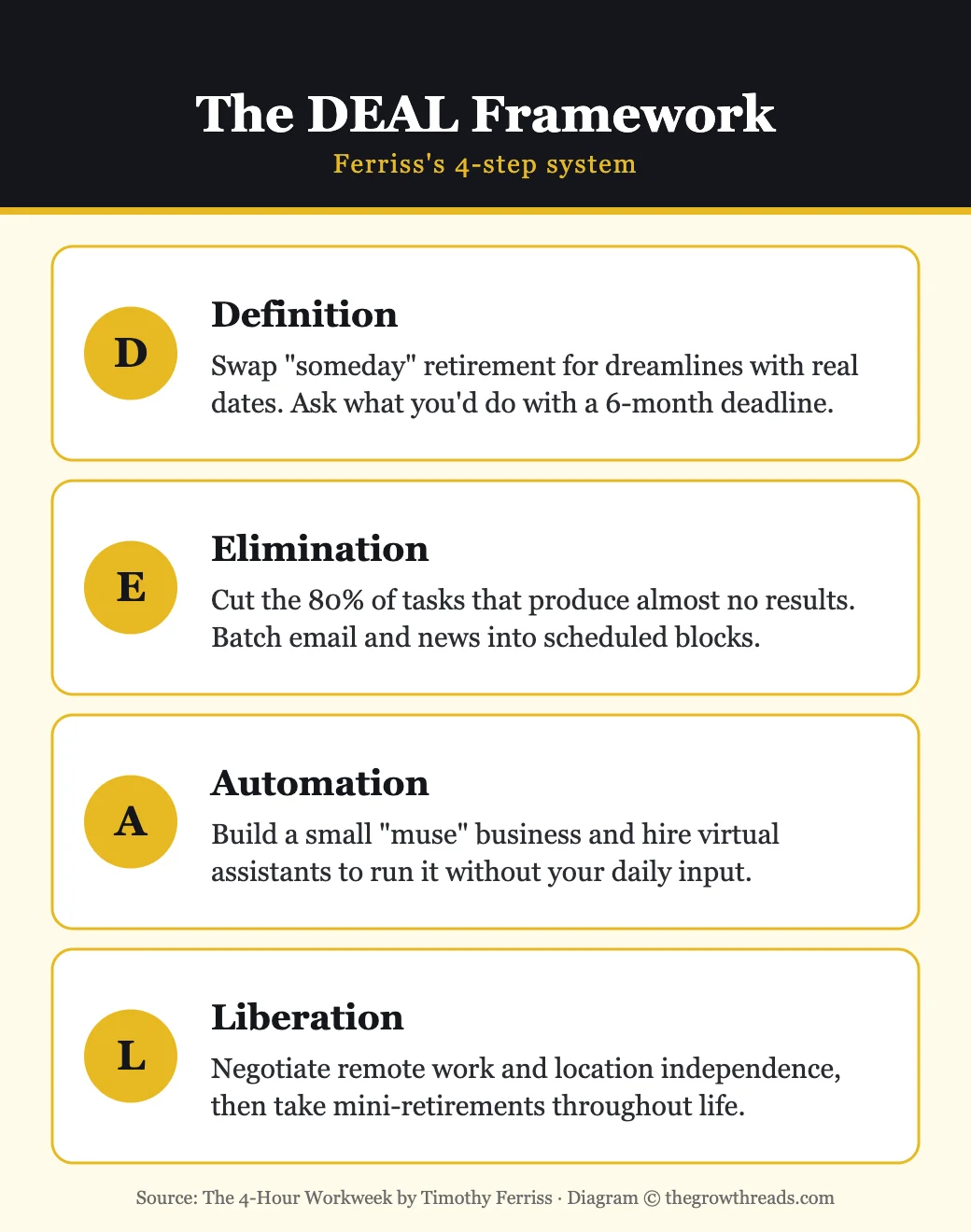
You don’t need to get rich before you get free — you need to redesign your relationship with time. Timothy Ferriss’s 2007 bestseller argues that the standard life plan — grind for forty years, defer the good parts, retire at 65 — is a bad bet, because it trades your best years for a payoff you might never fully enjoy. Instead, Ferriss lays out a four-part system he calls DEAL: Definition (redefine what “rich” actually means to you), Elimination (cut the low-value 80% of your work), Automation (build small, self-running income streams), and Liberation (use the time and money you’ve freed up to live wherever, whenever). The book is part manifesto, part toolkit — fear-setting exercises, outsourcing scripts, negotiation templates — aimed at proving that a radically freer life is available years sooner than people assume, without needing to already be wealthy.
Key takeaways
- Redefine wealth as time and mobility, not just money: Ferriss calls people who optimize for freedom instead of net worth the “New Rich” — money is a tool for buying back time, not the goal itself.
- The deferred-life plan is a bad bet: saving all your freedom for retirement at the end of your working life risks a payoff that may arrive too late or not at all — spread it out instead.
- Fear-setting beats goal-setting when you’re stuck: define the worst realistic outcome of a scary decision, how you’d repair it, and the cost of never attempting it.
- Apply the 80/20 rule ruthlessly: a small share of your clients, tasks, and daily habits produce almost all of your meaningful results — find that slice and cut the rest.
- Shrink deadlines, not to-do lists: Parkinson’s Law means the same work often gets done in a fraction of the time when you give it a tighter deadline.
- Put yourself on a low-information diet: batch email and news into one or two scheduled windows a day instead of checking reflexively all day long.
- Build a “muse,” not a startup: a small, deliberately unambitious, automatable income stream is far easier to run remotely than a business you’re expected to grow forever.
- Outsource what someone else can do at $10–15 an hour: hand off tasks a virtual assistant can do competently so your best hours go to the few things only you can do.
- Test before you build: a landing page and a small ad budget can tell you whether a product idea has real demand before you invest months building it.
- Negotiate remote work with evidence, not permission-seeking: pitch a defined trial period backed by your actual performance data, and let the results make your case.
What is The 4-Hour Workweek about?
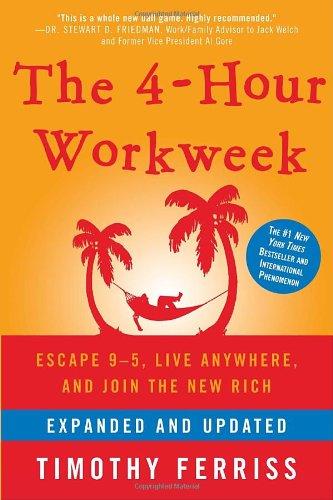
The 4-Hour Workweek is Timothy Ferriss’s guide to escaping the 9-to-5 by redesigning your relationship with time, work, and money. Using his DEAL framework — Definition, Elimination, Automation, Liberation — it shows how to cut low-value work, automate income through small outsourced businesses, and build real freedom now instead of waiting for retirement to enjoy it.
About the author
Timothy Ferriss built his reputation as a self-described “human guinea pig,” running extreme self-experiments in business, fitness, and learning before writing about what actually worked. Before this book, he ran a sports-nutrition supplement company, BrainQUICKEN, which he eventually restructured to run with minimal daily involvement from him — the real-world test case behind the book’s “muse business” idea. He has guest-lectured on high-tech entrepreneurship at Princeton, was an early angel investor in companies including Uber, Facebook, and Twitter, and later became known for The Tim Ferriss Show, one of the most downloaded business podcasts in the world. His follow-up books, The 4-Hour Body and The 4-Hour Chef, extended the same “minimum effective dose” thinking to fitness and skill acquisition. In the years since, Ferriss has largely lived out the lifestyle-design principles this book only introduced. Explore all Timothy Ferriss book summaries →
Key concepts at a glance
| Concept | What it means | Use it when |
|---|---|---|
| New Rich (NR) | People who optimize for time and mobility instead of a deferred retirement payoff | Redefining what “wealth” actually means to you |
| DEAL framework | Definition, Elimination, Automation, Liberation — the book’s four-step system | Restructuring your entire work life, not just one habit |
| 80/20 Rule (Pareto Principle) | Roughly 80% of your results come from 20% of your effort, clients, or tasks | Deciding what to cut from your workload |
| Parkinson’s Law | Work expands to fill the time you allot to it | Setting deadlines that force focus on what matters |
| Fear-setting | A structured exercise for defining, and defusing, worst-case outcomes | You’re paralyzed by a big, scary decision |
| Low-information diet | Scheduled, deliberately limited news and email consumption | Reclaiming attention that’s currently going to reflexive checking |
| Muse business | A small, automatable income stream, not a business you must grow forever | Building location-independent income |
| Mini-retirement | Extended time off distributed across your working life, not saved for age 65 | Planning the next 1–5 years, not just this week |
| Outsourcing / virtual assistants | Delegating low-value, repeatable tasks to remote help | Scaling your time without hiring full-time staff |
Part 1: Definition — Redefining the Rules
Ferriss opens by attacking what he calls the “deferred-life plan”: study hard, work hard, save diligently, and enjoy the payoff decades later, at retirement. The problem, he argues, isn’t ambition — it’s the bet itself. You’re wagering your best physical years, and a large share of your total life energy, on a promise that arrives so late it may not be worth as much as you think, if it arrives at all. His alternative isn’t “do nothing” — it’s to stop treating freedom as something you earn once, at the end, and start treating it as something you design continuously, starting now.
The first tool for this is fear-setting, a written exercise Ferriss borrows loosely from Stoic philosophy. Instead of vague goal-setting (“I want to quit my job” or “I want to travel more”), you write down, in detail, the worst realistic outcome of the decision you’ve been avoiding. Then you write how you’d repair each part of that outcome if it happened. Then you write the cost — financial, emotional, physical — of doing nothing for the next six months, one year, three years. Most people, Ferriss observes, overestimate the worst case and underestimate the cost of staying stuck; writing both down side by side tends to break the paralysis.
The second tool is “dreamlining”: instead of a vague goal like “I want to be rich,” you get specific about what you’d have, do, and be over the next six and twelve months, then price it out as a Target Monthly Income (TMI) — the actual dollar figure that would fund that specific life. A number attached to a date is a plan; “I want more money” is not.
TGR Note: Ferriss and Greg McKeown reach a similar conclusion from different directions. Ferriss says define what you actually want before you start eliminating; McKeown’s Essentialism argues you can’t have it all, so decide deliberately what matters before anything else gets your time. Read them as a pair: dreamline first, then apply Essentialism’s “less but better” filter to everything that isn’t on the list.
Part 2: Elimination — Do Less, On Purpose
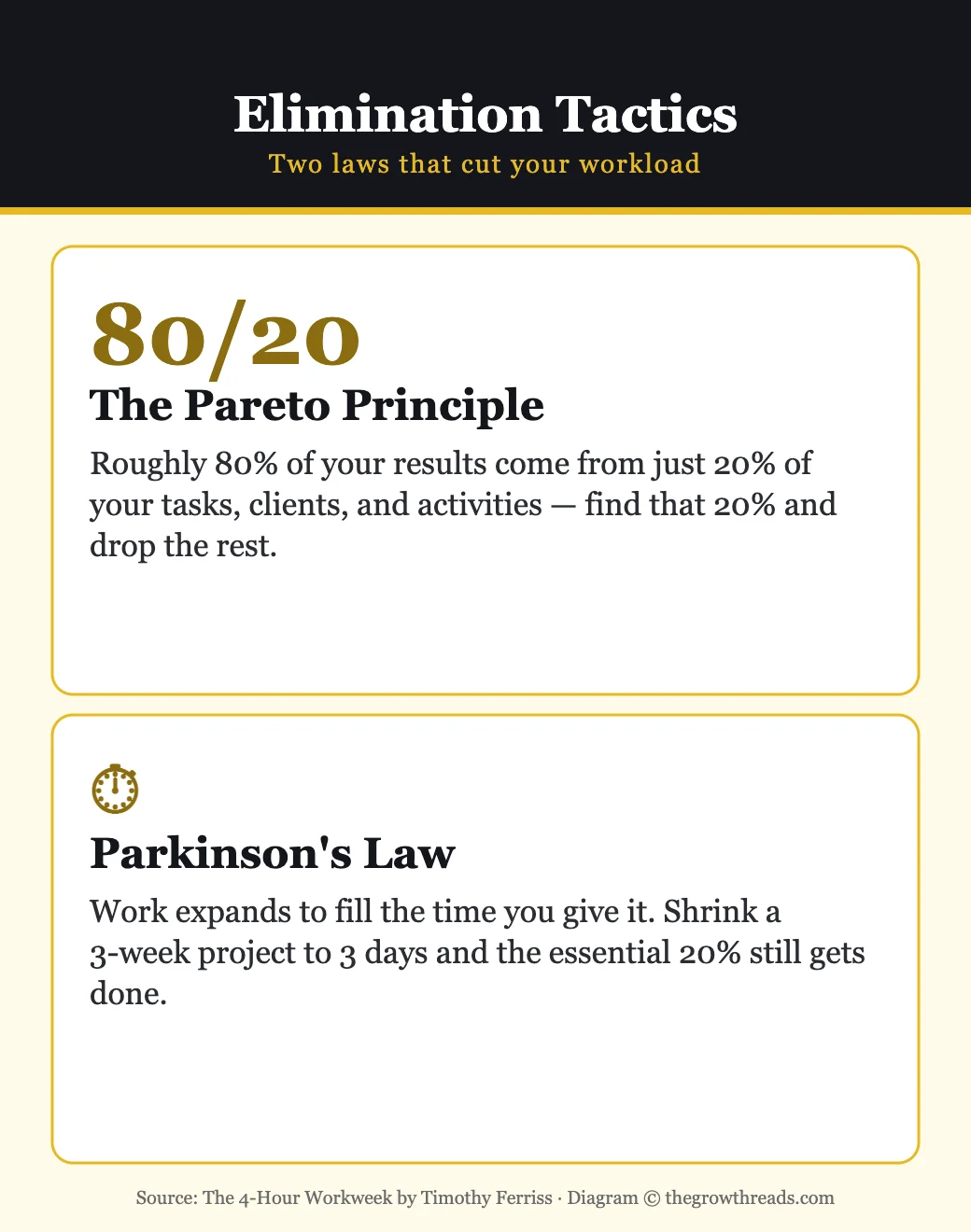
Once you know what you’re actually working toward, Ferriss turns to cutting everything that isn’t moving you there. The centerpiece is the 80/20 rule, or Pareto Principle: in most areas of work and life, roughly 80% of your results trace back to about 20% of your effort, clients, or tasks. Ferriss’s application is blunt — audit your client list, your task list, even your social obligations, identify the vital 20%, and cut or delegate the rest, even when the remaining 80% still “feels” productive. Busy is not the same as effective, and he treats the two as opposites more often than not.
The second lever is Parkinson’s Law: work expands to fill the time available for its completion. A report given three weeks will somehow take three weeks; the same report given three days often gets done in three days, because the deadline forces you to identify and execute only the essential steps. Ferriss’s advice is to deliberately shrink self-imposed deadlines and see how much of the “necessary” busywork quietly disappears.
The third piece is the low-information diet: a conscious decision to stop checking email and news reflexively throughout the day, and instead batch it into one or two scheduled windows. Most incoming information, Ferriss argues, is neither time-sensitive nor actionable by you specifically — an autoresponder buys you the time to find out which messages actually are.
TGR Note: Cal Newport’s Deep Work gives the neuroscience behind why Ferriss’s batching works so well: every time you glance at an inbox mid-task, you leave “attention residue” behind that slows the task you return to. Batching email isn’t just about saving minutes — it’s about protecting the quality of the hours in between.
TGR Note: If the low-information diet resonates but your bigger problem is compulsive phone-checking rather than email volume, Cal Newport’s later book Digital Minimalism is a more thorough treatment of the same instinct — scheduled, intentional use of technology instead of reactive, all-day use.
Part 3: Automation — Build a Muse, Not a Job
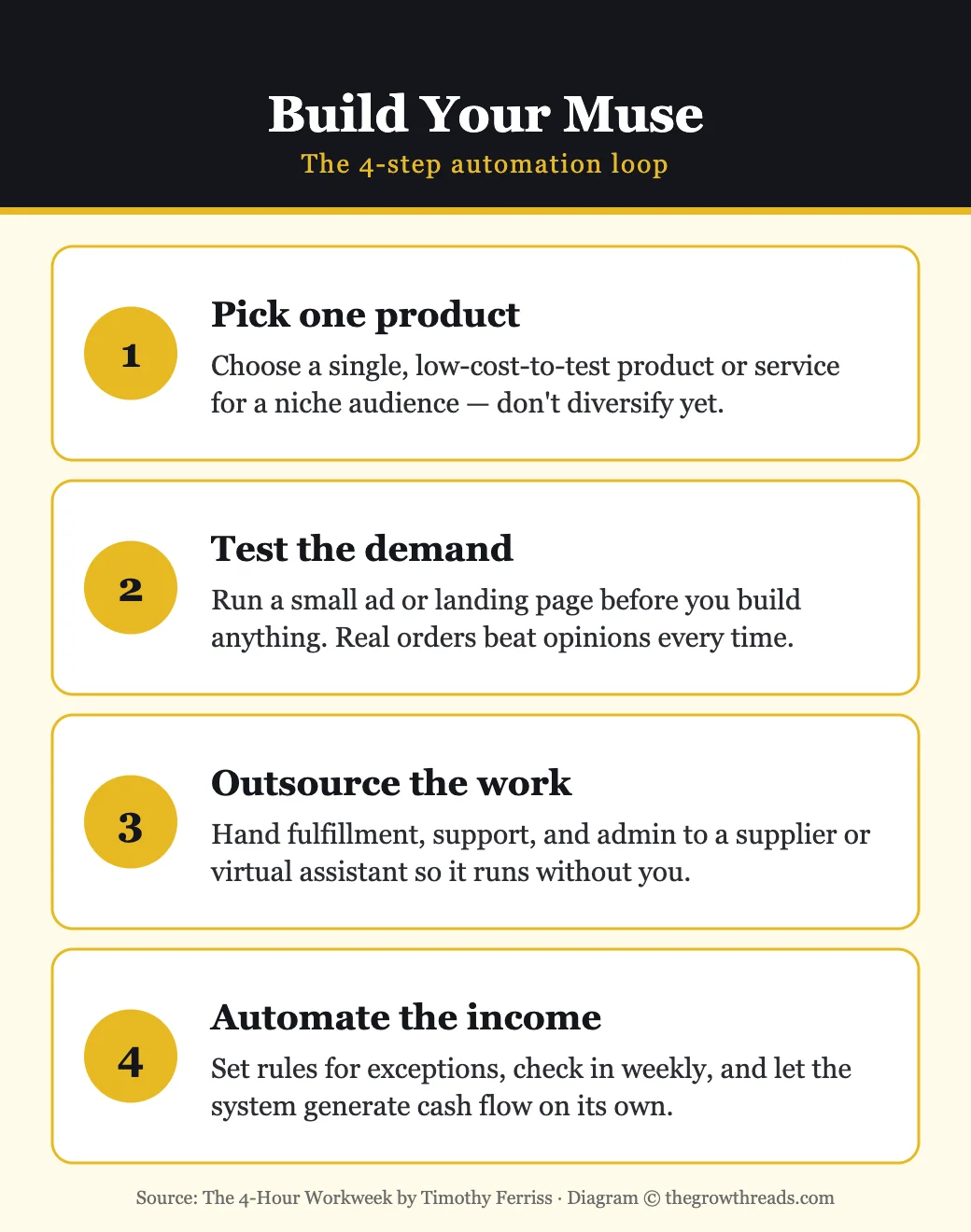
With low-value work eliminated, Ferriss turns to replacing your income with something that doesn’t require your constant presence. His term for this is a “muse”: a small, deliberately unambitious business built to generate a specific target income with minimal daily management, not a startup you’re expected to scale into an empire. The distinction matters — a muse is designed around your lifestyle goals from the TMI exercise in Part 1, not around growth for its own sake.
The mechanism is outsourcing. Ferriss’s own case study was restructuring his supplement company so that customer service, order fulfillment, and routine admin were handled by outsourced staff and virtual assistants, often paid a fraction of a US hourly wage for the same competent work. The goal isn’t to exploit cheap labor for its own sake — it’s to buy back the hours that used to go to tasks that didn’t require his specific judgment, so those hours could go toward decisions that did.
Before committing to a muse idea, Ferriss insists on testing it cheaply: a simple landing page, a small paid-ad budget, and real purchase intent (not just survey answers) tell you in days whether a product idea has demand, long before you’d know from building it first. Combined with geographic arbitrage — earning in a strong currency while living somewhere with a lower cost of living — a modest muse income can fund a lifestyle that would require a much larger salary anywhere else.
TGR Note: Outsourcing only works if the tasks you’re handing off are clearly defined, which is exactly the problem David Allen’s Getting Things Done solves. Run your tasks through GTD’s “next action” thinking before you hand them to a virtual assistant, and the handoff goes far more smoothly.
Part 4: Liberation — Design Your Mobility
The payoff of Definition, Elimination, and Automation is Liberation: using the time and location freedom you’ve built to actually live differently, not just to have the option to. For people who stay employed rather than going the muse-business route, Ferriss devotes real attention to negotiating remote work — not by asking permission, but by proposing a defined trial period, backed by recent performance data, with a specific plan for staying reachable and productive. Employers rarely say yes to an open-ended request; they often say yes to a two-week pilot with clear success metrics attached.
For everyone, the bigger structural idea is the mini-retirement: instead of saving all your unstructured time for a single multi-decade retirement at the end of your working life, Ferriss argues for taking repeated, extended breaks — a month, three months, six months — spread throughout your twenties, thirties, and forties. The math is straightforward: a shorter career interrupted by several genuine breaks often produces more total life satisfaction than one long uninterrupted grind followed by one long uninterrupted rest, especially since energy, health, and relationships don’t wait patiently for age 65.
Ferriss is candid that the biggest obstacle to Liberation usually isn’t logistics — it’s psychology. People who’ve spent a decade defining themselves by their job title often find unstructured time genuinely uncomfortable at first, and he recommends easing into mini-retirements with structure (a language course, a specific project, a fitness goal) rather than expecting total freedom to feel good immediately.
TGR Note: The mobility described in this part only holds up if the muse income from Part 3 is genuinely stable, which is a compounding problem, not a one-time fix. Darren Hardy’s The Compound Effect is a useful companion here — it’s the discipline that keeps a small automated system running well after the initial excitement of building it has worn off.
Who is The 4-Hour Workweek best for — and who should read something else first?
This book is best for people in traditional jobs who want more autonomy without waiting for retirement, aspiring entrepreneurs who want a low-risk way to test a business idea before quitting anything, and remote-curious employees who need a concrete negotiation script rather than just encouragement. It rewards readers who are willing to actually run the exercises — fear-setting, dreamlining, task audits — rather than just read about them.
If the idea of “doing less” appeals to you but the entrepreneurial framing doesn’t, start with Essentialism for the underlying mindset before Ferriss’s more tactical, business-oriented playbook. If your actual blocker is attention and screens rather than income or client load, Digital Minimalism tackles that more directly and in more depth. And if you already like your job and just want to execute better inside it rather than escape it, Getting Things Done is the better starting point.
Questions to reflect on
- If you had a firm six-month deadline to reach your current life goals, what would you actually do differently starting Monday?
- Which 20% of your clients, tasks, or daily commitments produce 80% of what actually matters to you — and what’s still on your plate that doesn’t?
- What’s the worst realistic outcome if you turned off email for two weeks and took a real vacation — and how would you recover from it?
- What’s one task on your plate this month that a $12-an-hour virtual assistant could do just as well as you can?
- What would you test with a simple landing page and $100 in ads before deciding whether a business idea is actually worth building?
🔥 Ready to design a life you don’t need a vacation from?
Get the full DEAL framework, the fear-setting worksheets, and Ferriss’s actual outsourcing and negotiation scripts in the original book.
How to apply The 4-Hour Workweek (7-day plan)
- Day 1 — Dreamline: for a 6-month and a 12-month horizon, list what you’d have, do, and be, then price out the actual monthly cost of that life.
- Day 2 — Fear-set: run the fear-setting exercise on the one decision you’ve been avoiding — define the worst case, how you’d repair it, and the cost of doing nothing.
- Day 3 — Audit: track every task for a full day and flag the roughly 20% that produced most of your real results, plus anything you could cut outright.
- Day 4 — Compress: pick one task or project this week and give it half the deadline you’d normally allow, then see what still gets done.
- Day 5 — Batch: choose two fixed times to check email and news, and turn off notifications for the rest of the day.
- Day 6 — Sketch a muse: list 3–5 small, testable income ideas, then write a one-page test plan — a landing page and a small ad budget — for the strongest one.
- Day 7 — Propose: draft a one-page remote-work or time-off proposal backed by a recent performance win, even if you’re not ready to send it yet.
Frequently asked questions
Is The 4-Hour Workweek actually about working only four hours a week?
Not literally, and Ferriss says as much inside the book. The title is a hook for the underlying idea: most jobs and businesses are full of low-value work that expands to fill available time, and once you eliminate it and automate what’s left, the hours required to sustain your income drop dramatically. The realistic promise isn’t a four-hour week for everyone — it’s that the standard 40-plus-hour week contains far more slack than most people assume, and that slack is worth hunting down.
Is the advice still relevant, given the book was written in 2007?
Mostly yes, with some updating needed. The core ideas — the 80/20 rule, Parkinson’s Law, fear-setting, outsourcing repeatable work — don’t depend on any specific technology and still hold up. Some of the tactical specifics, like which outsourcing platforms or payment tools to use, are dated; readers today generally swap those for current equivalents while keeping the underlying strategy the same.
Do you need to start a business to get value from this book?
No. The Definition and Elimination sections — dreamlining, fear-setting, the 80/20 rule, the low-information diet — apply directly to anyone with a job, and many readers use only those parts. The Automation and Liberation sections lean more heavily on entrepreneurship and are most useful if building a side income or negotiating remote work is actually part of your plan.
What exactly is a “muse” business?
A muse is Ferriss’s term for a small, deliberately unambitious business built to hit a specific target income with minimal ongoing management from you, as opposed to a startup you’re expected to keep growing indefinitely. It’s sized to fund a particular lifestyle, tested cheaply before you build it, and run mostly by outsourced help once it’s working — freedom is the goal, not maximum revenue.
Is outsourcing to virtual assistants realistic on a normal budget?
For many repeatable tasks, yes — competent remote help for scheduling, research, customer email, and basic admin is often available for a modest hourly rate, well below typical local employment costs. Ferriss’s point isn’t that outsourcing is free, but that even a small, well-scoped budget for delegation usually returns far more in reclaimed hours than it costs.
How is this different from books like Deep Work or Essentialism?
They’re complementary rather than competing. Essentialism and Deep Work focus mainly on how you think and work as an individual — what to say no to, how to protect focus. The 4-Hour Workweek is more structural and entrepreneurial: it’s specifically about redesigning your income and location, not just your daily habits, and spends real space on outsourcing, testing business ideas, and negotiating remote arrangements.
Does Ferriss argue that money doesn’t matter?
No — he argues money is a means, not the goal. The book’s central reframe is that most people chase money as a proxy for freedom and mobility without ever pricing out what freedom would actually cost, which is why the Target Monthly Income exercise exists: to find the real number, rather than an open-ended “more,” that would fund the specific life you actually want.
Related summaries
If The 4-Hour Workweek resonated, these go deeper on specific pieces of the framework: Essentialism for the “less but better” mindset behind Elimination, Digital Minimalism for a deeper treatment of the low-information diet, Deep Work for the focus science behind batching, and Getting Things Done for organizing tasks well enough to outsource them cleanly. For the full list, see our best productivity books guide.
How we analyze books: we read the full text, cross-reference the author’s other published work and interviews, and test the frameworks against other titles in our library before writing a summary. We focus on practical application over critique. Read our full methodology.