

⭐⭐⭐⭐✬ 4.5/5 — The most accessible daily philosophy practice ever published.
Best for: Anyone who wants a structured, low-commitment entry into Stoic philosophy that compounds over a year.
Reading time: ~3 min/day (designed for 366 days; cover-to-cover ~7 hrs)
Difficulty to apply: Low — one meditation per morning is all it takes to start.
The Daily Stoic in one minute
Ancient philosophy, delivered one day at a time, so you can actually use it. Ryan Holiday and Stephen Hanselman distill 2,000 years of Stoic wisdom into 366 daily meditations — one for every day of the year. Each entry pairs an original translation from Marcus Aurelius, Seneca, or Epictetus with a short, practical interpretation that connects the ancient insight to modern challenges. The book is organized around the three Stoic disciplines of perception, action, and will, giving readers a structured path to becoming calmer, more resilient, and more focused. Rather than reading philosophy as an academic exercise, The Daily Stoic turns it into a daily habit — a morning ritual that compounds over a full year into a fundamentally different way of seeing the world.
Key takeaways
- Control the controllable: The single most important Stoic practice is distinguishing between what is in your power (your thoughts, choices, and effort) and what is not (other people, weather, outcomes) — then focusing exclusively on the former.
- Perception is everything: Events are neutral; your judgment about them creates your suffering. Reframing obstacles as opportunities is not naive optimism — it is a trainable skill.
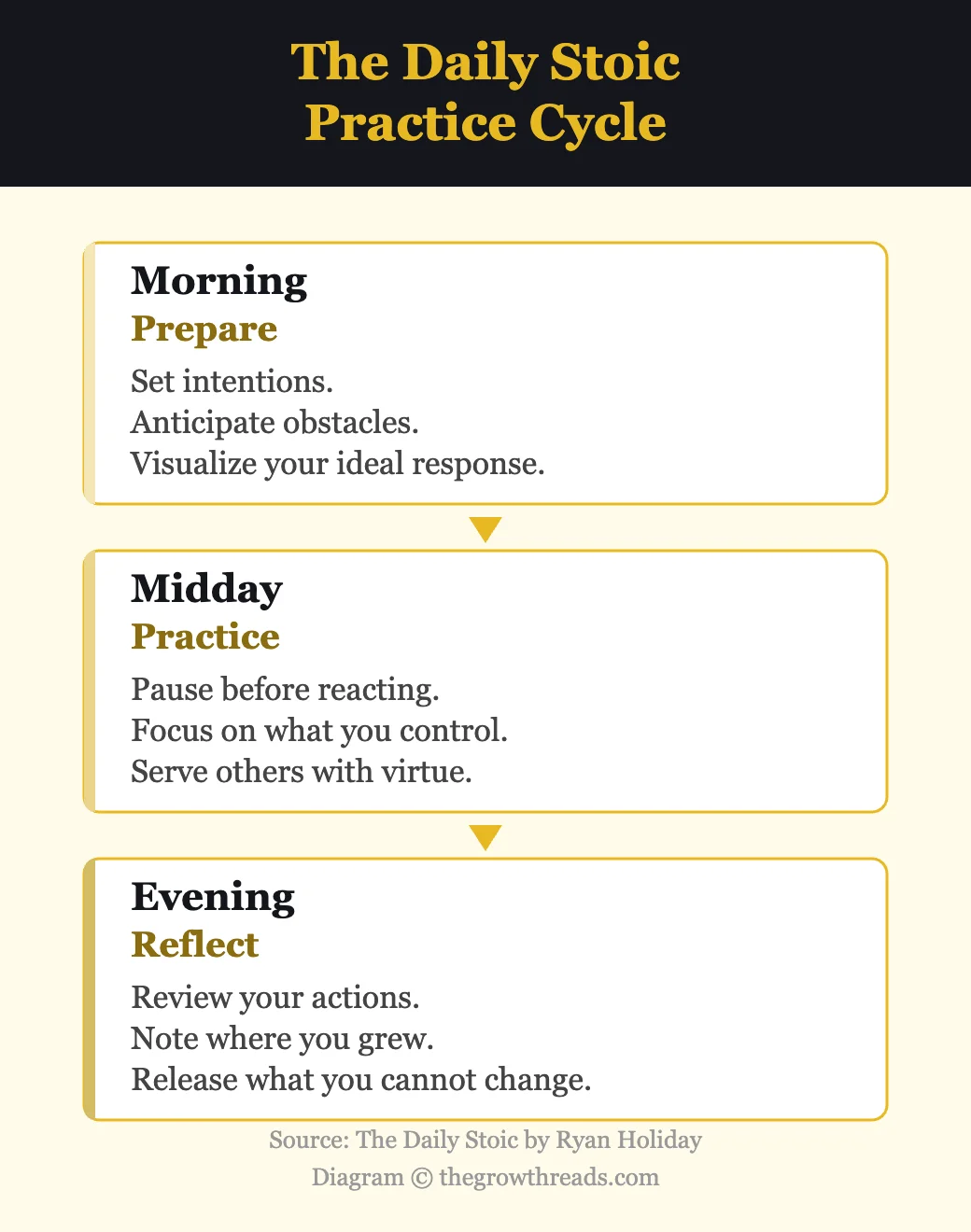
- Build a morning philosophy practice: Reading one meditation each morning takes under five minutes but creates a mental framework that shapes every decision you make that day.
- Memento mori sharpens priorities: Regularly reflecting on mortality eliminates trivial concerns and brings your attention to what truly matters — relationships, contribution, and character.
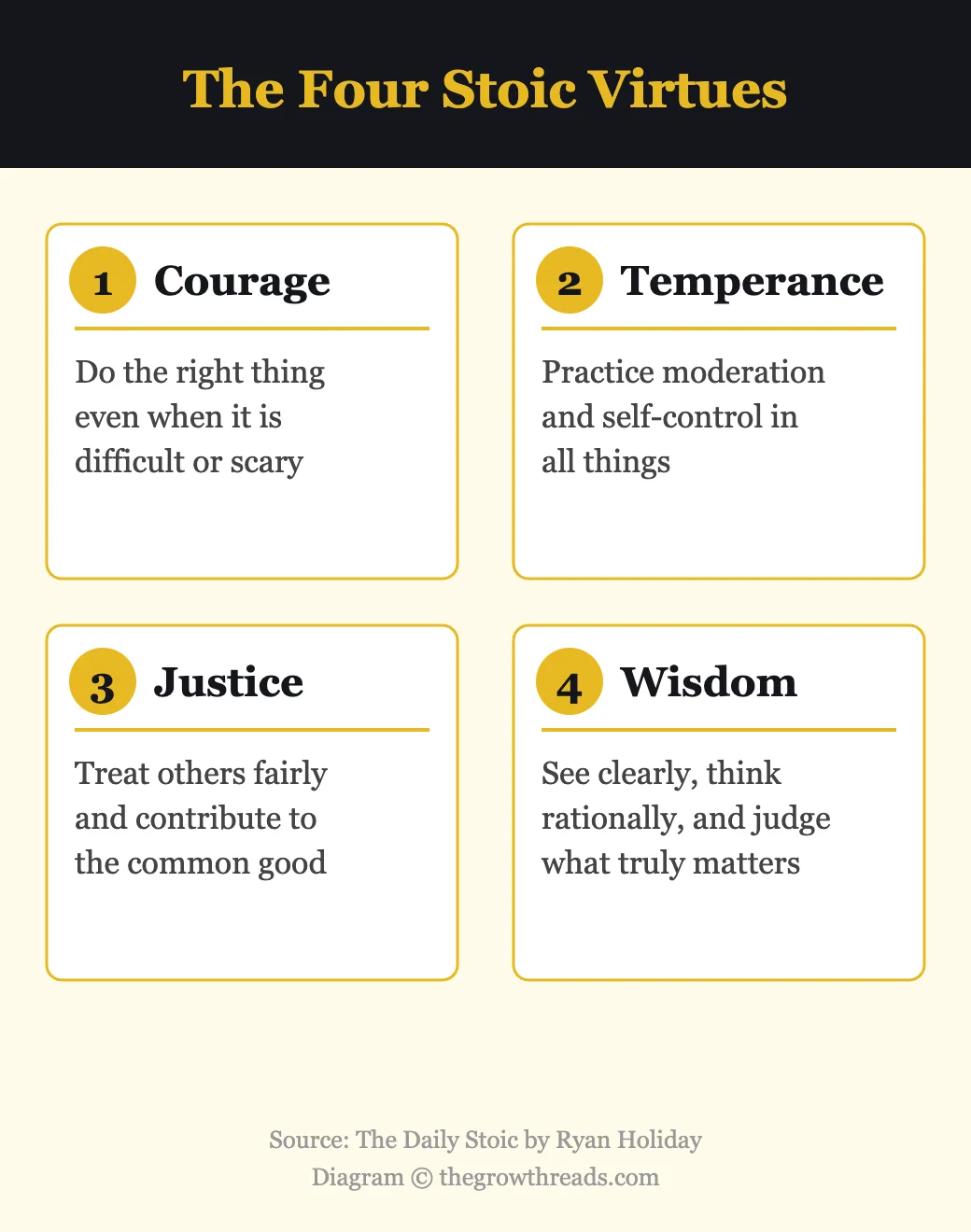
- Virtue is the only true good: The four Stoic virtues — courage, temperance, justice, and wisdom — are not abstract ideals but practical decision-making filters you can apply to any situation.
- Journaling closes the loop: Marcus Aurelius wrote Meditations as a private journal. Following his example turns passive reading into active self-examination and accelerates growth.
- Anger is always a choice: Seneca taught that anger begins with a judgment (“this should not have happened”). Questioning that judgment dissolves the emotion before it controls your behavior.
- Amor fati — love your fate: Instead of merely tolerating adversity, the Stoics practiced loving everything that happens as fuel for growth. This transforms your relationship with difficulty entirely.
- Small daily actions compound: Philosophy is not something you study once; it is something you practice every single day. Consistency matters more than intensity.
- Community strengthens practice: The Stoics emphasized duty to others. Bringing Stoic principles into your relationships, work, and community service deepens your own practice.
What is The Daily Stoic about?
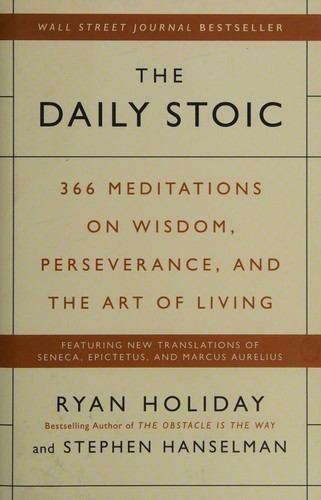
The Daily Stoic is a year-long guided practice of Stoic philosophy. Each of the 366 entries presents an original translation from Marcus Aurelius, Seneca, or Epictetus, followed by a modern interpretation that connects the ancient teaching to everyday challenges around work, relationships, and self-discipline.
About the author
Ryan Holiday dropped out of college at 19 to apprentice under Robert Greene, became director of marketing for American Apparel, and then pivoted to become one of the most widely read writers on Stoic philosophy in the modern era. His books — including The Obstacle Is the Way, Ego Is the Enemy, and Stillness Is the Key — have sold millions of copies worldwide and have been adopted by NFL teams, special operations units, and Fortune 500 executives. Stephen Hanselman, co-author and literary agent, contributed the original translations from Greek and Latin that anchor each daily entry. Holiday runs the Daily Stoic website and newsletter, which reaches over a million subscribers.
Key concepts at a glance
| Concept | What it means | Use it when |
|---|---|---|
| Dichotomy of control | Separate what you can control from what you cannot | You feel anxious about outcomes beyond your influence |
| Memento mori | Remember that you will die — use this as a priority filter | You are procrastinating on what matters most |
| Amor fati | Love everything that happens as necessary for your growth | You face setbacks, rejection, or unexpected change |
| Premeditatio malorum | Visualize obstacles in advance so they do not surprise you | Before an important meeting, launch, or difficult conversation |
| Sympatheia | Recognize your connection to all other people and nature | You feel isolated or self-centered |
| The four virtues | Courage, temperance, justice, and wisdom as daily guides | You face a decision with no clear right answer |
| The inner citadel | Your mind is a fortress no external force can penetrate | You are under pressure, criticism, or emotional attack |
| Voluntary discomfort | Deliberately practice hardship to build resilience | Life feels too comfortable and your edge is dulling |
Part 1: The Discipline of Perception (January–April)
The first third of The Daily Stoic tackles the foundational skill of Stoicism: seeing things clearly. Holiday opens the year with Epictetus’s famous line about how it is not events that disturb us but our judgments about them, and then spends four months showing how to apply this principle in practice. January entries focus on clarity — stripping away assumptions, recognizing cognitive biases, and developing what Holiday calls “the ability to see things as they really are, not as you fear or hope they might be.”
February meditations address the problem of desire: wanting what you do not have and fearing the loss of what you do. Seneca’s letters provide the backbone here, particularly his insight that we suffer more in imagination than in reality. Holiday connects this to modern psychology research on hedonic adaptation — the tendency to quickly return to a baseline level of happiness regardless of what you acquire.
March and April explore perspective-taking and the practice of reframing. Marcus Aurelius frequently reminded himself that the same events that feel catastrophic in the moment will be forgotten within a generation. Holiday walks readers through exercises in zooming out — viewing problems from the perspective of a decade, a century, or the cosmos — to reduce the emotional charge of daily frustrations.
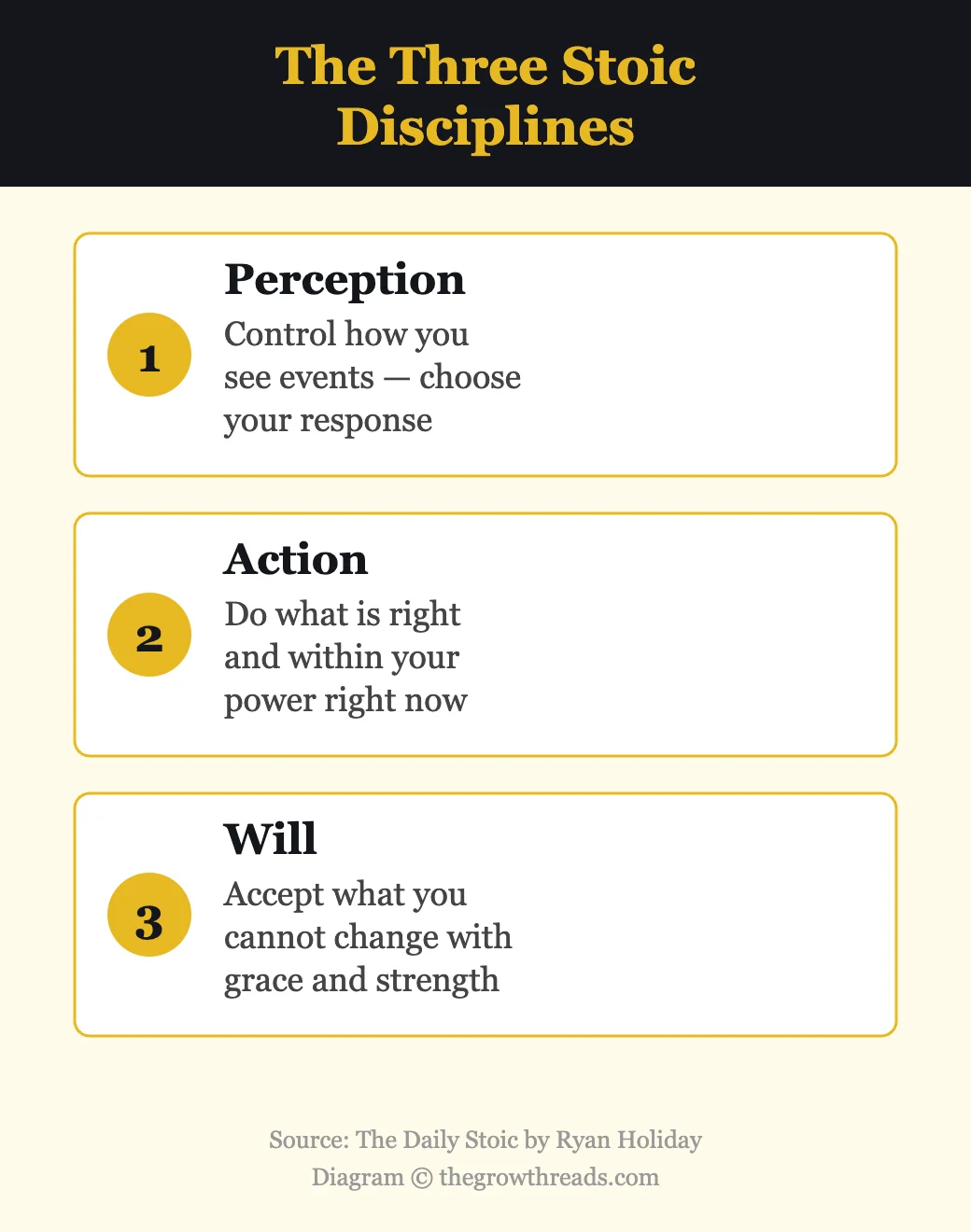
Part 2: The Discipline of Action (May–August)
Having trained the reader’s perception, Holiday shifts to action — the domain of what you actually do with your clear seeing. May opens with Marcus Aurelius’s reminder that “waste no more time arguing about what a good man should be — be one.” The meditations here focus on duty, discipline, and showing up consistently regardless of whether you feel motivated.
June entries explore courage — not the dramatic kind, but the everyday courage of speaking truthfully, making the difficult phone call, and doing the right thing when no one is watching. Holiday draws on Cato’s example, the Roman senator who repeatedly chose principle over popularity, to show that courage is a muscle that atrophies without daily exercise.
July meditations focus on pragmatism and effectiveness. The Stoics were not dreamers — they were generals, emperors, and advisors who needed philosophy to work under extreme pressure. Holiday shares anecdotes from military leaders and entrepreneurs who have adopted Stoic principles to make faster, clearer decisions under uncertainty.
August tackles the virtue of justice — our obligations to other people. Stoicism is sometimes mischaracterized as cold detachment, but Holiday shows that the tradition is deeply social. Marcus Aurelius governed an empire of 70 million people while writing his private meditations. The Stoic practice of justice asks: “What can I contribute? How can I serve? What does this situation demand of me?”
Part 3: The Discipline of Will (September–December)
The final section addresses the hardest Stoic practice: accepting what you cannot change. September meditations introduce amor fati — the Nietzschean term (borrowed from the Stoics) meaning “love of fate.” Holiday argues this is not passive resignation but an active embrace: treating every obstacle, loss, and setback as material you can use to become stronger.
October turns to resilience and endurance. Epictetus — a former slave who was physically disabled — serves as the primary teacher here. His message is uncompromising: you may not choose your circumstances, but you always choose your response. Holiday connects these teachings to modern trauma research, noting that psychologists have found that post-traumatic growth is more common than post-traumatic stress disorder.
November meditations focus on impermanence and memento mori. Seneca wrote extensively about death — not morbidly, but as a tool for living. When you remember that time is finite, trivial grievances lose their power. Holiday includes practical exercises like reviewing your calendar and asking: “If I had six months to live, would I keep this commitment?”
December closes the year with preparation for the next. The entries focus on building a sustainable practice — making philosophy a lifestyle rather than a one-time read. Holiday emphasizes that the Stoics measured progress not in knowledge gained but in behavior changed, and invites readers to start the cycle again on January 1st.
Who is The Daily Stoic best for — and who should read something else first?
Best for: Anyone who wants a structured daily philosophy practice without committing to reading dense ancient texts. People who feel overwhelmed by news, work stress, or emotional reactivity will find immediate relief in the perception exercises. Leaders, athletes, and entrepreneurs looking for a mental edge that compounds over time will especially benefit from the action discipline.
Read something else first if: You want a single narrative argument rather than a daily devotional format — start with The Obstacle Is the Way instead. If you want a deeper dive into habit formation specifically, Atomic Habits is more tactical. And if you are looking for Stoic philosophy applied to emotional resilience and trauma, Man’s Search for Meaning provides the lived experience that the meditations reference.
Questions to reflect on
- What am I currently spending energy on that is completely outside my control — and what would change if I redirected that energy to what I can control?
- When was the last time I reframed a setback as an opportunity? What happened as a result?
- If I had only six months to live, which commitments would I immediately drop, and which would I double down on?
- Which of the four Stoic virtues — courage, temperance, justice, or wisdom — am I weakest in right now, and what one action could I take today to strengthen it?
- Do I have a consistent morning practice that grounds my thinking, or do I start most days reactively scrolling through other people’s agendas?
🔥 Ready to start your daily Stoic practice?
366 meditations to build wisdom, resilience, and calm — one day at a time.
How to apply The Daily Stoic (7-day plan)
- Day 1 — Set up your morning ritual: Place the book on your nightstand or desk. Read today’s entry first thing, before checking your phone. Write one sentence in a journal about what the meditation means for your day.
- Day 2 — Practice the dichotomy of control: Make two columns on a piece of paper: “In my control” and “Not in my control.” List everything currently worrying you, then cross out the right column.
- Day 3 — Try negative visualization: Spend two minutes imagining you lost something you take for granted — your health, a relationship, your job. Notice how gratitude floods in when you open your eyes. This is premeditatio malorum.
- Day 4 — Catch one judgment: Notice a moment today where you add a story to a neutral event (“this traffic is ruining my day”). Pause and restate the fact without the judgment (“there is traffic”).
- Day 5 — Do one uncomfortable thing on purpose: Take a cold shower, have a difficult conversation, or skip a comfort you usually reach for automatically. This is voluntary discomfort — the Stoic antidote to softness.
- Day 6 — Write an evening review: Before bed, answer three questions: What did I do well today? Where did I fall short? What will I do differently tomorrow? Marcus Aurelius did this nightly for decades.
- Day 7 — Teach one Stoic idea: Share one concept from this week with a friend, partner, or colleague. Explaining it will deepen your own understanding and create accountability for continuing the practice.
Frequently asked questions
Is The Daily Stoic worth reading?
Yes — especially if you want a low-commitment entry point into Stoic philosophy. Each daily entry takes about three minutes to read, making it one of the most accessible ways to build a consistent philosophical practice. The original translations from Hanselman add scholarly depth that most popular Stoicism books lack, while Holiday’s modern interpretations keep the ideas immediately practical. It has sold over five million copies for good reason.
Do you need to read The Daily Stoic in order?
The book is designed to follow the calendar year from January 1st to December 31st, and the three sections build on each other — perception, then action, then will. Starting on January 1st gives you the intended progression. However, you can also open to today’s date and begin immediately. Many readers start mid-year and then restart from January when the new year arrives, getting the structure on the second pass.
What is the difference between The Daily Stoic and Meditations by Marcus Aurelius?
Meditations is Marcus Aurelius’s private journal — raw, unstructured, and sometimes repetitive. The Daily Stoic curates the best passages from Marcus alongside Seneca and Epictetus, organizes them thematically, and adds modern context. Think of Meditations as the primary source and The Daily Stoic as a guided tour through the highlights. Ideally, you read The Daily Stoic first to build the framework, then read Meditations with deeper understanding.
How long does it take to read The Daily Stoic?
Each daily entry takes two to four minutes, so the book is designed to be read over a full year — one entry per day. If you read it cover-to-cover in one sitting, it takes roughly six to eight hours. However, the daily format is central to the book’s value; treating it as a 365-day practice rather than a single read significantly increases retention and application of the ideas.
Is Stoicism about suppressing emotions?
No — this is the most common misconception. Stoicism teaches you to examine your emotions, not eliminate them. The Stoics distinguished between first impressions (automatic emotional reactions, which are natural) and assent (choosing to believe the story your emotions are telling, which is optional). The goal is not to feel nothing but to avoid being controlled by feelings that are based on faulty judgments.
What are the best books to read after The Daily Stoic?
Start with Holiday’s own trilogy: The Obstacle Is the Way (action), Ego Is the Enemy (humility), and Stillness Is the Key (peace). Then go to the original sources: Meditations by Marcus Aurelius, Letters from a Stoic by Seneca, and Discourses by Epictetus. For modern applied Stoicism, try A Guide to the Good Life by William B. Irvine, which is the best academic-yet-readable overview available.
Can The Daily Stoic help with anxiety?
Many readers report significant anxiety reduction from the daily practice. The dichotomy of control — the central Stoic exercise — is essentially a cognitive reappraisal technique, which modern CBT research has shown to be one of the most effective anxiety management strategies. By consistently practicing the separation of what you can and cannot control, you train your brain to stop catastrophizing about outcomes that are not in your hands.
Related summaries
If The Daily Stoic resonated with you, explore these related summaries:
- The Obstacle Is the Way — Holiday’s narrative deep dive into the Stoic discipline of action
- Ego Is the Enemy — How unchecked ego sabotages success at every stage
- Atomic Habits — The modern science of building daily practices that stick
- Man’s Search for Meaning — Viktor Frankl’s lived proof that perception shapes survival