

⭐⭐⭐⭐✦ 4.5/5
One-liner: The simplest, most actionable personal finance plan ever written — one that actually works for normal people.
Best for: Anyone who knows they should get their money sorted but feels overwhelmed, couples who fight about finances, and young adults building their first financial foundation.
Reading time: ~5 hours (272 pages)
Difficulty to apply: Low — the entire plan can be set up in a single weekend.
The Barefoot Investor in one minute
You do not need a financial advisor, a spreadsheet, or a finance degree — you need a plan you will actually follow. Scott Pape, Australia’s most trusted personal finance commentator, lost his family home in a bushfire and rebuilt his financial life from the ground up. His plan is brutally simple: set up three bank accounts (Blow, Mojo, Grow), automate your money into them, destroy your debts using the domino method, and invest in low-cost index funds. The book is structured around weekly “date nights” — regular conversations about money that turn financial planning from a chore into a habit. Over two million copies sold, mostly by word of mouth, because the plan works and anyone can do it.
Key takeaways
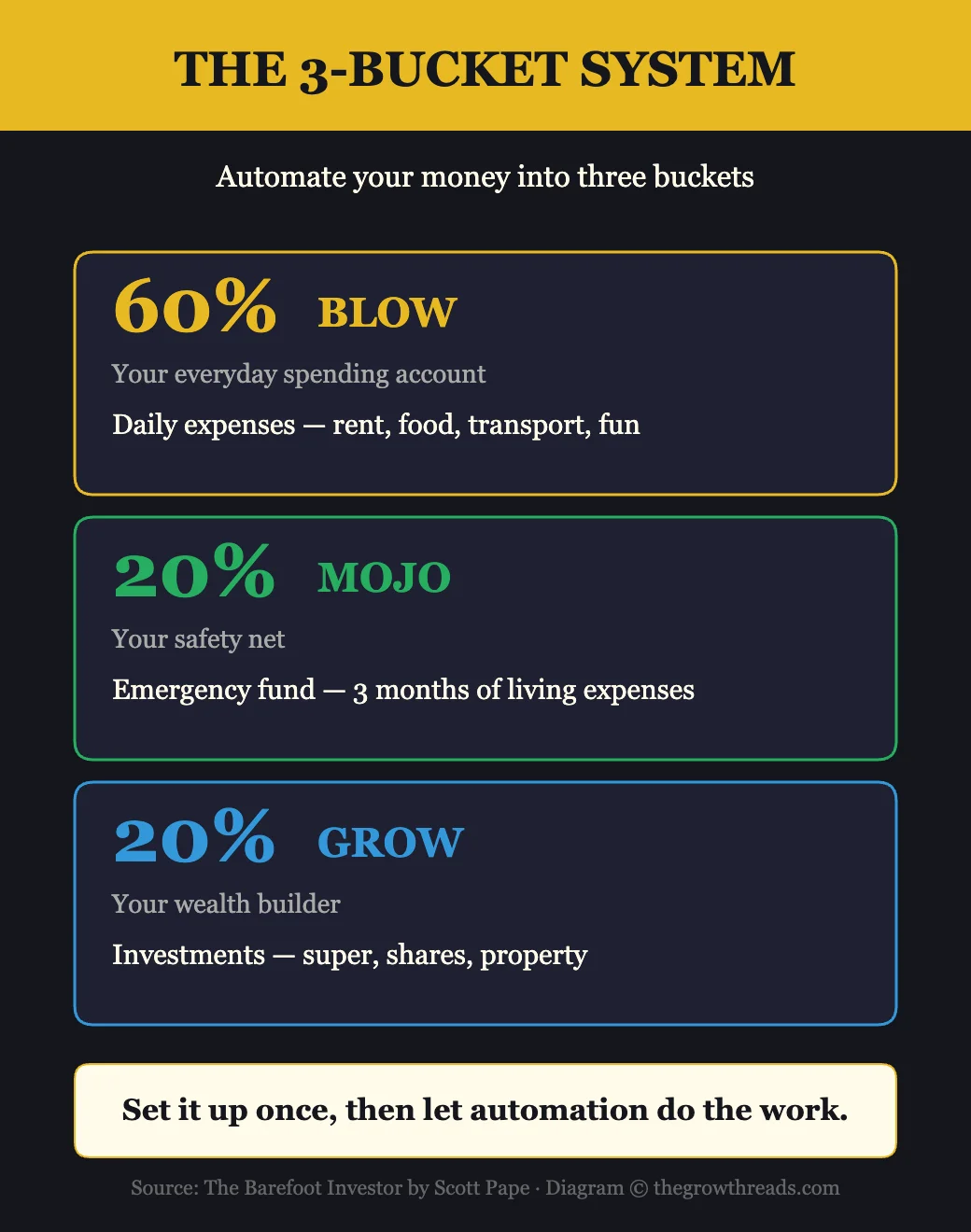
- Three buckets, not a budget: split your income into Blow (60% daily expenses), Mojo (20% emergency fund), and Grow (20% investments). Automate the split so you never think about it.
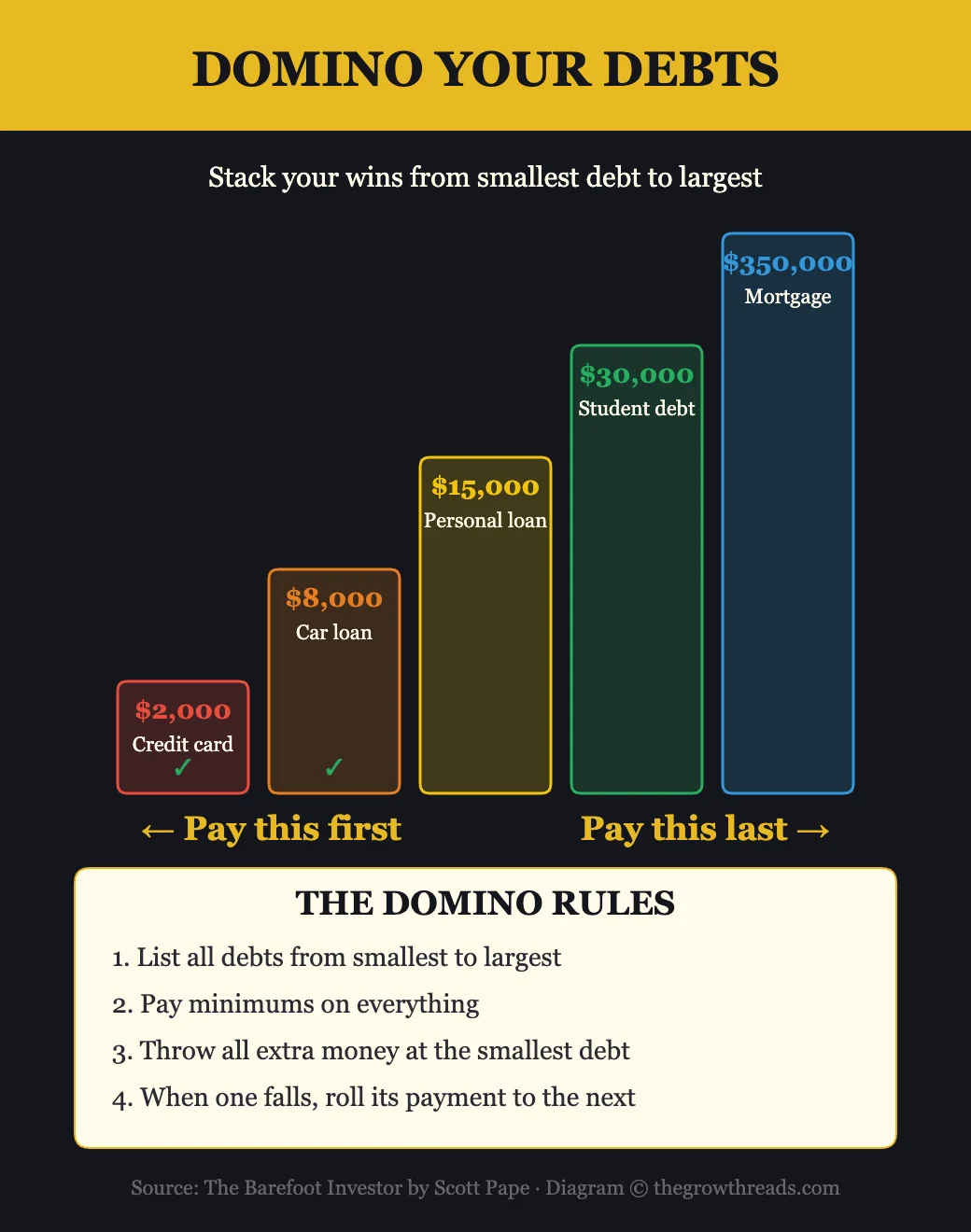
- Domino your debts: list all debts from smallest to largest, pay minimums on everything, then throw every extra dollar at the smallest. When it falls, roll its payment into the next.
- Schedule a weekly money date night: whether you are single or in a relationship, a regular conversation about money turns financial management from crisis-driven to habitual.
- Your super (retirement) is your most powerful investment tool: increasing contributions by even a few percent compounds dramatically over a career.
- Index funds beat stock-pickers over time: Pape recommends low-cost index funds over actively managed funds, citing decades of data showing most fund managers underperform the market.
- Get the Big Four insurances: income protection, total and permanent disability, life insurance, and health insurance. These are not optional — they protect everything else.
- Your home is not an investment — it is a home: buy when you can afford a 20% deposit, choose a fixed-rate mortgage you could service on one income, and pay it off aggressively.
- Negotiate your salary and fees ruthlessly: a single phone call to reduce bank fees or insurance premiums can save thousands over a lifetime.
- Build Mojo first: three months of living expenses in a separate account means you never have to panic — it buys you the confidence to make better decisions.
- Start now, not perfectly: the system does not require perfection. Set up the buckets, automate what you can, and improve over time.
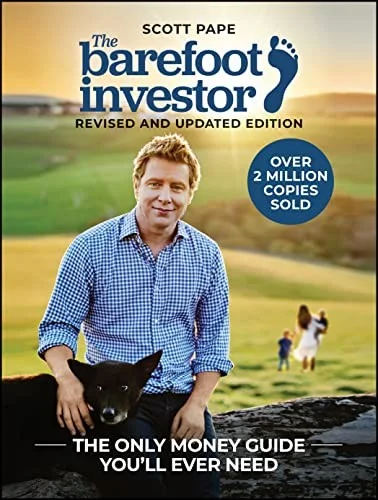
What is The Barefoot Investor about?
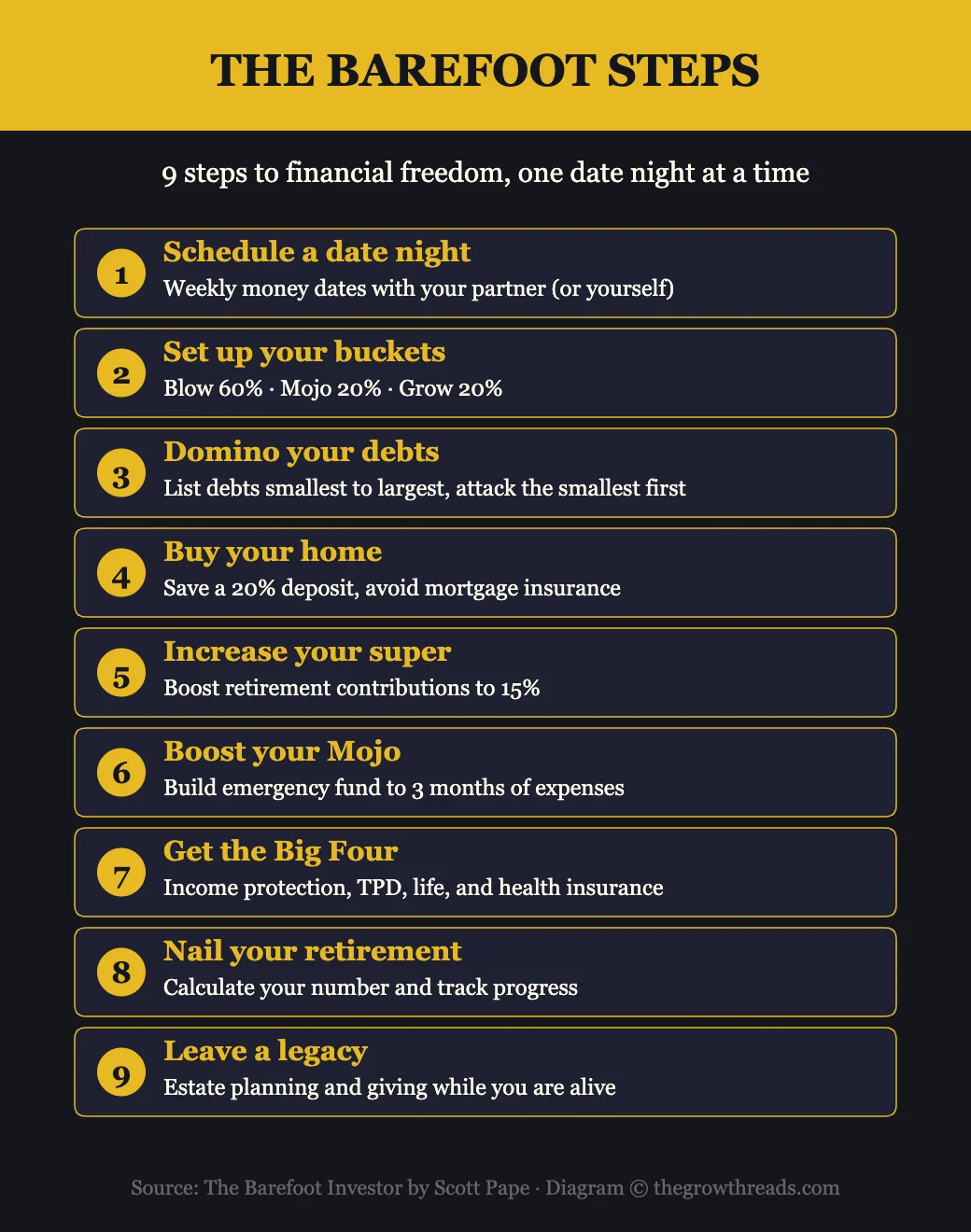
The Barefoot Investor is a step-by-step personal finance plan that covers the full spectrum of money management: setting up a simple banking structure, eliminating debt, building an emergency fund, investing for retirement, buying a home, protecting your family with insurance, and eventually building enough wealth to leave a legacy. The book organizes these steps into a series of “date nights” — regular sessions where you take one concrete action toward financial freedom.
About the author
Scott Pape grew up on a farm in rural Victoria, Australia, where his grandfather taught him about money, work, and independence. He became one of Australia’s most recognized personal finance commentators through his newspaper column and media appearances. In 2014, a bushfire destroyed his family’s property — including the farmhouse where he had learned those early lessons. He rebuilt from the ground up, and the experience deepened his commitment to practical, no-nonsense financial advice. The Barefoot Investor, first published in 2004 and substantially updated in 2017, has sold over two million copies in Australia alone, making it the country’s bestselling finance book in history. Pape donates a significant portion of the book’s proceeds to financial literacy programs for Indigenous Australians. Explore all Scott Pape book summaries →
Key concepts at a glance
| Concept | What it means | Use it when |
|---|---|---|
| Three buckets | Blow (60%), Mojo (20%), Grow (20%) — automate your income split | You want a system simpler than line-item budgeting |
| Barefoot date night | Weekly money conversation focused on one action step | You avoid talking about money or fight about it |
| Debt domino | Pay off debts smallest-first for psychological momentum | You have multiple debts and feel paralyzed |
| Mojo account | Emergency fund with 3 months of living expenses | You live paycheck to paycheck or fear unexpected costs |
| The serviette strategy | Entire retirement plan sketched on a napkin | You need a simple framework for long-term wealth |
| Insurance Big Four | Income protection, TPD, life, and health insurance | You have dependents or a mortgage |
| Index investing | Low-cost diversified funds that track the market | You want to invest but do not want to pick stocks |
| Donald Bradman principle | Negotiate everything — fees, rates, salary | You are paying full price for financial products |
Part 1 — Plant: Set up your financial foundation
Pape opens with the most disarming move in personal finance writing: he tells you to schedule a date night. Not with a spreadsheet — with a bottle of wine (or a coffee), a good meal, and a pen. The entire book is organized around these date nights, each focused on one actionable step. The first date night is about setting up your three buckets: separate bank accounts labeled Blow (daily expenses, 60%), Mojo (emergency fund, 20%), and Grow (investments, 20%). The idea is that budgets fail because they require constant willpower, but automation succeeds because it removes the decision.
The Blow account handles rent, groceries, transport, and fun money. No guilt, no tracking — if it is in the Blow account, you can spend it. The Mojo account is your emotional anchor: three months of living expenses sitting in a high-interest savings account that you never touch except in genuine emergencies. The Grow account feeds your investments. Pape is emphatic that the split does not need to be perfect — the act of automating any split is infinitely better than leaving money in one pool and hoping you will manage it wisely.
Part 2 — Grow: Destroy debt and build momentum
With the buckets in place, Pape turns to the emotional core of most people’s financial stress: debt. His approach — the debt domino — is deliberately psychological rather than mathematically optimal. Instead of paying off the highest-interest debt first (which saves more in interest but gives no early wins), you attack the smallest balance first. The reason is behavioral: paying off a $500 credit card in two months gives you a rush of accomplishment that paying down 3% of a $30,000 loan never will. Each small win builds confidence and momentum for the next.
He walks through the mechanics: list every debt with its balance and minimum payment. Pay the minimum on all of them. Then throw every spare dollar — from your Grow bucket, from selling things you do not need, from negotiated raises — at the smallest debt. When it is gone, take its entire payment and add it to the next smallest. The “domino” analogy is precise: each falling debt knocks over the next with increasing force.
Pape is particularly fierce about credit cards. He advises calling your bank, negotiating the interest rate down, and if they will not budge, doing a balance transfer to a zero-percent introductory offer. Then he tells you to take a pair of scissors and cut the card in half. Not freeze it in a block of ice, not hide it in a drawer — cut it. The physical act matters because it closes the psychological loop: the debt era is over.
Part 3 — Harvest: Invest and protect your wealth
Once debts are falling and Mojo is building, Pape introduces investing. His philosophy is simple and evidence-based: invest in low-cost index funds and hold them forever. He cites the SPIVA data showing that over any 15-year period, the vast majority of actively managed funds underperform their benchmark index — meaning you pay higher fees for worse returns. His recommendation is to start with a diversified, low-cost index fund and to increase your contributions over time.
The retirement chapter uses what he calls the “serviette strategy” — a retirement plan simple enough to sketch on a restaurant napkin. The formula: figure out how much you need per year in retirement, multiply by 25 (based on the 4% withdrawal rule), and that is your number. Then work backward: how much do you need to save each month to hit that number by your target age? Pape argues that most people drastically overestimate how much they need and underestimate how powerful compound interest is when given decades to work.
He devotes serious attention to insurance — what he calls the Big Four: income protection (replaces your salary if you cannot work), total and permanent disability, life insurance, and health insurance. Pape considers these non-negotiable for anyone with dependents or a mortgage. His argument is simple: without these protections, a single health crisis can undo years of financial progress. He provides specific advice on how to negotiate better rates and how to avoid being over-insured by commission-driven advisors.
Part 4 — Reap: Build your legacy
The final section addresses what happens after financial security is achieved: buying a home wisely, building long-term wealth, and eventually giving back. On property, Pape is refreshingly conservative: save a genuine 20% deposit so you avoid mortgage insurance, choose a loan you could service on one income even if you are a couple, and pay it off as aggressively as possible. He pushes back against the cultural obsession with real estate as an investment, arguing that a home’s primary value is emotional security and stability, not financial return.
The legacy chapter, which closes the book, is perhaps the most personal. Pape describes sitting with his grandfather in the very farmhouse that would later burn, learning that true wealth is not a number — it is the freedom to spend time on what matters and the ability to help others. He advises establishing a giving plan alongside your savings plan: a percentage of your income directed toward causes you care about, not as an afterthought when you are “rich enough” but as a structural part of your financial life from the start.
Who is The Barefoot Investor best for — and who should read something else first?
This book is ideal for anyone in their twenties or thirties building their first financial foundation, couples who fight about money or avoid the topic entirely, and anyone who has tried detailed budgeting and found it unsustainable. The strength of the plan is its simplicity — if you can set up three bank accounts, you can follow the Barefoot plan.
While written primarily for an Australian audience (specific account names, superannuation rules, and local references), the underlying principles are universal. International readers should substitute local equivalents for Australian-specific products. If you want a plan specifically designed for the American financial system, I Will Teach You to Be Rich by Ramit Sethi covers similar ground with US-specific advice. If your primary challenge is debt and you want maximum intensity, The Total Money Makeover by Dave Ramsey focuses entirely on debt elimination.
Questions to reflect on
- When was the last time you had a calm, productive conversation about money — either with your partner or with yourself? What would a weekly date night look like?
- If you listed all your debts from smallest to largest right now, which one could you eliminate within 90 days?
- Do you have three months of living expenses sitting in a separate, untouchable account? If not, what would change in your stress levels if you did?
- Are you paying active management fees on any investment that has underperformed its benchmark index? What would switching to an index fund save you over 20 years?
- What does financial freedom actually look like for you — not a number, but a daily life? How close are you?
🔥 Ready to set up your financial plan in one weekend?
Get Scott Pape’s simple, proven system that has helped millions take control of their money.
How to apply The Barefoot Investor (7-day plan)
- Day 1 — Schedule your first date night. Block 90 minutes this week — with your partner or alone. Choose a restaurant, pour a drink, or just clear the kitchen table. This is your money meeting.
- Day 2 — Set up three accounts. Open (or rename) three bank accounts: Blow, Mojo, and Grow. Set up automatic transfers from your pay so 60% goes to Blow, 20% to Mojo, and 20% to Grow.
- Day 3 — List your debts. Write down every debt you have: credit cards, personal loans, car loans, student loans, and the balance on each. Order them from smallest to largest.
- Day 4 — Make the domino call. Call each credit card company and ask for a lower interest rate. If they refuse, research balance transfer options. Then set all debts to minimum payments except the smallest — throw everything extra at that one.
- Day 5 — Negotiate one fee. Call your bank, your insurer, or your phone provider and negotiate a lower rate. Keep a tally of what you save — this is found money for your domino.
- Day 6 — Check your super/retirement. Log in to your retirement account. Check the fees, confirm the investment option, and increase your contribution by 1%. Set a calendar reminder to increase again in six months.
- Day 7 — Plan your next date night. Review what you set up this week. Write down one thing to tackle next week (insurance audit, investment research, next debt target). The system works through repetition.
Frequently asked questions
What is The Barefoot Investor about in simple terms?
The Barefoot Investor is a step-by-step money plan that shows you how to set up a simple banking system (three buckets), eliminate debt, build an emergency fund, invest for retirement, buy a home, and protect your family with insurance. The book is organized around weekly “date nights” — short, focused sessions where you take one action step. It has sold over two million copies because the plan is simple enough to set up in a weekend and effective enough to build real wealth over time.
What is the 3-bucket system in The Barefoot Investor?
The 3-bucket system splits your income into three separate bank accounts: Blow (60% for daily expenses like rent, food, and fun), Mojo (20% for your emergency fund — three months of living expenses), and Grow (20% for investments and retirement). You automate the split so money flows into each bucket on payday without any manual effort. The power of the system is its simplicity — you do not need to track individual expenses or stick to a detailed budget. If the money is in your Blow account, you can spend it guilt-free.
Does The Barefoot Investor work outside Australia?
The core principles — automation, debt elimination, emergency funds, index investing — are universal and work in any country. The specific product recommendations (Australian bank accounts, superannuation rules, local insurance providers) are Australia-specific, so international readers will need to substitute local equivalents. For American readers, I Will Teach You to Be Rich by Ramit Sethi offers a similar approach with US-specific account types and investment vehicles. The underlying financial logic is identical across borders.
What is the debt domino method?
The debt domino (also called the debt snowball) works like this: list all your debts from smallest balance to largest. Pay the minimum on everything except the smallest debt — throw every extra dollar at that one. When it is paid off, take its entire payment and add it to the minimum payment on the next smallest debt. Each paid-off debt creates a larger payment for the next, building momentum like falling dominoes. The method is designed for psychological wins rather than mathematical optimization — early victories keep you motivated.
Is The Barefoot Investor worth reading in 2026?
Absolutely. While some specific product recommendations may have changed since the 2017 update, the financial principles are timeless: spend less than you earn, automate your savings, eliminate high-interest debt, invest in diversified low-cost funds, and protect your income with insurance. The book’s greatest strength — its simplicity — only becomes more valuable as the financial products landscape grows more complex. Over two million copies have been sold primarily through word-of-mouth recommendation, which is the strongest endorsement any finance book can receive.
What are the Barefoot date nights?
Barefoot date nights are weekly sessions — ideally with your partner, but solo works too — where you focus on one financial action step. Each chapter of the book corresponds to a date night with a specific agenda: setting up accounts, listing debts, negotiating fees, reviewing insurance, checking investments. The date night format works because it transforms financial planning from a dreaded annual event into a regular, low-pressure habit. Pape recommends pairing it with a nice meal to make it something you look forward to rather than avoid.
How much emergency fund does The Barefoot Investor recommend?
Pape recommends building your Mojo account to three months of living expenses. This is your financial safety net — money that sits in a high-interest savings account and is never touched except in genuine emergencies (job loss, medical crisis, major unexpected repair). The psychological benefit of having Mojo is as important as the financial benefit: knowing you have three months of runway eliminates the panic that drives bad financial decisions. Pape suggests building Mojo before aggressive investing — security first, growth second.
Related summaries
- I Will Teach You to Be Rich by Ramit Sethi — the American equivalent with US-specific automation advice.
- The Total Money Makeover by Dave Ramsey — maximum-intensity debt elimination for the deeply committed.
- The Little Book of Common Sense Investing by John Bogle — the deep evidence behind index investing.
- Best Money Books — our complete guide to the top personal finance reads.