

⭐⭐⭐⭐ 4.2/5 — A deceptively simple metacognition tool that interrupts hesitation at the neurological level — one countdown at a time.
Best for: Chronic procrastinators, overthinkers, and anyone who knows what they should do but struggles to make themselves actually do it.
Reading time: ~5 hours (248 pages)
Difficulty to apply: Very Low — the rule itself takes 5 seconds. Building the habit of using it consistently takes 2–3 weeks.
The 5 Second Rule in one minute
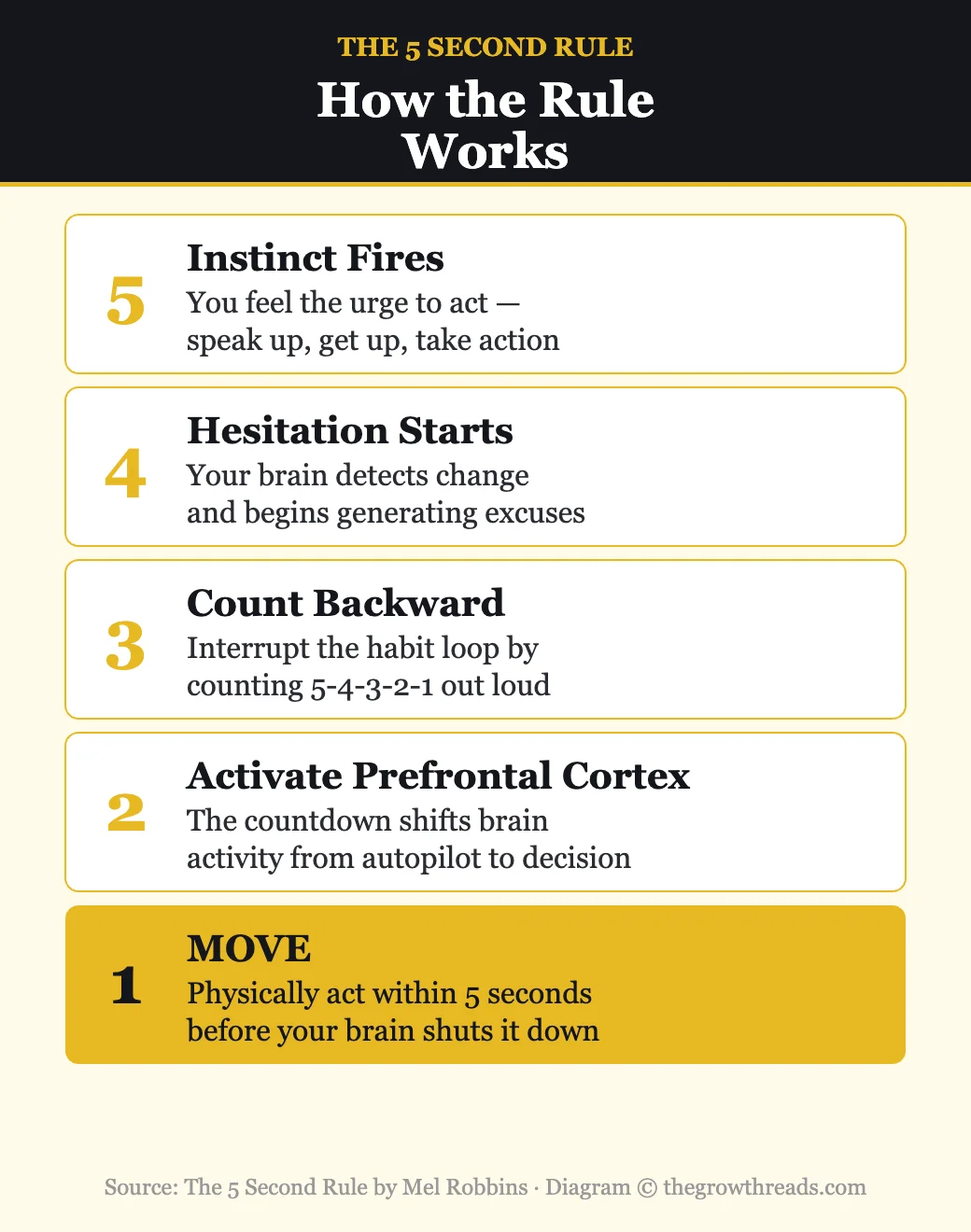
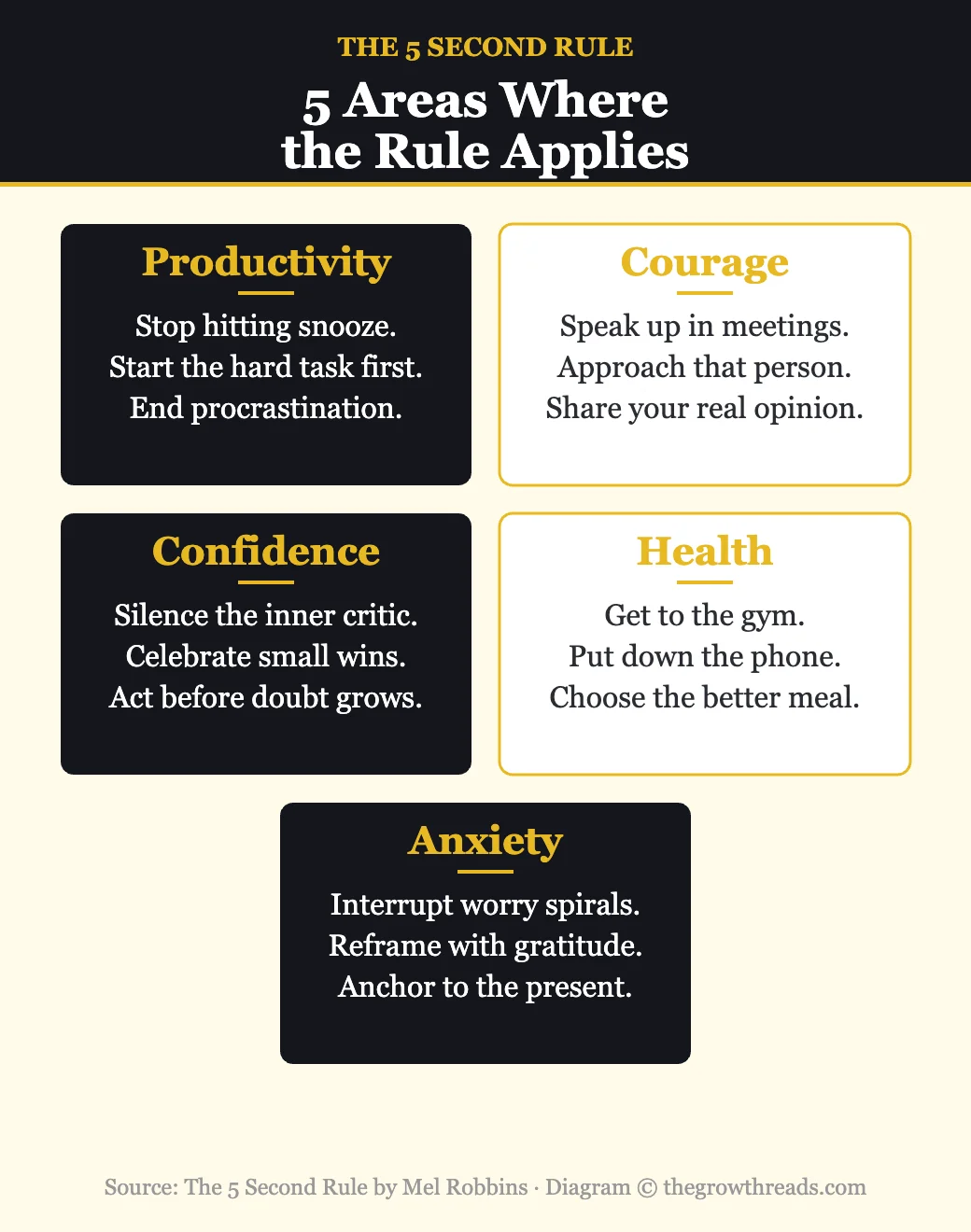
The moment you have an instinct to act on a goal, count 5-4-3-2-1 and physically move before your brain talks you out of it. That is the entire rule — and Mel Robbins argues it is the single most effective tool she has ever discovered for closing the gap between knowing what to do and actually doing it. The countdown works because it interrupts the brain’s default hesitation patterns, activates the prefrontal cortex (the decision-making part of the brain), and creates a “starting ritual” that overrides the habit loop before fear, self-doubt, or laziness can take over. Robbins discovered the rule during the lowest point in her life — unemployed, financially ruined, and unable to get out of bed — and used it to rebuild everything. The book combines neuroscience, behavioral psychology, and hundreds of reader case studies to show how the rule applies to productivity, courage, confidence, health, and managing anxiety.
Key takeaways
- You will never feel like doing hard things: Motivation is not a feeling that precedes action — it is a result of action. Waiting until you feel ready guarantees you will never start.
- Hesitation is the killer: When you hesitate, your brain interprets the pause as danger and activates protection mechanisms — excuses, rationalization, avoidance. The window for action is about 5 seconds.
- The countdown is a starting ritual: Counting 5-4-3-2-1 serves as a “launch sequence” that creates a clean break between thinking and acting, much like a rocket countdown creates a defined ignition point.
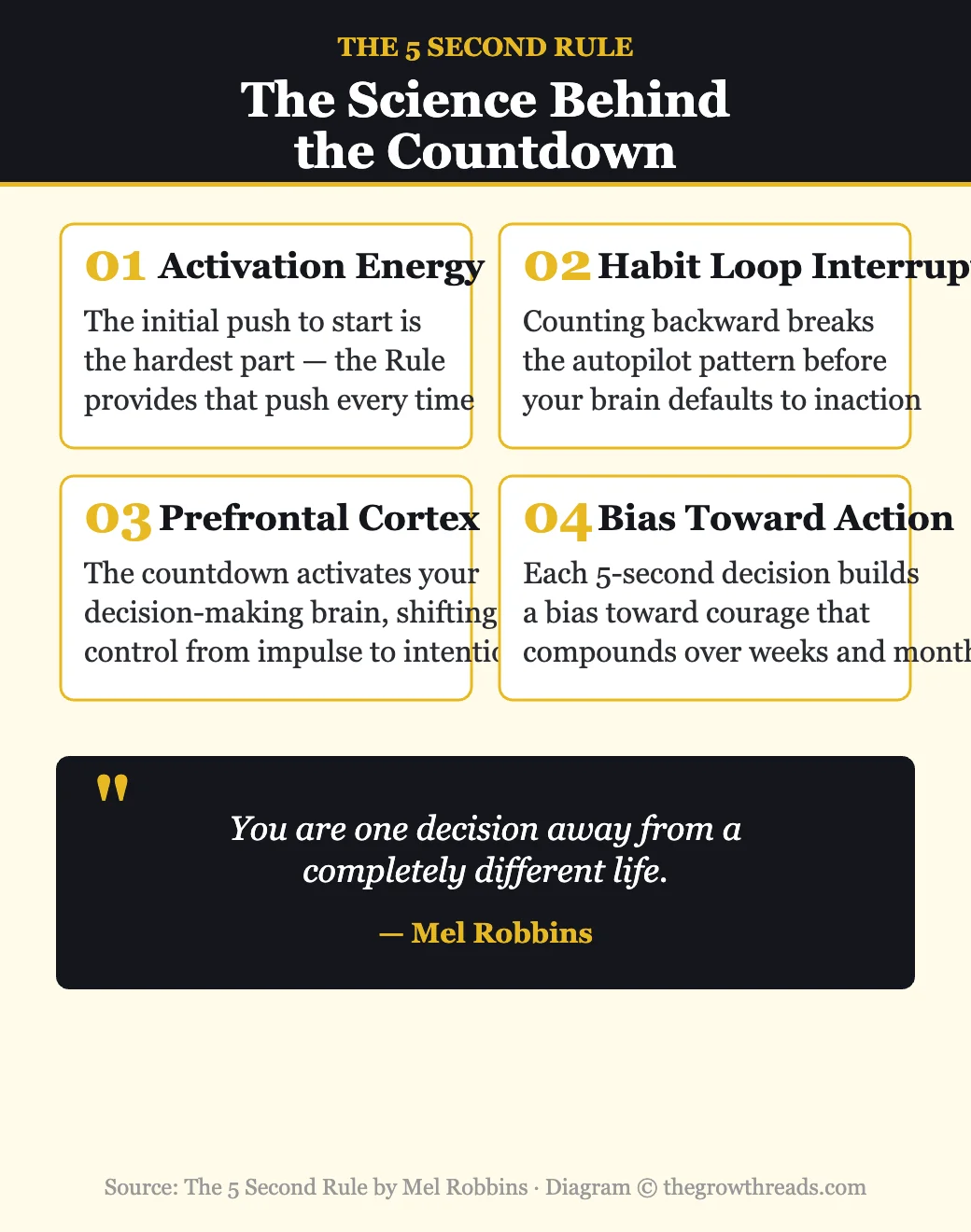
- It works because of activation energy: The hardest part of any task is starting. The Rule provides just enough push to overcome initial inertia — once you are in motion, continuing is much easier.
- The countdown activates the prefrontal cortex: Counting backward requires focus, which shifts brain activity from the basal ganglia (autopilot/habit) to the prefrontal cortex (deliberate decision-making).
- Courage is a daily practice, not a personality trait: Every time you use the Rule, you build a “bias toward action” that compounds over time. Courage is not fearlessness — it is acting despite fear.
- The rule works for anxiety too: When worry spirals begin, counting 5-4-3-2-1 and immediately redirecting attention to something productive interrupts the anxiety loop before it escalates.
- Small decisions shape your identity: Every 5-second decision — getting out of bed when the alarm goes off, raising your hand in a meeting, choosing the healthier meal — is a vote for the person you want to become.
- Feelings are not facts: The emotions telling you to stay comfortable, avoid risk, and procrastinate are survival mechanisms, not wisdom. The Rule teaches you to act on decisions rather than feelings.
- The rule replaces complex systems with one habit: Instead of needing 15 different productivity tools, you need one metacognitive pattern: notice the instinct, count backward, move.

What is The 5 Second Rule about?
The 5 Second Rule teaches a metacognitive technique for overcoming hesitation: when you feel the instinct to act on a goal, count 5-4-3-2-1 and physically move before your brain generates excuses. Robbins explains the neuroscience behind why hesitation kills motivation and shows how the countdown applies to productivity, courage, confidence, health, and anxiety management.
About the author
Mel Robbins is an American motivational speaker, television host, author, and former criminal defense attorney. After graduating from Dartmouth College and Boston College Law School, she practiced law before pivoting to media and personal development. Her 2011 TEDx talk “How to Stop Screwing Yourself Over” became one of the most-watched TEDx talks of all time, with over 30 million views. The 5 Second Rule, published in 2017, became a global bestseller translated into 36 languages. She has since hosted “The Mel Robbins Show” on CBS and built one of the largest personal development audiences across social media, with her content reaching hundreds of millions of people. Her later books include The High 5 Habit and The Let Them Theory. Explore all Mel Robbins book summaries →
Key concepts at a glance
| Concept | What it means | Use it when |
|---|---|---|
| The 5 Second Rule | Count 5-4-3-2-1, then physically move toward your goal | You know what to do but cannot make yourself start |
| Activation energy | The initial push required to begin any action | The hardest part is getting started, not continuing |
| Habit loop interrupt | Counting backward breaks autopilot patterns | You keep defaulting to old behaviors despite good intentions |
| Prefrontal cortex activation | The countdown shifts control from autopilot to decision-making | You want to act deliberately instead of reacting habitually |
| Bias toward action | Each courageous decision builds momentum for the next | You want to build confidence through accumulated small wins |
| Anchor thoughts | Replacing anxious spirals with constructive focus | Worry is escalating and you need to redirect your attention |
| Everyday courage | Courage is not heroic moments but daily 5-second decisions | You think courage means fearlessness and feel like a coward |
| Locus of control | The Rule shifts power from external circumstances to internal choices | You feel like life is happening to you rather than being shaped by you |
Part 1: The rule and the moment of hesitation
Robbins opens with her own rock-bottom story. In 2009, she was unemployed, her husband’s restaurant business had failed, they were facing foreclosure, and she was struggling with depression and alcohol. Every morning, the alarm would go off and she would hit snooze — sometimes for over an hour. She knew she needed to get up, apply for jobs, and take care of her family. She knew exactly what to do. But she could not make herself do it.
One night, watching a rocket launch on television, she had the idea that changed everything. She decided that the next morning, when the alarm went off, she would count down 5-4-3-2-1 and launch herself out of bed like a rocket — before her brain could generate excuses. It worked. And she began applying the same technique to every area of her life where she was stuck.
The 5 Second Rule is deceptively simple: the moment you have an instinct to act on a goal, count 5-4-3-2-1 and physically move. If you do not move within 5 seconds, your brain will kill the impulse. It will generate reasons to stay safe, stay comfortable, and stay exactly where you are. The window between impulse and excuse is about 5 seconds — after that, you have lost the moment.
Robbins emphasizes that the Rule is not about motivation. Motivation is unreliable — it comes and goes based on mood, energy, and circumstances. The Rule is about activation energy: providing just enough force to overcome initial inertia and get yourself into motion. Once you are moving, momentum takes over and continuing is far easier than starting.
Part 2: The neuroscience — why the countdown works
Robbins dedicates a substantial portion of the book to explaining the brain science behind the Rule. The explanation centers on two brain systems: the basal ganglia, which runs habitual, automatic behavior, and the prefrontal cortex, which handles deliberate, conscious decision-making.
Most of what you do all day is controlled by the basal ganglia — routines, habits, patterns you have repeated thousands of times. This system operates on autopilot. When your alarm goes off, your basal ganglia knows the pattern: hit snooze. When you sit down to work, your basal ganglia knows the pattern: check email first. These patterns are efficient but they are also the source of procrastination, avoidance, and self-defeating behavior.
Counting backward — 5-4-3-2-1 — is cognitively demanding enough to interrupt the basal ganglia’s autopilot. It forces the prefrontal cortex online, shifting control from the habit system to the decision system. In that brief window of prefrontal engagement, you have the cognitive resources to make a deliberate choice rather than default to a comfortable pattern.
Robbins also draws on research about the spotlight effect (our tendency to overestimate how much others notice our actions), anxiety reappraisal (reframing nervousness as excitement), and cognitive behavioral therapy principles (the idea that changing behavior can change feelings, not just the reverse). The countdown functions as a form of metacognition — thinking about your thinking — that gives you a split-second of agency over processes that normally happen automatically.
Part 3: Applications — courage, confidence, and anxiety
The second half of the book expands the Rule beyond productivity into three areas where Robbins argues it is even more powerful: everyday courage, building confidence, and managing anxiety.
Everyday courage is Robbins’s term for the small acts of bravery that most people avoid — speaking up in a meeting, approaching someone you want to meet, sharing an honest opinion, pitching a creative idea, having a difficult conversation. She argues that courage is not a personality trait that some people have and others lack. It is a skill that you build through repeated 5-second decisions. Every time you count 5-4-3-2-1 and act despite discomfort, you deposit into what she calls your “courage bank account.” Over time, these deposits compound, and what once felt terrifying becomes routine.
Confidence, Robbins argues, does not precede action — it follows it. You do not wait until you feel confident to act; you act and then confidence develops as evidence accumulates that you can handle uncomfortable situations. The 5 Second Rule is the mechanism for generating this evidence: each time you override hesitation and take action, you prove to yourself that you are the kind of person who moves toward discomfort rather than away from it. This is an identity-level shift, not just a behavioral one.
Anxiety management is perhaps the most nuanced application. Robbins draws on her own experience with severe anxiety to explain how the Rule can interrupt worry spirals. When anxious thoughts begin escalating — “What if the presentation goes badly? What if they think I’m incompetent? What if I lose my job?” — counting 5-4-3-2-1 and immediately redirecting attention to something concrete and productive breaks the cycle before it reaches full intensity. She combines this with “anchor thoughts” — pre-prepared positive or constructive mental images that you redirect attention toward after the countdown.
Who is The 5 Second Rule best for — and who should read something else first?
This book is ideal for people who already know what they need to do but struggle to make themselves do it. If procrastination, overthinking, or self-doubt is your primary obstacle — not lack of knowledge or strategy — the 5 Second Rule offers a remarkably effective intervention. It is also valuable for anyone dealing with anxiety who wants a practical, in-the-moment technique for interrupting worry patterns.
If your problem is not hesitation but rather not knowing what to focus on, start with Essentialism or The ONE Thing first. If you want a comprehensive habit-building system rather than a single activation tool, Atomic Habits or Tiny Habits are stronger starting points. The 5 Second Rule works best as a complement to these strategic frameworks — it provides the ignition that their structures require.
Questions to reflect on
- What is the one thing you have been putting off that you already know you should do? What would happen if you counted 5-4-3-2-1 and started it right now?
- How many times today did you feel an instinct to act — speak up, take initiative, make a call — and let the moment pass? What excuses did your brain generate?
- Do you tend to wait for motivation before acting? How has that strategy worked out for you over the past year?
- Which area — productivity, courage, confidence, health, or anxiety — would benefit most from adding the 5 Second Rule to your daily toolkit?
- What identity would you be building if you used the Rule 10 times a day for the next month? What kind of person makes 300 courageous micro-decisions in 30 days?
🔥 Ready to stop overthinking and start moving?
Robbins’s deceptively simple countdown could be the only productivity tool you actually need.
How to apply The 5 Second Rule (7-day plan)
- Day 1 — Use it to get out of bed: Tonight, set your alarm 30 minutes earlier than usual. Tomorrow morning, the instant it rings, count 5-4-3-2-1 out loud and physically stand up. Do not negotiate with yourself. This is your proof of concept.
- Day 2 — Use it at work: Apply the Rule to one work task you have been avoiding. The moment it crosses your mind, count 5-4-3-2-1 and open the document, send the email, or make the call. You do not have to finish — just start.
- Day 3 — Use it for courage: Find one moment today where you would normally stay quiet — a meeting, a conversation, a social situation — and count 5-4-3-2-1 and speak up. Say what you actually think, not what feels safe.
- Day 4 — Use it for health: Apply the Rule to one health decision: count 5-4-3-2-1 and go for a walk instead of scrolling, choose water over soda, or put your phone down 30 minutes before bed.
- Day 5 — Use it for anxiety: The next time you notice a worry spiral starting, count 5-4-3-2-1 and immediately redirect your attention to three things you are grateful for or one productive action you can take in the next 60 seconds.
- Day 6 — Stack the Rule on existing habits: Identify your three biggest daily hesitation points (they are consistent — same situations every day). Pre-commit to using the Rule in those exact moments tomorrow.
- Day 7 — Reflect and compound: Write down every instance this week where you used the Rule and what happened. Count your courage deposits. Notice the pattern: you survived every one of them. Plan next week with the Rule as your default response to hesitation.
Frequently asked questions
What is the 5 Second Rule?
The 5 Second Rule is a metacognitive technique: the moment you feel an instinct to act on a goal, you count 5-4-3-2-1 and physically move before your brain generates excuses. The countdown interrupts habitual hesitation patterns, activates the prefrontal cortex (the decision-making part of the brain), and creates a starting ritual that overrides procrastination, self-doubt, and avoidance. It was developed by Mel Robbins during a personal crisis and has since been used by millions of people worldwide to overcome procrastination, build confidence, and manage anxiety.
Why do you count backward instead of forward?
Counting backward (5-4-3-2-1) works better than counting forward (1-2-3-4-5) because forward counting has no definite endpoint — your brain can keep going (6, 7, 8…) and use the counting itself as another form of procrastination. Backward counting creates a clear launch point at “1” and requires more cognitive effort than forward counting, which engages the prefrontal cortex more effectively. The backward countdown also creates psychological momentum toward action — it feels like a launch sequence with a defined ignition point.
Does the 5 Second Rule actually work for anxiety?
Robbins presents evidence that the Rule can be effective for interrupting anxiety spirals — not as a replacement for professional treatment, but as an in-the-moment coping technique. When you notice anxious thoughts escalating, counting 5-4-3-2-1 and immediately redirecting attention to something concrete breaks the worry loop before it reaches full intensity. Robbins combines this with “anchor thoughts” — pre-prepared constructive images or gratitude lists that you redirect toward after the countdown. The technique draws on cognitive behavioral therapy principles of thought interruption and attention redirection.
Is The 5 Second Rule just about willpower?
No — and this is an important distinction. Willpower is a limited resource that depletes throughout the day. The 5 Second Rule is a metacognitive technique that does not rely on willpower at all. Instead, it works by interrupting the brain’s autopilot patterns before they can generate resistance. The countdown shifts neural activity from the basal ganglia (habitual, automatic behavior) to the prefrontal cortex (deliberate, conscious decision-making). It is more like a mental shortcut than a display of raw discipline — which is why it works even when you are tired, stressed, or low on willpower.
How is this different from Atomic Habits or Tiny Habits?
Atomic Habits (James Clear) and Tiny Habits (BJ Fogg) are comprehensive systems for designing and building habits over time. The 5 Second Rule is a single activation technique for overcoming hesitation in the moment. They solve different problems: habit-building systems help you figure out what to do and how to structure it; the 5 Second Rule helps you actually do it when the moment arrives. They are highly complementary — design your habits using Clear or Fogg’s frameworks, then use the 5 Second Rule as the launch mechanism when hesitation strikes.
Can the 5 Second Rule help with public speaking?
Yes, and Robbins addresses this directly. The Rule applies to the moment before you speak — counting 5-4-3-2-1 and raising your hand, standing up, or starting to talk before your brain can generate “what if I sound stupid” or “everyone will judge me” thoughts. For the anxiety that precedes a presentation, she recommends combining the Rule with anxiety reappraisal: count 5-4-3-2-1, then say “I am excited” rather than “I am nervous.” Research shows that reframing nervousness as excitement — both are physiologically similar arousal states — improves performance.
Is The 5 Second Rule worth reading or is it just a simple tip?
The core rule is genuinely simple — you can learn it in 30 seconds. The book’s value lies in the neuroscience explaining why it works, the extensive case studies showing how others have applied it, and the detailed chapters on applying the Rule to specific challenges (confidence, anxiety, motivation, health). If you just want the technique, the rule is: count 5-4-3-2-1, move. If you want to understand the brain science, see the evidence, and learn the nuances of applying it across different domains, the full book rewards reading.
Related summaries
- Atomic Habits Summary — Clear’s comprehensive system for building and breaking habits (pair with the 5 Second Rule for execution).
- Tiny Habits Summary — Fogg’s approach to making behavior change effortless by shrinking the first step.
- The Power of Habit Summary — Duhigg’s exploration of the habit loop that the 5 Second Rule is designed to interrupt.
- Eat That Frog Summary — Tracy’s method for tackling your most important task first (combine with the Rule for the hardest morning start).
📚 Explore more: This book is part of our Best Productivity Books collection — see the full ranked list for our top picks across focus, habits, time management, and performance.