

★★★★☆ 4.1/5 — A massive, experiment-driven manual for rapid body transformation using minimum effective doses of diet, exercise, and biohacking.
Best for: Self-experimenters, data-driven health optimizers, and anyone who wants dramatic physical results with the least time investment.
Reading time: ~9 hrs (guide: 20 min) — designed to be read selectively, not cover to cover.
Difficulty to apply: Low for the Slow-Carb Diet; moderate to high for advanced protocols.
The 4-Hour Body in one minute
What if you could lose 20 pounds in 30 days, double your strength in 8 weeks, and sleep better tonight — all by doing less, not more? Tim Ferriss applies his signature “minimum effective dose” philosophy to the human body, treating it as a machine that responds to precise inputs. The result is a 600-page reference manual covering rapid fat loss (the Slow-Carb Diet), muscle gain (Occam’s Protocol), sleep optimization, injury prevention, and performance enhancement — each chapter built on self-experiments, clinical data, and interviews with world-class athletes and scientists. The book is intentionally modular: read only the chapters that address your specific goal and ignore the rest.
Key takeaways
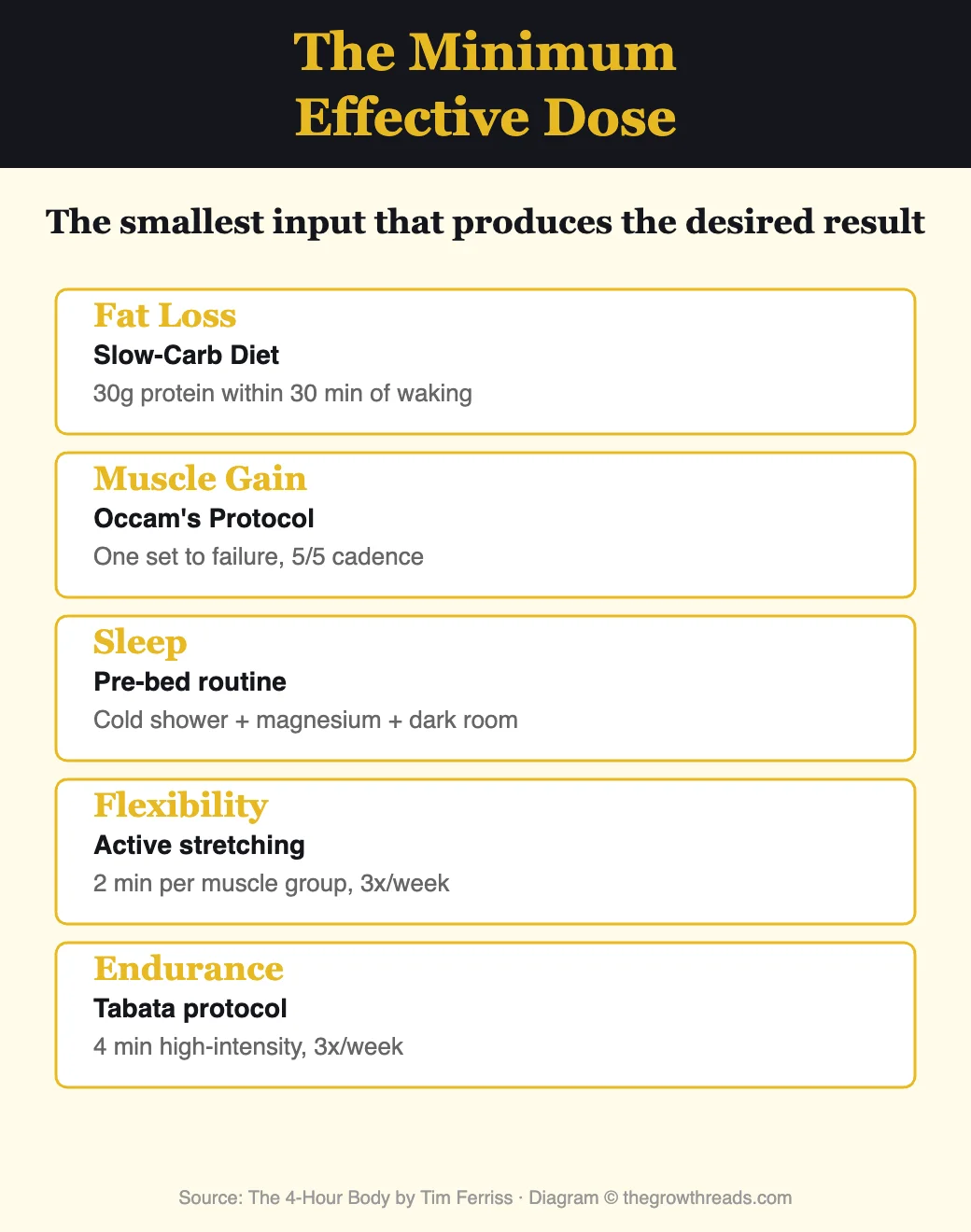
- Minimum effective dose wins: The smallest dose that produces the desired outcome is the MED. Anything beyond it is waste. Boiling water needs 100°C — more heat does not make it more boiled.
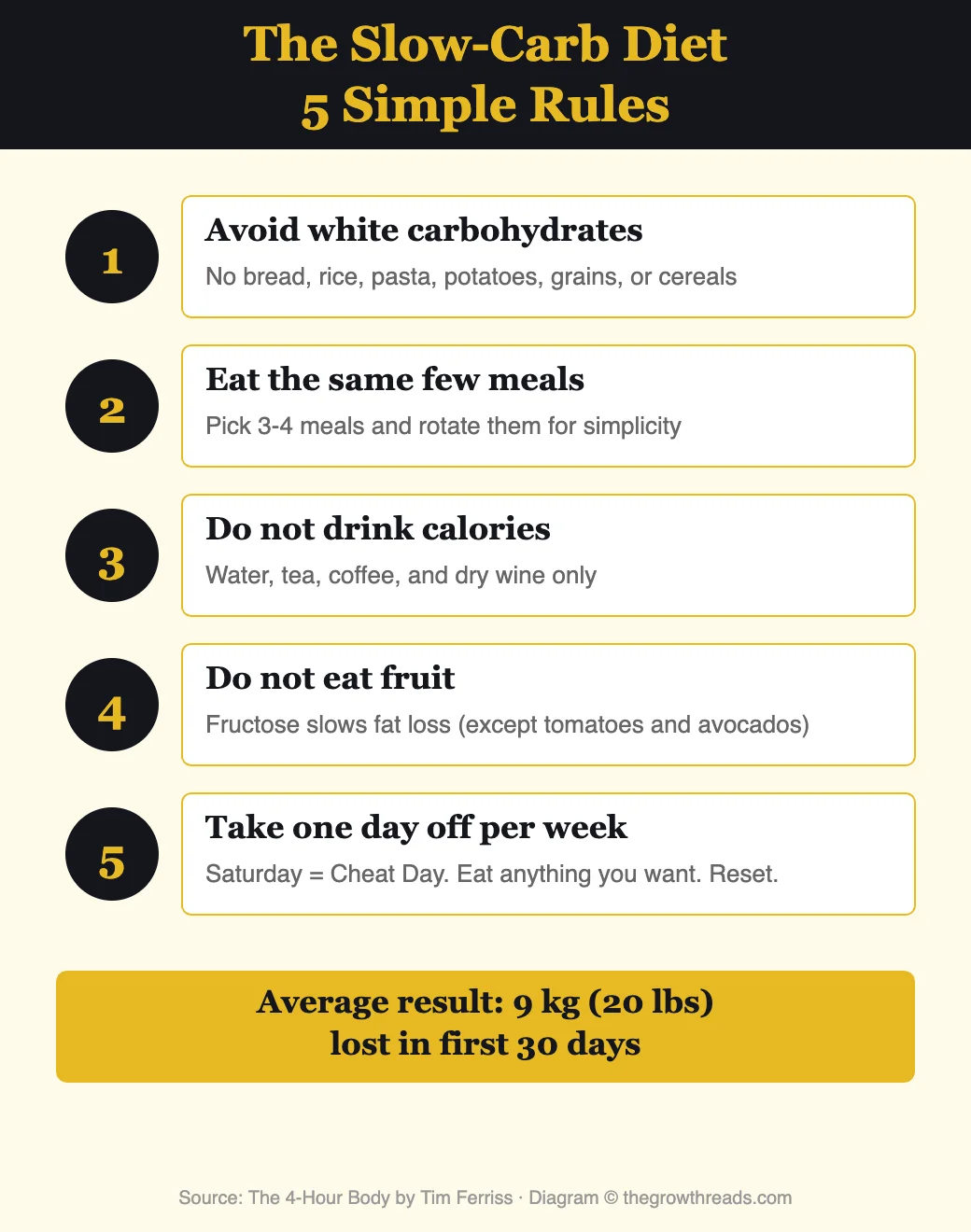
- The Slow-Carb Diet is radically simple: Five rules (no white carbs, same meals repeated, no liquid calories, no fruit, one cheat day per week) produce an average of 9 kg lost in 30 days.
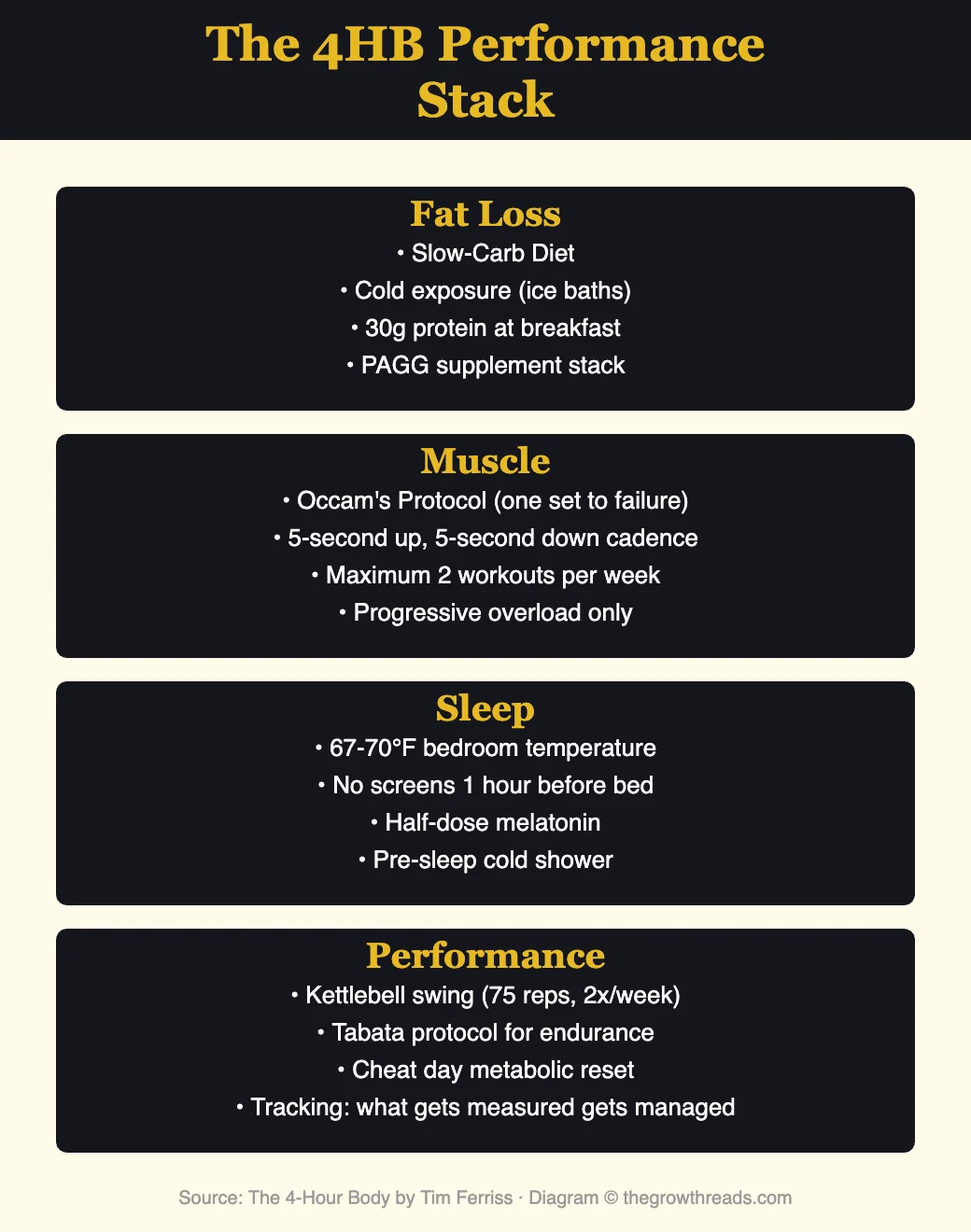
- 30 grams of protein within 30 minutes of waking: This single habit accelerates fat loss more than almost any other dietary change, by reducing morning cortisol and stabilizing blood sugar.
- Cold exposure accelerates fat loss: Cold showers, ice baths, and cold packs on the upper back and neck activate brown adipose tissue, which burns white fat for heat.
- Less exercise, more results: Occam’s Protocol builds muscle with just two 30-minute workouts per week — one set per exercise, performed to absolute failure with a 5-second concentric and 5-second eccentric cadence.
- Sleep is the force multiplier: Bedroom temperature (67-70°F), pre-sleep cold exposure, and light management produce deeper sleep than any supplement.
- Track everything: What gets measured gets managed. Body measurements, food logs, and sleep data reveal patterns that subjective feelings miss entirely.
- The cheat day is strategic: One day per week of unrestricted eating prevents metabolic slowdown, replenishes glycogen, and provides the psychological relief that makes the other six days sustainable.
What is The 4-Hour Body about?
The 4-Hour Body is a self-experimentation guide that applies the minimum effective dose principle to rapid fat loss, muscle gain, sleep optimization, and physical performance, providing protocols tested on the author and hundreds of volunteers with measurable, often dramatic, results.
About the author
Tim Ferriss is a bestselling author, podcast host, angel investor, and self-described “human guinea pig” best known for The 4-Hour Workweek, which spent seven years on the New York Times bestseller list. A Princeton graduate and former national Chinese kickboxing champion, Ferriss built his career on deconstructing world-class performance across domains. He has invested early in companies including Uber, Facebook, Twitter, and Shopify. His podcast, The Tim Ferriss Show, has surpassed one billion downloads. For The 4-Hour Body, Ferriss spent years testing protocols on himself — gaining 34 pounds of muscle in 28 days, dropping his body fat to single digits, and running 50-kilometer ultramarathons on minimal training — documenting every result with obsessive data collection. Explore all Tim Ferriss book summaries →
Key concepts at a glance
| Concept | What it means | Use it when |
|---|---|---|
| Minimum Effective Dose | The smallest input that produces the desired result | You want maximum results with minimum time |
| Slow-Carb Diet | Five-rule fat loss system with weekly cheat day | You want simple, sustainable fat loss |
| Occam’s Protocol | Minimal-volume strength training to failure | You want muscle gain in under 2 hrs/week |
| Cold Thermogenesis | Cold exposure to activate brown fat and boost metabolism | You want to accelerate fat loss |
| The Harajuku Moment | The emotional trigger that makes change non-negotiable | You need motivation to start |
| PAGG Stack | Supplement protocol for fat loss support | You want to optimize the Slow-Carb Diet |
| The 80/20 Analysis | 20% of inputs produce 80% of results | You want to identify the highest-leverage changes |
Part 1: Subtracting fat — the Slow-Carb Diet
The Slow-Carb Diet is arguably the most popular protocol in the book, and its appeal lies in its brutal simplicity. Five rules, no calorie counting, no portion control, no willpower battles. Rule one: avoid all white carbohydrates (bread, rice, pasta, potatoes, cereal, tortillas) — if it is white or could be white, skip it. Rule two: eat the same few meals over and over. Ferriss recommends picking three to four meals you enjoy and rotating them. This eliminates decision fatigue and simplifies grocery shopping.
Rule three: do not drink calories. Water, unsweetened tea, black coffee, and up to two glasses of dry red wine per day are permitted. No juice, no soda, no milk, no smoothies. Rule four: do not eat fruit. Ferriss argues that fructose, while natural, slows fat loss by replenishing liver glycogen and blunting the metabolic signal to burn stored fat. Tomatoes and avocados are exceptions because they are technically fruits with minimal fructose. Rule five — and the one that makes the diet psychologically sustainable — is the weekly cheat day. One day per week (Ferriss uses Saturday), eat whatever you want in whatever quantity you want. Pizza, ice cream, pasta, doughnuts — nothing is off limits.
Part 2: Adding muscle — Occam’s Protocol and minimum training
Ferriss’s approach to muscle building is radically minimalist. Occam’s Protocol requires just two workouts per week — one for upper body, one for lower body — with each exercise performed for a single set to absolute muscular failure. The tempo is controlled: five seconds lifting (concentric), five seconds lowering (eccentric). When you can complete more than the target rep range, you increase the weight by 10 pounds for upper body or 20 for lower body.
The protocol is based on Arthur Jones’s high-intensity training research and the work of Dr. Doug McGuff. The principle is that muscle growth is triggered by momentary muscular failure — the point where you physically cannot complete another rep with proper form — and that additional volume beyond this point is not just unnecessary but counterproductive because it extends recovery time without triggering additional growth stimulus.
Part 3: Sleep, recovery, and the performance stack
The sleep chapter is one of the most practically useful sections. Ferriss identifies bedroom temperature as the single most impactful variable — keeping the room at 67-70°F (19-21°C) dramatically improves deep sleep duration. He also recommends a pre-bed cold shower (which lowers core temperature), minimal light exposure in the hour before sleep, and avoiding alcohol within three hours of bedtime (alcohol fragments sleep architecture even if it helps you fall asleep faster).
The cold thermogenesis sections describe using cold exposure — ice baths, cold showers, and ice packs placed on the upper back and neck — to activate brown adipose tissue (BAT), a type of fat that burns white fat to generate heat. Ferriss reports significant increases in metabolic rate from as little as 20 minutes of cold exposure per session, and the protocol has since been validated by research on cold-activated thermogenesis.
Who is The 4-Hour Body best for — and who should read something else first?
The 4-Hour Body is ideal for data-driven people who love experimentation and want specific, measurable protocols they can test immediately. It is particularly strong for the Slow-Carb Diet (fat loss) and sleep optimization chapters. If you enjoy tracking numbers and running self-experiments, this book will feel like a playground.
If you want a more holistic, longevity-focused approach to health, Outlive by Peter Attia is more current and comprehensive. If your primary interest is nutrition science rather than body composition, How Not to Die provides deeper coverage of disease prevention through diet.
Questions to reflect on
- What is the one body-composition change that would make the biggest difference in how you feel daily?
- Which of Ferriss’s five Slow-Carb rules would be hardest for you to follow — and what does that resistance reveal about your eating habits?
- If you could only change one variable about your sleep environment tonight, what would produce the biggest improvement?
- What is your “Harajuku Moment” — the emotional trigger that makes body transformation feel non-negotiable rather than aspirational?
- How would you design a 30-day self-experiment to test one protocol from this book, including clear metrics and a tracking system?
🔥 Ready to hack your body with minimum effective doses?
Get the protocols that produce dramatic results with the least time investment.
How to apply The 4-Hour Body (7-day plan)
- Day 1: Take baseline measurements: weight, waist, hips, and one progress photo. Write down your primary goal (fat loss, muscle gain, or better sleep).
- Day 2: Start the Slow-Carb Diet. Eat 30g protein within 30 minutes of waking (3 eggs + beans works). No white carbs, no fruit, no liquid calories for the next 6 days.
- Day 3: Optimize your sleep environment: set bedroom to 67-70°F, remove all light sources, take a 30-second cold shower before bed.
- Day 4: Add cold exposure: end your morning shower with 30 seconds of cold water on your upper back and neck. Increase to 60 seconds by end of week.
- Day 5: Do one Occam’s Protocol workout: 3 exercises (machine chest press, machine row, machine overhead press), one set each to failure, 5-second up and 5-second down.
- Day 6: Track your food intake for the week. Are you hitting the 30g breakfast protein target? Are white carbs creeping in? Adjust based on data.
- Day 7 (Cheat Day): Eat whatever you want. Pizza, ice cream, doughnuts — go wild. This resets your metabolism and refills glycogen. Take measurements on Day 8 morning.
Frequently asked questions
Does the Slow-Carb Diet actually work?
For the majority of people who follow the five rules consistently, yes. Ferriss reports an average of 9 kg (20 lbs) of fat loss in the first 30 days across hundreds of test subjects. The results align with what low-carb and high-protein diets produce in clinical research. The cheat day, while counter-intuitive, prevents the metabolic adaptation that stalls many diets after the first few weeks. Individual results vary based on starting weight, adherence, and metabolic factors, but the protocol has one of the highest compliance rates of any diet because of its simplicity.
Why no fruit on the Slow-Carb Diet?
Ferriss argues that fructose (fruit sugar) is preferentially stored as liver glycogen and, in excess, converted to fat through de novo lipogenesis. While whole fruit is nutritionally valuable, the fructose content slows the specific metabolic state the Slow-Carb Diet is designed to maintain. Ferriss allows tomatoes and avocados (technically fruits with minimal fructose) and reintroduces all fruit on the weekly cheat day. This is one of the more controversial rules; some nutritionists disagree, noting that whole fruit fiber mitigates the fructose effect.
Is the cheat day really necessary?
Ferriss considers it essential for two reasons. Physiologically, a high-calorie day once per week prevents the metabolic slowdown (reduced thyroid output, decreased leptin) that accompanies sustained caloric restriction. Psychologically, knowing that any craving can be satisfied on Saturday makes the other six days dramatically easier to maintain. Most dieters who eliminate the cheat day report higher dropout rates within the first month. The key is confining it to one day, not letting it bleed into two or three.
Can I build real muscle with just two workouts per week?
Yes, if you train to genuine muscular failure with controlled tempo. Ferriss gained 34 pounds of lean muscle in 28 days using this protocol (an extreme case involving optimized nutrition and supplementation). For typical trainees, expect 5-10 pounds of muscle in the first 8-12 weeks. The science behind single-set-to-failure training is robust — research by Carpinelli, Otto, and Winett shows that single sets produce statistically equivalent strength gains to multiple sets in novice and intermediate trainees. Advanced athletes may need more volume, but most people are not advanced.
Is cold exposure safe?
For most healthy adults, brief cold exposure (cold showers, ice packs) is safe and well-documented in research. Ice baths require more caution — start with shorter durations (5-10 minutes) and work up gradually. People with cardiovascular conditions, Raynaud’s disease, or cold urticaria should consult a physician before starting any cold exposure protocol. Ferriss recommends starting with the mildest form (ending a warm shower with 30 seconds of cold water) and progressing only after establishing comfort at each level.
Do I need to read the entire 600-page book?
No — and Ferriss explicitly designs it to be read selectively. The book is structured as a reference manual with independent chapters. If your goal is fat loss, read the Slow-Carb Diet and cold thermogenesis chapters (~80 pages). If your goal is muscle, read Occam’s Protocol (~40 pages). If your goal is sleep, that chapter is ~30 pages. Ferriss estimates that most readers will only need 100-150 pages to get their specific results. Skip the chapters on subjects that do not interest you.
Is The 4-Hour Body still relevant in 2026?
The core protocols — Slow-Carb Diet, minimum effective dose training, sleep optimization — remain valid and well-supported by subsequent research. Cold thermogenesis has gained mainstream acceptance since the book’s publication, with researchers like Andrew Huberman popularizing cold exposure for metabolic and mental health benefits. Some supplementation recommendations have been updated by newer research, and the CGM (continuous glucose monitoring) revolution has provided better tools for tracking the metabolic effects Ferriss describes. The principles are timeless; the specific tools keep improving.
Related summaries
- Outlive Summary & Review — Peter Attia on the science of longevity and healthspan.
- Why We Sleep Summary & Review — Matthew Walker on the transformative power of sleep.
- Glucose Revolution Summary & Review — Jessie Inchauspe on managing blood sugar for energy and fat loss.
- Best Health Books — Our complete guide to the top books on physical and mental well-being.
How we analyze books: Every summary on The Growth Reads is built from a close reading of the full text, cross-referenced with the author’s published interviews, peer-reviewed research where applicable, and reader feedback from multiple platforms. We focus on extracting actionable frameworks rather than abstract theory. Read our full methodology.