

⭐⭐⭐⭐✬ 4.3/5
| Actionability: | ⭐⭐⭐⭐⭐ 5/5 |
| Writing Quality: | ⭐⭐⭐⭐ 4/5 |
| Research Depth: | ⭐⭐⭐⭐ 4/5 |
| Accessibility: | ⭐⭐⭐⭐⭐ 5/5 |
| Lasting Impact: | ⭐⭐⭐⭐ 4/5 |
The definitive playbook for Objectives and Key Results — the goal-setting system that powered Google from 40 employees to a global giant.
Best for: Founders, team leads, managers, and anyone who struggles to translate ambitious goals into measurable progress.
Reading time: ~7 hours (320 pages) | Difficulty to apply: Moderate — the framework is simple, but embedding it in team culture takes 2–3 quarterly cycles.
Measure What Matters in one minute
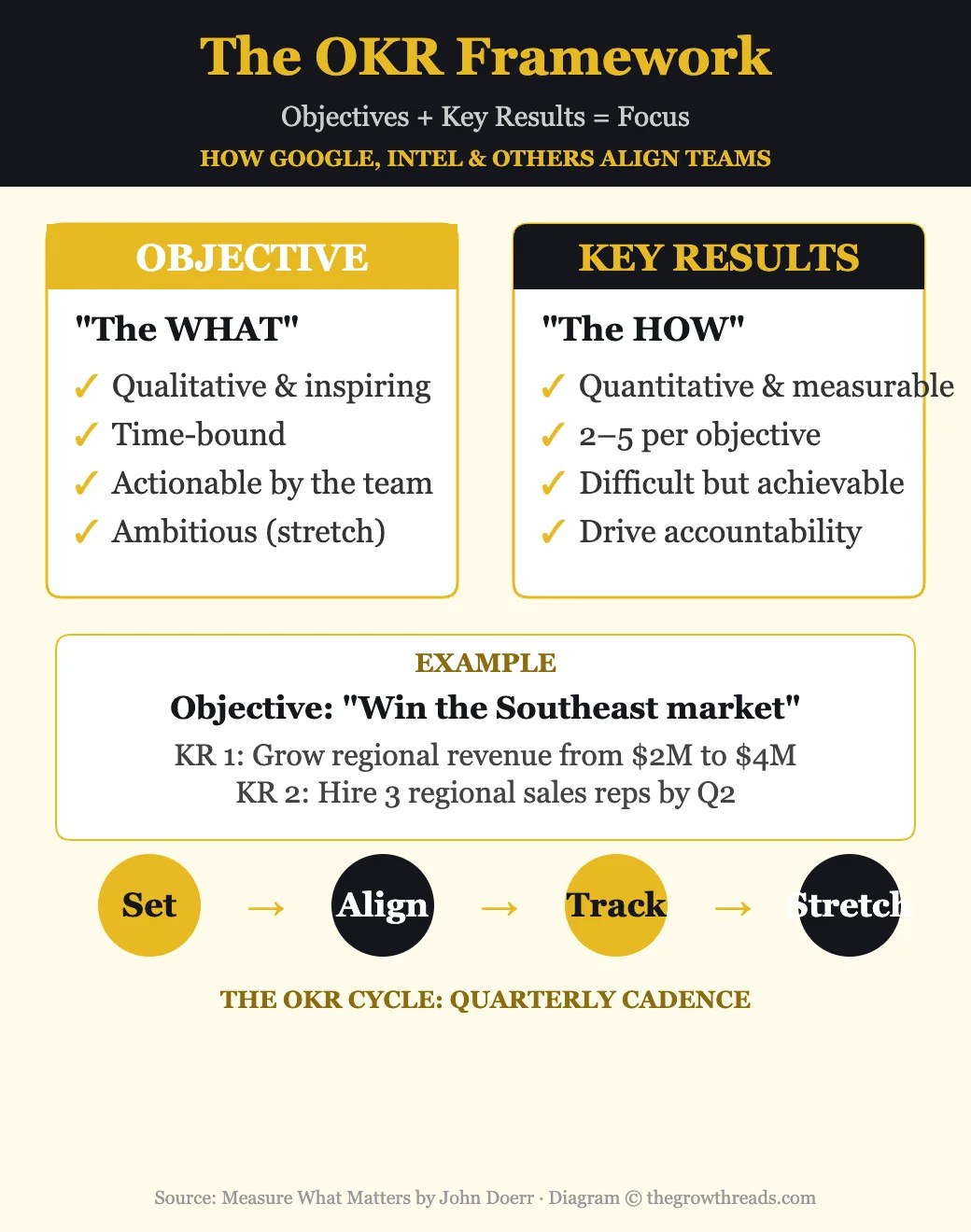
The companies that change the world are the ones that know exactly what they want and can prove they are getting there. John Doerr learned the OKR system from Andy Grove at Intel in the 1970s, then brought it to a fledgling Google in 1999 — where it helped two grad students in a garage scale into one of the most valuable companies on earth. An Objective is what you want to achieve: qualitative, inspiring, time-bound. Key Results are how you know you have achieved it: quantitative, specific, verifiable. Together, OKRs create radical transparency, relentless focus, and coordinated ambition across an entire organization. Doerr pairs this with CFRs — Conversations, Feedback, and Recognition — to build a culture where high performance is continuous, not annual. Through case studies spanning Google, the Gates Foundation, Bono’s ONE Campaign, and Intuit, the book proves that what you measure truly determines what you achieve.
Key takeaways
- OKRs provide structured ambition: Objectives define what you want to achieve (qualitative and inspiring); Key Results prove you got there (quantitative and measurable). Together they turn vague aspirations into trackable progress.
- Focus is the first superpower: choosing a small number of objectives forces you to say no to everything else — and saying no is where real strategy begins.
- Alignment connects the dots: when OKRs are transparent across the organization, every team and individual can see how their work connects to the company’s highest-priority goals.
- Tracking keeps you honest: regular check-ins (weekly or monthly) allow you to score progress, spot problems early, and course-correct before the quarter ends.
- Stretch goals unlock potential: setting targets at 60–70% probability of success — “moonshots” — forces creative problem-solving and prevents teams from sandbagging safe targets.
- CFRs replace annual reviews: Conversations, Feedback, and Recognition provide continuous performance management that keeps people growing, not just evaluated.
- Separate OKRs from compensation: when OKRs drive bonuses, people set easy goals. Decouple them so teams pursue ambitious objectives without fear of punishment.
- Bottom-up and top-down: roughly half of OKRs should originate from individual contributors and teams, not just leadership — this builds ownership and surfaces ground-level insights.
- Less is more: three to five objectives per cycle, with two to five key results each, is the sweet spot. More than that dilutes focus and creates noise.
- Culture eats OKRs for breakfast: the system only works in organizations that value transparency, accountability, and psychological safety — it is a cultural commitment, not just a management tool.
What is Measure What Matters about?
Measure What Matters is a management book by venture capitalist John Doerr that introduces and evangelizes Objectives and Key Results (OKRs), a goal-setting framework originally developed by Andy Grove at Intel. Through first-person case studies from Google, the Gates Foundation, Intuit, and more, Doerr shows how OKRs create focus, alignment, tracking, and stretch across organizations of any size.
About the author
John Doerr is an engineer, venture capitalist, and chairman of Kleiner Perkins, one of Silicon Valley’s most storied investment firms. He was an early backer and board member at both Google and Amazon, helping create more than half a million jobs and two of the world’s most valuable companies. Doerr first encountered OKRs as a young engineer at Intel under Andy Grove’s leadership in the 1970s. He went on to introduce the system to more than fifty portfolio companies. Beyond technology, he serves on the board of the Obama Foundation and ONE.org, applying the same goal-setting discipline to social impact. Explore all John Doerr book summaries →
Key concepts at a glance
| Concept | What it means | Use it when |
|---|---|---|
| Objectives | Qualitative, inspiring goals that define what you want to achieve | Setting quarterly or annual direction |
| Key Results | Measurable outcomes (2–5 per objective) that prove you reached the objective | Translating vision into numbers |
| Committed OKRs | Must-hit targets (100% expected completion) tied to core operations | Business-critical deliverables |
| Aspirational OKRs | Stretch “moonshot” goals (60–70% expected completion) | Driving innovation and bold thinking |
| CFRs | Conversations, Feedback, Recognition — continuous performance management | Replacing or supplementing annual reviews |
| Alignment | Transparent cascading of OKRs so every level connects to company goals | Eliminating silos and duplicate work |
| Scoring | Rating each key result 0.0–1.0 at the end of a cycle | Evaluating progress honestly |
| Cadence | Quarterly cycles for short-term OKRs, annual for long-term | Balancing agility with strategic vision |
Part 1: Andy Grove and the birth of OKRs at Intel
The story begins at Intel in the 1970s, where CEO Andy Grove transformed Peter Drucker’s Management by Objectives (MBO) into something far more rigorous and dynamic. Grove’s innovation was pairing each objective with measurable key results and running them on quarterly cycles instead of annually. At Intel, this created a culture of relentless execution where everyone — from engineers to executives — knew exactly what they were working on and why it mattered.
Doerr arrived at Intel as a young engineer and witnessed Grove’s system firsthand. He describes a pivotal meeting where Grove explained the concept in its simplest form: the objective is the direction, the key results are the milestones that tell you whether you are getting there. Grove’s version stripped away the bureaucracy of traditional MBOs — no elaborate paperwork, no year-long review cycles, no cascading mandates that took months to trickle down. Instead, OKRs were lightweight, transparent, and fast-moving.
The key insight from Grove’s Intel was that execution matters more than strategy. Intel’s famous pivot from memory chips to microprocessors — one of the most consequential strategic decisions in business history — was powered by OKRs. The entire company realigned around a new objective in weeks rather than months, because the system made priorities visible and adjustable in real time.
Part 2: The four superpowers of OKRs
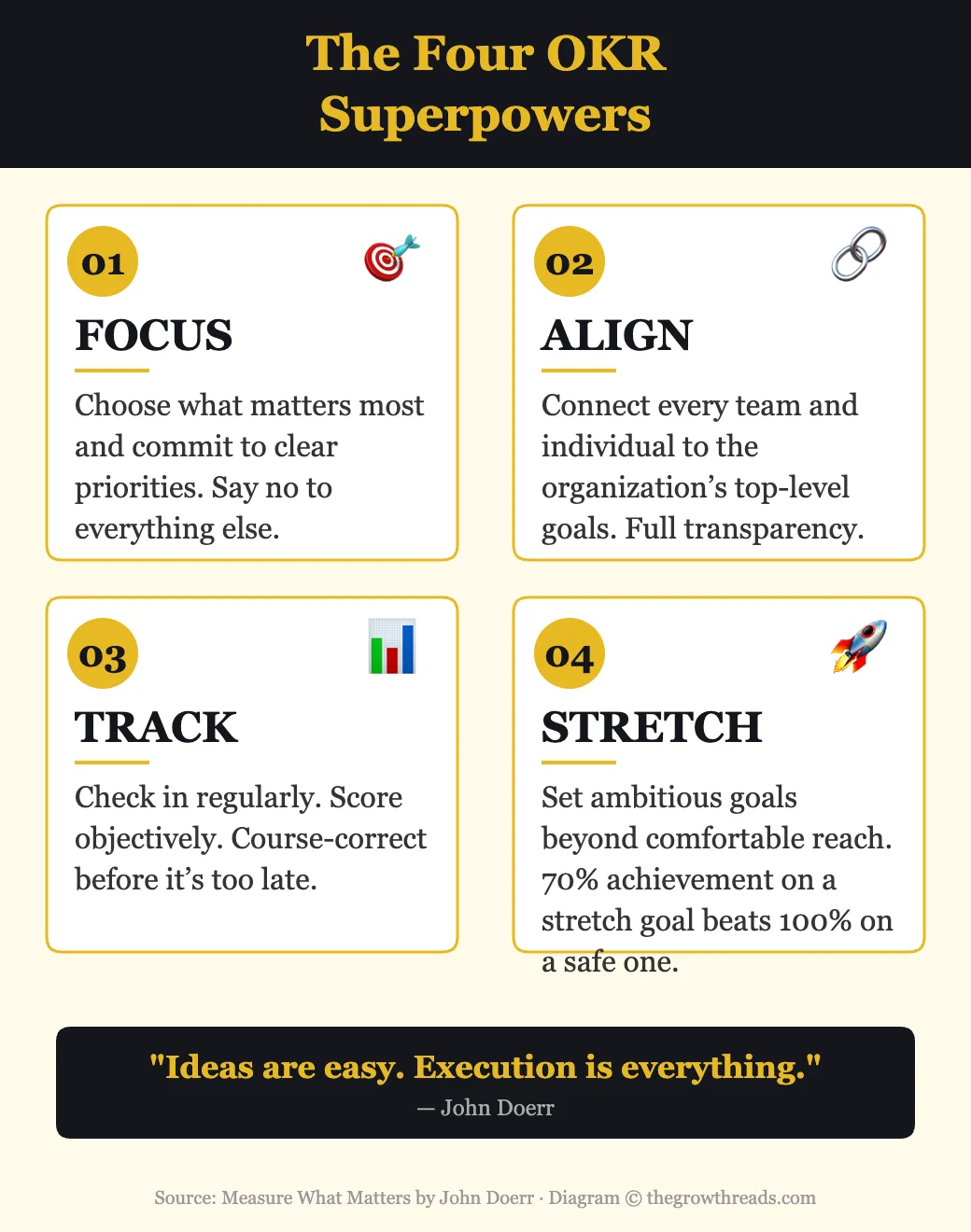
The core of the book organizes OKR’s benefits into four “superpowers,” each illustrated with detailed case studies.
Superpower 1: Focus and Commit to Priorities. Doerr argues that the most important word in business is “no.” Choosing three to five objectives per quarter forces leaders to identify what truly matters and ignore everything else. He tells the story of Remind, an education technology startup that was spreading itself across dozens of initiatives. After implementing OKRs, the CEO narrowed the company’s focus to three objectives. Within two quarters, user engagement doubled — not because they did more, but because they stopped doing the wrong things.
Superpower 2: Align and Connect for Teamwork. When OKRs are public — visible to every employee — silos dissolve. People can see what every other team is working on and identify overlaps, gaps, or opportunities for collaboration. At Google, every employee’s OKRs are published on the internal directory. A new engineer can look up the CEO’s OKRs on day one and trace the line from their own work to the company’s top priority.
Superpower 3: Track for Accountability. Doerr introduces the concept of regular check-ins — weekly, biweekly, or monthly — where teams score their key results on a 0.0–1.0 scale. A score of 0.7–0.8 on a stretch goal is considered success; a consistent 1.0 means the goal was set too low. This creates a rhythm of accountability without micromanagement. The Gates Foundation used this superpower to track progress against their audacious health goals, scoring their OKRs every quarter and redirecting hundreds of millions of dollars based on the data.
Superpower 4: Stretch for Amazing. Google famously divides its OKRs into “committed” (must-hit operational targets) and “aspirational” (moonshots with a 40% expected failure rate). The distinction is critical: committed OKRs guarantee baseline performance, while aspirational OKRs push teams beyond what seems possible. Google Chrome set an aspirational OKR of 20 million weekly users. They hit 111 million. The stretch target changed how the team thought about distribution, partnerships, and product design.
Part 3: CFRs and continuous performance management
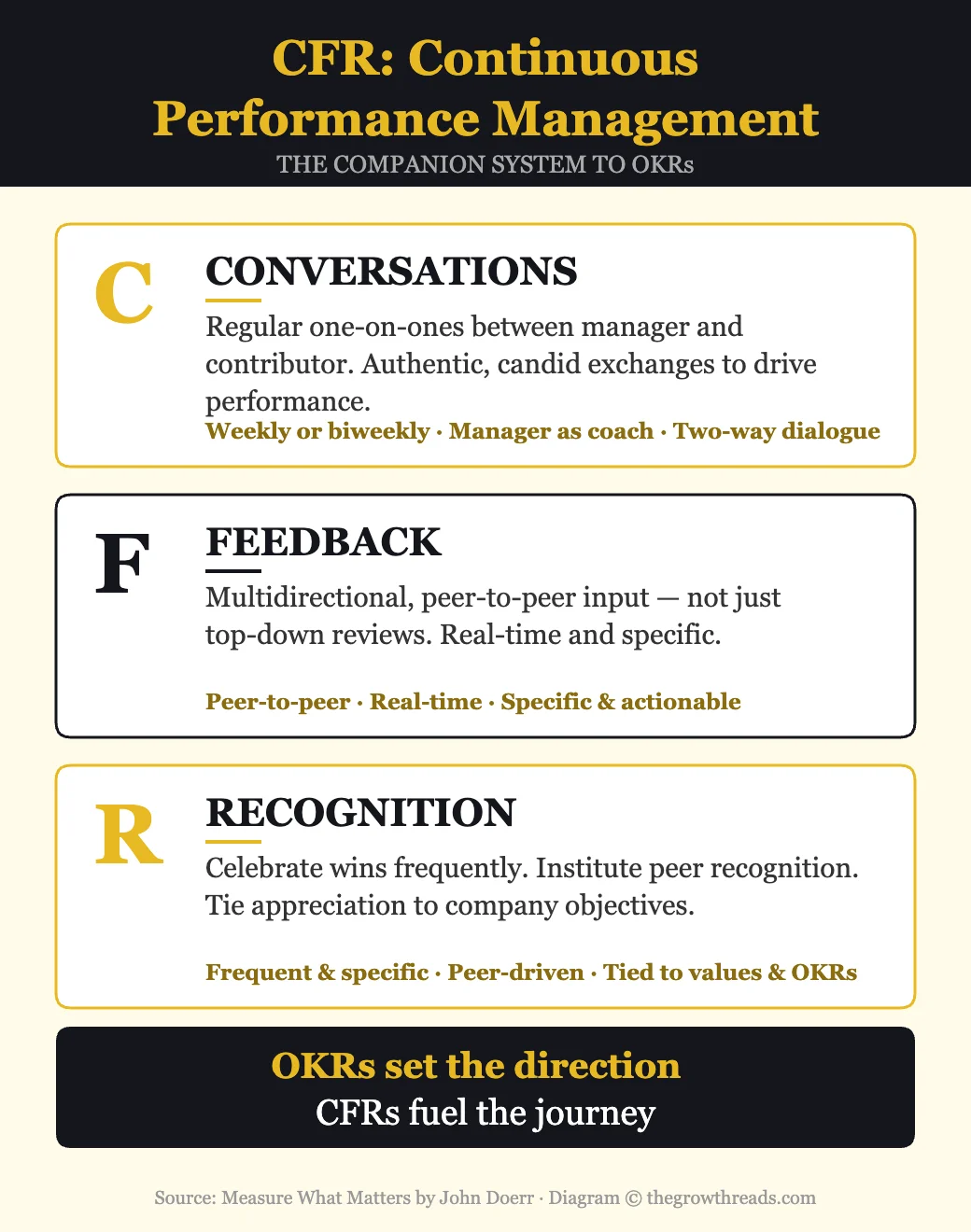
Doerr devotes significant attention to what he calls the “companion system” to OKRs: CFRs (Conversations, Feedback, Recognition). His argument is that OKRs tell you what to measure, but CFRs determine whether people actually grow in the process.
Conversations are regular one-on-ones between managers and contributors. These are not status updates; they are coaching sessions focused on goal progress, obstacles, career development, and personal wellbeing. Doerr draws on research showing that employees who have weekly check-ins with their manager are 2.8 times more likely to be engaged at work.
Feedback should be multidirectional and continuous, not confined to annual reviews. Doerr cites Adobe’s decision to eliminate annual performance reviews entirely. After switching to ongoing “Check-ins” (a CFR-style system), Adobe saw voluntary attrition drop by 30% and involuntary departures rise — because managers were addressing problems in real time instead of storing them up for a year-end surprise.
Recognition should be frequent, specific, and peer-driven. Doerr advocates for systems where any employee can recognize any other employee, tied to the company’s values and objectives. Zume Pizza built a “High Five” system that let any team member publicly praise a colleague’s contribution to an OKR. The result was a measurable increase in collaboration across departments that had previously operated independently.
Part 4: Culture, purpose, and OKRs beyond business
The final section expands OKRs beyond corporate settings into nonprofits, social movements, and personal life. Doerr profiles Bono’s ONE Campaign, which used OKRs to organize its advocacy efforts for global health and poverty reduction. The organization set a stretch OKR to convince world leaders to commit $100 billion to fighting AIDS, tuberculosis, and malaria. They tracked progress against specific legislative milestones in each country, and the transparency of the OKR system allowed thousands of volunteers to coordinate their advocacy efforts without centralized micromanagement.
The Gates Foundation’s story is equally compelling. Bill Gates describes how OKRs helped the foundation move from writing large checks to tracking whether those investments actually saved lives. They set objectives around specific diseases — like reducing polio cases by 99% — and defined key results in terms of measurable health outcomes. The rigor of OKR scoring forced the foundation to confront uncomfortable truths about which programs were working and which needed radical rethinking.
Doerr closes with a chapter on culture, arguing that OKRs are not a management trick but a cultural commitment to transparency, accountability, and ambitious goal-setting. The system fails in organizations that punish failure, hoard information, or treat goals as top-down mandates. It thrives where leaders model vulnerability by sharing their own OKR scores — including the failures — and where teams feel safe setting stretch targets without fear of retribution.
Who is Measure What Matters best for — and who should read something else first?
This book is ideal for founders, CEOs, team leads, and managers at organizations of any size who want a proven, practical system for setting and tracking goals. It is particularly valuable for leaders who feel their teams are busy but not productive — working on many things but making progress on nothing. If your organization has tried goal-setting frameworks before and found them too bureaucratic, too vague, or too disconnected from daily work, OKRs offer a lighter, faster alternative.
If you are a solo entrepreneur or freelancer, the framework still applies but you may find the team-alignment chapters less immediately relevant. Consider starting with Atomic Habits for personal goal systems, then graduating to OKRs when your team grows. If you want deeper insight into the people side of leadership before tackling the system side, read Leaders Eat Last first.
Questions to reflect on
- If you could only pursue three objectives this quarter, what would they be — and what would you have the courage to drop?
- Can every person on your team explain how their daily work connects to the organization’s top priority?
- When was the last time your team set a goal so ambitious that 70% achievement would still be a major win?
- Are your performance conversations coaching sessions or status updates?
- What would change in your organization if every employee’s goals were visible to everyone else?
🔥 Ready to transform how your team sets and hits goals?
Measure What Matters gives you the exact system that powered Google, Intel, and the Gates Foundation.
How to apply Measure What Matters (7-day plan)
- Day 1 — Audit your current goals: List every goal, target, and initiative you or your team is currently pursuing. Circle the three that would matter most if everything else disappeared.
- Day 2 — Write your first objective: Take your top priority and craft a qualitative, inspiring objective statement. Test it: does it make you want to get out of bed and work on it?
- Day 3 — Define key results: Write 2–4 measurable key results for your objective. Each should be specific enough that anyone could verify whether you hit it.
- Day 4 — Make them visible: Share your OKRs with your team, manager, or accountability partner. Publish them somewhere everyone can see — a shared doc, a wall, a team wiki.
- Day 5 — Set your first CFR: Schedule a 30-minute conversation with one direct report or peer. Focus on their goals, obstacles, and development — not status updates.
- Day 6 — Score honestly: If you have existing goals, score each one on a 0.0–1.0 scale right now. Notice where you have been avoiding honest assessment.
- Day 7 — Commit to the cadence: Block 15 minutes every Monday to check in on your key results. Block 1 hour at the end of the quarter to score, reflect, and set the next cycle.
Frequently asked questions
What does OKR stand for and how does it work?
OKR stands for Objectives and Key Results. An Objective is a qualitative, inspiring goal that defines what you want to achieve. Key Results are the quantitative, measurable milestones (typically 2–5) that prove you reached the objective. Together, they create a system where ambitious goals are paired with concrete evidence of progress. Organizations typically run OKR cycles quarterly, with scoring at the end of each cycle on a 0.0–1.0 scale. The system was developed by Andy Grove at Intel and popularized by John Doerr at Google.
How many OKRs should a team have per quarter?
Doerr recommends three to five objectives per quarter, with two to five key results for each objective. This constraint is essential: the point of OKRs is focus, and having too many objectives defeats the purpose. If everything is a priority, nothing is. At Google, most teams operate with four to six key results total per quarter. The discipline of choosing forces leaders to make hard trade-offs about what truly matters versus what merely seems urgent.
What is the difference between committed and aspirational OKRs?
Committed OKRs are must-hit targets tied to core business operations — things like revenue goals, product launches, or compliance requirements. Teams are expected to hit 100% of committed OKRs. Aspirational OKRs are stretch “moonshot” goals with a 60–70% probability of success. They are designed to push teams beyond their comfort zone. A score of 0.7 on an aspirational OKR is considered a strong result. Google uses both types simultaneously: committed OKRs guarantee baseline performance while aspirational OKRs drive innovation.
Should OKRs be tied to employee compensation?
Doerr strongly recommends separating OKRs from compensation. When OKRs directly determine bonuses or raises, employees set easy, achievable goals to protect their pay — which destroys the stretch component that makes OKRs powerful. At Google, OKRs are one input into performance discussions but never the sole determinant of compensation. The separation allows people to set genuinely ambitious targets without fearing financial consequences for falling short. Performance evaluation should use OKRs as context, not as a mechanical scoring formula.
Can OKRs work for small teams or individuals?
Yes. While the book’s case studies feature large organizations, Doerr emphasizes that OKRs scale down effectively. A solo founder can use one or two objectives with two to three key results per quarter. A small team of five can run a lightweight weekly check-in in fifteen minutes. The key principles — focus, measurability, transparency, and stretch — apply at any scale. The main adaptation for small teams is simplicity: skip complex scoring systems and focus on the habit of setting, reviewing, and honestly assessing progress against clear goals.
What is CFR and how does it relate to OKRs?
CFR stands for Conversations, Feedback, and Recognition — the continuous performance management system that Doerr positions as OKRs’ essential companion. Conversations are regular one-on-ones focused on coaching, not status. Feedback is multidirectional and real-time, not confined to annual reviews. Recognition is frequent, specific, and peer-driven. Together, CFRs ensure that the human side of performance is addressed alongside the measurement side. Doerr argues that OKRs without CFRs become a cold, mechanical system; CFRs provide the warmth, growth, and motivation that sustain performance over time.
How long does it take to implement OKRs successfully?
Most organizations need two to three quarterly cycles to get OKRs right. The first quarter is typically messy: teams set too many objectives, write vague key results, and struggle with scoring. The second quarter improves as people learn what measurable really means and start seeing the value of transparency. By the third quarter, the rhythm usually clicks. Doerr recommends starting with a pilot team, learning from their experience, then rolling out gradually. Trying to implement OKRs company-wide on day one is the most common mistake — and the fastest path to abandoning the system entirely.
Related summaries
- High Output Management — Andy Grove’s own management playbook, the intellectual foundation for everything in Measure What Matters.
- The Lean Startup — Eric Ries’s build-measure-learn loop shares OKRs’ obsession with measurable progress and rapid iteration.
- Radical Candor — Kim Scott’s guide to giving direct, caring feedback — the interpersonal skill that makes CFRs effective.
- Best Leadership Books — Our complete curated list of the most impactful leadership books.