

★★★★☆ 4.4 / 5
One-liner: A battle-tested blueprint for transforming rigid hierarchies into adaptive networks that can thrive in complexity.
Best for: Leaders managing fast-changing environments, cross-functional teams, or organizations that need to move faster without sacrificing coordination.
Reading time: ~7 hours (304 pages)
Difficulty to apply: High — the principles are clear but require genuine cultural change: sharing information widely, ceding control, and rebuilding trust across silos.
Team of Teams in one minute
The most efficient organization in the world could not defeat a far smaller, less resourced enemy — because efficiency is the wrong goal in a complex environment. General Stanley McChrystal led the Joint Special Operations Task Force in Iraq and discovered that his precisely tuned military machine was too slow to fight a decentralized terrorist network. The enemy adapted in days; his approval chains took weeks. His solution was to transform the Task Force from a “command of teams” — a traditional hierarchy where information flowed up and orders flowed down — into a “team of teams,” a networked organization built on shared consciousness, trust across silos, and empowered execution. The result was a force that combined the agility of small teams with the power of a large enterprise. The book argues that every organization facing complexity — from hospitals to corporations — needs the same transformation.
Key takeaways
- Efficiency kills in complex environments: Organizations optimized for efficiency (predictable, repeatable processes) fail when the environment becomes complex (unpredictable, interdependent, fast-changing).
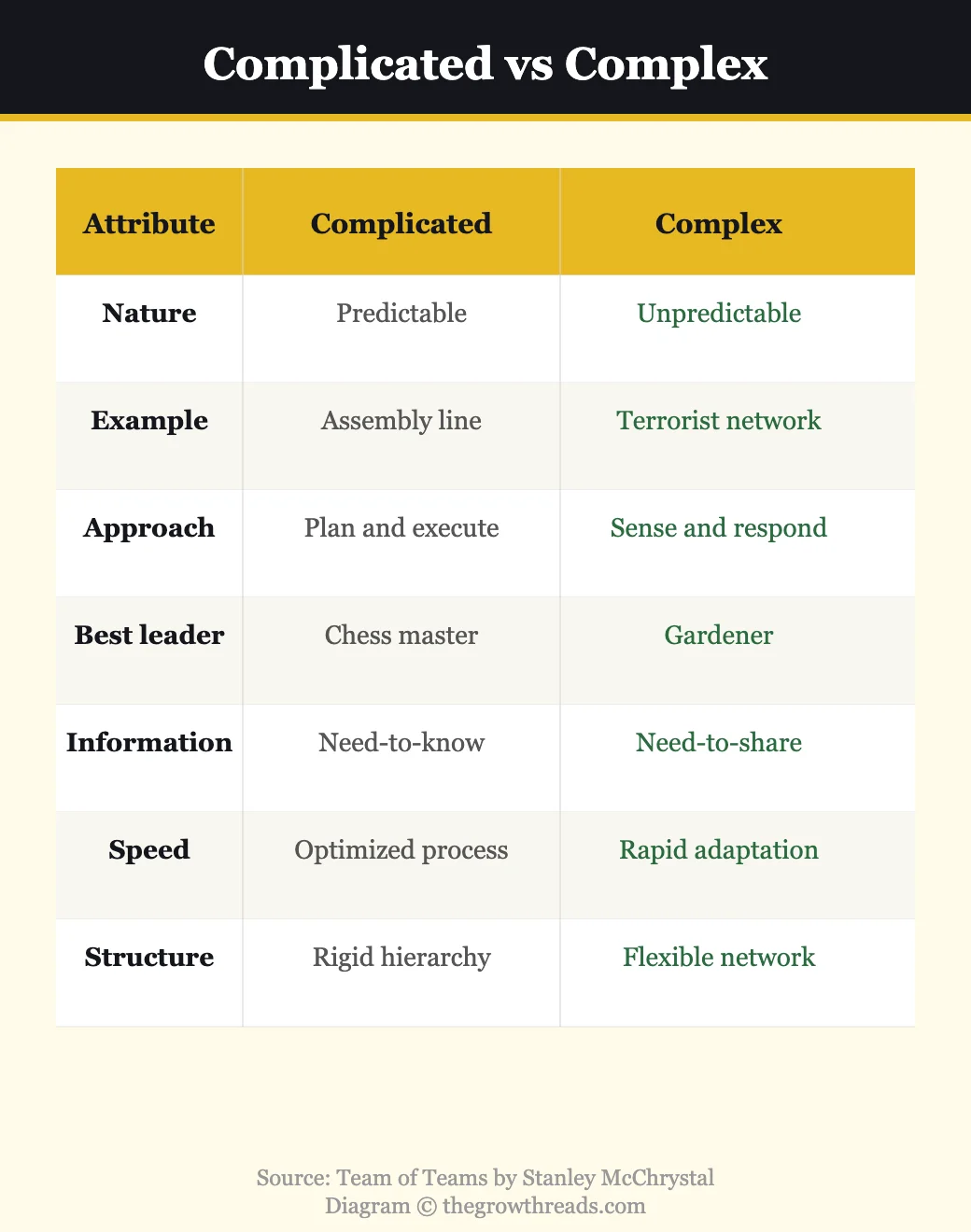
- Complicated is not complex: Complicated problems (like building a jet engine) can be solved with expertise and planning. Complex problems (like fighting a network) require adaptation and real-time sensing.
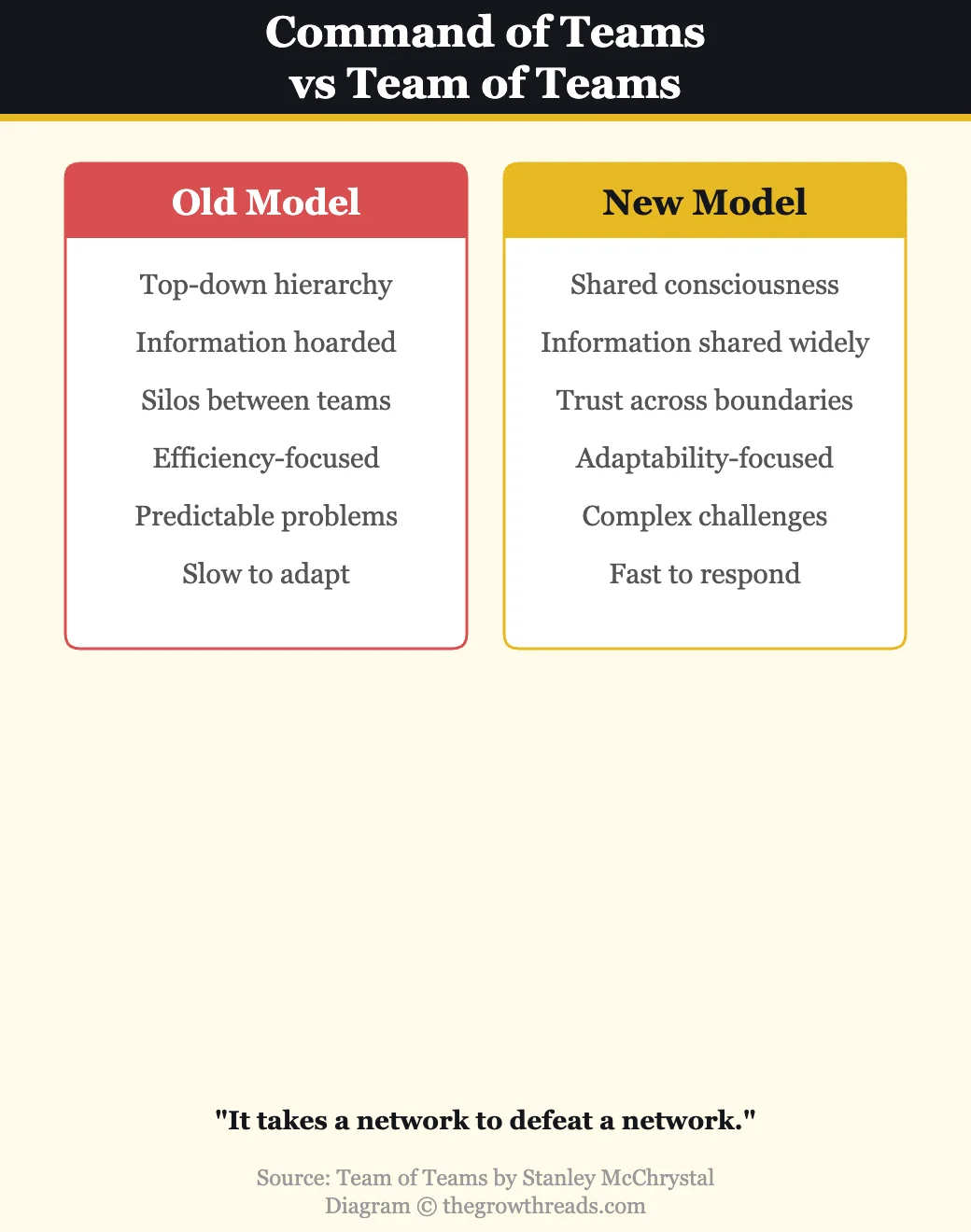
- It takes a network to defeat a network: Hierarchical organizations cannot outmanoeuvre decentralized opponents. You must become as agile as the threat you face.
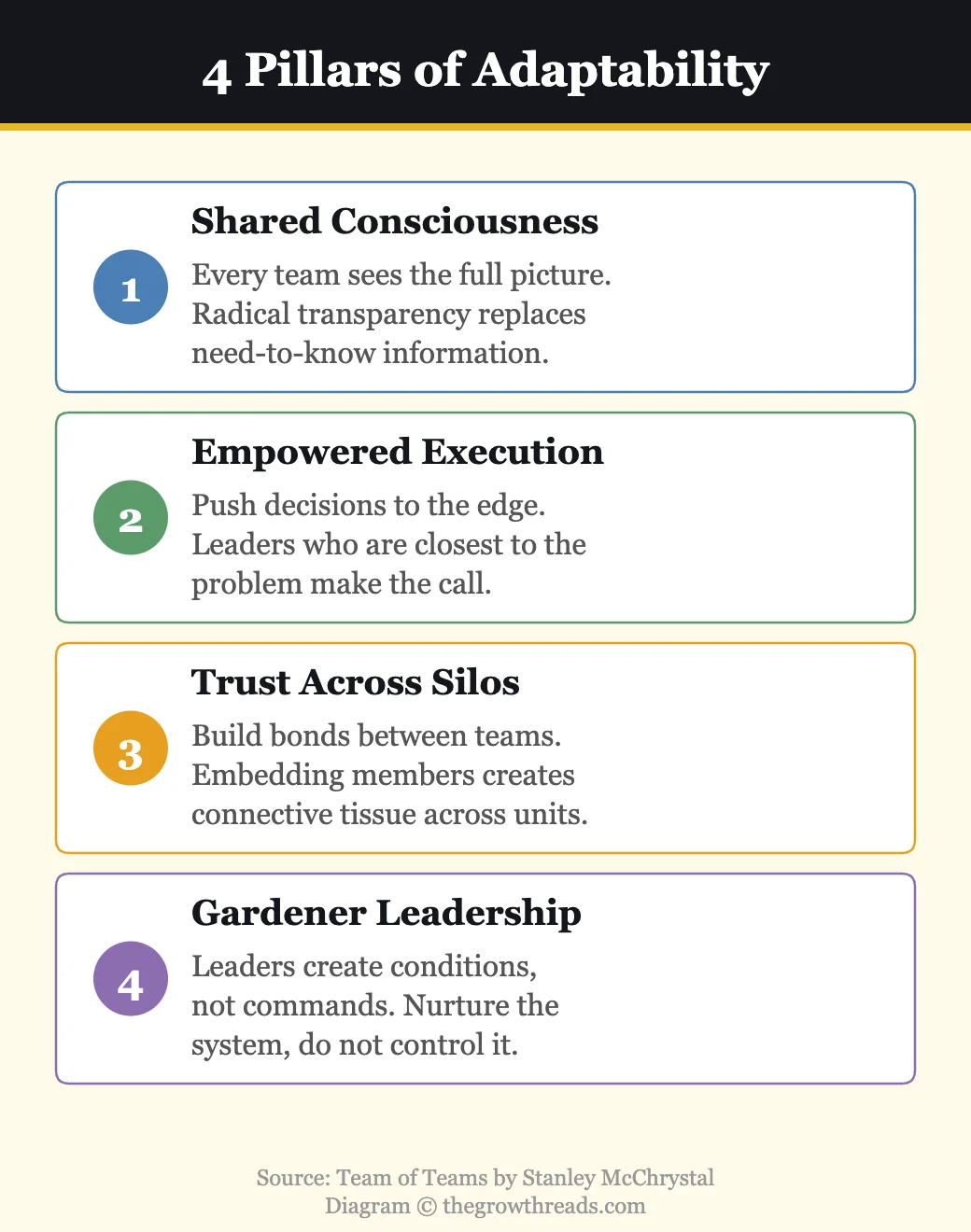
- Shared consciousness replaces need-to-know: When every team has access to the big picture — not just their piece of it — decisions improve dramatically because people understand context, not just orders.
- Trust across silos is the connective tissue: Small teams naturally build deep trust internally. The challenge is extending that trust between teams through embedding programs, liaison officers, and shared spaces.
- Empowered execution pushes decisions to the edge: The leader closest to the problem should make the call. Waiting for headquarters approval in a fast-moving situation means acting on yesterday’s information.
- Leaders must be gardeners, not chess masters: Instead of directing every move, leaders create the conditions — transparency, trust, communication infrastructure — that allow the network to self-organize.
- The O&I forum was the engine of transformation: A daily 90-minute video conference connecting 7,000 people across the globe created shared consciousness at scale.
- Speed of decision mattered more than quality of decision: In complex environments, a good decision now beats a perfect decision next week. The cost of delay exceeds the cost of imperfection.
- Organizational culture must change, not just structure: Redrawing org charts is meaningless if the underlying culture still hoards information, punishes mistakes, and rewards turf protection.
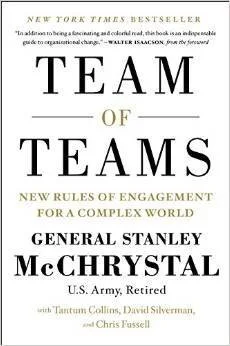
What is Team of Teams about?
Team of Teams is a leadership and organizational design book that draws on General McChrystal’s experience commanding special operations forces in Iraq to argue that traditional hierarchies must evolve into adaptive networks. It lays out a practical framework — shared consciousness, empowered execution, and cross-silo trust — for organizations facing complex, fast-changing environments.
About the author
General Stanley McChrystal is a retired four-star general who spent thirty-four years in the US Army, culminating in his command of the Joint Special Operations Command (JSOC) and later all US and international forces in Afghanistan. During his time leading JSOC, McChrystal transformed the Task Force from a collection of elite but siloed units into a networked organization that conducted over ten operations per night — up from one every few weeks. After retiring from the military, he founded the McChrystal Group, a leadership consulting firm, and became a senior fellow at Yale University. His co-authors Tantum Collins, David Silverman, and Chris Fussell served alongside him and helped translate military lessons into civilian organizational principles. Explore all Stanley McChrystal book summaries →
Key concepts at a glance
| Concept | What it means | Use it when |
|---|---|---|
| Shared Consciousness | Everyone sees the full picture through radical information sharing | Teams are making bad decisions because they lack context |
| Empowered Execution | Decision authority pushed to the person closest to the problem | Approval chains slow you down in time-sensitive situations |
| Team of Teams | A network of small teams connected by trust and shared awareness | Your organization has strong teams that do not coordinate well |
| O&I Forum | Daily cross-organization briefing that builds shared understanding | Departments operate in silos with their own priorities |
| Gardener Leadership | Leaders shape the environment instead of directing every move | Your team is talented but waits for permission to act |
| Embedding Program | Rotating members between teams to build cross-team trust | Teams distrust or misunderstand each other’s work |
| Complicated vs Complex | Predictable vs unpredictable environments require different approaches | You are applying planning-based solutions to adaptive problems |
| Eyes On, Hands Off | Leaders maintain awareness without micromanaging execution | You struggle to delegate without losing situational awareness |
Part 1: The problem — why efficiency fails
McChrystal opens with a vivid paradox: in 2004, the most well-funded, well-trained, technologically advanced military force in history was being outmaneuvered by a ragtag network of insurgents. Al Qaeda in Iraq (AQI) had no central command, no formal training pipeline, and a fraction of the resources. Yet they were adapting faster, striking more effectively, and recruiting at a pace that the Task Force’s traditional approach could not match.
The root problem, McChrystal realized, was not a lack of resources or talent — it was an organizational design built for a world that no longer existed. The US military’s command structure was a masterpiece of efficiency, perfected over two centuries to solve complicated problems: move troops here, supply them there, execute the plan. But AQI was not a complicated problem. It was a complex one — a decentralized, adaptive network where cause and effect were nonlinear and where the environment changed faster than any planning cycle could accommodate.
He draws on complexity science to illustrate the distinction. Complicated systems (like a Swiss watch) have many parts but behave predictably. Complex systems (like a weather system or a terrorist network) have parts that interact in unpredictable ways, producing emergent behaviours that no amount of analysis can forecast. The military had been treating Iraq like a Swiss watch when it was actually a weather system.
Part 2: The solution — shared consciousness and trust
McChrystal’s transformation began with a radical act: he opened up information flows across the entire Task Force. Previously, intelligence was compartmentalized on a strict need-to-know basis. Each team saw only its own slice of the picture. This made sense for security but created a devastating side effect: no one understood the whole system they were fighting.
The centrepiece of the new approach was the Operations and Intelligence (O&I) forum — a daily 90-minute video teleconference that eventually connected over 7,000 participants from dozens of agencies across multiple time zones. Every morning, teams briefed the entire network on what they had learned, what they were planning, and what they needed. Intelligence analysts, special operators, diplomats, and partner agencies all heard the same information at the same time.
The O&I forum was expensive in time and attention. But it was the single most important lever McChrystal pulled. By creating shared consciousness — a common operating picture that everyone could see — he eliminated the information asymmetry that had been crippling coordination. Teams that previously competed for resources now saw how their operations affected each other. Patterns that were invisible to any single team became visible when the whole network could connect the dots.
Building trust across teams was harder. Within a SEAL team or a Delta unit, trust was absolute — forged through shared suffering, shared risk, and years of operating together. Between teams, trust was thin to nonexistent. McChrystal’s solution was an embedding program: he rotated individual operators between units for six-month tours. A SEAL would serve with an Army Ranger unit; an intelligence analyst would embed with a special operations team. These individuals became human bridges — they built personal relationships across organizational boundaries and carried those relationships (and the trust they generated) back to their home units.
Part 3: Empowered execution and gardener leadership
Shared consciousness and trust were necessary but not sufficient. The final transformation was pushing decision authority to the edge of the network. McChrystal realized that in a fast-moving environment, the person closest to the problem had the best information — but under the old system, that person had to send a request up the chain and wait for approval from someone who understood the situation less well and was seeing it hours later.
The shift to empowered execution meant that operators on the ground could approve raids, adjust targets, and reallocate resources in real time — as long as they operated within the shared consciousness. The key constraint was not permission but context: if you understood the big picture (because you had attended the O&I and absorbed the shared consciousness), you could be trusted to make decisions that aligned with the overall mission.
This required McChrystal to fundamentally redefine his own role. Instead of being a chess master — planning every move, directing every piece — he became a gardener. His job was not to make decisions but to create the conditions in which good decisions could emerge: transparent information flows, cross-team trust, clear intent, and a culture that rewarded initiative over obedience. He describes his leadership approach as “eyes on, hands off” — maintaining situational awareness without micromanaging execution.
The results were dramatic. The Task Force went from conducting roughly one operation per night to over ten. The time between identifying a target and executing an operation collapsed from weeks to hours. Most importantly, the quality of decisions improved because they were being made by people with both local knowledge and systemic awareness.
Who is Team of Teams best for — and who should read something else first?
This book is ideal for leaders managing organizations that need to move faster in unpredictable environments — startup founders scaling beyond a single team, corporate executives trying to break down silos, or any leader who feels their organization knows what to do but cannot execute quickly enough. It is particularly powerful for anyone leading cross-functional teams or managing through organizational transformation.
If you are new to leadership and want foundational principles before organizational design, start with Leaders Eat Last by Simon Sinek or Extreme Ownership by Jocko Willink. If you want to understand team dynamics at a smaller scale first, The Five Dysfunctions of a Team by Patrick Lencioni is the better starting point. And if your challenge is more about building a culture of trust than about organizational structure, The Culture Code by Daniel Coyle is a natural complement.
Questions to reflect on
- Is your organization solving complicated problems with planning or complex problems with adaptation — and are you using the right approach for the right type?
- Who in your organization has critical information that others need but do not receive? What would change if they did?
- Are decisions being made by the people closest to the problem, or are they waiting for approval from someone further away?
- If you disappeared for a week, would your team continue to make good decisions — or would they wait for your return?
- What is your organization’s equivalent of an embedding program — how do you build trust across silos?
🔥 Ready to build an organization that adapts as fast as the challenges it faces?
Get Team of Teams and learn the battle-tested framework for leading in complexity.
How to apply Team of Teams (7-day plan)
- Day 1 — Audit your information flows: Map how information currently moves through your organization. Where does it get stuck? Who is hoarding context that others need? Write down three pieces of information that should be shared more widely.
- Day 2 — Launch a daily standup: Start a brief (15–20 minute) daily meeting where every team shares one update and one blocker. The goal is not to solve problems but to build shared consciousness — everyone sees the whole picture.
- Day 3 — Identify a decision bottleneck: Find one recurring decision that currently requires your approval but could be made by someone closer to the action. Define the boundaries (“you can decide X as long as Y is true”) and delegate it explicitly.
- Day 4 — Start an embedding experiment: Assign one team member to sit in on another team’s meetings for a week. Their job is to observe, build relationships, and report back on what they learned about the other team’s challenges and priorities.
- Day 5 — Practice eyes on, hands off: For one full day, observe your team’s work without making a single directive decision. If someone asks for approval, ask them what they think the right call is — and then support their judgment.
- Day 6 — Assess your culture: Ask three team members (anonymously if needed): “What happens here when someone makes a mistake? What happens when someone shares bad news?” Their answers will tell you whether your culture supports empowered execution.
- Day 7 — Write your gardener’s intent: Draft a one-page document that describes your team’s purpose, boundaries, and decision-making principles. Share it with your team and ask: “If you understood this, could you make good decisions without asking me?”
Frequently asked questions
Is Team of Teams worth reading?
Yes, particularly if you lead an organization that struggles with speed, coordination, or cross-team collaboration. McChrystal’s military narrative makes the principles vivid and memorable, but the book carefully translates each lesson into civilian organizational contexts. It is one of the most practical books on organizational adaptation written in the past decade, and its core framework — shared consciousness plus empowered execution — applies to any organization facing complexity.
What is the main idea of Team of Teams?
The central argument is that traditional hierarchies optimized for efficiency cannot succeed in complex, fast-changing environments. Instead, organizations must become networks of empowered small teams connected by shared information and cross-team trust. McChrystal calls this a “team of teams” — an organization that combines the adaptability of small units with the scale and resources of a large enterprise, enabling rapid decentralized decision-making.
What is shared consciousness in Team of Teams?
Shared consciousness means that every team and every individual in the organization has access to the same big-picture understanding of the mission, the environment, and the actions of other teams. McChrystal achieved this through the daily O&I forum — a 90-minute video conference connecting thousands of people — and by replacing need-to-know information policies with radical transparency. The result was that people at every level could make better decisions because they understood the context surrounding their own work.
What does “gardener leadership” mean?
Gardener leadership is McChrystal’s metaphor for the leadership style required in complex environments. Unlike a chess master who directs every piece, a gardener creates the conditions for growth — soil, sunlight, water — and then lets the plants grow on their own. In organizational terms, this means leaders build transparent communication systems, foster trust, set clear intent, and then step back to let empowered teams execute. The leader’s job is to shape the environment, not to make every decision.
How is Team of Teams different from other leadership books?
Most leadership books focus on individual leader behaviour — how to communicate, inspire, or make decisions. Team of Teams focuses on organizational design — how to structure information flows, trust networks, and decision authority so that the entire system adapts faster. It is less about what a leader should do and more about what a leader should build. The military context gives the principles a high-stakes credibility that business case studies often lack.
Can Team of Teams principles work in small organizations?
Yes, and in some ways they are easier to implement at small scale. A ten-person startup can achieve shared consciousness with a daily standup and a shared dashboard; a large corporation needs the equivalent of McChrystal’s 7,000-person O&I forum. The embedding program scales down to simply having team members shadow each other for a day. The principles — share information, build trust across boundaries, push decisions to the edge — apply regardless of organization size.
What is the difference between complicated and complex?
Complicated problems have many parts but behave predictably — like a jet engine. An expert can analyse the components, understand the interactions, and solve the problem with enough knowledge and planning. Complex problems have parts that interact in unpredictable, nonlinear ways — like a terrorist network or a financial market. No amount of analysis can predict the system’s behaviour because the parts adapt and the interactions change. Complex problems require sensing and responding, not planning and executing.
Related summaries
- The Culture Code by Daniel Coyle — how the best teams build trust and belonging.
- Extreme Ownership by Jocko Willink — decentralized command from another special operations leader.
- Multipliers by Liz Wiseman — how leaders amplify their team’s intelligence.
- High Output Management by Andy Grove — information-driven decision-making in organizations.
📚 Explore more: Best Leadership Books · Best Self-Help Books