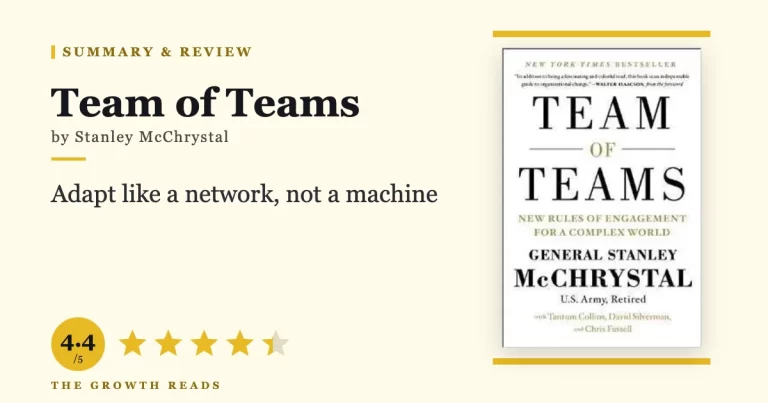
Team of Teams Summary & Review: Leading in Complexity
Stanley McChrystal's Team of Teams shows how to transform rigid hierarchies into adaptive networks. Shared consciousness, empowered execution, and gardener leadership for…
Read Summary →
"The general who rebuilt military command for a world too fast for hierarchy."
Stanley McChrystal is a retired four-star U.S. Army general who commanded the Joint Special Operations Command and later served as commander of NATO's International Security Assistance Force in Afghanistan. His book, Team of Teams, distills the organizational lessons he learned fighting a decentralized, fast-adapting insurgent network with a military built for a slower, more hierarchical era. McChrystal's central argument is that in complex, rapidly changing environments, rigid top-down command structures are too slow to adapt, and that effective organizations need to function as a 'team of teams' — small, empowered units connected by shared purpose and radical transparency rather than by centralized control. His signature reframe is that leaders must shift from acting like a chess master directing every move to acting like a gardener, creating the conditions for adaptive teams to make good decisions on their own.

Our in-depth summaries and reviews of his work

Stanley McChrystal's Team of Teams shows how to transform rigid hierarchies into adaptive networks. Shared consciousness, empowered execution, and gardener leadership for…
Read Summary →McChrystal argues that in complex environments, leaders must give up trying to control every move like a chess master and instead cultivate conditions — trust, shared purpose, transparency — that let empowered teams adapt on their own.
McChrystal contends that shared purpose affirms trust and trust affirms purpose, and together these two forces are what actually forge individuals into a genuinely effective team.
McChrystal warns that organizations overly attached to fixed procedure, rather than underlying purpose, become brittle and fail to adapt when conditions change rapidly.
"The temptation to lead as a chess master, controlling each move of the organization, must give way to an approach as a gardener, enabling rather than directing."— Team of Teams
"Purpose affirms trust, trust affirms purpose, and together they forge individuals into a working team."— Team of Teams
"The crew's attachment to procedure instead of purpose offers a clear example of the dangers of prizing efficiency over adaptability."— Team of Teams

Stanley McChrystal's Team of Teams shows how to transform rigid hierarchies into adaptive networks. Shared consciousness, empowered execution, and gardener leadership for complex environments.