

⭐⭐⭐⭐ 4.3/5
One-liner: A calm, persuasive case for replacing busyness with meaningful output — backed by history and practical principles.
Best for: Knowledge workers drowning in tasks, creative professionals seeking sustainable output, anyone tired of hustle culture.
Reading time: ~5 hours (256 pages)
Difficulty to apply: Medium — requires saying no and restructuring commitments, which takes courage and patience.
Slow Productivity in one minute
Modern productivity is broken because it measures visible busyness rather than meaningful results. Cal Newport argues that knowledge workers have adopted an industrial-era model of productivity — treating the volume of tasks completed as a proxy for useful effort — and that this approach is making everyone exhausted and miserable without actually producing better work. Drawing on examples from Isaac Newton, Jane Austen, Georgia O’Keeffe, and other great thinkers throughout history, Newport proposes three principles for a better approach: do fewer things, work at a natural pace, and obsess over quality. The result is not laziness — it is a way to produce work that actually matters while sustaining the energy to keep doing it for decades.
Key takeaways
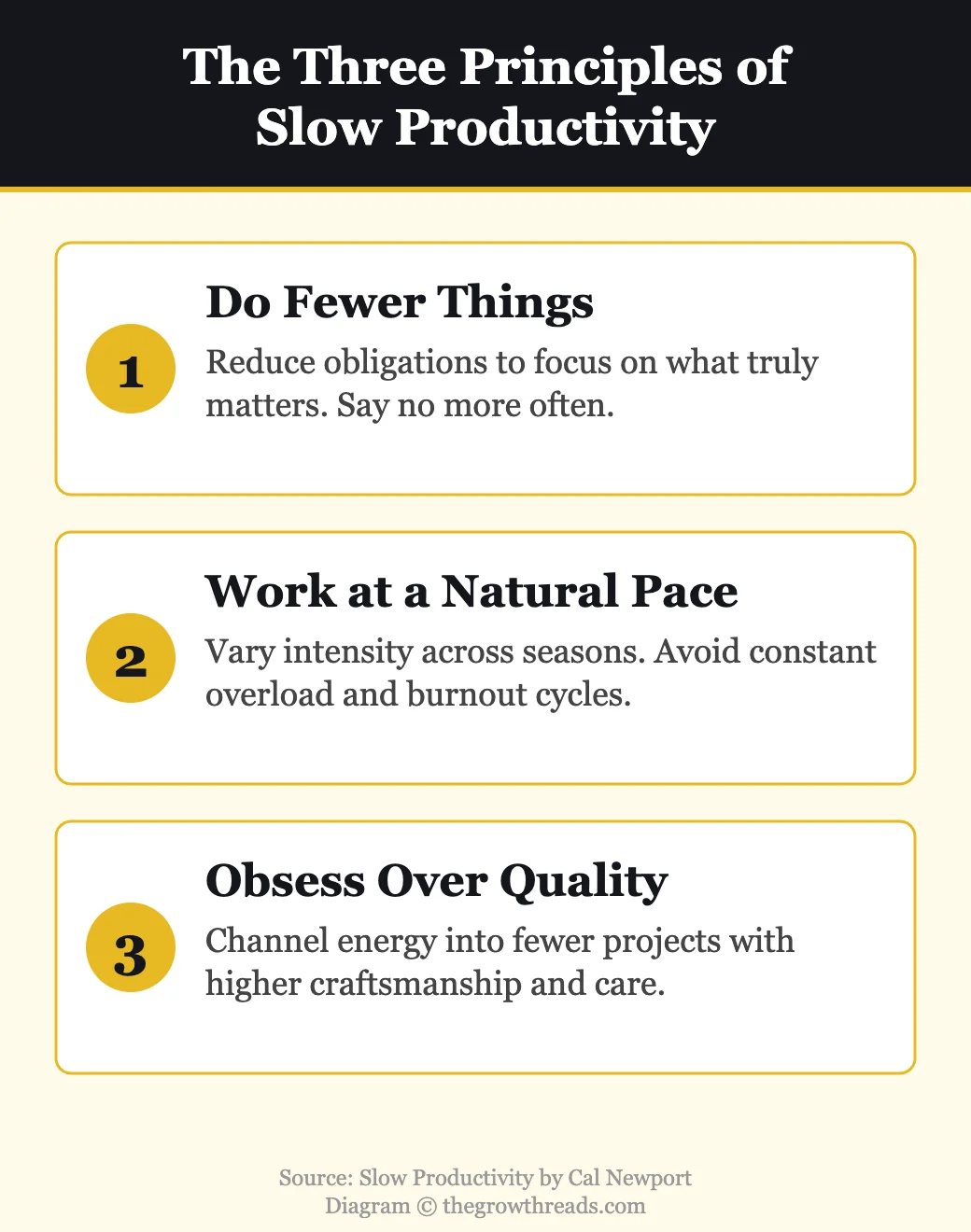
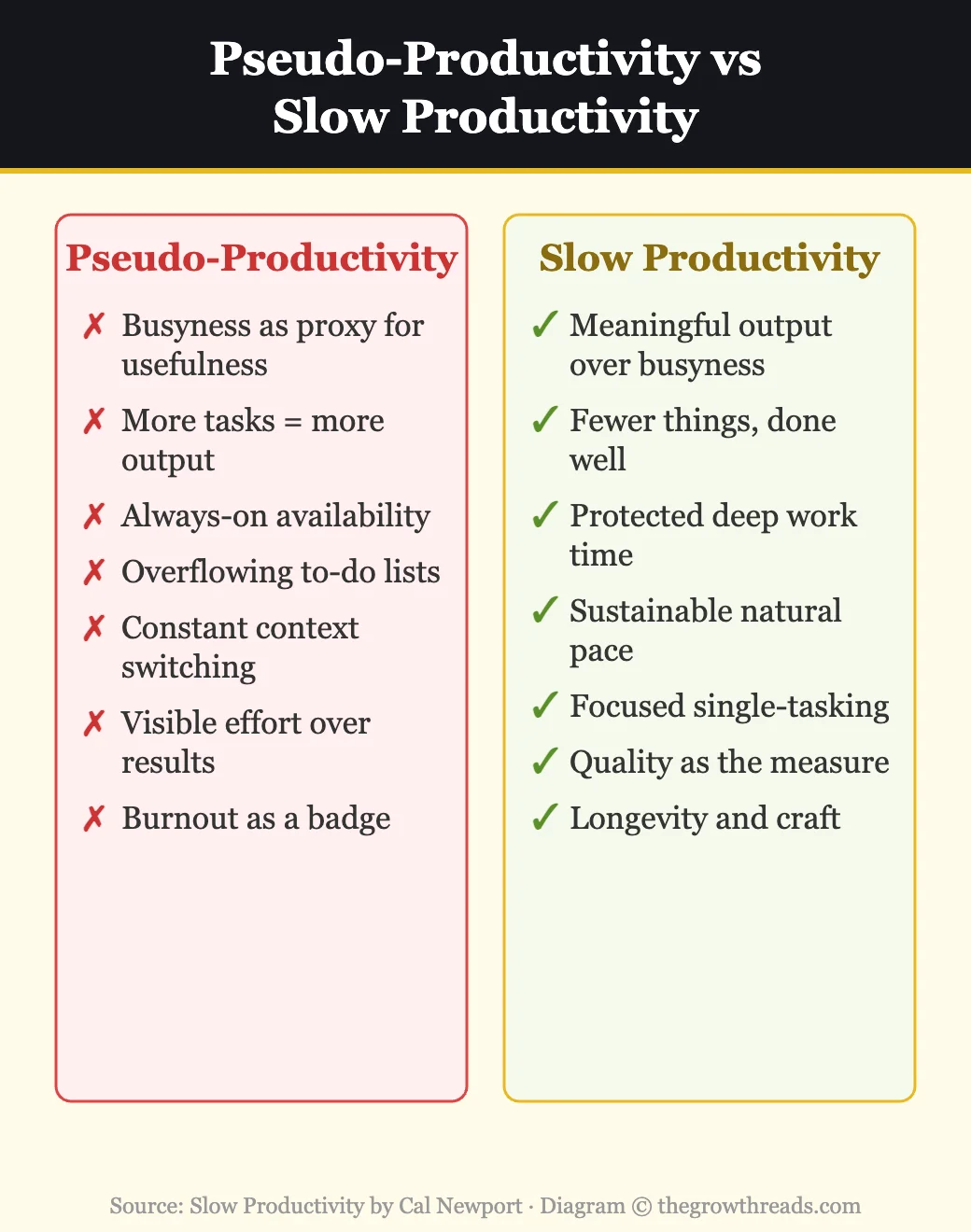
- Pseudo-productivity is the core problem: Using visible activity as the primary measure of useful effort leads to overloaded schedules and shallow work.
- Do fewer things: Limit active projects and missions so you can give genuine attention to the ones that remain.
- Work at a natural pace: Vary your intensity across weeks and seasons rather than grinding at the same relentless rate year-round.
- Obsess over quality: Channel your freed-up time and attention into producing fewer but dramatically better outputs.
- History supports slowness: Newton took 20 years to publish the Principia; Austen wrote six novels across her entire adult life. Great work rarely emerges from sprints.
- Limit your missions: Newport recommends holding one major project, one smaller supporting project, and a short maintenance list — never more.
- Pull-based workflows beat push-based ones: Instead of accepting every task that lands on your plate, pull new work only when capacity opens.
- Seasonal variation is healthy: Some months should be intense; others should be deliberately quieter. Planning for this prevents burnout.
- Rituals and environments matter: Investing in quality tools, workspaces, and creative rituals compounds over time into superior output.
- Betting on quality is strategic: In a world of overloaded inboxes and distracted competitors, consistently excellent output is the most reliable path to career success.
What is Slow Productivity about?
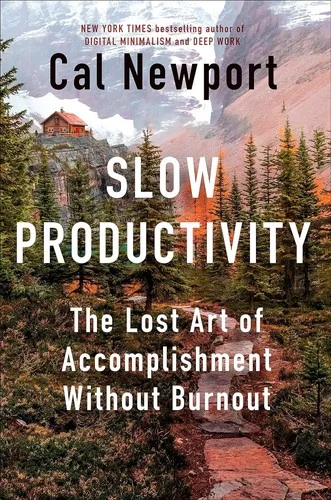
Slow Productivity is a guide to replacing the modern cult of busyness with a sustainable philosophy built on three principles: do fewer things, work at a natural pace, and obsess over quality. Cal Newport draws on historical examples of great thinkers and creators to show that meaningful accomplishment has never required constant overwork — and proposes practical strategies for knowledge workers to reclaim their time and attention.
About the author
Cal Newport is a computer science professor at Georgetown University and one of the most influential thinkers on focused work and technology in the modern workplace. He has written eight books, including the bestsellers Deep Work, Digital Minimalism, and A World Without Email. Newport coined the term “deep work” and runs a popular blog and podcast exploring how knowledge workers can produce high-quality output without burning out. His ideas have been featured in The New York Times, The Wall Street Journal, and The New Yorker. He lives in the Washington D.C. area with his family and practices the slow productivity principles he preaches — publishing roughly one book every two years while maintaining a full academic career.
Key concepts at a glance
| Concept | What it means | Use it when |
|---|---|---|
| Pseudo-productivity | Using visible busyness as a proxy for useful effort | You notice you are busy all day but produce nothing meaningful |
| Do Fewer Things | Radically reduce active commitments and obligations | Your project list has grown beyond what one person can do well |
| Pull-Based Workflow | Accept new tasks only when capacity opens up | Incoming requests constantly overwhelm your current priorities |
| Work at a Natural Pace | Vary intensity across days and seasons | You feel the same unsustainable pressure every single week |
| Double Your Timelines | Give projects twice the time you initially estimate | You chronically under-deliver or rush to finish things |
| Obsess Over Quality | Channel energy into craftsmanship rather than volume | Your output feels interchangeable with anyone else doing the same job |
| Seasonal Planning | Map intensive and recovery periods across the year | You need to sustain high-quality output for years, not weeks |
| Ritualized Work | Build specific environments and habits that support deep focus | You struggle to enter a creative or analytical flow state |
Part 1: Foundations — The problem with pseudo-productivity
Newport opens with a diagnosis: knowledge work has no clear definition of productivity. Factory workers have widgets per hour. Farmers have bushels per acre. But office workers? The metric defaulted to the simplest thing managers could observe — visible activity. He calls this pseudo-productivity: the use of visible effort as the primary means of approximating useful output.
The consequences have been devastating. Email volume exploded from an average of 5 messages per day in the early 2000s to over 125 by the 2020s. Meetings multiplied. “Always-on” cultures emerged. Workers began optimising for looking busy — rapid email replies, packed calendars, Slack presence indicators — rather than for producing anything of lasting value. Newport marshals research showing that task-switching drains cognitive performance, that chronic overload triggers the stress hormone cortisol, and that the “knowledge worker burnout epidemic” documented since the mid-2010s is not a personal failure but a systemic one.
The historical contrast is striking. Newport profiles Isaac Newton, who spent roughly 20 years developing the Principia Mathematica — not because he was lazy, but because deep mathematical thought does not compress into sprints. He shows that Copernicus delayed publishing De revolutionibus for over 30 years, that Darwin took two decades to write On the Origin of Species, and that in every case, the slow pace produced work that reshaped civilisation. These examples are not exceptions — they are the norm for transformative intellectual output.
Part 2: Do fewer things
The first principle is deceptively simple: reduce the number of things you are working on at any given time. Newport acknowledges that this sounds obvious, but argues that most knowledge workers vastly underestimate how many active commitments they carry. He asks readers to list every project, obligation, and ongoing responsibility — and reports that most are shocked to find 20, 30, or even 50 active items.
The problem with overload is not just time. It is what Newport calls the overhead tax: every commitment brings with it a stream of emails, meetings, status updates, and mental context-switches that consume far more energy than the actual work. A project that takes 10 hours of focused effort might generate 40 hours of administrative overhead. When you are carrying 25 projects, the overhead alone swamps your calendar.
Newport proposes a radical solution: limit yourself to a mission, project, and maintenance framework. At any given time, hold one large mission (the work that defines your professional identity right now), one or two smaller supporting projects, and a short list of maintenance tasks. Everything else goes on a waiting list. New work enters only when something exits — a pull-based system borrowed from lean manufacturing.
He profiles the filmmaker Jewel, the writer Lin-Manuel Miranda, and several academics who deliberately constrain their active project loads. In each case, the reduced volume paradoxically increased output quality and often total output as well, because the overhead tax shrank so dramatically that far more time was available for actual creation.
Part 3: Work at a natural pace
The second principle pushes back against the constant, unvarying intensity that defines modern work culture. Newport argues that humans are not designed for an industrial rhythm — the same eight hours of effort, five days a week, fifty weeks a year. Instead, our creative and cognitive capacities fluctuate naturally across days, weeks, and seasons.
He studies the working patterns of historical creators. Jane Austen wrote her six major novels across a span of roughly 20 years, with long fallow periods between bursts of intense productivity. Georgia O’Keeffe painted prolifically in New Mexico but spent winters in New York doing relatively little studio work. Galileo alternated between years of obsessive research and years of teaching and administrative duties.
Newport translates this into practical advice. Double your project timelines — if you think something will take two months, plan for four. This is not about padding for laziness; it is about building in the slack that allows deep thinking, iteration, and the natural ebb and flow of creative energy. He recommends seasonal planning: mapping out the year so that intense creative periods alternate with lighter administrative or maintenance periods. Some months are for building; others are for recovering, learning, and thinking.
He also addresses the uncomfortable truth that working at a natural pace requires saying no — to bosses, clients, and collaborators who expect constant, immediate output. Newport provides scripts and strategies for protecting slower timelines, including the power of framing: “I want to give this the attention it deserves, so I’m planning to have it ready by [longer date]” works far better than “I’m too busy.”
Part 4: Obsess over quality
The third principle is where Newport ties the previous two together. If you are doing fewer things and working at a sustainable pace, what do you do with the freed-up attention? You pour it into making your remaining work exceptionally good.
Newport argues that quality is not just personally satisfying — it is strategically powerful. In a world where most knowledge workers are overwhelmed and producing mediocre work at volume, someone who consistently ships fewer but dramatically better outputs builds an outsized reputation. He calls this the quality bet: the wager that in the long run, excellence compounds in ways that busyness never does.
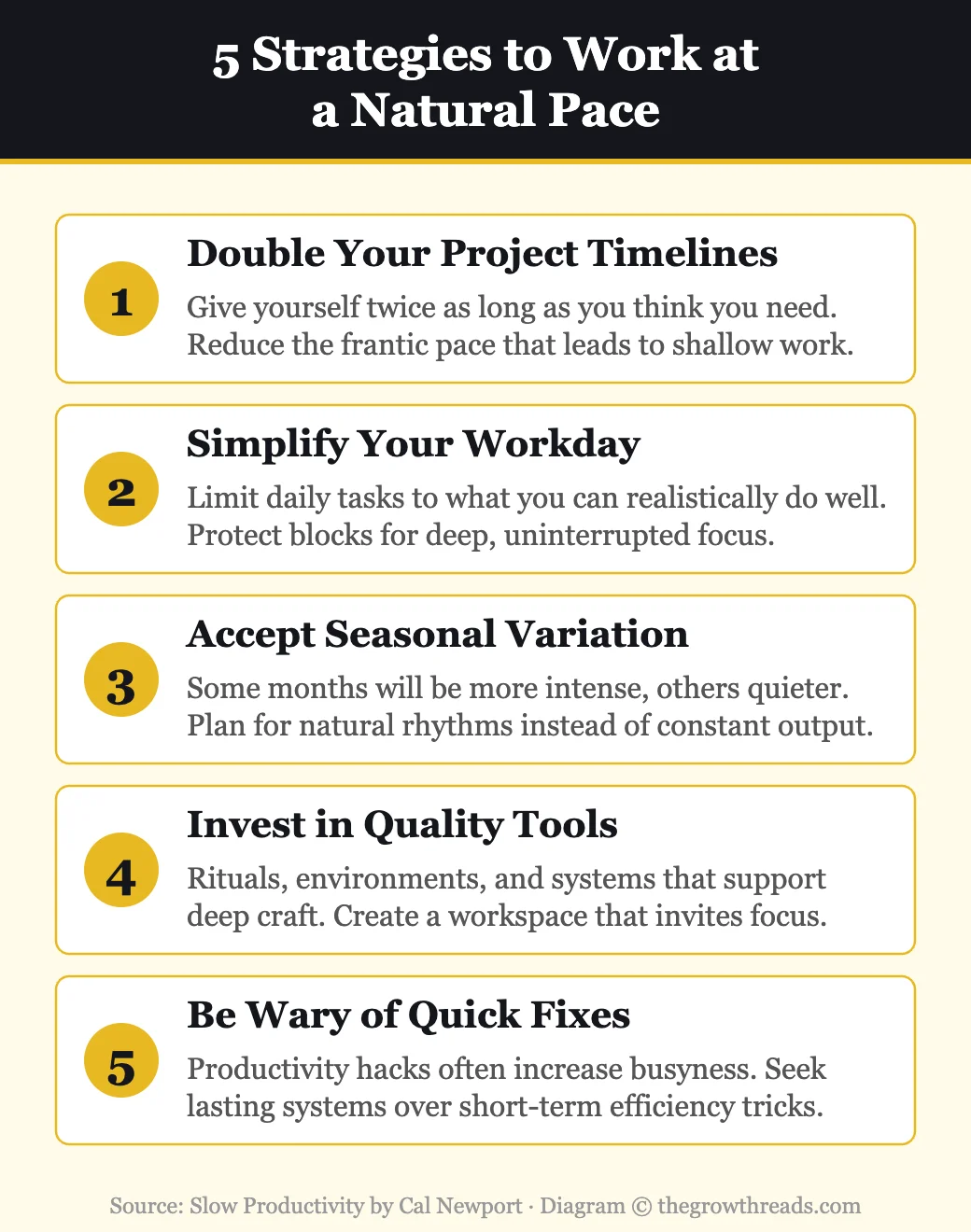
To support quality, Newport recommends investing in rituals, environments, and tools. He profiles writers who rent separate workspaces, programmers who use noise-cancelling headphones and Pomodoro timers, and architects who keep physical sketchbooks to separate creative thinking from screen time. The common thread is that quality output requires a quality process — and process requires deliberate investment.
He also warns against the trap of premature optimisation. Quality, in Newport’s framing, is not about perfectionism or polish. It is about depth of thought. A blog post that contains a genuinely original insight written in plain prose is higher quality than a beautifully formatted post that says nothing new. He urges readers to develop their taste — the ability to distinguish between work that matters and work that merely looks impressive — and to use that taste as a compass for where to invest their limited attention.
Who is Slow Productivity best for — and who should read something else first?
Slow Productivity is ideal for knowledge workers, creative professionals, freelancers, and anyone who feels trapped in a cycle of busyness without meaningful output. If you finish each week exhausted but unable to point to anything you are genuinely proud of, this book is written for you. It is also excellent for managers looking to redesign team workflows around sustainable output rather than visible activity.
If you are new to Cal Newport’s ideas, you might want to start with Deep Work, which establishes the foundation that Slow Productivity builds upon. If your productivity problems are more about personal habits than systemic overload, Atomic Habits by James Clear or Tiny Habits by BJ Fogg may be more immediately actionable. And if you are primarily struggling with email and communication overload, Newport’s own A World Without Email goes deeper on that specific problem.
Questions to reflect on
- If you listed every active project and obligation in your work life right now, how many would there be — and how many could you cut without real consequences?
- When was the last time you produced something you were genuinely proud of, and what conditions made that possible?
- What would your work look like if you doubled your default project timelines — would the quality improve enough to justify the slower pace?
- Are you optimising for visible busyness or for meaningful output — and how would your colleagues or manager tell the difference?
- What one ritual, tool, or environment change could you make this week to create better conditions for deep, quality work?
🔥 Ready to reclaim your time and do work that matters?
Slow Productivity shows you how to escape busyness and build a sustainable creative life.
How to apply Slow Productivity (7-day plan)
- Day 1 — Inventory your commitments. List every project, obligation, and ongoing responsibility you carry at work. Count them. Be honest about anything you have silently agreed to.
- Day 2 — Identify your mission. Choose the single most important project that defines your professional value right now. Everything else moves to the supporting or waiting list.
- Day 3 — Set a pull-based limit. Decide on a maximum number of active projects (Newport suggests 2–3 beyond your mission). Communicate to colleagues that new requests will enter a queue.
- Day 4 — Double one timeline. Take your most pressing deadline and negotiate a longer delivery date. Use the extra space for deeper thinking, not more tasks.
- Day 5 — Design a quality ritual. Create one specific habit that supports deep work: a morning writing block, a no-meeting afternoon, or a dedicated workspace change.
- Day 6 — Map your seasonal plan. Look at the next 3–6 months and mark intensive periods versus lighter recovery periods. Communicate these rhythms to your team.
- Day 7 — Protect the system. Review what you have built. Practice saying no to one new request using Newport’s framing scripts. Commit to reviewing your active project list weekly.
Frequently asked questions
Is Slow Productivity the same as being lazy or doing less work?
No. Newport is explicit that slow productivity is not about doing less — it is about doing better. The goal is to produce fewer outputs of much higher quality by eliminating the overhead, context-switching, and shallow busywork that consume most knowledge workers’ days. Historical examples like Newton and Austen produced some of the greatest intellectual works in history while working at paces that would look lazy by modern standards. The point is that deep, meaningful work requires space that busyness destroys.
How is Slow Productivity different from Deep Work?
Deep Work focused on the value of concentrated, distraction-free work and provided strategies for achieving it within your existing schedule. Slow Productivity zooms out further and asks: why is your schedule so full that deep work is nearly impossible? It addresses the structural problem of pseudo-productivity — the systemic pressure to look busy — and provides principles for redesigning your entire approach to work, not just your daily routine. Think of Deep Work as the technique and Slow Productivity as the philosophy.
Can I apply slow productivity if I work for a demanding boss or company?
Newport acknowledges this is the hardest application challenge. His advice is to focus on what you can control: limit the commitments you voluntarily accept, protect blocks of uninterrupted time, and demonstrate that your reduced-volume output is higher quality. Over time, consistently excellent work builds the credibility needed to negotiate more autonomy. He also provides specific communication scripts for pushing back on overload without appearing lazy or uncooperative.
What is pseudo-productivity and why does Newport think it is a problem?
Pseudo-productivity is Newport’s term for using visible activity as the primary measure of useful effort. Because knowledge work lacks clear output metrics, organisations defaulted to rewarding whoever appeared busiest — answering emails fastest, attending the most meetings, maintaining full calendars. The problem is that this visible busyness often crowds out the deep, focused work that actually produces valuable results. Newport argues this is not a personal failing but a systemic one that requires a philosophical shift.
How many books has Cal Newport written about productivity?
Slow Productivity is Newport’s eighth book overall and the fourth in his series about how knowledge workers can produce better work. The direct lineage runs from So Good They Can’t Ignore You (2012, on building career capital through skill), to Deep Work (2016, on focused concentration), to Digital Minimalism (2019, on controlling technology), to A World Without Email (2021, on communication overload), and now to Slow Productivity (2024, on replacing busyness with sustainable excellence). Each book builds on the previous ones while standing alone.
What are the three principles of slow productivity?
The three principles are: (1) Do fewer things — radically reduce your active commitments so the overhead of managing them does not consume all your time; (2) Work at a natural pace — vary your intensity across days, weeks, and seasons instead of grinding at the same relentless tempo; and (3) Obsess over quality — pour the attention you have freed up into producing fewer but dramatically better outputs. Together, these principles form a complete philosophy for sustainable, meaningful knowledge work.
Is Slow Productivity worth reading in 2026?
Absolutely. The book’s core argument has only become more relevant as AI tools increase the volume of work knowledge workers are expected to produce. Newport’s principles offer a counterweight to the pressure to “do more with AI” by asking whether doing more is the right goal at all. The historical examples and practical strategies are timeless, and the three-principle framework is simple enough to implement immediately. If you are feeling overwhelmed by modern work culture, this remains one of the most useful books available.
Related summaries
- Deep Work by Cal Newport — the foundational case for focused, distraction-free work.
- Essentialism by Greg McKeown — a complementary “less but better” philosophy applied to all of life.
- Four Thousand Weeks by Oliver Burkeman — a philosophical take on accepting our finite time.
- Atomic Habits by James Clear — the gold standard for building systems that make behaviour change stick.
We read every book cover to cover, cross-reference key claims with primary research, and test practical advice against real-world application. Our ratings weigh five criteria equally: actionability, evidence quality, writing clarity, originality, and lasting value. Read our full methodology.