

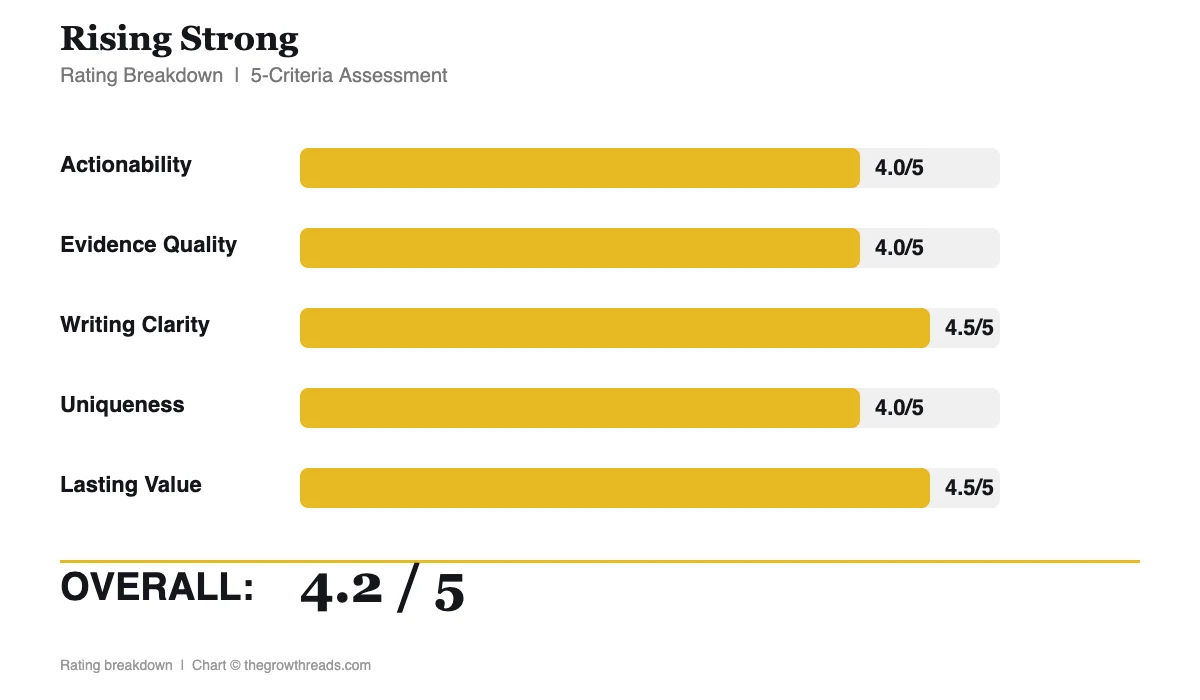
⭐⭐⭐⭐ 4.2 / 5
The essential sequel to Daring Greatly — a practical framework for getting back up after vulnerability knocks you down.
Best for: Anyone who has taken an emotional fall — in relationships, work, or parenting — and wants a structured process for turning failure into growth.
Reading time: ~6 hours (288 pages)
Difficulty to apply: Moderate — the framework is clear but the emotional work of questioning your own narratives is genuinely hard.
Rising Strong in one minute
If you are brave enough to dare greatly, you are going to fall — and Rising Strong is about how you get back up. Brene Brown completes the trilogy she began with The Gifts of Imperfection (the inner work) and Daring Greatly (the courage to be vulnerable) by addressing the question both books left unanswered: what happens when vulnerability does not go well? When you put yourself out there and get hurt, rejected, or blindsided, how do you recover without shutting down? Brown’s answer is a three-part process — the Reckoning, the Rumble, and the Revolution — built on one deceptively powerful move: writing down “the story I am making up” about what just happened, then interrogating that story for the fiction your brain invented to protect you. The result is not just recovery but transformation: people who rise strong do not return to who they were before the fall; they become someone braver.
Key takeaways
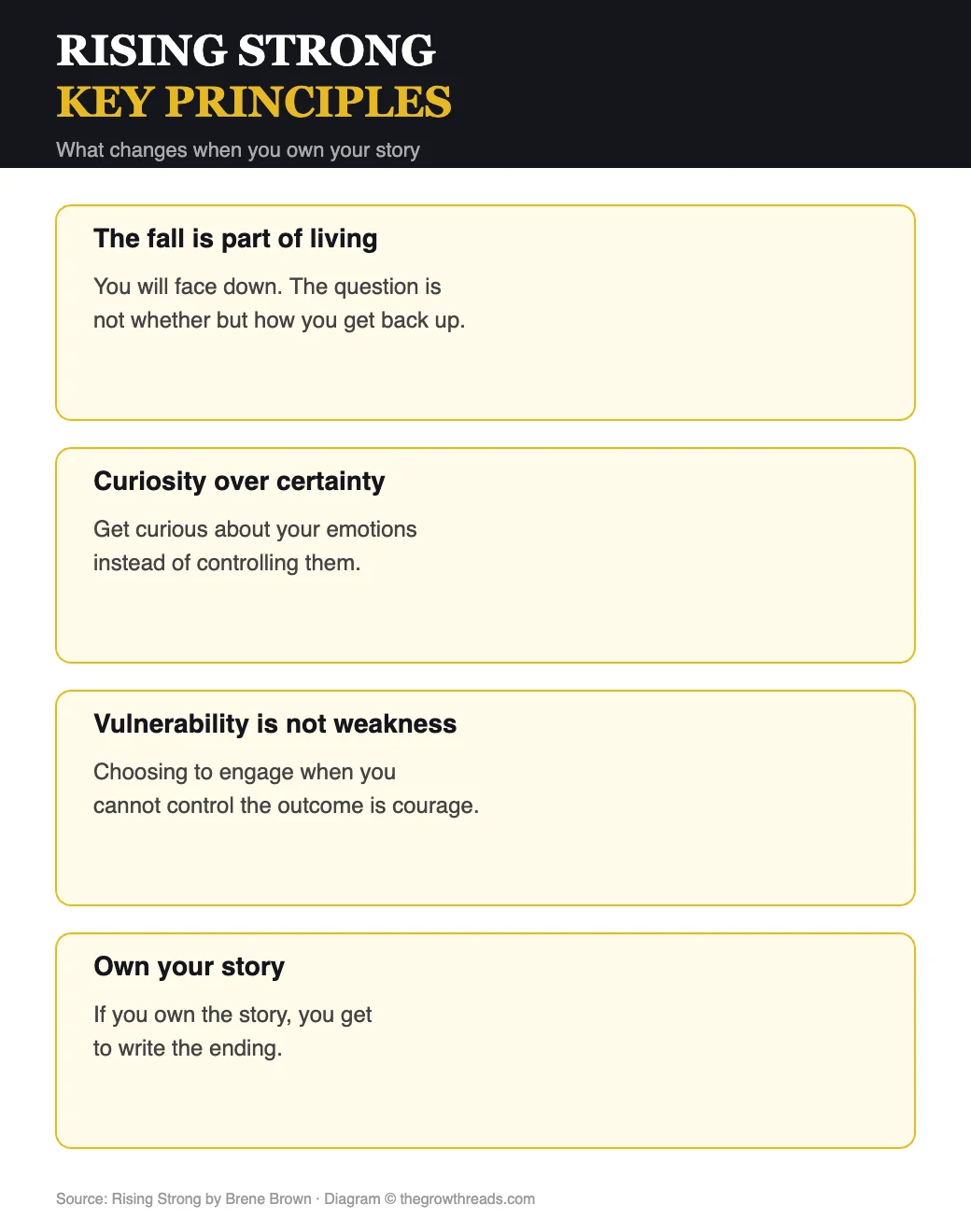
- The fall is not the failure: If you choose to be vulnerable (in love, creativity, leadership), you will get hurt. The fall is not the problem — refusing to get back up is.
- Your brain is a story machine: In the absence of complete information, your brain confabulates — it fills gaps with assumptions, usually fear-based. These “stormy first drafts” feel true but rarely are.
- Name the story you are making up: The single most powerful tool in the book. When you are emotionally triggered, say or write: “The story I am making up is…” This creates distance between you and your reactive narrative.
- Curiosity is the gateway: Getting curious about your emotional response — rather than numbing, controlling, or performing — is the entry point for the entire process.
- The Reckoning is recognition: Notice that you are in an emotional response. Most people skip this step, moving straight from trigger to reaction without awareness.
- The Rumble is the hard work: Challenge your SFD by asking: What do I actually know? What am I assuming? What am I feeling? What is my part in this? This is where you separate fact from fiction.
- The Revolution is integration: Once you have separated truth from story, you write a new ending that changes how you live, love, parent, and lead going forward.
- Boundaries are essential to empathy: Brown’s research found that the most compassionate people are also the most boundaried. You cannot be genuinely open if you have no limits.
- Nostalgia is a dangerous emotion: Romanticizing the past prevents honest reckoning with the present. Rising strong requires engaging with what is, not what was.
- Owning your story is the bravest thing you will ever do: If you do not own your story, it owns you. The process of writing and rewriting your narrative is how you reclaim agency.
What is Rising Strong about?
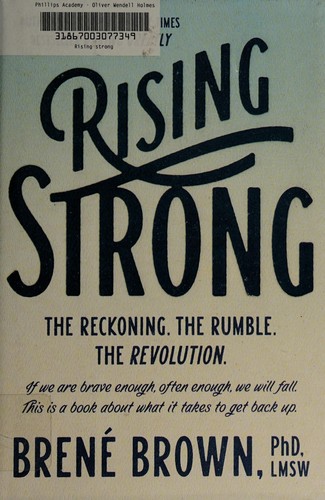
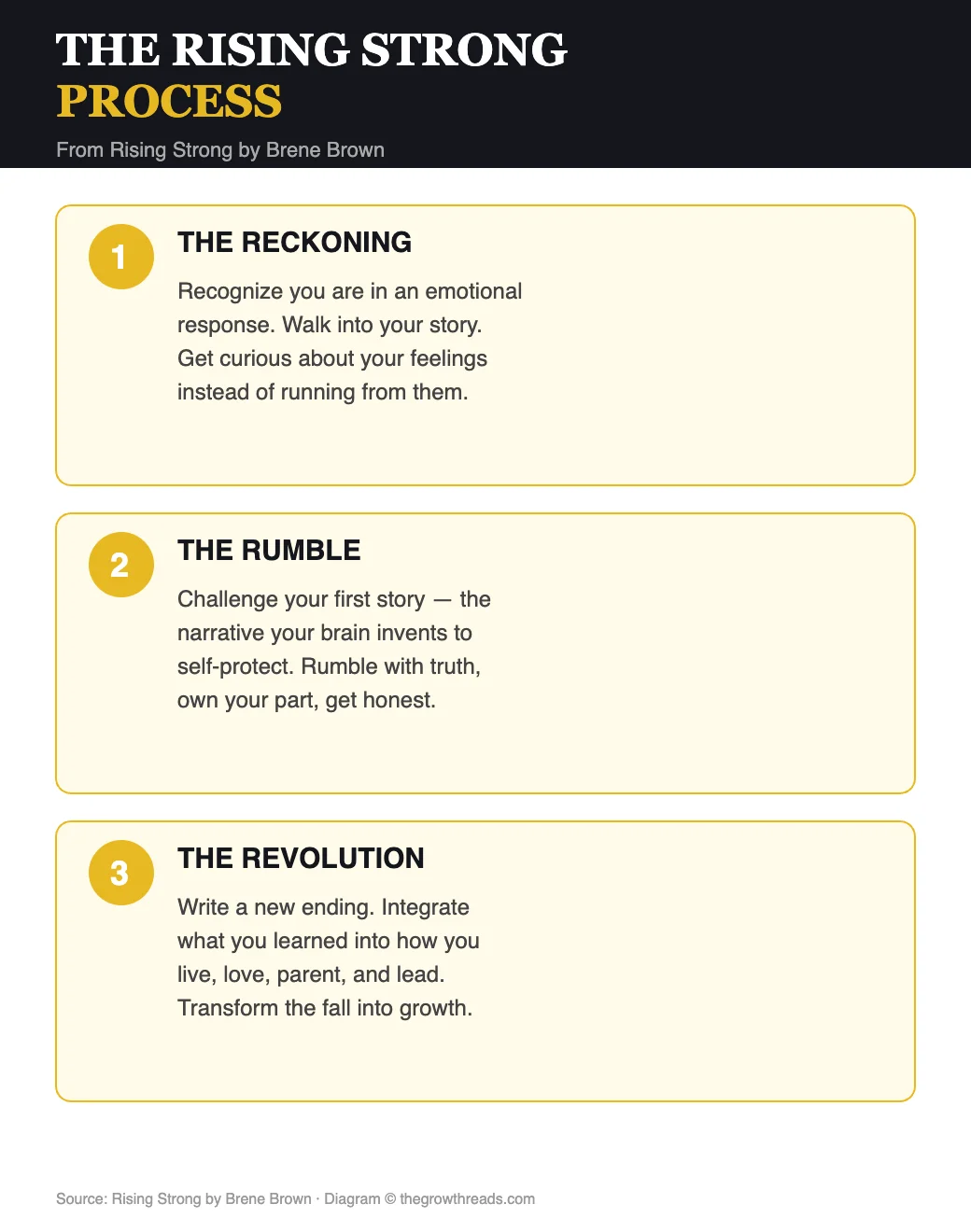
Rising Strong presents a three-part process for recovering from emotional falls — the Reckoning (recognizing you are triggered), the Rumble (challenging the story your brain invents), and the Revolution (integrating what you learn into lasting change). Brown uses research, personal stories, and case studies to show how questioning our self-protective narratives transforms setbacks into growth.
About the author
Brene Brown is a research professor at the University of Houston who has spent over two decades studying courage, vulnerability, shame, and empathy. Her 2010 TED talk “The Power of Vulnerability” has been viewed over 60 million times. Rising Strong is the third book in her vulnerability trilogy, following The Gifts of Imperfection and Daring Greatly. She holds the Huffington Foundation Endowed Chair at the Graduate College of Social Work, hosts two podcasts, and has a Netflix special. Her research is based on grounded theory methodology using thousands of qualitative interviews. She lives in Houston, Texas. Explore all Brené Brown book summaries →
Key concepts at a glance
| Concept | What it means | Use it when |
|---|---|---|
| The Reckoning | Recognizing you are in an emotional response and getting curious instead of reactive | Any moment you feel triggered, defensive, or shut down |
| The Rumble | Challenging the story your brain invented — separating fact from assumption | When your first interpretation of events feels absolute and painful |
| The Revolution | Writing a new ending based on truth rather than self-protective fiction | Integrating lessons from a fall into lasting behavioral change |
| SFD (Stormy First Draft) | The first narrative your brain creates to explain a painful event — almost always inaccurate | Anytime you catch yourself in a spiraling story about what just happened |
| Confabulation | The brain’s tendency to fill in missing information with assumptions rather than uncertainty | Understanding why your emotional stories feel true even when they are not |
| Delta (the Change) | The gap between your SFD and the truth — where growth lives | Measuring how much your understanding shifted through the rumble |
| Chandelier Pain | Pain so acute that touching it makes you jump — often hidden and often the real issue | When someone’s reaction seems disproportionate to the situation |
Part 1: The physics of vulnerability
Brown opens with a disarmingly simple observation: if you are brave enough to dare greatly — to be vulnerable in love, work, creativity, or leadership — you are going to get hurt. This is not a possibility; it is a certainty. The question is not how to avoid the fall but how to get back up when it happens.
She introduces the idea that most people respond to emotional falls in one of three ways: they shut down and refuse to engage (the armored response), they charge through without processing (the bulldozer response), or they numb themselves with work, food, alcohol, or distraction (the checked-out response). None of these produces growth. Rising strong requires a fourth path: walking into the pain with curiosity, questioning the stories you tell yourself about what happened, and emerging with a truer understanding of yourself and others.
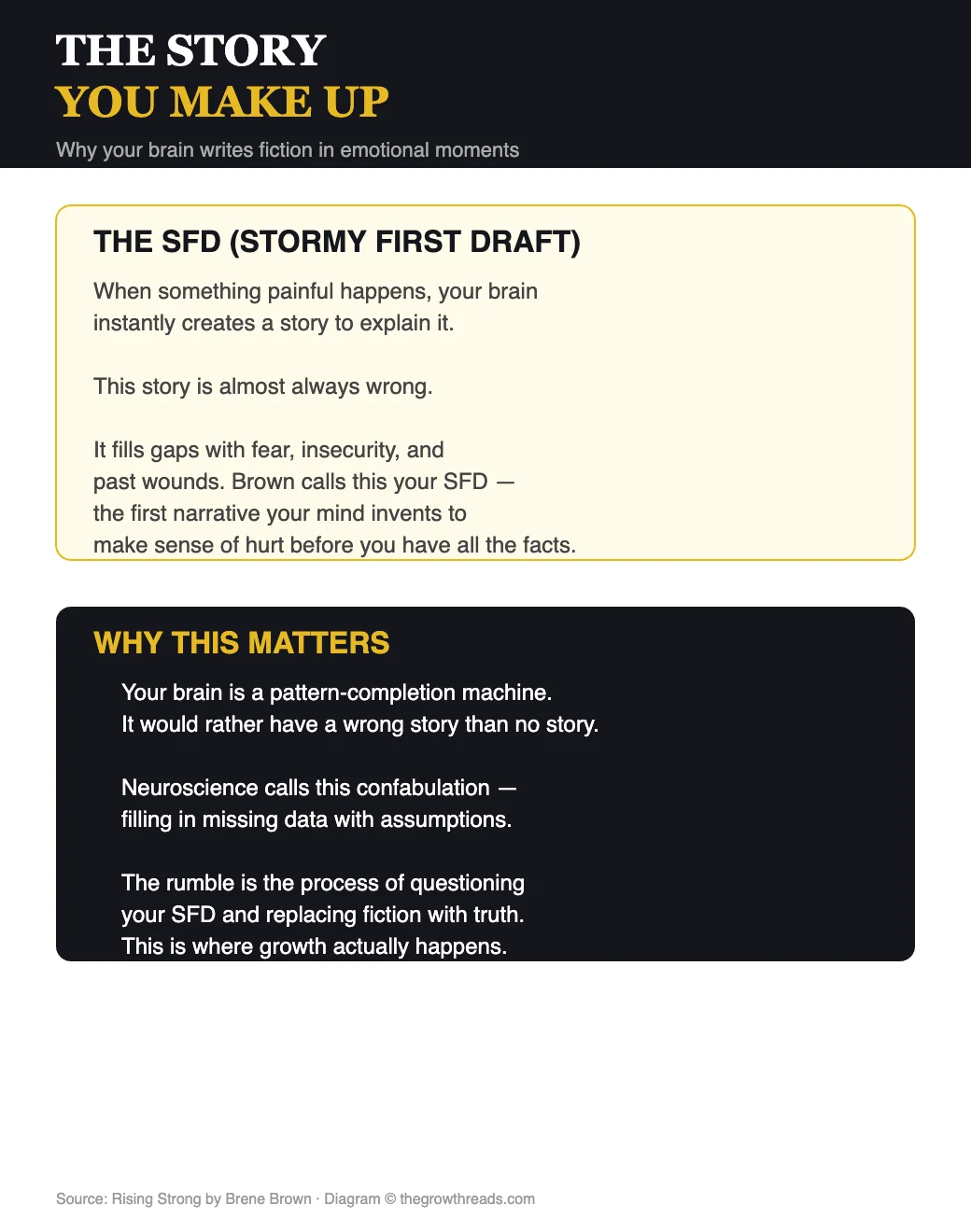
This framework rests on a critical neuroscience insight: the human brain is a pattern-completion machine. When it encounters incomplete information — which is most emotional situations — it does not tolerate ambiguity. Instead, it confabulates, filling in the gaps with assumptions drawn from your deepest fears, insecurities, and past wounds. The story your brain invents feels absolutely true, which is why it is so dangerous. The entire Rising Strong process is built around learning to recognize these stories as fiction and doing the harder work of finding what actually happened.
Part 2: The Reckoning — walking into your story
The Reckoning is the first step: recognizing that you are in an emotional response. This sounds simple, but most people move from trigger to reaction without any awareness of the gap between them. Brown describes the Reckoning as learning to notice the physical and emotional signals that indicate you have been hooked — the tightening in your chest, the heat in your face, the impulse to withdraw or attack.
The key practice is curiosity. Instead of running from the feeling, numbing it, or immediately acting on it, you get curious. What am I feeling? What triggered this? Brown emphasizes that this does not mean analyzing yourself into paralysis — it means creating enough space between the trigger and your response to make a conscious choice rather than an automatic reaction.
She shares stories from her own life — the time she spiraled into a shame storm after a speaking event, the moment she catastrophized about her marriage based on a misread facial expression — to show that even someone who has studied these patterns for decades still gets hooked. The difference is not that wholehearted people avoid emotional responses; it is that they recognize them faster and engage with them more honestly.
Part 3: The Rumble — challenging your stormy first draft
The Rumble is the most challenging and most transformative part of the process. It begins with Brown’s signature tool: writing down “the story I am making up is…” This deceptively simple phrase does something powerful — it acknowledges that what you are feeling and believing is a story, not necessarily the truth.
Brown calls this initial narrative the SFD — the “stormy first draft.” Your SFD is the story your brain generates within seconds of a painful event. It is usually populated by your deepest insecurities and rarely accounts for context, nuance, or the other person’s perspective. The Rumble is the process of interrogating this story by asking a series of questions: What do I actually know for certain? What am I assuming? What are my emotions telling me? What is my part in this? What do I need to learn?
The Rumble often reveals that your initial story was protecting you from a deeper truth you did not want to face. Brown gives the example of a professional setback where her SFD was “They don’t respect my work” — but the Rumble revealed the real issue was her own unexamined fear that she was not good enough. The SFD was armor; the truth underneath was the real material for growth.
Part 4: The Revolution — writing a new ending
The Revolution is what happens after the Rumble. Once you have separated the fiction in your SFD from the facts — once you have identified your assumptions, owned your part, and confronted the uncomfortable truths your brain was trying to protect you from — you write a new ending. This is not about putting a positive spin on painful events. It is about integrating what you learned into how you live, love, parent, and lead going forward.
Brown describes the Revolution as both personal and relational. Personally, it changes the way you respond to future triggers — you develop a habit of questioning your stories rather than acting on them. Relationally, it transforms how you engage with others during conflict. Instead of leading with accusations (which are always based on your SFD), you lead with curiosity: “The story I’m making up is… Help me understand what actually happened.”
She closes by connecting Rising Strong to the broader vulnerability trilogy. The Gifts of Imperfection teaches you to accept yourself. Daring Greatly teaches you to show up and be seen. Rising Strong teaches you to get back up when showing up does not go as planned. Together, they form a complete emotional resilience framework: accept, dare, fall, rise, repeat.
Who is Rising Strong best for — and who should read something else first?
Rising Strong is ideal for anyone who has read or experienced the power of vulnerability and then gotten hurt — and did not know what to do next. It is particularly valuable for people in emotionally complex relationships, leaders navigating team conflict, and anyone in a season of recovery after a significant setback. The writing is warm and personal, with Brown sharing her own falls alongside her research.
If you have not read Brown before, start with Daring Greatly — Rising Strong assumes you understand why vulnerability matters and focuses on what to do when it costs you. If your primary challenge is communication rather than emotional processing, Crucial Conversations provides the tactical tools. And if you want a deeper dive into how stories shape identity, Maybe You Should Talk to Someone pairs beautifully.
Questions to reflect on
- Think of a recent conflict or emotional trigger — what was the SFD your brain wrote, and how much of it can you verify as fact?
- Which of the three common fall responses do you default to — shutting down, bulldozing through, or numbing — and what does that pattern cost you?
- If you used “The story I am making up is…” in your next difficult conversation, how might it change the outcome?
- What is one painful experience from your past where you never completed the Rumble — and what might change if you did?
- Brown says the most compassionate people are the most boundaried. Where in your life are you over-giving without boundaries and calling it empathy?
🔥 Ready to learn how to get back up?
Rising Strong gives you the process for turning emotional falls into the most transformative moments of your life.
How to apply Rising Strong (7-day plan)
- Day 1 — Learn your fall pattern: Reflect on your last three emotional setbacks. Did you shut down, bulldoze, or numb? Write down your default pattern and what it costs you.
- Day 2 — Practice the Reckoning: Set an intention to notice emotional triggers today. When one hits, pause and name the feeling before responding. Just notice — no action required.
- Day 3 — Write your first SFD: Choose a current situation that is bothering you. Write “The story I am making up is…” and let yourself write the full, uncensored narrative your brain is running.
- Day 4 — Rumble with your SFD: Take yesterday’s story and ask: What do I actually know? What am I assuming? What is my part? Where is the fiction? Write a revised version based on what you can verify.
- Day 5 — Use it in conversation: In a low-stakes interaction today, try saying “The story I’m making up is…” and see how the other person responds. Notice how naming your story changes the dynamic.
- Day 6 — Identify your chandelier pain: Write about one topic that triggers a disproportionate emotional response. Get curious about what deeper wound might be underneath.
- Day 7 — Write your new ending: Look at the SFD from Day 3 and the revised story from Day 4. Write a paragraph about what this experience taught you and how it changes the way you want to show up going forward.
Frequently asked questions
How is Rising Strong different from Daring Greatly?
Daring Greatly is about why vulnerability matters and how to show up courageously. Rising Strong is about what to do when showing up does not go well — when vulnerability leads to failure, heartbreak, or rejection. Think of Daring Greatly as learning to step into the arena and Rising Strong as learning to get back up after you get knocked down. Together with The Gifts of Imperfection, they form a complete trilogy on emotional resilience.
What is the SFD and why does it matter?
The SFD — stormy first draft — is the first story your brain writes about a painful event. It matters because this story is almost always inaccurate: your brain fills gaps with fear-based assumptions rather than facts. The SFD feels completely true, which is why people act on it without questioning it. Learning to recognize your SFD as a draft rather than the final version is the single most transformative skill in the book, because it creates space between what happened and how you respond.
Can you use “the story I’m making up” with other people?
Yes, and Brown strongly encourages it. Saying “The story I’m making up is…” in a difficult conversation does two things: it owns your narrative as a story rather than presenting it as fact, and it invites the other person to help you understand what actually happened. It disarms defensiveness because you are not accusing — you are sharing your experience and asking for theirs. Brown reports that this single phrase has transformed countless relationships and team dynamics.
What is confabulation?
Confabulation is a neuroscience term for the brain’s tendency to fill in missing information with made-up explanations rather than tolerating uncertainty. Your brain would rather have a wrong story than no story at all, because narratives help you feel in control. In emotional situations, confabulation draws heavily on your deepest fears and past wounds, which is why your SFD often reflects your insecurities more than the actual situation. Understanding confabulation helps you take your first stories less literally.
What is chandelier pain?
Chandelier pain is Brown’s term for pain so acute that even lightly touching it makes you jump — like hitting your head on a chandelier. It refers to hidden emotional wounds that produce disproportionate reactions to seemingly small triggers. Someone who explodes when given feedback might be carrying chandelier pain from a childhood of harsh criticism. Recognizing chandelier pain — in yourself and others — is essential for understanding why reactions sometimes seem out of proportion to the situation.
Is Rising Strong based on research?
Yes. Like all of Brown’s work, Rising Strong is grounded in her qualitative research using grounded theory methodology. She interviewed thousands of participants about their experiences with failure, disappointment, and emotional recovery. The three-phase process (Reckoning, Rumble, Revolution) emerged from patterns in this data, not from theory. She also draws on neuroscience research on confabulation and emotional regulation to explain why the brain behaves the way it does during falls.
Do I need to read the other Brown books first?
It helps but is not strictly necessary. Rising Strong assumes you accept the premise that vulnerability is essential (the core argument of Daring Greatly), and it builds on the self-acceptance work of The Gifts of Imperfection. Reading the trilogy in order provides the most complete experience. However, Rising Strong stands alone as a practical guide to emotional recovery, and Brown provides enough context within the book that new readers will not feel lost.
Related summaries
- Daring Greatly Summary — Brown’s guide to showing up and being vulnerable in leadership, love, and life.
- Crucial Conversations Summary — Patterson and Grenny on navigating high-stakes emotional conversations.
- Maybe You Should Talk to Someone Summary — Lori Gottlieb on how the stories we tell shape who we become.
- Nonviolent Communication Summary — Marshall Rosenberg on compassionate communication that connects rather than divides.
📚 Explore the full Relationships collection
This summary is part of our best relationship books series — 40 in-depth reviews on communication, intimacy, boundaries, and building deeper connections.