

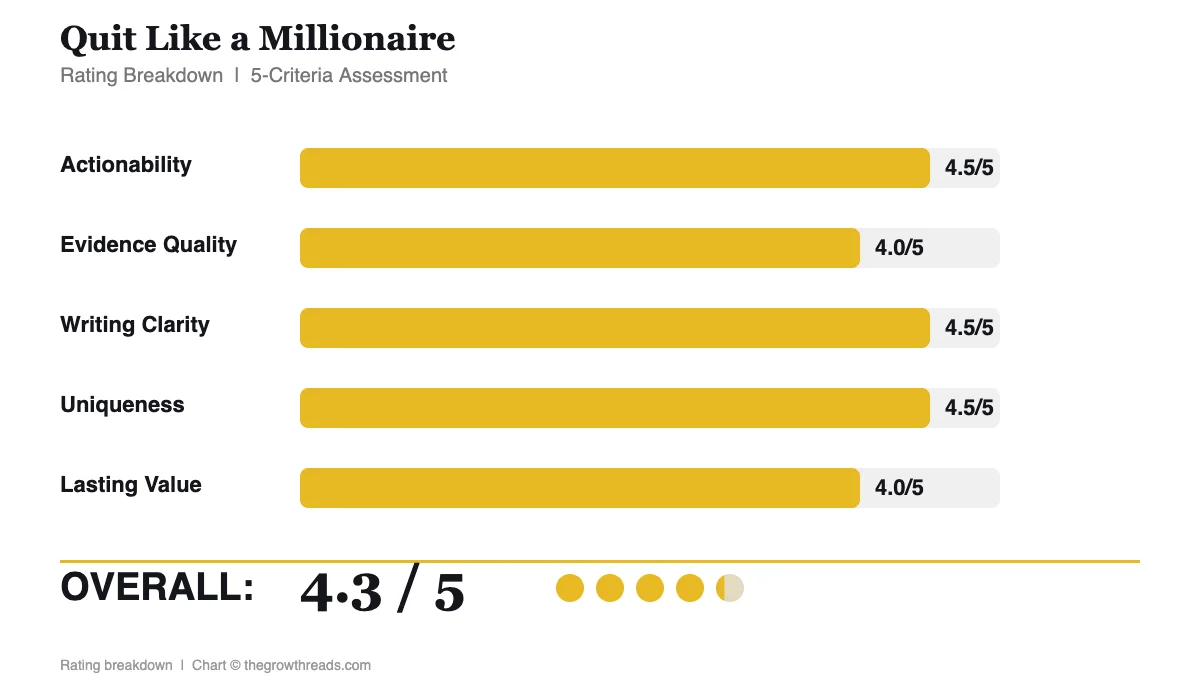
⭐⭐⭐⭐ 4.3 / 5
A refreshingly data-driven guide to financial independence that proves you do not need a six-figure salary — you need a high savings rate and low-cost index funds.
Best for: Anyone curious about the FIRE movement who wants a math-first, no-nonsense roadmap to making work optional.
Reading time: ~6 hours (288 pages)
Difficulty to apply: Moderate — requires sustained lifestyle changes and consistent investing, but the steps are concrete and sequential.
Quit Like a Millionaire in one minute
You do not need to be rich to retire early — you need to be strategic. Kristy Shen grew up in rural China so poor her family regularly dug through trash for food. She immigrated to Canada, became a computer engineer, and by age 31 had built a million-dollar portfolio that generates enough passive income to cover her living expenses worldwide. This book is the exact playbook she and her husband Bryce Leung used to do it — no inheritance, no real estate gambles, no stock-picking. Instead, they optimized the three biggest expenses (housing, transportation, food), crushed their debt using math rather than emotion, invested exclusively in low-cost index funds, and built a two-layer safety net they call the Cash Cushion and Yield Shield. The result is a system anyone can replicate regardless of income level, because the variable that matters most is not how much you earn but how much you keep.
Key takeaways
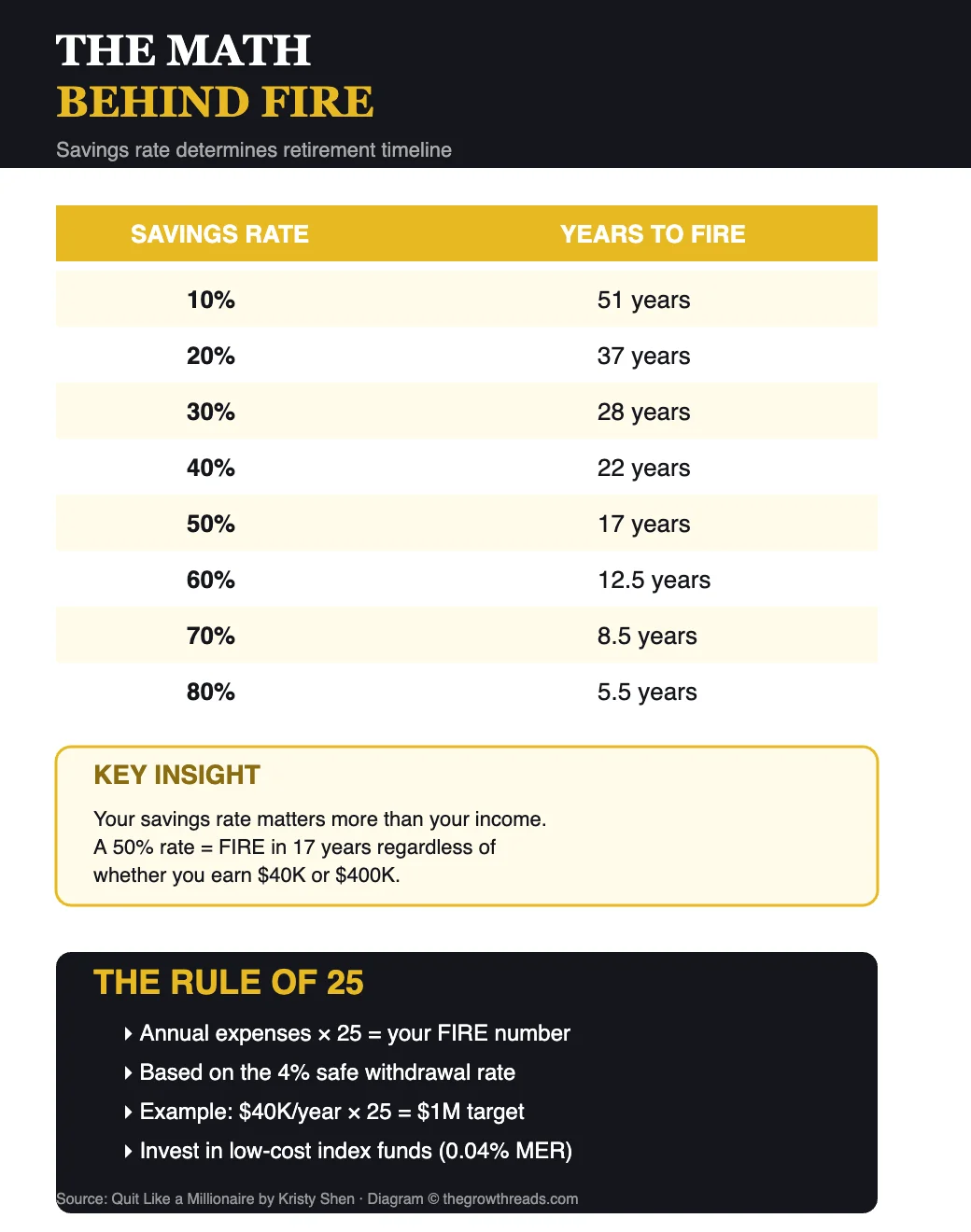
- Savings rate trumps income: A person saving 50% of their income will reach financial independence in roughly 17 years regardless of whether they earn $40,000 or $400,000. The math is the same.
- Optimize the Big Three: Housing, transportation, and food consume the majority of most budgets. Cutting these strategically — not through deprivation but through smarter choices — is where the real savings come from.
- Use the Rule of 25: Multiply your annual expenses by 25 to calculate your FIRE number. Once your portfolio reaches that figure, you can safely withdraw 4% per year indefinitely.
- Index funds beat stock-picking: Low-cost, broadly diversified index funds outperform the vast majority of actively managed funds over time. Keep your management expense ratio under 0.5%.
- Debt is an emergency: Pay off high-interest debt using the avalanche method (highest interest rate first). The math proves this saves the most money regardless of how it feels emotionally.
- Build a Yield Shield: Before retiring, construct a portfolio layer of dividend-paying ETFs, REITs, and bonds that generates 3-4% annual yield to cover living expenses without selling shares.
- Maintain a Cash Cushion: Keep 3-5 years of living expenses in cash to ride out market downturns without being forced to sell at a loss — this neutralizes sequence-of-returns risk.
- Travel hacking slashes costs: Credit card points and geographic arbitrage can reduce living costs by 30-50% in retirement, making your portfolio last even longer.
- Passion is overrated career advice: Shen argues that following your passion is financially dangerous. Instead, use a cost-benefit analysis comparing tuition costs against expected lifetime earnings (the POT Score) before choosing a career path.
- Fear is the biggest obstacle: Most people who could achieve financial independence never try because they cannot imagine a life outside the conventional earn-spend-retire-at-65 framework.
What is Quit Like a Millionaire about?
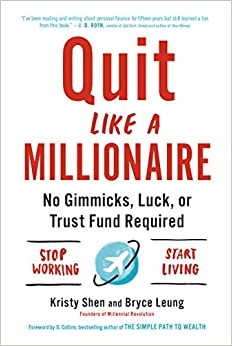
Quit Like a Millionaire is a step-by-step guide to achieving financial independence and early retirement using index fund investing, aggressive savings optimization, and a two-layer withdrawal strategy called the Cash Cushion and Yield Shield. Written by Kristy Shen and Bryce Leung, it draws on their personal journey from middle-class salaries to retiring at 31 with a seven-figure portfolio.
About the author
Kristy Shen grew up in Sichuan Province, China, where her family lived on 44 cents a day. After immigrating to Canada, she studied computer engineering at the University of Waterloo and worked as a software developer. Together with her husband Bryce Leung — also a computer engineer and co-author — she applied relentless optimization to their finances, reaching a net worth of one million dollars by age 31. The couple retired in 2015 and have since traveled to over 40 countries while their portfolio continues to grow. They run the popular blog Millennial Revolution and have been featured in CBC, The Globe and Mail, Business Insider, CNBC, and the New York Times. JL Collins, author of The Simple Path to Wealth, wrote the foreword. Explore all Bryce Leung book summaries →
Key concepts at a glance
| Concept | What it means | Use it when |
|---|---|---|
| POT Score | Pay-Over-Tuition ratio — compare expected lifetime earnings to education cost | Choosing a degree or career change |
| Rule of 25 | Annual expenses × 25 = your FIRE target number | Setting your retirement savings goal |
| 4% Rule | Withdraw 4% of your portfolio annually and it should last 30+ years | Planning retirement withdrawals |
| Yield Shield | Dividend/interest income that covers living expenses without selling shares | Building your pre-retirement portfolio |
| Cash Cushion | 3-5 years of expenses in cash to survive market crashes | Protecting against sequence-of-returns risk |
| Geographic Arbitrage | Living in low-cost countries while earning or withdrawing in stronger currencies | Stretching your portfolio further in retirement |
| Travel Hacking | Using credit card rewards and points to reduce travel costs by 30-50% | Cutting expenses during early retirement travel |
| Avalanche Method | Pay off debts starting with the highest interest rate first | Eliminating debt as fast and cheaply as possible |
Part 1: The poverty trap and the education gamble
Shen opens with her childhood in rural China, where her family survived on the equivalent of 44 cents a day. She recounts digging through garbage for soda cans to recycle and watching her father calculate whether they could afford a single Coca-Cola. This is not a rags-to-riches story meant to inspire through exceptionalism — it is context for her core argument: poverty taught her that every dollar has weight, and that lesson became her greatest financial advantage.
When her family immigrated to Canada, Shen faced a critical decision about education. She introduces the POT Score (Pay-Over-Tuition), a formula that divides the expected increase in lifetime earnings by the total cost of a degree. A POT Score above 1.0 means the degree pays for itself; below 1.0 means you are paying for a credential that will not earn back its cost. She argues that many popular degrees — particularly in the arts and humanities — score well below 1.0, making them financially dangerous choices regardless of passion.
This framework directly challenges the conventional wisdom of following your passion. Shen does not dismiss passion entirely, but she insists that passion should follow financial security, not precede it. She chose computer engineering specifically because it had one of the highest POT Scores available, then used her engineering salary to build the foundation for early retirement.
Part 2: Optimizing the Big Three and crushing debt
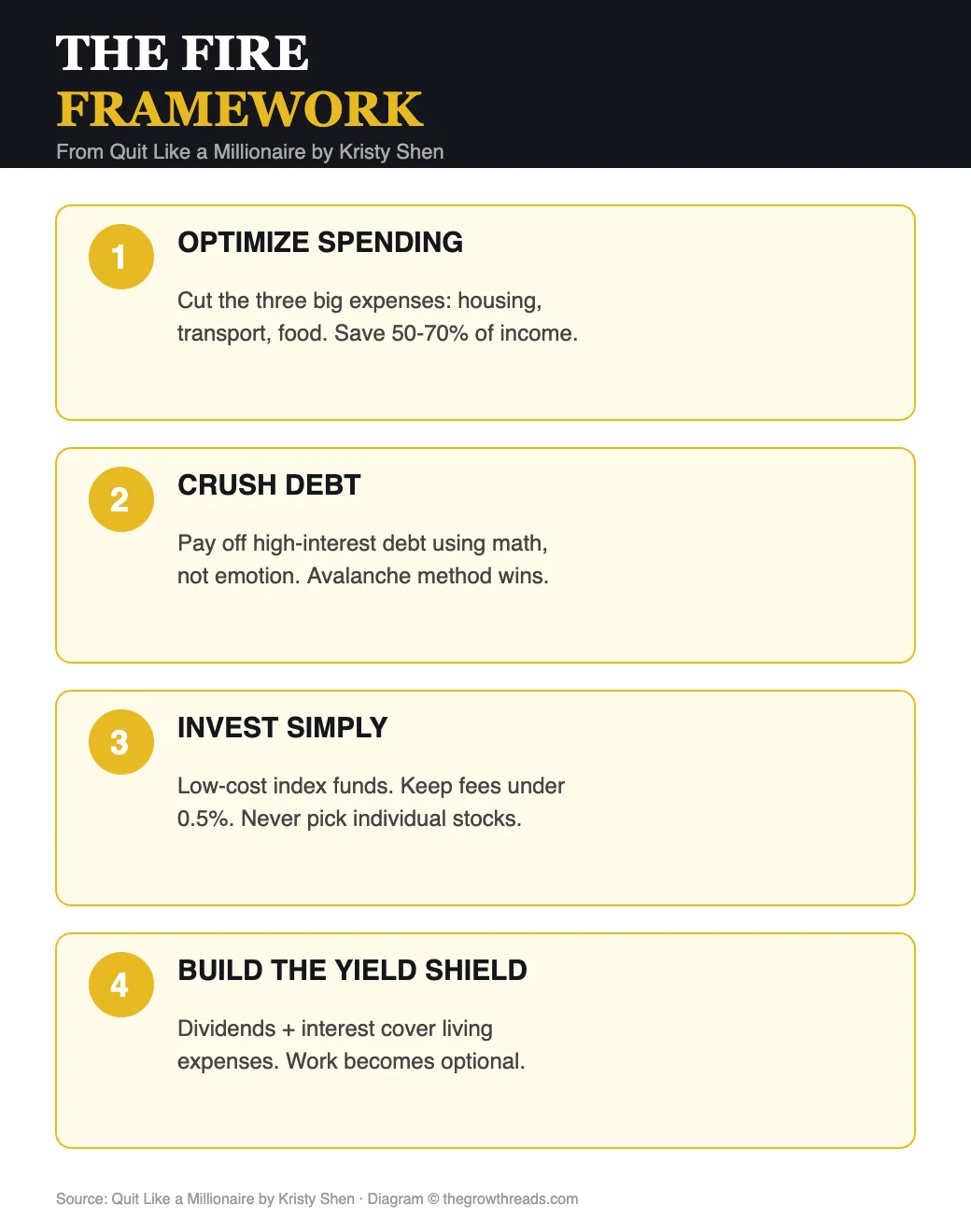
With a solid income established, Shen turns to the spending side of the equation — and this is where the book becomes genuinely actionable. She identifies the three expenses that consume the majority of most people’s budgets: housing, transportation, and food. Rather than suggesting you skip lattes (a jab at David Bach’s famous advice), she demonstrates that optimizing these three categories alone can shift your savings rate from 10% to 50% or higher.
For housing, Shen controversially argues against homeownership in many markets. She introduces the Rule of 150 — if the monthly cost of owning (mortgage, taxes, insurance, maintenance) exceeds 150% of renting the same property, renting is the mathematically superior choice. She backs this with detailed calculations showing that the opportunity cost of a down payment, when invested in index funds instead, often produces greater returns than home appreciation.
On debt, Shen is unequivocal: treat it as an emergency. She advocates the avalanche method — paying off the highest-interest debt first — because it minimizes total interest paid. She acknowledges the psychological appeal of the snowball method (smallest balance first) but argues that math should override feelings when the stakes are this high.
Part 3: The investment engine — index funds and the 4% rule
The investing section of Quit Like a Millionaire is refreshingly simple. Shen and Leung argue that the entire complexity of Wall Street exists to extract fees from investors, and that the evidence overwhelmingly supports a single strategy: buy and hold low-cost, broadly diversified index funds.
They walk through the math of why actively managed funds underperform their benchmarks over time. The primary culprit is fees — a management expense ratio (MER) of 2% might sound small, but compounded over 30 years it can consume nearly half your returns. They recommend keeping total fees below 0.5% and suggest specific asset allocations ranging from 60/40 to 80/20 stocks-to-bonds depending on risk tolerance and timeline.
The centerpiece of their investment strategy is the 4% Rule, derived from the Trinity Study. If your portfolio equals 25 times your annual expenses (the Rule of 25), you can withdraw 4% per year and the portfolio should survive for at least 30 years with a 95% success rate. For a couple spending $40,000 per year, the target is $1 million. Shen emphasizes that this number is based on expenses, not income — which is why reducing expenses has a double effect: it both increases your savings rate and lowers your FIRE target.
Part 4: The safety net — Cash Cushion and Yield Shield
This is the most original section of the book and the one that distinguishes Shen’s approach from standard FIRE advice. Most early retirement guides stop at “build your portfolio to 25x expenses and withdraw 4%.” Shen goes further by addressing the biggest risk in early retirement: sequence-of-returns risk — the danger that a market crash in your first few years of retirement could permanently deplete your portfolio.
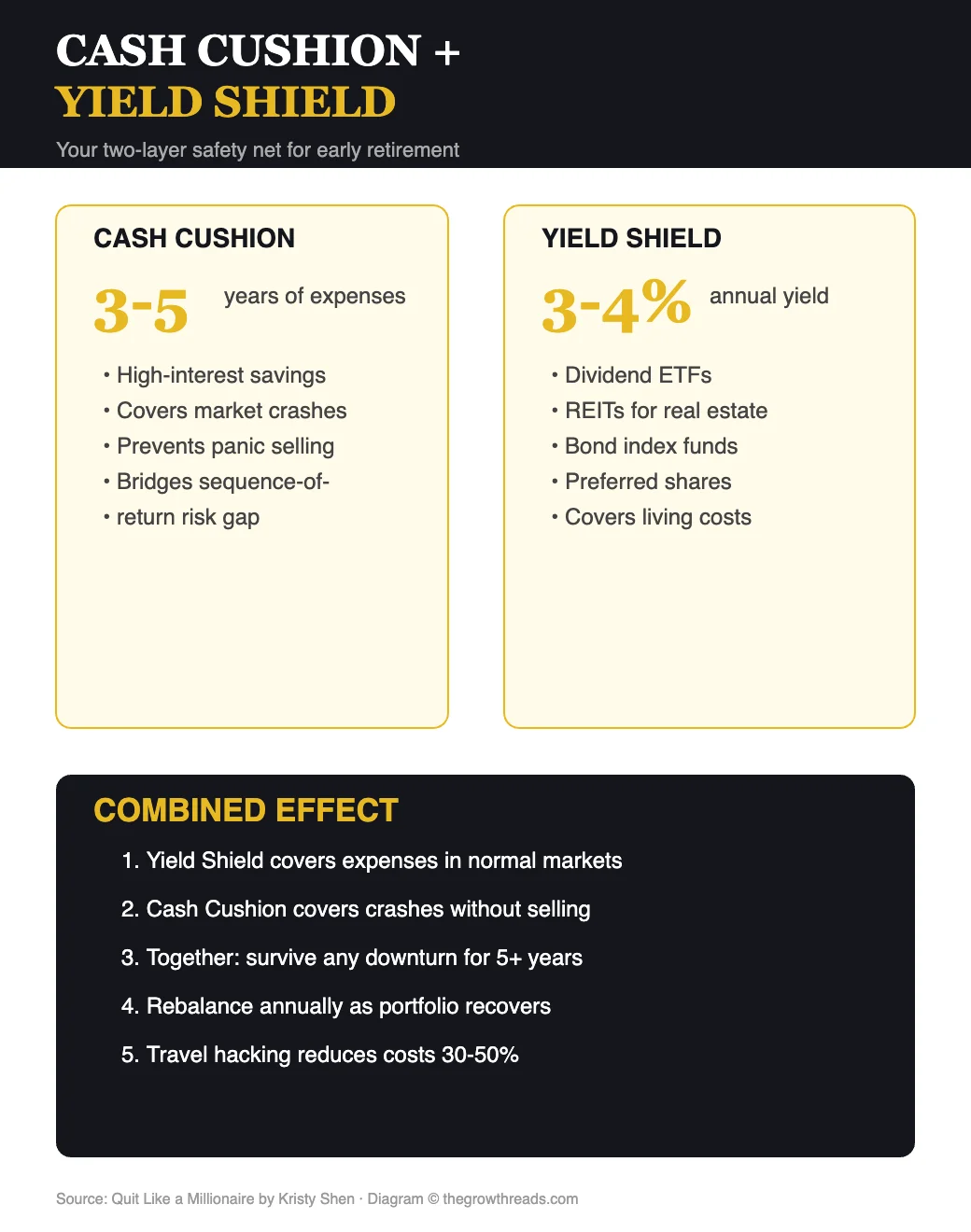
Her solution is a two-layer safety net. The Yield Shield is a portfolio allocation designed to generate enough passive income (dividends, interest, REIT distributions) to cover annual living expenses without selling any shares. She targets a 3-4% yield by including dividend-focused ETFs, REITs, preferred share ETFs, and bond index funds alongside the core equity holdings.
The Cash Cushion is a separate reserve of 3-5 years of living expenses held in high-interest savings accounts. During a market downturn, instead of selling depreciated shares, you draw from this cash reserve. Once the market recovers, you replenish the cushion. This combination means that even in the worst historical market scenarios, you would never be forced to sell at a loss.
Shen also covers geographic arbitrage — living in countries with lower costs of living while withdrawing from a portfolio denominated in a stronger currency. She and Leung have spent extended periods in Southeast Asia, Eastern Europe, and South America, where their $40,000 annual budget provides a comfortable lifestyle. Combined with travel hacking (using credit card points for flights and hotels), their actual out-of-pocket costs are even lower than the 4% withdrawal suggests.
Who is Quit Like a Millionaire best for — and who should read something else first?
Quit Like a Millionaire is ideal for anyone earning a middle-class income who suspects there might be a faster path to financial freedom than the traditional 40-year career. It is especially powerful for engineers, tech workers, and high-income professionals who have the earnings but lack a strategic framework for converting that income into permanent freedom. The tone is direct and numbers-heavy, which will appeal to analytical thinkers.
If you are completely new to personal finance and need a gentler introduction, start with I Will Teach You to Be Rich by Ramit Sethi, which covers the same automation principles with a more lifestyle-friendly approach. If you are already sold on index fund investing and want deeper portfolio construction, The Simple Path to Wealth by JL Collins goes further into asset allocation. And if your primary challenge is mindset rather than math, The Psychology of Money by Morgan Housel is the essential companion read.
Questions to reflect on
- What is your current savings rate, and what would need to change in your Big Three expenses (housing, transportation, food) to raise it by 10 percentage points?
- If you calculated your POT Score before choosing your career or degree, would the math have changed your decision?
- How much of your resistance to the idea of early retirement comes from genuine preference for your work versus fear of the unknown?
- If you applied the Rule of 150 to your current housing situation, does owning or renting come out ahead?
- What would you actually do with your time if work became optional tomorrow — and how confident are you that you would find that life fulfilling?
🔥 Ready to make work optional?
Quit Like a Millionaire gives you the exact math, strategy, and safety nets to achieve financial independence — no trust fund required.
How to apply Quit Like a Millionaire (7-day plan)
- Day 1 — Calculate your FIRE number: List your monthly expenses, multiply by 12 to get annual expenses, then multiply by 25. This is the portfolio size that makes work optional.
- Day 2 — Audit the Big Three: Calculate exactly what percentage of your income goes to housing, transportation, and food. Identify one optimization in each category you could implement this month.
- Day 3 — Run the debt avalanche: List all debts by interest rate. Set up automatic extra payments to the highest-rate debt while maintaining minimums on the rest.
- Day 4 — Open a brokerage account: If you do not already have one, open an account with a low-cost provider and purchase your first total stock market index fund.
- Day 5 — Automate your savings: Set up automatic transfers from your checking account to your investment account on payday. Start with whatever you can, then increase by 1% each month.
- Day 6 — Calculate your savings rate: Divide your monthly savings (including investments) by your gross income. Write this number down and commit to tracking it monthly.
- Day 7 — Project your timeline: Using the savings-rate-to-years table from the book, determine how many years you are from financial independence. Then identify the single biggest lever that would shorten that timeline.
Frequently asked questions
Is Quit Like a Millionaire only for high-income earners?
No. While Shen and Leung had engineering salaries, the core principle — that savings rate matters more than income — applies at any income level. Someone earning $50,000 who saves 50% will reach financial independence before someone earning $200,000 who saves 10%. The book provides optimization strategies for every budget level, and geographic arbitrage means your portfolio can stretch further in lower-cost regions. The math works regardless of your starting salary.
What is the 4% rule and does it actually work?
The 4% rule comes from the Trinity Study, which analyzed historical market data and found that a portfolio of stocks and bonds can sustain a 4% annual withdrawal rate for at least 30 years with a 95% success rate. Shen strengthens this with her Cash Cushion and Yield Shield, which protect against the main vulnerability — a market crash early in retirement. Updated research continues to support the rule, though some financial planners now suggest 3.5% for greater safety margins.
Is the book against homeownership?
Not universally. Shen argues against the blanket assumption that buying is always better than renting. She provides the Rule of 150 as a decision framework: if owning costs more than 150% of renting the equivalent property, the math favors renting and investing the difference. In some markets homeownership makes financial sense; in expensive cities with high price-to-rent ratios, it often does not. Her point is to run the numbers rather than follow cultural assumptions.
What is the Cash Cushion and Yield Shield?
These are two complementary strategies for surviving market downturns in early retirement. The Yield Shield is a portfolio layer (dividend ETFs, REITs, bonds) designed to generate 3-4% annual income without selling shares. The Cash Cushion is 3-5 years of living expenses held in cash savings. Together, they ensure you never need to sell investments at a loss during a crash — the yield covers normal years, and the cash covers bad ones.
How long did it take the authors to reach financial independence?
Kristy Shen and Bryce Leung reached a net worth of one million dollars by age 31, roughly nine years after starting their engineering careers. Their savings rate averaged around 50-70% during their accumulation years. They officially retired in 2015 and have since traveled to more than 40 countries while their portfolio has continued to grow, even through the COVID-19 market crash — a real-world stress test of their Cash Cushion strategy.
What is the POT Score and how do I calculate mine?
The POT Score (Pay-Over-Tuition) divides the expected increase in lifetime earnings from a degree by the total cost of obtaining that degree (tuition, fees, living expenses, opportunity cost). A score above 1.0 means the degree is likely to pay for itself; below 1.0 means you may never recoup the investment. Shen uses it to argue that career decisions should be financially informed, not purely passion-driven — especially when student debt is involved.
Do Shen and Leung still travel full-time?
As of their most recent updates, Shen and Leung continue to travel extensively, though they have established semi-permanent bases in several countries. Their blog Millennial Revolution documents their ongoing journey and provides annual portfolio updates showing their net worth trajectory. They have maintained their lifestyle through multiple market corrections, including the 2020 crash, validating the durability of their Cash Cushion and Yield Shield approach.
Related summaries
- The Simple Path to Wealth Summary — JL Collins on index fund investing and the simplest route to financial independence.
- The Psychology of Money Summary — Morgan Housel on why behavior matters more than knowledge in building wealth.
- Die With Zero Summary — Bill Perkins on the opposite end of the spectrum: spending strategically before you run out of time.
- Financial Freedom Summary — Grant Sabatier on reaching financial independence through side hustles and investing.
📚 Explore the full Money collection
This summary is part of our best money books series — 40 in-depth reviews to help you earn, save, invest, and build lasting wealth.