

★★★★★ 4.7/5 — A no-nonsense system for deciding what deserves your time across every part of your life, not just your inbox.
Best for: Readers who want a structured, beginner-friendly framework that treats time management as whole-life management, not just a productivity hack.
Reading time: ~6 hrs full book (this guide: ~9 min)
Difficulty to apply: Easy — the seven-step process and ten categories can be started the same day.
Master Your Time, Master Your Life in one minute
Time management is not really about the clock — it’s about deciding, deliberately, which parts of your life get your best hours. Brian Tracy’s Master Your Time, Master Your Life expands on the discipline he’s taught for decades: sort your life into ten distinct categories (career, family, health, money, and more), decide what you actually want in each one, write it down as a goal, and build a repeatable process for turning that written goal into daily action. The book is less about squeezing more tasks into a day and more about making sure the tasks you do choose are pointed at a life you’d actually choose, if you stopped to think about it.
Key takeaways
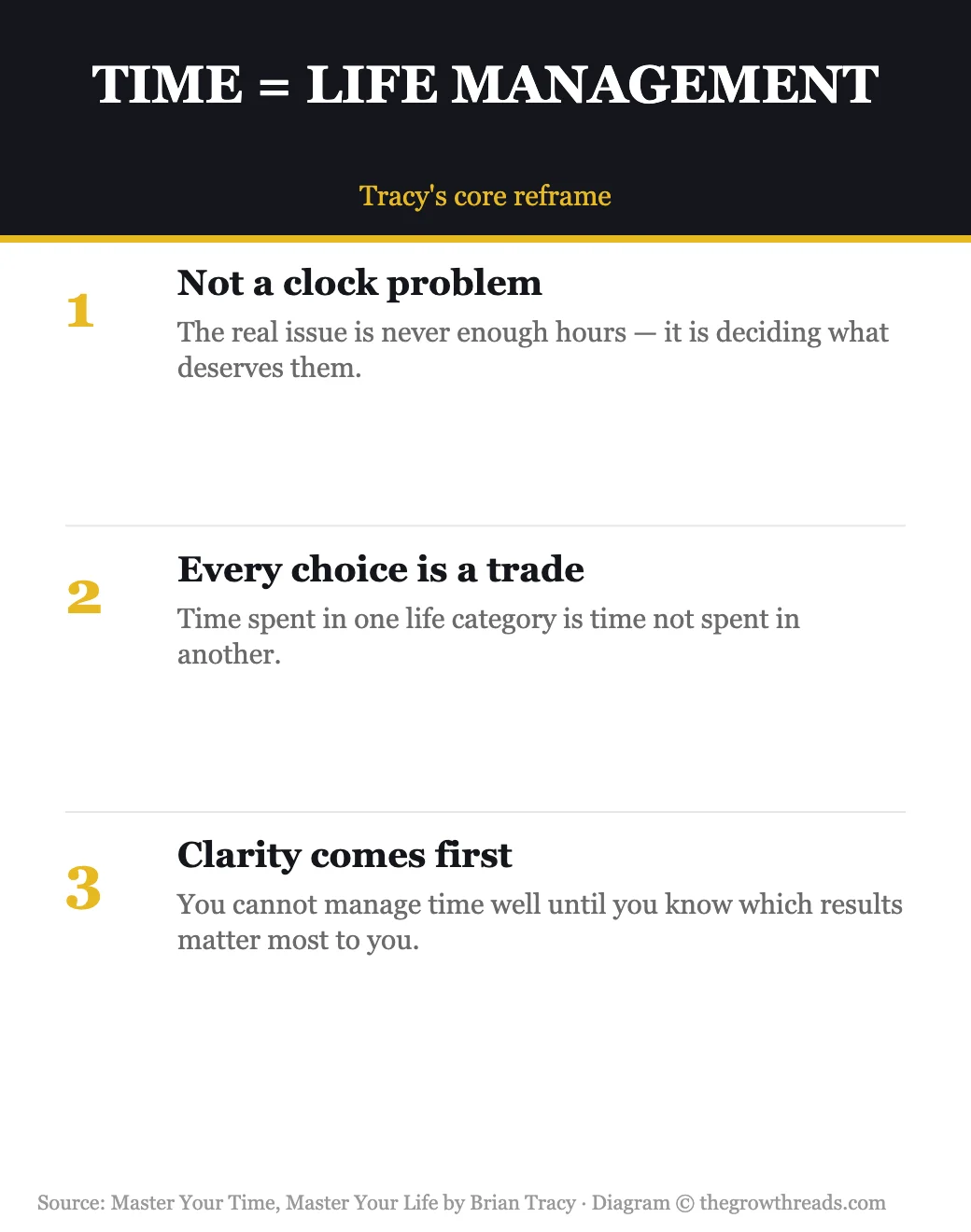
- Time management is life management: how you spend your hours is, cumulatively, how you spend your life — so the categories you neglect quietly become the life you didn’t choose.
- Ten categories, one life: Tracy organizes a whole life into ten priority areas so that career ambition doesn’t quietly crowd out health, family, or personal growth.
- Unwritten goals are just wishes: a goal that isn’t on paper has no deadline, no accountability, and rarely survives contact with a busy week.
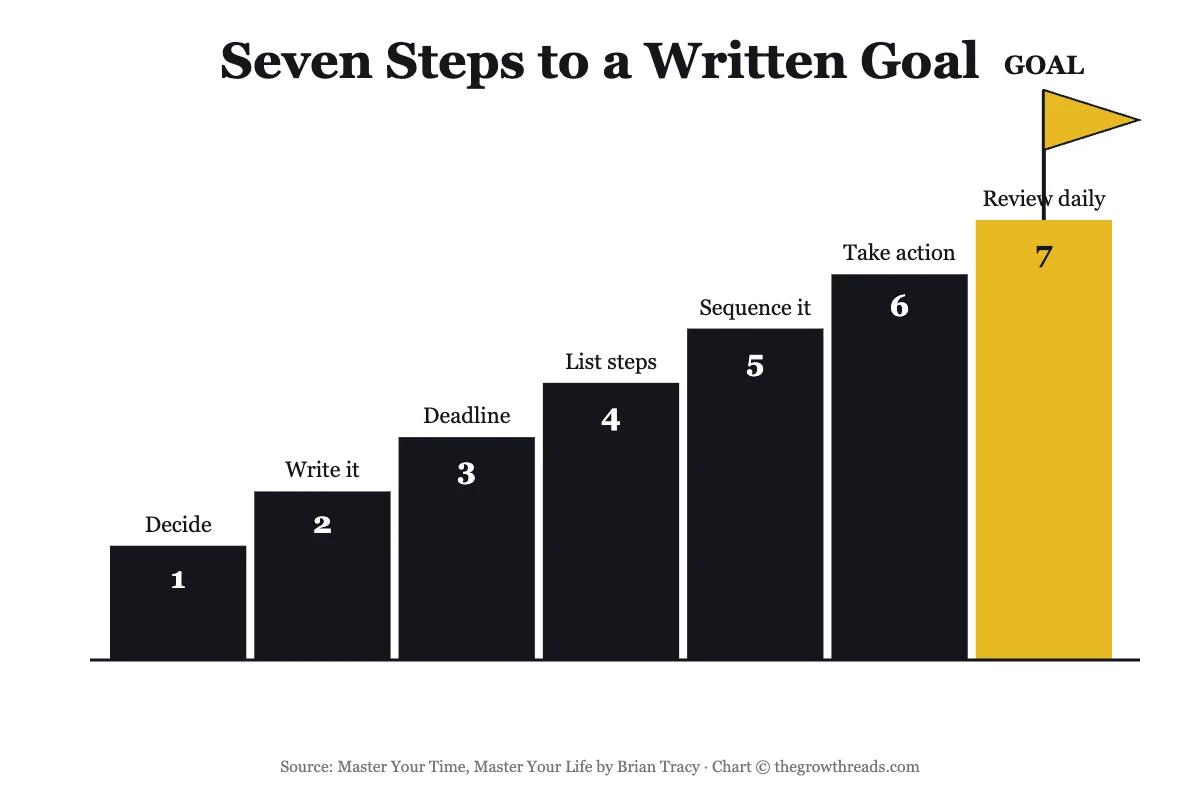
- The seven-step process: decide, write it down, set a deadline, list every step, put the list in order, take action, and review daily — a repeatable loop rather than a one-time planning session.
- Deadlines create urgency: a goal without a date is easy to postpone indefinitely; a dated goal starts pulling your attention immediately.
- Sequencing beats sprawl: a long list of steps is only useful once it’s ordered — knowing what to do first prevents the paralysis of an unsorted list.
- Daily review keeps goals alive: looking at your written goals every day, even briefly, keeps them influencing your daily choices instead of fading into a drawer.
- Balance is a design choice: neglecting eight categories to over-invest in one (usually career) is a decision, even when it doesn’t feel like one.
- Small redirections compound: modestly shifting time toward a neglected category, sustained over months, reshapes a life far more than one dramatic overhaul.
- Clarity has to come before control: you cannot manage time well until you’re honest about which results, in which categories, actually matter to you.
What is Master Your Time, Master Your Life about?
Master Your Time, Master Your Life is Brian Tracy’s system for treating time management as whole-life management. It divides life into ten priority categories, then applies a seven-step goal-setting process — decide, write it down, set a deadline, list the steps, sequence them, act, and review daily — so ambition in one area of life stops quietly starving the others.
About the author
Brian Tracy is the chairman and CEO of Brian Tracy International, a consulting and training firm, and one of the most prolific authors in the personal-development category, with more than 70 books to his name, including the bestseller Eat That Frog!. He built his career from the ground up — starting in sales and working his way into corporate leadership before becoming a full-time speaker, consultant, and writer. His teaching style is prescriptive and structured: clear steps, repeatable processes, and an emphasis on discipline over motivation. Master Your Time, Master Your Life sits within a broader catalog of Tracy titles that circle similar territory — goal-setting, prioritization, and personal effectiveness — reworked here around the specific lens of managing an entire life, not just a workday. Explore all Brian Tracy book summaries →
Key concepts at a glance
| Concept | What it means | Use it when |
|---|---|---|
| Ten life categories | A checklist covering career, family, health, money, growth, social life, spirituality, recreation, environment, and long-term goals | You want to check whether your time is going somewhere you’d actually choose |
| Written goals | A goal committed to paper, not just held as an intention | Something matters enough that you want it to survive a busy week |
| Seven-step process | Decide, write it, deadline, list steps, sequence, act, review daily | You have a goal but no clear path from wanting it to doing it |
| Deadline pressure | A specific date attached to a goal, creating urgency | A goal keeps slipping without ever being explicitly postponed |
| Sequencing | Ordering a list of steps so the next action is always obvious | A long to-do list feels overwhelming or directionless |
| Daily review | A short daily check-in with your written goals | You want a goal to stay influential instead of fading from memory |
| Category balance | Deliberately distributing attention across all ten areas, not just the loudest one | One area of life (often career) has been quietly consuming the others |
Part 1: Why time management really means life management
Tracy opens with a reframe that runs through the whole book: the phrase “time management” is a little misleading, because time itself can’t be managed — it moves at the same pace no matter what you do. What can be managed is you: your choices, your priorities, and the sequence in which you tackle them. Every hour spent on one thing is, by definition, an hour not spent on something else, so the real skill isn’t squeezing more into a day but getting more honest about the trade-offs you’re already making.
This is why he insists on stepping back from the calendar and looking at the whole life first. Someone who’s excellent at defending their calendar for work tasks but never applies the same discipline to health, relationships, or personal growth isn’t practicing time management — they’re just optimizing one category at the expense of the rest. The book’s opening chapters are less about techniques and more about this shift in framing: before you organize your week, decide what a well-organized life would actually contain.
Part 2: The ten categories that make up a whole life
The structural core of the book is a list of ten categories Tracy asks readers to evaluate honestly: work and career, family and relationships, health and fitness, financial and money goals, intellectual growth and learning, social life and friendships, spiritual life, recreation and fun, physical environment, and long-term life goals. The exercise isn’t complicated — for each category, you rate your current satisfaction and write down what “excellent” would actually look like — but it’s the honesty, not the format, that does the work.
Most readers, Tracy argues, can name their top category without hesitation (usually career or money) but struggle to say anything specific about the bottom three. That gap is the point. A category you can’t describe in detail is almost certainly a category you haven’t been managing at all — it’s just been absorbing whatever time was left over after everything else.
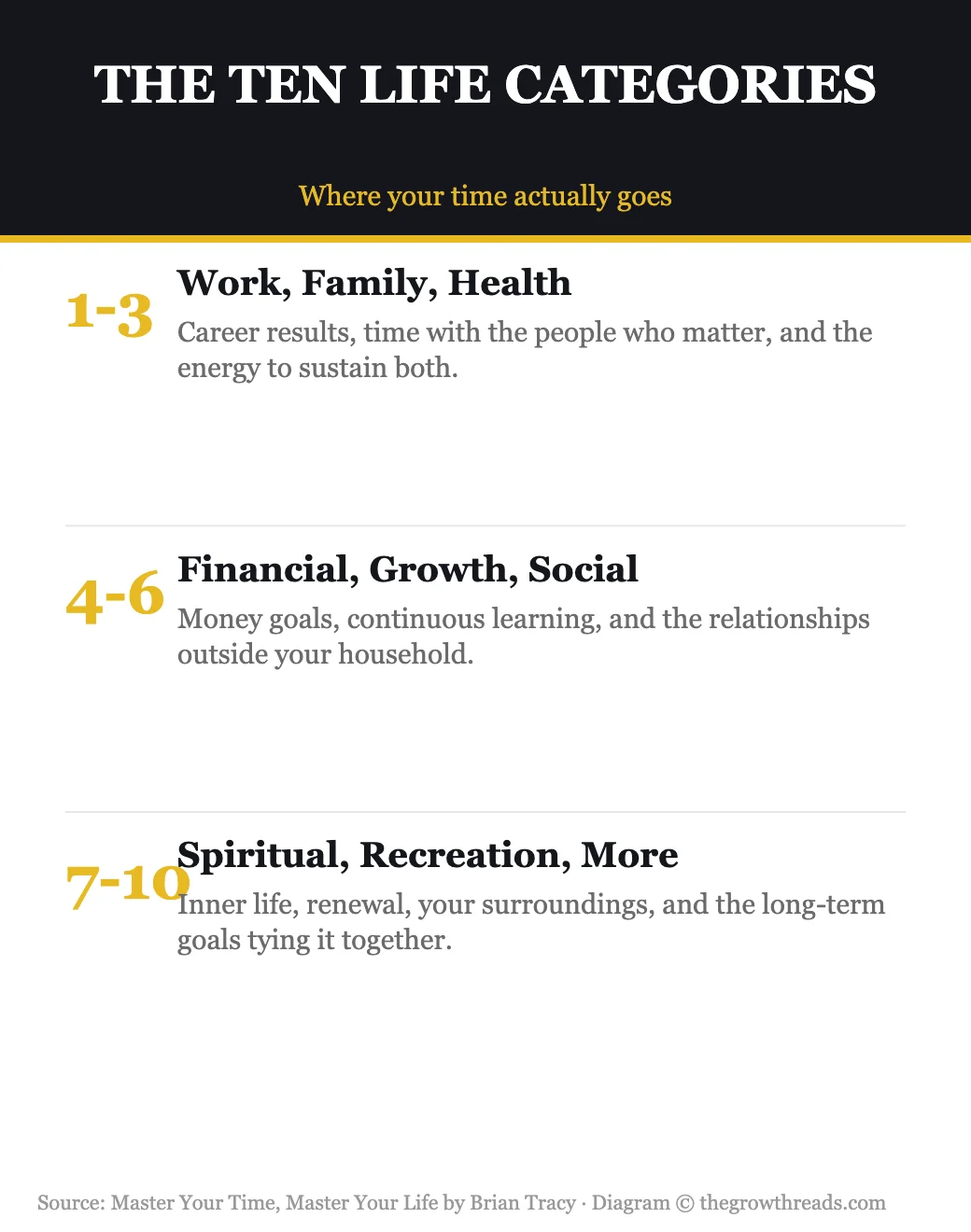
The categories aren’t meant to be weighted equally all the time — Tracy is clear that different seasons of life call for different emphasis. A new business or a new baby will legitimately dominate the calendar for a while. The failure mode isn’t temporary imbalance; it’s permanent imbalance that never gets revisited because no one ever stopped to look at the full list.
Part 3: The seven-step process for turning wishes into written goals
Once the categories are mapped, the book moves into its most concrete section: a seven-step process for converting a vague want into a goal that actually gets pursued. The steps are: decide exactly what you want, write it down, set a deadline, make a list of everything you could do to achieve it, organize that list into a logical sequence, take action on the first step immediately, and review the written goal every day.
Tracy is emphatic about the writing step in particular — an idea that stays in your head, he argues, competes with dozens of other unwritten ideas for the same limited attention, and almost always loses. Putting it on paper (or in a note you’ll actually reopen) gives it a fixed, reviewable form. Combined with a deadline, a written goal stops being a someday-maybe and starts behaving like a project with a due date.
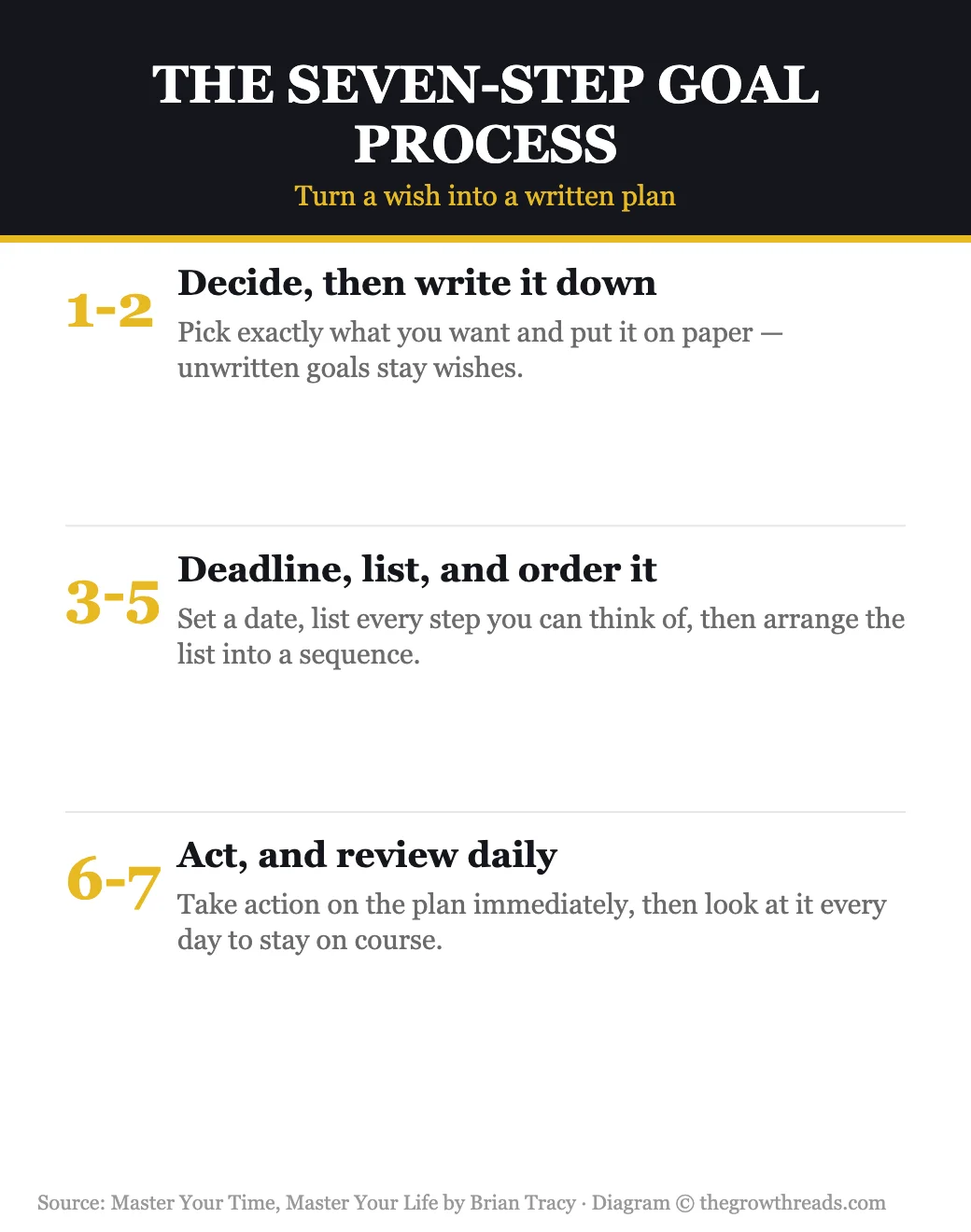
The sequencing step deserves particular attention because it’s where a lot of goal-setting attempts quietly fail. A list of ten possible actions, unordered, feels like ten separate decisions every time you look at it. The same list, sequenced, only ever asks one question: what’s next. Tracy treats this as a small but critical piece of friction removal — it’s the difference between a plan you can act on and a plan you keep re-reading.
Part 4: Turning the system into a daily habit
The book’s final movement is about durability — how a seven-step process and a ten-category life map survive contact with an ordinary, distraction-filled week. The answer, unsurprisingly, is repetition: a short daily review of written goals, a habit of re-checking the ten categories periodically (Tracy suggests at natural checkpoints like the start of a month or a season), and a willingness to revise the plan rather than treat it as fixed once written.
This is also where the book leans hardest on its central reframe. Time management, done well, isn’t a one-time system you set up and then forget — it’s closer to a daily habit of asking “does today’s use of my time match the life I actually mapped out.” That question, repeated often enough, is what keeps the ten categories from drifting back out of balance.
Who is Master Your Time, Master Your Life best for — and who should read something else first?
This book is best for readers who are new to structured goal-setting and want a clear, beginner-friendly entry point that covers an entire life rather than just a work calendar. If you’ve never written a goal down with a deadline before, the seven-step process is an easy, low-friction place to start. It’s also a good fit for anyone who suspects their calendar has quietly narrowed to one or two categories and wants a simple audit to confirm it.
If you’ve already read extensively in the goal-setting and productivity space — particularly other Brian Tracy titles like Eat That Frog! — some of this material will feel familiar rather than new, since Tracy’s core teaching vocabulary carries across much of his catalog. Readers looking for something more specifically about daily execution and single-task focus may prefer Hell Yeah or No, and those wanting an energy-first rather than goal-first lens might start with Do Less instead.
Questions to reflect on
- Which of the ten life categories could you not describe in specific, satisfying detail right now — and what does that gap tell you?
- What’s one goal you’ve been carrying in your head for months without ever writing it down?
- If you set a real deadline on that goal today, what would the first concrete step be?
- Which category has been quietly absorbing time that another category actually needs more?
- What would a short daily review of your written goals realistically look like in your current schedule?
🔥 Ready to map your ten categories and write your first real goal?
Grab Master Your Time, Master Your Life and start the seven-step process today.
How to apply Master Your Time, Master Your Life (7-day plan)
- Day 1 — Decide: Pick one life category that’s been neglected and decide, specifically, what “excellent” would look like in it.
- Day 2 — Write it down: Turn that decision into a single written goal, in your own words, somewhere you’ll actually reopen it.
- Day 3 — Deadline: Attach a real date to the goal — close enough to feel urgent, realistic enough to feel achievable.
- Day 4 — List steps: Brainstorm every action you can think of that would move you toward the goal, without filtering yet.
- Day 5 — Sequence it: Put that list in order, so the next action is always obvious rather than a fresh decision.
- Day 6 — Take action: Complete the first step on your sequenced list, however small.
- Day 7 — Review and repeat: Reread your written goal, note what worked, and set the daily-review habit going forward.
Frequently asked questions
Is Master Your Time, Master Your Life just a repackaged version of Eat That Frog!?
Not exactly, though the two books share a family resemblance and some of Tracy’s core vocabulary. Eat That Frog! is narrowly focused on prioritizing and completing your single most important task each day. Master Your Time, Master Your Life is broader in scope, applying goal-setting and prioritization across an entire life mapped into ten categories rather than a daily task list. Whether that broader scope feels like meaningful expansion or familiar repetition is a matter of reader taste — if you’ve read several Tracy titles already, expect some overlap in tone and technique.
Do I need to work through all ten life categories at once?
No. The book presents all ten as a mapping exercise so you can see the whole picture, but it doesn’t require simultaneous action on every category. Most readers get more traction picking one or two neglected categories to focus on first, using the seven-step process there, and revisiting the full list periodically rather than trying to overhaul everything at once.
What if I don’t hit the deadline I set for a goal?
Tracy treats deadlines as tools for urgency, not rigid contracts. Missing one isn’t presented as failure — it’s a prompt to revisit the goal, adjust the timeline or the steps, and keep going. The daily-review habit is partly designed to catch a slipping deadline early enough to course-correct rather than abandon the goal entirely.
Is this book more about career productivity or personal life balance?
Both, deliberately. The ten-category structure is built specifically to prevent career goals from crowding out everything else, so while the seven-step process works fine for a work project, the book’s stated intent is to apply the same discipline to health, relationships, and personal growth just as seriously as to career and money.
How much time does the daily review actually take?
The book doesn’t prescribe an exact duration, but the review is meant to be brief — a quick read of your written goals and a short check on whether today’s choices are moving you toward them, not a lengthy planning session. The emphasis is on consistency over length; a two-minute daily habit that actually happens beats a thorough weekly review that keeps getting skipped.
Is the seven-step goal process backed by research, or is it Tracy’s own framework?
It’s presented as Tracy’s own practical framework, built from decades of sales, coaching, and consulting experience rather than as a citation-backed academic model. The individual components — writing goals down, setting deadlines, breaking work into ordered steps — align with well-established goal-setting principles found more broadly in the personal-development and management literature, even where this specific seven-step packaging is Tracy’s own.
Who should skip this book?
Readers already deeply familiar with Brian Tracy’s broader catalog, or with goal-setting frameworks in general, may find the core ideas here familiar rather than groundbreaking — some readers describe his books as recycling similar frameworks across different titles. If you want something narrower and more execution-focused, Eat That Frog! covers the daily-prioritization piece in less space; if you want a life-balance exercise without as much goal-setting machinery, a life-wheel-style book may suit you better.
Related summaries
Continue exploring the Time Management collection: Your Best Year Ever · Hell Yeah or No · Two Awesome Hours · The Miracle Equation. For the full library, see our best productivity books pillar guide.