

★★★★★ 4.6/5 — A structured, repeatable system for turning vague resolutions into an actual annual plan.
Best for: Anyone who dreads the vague “new year, new me” ritual and wants a concrete, repeatable planning system instead.
Reading time: ~4 hrs to read · guide: 20 min to skim this summary.
Difficulty to apply: Moderate — the framework is simple, but it asks for real reflection time up front.
Your Best Year Ever in one minute
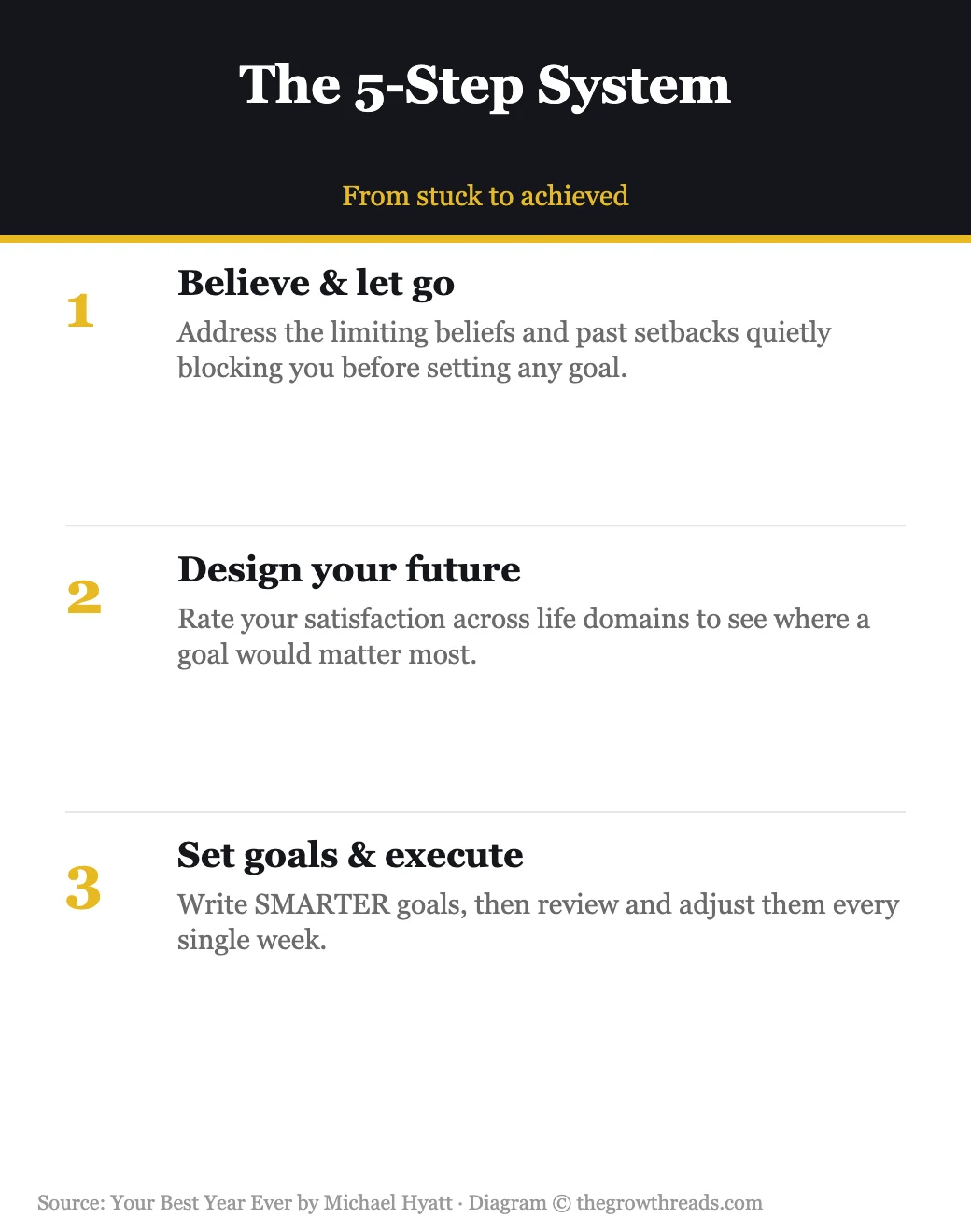
Most goals fail before January even ends — not from laziness, but from being poorly designed in the first place. Michael Hyatt’s Your Best Year Ever lays out a 5-step system — Believe, Complete the Past, Design Your Future, Set SMARTER Goals, and Make It Happen — for building an annual plan that actually survives contact with a busy year. Instead of one big January resolution, it’s a repeatable process: rate every life domain honestly, pick a few to focus on, write goals that are specific and genuinely exciting, then run a short weekly review that catches drift before it becomes failure.
Key takeaways
- Limiting beliefs set your ceiling before you even start: unexamined assumptions about what’s possible quietly cap the goals you’re willing to attempt.
- Unprocessed setbacks carry forward: a past failure you haven’t consciously closed the loop on keeps draining energy from this year’s goals.
- Ten life domains, not one: marriage, family, friendship, health, work, finances, spiritual life, avocation, community, and giving — goals set in isolation ignore the other nine.
- Rate before you plan: score every domain 1-10 before deciding where to focus, so the choice is based on evidence, not whichever area feels loudest.
- Focus beats coverage: pick 2-3 domains for deliberate goals this year rather than trying to overhaul all ten at once.
- SMARTER, not just SMART: add Exciting and Relevant to Specific, Measurable, Actionable, Risky, and Time-keyed — a technically correct goal still fails if it doesn’t excite you.
- Goals need a next physical action: a goal without a concrete first step stays an intention, not a plan.
- The weekly review is the engine: a short, consistent checkpoint catches stalled goals in week 3, not December.
- Progress is information, not a verdict: a missed goal tells you something about the plan — adjust it rather than treating it as personal failure.
What is Your Best Year Ever about?
Your Best Year Ever is Michael Hyatt’s 5-step system for setting and achieving meaningful goals across every important area of life. The book argues that goals typically fail not from lack of effort but from being poorly designed — undermined by limiting beliefs, unprocessed setbacks, and the absence of a regular review system — and offers a structured, repeatable annual planning process to fix that.
About the author
Michael Hyatt served as Chairman and CEO of Thomas Nelson Publishers, one of the largest Christian and trade publishers in the United States, before it was acquired by HarperCollins. He went on to found Michael Hyatt & Company, later rebranded Full Focus, a leadership and productivity coaching company built around the goal-setting and planning systems described in this book. His other books include Free to Focus, Living Forward (co-authored with Daniel Harkavy), and Win at Work and Succeed at Life, co-authored with his daughter and Full Focus CEO Megan Hyatt Miller. His background running a major publishing company gives the book’s advice a practical, execution-focused edge rather than a purely motivational one. Hyatt has also built a large platform around these ideas through his podcast, keynote speaking, and the Full Focus certified coach network, which trains other consultants to run the 5-Step Plan process inside companies and with individual clients. That practitioner-facing background shows up in the book’s structure — it reads less like a memoir of one person’s productivity journey and more like a facilitator’s guide, with exercises designed to be run repeatedly rather than read once. Explore all Michael Hyatt book summaries →
Key concepts at a glance
| Concept | What it means | Use it when |
| Believe | Identify and rewrite limiting beliefs about what’s possible for you this year. | You catch yourself thinking “that’s just not realistic for someone like me.” |
| Complete the past | Consciously review wins and losses from the past year and close the loop on setbacks. | You’re carrying an unresolved disappointment into the new year. |
| Life domains | Ten areas of life (marriage, family, friendship, health, work, finances, spiritual, avocation, community, giving) rated 1-10. | You want an honest baseline before setting any goals. |
| SMARTER goals | Specific, Measurable, Actionable, Risky, Time-keyed, Exciting, Relevant. | You’re converting a vague intention into a written goal. |
| Weekly review | A 15-20 minute checkpoint on progress, obstacles, and next actions. | You want to catch a stalled goal before it quietly dies. |
| Next action | The single concrete physical step that moves a goal forward this week. | A goal feels stuck or too abstract to start. |
| Full Focus Planner | An optional companion planner (sold separately) built around this exact system. | You want a physical or digital template rather than building your own. |
Part 1: Believe, then complete the past
Hyatt opens with a claim that sounds more like a mindset book than a planning system: your beliefs about what’s possible set an invisible ceiling on the goals you’re willing to attempt in the first place. If you quietly believe you’re “not the kind of person” who runs a business, gets healthy, or repairs a strained relationship, no amount of SMART-goal formatting will get you there — you’ll self-sabotage or simply never attempt it. The exercise here is to write down a limiting belief and consciously rewrite it into something more accurate and expansive before doing any actual goal-setting.
The second half of Part 1 asks readers to complete the past — to run a structured review of the previous year’s wins and losses and consciously close the loop on any unresolved setback. Hyatt’s argument is that an unprocessed failure doesn’t just fade; it keeps quietly draining energy and confidence from whatever you attempt next, so naming it and deciding what it means is what actually frees up the emotional bandwidth for a fresh plan.
Hyatt is careful to distinguish this from dwelling on the past. The exercise has a clear endpoint — write it down, name what you’d do differently, and close the file — rather than an open-ended rumination. Readers who skip this step often report the same pattern: they set an ambitious new goal in January that looks suspiciously like last year’s abandoned one, just with a fresh coat of enthusiasm and none of the underlying obstacle actually addressed.
Part 2: Design your future across every domain
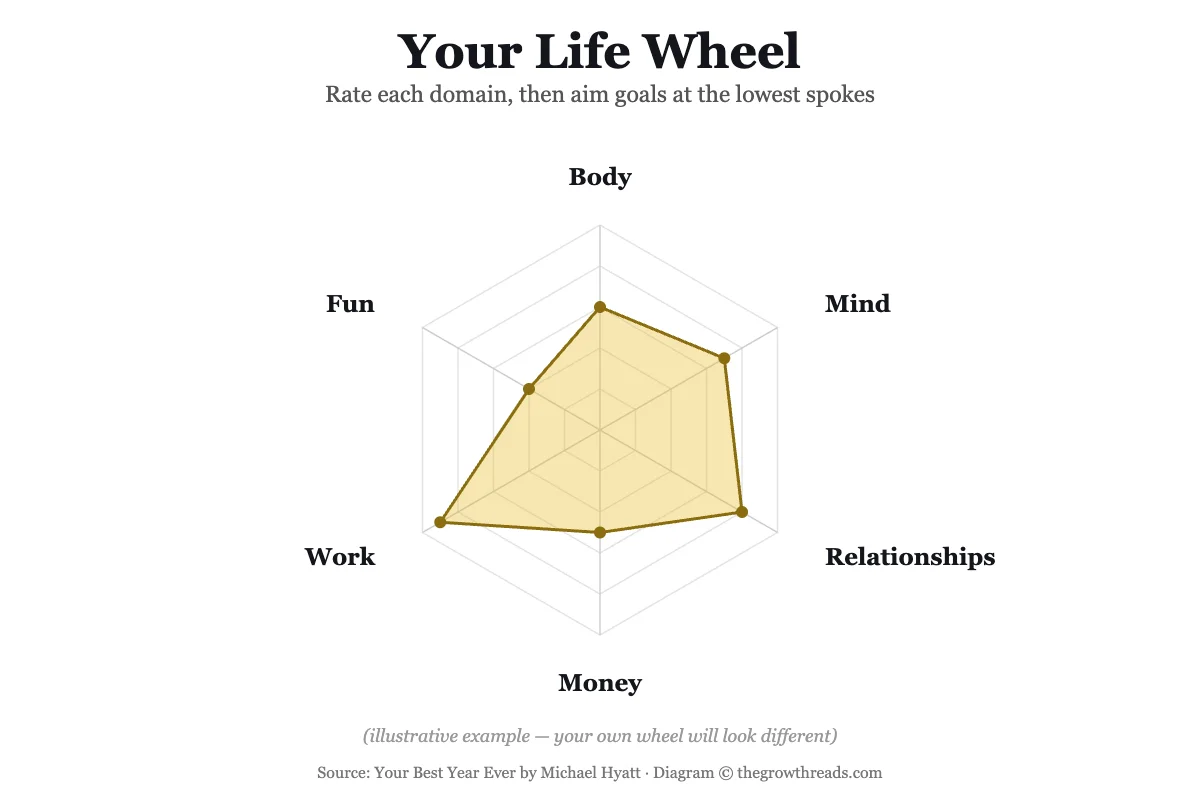
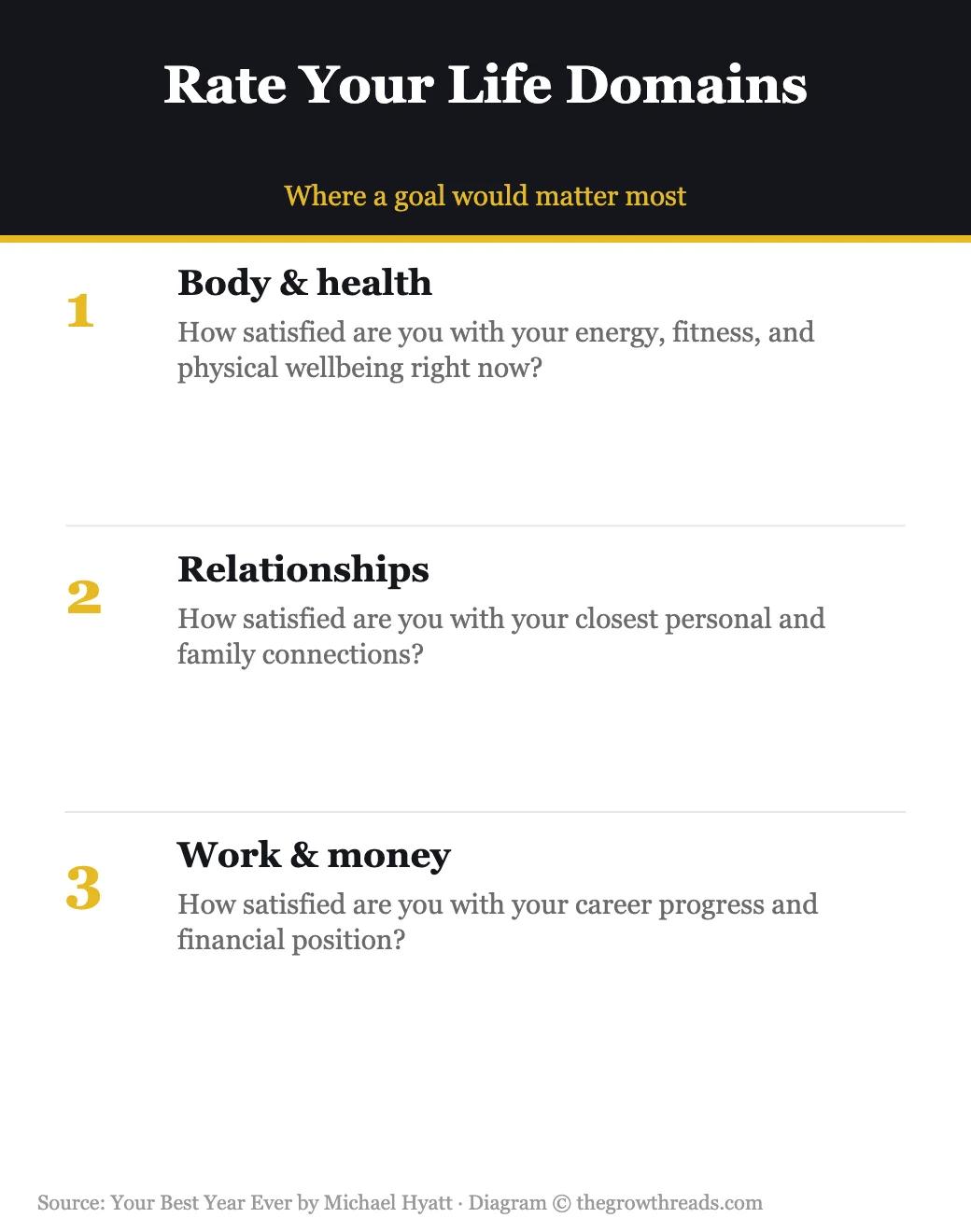
Once the past is processed, Hyatt shifts to a full-life audit across ten domains: marriage, family, friendship, health, work, finances, spiritual life, avocation, community, and giving. Each gets an honest 1-10 rating, which sounds simple but routinely surprises readers — it’s common to discover that the domain you assumed was fine is actually your lowest score, while the one you’d been agonizing over is already solid.
The insight Hyatt pushes hardest here is that most people set life goals in just one or two domains — usually work or money — while leaving the other eight on autopilot. Rating all ten forces a more honest allocation of attention, even if the actual goal-setting that follows stays deliberately narrow.
Part 3: Set SMARTER goals
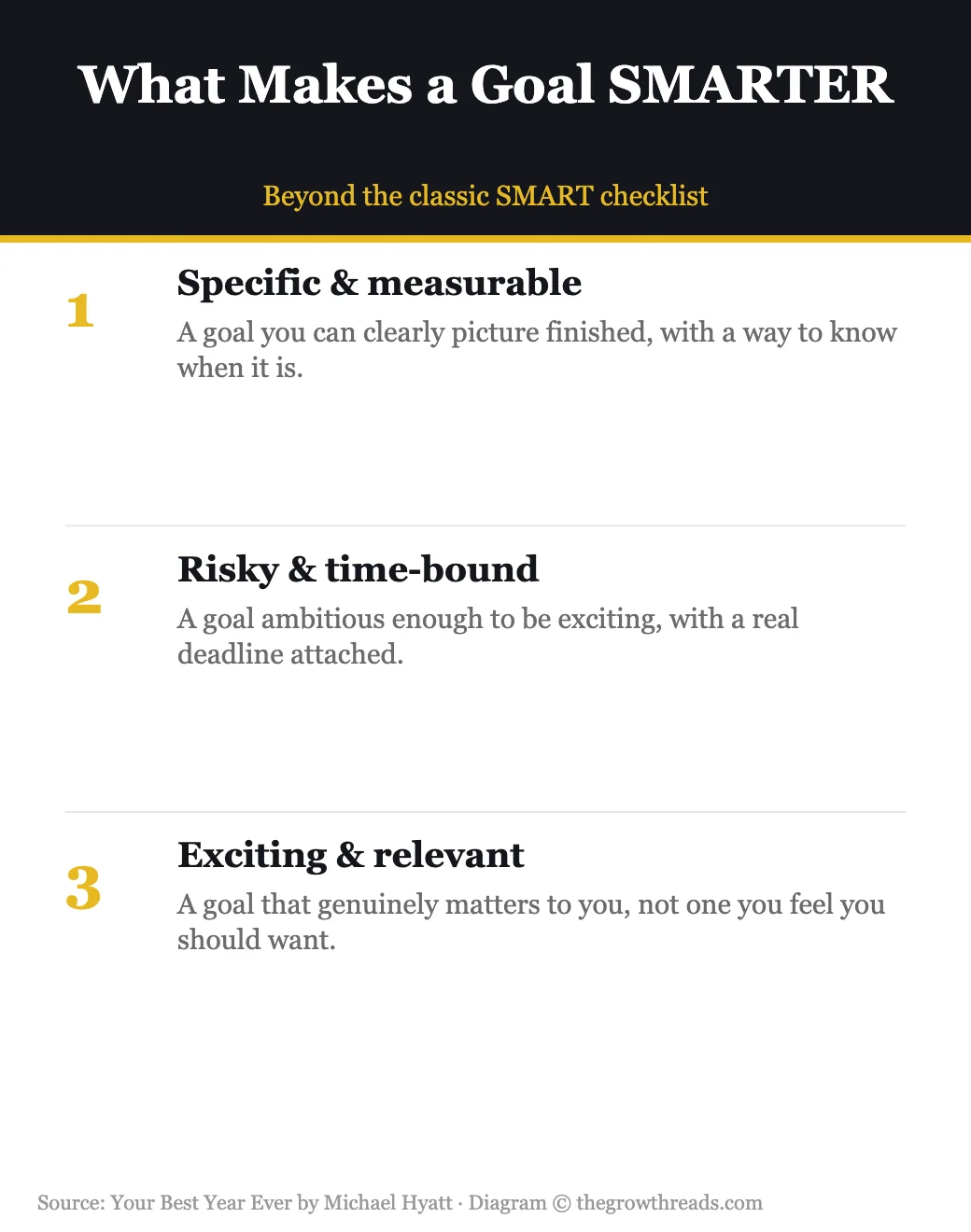
With domains rated, Hyatt introduces his signature framework: SMARTER goals, an extension of the familiar SMART acronym with two additions. Specific, Measurable, Actionable, Risky, and Time-keyed cover the mechanics of a well-formed goal; Exciting and Relevant are the additions, and Hyatt treats them as equally load-bearing — a goal can be perfectly specific and measurable and still fail because it never generated real enthusiasm or never actually mattered to the person setting it.
The chapter walks through common goal-writing mistakes: goals that are really just tasks, goals with no real deadline, and goals borrowed from someone else’s definition of success rather than the goal-setter’s own. The fix in each case is the same — run the goal back through all seven SMARTER letters before committing to it.
One distinction Hyatt returns to often is the difference between a goal and a habit. “Read more” is a habit-shaped intention with no finish line, which makes it hard to know if you’re succeeding; “Read 24 books this year” is a SMARTER goal with a number and a deadline attached. The book’s position isn’t that habits don’t matter — it’s that annual goals and daily habits solve different problems, and conflating the two is one of the more common reasons people’s yearly plans quietly dissolve into nothing by March.
Part 4: Execute with a weekly review
The final step is where Hyatt says most annual plans quietly die: execution without a review cadence. His answer is a short, consistent weekly review — roughly 15-20 minutes — where you check what moved, what stalled, and what the next physical action is for each active goal. The brevity is deliberate; a review that takes an hour is one people start skipping the first busy week.
Hyatt frames a stalled goal not as a personal failure but as information: wrong next action, wrong timing, or possibly the wrong goal altogether. The weekly review’s job is to surface that signal early — in week three, not in a guilty December postmortem — so the plan can be adjusted while there’s still runway left in the year.
Who is Your Best Year Ever best for — and who should read something else first?
This book is best for people who feel stuck in a fog of vague resolutions and want a repeatable, structured system for turning “I should really change this year” into an actual plan with dates attached. Leaders, entrepreneurs, and anyone doing an annual planning ritual will find the 5-Step framework easy to adapt to team goal-setting too.
If your biggest obstacle isn’t planning but follow-through under willpower fatigue, pair this with Willpower Doesn’t Work, which focuses on redesigning your environment so good choices take less effort. If you want a deeper toolkit for prioritizing which goals deserve your best hours once you’ve set them, The 5 Choices is the natural next read. And if your real blocker is that you’re too busy achieving to notice you’re depleted, Time Off makes the case for rest as part of the plan, not a reward for finishing it.
Questions to reflect on
- Which belief about yourself or your circumstances has quietly been setting a ceiling on what you attempt?
- Is there an unprocessed setback from this past year you’re still carrying — and what would it take to close the loop on it?
- Which single life domain, if it improved even 20%, would make the whole year feel like a win?
- What would a SMARTER version of your vaguest current goal actually look like written down?
- If you only kept one habit from this book — the weekly review — would you actually do it every week?
🔥 Ready to design your best year yet?
Grab a copy and build your own 5-step plan before the year gets away from you.
How to apply Your Best Year Ever (7-day plan)
- Day 1 — Believe: Write down one limiting belief about your future and rewrite it as a more accurate, empowering alternative.
- Day 2 — Complete the past: List your wins and losses from the past year, then write one sentence closing the loop on your biggest setback.
- Day 3 — Rate your life domains: Score each of the 10 domains (marriage, family, friendship, health, work, finances, spiritual, avocation, community, giving) from 1-10.
- Day 4 — Pick your focus domains: Choose the 2-3 lowest-scoring or highest-leverage domains to set goals in this year, not all ten.
- Day 5 — Draft SMARTER goals: Write one SMARTER goal per focus domain, specific and time-bound.
- Day 6 — Break goals into next actions: For each goal, write the single next physical action you can take this week.
- Day 7 — Schedule your first weekly review: Put a recurring 20-minute weekly review on your calendar and run the first one now.
Frequently asked questions
Is Your Best Year Ever just another goal-setting book?
It covers familiar ground — SMART-style goals, annual planning — but its distinct contribution is the “Believe” and “Complete the past” steps before any goal-setting happens. Michael Hyatt argues that unprocessed setbacks and limiting beliefs quietly sabotage goals set on top of them, so the book spends real space on mindset work most planning guides skip, before moving into a concrete, repeatable annual system.
Do I need to set goals in all 10 life domains at once?
No. The book explicitly recommends against it — trying to overhaul every domain simultaneously tends to produce shallow effort everywhere rather than real progress anywhere. The recommended approach is rating all 10 domains honestly, then choosing just 2-3 to focus deliberate goals on for the year while maintaining the rest.
What makes a goal “SMARTER” instead of just “SMART”?
SMARTER adds two letters to the familiar Specific, Measurable, Actionable, Risky, Time-keyed acronym: Exciting and Relevant. The idea is that a technically well-formed goal still fails if it doesn’t genuinely excite you or connect to something that matters in your life — precision alone isn’t enough to sustain motivation across a full year.
How much time does the weekly review actually take?
Hyatt frames it as roughly 15-20 minutes, done at a consistent time each week. The short duration is intentional — a review that takes an hour is one people skip when busy. The goal is a fast checkpoint: what moved, what stalled, what’s the next action, not a full re-planning session.
Is this book only useful for January or New Year’s planning?
No — while it’s often read around New Year’s, the 5-step system (Believe, Complete the past, Design your future, Set SMARTER goals, Make it happen) works as a quarterly or even project-level reset. Many readers apply it at any natural checkpoint: a new job, a birthday, or the start of a new quarter.
Does the book address what happens when you fall behind on a goal mid-year?
Yes — the weekly review process is designed specifically to catch drift early rather than let a goal quietly die and only get noticed in December. The book’s guidance is to treat a stalled goal as information (wrong next action, wrong timing, or wrong goal) rather than a personal failure, and to adjust the plan rather than abandon the review habit.
How does this compare to a habit-focused book like Atomic Habits?
They’re complementary rather than competing. Atomic Habits focuses on the mechanics of building and sustaining small daily behaviors, while Your Best Year Ever operates one level up — deciding which outcomes across your whole life deserve those habits in the first place. Many readers use Hyatt’s system to choose the goal, then Atomic Habits’ systems to build the daily behavior that gets them there.
Related summaries
- Willpower Doesn’t Work Summary & Review
- The 5 Choices Summary & Review
- Time Off Summary & Review
- Atomic Habits Summary & Review
- Best Productivity Books